Evaluation of Coreference Resolution Tools for Polish
from the Information Extraction Perspective
Adam KaczmarekInstitute of Computer Science University of Wrocław
Wrocław, Poland
Michał Marci´nczuk
Department of Computational Intelligence Wrocław University of Technology
Wrocław, Poland
Abstract
In this paper we discuss the performance of existing tools for coreference resolution for Polish from the perspective of informa-tion extracinforma-tion tasks. We take into consid-eration the source of mentions, i.e., gold standard vs mentions recognized automat-ically. We evaluate three existing tools, i.e., IKAR, Ruler and Bartek on the KPWr corpus. We show that the widely used met-rics for coreference evaluation (B3, MUC, CEAF, BLANC) do not reflect the real performance when dealing with the task of semantic relations recognition between named entities. Thus, we propose a sup-plementary metric called PARENT, which measures the correctness of linking be-tween referential mentions and named en-tities.
1 Introduction
In this paper we approach the problem of coref-erence resolution and its evaluation metrics. We consider this problem from a slightly different perspective—not as a simple clustering problem, but rather as a problem of extracting information from text. We make an observation that not every mention carries equal amount of information, e.g., when considering a pronoun resolution problem there are usually a few named entities that can be assigned to real world objects and relatively larger amount of pronouns that carry almost no informa-tion about the object they are referring to, without resolving the coreference with the named entity. Thus we do not want to treat named entities and pronouns equally as in the case below. We can imagine a document with two named entities, for simplicity each with equal count ofnpronouns in gold coreferential clusters:
{Romeo,he1,he2, . . . ,hen}
{Juliet,she1,she2, . . . ,shen}
and two possible system responses, one with two pronouns interchanged between coreferential clus-ters:
{Romeo,she1,he2, . . . ,hen}
{Juliet,he1,she2, . . . ,shen}
and the second with the named entities inter-changed:
{Juliet,he1,he2, . . . ,hen}
{Romeo,she1,she2, . . . ,shen}
According to the measures which do not distin-guish between types of mentions and are based only on the similarity of clusters, these two re-sponses are scored equally. However, from infor-mation extraction perspective the first answer is almost correct, while the second gives us totally incorrect information about both named entities. Thus we propose a supplementary method to score the performance of coreference resolution systems with respect to different types of mentions.
2 Related Work
We will present here work related to this topic in a two-way manner: first by introducing the coref-erence evaluation metrics and second describing current tools for coreference resolution for Polish. 2.1 Evaluation
Coreference evaluation is a widely studied prob-lem in the literature. Starting from 1995 with the introduction of the MUC evaluation metric (Vi-lain et al., 1995) that calculates a score based on
the missing/wrong links between the coreference chains according to a minimal amount of such links needed to be added or removed to trans-form the system response into the key coreference chains. This approach leads to a counter-intuitive result in the case of merging large chains, when keeping the recall equal to 100% and dropping theprecisiononly by a small amount independent from the size of improperly merged chains. This metric was followed by the B3 score (Bagga and Baldwin, 1998) developed as an attempt to ad-dress some drawbacks of the MUCevaluation met-ric. In this metricprecisionandrecallare calcu-lated as an average score for every mention in the text. This metric, unlike MUC, takes into account singletons but is vulnerable to multiple singletons causing precision to increase. To overcome the disadvantages of MUC and B3, Luo (2005) pro-posed a metric called CEAF. This metric uses an one-to-one mapping between the gold and the sys-tem coreference clusters mapping. The most im-portant feature is that this metric can be considered as interpretable—the score reflects a percentage of mentions assigned to the correct clusters. How-ever, it is still sensitive to the singletons and in some cases the correct links can be ignored. One of the latest metrics is BLANC—a metric based on the Rand index for clustering, which was intro-duced in the original form by Recasens and Hovy (2011). It focuses on the relations between every single pair of mentions—both coreferential and non-coreferential. The final values of precision,
recalland F1 are calculated as means of respec-tive values for coreferential and non-coreferential links separately. This metric solves the problem of singletons and takes into account the size of the clusters. In the original form BLANCassumes that the mentions in the gold standard data and in the system response are the same. Luo et al. (2014) proposed a modified version of BLANC, called BLANC-SYS, which can handle imperfect mention recognition. This modification also intro-duced a joint way of scoring the mention detection in conjunction with the coreference resolution.
Twinless Mentions
Simultaneously to the development of the BLANC metric there were several observations made on the problematic nature of the twinless mentions1
1A twinless mention is a mention which occurs only in
the gold standard data or in the system response.
occurring due to imperfect mention detection in end-to-end coreference resolution systems. Cai and Strube (2010) addressed this problem for metrics considering only the coreferential rela-tions between menrela-tions. Additionally, they dis-tinguishedtwinlesssingletons, which are not con-nected by any coreferential relation.
Evaluation from Applications Perspective Holen (2013) made some critical observations on the nature of commonly used evaluation metrics, claiming that the loss of information value—an important factor in the perception of coreference resolution—is not addressed good enough in the current evaluation metrics. Some of the issues with different levels of informativeness of men-tions were addressed by Chen and Ng (2013). The main idea was to extend the existing metrics with link weights that would reflect the informative-ness of certain types of relations. These enhance-ments provided a more accurate way of scoring coreference results, however, making them less in-tuitive and harder to interpret. Tuggener (2014) presented an approach that considers coreference results as mention chains and scores every men-tion according to whether it has a correct direct antecedent. As an extension of this approach he proposed to consider the relations to the closest preceding nouns, e.g., two pronouns are not really useful for higher level applications of coreference resolution. The final proposition was to determine the so-calledanchor mentionsfor each key coref-erence chain and to measure the score as the har-monic mean of the score for detection of these an-chor mentions and the score for resolving men-tions to anchor mentions that were found by the system.
2.2 Coreference Resolution for Polish
the other hand, Ruler and Bartek were designed to resolve the coreference relations between any two mentions.
3 IKAR with a Zero-Anaphora Baseline
The task of zero anaphora resolution in Polish was ignored in most of the studies as a non-trivial problem. To be able to fully compare these al-gorithms we needed first to implement a method for zero-anaphora resolution in IKAR. We made an approach to prepare a zero-anaphora resolu-tion baseline based on the previous work made in IKAR. The main motivation for this baseline ap-proach is the fact that, as stated by Kaczmarek and Marci´nczuk (2015), Polish zero subjects carry at least the same amount of grammatical information as pronouns (gender, number and person), so we can approach the problem of zero-anaphora simi-larly to the pronoun coreference.
3.1 IKAR Approach to Coreference Resolution
In the current approach IKAR divides the corefer-ence resolution problem into four subcategories of coreferential relations, each pointing to a named entity, but originating from different types of mentions, namely: named entities, agreed noun phrases, personal pronouns and zero subjects. The coreference resolution mechanism for each type (except zero subjects) was originally implemented in IKAR as a C4.5 decision tree classifier2 (Quin-lan, 1993) utilizing different sets of features. The coreference is resolved in entity-mention manner, where discourse entities are introduced by named entities, what means that for each mention we per-form a binary classification of pairs consisting of the considered mention and a preceding named entity. In the final step the relations are disam-biguated to avoid assigning one mention to many different entities. The disambiguation is based on the number of mentions assigned to given entity and on the distance to the mention.
3.2 Na¨ıve Zero-Anaphora in IKAR
The classifier for recognition of pronoun and zero-anaphora links uses thepronounlinkfeatures which take into consideration the grammatical agreement (person, number, gender) and consider
2IKAR uses an implementation from the Weka software
(Hall et al., 2009).
either a direct coreference relation from the pro-noun/zero subject to a named entity or a corefer-ence relation to an agreed phrase that is semanti-cally similar to the named entity. This semantic similarity is calculated using a wordnet3 distance between the phrase’s head and a synset inferred from the type of named entity.
4 PARENTMetric
To address the problem with non-intuitive results from an information extraction perspective, we propose a supplementary measure called PARENT (Performance of Anaphora Resolution to ENTi-ties) that will reflect the amount of correct infor-mation returned by a coreference resolution sys-tem.
4.1 Defining and Referring Mentions
For the purpose of our scoring metric we introduce concepts ofdefiningandreferringmentions. The
definingmentions are mentions which we consider as self-defining, i.e., carrying enough information to be identified as real-world objects. The refer-ring mentions are those mentions which do not hold this property. All mentions in a document can be divided into two disjoint subsets: defining
mentions andnon-definingmentions.
Mall =Mdefining∪Mnon-defining
Mdefining∩Mnon-defining =∅
The non-defining mention subset is then defined as a union ofreferring mentions that we are par-ticularly interested in andignoredmentions which we do not want to consider in the scoring proce-dure, for the purpose of scoring different variants of coreference resolution (e.g., pronoun resolution or zero subject coreference resolution in a isola-tion).
Mnon-defining=Mreferring∪Mignored
Mreferring∩Mignored=∅
The split intoMdefining,MreferringandMignored
should be made on the basis of some criteria which will be taken as a parameter for the scoring algo-rithm. The split criteria must be also independent from the gold mention annotation, as it can be ap-plied to the system response as well. For example,
3A wordnet for Polish called Słowosie´c (Maziarz et al.,
{Romeo | {z }
defining
,he1, . . .hen
| {z }
referring
,boy,young man. . .
| {z }
ignored
}
(a) Mention split 1 – noun phrases are ignored.
{Romeo | {z }
defining
,he1, . . .hen,boy,young man. . .
| {z }
referring
}
(b) Mention split 2 – no mentions are ignored. Figure 1: Examples of mentions split.
if one want to evaluate the performance of linking pronouns with proper names, then thedefiningset will contain proper names, the referring set will contain pronouns and theignoredset will contain the remaining mentions (i.e., noun phrases) (see Figure 1a). In another scenario (see Figure 1b) one may want to evaluate the performance of link-ing non-proper names with proper names. Then, the definingset will contain proper names (as in the first example) and thereferringset will contain all the remaining mentions (i.e., pronouns, noun phrases). Theignoredset will remain empty.
4.2 Precision and Recall
The existing cluster-based metrics for coreference evaluation do not make distinction between the
defining and referring mentions. However, as shown in section 1, from the perspective of infor-mation extraction the links betweenreferringand
definingmentions are much more important than the links betweenreferringmentions only. Taking into account this assumption we will define preci-sion and recall as follows.
First, we want to relate the recallto finding a relation between a referring mention mr and at
least onedefiningmentionmdfrom the same gold
coreferential cluster. We are interested in connect-ing thereferringmentions to the proper discourse entities introduced by thedefiningmentions which are coreferential with thereferringmentions in the gold standard data. This way we infer additional information about the entities based on the con-text of thereferringmentions. For that purpose it is sufficient for eachreferringmentionmrto have
a coreferential link with only onemdfrom its gold
standard cluster.
Second, we want theprecisionto reflect the am-biguity of information extracted from the corefer-ence resolution system response, i.e., for a refer-ring mention mr we want to penalize situations
when mr is assigned to a definingmention from
a cluster which does not contain themr. The
ap-plied penalty is meant to be proportional to the dis-tinct number of entities (represented by their defin-ing mentions) assigned to each referring entity. This will address situations when the system re-turns non-existent coreferential links between ei-ther twodefiningmentions or between a defining
and areferringmention. We also want the preci-sionand therecallto be interpretable in following way:
• Precisionshould indicate the ratio of correct relations betweenreferringmentions and en-tities to all relations betweenreferring men-tions and entities returned by the system
• Recallshould indicate the ratio of correct re-lations betweenreferringmentions and enti-ties to all relations between referring men-tions and entities that are expected to be found basing on the gold standard data.
4.3 Description
Intuitively this metric works on links between two predefined groups of mentions. Additionally we map all the defining mentions occurring in the same gold cluster into one entity about which we will extract information based on the coreferential relations withreferringmentions. We do not want to penalize missing some of the defining mention links in cases when a gold cluster contains multi-ple defining mentions and relate the score to am-biguity of found links. We also do not want to consider the correctness of links between the non-definingmention pairs, because these relations do not give us any valuable information.
Atrue positive(tp) will be a correct relation be-tween areferringmention and adefiningmention from the same gold coreference cluster (redundant relations between thereferringmention and other
definingmentions from the same gold cluster will be ignored).
A false positive(fp) will be an incorrect rela-tion between a referring mention and a defining
mention from different gold coreference clusters (redundant relations between the referring men-tion and other defining mentions from the same gold cluster will be ignored).
Afalse negative(fn) will be a pair of a refer-ringmentionmrand adefiningmention, such that
4.4 Formal Definition
Formally we will denote the gold set of clusters as
Ckeyandi-th gold clusterCkey
i will be defined as
follows:
Cikey ={mid1. . . midl
| {z }
defining
, mir1. . . mirn
| {z }
referring
, mizl. . . mizk
| {z }
ignored
| {z }
non−defining
}
The gold cluster constitutes anentity. We will in-troduce the notation of equivalence classes with respect to the coreference relations to denote the
entity that given mention belongs to according to the gold standard clusters:
[[m]]key =Ckey
i such thatm∈Cikey
We will define a gold relation setGas follows:
G={(mi
rl, Cikey)|∀Cikey ∈Ckey∀mirl∈Cikey
This set contains pairs of areferringmention and the gold cluster it belongs to, one for each refer-ringmention, defining mapping from the mentions to the entities they should indicate.
The system set of clusters will be denoted by
Csys and the relation set based on the system
re-sponse will be defined as follows:
S = { (mi
rl,[[midk]]key)| ∀C
sys
i ∈Csys
∀mi rl∈C
sys
i ∀midk ∈C
sys i }
This set contains pairs of a referring men-tion and an entityit indicates, represented by the gold clusters containingdefiningmentions that are marked by the system as coreferential with the re-ferringmention.
Then we can defineprecisionandrecallas fol-lows:
precision= T PT P+F P = |G|S∩|S|
recall= T PT P+F N = |G|G∩|S|
Twinless Mentions
The PARENT metric is also designed to jointly score mention detection with coreference resolu-tion. The problem oftwinlessmentions is treated like Cai and Strube (2010) did—thetwinless sin-gletons are removed from both gold and system clusters, as we consider only coreferential links
between mentions. Defining mentions produced by the system, which are not present in the gold data but they were linked with other mentions, are added to the gold data as singletons. This is done because they can producefalse positivesand they must be added to the gold data in order to be in-cluded in the evaluation. In other case, thosefalse positives would be ignored. The rest of twinless
non-singleton mentions are left as they are. 4.5 Specific Case Analysis
Here we discuss some specific cases to illustrate the methodology of PARENTscoring:
• a missing link betweendefiningmentions— as long as we can correctly connect refer-ring mention with one defining mention it is enough, so these missing links should not have negative impact on neitherprecisionnor
recall;
• a missing link between a referring mention and adefiningmention will decrease the re-callby a unit value;
• an incorrect link betweendefiningmentions referring to different entities (clusters) in the gold standard data—this type of error will decrease the precision proportionally to the number of entities represented by defining
mentions in the system cluster and to the number ofreferringmentions.
Given a system response cluster Csys j , for eachreferringmentionmrin this cluster we
will increase thetrue positivesvalue for this cluster (tpj) by one if there is adefining men-tion in this cluster that is coreferential with
mr in the gold standard data and we will
in-crease the value oftrue and false positivesfor this cluster (tpj+fpj) by the number of enti-ties. So the final precision for such cluster will be equal to:
P
mjrl∈Cjsys1∃mjdk∈Cjsys,(mjrl,[[mjdk]]key)∈G
entitiesj ×referringj
where
entitiesj =|{[[mjdk]]key :∀mjdk ∈Cjsys}|
and
referringj =|{mjrl:∀mjrl ∈C
• an incorrect link between areferringmention and a defining mention will decrease preci-sionby a value proportional to the number of entities assigned to this mention by the sys-tem being scored (analogously to the previ-ous case);
• an one-cluster solution with only gold men-tions will be scored withrecall= 100%(all relations between referring mentions and en-tities are found) and precision inversely pro-portional to the number of entities, i.e.:
precision= #entities1 = |C1key|
• an one-cluster solution with invented men-tions I = {i1, . . . im} will have lower
pre-cision calculated as:
precision= (|R|+|I|R|)|× |Ckey|
where R is a set of all referring mentions from the gold clusters;
• an all-singleton solution will have both preci-sionandrecallequal to 0.
4.6 The Problem of Split
The PARENTmetric is parametrized with the def-initions of definingandreferring mentions. This task may occur to be not as easy as it seems due to the fact that it may not be exactly clear how to conclusively describe mentions that are informa-tive enough. Therefore, we left these definitions to be introduced as a parameter to the PARENT met-ric to allow an introduction of custom definitions ofdefiningandreferringmentions. That possibil-ity is also important for testing only certain parts of coreference resolution systems.
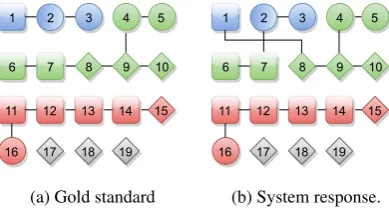
4.7 A Case Study for Metric Comparison Here we present a case study, which show the ad-vantage of the PARENTmetric over other cluster-based metrics. Figure 2 contains a visualization of a gold standard (Figure 2a) and a response re-turned by a system (Figure 2b). The squares rep-resent defining mentions (which are named enti-ties in this case) and the remaining shapes rep-resent referring mentions (the circles—pronouns and diamonds—nouns). The blue, red and green color represents groups of mentions referring to the same entity. The system response contains
1
8 6
11
17 18 19 15
16
3 4 5
9 10 7
12 13 14 2
(a) Gold standard
1
8 6
11
17 18 19 15
16
3 4 5
9 10 7
12 13 14 2
[image:6.595.313.508.66.171.2](b) System response. Figure 2: Examples of mentions split.
incorrect links between {2,3} and {6,7}, and {4,5,8,9,10}and{1}. As can be seen in Table 1 the cluster-based metrics (MUC, B3, CEAFE, CEAFM, BLANC) scored the response over 70% of F-measure. However, from the perspective of information extraction, the response is not so use-ful, as most of the referring mentions were in-correctly linked with thedefiningmentions—only two (15 and 16) out of nine referring mentions were correctly linked with their defining men-tions. The linguistically aware metrics presented by Chen and Ng (2013) (LMUC, LB3, LCEAFE, LCEAFM)4 scored between 30% and 70%—the values are a bit more accurate than their coun-terparts. According to PARENT the response was scored only 22.2% and the value is much more ac-curate.
5 Evaluation
We evaluated the following tools for Polish coref-erence resolution: IKAR, Bartek and Ruler. The results for IKAR were obtained for several differ-ent configuration settings. We tested it on the gold standard mentions and on the mentions that were automatically added by simply annotating all the agreed phrases and pronouns, and by using Minos (Kaczmarek and Marci´nczuk, 2015) for the detec-tion of zero subject verbs. Bartek and Ruler were tested on the same corpus but with system men-tions annotated by their own system for automatic mention annotation, i.e., MentionDetector (Kope´c, 2014). For the evaluation we used 10-fold cross validation on the KPWr corpus (see next section). IKAR was trained for each fold on the training part. For Bartek and Ruler we used the pre-trained models distributed with the tools.
MUC B3 CEAFE CEAFM LMUC LB3 LCEAFE LCEAFM BLANC PARENT
F1 80.0% 74.5% 80.8% 78.9% 30.8% 47.4% 66.7% 30.8% 76.6% 22.2%
Table 1: Comparison of different metrics for a sample system response.
5.1 KPWr Corpus
We used a subcorpus of the KPWr corpus (Broda et al., 2012b) version 1.1. It contains 689 docu-ments with a total of 27 452 links (14 141 of them are links other than zero-anaphora). The links were manually annotated between four types of mentions: named entities, agreed nominal phrases, pronouns and zero subjects.
5.2 PARENTConfiguration
We used a split, where the set of defining men-tions contains named entities and the set of refer-ringmentions contains nouns, pronouns and zero subjects.
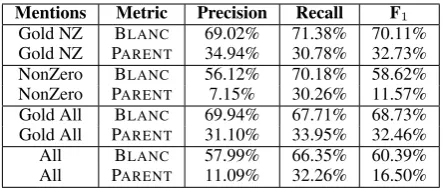
5.3 Impact of Automatic Mention Detection In the previous study the results of coreference res-olution of IKAR were only measured on the gold set of mentions. Here we want to present the im-pact of the automatic mention detection on the per-formance of this tool. To simulate the environment with automatically detected mentions we consid-ered as mentions all the hand-annotated agreed noun phrases and all words tagged as personal pro-nouns using WCRFT tagger (Radziszewski, 2013) and used Minos (Kaczmarek and Marci´nczuk, 2015) to annotate potential zero subjects. The re-sults shown in Table 2 indicate a decrease of preci-sion for coreference resolution with automatically detected mentions—particularly significant is the loss of precision for PARENTmetric that is several times higher than for BLANC.
5.4 Modifications due to BLANC-SYS
We performed the evaluation using the reference implementation of the coreference scorer (Prad-han et al., 2014). However, due to the fact that we wanted to measure how these systems are capable of recognizing proper coreferential rela-tions even with imperfect menrela-tions detected—for IKAR we mostly recognize much more mentions than are needed and we can omit only some zero subjects—we use a specific evaluation setting. Namely we compare the system results with the gold standard corpus that is modified by adding all system-invented mentions as singletons. This
is done due to the fact that in the most recent ver-sion of BLANC-SYSmetric we are penalized for finding incorrectnon-coreferentiallinks either be-tween twinless singleton mentions in the system response or connecting them to the gold standard mentions. So basically we are penalized for not finding coreference relations where they do not oc-cur. This is due to the fact that BLANC-SYSis in-tended to jointly score coreference resolution with mention detection. However for information ex-traction tasks we do not infer any information from singleton mentions and we are basically focused on relations between phrases, so such an approach is not suitable from this perspective.
5.5 PARENTand BLANCResult Comparison
In Table 2 we present results of IKAR with differ-ent settings of the mdiffer-ention detection and scores for PARENT and BLANC. We show results for IKAR without zero anaphora baseline (NonZero) and with it (All). The results forAllandNonZero
mention settings are however not directly compa-rable due to the evaluation setting for NonZero
mentions that scores only the coreferential rela-tions between named entities, agreed noun phrases and pronouns, excluding zero-anaphora. We can also observe that for each configuration we got much lower scores for PARENTthan BLANC. That indicates that although the coreference resolution system can recognize partial coreference clusters quite well it does not necessarily mean that the in-formation extracted from its result is as reliable as the BLANCscore would indicate. In a real-world scenario, where the mentions must be automati-cally recognized beforehand, IKAR does not solve the links between defining mentions and re-ferring mentions properly. Only 11% of the those links are correct. Also the recall drops by more than half from 66% to only 32%. In the context of information extraction for named entities it is a very low result.
5.6 Algorithm Comparison
Mentions Metric Precision Recall F1 Gold NZ BLANC 69.02% 71.38% 70.11% Gold NZ PARENT 34.94% 30.78% 32.73% NonZero BLANC 56.12% 70.18% 58.62% NonZero PARENT 7.15% 30.26% 11.57% Gold All BLANC 69.94% 67.71% 68.73% Gold All PARENT 31.10% 33.95% 32.46% All BLANC 57.99% 66.35% 60.39% All PARENT 11.09% 32.26% 16.50%
Table 2: IKAR results for different settings.
Algorithm Mentions Precision Recall F1 IKAR NonZero 7.15% 30.26% 11.57%
IKAR All 11.09% 32.26% 16.50%
Bartek NonZero 13.49% 5.29% 7.60%
Bartek All 17.67% 4.89% 7.66%
Ruler NonZero 14.77% 5.10% 7.59%
Ruler All 14.07% 3.00% 4.95%
Table 3: Evaluation of the tools for coreference resolution for Polish with the PARENTmetric.
to this presented in section 5.2 for theAllmention setting. For the NonZero mention setting we ex-cluded fromreferringmentions all zero-anaphora similarly to what was done for BLANCevaluation in section 5.5. The lower results for Bartek and Ruler can be explained by the fact that these al-gorithms were not tuned to recognize relations to named entities.
6 Conclusions
We faced the fact that the current state-of-the-art coreference metrics do not take into account vari-ous level of mention informativeness. To deal with this problem we introduced a new metric called PARENT5that is designed to measure the ability of coreference resolution system to retrieve informa-tion about entities in the text. In contrast to the en-hanced metrics presented by Chen and Ng (2013), PARENT is not as generic, however, it gives in-tuitive and interpretable results for given kinds of coreference relations. PARENT is also inde-pendent from the number of the correct/incorrect
defining mentions and from the size of clusters, while these metrics are influenced by size of clus-ters as well as by counts of the defining men-tions. In comparison to the approach presented by Tuggener (2014), PARENT is not constrained by the assumption that the coreferential relations must be interpreted either as relations to the
clos-5The PARENTmetric evaluation was implemented as a
part of Liner2 toolkit (Marci´nczuk et al., 2013).
est preceding noun or to a singleanchor mention
for a cluster what makes it more robust in case of imperfect mention detection. PARENTalso seems to be more generic by allowing a flexible defini-tion ofdefiningandreferringmentions. The main difference between PARENTand the other metrics is that PARENTtreats all definingmentions from a gold cluster as one object and does not require more than one relation between a referring men-tion and such an object that can be as set of defin-ing mentions. Being aware of some drawbacks of PARENT method (e.g., the score does not re-flect reliably the coreference resolution quality be-tween defining mentions) we will advise to use it as a complementary score for one of state-of-the-art metrics for scoring coreference systems.
The results for coreference resolution for Polish reported in the literature were optimistic. How-ever, when dealing with an information extraction task, where the linking between defining mentions and referring mentions is much more important than between referring mentions only, the perfor-mance drops significantly. The best results we ob-tained were 17.67% of precision for the Bartek system and 32.26% of recall for IKAR measured using the proposed metric PARENT. This shows, that for information extraction tasks oriented on named entities, like recognition of semantic re-lations between named entities (Marci´nczuk and Ptak, 2012), the performance of coreference res-olution systems for Polish needs a significant im-provement.
Acknowledgement Work financed by the Polish Ministry of Science and Higher Education, a pro-gram in support of scientific units involved in the development of a European research infrastructure for the humanities and social sciences in the scope of the consortia CLARIN ERIC and ESS-ERIC, 2015-2016. One of the authors is receiving Schol-arship financed by European Union within Euro-pean Social Fund.
References
Amit Bagga and Breck Baldwin. 1998. Algorithms for scoring coreference chains. InIn The First Interna-tional Conference on Language Resources and Eval-uation Workshop on Linguistics Coreference, pages 563–566.
[image:8.595.71.293.62.158.2]Boitet, editors, COLING 2012, 24th International Conference on Computational Linguistics, Proceed-ings of the Conference: Demonstration Papers, 8-15 December 2012, Mumbai, India, pages 25–32. In-dian Institute of Technology Bombay.
Bartosz Broda, Michał Marci´nczuk, Marek Maziarz, Adam Radziszewski, and Adam Wardy´nski. 2012b. KPWr: Towards a Free Corpus of Polish. In Nico-letta Calzolari, Khalid Choukri, Thierry Declerck, Mehmet U˘gur Do˘gan, Bente Maegaard, Joseph Mar-iani, Jan Odijk, and Stelios Piperidis, editors, Pro-ceedings of LREC’12. ELRA.
Jie Cai and Michael Strube. 2010. Evaluation met-rics for end-to-end coreference resolution systems. In Proceedings of the 11th Annual Meeting of the Special Interest Group on Discourse and Dialogue, SIGDIAL ’10, pages 28–36, Stroudsburg, PA, USA. Association for Computational Linguistics.
Chen Chen and Vincent Ng. 2013. Linguistically aware coreference evaluation metrics. In Sixth In-ternational Joint Conference on Natural Language Processing, IJCNLP 2013, Nagoya, Japan, October 14-18, 2013, pages 1366–1374.
Mark Hall, Eibe Frank, Geoffrey Holmes, Bernhard Pfahringer, Peter Reutemann, and Ian H. Witten. 2009. The weka data mining software: An update.
SIGKDD Explor. Newsl., 11(1):10–18, November.
Gordana Ilic Holen. 2013. Critical reflections on eval-uation practices in coreference resolution. In Lucy Vanderwende, Hal Daum´e III, and Katrin Kirchhoff, editors, HLT-NAACL, pages 1–7. The Association for Computational Linguistics.
Adam Kaczmarek and Michał Marci´nczuk. 2015. Heuristic algorihtm for zero subject detection in Pol-ish (to be publPol-ished). InText, Speech and Dialogue, Lecture Notes in Artificial Intelligence. Springer Berlin / Heidelberg.
Mateusz Kope´c and Maciej Ogrodniczuk. 2012. Cre-ating a Coreference Resolution System for Pol-ish. In Proceedings of the Eighth International Conference on Language Resources and Evalua-tion, LREC 2012, pages 192–195, Istanbul, Turkey. ELRA.
Mateusz Kope´c. 2014. Zero subject detection for Polish. In Proceedings of the 14th Conference of the European Chapter of the Association for Com-putational Linguistics, volume 2: Short Papers, pages 221–225, Gothenburg, Sweden. Association for Computational Linguistics.
Xiaoqiang Luo, Sameer Pradhan, Marta Recasens, and Eduard H. Hovy. 2014. An extension of BLANC to system mentions. InProceedings of the 52nd An-nual Meeting of the Association for Computational Linguistics, ACL 2014, June 22-27, 2014, Baltimore, MD, USA, Volume 2: Short Papers, pages 24–29.
Xiaoqiang Luo. 2005. On coreference resolution performance metrics. InIn Proc. of HLT/EMNLP, pages 25–32. URL.
Michał Marci´nczuk, Jan Koco´n, and Maciej Janicki. 2013. Liner2—A Customizable Framework for Proper Names Recognition for Polish. In Robert Bembenik, Łukasz Skonieczny, Henryk Rybi´nski, Marzena Kryszkiewicz, and Marek Niezg´odka, ed-itors, Intelligent Tools for Building a Scientific In-formation Platform, volume 467 ofStudies in Com-putational Intelligence, pages 231–253. Springer. Michał Marci´nczuk and Marcin Ptak. 2012.
Prelim-inary Study on Automatic Induction of Rules for Recognition of Semantic Relations between Proper Names in Polish Texts. In Petr Sojka, Aleˇs Hor´ak, Ivan Kopeˇcek, and Karel Pala, editors,Text, Speech and Dialogue, volume 7499 of Lecture Notes in Computer Science, pages 264–271. Springer Berlin Heidelberg.
Marek Maziarz, Maciej Piasecki, and Stanisław Sz-pakowicz. 2012. Approaching plWordNet 2.0. In
Proceedings of the 6th Global Wordnet Conference, Matsue, Japan, January.
Maciej Ogrodniczuk and Mateusz Kope´c. 2011. Rule-based coreference resolution module for Polish. In
Proceedings of the 8th Discourse Anaphora and Anaphor Resolution Colloquium (DAARC 2011), pages 191–200, Faro, Portugal.
Sameer Pradhan, Xiaoqiang Luo, Marta Recasens, Ed-uard H. Hovy, Vincent Ng, and Michael Strube. 2014. Scoring coreference partitions of predicted mentions: A reference implementation. In Proceed-ings of the 52nd Annual Meeting of the Association for Computational Linguistics, ACL 2014, June 22-27, 2014, Baltimore, MD, USA, Volume 2: Short Pa-pers, pages 30–35.
J. Ross Quinlan. 1993. C4.5: Programs for Machine Learning. Morgan Kaufmann Publishers Inc., San Francisco, CA, USA.
Adam Radziszewski. 2013. A tiered CRF tag-ger for Polish. In H. Rybi´nski M. Kryszkiewicz M. Niezg´odka R. Bembenik, Ł. Skonieczny, editor,
Intelligent Tools for Building a Scientific Informa-tion Platform: Advanced Architectures and Solu-tions. Springer Verlag.
Marta Recasens and Eduard H. Hovy. 2011. BLANC: implementing the rand index for coreference evalu-ation. Natural Language Engineering, 17(4):485– 510.
Yannick Versley, Simone Paolo Ponzetto, Massimo Poesio, Vladimir Eidelman, Alan Jern, Jason Smith, Xiaofeng Yang, and Alessandro Moschitti. 2008. Bart: A modular toolkit for coreference resolution. In Proceedings of the 46th Annual Meeting of the Association for Computational Linguistics on Hu-man Language Technologies: Demo Session, HLT-Demonstrations ’08, pages 9–12, Stroudsburg, PA, USA. Association for Computational Linguistics. Marc Vilain, John Burger, John Aberdeen, Dennis