Held-out versus Gold Standard:
Comparison of Evaluation Strategies for Distantly Supervised Relation
Extraction from Medline abstracts
Roland Roller and Mark Stevenson
Department of Computer Science University of Sheffield Regent Court, 211 Portobello
S1 4DP Sheffield, England
roland.roller,[email protected]
Abstract
Distant supervision is a useful technique for creating relation classifiers in the ab-sence of labelled data. The approaches are often evaluated using a held-out portion of the distantly labelled data, thereby avoid-ing the need for lablelled data entirely. However, held-out evaluation means that systems are tested against noisy data, mak-ing it difficult to determine their true ac-curacy. This paper examines the effec-tiveness of using held-out data to evalu-ate relation extraction systems by com-paring the results that are produced with those generated using manually labelled versions of the same data. We train clas-sifiers to detect two UMLS Metathesaurus relations (may-treat and may-prevent) in Medline abstracts. A new evaluation data set for these relations is made available. We show that evaluation against a distantly labelled gold standard tends to overesti-mate performance and that no direct con-nection can be found between improved performance against distantly and manu-ally labelled gold standards.
1 Introduction
Relation extraction is a popular topic in the biomedical domain and has been the subject of several challenges (e.g. DDI challenge (Segura-Bedmar et al., 2013), BioNLP Shared Task (N´edellec et al., 2013)). Many approaches rely on supervised learning techniques using manually labelled training data. However, the creation of annotated training data is time-consuming, expen-sive and often requires expert knowledge.
Distant supervision (self-supervised learning) is a widely applied technique for training relation ex-traction systems (Wu and Weld, 2007; Krause et al., 2012; Roth and Klakow, 2013; Ritter et al., 2013; Vlachos and Clark, 2014) that avoids the need for annotated training data. Training exam-ples are annotated automatically using a knowl-edge base. Facts from the knowlknowl-edge base are matched against text and used as training exam-ples. For example, a knowledge base may as-sert that the entity pairCONDITION(“hair loss”)-DRUG(“paroxetine”) is an instance of the re-lationship adverse-drug effect. Distant supervi-sion approaches normally assume that sentences containing both entities assert the relation be-tween them and, consequently, the following sen-tence would be used as a positive example of the
adverse-drug effectrelation:
“Findings on discontinuation and rechallenge supported the assumption that thehair losswas a side effect of the
paroxetine.” (PMID=10442258)
However, this assumption does not always hold which can lead to sentences containing entity pairs being mistakenly identified as asserting a particu-lar relation between them. For example, the fol-lowing sentence contains the same entity pair but does not assert theadverse-drug effectrelation:
“There are a few case reports on
hair loss associated with tricyclic antidepressants and serotonin selec-tive reuptake inhibitors (SSRIs), but none deal specifically withparoxetine.” (PMID=10442258)
Consequently, data annotated using distant su-pervision is noisy and unlikely to be of as high
quality as manually labelled data. Despite this dis-tantly supervised relation extraction provides rea-sonable results compared to those based on super-vised learning (see e.g. in (Thomas et al., 2011)).
Distant supervision allows relation extraction systems to be created without manually labelled data. However, this raises the issue of how such a system can be evaluated. Previous approaches have carried out evaluation using existing data sets labelled with examples of the target relation (Bellare and Mccallum, 2007; Nguyen and Mos-chitti, 2011; Min et al., 2013) or a similar relation (Thomas et al., 2011; Roller and Stevenson, 2014). However, in the majority of scenarios the best use for any labeled data available is as training data. Others, such as Craven and Kumlien (1999), gen-erated their own gold standard to annotate relevant relations of their knowledge base. But the effort required to generate manually labelled evaluation data somewhat negates the benefit of reduced de-velopment time provided by distant supervision.
An alternative approach, which does not require any labelled data, is held-out evaluation. This ap-proach splits facts from the knowledge base into two parts: one to generate distantly supervised training data and the other to generate distantly supervised evaluation data (Mintz et al., 2009; Riedel et al., 2010; Hoffmann et al., 2010; Roller et al., 2015).
This approach is often combined with a man-ual evaluation in which a subset of the predictions is selected to be examined in more detail. For example, Riedel et al. (2010) supplemented the held-out evaluation of their distant supervision ap-proach for Freebase by selecting the top 1000 facts it predicted and evaluating them manually. Others such as Surdeanu et al. (2012) and Intxaurrondo et al. (2013) work with the same knowledge base and are able to re-use the manually labelled data generated by Riedel et al. (2010). However, this data is only available for some Freebase relations and evaluation data has to be generated for each new relation. Approaches such as Takamatsu et al. (2012), Zhang et al. (2013) and Augenstein et al. (2014) combine a held-out evaluation with a man-ual evaluation of a randomly chosen subset or the top-k predictions. This technique is a more reli-able evaluation method but requires more effort in-cluding (potentially) domain knowledge and needs to be repeated for each version of the classifier.
Held-out evaluation using distantly labelled
data is a simple and quick technique for estimat-ing the accuracy of distantly supervised relation extraction systems. However, this evaluation data is noisy and it is unclear what effect this has on the accuracy of performance estimates.
The issue is explored in this paper by evaluating relation extraction systems for two biomedical re-lations using both manually and distantly labelled data. We automatically generate labelled held-out data and then carry out a manual annotation to allow direct comparison. A distantly supervised classifier is trained and evaluated on both data sets. Similar as in Xu et al. (2013) we show that a large portion of the labels generated by distant super-vision for the two relations are incorrect. How-ever we find that evaluating classifiers using held-out distantly supervised data tends to overestimate performance compared to manually labelled data and that improvements in performance observed in evaluation against distantly supervised data are not necessarily reflected in improved results when measured against manually labelled data. To the best of our knowledge this is the first direct com-parison of evaluating distantly supervised classi-fiers against distantly and manually labelled gold standards. Analysis in previous work has been re-stricted to determining the true labels for a set of positively predicted labels.
The remainder of this paper is structured as fol-lows. The next section 2 describes the creation of the distantly supervised data and a manually labelled subset. A comparison of the automati-cally and manually generated labels is carried out in Section 3. Sections 4 evaluates a relation extrac-tion system using different data sets and compares the performance obtained. The paper concludes with section 5.
2 Data Generation
A large set of distantly labelled examples was gen-erated (Section 2.1). A small portion of these were used as held-out test data. This data set was also manually annotated (Section 2.2).
2.1 Distant labelling
distantly labelled (DL) may-treat may-prevent
pos neg # pos neg #
manually labelled (ML) posneg 10694 13367 173227 11585 14654 139261
[image:3.595.163.439.62.125.2]200 200 200 200
Table 1: Comparison of manual and distantly labelled annotations
suited for distant supervision. Two biomedical re-lations (may-treatandmay-prevent) were selected from UMLS. These relations describe connections between a pharmacological substance (e.g. drug) and a disease. For example, the following sentence expresses amay-preventrelationship between the entitiesfluorideanddental caries:
“Although fluoride is clearly a major reason for the decline in the preva-lence of dental caries, there are no studies of the incremental benefit of in-office fluoride treatments for low-risk patients exposed to fluoridated wa-ter and using fluoridated toothpaste.” (PMID=10698247)
Training data for the two relations was gener-ated from approximately 1 million biomedical ab-stracts from Medline1annotated with UMLS
con-cepts by MetaMap2 (Aronson and Lang, 2010).
Sentences containing concepts that are identified as being related in the UMLS’sMRRELtable were selected and used as positive examples.3
Nega-tive examples were generated using a closed word assumption: pairs of concepts that are not listed as being related in UMLS for a given relation are considered to be negative examples of that rela-tion. Such pairs are generated by considering all possible pairs from a particular relation and creat-ing new pairs from the set of entities.
2.2 Test Data
A set of 400 distantly labelled sentences were ran-domly selected for each relation to generate held-out test data. Although the distantly labelled data contains more negatively labelled sentences than positive ones, equal numbers of positive and neg-ative examples (200 of each) are selected in order to ensure that a sufficient number of positive in-stances are included in the data set. The sentences
1http://mbr.nlm.nih.gov
2MetaMap annotations use UMLS release 2011AB, http://mbr.nlm.nih.gov/Download/MetaMapped Medline/
3The UMLS’s MRRELtable contains information about related Concept Unique Identifiers (CUIs).
in this data set were selected so that none of the in-stance pairs occur in the data used for training. We refer to this data set asDL(Distantly Labelled).
The DL data set was then manually annotated. Two annotators were recruited, both of whom were studying graduate degrees in subjects related to medicine at our institution. Given a sentence with a highlighted pharmacological substance and a highlighted disease, the annotators had to deter-mine whether a sentence expresses the relation-ship of interest between two presented entities or not. The annotators were not shown the labels gen-erated by the distant supervision process. The an-notators were asked to only label sentences as pos-itive if it contains a clear indication that the phar-macological substance either treats or prevents the disease. For example, the following sentence men-tions that a study has been carried out to determine whether the drugvoriconazoletreats paracoccid-ioidomycosis:
“A pilot study was conducted to investi-gate the efficacy, safety, and tolerability ofvoriconazolefor the long-term treat-ment of acute or chronic paracoccid-ioidomycosis, with itraconazole as the control treatment.” (PMID=17990229)
However, the sentence does not contain any indi-cation that the drug successfully treats the disease and should therefore be annotated as a negative ex-ample of the relation.
The annotators were asked to label all 400 sen-tences and then re-examine any for which there was disagreement. Inter-annotator agreement (Co-hen, 1960) after this stage was of κ = 0.91 for
may-treatandκ= 0.94formay-prevent. Remain-ing disagreements were resolved by one of the au-thors based on comments provided by both anno-tators and the annotation guidelines. The manually annotated version of the data set is referred to as
ML(Manually Labelled).4
may-prevent may-treat
evaluation on DL evaluation on ML evaluation on DL evaluation on ML # prec rec f1 prec rec f1 prec rec f1 prec rec f1 2000 33.33 21.95 26.47 44.44 20.34 27.91 44.97 54.03 49.08 48.32 51.43 49.83
[image:4.595.75.530.62.216.2]4000 27.27 14.63 19.05 40.91 15.25 22.22 46.32 50.81 48.46 46.32 45.00 45.65 6000 38.89 17.07 23.73 38.89 11.86 18.18 54.05 64.52 58.82 51.35 54.29 52.78 8000 47.62 24.39 32.26 57.14 20.34 30.00 57.03 58.87 57.94 53.91 49.29 51.49 10000 44.44 39.02 41.56 58.33 35.59 44.21 61.40 56.45 58.82 53.51 43.57 48.03 12000 58.33 34.15 43.08 58.33 23.73 33.73 65.05 54.03 59.03 53.40 39.29 45.27 14000 52.38 53.66 53.01 50.00 35.59 41.58 68.89 50.00 57.94 57.78 37.14 45.22 16000 70.83 41.46 52.31 58.33 23.73 33.73 66.02 54.84 59.91 55.34 40.71 46.91
Table 2: Results for relation extraction system evaluated against DL and ML data sets
3 Label Comparison
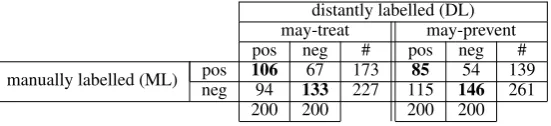
Table 1 shows differences in the annotations for the two techniques for labelling that data. The ML data set for may-treat contains 173 positive and 227 negative examples, whereas the ML data set for may-prevent contains 139 positives and 261 negatives examples. A comparison of the DL and ML data sets shows that 40.25% of the la-bels changed formay-treat and 39.75% for may-prevent. The distant supervision process generated more false positives than false negatives for both relations.
If we assume that we have a classifier that is able to identify themay-treatandmay-prevent re-lations with perfect accuracy then performance on the ML data sets would be precision=1.0, re-call=1.0 and f-score=1.0. However, the false la-bels on the DL data sets would lead to perfor-mance of the same classifiers being estimated as precision=0.61, recall=0.53 and f-score=0.57 for
may-treat and precision=0.61, recall=0.43 and f-score=0.50 formay-prevent. Hence, the two data sets may provide quite different estimates of sys-tem performance and we explore this in more de-tail in the next section.
4 Relation Extraction
A distantly supervised relation classifier was eval-uated using manually and distantly labelled ver-sions of the test data. Classifiers were trained for both relations and evaluated using both data sets (DL and ML). The evaluation was carried out us-ing entity level evaluation, i.e. precision and recall are computed based on the proportion of correctly identified entity pairs which occur in sentences la-beled as positive examples (according to the
anno-tations contained within DL or ML). Entity level evaluation is commonly used to evaluate distantly supervised relation extraction systems. Similar re-sults have been observed using the alternative ap-proach of sentence level evaluation in which pre-cision and recall are computed by examining the prediction for each sentence.
We use MultiR (Hoffmann et al., 2010), a multi-instance learning system that has been shown to provide state of the art results for distantly super-vised relation extraction. The features used are those described by Surdeanu et al. (2011). The system is trained using distantly labelled examples (Section 2.1) of themay-treatandmay-prevent re-lations containing equal numbers of positive and negative instances. The number of training exam-ples is varied from 2,000 to 16,000 in increments of 2,000.
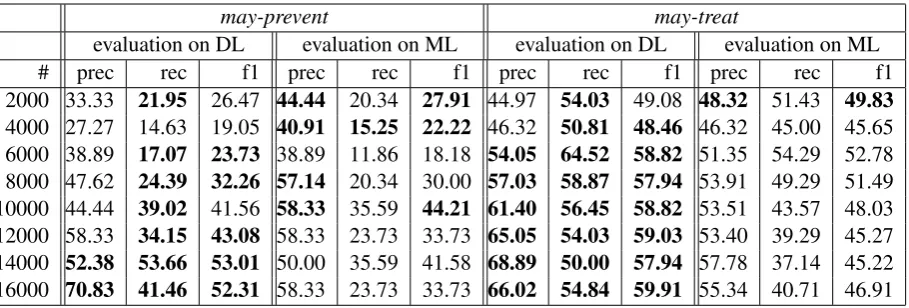
Results are shown in Table 2. Highlighted fig-ures indicate the data set (DL or ML) against which the highest score was obtained for each met-ric (prec., rec. and f1) and configuration (relation and number of training examples). In general in-creasing the amount of training data leads to im-proved results on the DL data. In particular an in-crease in precision is observed when there is more training data. However, a different pattern is ob-served for the ML data and increasing the amount of training data does not always lead to an im-provement in the f1-score. Results also show that the performance estimates obtained using the DL and ML data sets are only loosely associated. The results are similar for smaller training data sets but diverge as the amount of training data increases.
trend becomes more pronounced as the amount of training data used increases. The most likely rea-son for this difference is that the classifiers are trained using distantly supervised data and there-fore model the labels in the DL data set more closely than those in found in ML.
These results demonstrate that evaluation using distantly labelled gold standard data tends to over-estimate performance. In some cases the discrep-ancy is large (up to 18.58 for may-prevent and 13.76 for may-treat). However, it does not seem to be consistent or particularly predictable. Con-sequently, improving the performance of a rela-tion extracrela-tion system relative to distantly labelled evaluation data does not necessarily imply an in-crease in performance when measured against a manually annotated gold-standard.
5 Conclusion
This paper explored the effect of evaluating biomedical relation extraction systems using held-out test data annotated using distant supervision. Test data for two biomedical relations was an-notated using distant supervision and also man-ually annotated. The manual and automatic la-bels differed for a large portion of the sentences. A distantly supervised relation extraction system was also evaluated using both data sets. We found that evaluation using held-out distantly su-pervised data tended to overestimate performance and that the connection between improved per-formance against distantly and manually labelled data was unclear. The use of held-out distantly la-belled data is a cheap and efficient way to evalu-ate relation extraction systems, however this anal-ysis demonstrates that the results obtained should be treated with some caution and, ideally, systems should also be evaluated against manually labelled data.
The results presented here were obtained for two biomedical relations. In future we plan to ex-tend our analysis to a wider set of relations.
Acknowledgments
The authors are grateful to the Engineer-ing and Physical Sciences Research Council (EP/J008427/1) for funding the research described in this paper.
References
A. Aronson and F. Lang. 2010. An overview of MetaMap: historical perspective and recent ad-vances. Journal of the American Medical Associ-ation, 17(3):229–236.
Isabelle Augenstein, Diana Maynard, and Fabio Ciravegna. 2014. Relation extraction from the web using distant supervision. In Proceedings of the 19th International Conference on Knowledge Engi-neering and Knowledge Management (EKAW 2014), Link¨oping, Sweden, November.
Kedar Bellare and Andrew Mccallum. 2007. Learn-ing Extractors from Unlabeled Text usLearn-ing Relevant Databases. InSixth International Workshop on In-formation Integration on the Web (IIWeb).
Jacob Cohen. 1960. A coefficient of agreement for nominal scales. Educational and Psychological Measurement, 20:37–46.
Mark Craven and Johan Kumlien. 1999. Constructing biological knowledge bases by extracting informa-tion from text sources. InIn Proceedings of the Sev-enth International Conference on Intelligent Systems for Molecular Biology (ISMB), pages 77–86. AAAI Press.
Raphael Hoffmann, Congle Zhang, and Daniel S. Weld. 2010. Learning 5000 relational extractors. In
Proceedings of the 48th Annual Meeting of the As-sociation for Computational Linguistics, ACL ’10, pages 286–295, Stroudsburg, PA, USA. Association for Computational Linguistics.
Ander Intxaurrondo, Mihai Surdeanu, Oier Lopez de Lacalle, and Eneko Agirre. 2013. Remov-ing noisy mentions for distant supervision. Proce-samiento del Lenguaje Natural, 51:41–48.
Sebastian Krause, Hong Li, Hans Uszkoreit, and Feiyu Xu. 2012. Large-scale learning of relation-extraction rules with distant supervision from the web. In Proceedings of the 11th International Conference on The Semantic Web - Volume Part I, ISWC’12, pages 263–278, Berlin, Heidelberg. Springer-Verlag.
Bonan Min, Ralph Grishman, Li Wan, Chang Wang, and David Gondek. 2013. Distant supervision for relation extraction with an incomplete knowledge base. In Proceedings of the 2013 Conference of the North American Chapter of the Association for Computational Linguistics: Human Language Tech-nologies, pages 777–782, Atlanta, Georgia, June. Association for Computational Linguistics.
Stroudsburg, PA, USA. Association for Computa-tional Linguistics.
Claire N´edellec, Robert Bossy, Jin-Dong Kim, Jung-Jae Kim, Tomoko Ohta, Sampo Pyysalo, and Pierre Zweigenbaum. 2013. Overview of bionlp shared task 2013. In Proceedings of the BioNLP Shared Task 2013 Workshop, pages 1–7, Sofia, Bulgaria, August. Association for Computational Linguistics. Truc-Vien T. Nguyen and Alessandro Moschitti. 2011. Joint distant and direct supervision for relation ex-traction. In Proceedings of The 5th International Joint Conference on Natural Language Processing (IJCNLP’11), pages 732–740. Association for Com-putational Linguistics.
Sebastian Riedel, Limin Yao, and Andrew McCallum. 2010. Modeling relations and their mentions with-out labeled text. In Proceedings of the European Conference on Machine Learning and Knowledge Discovery in Databases (ECML PKDD ’10). Alan Ritter, Luke Zettlemoyer, Mausam, and Oren
Et-zioni. 2013. Modeling missing data in distant su-pervision for information extraction. InAssociation for Computational Linguistics Vol. 1 (TACL). Roland Roller and Mark Stevenson. 2014. Applying
umls for distantly supervised relation detection. In
Proceedings of the Fifth International Workshop on Health Text Mining and Information Analysis (Louhi 2014), Gothenburg, Sweden.
Roland Roller, Eneko Agirre, Aitor Soroa, and Mark Stevenson. 2015. Improving distant supervision us-ing inference learnus-ing. In Proceedings of the 53rd Annual Meeting of the Association for Computa-tional Linguistics and the 7th InternaComputa-tional Joint Conference on Natural Language Processing (Vol-ume 2: Short Papers), pages 273–278, Beijing, China, July. Association for Computational Linguis-tics.
Benjamin Roth and Dietrich Klakow. 2013. Com-bining generative and discriminative model scores for distant supervision. InProceedings of the 2013 Conference on Empirical Methods in Natural Lan-guage Processing, pages 24–29, Seattle, Washing-ton, USA, October. Association for Computational Linguistics.
Isabel Segura-Bedmar, Paloma Mart´ınez, and Mar´ıa Herrero Zazo. 2013. Semeval-2013 task 9 : Extrac-tion of drug-drug interacExtrac-tions from biomedical texts (ddiextraction 2013). In Second Joint Conference on Lexical and Computational Semantics (*SEM), Volume 2: Proceedings of the Seventh International Workshop on Semantic Evaluation (SemEval 2013), pages 341–350, Atlanta, Georgia, USA, June. Asso-ciation for Computational Linguistics.
Mihai Surdeanu, David McClosky, Mason Smith, An-drey Gusev, and Christopher Manning. 2011. Cus-tomizing an information extraction system to a new
domain. In Proceedings of the ACL 2011 Work-shop on Relational Models of Semantics, pages 2– 10, Portland, Oregon, USA, June. Association for Computational Linguistics.
Mihai Surdeanu, Julie Tibshirani, Ramesh Nallapati, and Christopher D. Manning. 2012. Multi-instance multi-label learning for relation extraction. In Pro-ceedings of the 2012 Joint Conference on Empirical Methods in Natural Language Processing and Com-putational Natural Language Learning, EMNLP-CoNLL ’12, pages 455–465, Stroudsburg, PA, USA. Association for Computational Linguistics.
Shingo Takamatsu, Issei Sato, and Hiroshi Nakagawa. 2012. Reducing wrong labels in distant supervi-sion for relation extraction. In Proceedings of the 50th Annual Meeting of the Association for Compu-tational Linguistics: Long Papers - Volume 1, ACL ’12, pages 721–729, Stroudsburg, PA, USA. Associ-ation for ComputAssoci-ational Linguistics.
Philippe Thomas, Ill´es Solt, Roman Klinger, and Ulf Leser. 2011. Learning protein protein interaction extraction using distant supervision. InProceedings of Robust Unsupervised and Semi-Supervised Meth-ods in Natural Language Processing, pages 34–41. Andreas Vlachos and Stephen Clark. 2014.
Application-driven relation extraction with limited distant supervision. In Proceedings of the First AHA!-Workshop on Information Discovery in Text, pages 1–6, Dublin, Ireland, August. Association for Computational Linguistics and Dublin City Univer-sity.
Fei Wu and Daniel S. Weld. 2007. Autonomously semantifying wikipedia. InProceedings of the Six-teenth ACM Conference on Conference on Informa-tion and Knowledge Management, CIKM ’07, pages 41–50, New York, NY, USA. ACM.
Wei Xu, Raphael Hoffmann, Le Zhao, and Ralph Gr-ishman. 2013. Filling knowledge base gaps for dis-tant supervision of relation extraction. In Proceed-ings of the 51st Annual Meeting of the Association for Computational Linguistics (Volume 2: Short Pa-pers), pages 665–670, Sofia, Bulgaria, August. As-sociation for Computational Linguistics.