Crosslingual Annotation and Analysis
of Implicit Discourse Connectives for Machine Translation
Frances Yung Kevin Duh
Nara Institute of Science and Technology 8916-5 Takayama, Ikoma, Nara, 630-0192 Japan
{pikyufrances-y, kevinduh, matsu}@is.naist.jp
Yuji Matsumoto
Abstract
Usage of discourse connectives (DCs) dif-fers across languages, thus addition and omission of connectives are common in translation. We investigate how implicit (omitted) DCs in the source text impacts various machine translation (MT) systems, and whether a discourse parser is needed as a preprocessor to explicitate implicit DCs. Based on the manual annotation and alignment of 7266 pairs of discourse rela-tions in a Chinese-English translation cor-pus, we evaluate whether a preprocessing step that inserts explicit DCs at positions of implicit relations can improve MT. Results show that, without modifying the translation model, explicitating implicit relations in the input source text has lim-ited effect on MT evaluation scores. In ad-dition, translation spotting analysis shows that it is crucial to identify DCs that should be explicitly translated in order to improve implicit-to-explicit DC translation. On the other hand, further analysis reveals that the disambiguation as well as explic-itation of implicit relations are subject to a certain level of optionality, suggesting the limitation to learn and evaluate this lin-guistic phenomenon using standard paral-lel corpora.
1 Introduction
Discourse relations are semantic and pragmatic re-lations between clauses or sentences. The rela-tions can be explicitly expressed by surface words known as explicit ‘discourse connectives’ (DCs) or implicitly inferred. The markedness of dis-course relations varies across languages. For
example, Chinese discourse units are typically clauses separated by commas, so DCs are often implicit. Explicit and implicit DCs account for 45% and 40% of the DCs annotated in the Penn Discourse Treebank (PDTB) (Prasad et al., 2008) respectively, while in the Chinese Discourse Tree-bank (CDTB), they account for 22% and 76% re-spectively (Zhou and Xue, 2015).
Comparing with other language pairs, such as Arabic and English, it is found that discourse factors impact machine translation quality more in Chinese-to-English translation, especially when translating discourse relations that are expressed implicitly in one language but explicitly in the other (Li et al., 2014).
When translating from Chinese to English, im-plicit DCs are exim-plicitated when necessary. For example, a causal relation can be inferred between the 2 clauses of the Chinese sentence below. In the English translation, the 2 clauses should be con-nected by an explicit DC, such as ‘thus’.
• 1[出口快速增长] , (export grows rapidly)
2[成为推动经济增长的重要力量。]
(become important strength in promoting the economy to grow.)
An open question in discourse for SMT is how best to handle cases where DCs are implicit in the source (e.g. Chinese) but explicit in the target (e.g. English). In this paper, we investigate how im-plicit DCs are translated in a translation corpus, and if explicitating implicit DCs in the source can improve MT.
2 Related Work
In translation studies, explicitation of implicit DCs is observed in translations between European languages (Becher, 2011; Zuffery and Cartoni,
2014). On the other hand, it is also reported that certain English explicit DCs are not translated ex-plicitly in French or German (Meyer and Webber, 2013). We hypothesize that explicitation is more common in Chinese-to-English translation.
To incorporate DC translation in SMT, explicit DCs are annotated in French-English parallel corpus and classifiers are trained to disambiguate DC senses before SMT training (Meyer et al., 2011; Meyer and Popescu-Belis, 2012). Also, translation model based on Rhetorical Structure Theory (Mann and Thompson, 1986) styled discourse parse has been used in Chinese-English SMT (Tu et al., 2013). These works focus on explicit discourse relations.
Chinese sentences can be ‘discourse-like’, consisting of a sequence of discourse units. Syntactic parsing of Chinese complex sentences (CCS) (Zhou, 2004) covers certain intersentential discourse relations, including both explicit and implicit relations. Tu et al. (2014) presents a CCS-tree-to-string translation model in which translation rules and language model are condi-tioned by automatic CCS parse. Improved BLEU scores are reported, but it is not clear how much the translation of implicit DCs has been improved.
Sense classification of implicit DCs is a hard task (Lin et al., 2009; Pitler et al., 2009; Park and Cardi, 2012). Echihabi and Marcu (2002) remove DCs in texts to create pseudo implicit DCs training instances. More useful pseudo sam-ples can be generated by classifying ommisable and non-ommisable explicit DCs (Rutherford and Xue, 2015). Concerning the options of explicit and implicit usage, Patterson and Kehler (2013) presents a model that accurately (86.6%) predicts the choice of using an explicit or implicit DC given the discourse sense. However, human per-formance of the task is only 66%, implying that both choices are acceptable in some cases.
3 Crosslingual manual alignment of DCs
To investigate how DCs are translated from Chi-nese to English, we manually align DCs in the source to their translations on a parallel corpus. The DCs are further annotated with their nature and senses. This section describes the strategy and findings of our annotation.
3.1 Annotation scheme
The parallel corpus comes from 325 newswire ar-ticles (2353 sentences) of the the Chinese Tree-bank and their English translation (Palmer et al., 2005; Bies et al., 2007)1. The annotation was car-ried out by1 professional Chinese-English trans-lator.
We use translation spotting technique (Meyer et al., 2011) to align the DCs crosslingually, consid-ering both explicit and implicit DCs. Annotation is carried out on the raw texts. Readers are ref-ered to Yung et al. (2015) for details concerning the Chinese side annotation, such as definition of discourse units and annotation policy for parallel connectives. The labels used in the crosslingual annotation are defined as follows:
• Explicit DC: An explicit DC is a lexical ex-pression that connects two discourse units with a relation. We do not define a close set of explicit DCs to be annotated. The list is constructed in the course of annotation. We also do not limit the syntactic categories of the DCs. In total,227Chinese and152 En-glish DCs are identified. (See Table 2)
• Implicit DC: An implicit DC is an implied relation between two discourse units repre-sented by a lexical expression, e.g. ‘and’ for an expansion relation. Since texts are natu-rally coherent, we assume that two consecu-tive discourse units are always related by a re-lation. The list of DCs that is used to annotate implicit relation is the list of ‘fine senses’. (see below)
• Redundant: The ‘redundant’ tag is used when it is not grammatically acceptable to in-sert an implicit DC. Typically, it is annotated on either side of a DC alignment. For exam-ple, either half of a pair of parallel Chinese DCs (e.g.‘因为’because...‘所以’therefore) is
aligned to ‘redundant’, as it is not grammati-cal to use both DCs in English.
relations are also labeled ‘AltLex’, such as ‘through’ for aContingencyrelation. This la-bel is defined on English side only.
• Coarse sense: We first group the DCs un-der the 4 top-level discourse senses defined in PDTB, namely Expansion, Contingency, ComparisonandTemporal.
• Fine sense: The sense hierarchy of PDTB is always modified in comparable discourse corpora of different languages (Prasad et al., 2014). Instead of defining a list of senses that cover discourse relations of both languages, we group interchangeable explicit DCs under the same category, and the category serves as the ‘fine sense’ label. For example, ‘be-sides’ ,‘moreover’ and ‘in addition’ are all annotated with the fine sense ‘in addition’. Similar to DC identification, the list of fine senses is built in the course of annotation. In total, there are74Chinese and75English fine senses (See Table 2).
The discourse sense annotation and DC alignment are carried out at one pass by below procedure:
1. Explicit DCs are identified in the source Chi-nese sentence, and labeled with sense tags.
2. The English translation of the DC is spotted, aligned to the Chinese DC and labeled with sense tags.
3. If the Chinese DC is not translated to an En-glish DC, the annotator first looks for ‘Alt-Lex’. If no ‘AltLex’ can be identified, an im-plicit DC is inserted. If insertion is not gram-matical, the DC is aligned to ‘redundant’. 4. On the Chinese side of the corpus, implicit
DCs are inserted between two discourse units if they are not related by an explicit DC2. The implicit DC is aligned following the strategy in Step 3.
5. Any explicit DCs on the English side that are not aligned are identified. Further im-plicit DCs are inserted to the Chinese side for alignment. If insertion of implicit DCs is un-grammatical, they are aligned to ‘redundant’. 2We treat each component of a paired DC independently: when only half of a paired DC occurs explicitly, the other half is inserted as an implicit DC.
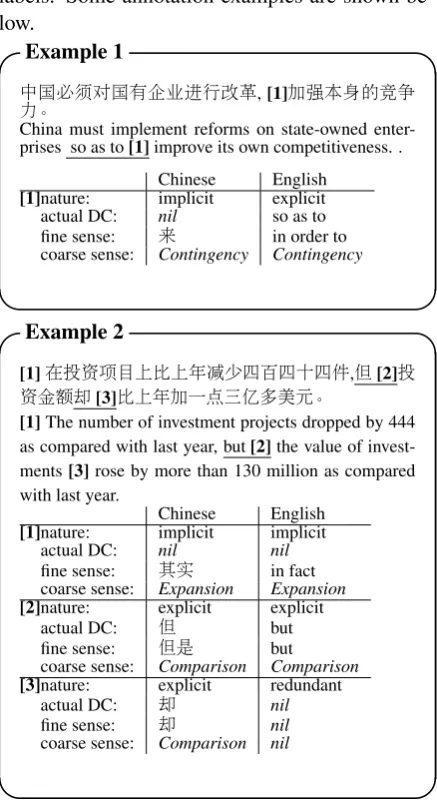
Each pair of aligned DCs are thus tagged with 8 labels. Some annotation examples are shown be-low.
Example 1
中国必须对国有企业进行改革,[1]加强本身的竞争
力。
China must implement reforms on state-owned enter-prises so as to[1]improve its own competitiveness. .
Chinese English [1]nature: implicit explicit actual DC: nil so as to fine sense: 来 in order to coarse sense: Contingency Contingency
Example 2
[1]在投资项目上比上年减少四百四十四件,但[2]投 资金额却[3]比上年加一点三亿多美元。
[1]The number of investment projects dropped by 444 as compared with last year, but[2]the value of invest-ments[3]rose by more than 130 million as compared with last year.
Chinese English [1]nature: implicit implicit
actual DC: nil nil
fine sense: 其实 in fact coarse sense: Expansion Expansion
[2]nature: explicit explicit
actual DC: 但 but
fine sense: 但是 but coarse sense: Comparison Comparison
[3]nature: explicit redundant
actual DC: 却 nil
fine sense: 却 nil
coarse sense: Comparison nil
3.2 How many DCs are identified?
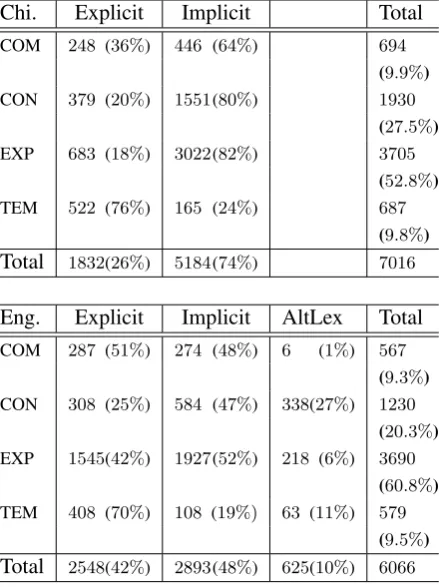
In total, 7266 pairs of discourse relations are aligned. Table 1 shows the distribution of coarse DC senses (Comparison (COM), Contingency (CON),Expansion(EXP) andTemporal(TEM)).
Similar to the findings in PDTB and CDTB, there are more implicit DCs than explicit DCs on the Chinese side but they are of similar propor-tion in English. Comparison, Contingency, and Expansion relations are more often expressed by implicit DCs than explicit DCs in Chinese. On the other hand,ContingencyandExpansionrelations are more often expressed by implicit DCs than ex-plicit DCs in English.
[image:3.595.308.527.86.488.2]Similar tendency is found in the PDTB. In CDTB, among the 9 coarse senses,Causation, En-tailment,ExpansionandConjunctionrelations are more often implicit than explicit.
Chi. Explicit Implicit Total COM 248 (36%) 446 (64%) 694
(9.9%) CON 379 (20%) 1551(80%) 1930
(27.5%) EXP 683 (18%) 3022(82%) 3705
(52.8%) TEM 522 (76%) 165 (24%) 687
(9.8%) Total 1832(26%) 5184(74%) 7016
Eng. Explicit Implicit AltLex Total COM 287 (51%) 274 (48%) 6 (1%) 567
(9.3%) CON 308 (25%) 584 (47%) 338(27%) 1230
(20.3%) EXP 1545(42%) 1927(52%) 218 (6%) 3690
(60.8%) TEM 408 (70%) 108 (19%) 63 (11%) 579
[image:4.595.72.292.59.356.2](9.5%) Total 2548(42%) 2893(48%) 625(10%) 6066 Table 1: Proportion of various DCs per coarse sense. On top of above, there are 250 Chinese and 1200 English ‘redundant’ cases
fine senses that are identified in the annotation pro-cess. A smaller variety of DCs are used in the English translation than the Chinese source. The number of fine senses recognized in implicit DCs is smaller than that of explicit DCs, implying that some fine senses are only expressed explicitly.
Exp.COM CON EXP TEM Total Chi.30(11) 63(18) 72(26) 62(19) 227(74) Eng.20(11) 41(13) 55(23) 40(14) 156(61) Imp.COM CON EXP TEM Total Chi.−(9) −(15) −(17) −(13) −(54) Eng.−(7) −(11) −(12) −(9) −(39)
Table 2: Number of unique DCs and DC fine senses (in brackets)3
Table 3 shows the number of alignments be-tween discourse relations of different nature. Among the5184 implicit DCs in Chinese, about 3DCs and fine senses that have multiple course senses are counted as different DCs/senses. If counted only once, the to-tal numbers of unique DCs and DC fine senses (in brackets) are: explicit-Chinese: 200(70); explicit-English: 139(56); implicit-Chinese: (52); implicit-English: (38)
Eng. / Chi. Explicit Implicit Redun. TTL
Explicit 1332 1193 23 2548
Implicit 81 2812 0 2893
Redund. 198 775 227 1200
AltLex 221 404 0 625
TTL 1832 5184 250 7266
Table 3: Number of alignments between discourse relations of different nature
70%are not explicitly translated in English (2812 aligned to implicit DCs and 775to ‘redundant’). The rest 30% are translated to explicit DCs or other explicit lexicalization in English. We further examine the crosslingual alignment of discourse senses in Section 5.2.
Statistics of the annotated parallel corpus shows the divergence in DC usage between Chinese and English. It suggests that certain implicit Chinese DCs are explicitated in the English translation. To correctly model the translation of implicit rela-tions, do we need a discourse parser that classifies an implicit source DC to its fine sense or coarse sense? Or will SMT robustly handle implicit-to-explicit DC translation without any discourse pre-processing? We seek to answer these questions in the next section.
4 Explicitating implicit DCs for MT based on manual annotation
With an automatic discoure parser, a discourse-tree-to-string translation model can be built. Nonetheless, state-of-the-art accuracy of implicit discourse sense classification is still low for down-stream application (Rutherford and Xue, 2014). In this work, we design oracle experiments to evalu-ate the MT of implicit DCs assuming that the gold discourse sense is given.
4.1 Method
In our annotation scheme, implicit DCs senses are defined by DCs that are identified during explicit DC annotation. In other words, the implicit DCs are represented by explicit DC that acturally occur in Chinese discourse. We hypothize that explici-tating implicit DCs in the source based on manual annotation will improve implicit-to-explicit DC translations and thus the overall MT result.
[image:4.595.72.292.63.357.2]prepro-cessed based on the manual DC annotations. We compare a number of variations of the preprocess:
• Implicit fine sense (FIN): We insert the an-notated lexicalized fine sense to the source text. For example, referring to Example 2 in Section 3.1, ‘其实 (‘in fact’) ’ is inserted at
position[1]in the source sentence.
• Implicit coarse sense (COA): Classifica-tion up to the coarse discourse sense could be helpful enough to translate the implicit DCs. We insert the most frequent fine sense of the annotated coarse sense to the source text4. Referring to the same example, ‘而且’ (‘and’) is inserted at position[1]because it is the most frequent fine sense under the coarse senseExpansion.
• Most explicitated DCs (TOP): According to findings in translation studies, explicitation of DCs is DC-dependent (Zuffery and Car-toni, 2014). We thus preprocess the input source text by explicitating only theN most frequently explicitated implicit DCs (implicit in source but explicit in target) according to the manual annotation5. Referring to the same example, no DC is inserted at position [1] because the annotated fine sense ‘其实’
(‘in fact’) is not within the top 4.
• Same DC for all implicit relations (SAM): To evaluate the effect of inserting explicit DCs to the source text independent of the discourse sense, we homogenously insert the most frequently explicited DC, ‘而且’ (‘and’), to all positions where an implicit DC is annotated in the source text. Therefore, ‘而 且’ is inserted to position[1]of both Exam-ple 1 and ExamExam-ple 2 under this setting. We compare the 4 kinds of preprocessing (FIN, COA, TOP, SAM) to see what kind of explica-tion of implicit DCs could improve MT. For each of the 4 kinds of preprocessing, we also exper-imented with an additional variant ‘implicit-to-explicit only’ (i2e), which restrictively ‘implicit-to-explicitate 4The top frequent DCs per coarse sense forExpansion,
Comparison, ContingencyandTemporalrelations are ‘而且’ (‘and’), ‘但’ (‘but’), ‘然后’ (‘then’), and ‘从而’ (‘thus’) re-spectively.
5We use the4most often explicitated fine senses, which are ‘而且’ (‘and’), ‘而’ (‘whearas’), ‘和’ (‘and’), ‘并’ (‘also’).
only those DCs that are actually aligned to explicit target DCs. This is to evaluate the importance of identifying which implicit DC has to be explicitly translated. Referring to Example 2, no DC is in-serted to position [1] since it is not an ‘implicit-to-implicit’ alignment. These various versions of source texts are decoded by SMT systems.
4.2 MT Settings
We train baseline MT systems with 2.5 million sentences of bitexts through the LDC6, including newswire, broadcast news and law genres. To see if there is any bias of DC translation to cer-tain framework, we build 3 types of SMT sys-tems with default settings: a phrase-based model and a hierarchical model using MOSES (Koehn et al., 2007), and a tree-to-string model using TRA-VATAR (Neubig, 2013). All models use a 5-gram language model trained on the English Gi-gaword (Parker et al., 2011) and are tuned by MERT (Och, 2003). We use GIZA++ (Och and
Ney, 2003) for automatic word alignment and the Stanford Parser (Levy and Manning, 2003) to parse the source text for tree-to-string MT train-ing. Tuning and testing with the newswire por-tions of OpenMT08 and OpenMT06 respectively, the phrase-based, Hiero and tree-to-string systems yield BLEU scores of26.7,26.1and20.4 respec-tively, evaluating against 4 reference translations.
We use these SMT models to translate the source text in which implicit DCs are explicitated by the methods described in Section 4.1. 1178 sen-tences and 1175 sensen-tences of the manually anno-tated parallel corpus are used as the tuning and test sets respectively. The systems are tuned with the tuning set preprocessed by theFINmethod.
Note that the SMT training data is not discourse annotated and thus the translation models are not trained with any discourse markups. Nonetheless, the source side of the training data contains abun-dant examples of both implicit and explicit DCs and we believe that the translation model will con-tain translation rules for both natures. The ques-tion is whether explicitating implicit DC senses in the source input will the improve final perfor-mance.
4.3 Result
Figure 4 shows the BLEU and METEOR scores of the SMT outputs resulting from various pre-processed test sets. Explicitation of implicit DCs in the source input generally results in evaluation scores comparable to that of the unprocessed in-put. Similar results are produced by the 3 SMT frameworks. Only theSAMpreprocess results in higher evaluation scores using Hiero SMT.
To our surprise, disambiguating the implicit dis-course sense up to the fine sense does not yeild better translation comparing with disambiguation up to the coarse sense. In turn, homogenously in-serting ‘而且’ (‘and’) without sense disambigua-tion yeilds even better result. Similar scores are produced by explicitating only the most fre-quently explicitated implicit DCs. The ‘implicit-to-explicit only’ restriction generally produces higher scores, suggesting that it is crucial to iden-tify which DCs should be explicitated in transla-tion and which should not.
Results of the oracle MT experiment show that
PBMT Hiero T2S
B M B M B M
[image:6.595.79.286.378.532.2]original 15.6 24.5 15.6 24.4 12.6 22.7 FIN 15.5 24.4 15.3 24.4 12.3 22.6 FIN+i2e 15.6 24.4 15.6 24.4 12.4 22.6 COA 15.4 24.5 15.4 24.4 12.4 22.7 COA+i2e 15.5 24.4 15.5 24.4 12.5 22.6 TOP 15.6 24.5 15.6 24.5 12.5 22.6 TOP+i2e 15.6 24.4 15.6 24.4 12.5 22.7 SAM 15.4 24.5 15.7 24.6 12.4 22.7 SAM+i2e 15.5 24.4 15.5 24.4 12.4 22.7
Table 4: BLEU (B) and METEOR (M) scores of MT outputs resulting from various DC insertions. Highest scores of each SMT system are bolded
MT performance is hardly improved by explici-tating implicit DCs even based on manual annota-tion. It will be more difficult to improve MT based on predicted implicit discourse senses.
5 Analysis
The negative MT results could be due to the following possibilities: (1) Improvement of DC translation is not captured by automatic evaluation scores. (2) The sense of the implicit DCs that re-quires explicitation is unevenly distributed, such that disambiguating the sense has limited effect.
(3) The context in which a discourse relation is ex-pressed explicitly in the source largely differs from the context in which it is expressed implicity. As a result, translation rules of actual explicit DCs can-not correctly translate artificially expliciated DCs.
We analyze these possibilities in this section. 5.1 Is the translation of implicit-to-explicit
DCs improved?
Since DCs contribute to a small portion of word counts in the MT output, the difference in DC translation is not sensitive to global n-gram-based evaluation metrics. Translation of DCs can be ac-tually improved while BLEU scores remain simi-lar (Meyer et al., 2012).
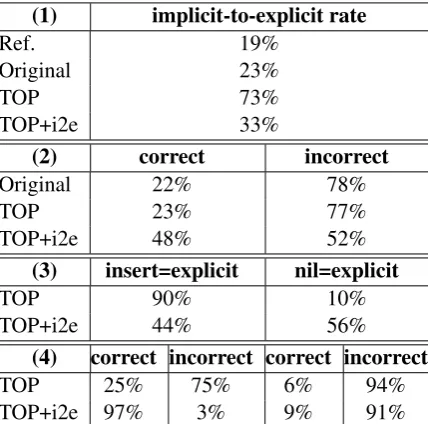
We manually analyze 100 sentences of the base-line Hiero output, the reference translation, as well as the Hiero MT outputs produced by the prepro-cesses TOP and TOP with ‘i2e’ restriction. It is done by spotting how each implicit source DC is translated - to which explicit DC or not translated as explicit DC. Table 5 shows the proportion of different DC alignments produced by different MT systems and the reference translation.
(1) implicit-to-explicit rate
Ref. 19%
Original 23%
TOP 73%
TOP+i2e 33%
(2) correct incorrect
Original 22% 78%
TOP 23% 77%
TOP+i2e 48% 52%
(3) insert=explicit nil=explicit
TOP 90% 10%
TOP+i2e 44% 56%
(4) correct incorrect correct incorrect
TOP 25% 75% 6% 94%
TOP+i2e 97% 3% 9% 91%
Table 5: Comparison of implicit DC translations in different preprocessing schemes
Part (1) of Table 5 compares the rate in which implicit source DCs are explicitated in the trans-lation outputs. As expected, more implicit DCs are translated explicitly in the output of the prepro-cessed source text than that of the original source text. However, the original output already explici-tates more implicit DCs than the reference does.
[image:6.595.308.523.399.611.2]target DCs aligned to (originally) implicit source DCs are correct translation. The explicit target DC is consideredcorrectif it matches with the explicit DC in the reference translation, andincorrect if the explicit DC is different from the reference DC or the relation is not translated as an explicit DC in the reference. It is seen that the preprocess (23%) hardly improves the accuracy comparing with the original output (22%), unless we only explicitate source DCs that are known to be explicitly trans-lated (48%).
Part (3) of the table shows how often explici-tating source DCs actually produces explicit DC translations. ‘insert=explicit’ means the target ex-plicit DC is aligned to a source exex-plicit DC in-serted by preprocess. ‘nil=explicit’ means the tar-get explicit DC is not aligned to any source DCs (inserted or not). It is observed that implicit DCs are sometimes explicitly translated by the MT sys-tems even without source explicitation, yet the translation accuracy is low, comparing with trans-lation from explicitated source DCs, as shown in Part (4) of the table.
Result of this analysis supports our hypothesis that the improvement in implicit-to-explicit DC translation is not captured by MT evaluation met-rics. Although the MT outputs under comparison have similar scores, implicit-to-explicit DC trans-lation is improved under the TOP+i2e setting, but not under the other settings. In addition, the result suggests that certain implicit-to-explicit DC trans-lation is captured by SMT even without source ex-plicitation preprocessiing.
5.2 Which senses are more common in implicit-to-explicit aligments?
On average, 18.5Chinese and15.25 English fine senses are identified under each of the 4 coarse senses. Nonetheless, the oracle MT experiment suggests that classifying the implicit discourse senses more precisely does not improve MT more. A possible explanation is that the senses of implicit-to-explicit DCs only limit to a small set of senses that are already captured by coarse sense classification.
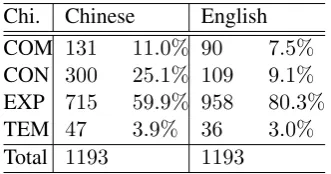
Among the 7266 aligned relations, there are 1193 implicit-explicit alignments (refer to Table 3). Table 6 shows the sense distribution of these pairs. While the sense distribution on the Chinese side is comparable to the overall sense distribution (refer to Table 1), over 80% of which are
trans-lated by explicit DCs that signal an Expansion sense. In fact,88%of the implicit source DCs are aligned to the explicit target DC ‘and’.
Chi. Chinese English
COM 131 11.0% 90 7.5% CON 300 25.1% 109 9.1% EXP 715 59.9% 958 80.3% TEM 47 3.9% 36 3.0%
[image:7.595.334.500.120.207.2]Total 1193 1193
Table 6: Sense distribution of imp.-exp. DC
Table 7 lists the top 10 frequent implicit-explicit alignments. It shows that ‘and’ is used to ex-plicitate a range of discourse relations. On the other hand, although ‘and’ ambiguously signal various senses, non-Expansionsenses only occur marginally in PTDB, as shown in Table8. The dis-tinct discrepancy suggests that DC usage differs between spontaneous writing and translation.
target source implicit explicit
fine sense DC count (coverage)
而且‘and’ and 203 (17%)
而‘whearas’ and 117 (15%)
和‘and’ and 139 (12%)
并‘also’ and 81 (11%)
从而‘thus’ and 61 (7%)
所以‘therefore’ and 46 (5%)
来‘in order to’ and 26 (4%)
因此‘therefore’ and 23 (3%)
然后‘and then’ and 18 (2%)
即‘which is’ and 18 (2%)
Table 7: Top 10 frequent imp.-exp. alignments
sense of explicit‘and’ count (coverage) Conjunction (expansion) 2543 (85%) result (contingency) 38 (1%) Conjunctionandresult 138 (5%)
others 281 (9%)
sense of implicit‘and’ count (coverage) Conjunction (expansion) 891 (70%)
List (expansion) 346 (27%)
others 35 (3%)
Analysis of the implicit-explicit alignments ex-plains why more precise sense disambiguation of the source relations does not improve MT. It is be-cause the reference translation uses ‘and’ as the ‘wild card’to translate most implicit DCs ‘explic-itly’, but without explicitating the discourse sense. This finding is similar to the analysis based on word-aligned Chinese-English translation corpus, which also reports that‘and’is the most frequently added DC to the reference translation (Li et al., 2014a). Therefore, to improve implicit-to-explicit DC translation, an additional task should be de-fined to identify whether a source implicit DC is kept implicit, explicitly translated to an ambigous DC such as‘and’, or explicitly translated to other unambiguous DCs.
Generally, it is pragmatically correct to use ‘and’ to translate an implicit discourse relation, or to keep the relation implicit as in the source. Nonetheless, repetatively using this stragegy will result in excessively long sentences, as in the ex-ample below. In this case, insertion of explicit DCs to the target text is desirable, instead of du-plicating the source writing style.
Source
1[天津港保税区投入运行五年来,]2[已建成了中
国第一货物分拨中心,]3[具备了口岸关的功能,] 4[开通了天津港保税区经西安、兰州到新疆阿拉山 口口岸的铁路专用线;]5[建立了一批集仓储、运
输、销售于一体的大型物流配给中心,]6[开办了
铁路和国际集装箱多式联运,]7[月接卸集装箱能
力达六千标准箱;]8[形成了七千门程控电话的装
机能力,]9[供电能力达二点五万千伏、日供水能
力一万吨。]
Reference
1[Since being put into operation five years ago,]2[the
Tianjin Port Bonded Area has completed the con-struction of China’s first goods distribution center,]
3[functioned like a customs port, ]4[opened up the
spe-cial use the railway line from the Tianjin Port Bonded Area passing Xi’an and Lanzhou to arrive at Xinjiang’s Allah Mountain pass customs port, ]5[established a
number of large-scale materials circulation distribution and supply centers integrating storage, transportation and sales,]6[opened multiple railway and international
container joint-operations ] 7[with a monthly loading
and unloading capacity reaching 6,000 standard con-tainers. ] 8[It has built up an installation capacity of
7,000 sets of program-controlled telephones,]9[with a
power supply capacity of 25,000 kilovolts, and a daily water supply capacity of 10,000 tons.]
5.3 Contexts of explicit/implicit DC usage
Lastly, we compare the contexts in which a par-ticular sense is expressed explicitly or implicitly in the source. If the contexts are distinctly differ-ent, it suggests that artificially explicitated source implicit DCs cannot be captured by a translation model trained only with naturally occuring ex-plicit DCs.
In addition, we compare the contexts in which a source implicit DC is translated into an explicit DC or by other means (by implicit DC or alterna-tive lexicalization). If the contexts are similar, it suggests that the translation strategy could be an option independent of the context.
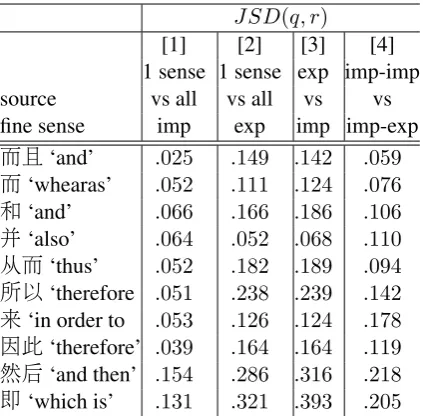
Following Rutherford and Xue (2015), we de-fine the context of a discourse relation as the uni-gram distribution of words in the 2 arguments con-nected by the relation. The context of a particular discourse usage is thus the sum of the unigram dis-tributions of all discourse relations associated with that usage. We also use the Jensen-Shannon Diver-gence (JSD) to evaluate the similarity of the con-textual distributions (Rutherford and Xue, 2015; Hutchinson, 2005; Lee, 2001). This metric com-pares2distributions with the average. If both dis-tributions are close to the average, it means they are close to each other as well. The metric value ranges from0(identical) toln 2.
Table 9 shows the difference between the con-text of each source sense against the concon-text of other senses, when the discourse relation is ex-pressed implicitly (Column [1]) and explicitly (Column [2]). The difference suggests that im-plicit and explict DCs are used in different con-texts, supporting our hypothesis. In particular, the difference between the context of each sense against others is smaller in implicit usage, thus making implicit relations harder to disambiguate.
Comparing with the difference in context be-tween implicit and explicit usage (Column [3]), the context of source implicit relations that are explicitated in the target is similar to the context of source implicit relations that are kept implicit (Column [4]). This suggests that to explicitate the implicit DC or not in translation is independent of the local context to certain extent.
re-JSD(q, r)
[1] [2] [3] [4]
1 sense 1 sense exp imp-imp
source vs all vs all vs vs
fine sense imp exp imp imp-exp
而且‘and’ .025 .149 .142 .059
而‘whearas’ .052 .111 .124 .076
和‘and’ .066 .166 .186 .106
并‘also’ .064 .052 .068 .110
从而‘thus’ .052 .182 .189 .094
所以‘therefore .051 .238 .239 .142
来‘in order to .053 .126 .124 .178 因此‘therefore’ .039 .164 .164 .119
然后‘and then’ .154 .286 .316 .218
[image:9.595.76.288.61.269.2]即‘which is’ .131 .321 .393 .205
Table 9: Jensen-Shannon Divergence (JSD) of var-ious discourse usage of the top imp-exp DCs
lation between Unit1and Unit2is translated to a TemporalDC‘as’in Reference 1, while translated to aContingencyDC‘so that’in Reference 3. In Reference 2, 4, it is kept implicit. This suggests that multiple reference are necessary for evalua-tion of DC translaevalua-tion.
Source:
1[这厚重的历史回声,通过电视台”连线”大陆和香 港],2[南京市民与香港同胞”天涯共此时” ,]3[共同
庆祝香港回归祖国十周年。]
Reference 1:
1[This rich echo of history connected the mainland and
Hong Kong via television,]2[asthe citizens of Nanjing
and Hong Kong compatriots ”shared the same occasion from the far corners of the earth”]3[andcelebrated
to-gether the tenth anniversary of Hong Kong’s reversion to the motherland.]
Reference 2
1[This echo of profound historical significance
”con-nected” the Mainland and Hong Kong through televi-sion; ]2[ citizens of Nanjing and their fellow
country-men in Hong Kong ”shared this mocountry-ment with the entire world” together]3[celebratingthe 10th anniversary of
Hong Kong’s handover to the motherland]
Reference 3
1[The sophisticated echo of history ”connected” the
mainland and Hong Kong through a TV channel,]
2[so thatNanjing citizens and Hong Kong compatriots
”shared the moments across the land”]3[tocelebrate
to-gether the 10th anniversary of Hong Kong’s return to the motherland.]
Reference 4
1[The heavy historical echo ”connected” the Mainland
with Hong Kong through television station.]2[Residents
of Nanjing shared the moment with Hong Kong compa-triots from afar]3[tocelebrate the 10th Anniversary of
the return of Hong Kong to its motherland together.]
6 Conclusion
Motivated by the difference in DC usage between Chinese and English, we investigate the translation of implicit to explicit DCs given the gold crosslin-gual DC senses. We present a scheme to annotate and align DCs crosslingually and annotate 7266 relations in a Chinese-English translation corpus.
To simulate the incorporation of implicit DC in-formation to MT, we explicitate the implicit DCs in the input source text based on annotation, and decode the preprocessed input by baseline, non-discourse-aware SMT models. Results show that artificially explicitating source implicit DCs in the input text alone does not improve the MT perfor-mance significantly.
Further analysis by translation spotting suggests that discourse usage as well as sense disambigua-tion can be subject to a certain level of opdisambigua-tionality. In our annotated corpus, explicitation of implicit source DCs in translation is suppressed, either by traslation not using an explicit DC, or by trans-lation using an ambiguous, sense-neutral explicit DC.
Nonetheless, our analysis is based on written-text in the news domain, while the discrepancy of Chinese-English DC usage is different in con-versation dialogues and other domains (Steele and Specia, 2014). The suppression in explicitation of implicit DC could be due to the fact that subjective interpretation is avoided in news report. The future direction of our work is thus to exploit data from other domains, and to identify implicit DC rela-tions that require explicitation in translation. The annotation used in this work is openly released on
http://cl.naist.jp/nldata/zhendisco.
References
Viktor Becher. 2011. When and why do translators add connectives? a corpus-based study. Target, 23(1). Ann Bies, Martha Palmer, Justin Mott, and Colin
Warner. 2007. English chinese translation treebank v1.0 (ldc2007t02).
discourse connectives. Proceedings of the Annual Meeting of the Cognitive Science Society.
Philipp Koehn, Hieu Hoang, Alexandra Birch, Chris Callison-Burch, Marcello Federico, Nicola Bertoldi, Brooke Cowan, Wade Shen, Christine Moran, Richard Zens, Chris Dyer, Ondrej Bojar, Alexan-dra Constantin, and Evan Herbst. 2007. Moses: Open source toolkit for statistical machine transla-tion. Proceedings of the Annual Meeting of the As-sociation for Computational Linguistics.
Lillian Lee. 2001. On the effectiveness of the skew di-vergence for statistical language analysis. Artificial Intelligence and Statistics.
Roger Levy and Christopher Manning. 2003. Is it harder to parse chinese, or the chinese treebank. Proceedings of the Annual Meeting of the Associ-ation for ComputAssoci-ational Linguistics.
Junyi Jessy Li, Marine Carpuat, and Ani Nenkova. 2014. Assessing the discourse factors that influence the quality of machine translation. Proceedings of the Annual Meeting of the Association for Computa-tional Linguistics.
Junyi Jessy Li, Marine Carpuat, and Ani Nenkova. 2014a. Cross-lingual discourse relation analysis: A corpus study and a semi-supervised classifacation system. Proceedings of the International Confer-ence on Computational Linguistics.
Yancui Li, Wenhi Feng, Jing Sun, Fang Kong, and Guodong Zhou. 2014b. Building chinese dis-course corpus with connective-driven dependency tree structure. Proceedings of the Conference on Empirical Methods on Natural Language Process-ing.
Ziheng Lin, Minyen Kan, and Hwee Tou Ng. 2009. Recognizing implicit discourse relations in the penn discourse treebank. Proceedings of the Conference on Empirical Methods on Natural Language Pro-cessing.
William C Mann and Sandra A Thompson. 1986. Rhetorical structure theory: Description and con-struction of text structures. Technical report, DTIC Document.
Daniel Marcu and Abdessamad Echihabi. 2002. An unsupervised approach to recognizing discourse re-lations. Proceedings of the Annual Meeting of the Association for Computational Linguistics.
Thomas Meyer and Andrei Popescu-Belis. 2012. Us-ing sense-labeled discourse connectives for statisti-cal machine translation. Proceedings of the Work-shop on Hybrid Approaches to Machine Translation. Thomas Meyer and Bonnie Webber. 2013. Implici-tation of discourse connectives in (machine) trans-lation. Proceedings of the Discourse in Machine Translation Workshop.
Thomas Meyer, Andrei Popescu-Belis, Sandrine Zuf-ferey, and Bruno Cartoni. 2011. Multilingual anno-tation and disambiguation of discourse connectives for machine translation. Proceedings of the Annual Meeting of the Special Interest Group on Discourse and Dialogue.
Thomas Meyer, Andrei Popescu-Belis, and Najeh Ha-jlaoui. 2012. Machine translation of labeled dis-course connectives. Proceedings of the Biennial Conference of the Association for Machine Trans-lation in the Americas.
Graham Neubig. 2013. Travatar: A forest-to-string machine translation engine based on tree transduc-ers. Proceedings of the Annual Meeting of the Asso-ciation for Computational Linguistics (Demonstra-tion Track).
Franz Josef Och and Hermann Ney. 2003. A sys-tematic comparison of various statistical alignment models. Computational Linguistics.
Franz Josef Och. 2003. Minimum error rate train-ing in statistical machine translation. Proceedings of the Annual Meeting of the Association for Com-putational Linguistics.
Martha Palmer, Fu-Dong Chiou, Nianwen Xue, and Tsan-Kuang Lee. 2005. Chinese treebank 5.0 (ldc2005t01).
Joonsuk Park and Claire Cardi. 2012. Improving im-plicit discourse relation recognition through feature set optimization. Proceedings of Annual Meeting on Discourse and Dialogue.
Robert Parker, David Graff, Junbo Kong, Ke Chen, and Kazuaki Maeda. 2011. English gigaword fifth edi-tion ldc2011t07. Linguistic Data Consortium.
Gary Patterson and Andrew Kehler. 2013. Predicting the presence of discourse connectives. Proceedings of the Conference on Empirical Methods on Natural Language Processing.
Emily Pitler, Annie Louis, and Ani Nenkova. 2009. Automatic sense prediction for implicit discourse re-lations in text. Proceedings of the Annual Meeting of the Association for Computational Linguistics and the International Joint Conference on Natural Lan-guage Processing.
Rashmi Prasad, Nikhit Dinesh, Alan Lee, Eleni Milt-sakaki, Livio Robaldo, Aravind Joshi, and Bonnie Webber. 2008. The penn discourse treebank 2.0. Proceedings of the Language Resource and Evalua-tion Conference.
Attapol Rutherford and Nianwen Xue. 2014. Dis-covering implicit discourse relations through brown cluster pair representation and coreference patterns. Proceedings of the Conference of the European Chapter of the Association for Computational Lin-guistics.
Attapol Rutherford and Nianwen Xue. 2015. Improv-ing the inference of implicit discourse relations via classifying explicit discourse connectives. Proceed-ings of the North American Chapter of the Associa-tion of ComputaAssocia-tional Linguistics.
David Steele and Lucia Specia. 2014. Divergences in the usage of discourse markers in english and man-darin chinese. Text, Speech and Dialogue.
Mei Tu, Yu Zhou, and Chengqing Zong. 2013. A novel translation framework based on rhetori- cal structure theory. Proceedings of the Annual Meeting of the Association for Computational Linguistics.
Mei Tu, Yu Zhou, and Chengqing Zong. 2014. En-hancing grammatical cohesion: Generating transi-tional expressions for smt. Proceedings of the An-nual Meeting of the Association for Computational Linguistics.
Frances Yung, Kevin Duh, and Yuji Matsumoto. 2015. Sequential annotation and chunking of chinese dis-course structure. The SIGHAN Workshop on Chi-nese Language Processing.
Yuping Zhou and Nianwen Xue. 2015. The chinese discourse treebank: a chinese corpus annotated with discourse relations. Language Resources and Eval-uation, 49(2):397–431.
Qiang Zhou. 2004. Annotation scheme for chinese treebank. Journal of Chinese Information Process-ing.