Towards Universal Web Parsebanks
Juhani Luotolahti1, Jenna Kanerva1,2, Veronika Laippala3,4 Sampo Pyysalo1, Filip Ginter1
1Department of Information Technology 2University of Turku Graduate School (UTUGS)
3 Turku Institute for Advanced Studies, University of Turku, Finland
4School of Languages and Translation Studies, University of Turku, Finland
University of Turku, Finland [email protected]
Abstract
Recently, there has been great interest both in the development of cross-linguistically applicable annotation schemes and in the application of syntactic parsers at web scale to create parsebanks of online texts. The combination of these two trends to create massive, consistently annotated parsebanks in many languages holds enor-mous potential for the quantitative study of many linguistic phenomena, but these opportunities have been only partially re-alized in previous work. In this work, we take a key step toward universal web parsebanks through a single-language case study introducing the first retrain-able parser applied to the Universal De-pendencies representation and its applica-tion to create a Finnish web-scale parse-bank. We further integrate this data into an online dependency search system and demonstrate its applicability by showing linguistically motivated search examples and by using the dependency syntax in-formation to analyze the language of the web corpus. We conclude with a discus-sion of the requirements of extending from this case study on Finnish to create consis-tently annotated web-scale parsebanks for a large number of languages.
1 Introduction
The enormous potential of the web as a source of material for linguistic research in a wide range of areas is well established (Kilgarriff and Grefen-stette, 2003), with many new opportunities cre-ated by web-scale resources ranging from simple
N-grams (Brants and Franz, 2006) to syntactically
analyzed text (Goldberg and Orwant, 2013). Yet, while the use of multilingual web data to sup-port linguistic research is well recognized (Way
and Gough, 2003), cross-linguistic efforts involv-ing syntax have so far been hampered by the lack of consistent annotation schemata and difficulties relating to coincidental differences in the syntac-tic analyses produced by parsers for different lan-guages (Nivre, 2015).
The Universal Dependencies (UD) project1
seeks to define annotation schemata and guide-lines that apply consistently across languages, standardizing e.g. part-of-speech tags, morpholog-ical feature sets, dependency relation types, and structural aspects of dependency graphs. The project further aims to create dependency tree-banks following these guidelines for many lan-guages. The effort builds on many recently proposed approaches, including Google universal part-of-speech tags (Petrov et al., 2012), the Inter-set inventory of morphological features (Zeman, 2010) and Universal Stanford Dependencies (de Marneffe et al., 2014), and previously released datasets such as the universal dependency tree-banks (McDonald et al., 2013). The first version of UD data, released in early 2015, contains anno-tations for 10 languages: Czech, English, Finnish, French, German, Hungarian, Irish, Italian, Span-ish, and Swedish.
The availability of the UD corpora creates a wealth of new opportunities for the cross-linguistic study of morphology and dependency syntax, which are only now beginning to be ex-plored. One particularly exiting avenue for re-search involves the combination of these anno-tated resources with fully retrainable parsers and web-scale texts to create massive, consistently an-notated parsebanks for many languages. In this study, we take the first steps toward realizing these opportunities by producing a UD parsebank of Finnish comprising well over 3 billion tokens, and combining it with a scalable query system and web
1http://universaldependencies.github.
io/docs/
interface, thus building a large-scale corpus and pairing it with the tools necessary for its efficient use. Using real-world examples, we show how the large web corpus with the syntactic annotation can be used for gathering data on rare phenomena in linguistic research.
For linguistic research web corpora, contain-ing broad scope of text, are well suited for the search of rare linguistics constructs as well as those which do not often appear on official text, such as the use of colloquial terms and structures. Other motivations beyond linguistic research for large web-corpora alone are found in natural lan-guage processing, for example in lanlan-guage model-ing which has uses in many areas such as informa-tion extracinforma-tion and machine translainforma-tion(Kilgarriff and Grefenstette, 2003).
We finish with a discussion of how to generalize our effort from one language to many, arguing that the framework and tools introduced as one of the primary contributions of this study present many opportunities and can meet the challenges for cre-ating web parsebanks all for all existing UD tree-banks.
2 Data
We next briefly introduce the manually annotated corpus used to train the machine learning-based components of our processing pipeline and the sources of unannotated data for creating the web parsebank.
2.1 Annotated data
For training the machine learning methods that form the core of the text segmentation, morpho-logical analysis, and syntactic analysis stages of the parser, we use the Universal Dependencies (UD) release 1.0 Finnish corpus (Nivre et al., 2015). This corpus was created by converting the annotations of the Turku Dependency Treebank (TDT) corpus (Haverinen et al., 2014) from its original Stanford Dependencies (SD) scheme into the UD scheme using a combination of automat-ically implemented mapping heuristics and man-ual revisions. TDT consists of documents from 10 different domains, ranging from legal texts and EU parliamentary proceedings, through Wikipedia and online news to student magazine texts and blogs. In total, the UD Finnish data consists of 202,085 tokens in 15,136 sentences, making it a mid-sized corpus among the ten UD release 1
corpora, which range in size from 24,000 tokens (Irish) (Lynn et al., 2014) to over 1,5 million to-kens (Czech) (Bejˇcek et al., 2012).
2.2 Unannotated data
We use two web-scale sources of unannotated text data: the openly accessible Common Crawl dataset,2and data produced by our own large-scale
web-crawl, introduced in Section 3.1. Common Crawl is a non-profit organization dedicated to producing a freely available reference web crawl dataset of the same name. As of this writing, the Common Crawl consists of several petabytes (1015) of data collected over a span of 7 years,
available through the Amazon web services Public Data Sets program.3
While web datasets such as the Common Crawl represent enormous opportunities for linguistic ef-forts, it should be noted that are many known chal-lenges to extracting clean text consisting of sen-tences with usable syntactic structure from such data. For one, text content must primarily be ex-tracted from HTML documents, and thus contains many lists, menus and other similar elements not (necessarily) relevant to syntactic analysis. In-deed, such text not consisting of parseable sen-tences represents the majority of all available text (see Section 4.1), necessitating a filtering step. Another major issue is the large prevalence of du-plicate content due to advertisements often appear-ing on many domains, many sites hostappear-ing copied content, such as the contents of the Wikipedia, in order to generate traffic and search engine hits, and sites such as web forums containing many URLs with overlapping content (e.g. URLs which high-light a specific comment of the thread). We dis-cuss the ways in which we address these issues in the following section.
3 Methods
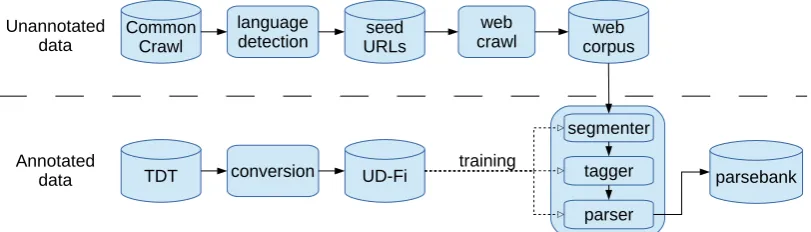
In the following, we present the primary process-ing stages for buildprocess-ing the parsebank, summarized in Figure 1, and the search system used to query the completed parsebank.
3.1 Dedicated web crawl
The currently existing non-UD Finnish Internet parsebank (Kanerva et al., 2014) is based on texts
2http://commoncrawl.org/ 3http://aws.amazon.com/
segmenter
tagger
parser language
detection Common
Crawl URLsseed
web
crawl corpusweb
conversion
TDT UD-Fi training parsebank
Unannotated data
[image:3.595.97.503.64.180.2]Annotated data
Figure 1: Processing stages. Seed URLs are first selected from Common Crawl data using language detection, and a web crawl is then performed using these seeds to identify an unannotated web corpus. To train the text segmentation, morphological tagging, and parsing stages of the analysis pipeline, UD Finnish data created by semiautomatic conversion of Turku Dependency Treebank is used. The final web parsebank is then created by applying the trained analysis pipeline on the unannotated web corpus.
extracted from the 2012 release of the Common Crawl dataset using the Compact Language Detec-tor.4 This 1.5 billion token corpus was assembled
from approximately 4 million URLs. However, as this dataset based solely on Common Crawl data fell somewhat short of our target corpus size, we expand it as part of this study with a dedicated crawl targeting Finnish.
To seed the crawl, we obtained all public do-mains registered in the Finnish top level domain (.fi) and extracted all the URLs from the cur-rent Common Crawl-based Finnish Internet parse-bank. This allows us to reach as wide a scope as possible, going beyond the Finnish top-level domain. Following the identification of the seed URLs, the final web corpus data used to build the parsebank was crawled using the open source web crawler SpiderLing (Suchomel and Pomik´alek, 2012). SpiderLing is designed for collecting unilingual text corpora from the web. During the crawl, the language of each downloaded page is recognized to maintain the language focus of the crawl. The language recognition, a built-in fea-ture of the crawler, is based on character trigrams. Similarly, the character encoding of the content is heuristically determined during the processing, and allows the content to be encoded into the stan-dard UTF-8 encoding when storing the data for further processing.
Supporting a focus on text-rich pages, Spider-Ling also keeps track of the text yield of each do-main, defined as the amount of text gathered from a domain divided by the amount of bytes down-loaded, and prioritizes domains from which can
4https://code.google.com/p/cld2/
be obtained more usable data in less time. The crawler also makes an effort to gather only text content from the web, avoiding downloading other content such as images, javascript, etc. Further, to extract clean text consisting of sentences, as op-posed to lists, menus and the like, the crawler auto-matically performs boilerplate removal, using the
justTextlibrary. The usable text detection is
based on various metrics such as the frequency of stop words in a given paragraph, link density, and the presence of HTML-tags. (Text deemed as boil-erplate is ignored when calculating the yield.)
The crawl was performed on a single server-grade Linux computer in a series of bursts between the summer and winter of 2014, taking approxi-mately 88 days. The crawl speed settings were kept very conservative to prevent causing false alarms to Internet security authorities. The text data from the old corpus will be merged in the corpus, but for now the result of this crawl is the source for all text in this version of the web corpus.
3.2 Text segmentation
For the segmentation of raw text into sentences and then further into tokens, we apply the machine-learning based sentence splitter and to-kenizer from the Apache OpenNLP toolkit5. Both
the sentence splitter and the tokenizer are retrain-able maximum entropy-based systems, and we trained new models for both based on the data from the UD Finnish corpus.
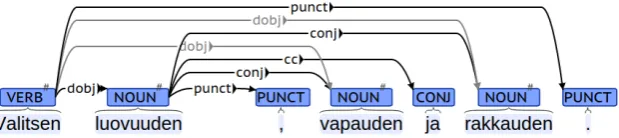
Figure 2: An example UD analysis of a Finnish sentenceValitsen luovuuden, vapauden ja rakkauden
“I choose creativity, freedom, and love.” Extended dependencies produced by propagating the object dependency into the coordinated constituents are shown in gray. Figure created usingBRAT(Stenetorp et al., 2012).
3.3 Morphological tagging
To assign the part-of-speech tags and the mor-phological features to words, we apply the Con-ditional Random Fields (CRF)-based tagger Mar-mot (Mueller et al., 2013), deriving lemmas and supplementing the feature set of the retrainable tagger with information derived from a pipeline combining the finite-state morphological analyzer OMorFi (Pirinen, 2011) with previously intro-duced heuristic rules for mapping its tags and fea-tures into UD (Pyysalo et al., 2015).
Our previous evaluation of the morphological analysis components on the UD Finnish data in-dicated that the best-performing combination of information derived from the finite-state analysis and the machine learning system allowed POS tags to be assigned with an accuracy of 97.0%, POS tags and the full feature representation with an accuracy of 94.0%, and the complete morpho-logical analysis, including the lemma, with an ac-curacy of 90.7% (Pyysalo et al., 2015). This level of performance represents the state of the art for the analysis for Finnish and is broadly compara-ble to the state-of-the-art results for these tasks in other languages.
3.4 Syntactic analysis
The dependency parsing is carried out using the graph-based parser of Bohnet et al. (2010) from the Mate tools package, trained on the UD Finnish data. The parser has previously been evaluated on the test section of the TDT corpus, achiev-ing 81.4% LAS (labeled attachment score). This approaches the best test score of 83.1% LAS re-ported in the study of Bohnet et al. (2013) using a parser that carries out tagging and dependency parsing jointly.6 However, at approximately 10ms
6Note that results are for the original SD annotation of the TDT corpus. While the UD Finnish treebank is created from
per sentence, the graph-based parser is an order of magnitude faster than the more accurate joint tagger and parser, which is a deciding factor when parsing billions of tokens of text. When re-training the graph-based parser on the UD scheme anno-tations, it achieved a LAS of 82.1% on the UD Finnish test set, showing that the parsing perfor-mance is not in any way degraded compared to that for the original SD scheme of the treebank.
In addition to the basiclayer of dependencies, which constitutes dependencies that form a tree structure, the parsing pipeline also predicts the UD Finnish extended layer dependencies, mod-eled after the conjunction propagation and exter-nal subject prediction in the origiexter-nal SD scheme (de Marneffe and Manning, 2008). This layer an-ticipates the introduction of such an extended layer into the UD scheme, which allows additional, non-tree dependencies in terms of its format but only presently provides guidelines for the basiclayer. The extended layer prediction is based on the method of Nyblom et al. (2013), originally devel-oped on the TDT corpus SD scheme, re-trained and adapted for the current study to conform to the UD scheme. An example parse with extended layer dependencies is shown in Figure 2.
3.5 Parsebank search
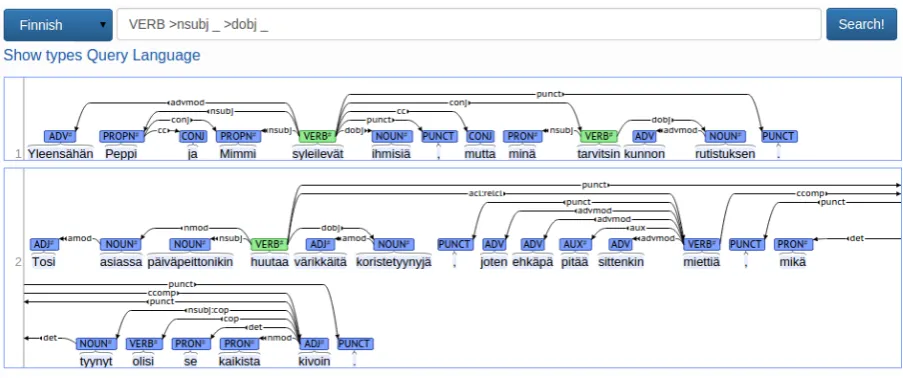
Figure 3: A screenshot of the online query interface, showing a simple query for transitive verbs.
and the extended layers of the analysis (Luotolahti et al., 2015). This detailed corpus search enables fast and easy retrieval of material for many linguis-tic questions that otherwise would require manual work to address.
The query system allows search for any arbi-trary subtree structure, including arbitrarily nested negations. For instance, one can search for verbs which have their subject in the partitive case, less that subject has a numeral modifier, and un-less the verb is governed by the clausal comple-ment relation. In addition to the constraints on the syntactic structure, any combination of normal and negated constraints on the morphology of the words is possible. The full description of the query system capabilities is, however, out of scope of this paper, and we refer the interested reader to the online documentation7. In addition to a scriptable,
command-line utility meant for gathering data for further processing, the query system also has an online interface which allows the results to be vi-sualized and inspected in real time (Figure 3).
In Section 5 we will demonstrate several real use-cases where this query system was used to ob-tain material for linguistic research from the parse-bank.
4 Results
We next briefly present the primary quantitative results of our study, the web corpus created as the result of our custom crawl, the performance char-acteristics of our newly trained parsing pipeline,
7http://bionlp.utu.fi/
searchexpressions-new.html
Item Number
All tokens 3,662,727,698
Lemma count 28,585,422
[image:5.595.309.508.294.394.2]Sentence count 275,690,022 Unique token count 39,688,642 Unique sentence count 178,547,962 Tokens without duplicates 2,554,094,599
Table 1: Web corpus statistics.
Item Number
All tokens 94,528,120
Lemma count 1,532,485
Sentence count 8,477,560 Unique token count 3,067,151 Unique sentence count 7,252,240 Tokens without duplicates 87,772,532
Table 2: News data statistics.
and some statistical characteristics of the web cor-pus. For reference, we contrast the web corpus to thenewssection of the Finnish Text Collection (Suomen kielen tekstikokoelma) corpus8, below
re-ferred to as the news corpus, as these news domain texts are a typical representative of a conventional corpus used for linguistic research.
4.1 Web crawl results
The web crawl retrieved in total 1.6 terabytes of HTML pages over the 88 days it was run. From this HTML data, 170 gigabytes of plain prose text was extracted, excluding markup and boilerplate content such as menus. This body of text still
tained a significant amount of duplication, which was eliminated on the document level in order to preserve the document context of the sentences in the parsebank. The deduplication process de-termined a document as a duplicate if more than 90% of its sentences were seen earlier during a sweep through the data. Following this dedupli-cation process, the resulting final web corpus is 33 gigabytes in size, i.e. only approximately 2% of the total data downloaded by the crawler. The basic statistics of the resulting corpus are given in Table 1, and corresponding statistics for the news corpus are presented in Table 2. We note that the web corpus is an order of magnitude or more larger that the extensive newswire corpus by any metric, most notably containing nearly 40 times the number of tokens of the conventional dataset.
4.2 Parsing accuracy and speed
The syntactic parsing pipeline has previously only been evaluated on the test set of the UD Finnish dataset, which closely reflects the distribution of the training data in terms of topics, genres and styles of writing. On this test set, the parser achieved 82.1% LAS on the basic UD dependen-cies. To evaluate how well the parser generalizes to out-of-domain web data, we selected a random 100 sentences from the parsebank and manually annotated them for UD syntax (both basic and ex-tended layers). In the process, we discarded two incomprehensible sentences, most likely produced by a machine translation system, for which it was not possible to arrive at a reasonable gold standard tree. We were then left with 98 sentences com-prising 1,191 tokens. On this sample, the LAS of the parsing pipeline is 78.1% when we take the extended layer into account (a token is counted as correct if it is correctly attached in both the sic and extended layers), and 78.8% for the ba-sic layer only. This about 3% point drop (from 82.1% to 78.8% LAS on UD basic layer) is quite acceptable considering that the parser has not been adapted to the general web text domain in any way. Dependency parsing errors of an earlier itera-tion of the same parsing-pipeline for Finnish using very related SD-scheme are analyzed in-depth by Haverinen et al.(2011).
The parsing was carried out on a cluster com-puter comprising thousands of compute nodes, and took approximately 8,000 CPU core hours (roughly one CPU-year), which due to the highly
parallel nature of the process was completed in a little over one day. While parsing is the most com-putationally demanding component of the overall process of creating the parsebank, it is thus not likely to be a bottleneck for real-time work in gen-eralizing to other languages, even if web corpora of an order of magnitude larger were considered.
4.3 Web corpus characteristics
In corpus linguistics, a standard method to provide an overview of corpus contents is offered by key-word analysis(Scott and Tribble, 2006). Describ-ing statistically the most typical words of the stud-ied corpus in relation to a reference one, keywords are typically informative on the corpus theme and style. Table 3 presents keywords extracted from the entire web corpus together with those for the news corpus used for reference. The keywords are calculated using the most significant text class fea-tures assigned to the two corpora by a linear clas-sifier trained to distinguish short segments of the two corpora.9 The classifier is trained using the
stochastic gradient method, with a 50/50 split on testing and training data, using labeled text seg-ments five sentences long.
The keywords presented are based on the 50 most significant tokens for the parsebank and 30 for the News corpus. Individual characters and fig-ures are excluded from the table. As can be seen from the number of keywords presented, this is al-ready revealing: numbers and individual charac-ters are clearly more frequent features in the parse-bank than in the news text. The actual keywords listed reflect the characteristic topics in the two corpora. The parsebank keywords include terms related to online stores, TV shows and social me-dia. In particular the emoticon is a typical exam-ple of computer-mediated text. The news corpora keywords, in contrast, are mainly composed of the names of Finnish towns, political parties and news agencies. An interesting detail is the apparition of the former Finnish currency (markka, used until 2001) on the list. This is explained by the fact that the new corpus dates from the 1990s; in the more recent Finnish Internet parsebank, this old form of currency is obviously referred to considerably less frequently.
Parsebank keywords
euroa, lue, sosiaali-, ;), vs, tuotantokausi, ty¨o, yms, 1990-luvun, eurolla, kommentit, kommenttia, tiivistelm¨a, voit, blogissa, blogi Parsebank keywords in English
euros, read, social-. ;), vs, season (as in TV shows), work, etc, of-the-1990s, with-a-euro, comments, a-comment, summary, you-can, in-a-blog. a-blog News Corpus keywords
karjalaisen, aamulehden, luvulla, kosovon, reuters, lieksan, tv, hhh, markalla, pohjois-karjalassa, ws, lehtikuva, n., demarin, pohjois-karjalan, joensuussa, joensuu, markan, joensuun, markkaa, demari, stt News Corpus keywords in English
[image:7.595.326.507.62.105.2]from-carelia (Finnish region), of-aamulehti (newspaper), with-the-figure, of-kosovo, reuters, of-lieksa (town), tv, hhh, with-a-mark, in-northern-carelia, ws, lehtikuva (Finland’s leading photo agency), about (abbreviation), of-a-social-democrat (colloquial), of-northern-carelia, in-joensuu (town), joensuu, of-mark, of-joensuu, marks, social-democrat (colloquial), stt (abbreviation of a Finnish media outlet)
Table 3: Keywords of the parsebank texts in com-parison with the news corpus.
5 Linguistic applications
We next illustrate the applicability of the web parsebank and the search system through three lin-guistically motivated applications based on real-world use-cases.
Web corpora with dependency syntax analyses can considerably speed-up the material collection in research of extremely rare phenomena, here ex-emplified by Finnish transitive sentences with a partitive subject (Huumo, 2015). Being unnor-mative, they cannot be easily found from edited or professionally written texts, which also makes web-crawled data a very convenient source for these constructions. In addition, gathering these examples from large corpora without the support of syntactic analyses would be extremely time-consuming. Unfortunately, the rarity of the con-struction also causes problems in the accuracy of their syntactic analysis. For instance, the parser training data does not have even a single exam-ple, and the parser thus tends to make errors in the analysis of this construction, often swapping the subject and the object of the verb (in Finnish, both the subject and the object can take the par-titive case). In practice, when listing a random sample of candidate occurrences for manual in-spection, the vast majority of these will be incor-rect. Nevertheless, even though correct instances are rare in the parsebank, the speed-up in gather-ing real examples is enormous, considergather-ing the
al-Query Results
koska“because” + no verb 22598
koska“because” + verb 505514
Table 4: Example queries and their results.
Conjunction Occurrences
ja“and” 738372
mutta“but” 533683
eli“or”, “in other words” 153180
tai“or” 110639
vaan“but” 9908
mut/ “but” (colloquial) 25057
[image:7.595.71.288.62.292.2]Total 1671041
Table 5: Sentence-initial conjunction frequencies.
ternatives. To illustrate this, we consider the verb
seurata“to follow” which is theoretized to be es-pecially susceptible for this use. In a sample of 4 million sentences, we find 7,875 transitive occur-rences of the verb, of which 111 have their subject in the partitive case, and of these 13 are correct. While this fraction is small, manually inspecting the roughly 100 occurrences took little effort and resulted in real examples being found from among a large number of occurrences of the verb.
Another example of a construction for which a web-based, syntactically analyzed corpus is very convenient is the new usage of the Finnish subor-dinating conjunctionkoska“because” (Sinnemaa, 2014; Rehn, 2014). Normatively, a subordinat-ing conjunction should be used in an subordinate clause with a finite verb, attached to the main clause, I ate because I was hungry. However, Finnish has recently seen a construction where the subordinate clause is left without the finite verb, but the conjunction is still present, in particular in informal language varieties:I ate because hungry. Since this construction is relatively infrequent, tra-ditional corpora without syntactic information can not be used to study the phenomenon. The syntac-tic analyses in the parsebank, however, enable the search for this exact construction. Table 4 shows the results of a search for koska “because” gov-erned by a verb and govgov-erned by a noun. As can be seen, although the normative usage with a verb is much more frequent, the search retrieves also a useful number of occurrences where the conjunc-tion is attached to a noun.
[image:7.595.323.513.137.248.2]be used to retrieve material to study phenomena crossing the limits of individual sentences, such as semantic relations between text elements and dis-course structure (Prasad et al., 2008; Laippala et al., 2015). As the search tool allows the restric-tion of the query to certain sentence elements, it can be delimited to sentence-initial elements, such as sentence-initial, individual conjunctions that in-stead of co-ordinating sentence-internal clauses or phrases refer to previous text elements and ex-press relations between sentences and the dis-course structure. This can provide useful informa-tion both on the frequency of different conjunc-tions used in this position and on discourse struc-ture more in general. The distribution of the most frequently used conjunctions in this functions is presented in Table 5. The results conform to ex-pectations, withandbeing the most frequent con-junction. The frequency of the colloquial form of
butalso illustrates the nature of the parsebank text.
6 Discussion
We have demonstrated the feasibility of creating a UD web parsebank at the scale of billions of words and making it searchable for complex syn-tactic patterns. However, our efforts in this study have a very obvious limitation, namely only in-volving a single language. To realize the full po-tential of web-scale parsebanks annotated using the cross-linguistically consistent UD scheme, this work must be extended to cover several languages, preferably at least the ten languages covered in the current, first release of UD data. We next briefly consider the technical requirements and computa-tional costs of this extension.
First, the parsing pipeline applied here should be largely straightforwardly applicable to cur-rently available UD languages. The core segmen-tation, morphological analysis, and dependency parsing components of the parser are all fully re-trainable, and each implemented using approaches that achieve levels of performance broadly compa-rable with the state of the art for their respective tasks in the ten UD release 1 languages. A mi-nor issue is the lack of finite-state morphological analyzers (comparable to OMorFi here) for many of the languages, but previous results suggest that the benefits of such a component may be modest for other UD languages, which are generally not as morphologically complex as Finnish (Bohnet et al., 2013). We anticipate that different strategies to
tokenization will eventually become necessary to generalize the approach to languages written us-ing systems that do not involve white-space token boundaries, such as Japanese and Chinese. How-ever, no such language is included in the initial set of UD languages.
Second, the language considered in this case study, Finnish, is comparatively rare on the web compared to most of the UD languages. This can be considered both a positive and a negative for generalization to other languages. On the positive side, it is much easier to create corpora of compa-rable size (billions of tokens) for languages such as English, French, German and Spanish. Indeed, Common Crawl data will suffice, removing the need to extend the data with a custom crawl. How-ever, it is considerably more challenging to create web corpora for such languages that would repre-sent a substantial fraction of the web in that lan-guage, and even if such a web corpus were avail-able, the computational cost of parsing it could become infeasible for the somewhat limited re-sources at our disposal. For these reasons, we will limit our near future efforts in creating the first set of universal web treebanks to similar scale as here for all considered languages (or smaller when not available for a language). We will also primarily rely on Common Crawl data, only performing ad-ditional crawls when this data fails to meet the tar-get size for a language.
As there are no components in the processing pipeline that would scale more than linearly in their computational cost with respect to the num-ber of sentences and we will not aim to substan-tially increase the size of any language-specific corpus over that created here, we expect the total computational cost of scaling from one language to ten to be simply an order of magnitude greater than that here. Thus, we estimate that the total computational cost of creating the first set of UD web parsebanks to be on the order of 100,000 CPU core hours. While this is a non-trivial cost, it is well within our resources.
7 Conclusions and future work
UD Finnish parsebank as a case study. Seeding a web crawl from Common Crawl data, we created the largest Finnish Internet language web corpus of over 3 billion tokens, trained a state-of-the-art dependency parser on the manual UD Finnish cor-pus annotation, and applied the trained parser to produce the first UD parsebank. We then demon-strated the application of the parsebank to linguis-tically motivated tasks by integrating it into a scal-able dependency corpus search system and sup-porting several real-world use cases focusing on the identification of relevant examples of rare phe-nomena.
In future work, we will extend this effort to cover all ten of the UD release 1.0 languages – Czech, English, Finnish, French, German, Hun-garian, Irish, Italian, Spanish, and Swedish – to create the first set of cross-linguistically consis-tently annotated web treebanks, which will be made freely available under open licenses.
Acknowledgments
This work was supported by the Kone Founda-tion and the Emil Aaltonen FoundaFounda-tion. Computa-tional resources were provided by CSC – IT Cen-ter for Science. Data from the Common Crawl foundation was used for web crawling.
References
Alekh Agarwal, Olivier Chapelle, Miroslav Dudi, and John Langford. 2014. A reliable effective terascale
linear learning system.JMLR, 15:1111–1133.
Eduard Bejˇcek, Jarmila Panevov´a, Jan Popelka, Pavel Straˇn´ak, Magda ˇSevˇc´ıkov´a, Jan ˇStˇep´anek, and Zdenˇek ˇZabokrtsk`y. 2012. Prague dependency tree-bank 2.5 – a revisited version of pdt 2.0. In Proceed-ings of the 24th International Conference on Com-putational Linguistics (Coling 2012), pages 231– 246.
Bernd Bohnet, Joakim Nivre, Igor Boguslavsky, Rich´ard Farkas, Filip Ginter, and Jan Hajiˇc. 2013. Joint morphological and syntactic analysis for richly inflected languages. Transactions of the Association for Computational Linguistics, 1:415–428.
Bernd Bohnet. 2010. Top accuracy and fast depen-dency parsing is not a contradiction. InProceedings of COLING’10, pages 89–97.
Thorsten Brants and Alex Franz. 2006. Web 1T 5-gram Version 1. Linguistic Data Consortium. LDC2006T13.
Marie-Catherine de Marneffe and Christopher D
Man-ning. 2008. Stanford typed dependencies
manual. Technical report, Stanford University.
http://nlp.stanford.edu/software/dependencies man-ual.pdf.
Marie-Catherine de Marneffe, Timothy Dozat, Na-talia Silveira, Katri Haverinen, Filip Ginter, Joakim Nivre, and Christopher D Manning. 2014. Univer-sal Stanford Dependencies: A cross-linguistic
ty-pology. In Proceedings of the 9th International
Conference on Language Resources and Evaluation (LREC), volume 14, pages 4585–4592.
Yoav Goldberg and Jon Orwant. 2013. A dataset of syntactic-ngrams over time from a very large
cor-pus of english books. In Second Joint Conference
on Lexical and Computational Semantics (*SEM), Volume 1: Proceedings of the Main Conference and the Shared Task: Semantic Textual Similarity, pages 241–247.
Katri Haverinen, Filip Ginter, Veronika Laippala, Samuel Kohonen, Timo Viljanen, Jenna Nyblom, and Tapio Salakoski. 2011. A dependency-based analysis of treebank annotation errors. In Proceed-ings of International Conference on Dependency Linguistics (Depling’11), Barcelona, Spain, pages 115–124.
Katri Haverinen, Jenna Nyblom, Timo Viljanen, Veronika Laippala, Samuel Kohonen, Anna Missil¨a, Stina Ojala, Tapio Salakoski, and Filip Ginter. 2014. Building the essential resources for Finnish: the
Turku Dependency Treebank. Language Resources
and Evaluation, 48(3):493–531.
Tuomas Huumo. 2015. The partitive A: On uses of the Finnish partitive subject in transitive clauses. In Di-achronic typology of differential argument marking.
Jenna Kanerva, Juhani Luotolahti, Veronika Laippala, and Filip Ginter. 2014. Syntactic n-gram collec-tion from a large-scale corpus of internet finnish. In
Proceedings of the Sixth International Conference Baltic HLT, pages 184–191.
Adam Kilgarriff and Gregory Grefenstette. 2003. In-troduction to the special issue on the web as corpus.
Computational linguistics, 29(3):333–347.
Veronika Laippala, Jenna Kanerva, Anna Missil¨a, Ka-tri Haverinen, Tapio Salakoski, and Filip Ginter. 2015. Towards a discourse-annotated corpus of
finnish: the finnish propbank. In Poster presented
at the TextLink Cost Action seminar, Louvain-la-Neuve, Belgium, 27.1.2015.
Teresa Lynn, Jennifer Foster, Mark Dras, and Lamia Tounsi. 2014. Cross-lingual transfer parsing for low-resourced languages: An Irish case study. In
Proceedings of the First Celtic Language Technol-ogy Workshop, pages 41–49.
Ryan McDonald, Joakim Nivre, Yvonne Quirmbach-Brundage, Yoav Goldberg, Dipanjan Das, Kuz-man Ganchev, Keith Hall, Slav Petrov, Hao Zhang, Oscar T¨ackstr¨om, Claudia Bedini, N´uria Bertomeu Castell´o, and Jungmee Lee. 2013. Uni-versal dependency annotation for multilingual
pars-ing. In Proceedings of the 51st Annual Meeting
of the Association for Computational Linguistics (ACL), pages 92–97.
Thomas Mueller, Helmut Schmid, and Hinrich Sch¨utze. 2013. Efficient higher-order CRFs for
morphological tagging. InProceedings of the 2013
Conference on Empirical Methods in Natural Lan-guage Processing, pages 322–332.
Joakim Nivre, Cristina Bosco, Jinho Choi, Marie-Catherine de Marneffe, Timothy Dozat, Rich´ard Farkas, Jennifer Foster, Filip Ginter, Yoav Gold-berg, Jan Hajiˇc, Jenna Kanerva, Veronika Laip-pala, Alessandro Lenci, Teresa Lynn, Christopher Manning, Ryan McDonald, Anna Missil¨a, Simon-etta Montemagni, Slav Petrov, Sampo Pyysalo, Natalia Silveira, Maria Simi, Aaron Smith, Reut Tsarfaty, Veronika Vincze, and Daniel Zeman.
2015. Universal dependencies 1.0. Available:
http://hdl.handle.net/11234/1-1464.
Joakim Nivre. 2015. Towards a universal grammar
for natural language processing. InComputational
Linguistics and Intelligent Text Processing, pages 3– 16. Springer.
Jenna Nyblom, Samuel Kohonen, Katri Haverinen, Tapio Salakoski, and Filip Ginter. 2013. Pre-dicting conjunct propagation and other extended
stanford dependencies. In Proceedings of the
In-ternational Conference on Dependency Linguistics (Depling 2013), pages 252–261.
Slav Petrov, Dipanjan Das, and Ryan McDonald. 2012. A universal part-of-speech tagset. InProceedings of the Eight International Conference on Language Re-sources and Evaluation (LREC), pages 2089–2096.
Tommi A Pirinen. 2011. Modularisation of Finnish finite-state language description–towards wide col-laboration in open source development of a morpho-logical analyser. InProceedings of the 18th Nordic Conference of Computational Linguistics (NODAL-IDA), pages 299–302.
Rashmi Prasad, Nikhil Dinesh, Alan Lee, Eleni Milt-sakaki, Livio Robaldo, Aravind Joshi, and Bonnie Webber. 2008. The Penn Discourse TreeBank 2.0. InProceedings of the Sixth International Conference on Language Resources and Evaluation (LREC’08). http://www.lrec-conf.org/proceedings/lrec2008/.
Sampo Pyysalo, Jenna Kanerva, Anna Missil¨a, Veronika Laippala, and Filip Ginter. 2015. Univer-sal Dependencies for Finnish. InProceedings of the 20th Nordic Conference of Computational Linguis-tics (Nodalida 2015), pages 163–173.
Anneliise Rehn. 2014. Because meaning: Language change through iconicity in internet speak. In2014 SURF Conference Proceedings.
Mike Scott and Christopher Tribble. 2006. Textual
patterns: key words and corpus analysis in language education. John Benjamins.
Tiina Sinnemaa. 2014. Ei saa ronkkia ruokaa, koska afrikan lapset! koska np-rakenteen merkityksest ja ilmaisuvoimasta / you should not play with your food because [of] the children in africa! on the sig-nificance and expressivity of the construction ’be-cause np’. Bachelor’s thesis, Department of Finnish, University of Turku.
Pontus Stenetorp, Sampo Pyysalo, Goran Topi´c, Tomoko Ohta, Sophia Ananiadou, and Jun’ichi Tsu-jii. 2012. Brat: a web-based tool for nlp-assisted
text annotation. InProceedings of the
Demonstra-tions at the 13th Conference of the European Chap-ter of the Association for Computational Linguistics, pages 102–107.
V´ıt Suchomel and Jan Pomik´alek. 2012. Efficient web
crawling for large text corpora. InProceedings of
the seventh Web as Corpus Workshop (WAC7), pages 39–43.
Andy Way and Nano Gough. 2003. webmt: develop-ing and validatdevelop-ing an example-based machine
trans-lation system using the world wide web.
Computa-tional Linguistics, 29(3):421–457.