Proceedings of The 9th International Natural Language Generation conference, pages 222–226,
Towards proper name generation: A corpus analysis
Thiago Castro Ferreira and Sander Wubben and Emiel Krahmer Tilburg center for Cognition and Communication (TiCC)
Tilburg University The Netherlands
{tcastrof,s.wubben,e.j.krahmer}@tilburguniversity.edu
Abstract
We introduce a corpus for the study of proper name generation. The corpus consists of proper name references to people in web-pages, extracted from the Wikilinks corpus. In our analyses, we aim to identify the different ways, in terms of length and form, in which a proper names are produced throughout a text.
1 Introduction
In natural language generation systems, referring ex-pression generation (REG) is the process of produc-ing references to discourse entities. Among the ref-erential forms which can be used to distinguish an entity, proper names are an important and commonly used one. For instance, Ferreira et al. (2016) showed that writers produce a proper name as a first mention to an entity in 91% of the analysed texts.
In generation systems, not only the choice of whether a proper name should be generated is im-portant, but also whichformthe proper name should take. For instance,Barack Hussein Obama II is the birth name of the 44th president of United States of America. However, he is also commonly referred to as Barack Obama, Obama, President Obama, etc. How to automatically decide which form to use?
In this paper, we introduce a new corpus of 53,102 proper names referring to people in 15,241 texts1.
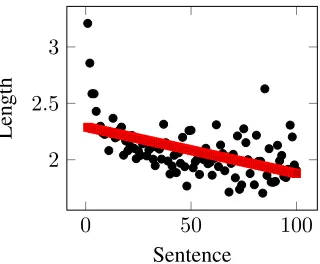
We analyse the corpus in terms of distribution of proper name lengths, intuitively expecting an in-versely proportional relation between length of a
1https://ilk.uvt.nl/˜tcastrof/regnames
name and sentence number in a text. We also anal-yse these references in terms of the presence of the first, middle and last name of the entity; and whether the reference is accompanied by a title or an apposi-tive.
2 Related Studies
Unlike the generation of descriptions (Krahmer and van Deemter, 2012), only a few studies have fo-cussed on the automatic generation of proper names. Reiter and Dale (2000) suggests the use of a full proper name for initial reference, optionally fol-lowed by an appositive to indicate properties of the entity important for the discourse. However, their approach does not account for variation in proper name references.
Van Deemter (2014) argues that proper name vari-ants can be generated using standard algorithms for the generation of descriptions. In other words, van Deemter (2014) proposes describing proper names based on a knowledge base of attribute-value pairs. Just like a set of attribute-attribute-value pairs {(type, cube),(color, blue)}is generated when the target needs to be singled out from differently coloured objects, a proper name like Frida Kahlo
can be seen to single out one person from a con-text set. When the set is smaller, generally a shorter name will suffice. Van Deemter, however, does not apply this model in the context of text generation.
to use pre- (role, affiliation and temporal modifiers) or post-modifiers (appositives and relative clauses). As far as we know, this is the only study that in-troduced a corpus analysis of how humans produce proper names in a discourse. However, it only dis-tinguished proper names among full names and sur-names in a small set of 876 news texts.
3 Data Gathering 3.1 Materials
To analyse how proper names are used in text, we analysed webpages from the Wikilinks corpus (Singh et al., 2012). This corpus was originally cre-ated to study cross-document coreference and com-prises around 40 million mentions to 3 million enti-ties. All the mentions were extracted automatically by finding hyperlinks to Wikipedia pages related to the entities.
To collect our data, we identified the 1,000 most frequently mentioned people in the corpus. To de-termine which entities are persons, we used DBpe-dia, a database that provides structured information from Wikipedia (Bizer et al., 2009). From the Wik-ilinks corpus, we then randomly chose a subset of webpages that contain at least one mention to one of the most frequently mentioned persons. In total, our corpus contains texts from 15,241 webpages. 3.2 Annotation
To annotate the proper name references, we created a knowledge base which describes all variations of a proper name for the studied persons. We also parsed the webpages to identify in which part of the discourse the different proper name references were used. The annotation procedure is explained in more detail below.
Proper Names Knowledge Base We used two ontologies present on DBpedia to extract differ-ent proper names for the studied differ-entities. The FOAF (Friend-of-a-Friend) ontology was used to extract the name (foaf:name), the given name (foaf:givenName) and the surname (foaf:surname) of a person. From the DBpedia ontology, we extracted the birth name of the entities (dbo:birthName).
Based on the proper names collected in DBpe-dia, we created a knowledge base by identifying 3
proper name attributes: first name, middle name andlast name. First names consist of the first to-ken from the name, given name and birth name, whereas last names consist of the token from the sur-name and the last tokens from the sur-name and birth name. Middle names are all the tokens which are not the first token in the given and birth names and last token in the name and birth name. For instance,
Charles Bukowski hasCharles, Bukowski, Charles BukowskiandHeinrich Karl Bukowskias his given name, surname, name and birth name in DBpedia, respectively. Based on this information, the knowl-edge base for this entity would consist of Charles
andHeinrichas first names; Karlas middle name; andBukowskias last name.
Discourse Annotation The webpages were parsed using the Stanford CoreNLP software (Man-ning et al., 2014). Using this tool, we performed part-of-speech tagging, lemmatization, named entity recognition, dependency parsing, syntactic parsing, sentiment analysis and coreference resolution.
To improve the coreference resolution we per-formed a post hoc sanity check, to see whether ref-erences which were labelled as being to the same entity were correct. For each entity distinguished by the software, we checked the proper nouns of each proper name reference. If at least the proper nouns of one proper name were values present in the knowledge base of the target entity, all the ref-erences of the entity distinguished by the software were considered references to the target entity.
Once the references to the target entity were dis-tinguished, we annotated their syntactic positions based on the output of the dependency parser and their referential statuses in the text and in the sen-tence - whether a reference is a first or an old men-tion to an entity. We also checked for the presence of a title or an appositive in the proper name ref-erences. These features were extracted based on the named entity recognition and dependency parser, re-spectively. In total, 53,102 proper name references were annotated in this way (an average of 3 per text).
3.3 Analyses
anal-0 50 100 2
2.5 3
Sentence
[image:3.612.108.268.69.201.2]Length
Figure 1: Average length of the proper names in to-kens by sentence.
Title 2.4%
First Name 59.3% Middle Name 7.1% Last Name 89% Appositive 1.7%
Table 1: Percentage of the proper name attributes
ysed the possible variations of a proper name by checking the presence of the first, middle and last name of the entity, and whether the proper name was accompanied by a title or an appositive.
4 Results
Figure 1 depicts the average length of proper name references in the first 100 sentences of the texts. A linear regression clearly shows that the length of a proper name decreases along the text, as predicted. Table 1 summarized the percentage of proper name attributes. It reveals that the last name is the most used one, followed by first name. The others occur less frequently.
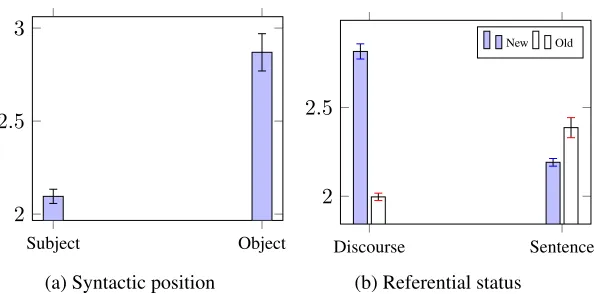
Figure 2 shows the average length of proper name references as a function of syntactic position and ref-erential status. Proper names in the object role of a sentence are generally longer than those in subject position (a); proper names that are new in the text are longer than those that have been mentioned in the text before, and vice versa when looking at new/old references per sentence (b).
Table 2 depicts frequency of various attribute sets, as a function of syntactic position and referential sta-tus in the text and sentence. Proper names consist-ing of both first and last name are the most common in the corpus. This proper name form is the most
common one in the subject role of a sentence and as a mention to a new entity in the discourse. On the other hand, in the object role of a sentence and as mention to an old entity in the text, the use of only the last name is most common.
In general, proper names described by the first and last names, and by the first, middle and last names occur more often in the subject role of a sentence as a mention to a new entity in the text. The com-bination of first and last names is also more likely as a mention to old entities in the sentence. Proper names described by just one proper name attribute reveal the opposite behaviour, occurring more in the object role of a sentence as a mention to an old entity in the text or new in the sentence.
5 Discussion
This study introduced a corpus for the study of proper name generation. We analysed the different forms in which proper name references occur in text by checking their length as well as the occurrence of different proper name attributes including the first, middle, last names of the mentioned entity, as well as possible modifiers, such as titles or appositives.
Analyses revealed that longer proper names - in terms of number of tokens and proper name at-tributes - are more likely to be generated early in the text, in the object role of a sentence, and as the reference to a new entity in the text or an old in the sentence. Concerning referential status in text, our results are broadly in line with Siddharthan et al. (2011), which shows that a new entity in the text is more likely to be referred to the full name, whereas only the surname is used for an old entity. Concern-ing referential status in the sentence, the fact that a proper name reference to an old entity in the text is more likely to be longer than one to a new entity was somewhat unexpected, since some referential theo-ries argue that a reference to previously mentioned entities tend to be shorter (Chafe, 1994). A possible explanation could be the presence of cataphora, as inUnlikehispeers,Harold Campingdoes not pack a positive punch.
Subject Object
2 2.5 3
(a) Syntactic position
Discourse Sentence
2 2.5
New Old
[image:4.612.164.461.68.215.2](b) Referential status
Figure 2: Average length of the proper names as a function of: (2a) syntactic position and (2b) referential status. Error bars represent 95% confidence intervals.
Syntax Text Sentence General
Subject Object New Old New Old
First+Last 57.41% 38.74% 69.52% 36.53% 44.19% 57.16% 46.2%
Last 24.45% 37.17% 10.60% 44.26% 35.93% 26.61% 34.9%
First 6.15% 11.98% 4.33% 10.12% 8.58% 7.78% 8.5%
Middle+Last 3.39% 3.38% 4.62% 2.02% 2.91% 1.76% 2.8%
First+Middle+Last 2.92% 2.79% 4.72% 1.36% 2.44% 1.53% 2.3%
Middle 1.06% 1.88% 0.78% 1.74% 1.57% 0.80% 1.5%
Others 4.62% 4.06% 5.43% 3.97% 4.38% 4.36% 3.8%
Table 2: Percentage of the attribute sets in the proper name references
a text, this model should be able to address the proper name preferences for each entity. For in-stance, it should account that Winston Churchill
is typically mentioned by his surname (Churchill), whereas Napoleon Bonaparte is by his first name (Napoleon). We will address this by training in-dividual models combining the a priori probability of a particular proper name for a particular individ-ual with contextindivid-ual factors. Additionally, we plan to annotate the proper name references to all the enti-ties present in the texts of our corpus, and not only the references to the 1,000 people studied here. We think this expansion will give a broader view of the generation of proper names, since we will be able to study the process as a function of other discourse conditions, as topicality.
Acknowledgments
This work has been supported by the National Coun-cil of Scientific and Technological Development from Brazil (CNPq).
References
Christian Bizer, Jens Lehmann, Georgi Kobilarov, Sren Auer, Christian Becker, Richard Cyganiak, and Sebas-tian Hellmann. 2009. Dbpedia - a crystallization point for the web of data.Web Semantics: Science, Services and Agents on the World Wide Web, 7(3):154 – 165. The Web of Data.
Wallace L. Chafe. 1994. Discourse, Consciousness, and Time: The Flow and Displacement of Conscious Expe-rience in Speaking and Writing. University of Chicago Press.
Thiago Castro Ferreira, Emiel Krahmer, and Sander Wubben. 2016. Individual variation in the choice of referential form. InProceedings of the 2016 Confer-ence of the North American Chapter of the Associa-tion for ComputaAssocia-tional Linguistics: Human Language Technologies, San Diego, California. Association for Computational Linguistics.
Emiel Krahmer and Kees van Deemter. 2012. Compu-tational generation of referring expressions: A survey. Comput. Linguist., 38(1):173–218, March.
Ehud Reiter and Robert Dale. 2000. Building natural language generation systems. Cambridge University Press, New York, NY, USA.
Advaith Siddharthan, Ani Nenkova, and Kathleen McK-eown. 2011. Information status distinctions and re-ferring expressions: An empirical study of references to people in news summaries.Computational Linguis-tics, 37(4):811–842.
Sameer Singh, Amarnag Subramanya, Fernando Pereira, and Andrew McCallum. 2012. Wikilinks: A large-scale cross-document coreference corpus labeled via links to Wikipedia. Technical Report UM-CS-2012-015.