National Intelligence, Basic Human
Needs, and Their Effect on Economic
Growth
Burhan, Nik Ahmad Sufian and Mohamad, Mohd Rosli and
Kurniawan, Yohan and Sidek, Abdul Halim
Department of Human Sciences, Centre for Language Studies and
Generic Development, Universiti Malaysia Kelantan, Faculty of
Entrepreneurship and Business, Universiti Malaysia Kelantan
2014
Online at
https://mpra.ub.uni-muenchen.de/77267/
National Intelligence, Basic Human Needs, and Their Effect on
Economic Growth
Nik Ahmad Sufian Burhan a,*, Mohd Rosli Mohamad b, Yohan Kurniawan a, Abdul
Halim Sidek b
a Department of Human Sciences, Centre for Language Studies and Generic Development, Universiti Malaysia Kelantan, PO. Box 36, Pengkalan Chepa, 16100 Kota Bharu, Kelantan, Malaysia
b Faculty of Entrepreneurship and Business,Universiti Malaysia Kelantan, P.O. Box 36, Pengkalan Chepa, 16100 Kota Bharu, Malaysia
* Corresponding author. Tel.: +60194601530
E-mail addresses: [email protected] (Nik Ahmad Sufian Burhan)
Abstract
Self-actualization theory suggests that all individuals hold potential, and they can focus their
motivations on actualizing this potential only if all basic and psychological needs are
satisfied. Contemporary economic literature has reported that national average intelligence
(IQ) is the most robust measure of human capital in raising economic productivity across
countries. Treating national IQ as an intrinsic potential of society, our study examined the
role of basic and psychological needs (i.e., life expectancy, life satisfaction, and political
stability) in moderating the impact of national IQ on economic growth among 118 countries
from 1970 to 2010. Hierarchical multiple regression indicates that the independent effects of
national IQ, life expectancy, political stability, and life satisfaction on economic growth rate
were significantly positive. Furthermore, life satisfaction was significantly negative in
moderating the effect of national IQ on growth, while the other two factors were
non-significant moderators. Therefore, we suggest that increased life satisfaction reduces desire
for better performance, thereby diminishing the effect of IQ on economic growth. This finding is in accordance with the predictions of Maslow’s hierarchy of needs.
Keywords: Basic needs, economic growth, intelligence, motivation, self-actualization.
1. Introduction
Intelligence (IQ) is a potentially powerful mechanism that drives humans towards
economic well-being. Previous studies have found positive effects of national average IQ on
various economic outcomes. National IQ predicts the level of GDP per capita (Lynn &
Vanhanen, 2002, 2006; Zajenkowski, Stolarski, & Meisenberg, 2013), GDP per capita
growth (Jones & Schneider, 2006; Meisenberg, 2012; Weede & Kämpf, 2002) and
technological progress (Gelade, 2008; Lynn, 2012) across countries, where scientific
technological achievements represent the path through which the impact of IQ on economic
growth is channeled (Rindermann, 2012; Rindermann & Thompson, 2011). Moreover,
national IQ is significantly more robust than other existing education and health indicators,
(e.g., school enrolment ratios, life expectancy, literacy rates, and number of years of
schooling) in determining productivity growth at a cross-country level (e.g., Jones &
Schneider, 2006; Ram, 2007; Weede & Kämpf, 2002). Schools should ideally be institutions
that cultivate critical thinking and social reformation; however, they often diffuse traditional
values of a society, which inadvertently discourage critical thinking. Alternatively, IQ is
strongly associated with critical thinking, which is an essential determinant of national wealth
and a modern, non-traditional worldview (Meisenberg, 2004).
An editorial declaration by 52 psychologists defines intelligence as a very general
mental capability that involves the ability to reason, plan, solve problems, think abstractly,
comprehend complex ideas, learn quickly, learn from experience, etc. Intelligence is not
defined by narrow academic skills such as book learning or test-taking ability. Rather, it
reflects a broader and deeper capability for comprehending our surroundings—―catching on,‖ ―making sense‖ of things, or ―figuring out‖ what to do (Gottfredson, 1997). Wechsler (1944, p. 3) defined intelligence as ―the aggregate or global capacity of the individual to act
purposefully, to think rationally, and to deal effectively with his environment.‖ Representing
the capability of a nation, national IQ is essential for people to self-actualize and be
successful within their competitive economies. Goldstein (1947) described self-actualization as the affinity to actualize, as fully as possible, one’s individual capacities within his living world. The affinity for self-actualization is the solitary drive by which the future outcome of
an individual is shaped. The drive that regulates an individual organism’s function is nothing
but the motivation that arises from its affinity to actualize itself as much as possible in
and optimal functioning is an active progression of a human being towards becoming
increasingly inwardly directed and well balanced in thought, emotion, and bodily reaction.
This cannot be perceived as a goal, but as a progression towards growth, development, and
the unfolding of human potential (Shostrom, 1976).
In relation to productivity, the economic actor has two basic goals: to maximize
material wealth and minimize effort (Beaudreau, 2012). Human motivation, which is oriented
by achievement, plays a major role within national economic performance, which is in turn a
more significant factor than the collective effects of institutional quality and education
quantity (Maridal, 2013). Therefore, the efficiency of skilled laborers will be limited if they
are not motivated to perform their jobs (Delaney & Huselid, 1996). Consequently, economic
growth rates will not improve when needs are met, as individuals become less motivated than
when their most important needs remained unfulfilled (Marini, 2004).
Based on self-actualization theory, our study investigated motivational factors that regulate individuals’ optimal function on their life performance. Next, applying this theory at the cross-national level, we examined how these motivational factors regulate
self-actualization of human capital potential (i.e., moderation of the effect of national IQ on
economic growth). Thus, we investigated empirically whether self-actualization theory could
partly explain the inequality of economic achievement across countries.
2. Self-actualization and Maslow’s hierarchy of needs
Self-actualization as a concept was first reported in Abraham Maslow's hierarchy of
needs. It represents the final stage of psychological development that can be realized when all
basic and psychological needs are satisfied. Only then can the actualization of one’s full
potential occur (Maslow, 1943). According to Maslow, as humans meet their basic needs,
they seek to fulfill, in sequence, higher needs that reside within a set hierarchy. Maslow's
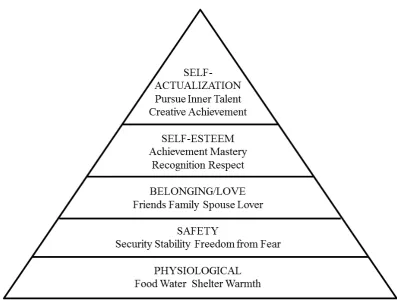
hierarchy of needs is often illustrated in the shape of a pyramid, with the principle and most
Figure 1. Maslow's hierarchy of human basic and psychological needs (Maslow, 1970).
The most essential and fundamental four layers of the hierarchy consist of what
Maslow called deficiency needs: esteem, friendship and love, security, and physical needs. If
these deficiency needs are not achieved, individuals experience anxiety and stress. Maslow's
theory proposes that the most fundamental level of needs must be attained before individuals
can focus their motivations on the secondary, high-level needs. Individuals can ultimately
achieve self-actualization at the summit of the hierarchy (Gleitman, Fridlund, & Reisberg,
2004).
Maslow defined self-actualization as the need for self-fulfillment, that is, for the
individual to actualize his/her potential. It is the desire to become to greater than what one
currently is, to develop into the whole entity that one is capable of becoming. Maslow applied
this phrase to describe it as a desire, rather than a driving force, which could culminate in
realizing one's potentials. Unlike Goldstein, Maslow did not believe that self-actualization
determines one's life. Instead, he believed that self-actualization bestows upon a specific
portrayed self-actualization as the full realization of individual potential (Gleitman et al.,
2004).
In contrast, Goldstein’s definition of self-actualization can be understood as a basic drive, rather than a goal to be accomplished at some point in the future. The organism has the
essential tendency to actualize all its capacities cumulatively toward its full potential.
Self-actualization theories suggest that, in any given circumstances, we seek to maximize the use
of all of our capacities in all of our actions to stimulate the best performance at that particular
condition and time. To simplify, two men with the same actual capacities will present two
different degrees of performance in two different conditions. For instance, if we consider two
groups of men with the same cognitive ability and the same job, the first group will be more
motivated to perform well in their job, and thereby contribute more to their firm because their
stomachs are full and they are consistently healthy and happy. On the other hand, the second
group might be demotivated to perform effectively, thereby contributing less to their firm, as
they are hungry, sick, and unhappy. Our freedom from emotional sickness is the first factor
toward expansion and fulfillment of health (Schultz, 1977). Thus, higher capacities will not
necessarily result in higher productivity if needs are left unmet.
Human potential supporters propose that considerable human progress has occurred
and that it is essential for society to continue to strive toward this desired, exceptional level of progress, and in turn actualize society’s innate potential (Schultz, 1977). Rogers (1959, 1975) also elaborated on self-actualization as an innate drive towards achieving one’s potential, parallel to Maslow (1971, 1998). Nevertheless, as opposed to Maslow’s ―self-actualization,‖ Rogers favors the process as continuous, and thus prefers, like Goldstein, the term ―self -actualizing.‖ These scholars, however, consistently perceive self-actualization as a growth process incorporating the same class of qualities (Reber, 1995).
3. Aims
In accordance with self-actualization theory, it cannot be assumed that, at a macro
potential because much of the world is deficient in the satisfaction of basic needs.1 Following
our literature review, we conceptualized national IQ as a human capacity for problem
solving, reasoning, and success within competitive economies. Thus, our study adopted this
idea with the assumption that national IQ can produce diverse effects on cross-country
economic growth when moderated by adequate satisfaction of basic and psychological needs.
This study did not seek to determine which basic needs are most important, as this has been
continually discussed by Maslow within the context of his hierarchy. Instead, we endeavored
to employ self-actualization theory to examine whether any deficit (or surplus) of basic and
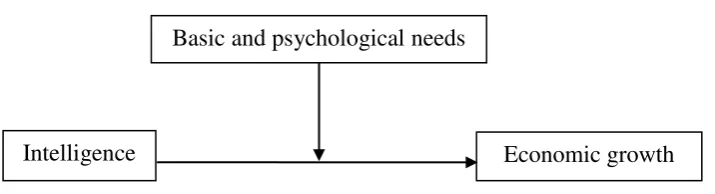
psychological needs will impede (or facilitate) the effect of national IQ on economic growth
[image:7.595.129.487.314.411.2]across countries, as illustrated in Figure 2.
Figure 2. The possible role of basic and psychological needs in moderating the impact of national intelligence potential on economic growth rates.
4. Methodology
To examine the role of basic needs in moderating the impact of IQ on economic
growth, we used a standard economic model as follows:
where the dependent variable is GROWTH, which denotes the average growth rate of real GDP per capita over the 1970–2010 period. Y1970 and IGDP are two control variables, initial
1 The disparity in degrees of human development has categorized our world into two major groups: developed and developing countries. A
developed nation is one in which all of its civilians experience a free and healthy life in a safe environment. A developing nation is one in
which citizens are incapable of maintaining material well-being and experiencing standards of civil liberties and environmental protection
(UNCTAD, 2000).
Intelligence Economic growth
GDP per capita in 1970 and the investment as a percentage of annual GDP averaged over the
years 1970–2010, respectively. These two control variables are universally employed in most
standard growth models worldwide (e.g., Mankiw, Romer, & Weil, 1992; Minier, 2007; Ram,
2007). Data on GROWTH and Y1970 were obtained from Penn World Table 7.1 (Heston,
Summers, & Aten, 2012), while the data on IGDP were obtained from the World
Development Indicators (WDI) from the World Bank (2013a) database. IQ is the national
average IQ for specific country i and was obtained from Meisenberg and Lynn (2011).
Additionally, we include X, which is a set of basic and psychological needs hypothesized to
moderate growth through the impact of IQ on GROWTH. Finally, ei is an error term. The
new idea in this study is the interaction, where we hypothesized that the association between
IQ and GROWTH would be affected by each value of X. To model for this interaction, we
follow Dawson (2014) and Zajenkowski et al. (2013) to construct an interaction term
that is the cross product of the two predictor variables, and place this interaction term into the
multiple regression along with the original predictors to determine the significance of the
interaction slope.
Drawing inspiration from Maslow’s hierarchy of needs, we suggest a set of three X’s representing the stages of basic and psychological needs, where each is included separately in
our estimation model.
Life expectancy (HEALTH)
The first stage of Maslow’s hierarchy of needs demonstrates the need to satisfy physiological needs and health for ideal human functioning. In the current study, we employ
life expectancy (at birth, total years) to represent the level of health in the populations that
would affect the full functioning of IQ on economic growth. Data were obtained from the
World Bank (2013a) database. Health is a core component that allows us to fully actualize
our capacities. Health decline causes physical and emotional deterioration and is a hindrance
to normal human activity. Healthy individuals are more competent at assimilating knowledge
and skills, and therefore, they are more productive (Knowles & Owen, 1995). Grossman
(1972) perceives health as a long-lasting capital stock that creates an output of healthy time.
The allocation of healthy time is divided between leisure and work. Adding poor health to
this equation will limit the amount of healthy time allocated to generating income. Because
laborers are not working to their potential, the loss of productivity occurs when they come to
productive since they maintain greater physical and mental readiness and engage in a
sufficient amount of work, which leads to higher per capita income (Bloom & Canning,
2000). Furthermore, to our knowledge, most studies found a significant role of health in
raising productivity at a micro level and, therefore, economic growth at a macro level (e.g.,
Bloom, Canning, & Sevilla, 2004; Cole & Neumayer, 2006; Knowles & Owen, 1995, 1997).
Political stability and absence of violence or terrorism (PEACE)
Based on the second stage of Maslow’s hierarchy of needs, we hypothesized that safety and security of individuals, peace of surroundings, and freedom from fear would also
play an important role in moderating the effect of human potential on economic growth. To
investigate the safety and peace of nations, we utilized data on political stability and the
absence of violence and terrorism. The data were obtained from the Worldwide Governance
Indicators 2013 (World Bank, 2013b) database, in which higher values indicate greater
political stability and absence of violence and terrorism. Haggard and Tiede (2010) reported
that political violence is an essential barrier to the growth process. Violent conflict and
political war within societies will have a negative impact on human motivation and,
consequently, on economic growth. Economic studies have corroborated this suggestion.
Political violence is associated with lower national productivity (e.g., Collier, Hoeffler, &
Rohner, 2009; Kang & Meernik, 2005). The economic, political, and social consequences of
this instability are substantial. Instability compromises social structure, destroys capital and
infrastructure, interrupts schooling, jeopardizes civil liberties, and impairs the quality and
functioning of institutions (Acemoglu, Johnson, & Robinson, 2005; Blattman & Annan,
2010; Collette & Cullen, 2000). Thus, when civil wars end, there is a considerable
revitalization in economic performance, education, health, and political development
(Brakman, Garretson, & Schramm, 2004; Chen, Loayza, & Reynal-Querol, 2008; Davis &
Weinstein, 2002; Justino & Verwimp, 2006; Miguel & Roland, 2011).
Satisfaction with Life Index (SWL)
We investigated the impact of human capacity on growth when a national population
has achieved distinct levels of life satisfaction or happiness. The SWL is a subjective
value-based survey and data were obtained from White (2007). Data were collected from
large-scale standardized national surveys asking people about how happy they are, the extent to
goals. Data, which were analyzed by White (2007), were published by the Afrobarometer,
CIA, Latinbarometer, New Economics Foundation (NEF), United Nations Educational,
Scientific and Cultural Organization (UNESCO), United Nations Human Development
Report (UNHDR), Veenhoven Database, and the World Health Organization (WHO) to establish ―a global projection of subjective well-being: the first world map of happiness.‖ Participants in several studies were asked questions concerning their happiness and life satisfaction. White’s (2007) meta-analysis was centered on discoveries from more than 100 different studies worldwide with a total sample of about 80,000 individuals (University of
Leicester, 2006).2
The validity of the SWL has been intensely discussed and verified by Kahneman and
Krueger (2006) as well as by Wallace and Wheeler (2002). Life satisfaction implies
contentment with or acceptance of life circumstances, or the fulfillment of wants and needs
for life as a whole (Kashdan, 2004; Sousa & Lyubomirsky, 2001). Wilson (1967) and
Chekola (1975) suggested that unfulfilled needs facilitate unhappiness, but fulfillment of
needs will facilitate happiness. The life satisfaction index not only asks how people feel, but
also their level of social and economic development. This measure of subjective well-being is
therefore a kind of motivation variable as it is measured by the existence of positive
experiences and impressions (e.g., enjoyment and self-esteem in achievement) and the
nonexistence of negative experiences and impressions (e.g., suffering, worry, and sorrow).
We suggest that these achievements are essential factors for self-esteem with regard to Maslow’s hierarchy of needs, and thus, they are essential for economic growth. However, at the same time, higher life satisfaction would ambiguously decrease individuals’ effort towards further life achievement. According to Maslow (1970, p. 393 ) ―[a] satisfied need is not a motivator,‖ a statement corroborated by Heylighen (1992, p. 40), who reframed a
2 The relationship between SWL and individual income levels has also been a controversial issue among empirical studies. A number of
studies found a positive relationship between income and subjective well-being, with no satiation point (e.g., Deaton, 2008; Sacks,
Stevenson, & Wolfers, 2012; Stevenson & Wolfers, 2008, 2013). Conversely, other studies did not find a permanent relationship between
SWL and income (e.g., Di Tella & MacCulloch, 2008; Kahneman & Deaton, 2010). Several empirical studies have found that life
satisfaction and happiness tend to fluctuate only in the short term, as a result of prominent positive or negative events and life adjustments
(e.g., Easterlin, 2011; Easterlin, McVey, Switek, Sawangfa, & Zweig, 2010; Eysenck, 1994; Kahneman, Diener, & Schwarz, 1999) and
focusing illusion, which is a cognitive bias that arises when individuals put too much importance on one aspect of an event, leading to an
inaccuracy in predicting the utility of a future outcome (e.g., Diener, Kahneman, Tov, & Arora, 2010; Kahneman, Krueger, Schkade,
Schwarz, & Stone, 2006; Schkade & Kahneman, 1998). However, it stabilizes across decades (e.g., Clark, Frijters, & Shields, 2008; Diener
& Seligman, 2004; Easterlin, 1995, 2005; Eysenck, 1994; Frey & Stutzer, 2002; Fujita & Diener, 2005; Kahneman et al., 1999; Kubiszewski
et al., 2013; Veenhoven, 1993). The main reason for this stabilization is genetic attributes (e.g., Bartels & Boomsma, 2009; Frijters,
Johnston, & Shields, 2011; Hamer, 1996; Kendler, Myers, Maes, & Keyes, 2011; Lykken & Tellegen, 1996; Nes, Røysamb, Tambs, Harris,
cognitive-systemic construct of Maslow’s self-actualization theory. Heylighen emphasizes
the finding that human needs that have been satisfied are no longer active. Therefore, the
higher human satisfaction becomes, the less active needs become. Di Tella and MacCulloch
(2008) further emphasized that full adaptation to subsequent economic growth takes place
once satisfaction of basic needs has been achieved. Life satisfaction is negatively associated
with human desire. Michalos (1985), in an empirical study, found that discrepancy between
desires and possessions accounted for more than 50% of the variability in life satisfaction,
where people with higher life satisfaction had fewer desires. Another empirical study by
Crawford Solberg et al. (2002) found that people’s satisfaction is associated with desires,
where people with less (more) desire have less (more) satisfaction as income increases. Thus,
in this case, it could be that populations with higher life satisfaction index would possess a
decreased motivation.
The Interactions
A problem with the inclusion of interaction terms is that lower order terms will
frequently be highly correlated with their interactions. This causes misleading interpretations
of the true effect of variables due to computational problems and inflated variances of
estimated coefficients, that is, the collinearity problem. To overcome this problem within
moderating effects, we follow procedures recommended by Frazier, Tix, and Barron (2004)
and Dawson (2014). First, the dependent (GROWTH) and independent (Y1970, IGDP, IQ, X)
variables are standardized to a standard deviation of one, that is, by subtracting the mean
from each observation and dividing by the original standard deviation. Then, the value of
interaction term (IQ*X) that is constructed from these standardized predictor values is
standardized. Therefore, the slope (β5) of IQ*X is estimated by analyzing standardized
variables and standardized regression coefficients from the output, so that regression
coefficients (β1, β2, β3, β4, β5) are comparable between predictors, all with a standard
deviation of one. This standardization method will reduce collinearity between predictors on
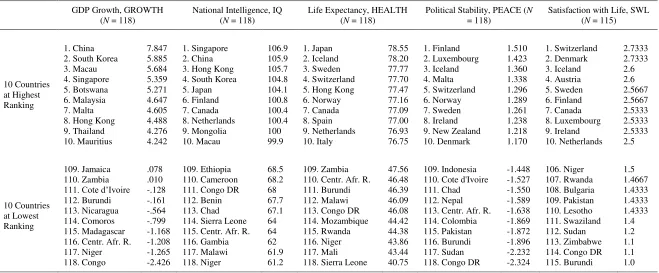
the dependent variable and ensure normal distribution of data. Table 1 shows the list of
Table 1
List of Countries with Top- and Bottom-10 Rankings for All Variables
GDP Growth, GROWTH (N = 118)
National Intelligence, IQ (N = 118)
Life Expectancy, HEALTH (N = 118)
Political Stability, PEACE (N = 118)
Satisfaction with Life, SWL (N = 115)
10 Countries at Highest Ranking
1. China 2. South Korea 3. Macau 4. Singapore 5. Botswana 6. Malaysia 7. Malta 8. Hong Kong 9. Thailand 10. Mauritius 7.847 5.885 5.684 5.359 5.271 4.647 4.605 4.488 4.276 4.242 1. Singapore 2. China 3. Hong Kong 4. South Korea 5. Japan 6. Finland 7. Canada 8. Netherlands 9. Mongolia 10. Macau 106.9 105.9 105.7 104.8 104.1 100.8 100.4 100.4 100 99.9 1. Japan 2. Iceland 3. Sweden 4. Switzerland 5. Hong Kong 6. Norway 7. Canada 8. Spain 9. Netherlands 10. Italy 78.55 78.20 77.77 77.70 77.47 77.16 77.09 77.00 76.93 76.75 1. Finland 2. Luxembourg 3. Iceland 4. Malta 5. Switzerland 6. Norway 7. Sweden 8. Ireland 9. New Zealand 10. Denmark 1.510 1.423 1.360 1.338 1.296 1.289 1.261 1.238 1.218 1.170 1. Switzerland 2. Denmark 3. Iceland 4. Austria 5. Sweden 6. Finland 7. Canada 8. Luxembourg 9. Ireland 10. Netherlands 2.7333 2.7333 2.6 2.6 2.5667 2.5667 2.5333 2.5333 2.5333 2.5 10 Countries at Lowest Ranking 109. Jamaica 110. Zambia 111. Cote d’Ivoire 112. Burundi 113. Nicaragua 114. Comoros 115. Madagascar 116. Centr. Afr. R. 117. Niger 118. Congo .078 .010 -.128 -.161 -.564 -.799 -1.168 -1.208 -1.265 -2.426 109. Ethiopia 110. Cameroon 111. Congo DR 112. Benin 113. Chad 114. Sierra Leone 115. Centr. Afr. R. 116. Gambia 117. Malawi 118. Niger 68.5 68.2 68 67.7 67.1 64 64 62 61.9 61.2 109. Zambia 110. Centr. Afr. R. 111. Burundi 112. Malawi 113. Congo DR 114. Mozambique 115. Rwanda 116. Niger 117. Mali 118. Sierra Leone
47.56 46.48 46.39 46.09 46.08 44.42 44.38 43.86 43.44 40.75 109. Indonesia 110. Cote d'Ivoire 111. Chad 112. Nepal 113. Centr. Afr. R. 114. Colombia 115. Pakistan 116. Burundi 117. Sudan 118. Congo DR
5. Results
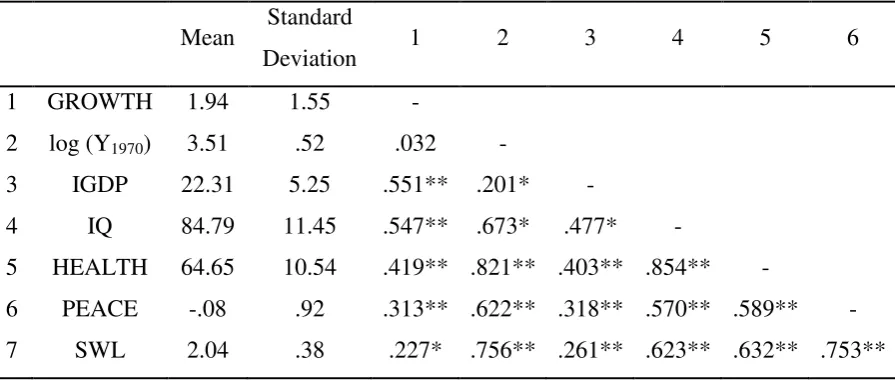
Table 2 presents univariate statistics and correlation matrix for selected variables.
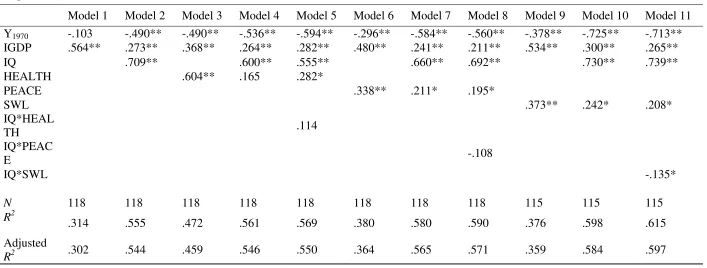
Table 3 provides a summary of regression analysis, where we used 11 models based on the
inclusion and exclusion of the present variables. All models included Y1970 and IGDP, but
differed on the inclusion of other factors and interaction terms. IQ was significant (p < .01) in
all regressions. Across 118 countries, we find a substantial increase in adjusted R2 between
Model 1 (R2 = .302) and Model 2 (R2 = .544) before and after the inclusion of IQ into the
regression. Accordingly, Model 2 can explain approximately 55.5% of the variance in
GROWTH, where a one standard deviation increase in IQ will raise economic growth rate by
[image:13.595.71.519.380.570.2]0.709 standard deviations.
Table 2
Univariate Statistics and Correlation Matrix for Selected Variables.
Note: Y1970 was log-transformed to improve normality.
*p≤ .05 **p≤ .01
In other models, we find that HEALTH (Model 3), PEACE (Model 6), and SWL
(Model 9) are significant (p < .01). When IQ is added to these models, HEALTH (Model 4)
becomes non-significant, while the significances of PEACE (Model 7) and SWL (Model 10)
were reduced to the p < .05 level. These outcomes demonstrate the stronger impact of IQ
relative to other predictors in explaining economic growth rate from 1970 to 2010. Mean Standard
Deviation 1 2 3 4 5 6
1 GROWTH 1.94 1.55 -
2 log (Y1970) 3.51 .52 .032 -
3 IGDP 22.31 5.25 .551** .201* -
4 IQ 84.79 11.45 .547** .673* .477* -
5 HEALTH 64.65 10.54 .419** .821** .403** .854** -
6 PEACE -.08 .92 .313** .622** .318** .570** .589** -
Table 3
Summary of Regression Analysis Predicting Growth with Interaction Terms
Note: Regression coefficients are standardized betas. All variables have a mean of zero and a standard deviation of one. *p≤ .05
**p≤ .01
Dependent Variable: GROWTH (GDP Growth Rates, % (1970–2010))
Model 1 Model 2 Model 3 Model 4 Model 5 Model 6 Model 7 Model 8 Model 9 Model 10 Model 11
Y1970 -.103 -.490** -.490** -.536** -.594** -.296** -.584** -.560** -.378** -.725** -.713**
IGDP .564** .273** .368** .264** .282** .480** .241** .211** .534** .300** .265**
IQ .709** .600** .555** .660** .692** .730** .739**
HEALTH .604** .165 .282*
PEACE .338** .211* .195*
SWL .373** .242* .208*
IQ*HEAL
TH .114
IQ*PEAC
E -.108
IQ*SWL -.135*
N 118 118 118 118 118 118 118 118 115 115 115
R2
.314 .555 .472 .561 .569 .380 .580 .590 .376 .598 .615
Adjusted
Regarding the interaction terms, Models 5 and 8 show small increases in adjusted R2
with the inclusion of interaction terms, which are non-significant. Nevertheless, HEALTH
and PEACE have a direct impact on growth. Their effects on GROWTH are independent of
IQ. Interestingly, we find that the interaction term IQ*SWL (Model 11) is negatively
significant (p < .05), showing an inverse relationship between IQ and SWL on economic
growth. However, the magnitude of IQ*SWL (-.135) is much smaller than that of IQ (.739)
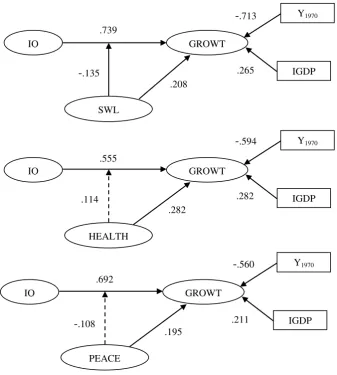
and SWL (.208) independently. Finally, based on the Models 5, 8, and 11, we construct path
diagrams to illustrate the moderating effect of variables on the IQ-GROWTH relationship, as
shown in Figure 3.
Figure 3. Standardized path coefficients between national IQ, GROWTH (GDP per capita growth rate), Y1970 (initial GDP per capita), IGDP (investment as a percentage of GDP), SWL
(satisfaction with life index), HEALTH (life expectancy), and PEACE (political stability and absence of violence or terrorism). Ovals represent variables of theoretical interest and boxes represent control variables. Significant pathways (p ≤ .05) are represented by solid lines, and
non-significant paths are represented by dotted lines, which could be removed from the models.
-.594
.282 .282
.555
.114 IGDP
Y1970
IQ GROWT
HEALTH
.211
-.560
.195 .692
-.108 IGDP
Y1970
IQ GROWT
PEACE
.265
-.713
.208 .739
-.135 IGDP
Y1970
IQ GROWT
[image:15.595.128.466.271.647.2]6. Discussion
The main purpose of our study was to examine the role of basic needs and
psychological needs in moderating the effect of human potential IQ on economic growth. Our
study demonstrates that IQ is the strongest predictor of economic growth compared to other
socioeconomic predictors. In previous studies (e.g., Knowles & Owen, 1995) life expectancy
was considered a robust predictor of economic growth. However, in our study, the inclusion
of IQ into the model made life expectancy non-significant. Consistent with the literature,
political stability (absence of violence and terrorism) was directly related to economic
growth. National peace is helpful in facilitating promoting productivity in society. However,
these two growth predictors do not contribute to the effect of IQ on economic growth, leading
to non-significant values for IQ*HEALTH and IQ*PEACE.
Furthermore, life satisfaction is positively related to economic growth. This suggests
that the existence of positive feelings with the nonexistence of negative feelings will directly
stimulate productivity over time. However, there is a significant negative interaction between intelligence and life satisfaction, which suggests that high life satisfaction decreases people’s desire for and effort toward further life achievement, thus discouraging the optimal
functioning of IQ potential on economic growth. This finding is in accordance with what has
been proposed by Maslow (1970) and Heylighen (1992)—that satisfied needs cannot be
motivators; hence, higher satisfaction leads to reduced motivation. On the other hand, the
importance of this negative interaction effect is attenuated by the highly significant, positive
effects of the independent predictors.
We conclude that basic and psychological needs do not amplify the effect of national
IQ potential on economic growth. The impact of IQ alone is sufficiently strong to increase the
economic growth rate, even without the contribution of other socioeconomic factors. For this
reason, it is expected that the findings reported in this study will contribute as beneficial
points especially in employing IQ as an important measurement of human capital in
cross-national studies of economic growth. Policymakers and social scientists who wish to narrow
the gap of cross-national disparities in living standards will have to put in effort particularly
in understanding what can be improved to taper those persistent IQ gaps between employees
across countries. Lastly, it would be insightful to extend the analysis in future studies to
identify other potential moderating factors that may regulate the IQ-growth relationship, in
Acknowledgements The authors would like to thank two anonymous reviewers and the editor (Douglas K. Detterman) of Intelligence for valuable suggestions. The authors also
gratefully acknowledge some helpful comments from Sazali A. Wahab, Zulkarnain M. Sori,
and faculty members of Universiti Malaysia Kelantan. Nik A. Sufian would also like to
express his deepest gratitude to Garett Jones (George Mason University, Fairfax) for his
helpful advice, as well as Richard Lynn (University of Ulster, Coleraine) for providing latest
dataset on national IQ, and a professional proofreader from Elsevier. Responsibility for all
References
Acemoglu, D., Johnson, S., & Robinson, J. A. (2005). Institutions as a fundamental cause of long-run growth. Handbook of Economic Growth, 1, 385–472.
Bartels, M., & Boomsma, D. I. (2009). Born to be happy? The etiology of subjective well-being. Behavior Genetics, 39, 605–615.
Beaudreau, B. C. (2012). A humanistic theory of economic behavior. The Journal of Socio-Economics, 41, 222–234.
Blattman, C., & Annan, J. (2010). The consequences of child soldiering. The Review of Economics and Statistics, 92, 882–898.
Bloom, D. E., & Canning, D. (2000). The health and wealth of nations. Science (Washington), 287, 1207–1209.
Bloom, D. E., Canning, D., & Sevilla, J. (2004). The effect of health on economic growth: a production function approach. World Development, 32, 1–13.
Brakman, S., Garretsen, H., & Schramm, M. (2004). The strategic bombing of German cities during World War II and its impact on city growth. Journal of Economic Geography, 4, 201– 218.
Chekola, M. G. (1975). The concept of happiness. Dissertation Abstracts International: A. The Humanities and Social Sciences, 35, 4609A.
Chen, S., Loayza, N. V., & Reynal-Querol, M. (2008). The aftermath of civil war. The World Bank Economic Review, 22, 63–85.
Clark, A. E., Frijters, P., & Shields, M. A. (2008). Relative income, happiness, and utility: An explanation for the Easterlin paradox and other puzzles. Journal of Economic Literature, 46, 95–144.
Cole, M. A., & Neumayer, E. (2006). The impact of poor health on total factor productivity. Journal of Development Studies, 42, 918–938.
Colletta, N. J., & Cullen, M. L. (2000). The nexus between violent conflict, social capital and social cohesion: Case studies from Cambodia and Rwanda. Washington, D.C: World Bank.
Collier, P., Hoeffler, A., & Rohner, D. (2009). Beyond greed and grievance: Feasibility and civil war. Oxford Economic Papers, 61, 1–27.
Crawford Solberg, E., Diener, E., Wirtz, D., Lucas, R. E., & Oishi, S. (2002). Wanting, having, and satisfaction: Examining the role of desire discrepancies in satisfaction with income. Journal of Personality and Social Psychology, 83, 725–734.
Dawson, J. F. (2014). Moderation in management research: What, why, when, and how.
Journal of Business and Psychology, 29, 1–19.
Deaton, A. (2008). Income, health, and well-being around the world: Evidence from the Gallup World Poll. Journal of Economic Perspectives, 22, 53–72.
Delaney, J. T., & Huselid, M. A. (1996). The impact of human resource management practices on perceptions of organizational performance. Academy of Management Journal, 39, 949–969.
Di Tella, R., & MacCulloch, R. (2008). Happiness adaptation to income beyond "basic needs" (NBER Working Papers 14539). Cambridge, MA: National Bureau of Economic Research.
Diener, E., Kahneman, D., Tov, W., & Arora, R. (2010). Income’s association with judgments of life versus feelings. In E. Diener, D. Kahneman, & J. F. Helliwell (Eds),
International differences in well-being (pp. 3–15). Oxford, UK: Oxford University Press.
Diener, E., & Seligman, M. (2004). Beyond money: Toward an economy of well-being.
Psychological Science in the Public Interest, 5, 1–31.
Easterlin, R. A. (1995). Will raising the incomes of all increase the happiness of all? Journal of Economic Behavior & Organization, 27, 35–47.
Easterlin, R. A. (2005). Feeding the illusion of growth and happiness: A reply to Hagerty and Veenhoven. Social Indicators Research, 74, 429–443.
Easterlin, R. A. (2011). Happiness, growth, and the life cycle, Chapter 5. Oxford, UK: Oxford University Press.
Easterlin, R. A., McVey, L. A., Switek, M., Sawangfa, O., & Zweig, J. S. (2010). The
happiness–income paradox revisited. Proceedings of the National Academy of Sciences, 107, 22463–22468.
Eysenck, M. (1994). Happiness: Facts and myths. East Sussex: Psychology Press.
Frazier, P. A., Tix, A. P., & Barron, K. E. (2004). Testing moderator and mediator effects in counseling psychology research. Journal of Counseling Psychology, 51, 115–134.
Frey, B. S., & Stutzer, A. (2002). Happiness and economics: How the economy and institutions affect well-being. Princeton, NJ: Princeton University Press.
Frijters, P., Johnston, D., & Shields, M. (2011). Destined for (un) happiness: Does childhood predict adult life satisfaction? (IZA Discussion Paper 5819). Bonn: Institute for the Study of Labor.
Gelade, G. A. (2008). IQ, cultural values, and the technological achievement of nations.
Intelligence, 36, 711−718.
Gleitman, H., Fridlund, H., & Reisberg, D. (2004). Psychology. (6th Ed.). New York: Norton.
Goldstein, K. (1947). Human nature in the light of psychopathology. Cambridge, MA: Harvard University Press.
Gottfredson, L. S. (1997). Mainstream science on intelligence: An editorial with 52 signatories, history, and bibliography. Intelligence, 24, 13–23.
Grossman, M. (1972). On the concept of health capital and the demand for health. The Journal of Political Economy, 80, 223-255.
Haggard, S., & Tiede, L. (2011). The rule of law and economic growth: where are we?. World Development, 39, 673–685.
Hamer, D. H. (1996). The heritability of happiness. Nature Genetics,14, 125–126.
Heston, A., Summers, R., & Aten, B. (2012). Penn World Table (Version 7.1). Center for International Comparisons of Production, Income and Prices at the University of
Pennsylvania, November 30, 2012.
Heylighen, F. (1992). A cognitive‐systemic reconstruction of Maslow's theory of self‐ actualization. Behavioral Science, 37, 39–58.
Jones, G., & Schneider, W. J. (2006). Intelligence, human capital, and economic growth: A Bayesian averaging of classical estimates (BACE) approach. Journal of Economic
Growth, 11, 71–93.
Justino, P., & Verwimp, P. (2006). Poverty dynamics, violent conflict and convergence in Rwanda (Households in Conflict Network Working Paper 16). Falmer, Brighton: Institute of Development Studies, University of Sussex.
Kahneman, D., & Deaton, A. (2010). High income improves evaluation of life but not emotional well-being. Proceedings of the National Academy of Sciences, 107, 16489–16493.
Kahneman, D., Diener, E., & Schwarz, N. (1999). Well-being: Foundations of hedonic psychology. New York: Russell Sage.
Kahneman, D., & Krueger, A. B. (2006). Developments in the measurement of subjective well-being. Journal of Economic Perspectives, 20, 3–24.
Kahneman, D., Krueger, A. B., Schkade, D., Schwarz, N., & Stone, A. A. (2006). Would you be happier if you were richer? A focusing illusion. Science, 312, 1908–1910.
Kashdan, T. B. (2004). The assessment of subjective well-being (issues raised by the Oxford Happiness Questionnaire). Personality and Individual Differences, 36, 1225–1232.
Kendler, K. S., Myers, J. M., Maes, H. H., & Keyes, C. L. (2011). The relationship between the genetic and environmental influences on common internalizing psychiatric disorders and mental well-being. Behavior Genetics, 41, 641–650.
Knowles, S., & Owen, P. D. (1995). Health capital and cross-country variation in income per capita in the Mankiw-Romer-Weil model. Economics Letters, 48, 99–106.
Knowles, S., & Owen, P. D. (1997). Education and Health in an Effective‐Labour Empirical Growth Model. Economic Record, 73, 314-328.
Kubiszewski, I., Costanza, R., Franco, C., Lawn, P., Talberth, J., Jackson, T., & Aylmer, C. (2013). Beyond GDP: Measuring and achieving global genuine progress. Ecological
Economics, 93, 57–68.
Lykken, D., & Tellegen, A. (1996). Happiness is a stochastic phenomenon. Psychological Science, 7, 186–189.
Lynn, R. (2012). IQs predict differences in the technological development of nations from 1000 BC through 2000 AD. Intelligence, 40, 439–444.
Lynn, R., & Vanhanen, T. (2002). IQ and the wealth of nations. Westport, CT: Praeger.
Lynn, R., & Vanhanen, T. (2006). IQ and global inequality. Augusta, GA: Washington Summit.
Mankiw, N. G., Romer, D., & Weil, D. N. (1992). A contribution to the empirics of economic growth. The Quarterly Journal of Economics, 107, 407–437.
Maridal, J. H. (2013). Cultural impact on national economic growth. The Journal of Socio-Economics, 47, 136–146.
Marini, M. (2004). Cultural evolution and economic growth: A theoretical hypothesis with some empirical evidence. The Journal of Socio-Economics, 33, 765–784.
Maslow, A. H. (1943). Theory of human motivation. Psychological Review, 50, 370–396.
Maslow, A. H. (1970). Motivation and personality. 1954 (3rd ed.). New York: Harper and Row, Inc.
Maslow, A. H. (1971). The farther reaches of human nature. New York: Viking.
Maslow, A. H. (1998). Toward a psychology of being. New York: Wiley.
Meisenberg, G. (2012). National IQ and economic outcomes. Personality and Individual Differences, 53, 103–107.
Meisenberg, G., & Lynn, R. (2011). Intelligence: A measure of human capital in nations. Journal of Social, Political & Economic Studies, 36, 421–454.
Michalos, A. C. (1985). Multiple discrepancies theory (MDT). Social Indicators Research, 16, 347–413.
Miguel, E., & Roland, G. (2011). The long-run impact of bombing Vietnam. Journal of Development Economics, 96, 1–15.
Minier, J. (2007). Nonlinearities and robustness in growth regressions. American Economic Review, 97, 388–392.
Nes, R. B., Røysamb, E., Tambs, K., Harris, J. R., & Reichborn-Kjennerud, T. (2006). Subjective well-being: Genetic and environmental contributions to stability and change. Psychological Medicine, 36, 1033–1042.
Ram, R. (2007). IQ and economic growth: Further augmentation of Mankiw–Romer–Weil model. Economics Letters, 94, 7–11.
Reber, A. S. (1995). The penguin dictionary of psychology (2nd ed.). London: Penguin.
Rindermann, H. (2012). Intellectual classes, technological progress and economic
development: The rise of cognitive capitalism. Personality and Individual Differences, 53, 108–113.
Rindermann, H., & Thompson, J. (2011). Cognitive capitalism: The effect of cognitive ability on wealth, as mediated through scientific achievement and economic freedom. Psychological Science, 22, 754–763.
Rogers, C. R. (1959). A theory of therapy, personality relationships as developed in the client-centered framework. In S. Koch. (Ed.), Psychology: A study of a science. Vol. 3: Formulations of the person and the social context. (pp. 185–256). New York: McGraw Hill.
Rogers, C. R. (1975). On becoming a person: A therapist view of psychotherapy (3rd ed.). London: Constable.
Røysamb, E., Tambs, K., Reichborn-Kjennerud, T., Neale, M. C., & Harris, J. R. (2003). Happiness and health: Environmental and genetic contributions to the relationship between subjective well-being, perceived health, and somatic illness. Journal of Personality and Social Psychology, 85, 1136–1146.
Sacks, D. W., Stevenson, B., & Wolfers, J. (2012). The new stylized facts about income and subjective well-being. Emotion, 12, 1181–1187.
Schultz, D. (1977). Growth psychology: Models of the healthy personality. New York: Van Nostrand.
Shostrom, E. L. (1976). Actualising therapy: Foundations for a scientific ethic. San Diego: EdlTS.
Sousa, L., & Lyubomirsky, S. (2001). Life satisfaction. In J. Worell (Ed.), Encylopedia of women and gender: Sex similarities and differences and the impact of society on gender (Vol. 2, pp. 667–676).San Diego, CA: Academic Press.
Stevenson, B., & Wolfers, J. (2008). Economic growth and subjective well-being: Reassessing the Easterlin paradox. Brookings Papers on Economic Activity, 39, 1–102.
Stevenson, B., & Wolfers, J. (2013). Subjective well-being and income: Is there any evidence of satiation? American Economic Review, 103, 598–604.
UNCTAD (2000). Text of Secretary-General Kofi Annan's address to the Tenth United Nations Conference on Trade and Development ("UNCTAD X"), Bangkok, 12 February 2000. Press Release No. G/05/2000. United Nations Conference on Trade and Development.
Retrieved January 22, 2014, from http://e.unescap.org/unis/press/g_05_00.htm.
University of Leicester (2006, November 14). Psychologist Produces The First-ever 'World Map Of Happiness'. ScienceDaily. Retrieved January 22, 2014, from
http://www.sciencedaily.com/releases/2006/11/061113093726.htm.
Veenhoven, R. (1993). Happiness in nations: Subjective appreciation of life in 56 nations 1946-1992. Rotterdam: RISBO Erasmus University Rotterdam.
Wallace, K. A., & Wheeler, A. J. (2002). Reliability generalization of the life satisfaction index. Educational and Psychological Measurement, 62, 674–684.
Wechsler, D. (1944). The measurement of adult intelligence. Baltimore: Williams & Wilkins.
Weede, E., & Kämpf, S. (2002). The impact of intelligence and institutional improvements on economic growth. Kyklos, 55, 361–380.
White, A. (2007). A global projection of subjective well- being: A challenge to positive psychology? Psychtalk, 56, 17–20.
Wilson, W. R. (1967). Correlates of avowed happiness. Psychological bulletin, 67, 294–306.
World Bank (2013a). World Development Indicators 2013.Washington, DC: World Bank.
World Bank (2013b). Worldwide Governance Indicators 2013. Washington, DC: World Bank.