Reduction of Non-stationary Noise for a Robotic Living Assistant using
Sparse Non-negative Matrix Factorization
Benjamin Cauchi1, Stefan Goetze1, Simon Doclo1,2 1
Fraunhofer Institute for Digital Media Technology (IDMT), Project group Hearing, Speech and Audio Technology (HSA), 26129 Oldenburg, Germany
2
University of Oldenburg, Signal Processing group, 26129 Oldenburg, Germany
{benjamin.cauchi,s.goetze,simon.doclo}@idmt.fraunhofer.de
Abstract
Due to the demographic changes, support by means of assistive systems will become in-evitable for home care and in nursing homes. Robot systems are promising solutions but their value has to be acknowledged by the pa-tients and the care personnel. Natural and in-tuitive human-machine interfaces are an es-sential feature to achieve acceptance of the users. Therefore, automatic speech recogni-tion (ASR) is a promising modality for such assistive devices. However, noises produced during movement of robots can degrade the
ASR performances. This work focuses on
noise reduction by a non-negative matrix fac-torization (NMF) approach to efficiently sup-press non stationary noise produced by the sensors of an assisting robot system.
1 Introduction
The amount of older people in today’s societies con-stantly grows due to demographic changes (Euro-pean Commision Staff, 2007). Technical systems become more and more common to support for rou-tine tasks of care givers or to assist older persons living alone in their home environments (Alliance, 2009). Various technical assistive systems have been developed recently (Lisetti et al., 2003), ranging from reminder systems (Boll et al., 2010; Goetze et al., 2010) to assisting robots (Chew et al., 2010; Goetze et al., 2012). If robot systems are supposed to navigate autonomously they usually rely on vision sensors (Aragon-Camarasa et al., 2010) or acous-tic sensors (Youssef et al., ). Acousacous-tic signals are
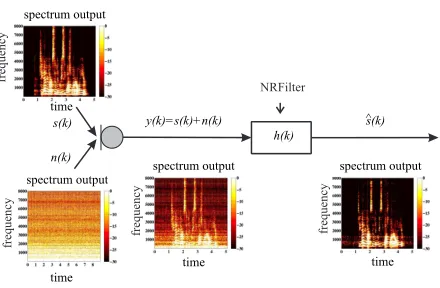
usually picked up by microphones mounted on the robot. In real-world scenarios not only the desired signal part is picked up by these microphones as pre-sented in Figure 1.
spectrum speech
NRFilter
y[k]=s[k]+n[k]
h[k]
hats[k]
0.5 1 1.5 2
0 1 2 3 4
-25 -20 -15 -10 -5 0
0.5 1 1.5 2
0 1 2 3 4
-25 -20 -15 -10 -5 0
0.5 1 1.5 2
0 1 2 3 4
-25 -20 -15 -10 -5 0
n[k]
0.5 1 1.5 2
0 1 2 3 4
-25 -20 -15 -10 -5 0
frequency
s[k] time
frequency
spectrum noise
time time
time
frequency frequency
spectrum micspectrum output spectrum outputspectrum output
spectrum output spectrum output
time time
time time
y(k)=s(k)+n(k)
h(k)
s(k) ^
[image:1.612.315.535.308.452.2]n(k) s(k)
Figure 1: General denoising scheme
The desired signal part is usually superposed with disturbing noise originating from the environment or the robot system itself. This disturbance has to be removed from the microphone signal before it can be further processed, e.g. for navigation, position estimation, acoustic event detection, speaker detec-tion or automatic speech recognidetec-tion. This contri-bution focuses on acoustic input for a robot system and more specifically on the noise reduction pre-processing which is needed to clean up noisy sound signals.
Automatic speech recognition (Huang et al., 2001; Wölfel et al., 2009) is a convenient way to in-teract with robot assistants since speech is the most natural form of communication. However, to en-sure acceptance of speech recognition systems a
ficiently high recognition rate has to be achieved (Pfister and T., 2008). Today’s speech recognition systems succeed in achieving this recognition rate for environments with low amount of noise and re-verberation. Unfortunately, while moving, robots can produce noise degrading the reliability of the ASR.
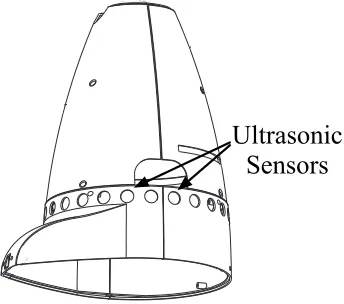
[image:2.612.102.274.303.455.2]This work focuses on a specific application, sup-pressing the non stationary noise produced by the ultra-sonic sensors of a robotic assistant while mov-ing. Please note that although in theory ultrasonic sensors do not produce sound disturbances in the au-dible range, artefacts due to the fast activation and deactivation of the sensors are present in the audible range and are clearly perceivable as a disturbance in the picked up microphone signal as shown later in Figure 6.
Ultrasonic
Sensors
Figure 2: Lower part of the robot with ultrasonic sen-sors (Metralabs, 2010).
Non-negative Matrix Factorization (NMF) is an approach introduced by Lee & Seung (Lee and Se-ung, 2001) in which the data is described as the product of a set of basis and of a set of activation co-efficients both being non-negative. We will apply the NMF approach to remove the disturbances caused by the ultrasonic sensors from the microphone input signal in the following. NMF and its various exten-sions have been proven efficient in sources separa-tion (Cichocki et al., ; Virtanen, 2007), supervised detection of acoustic events (Cotton and Ellis, 2011) or to wind noise reduction (Schmidt et al., ). As the NMF algorithm can be fed with prior informa-tion about the content to identify, it is a handy way to suppress the non stationary noise produced by the
sensors of the considered robotic assistant.
The remainder of this paper is organized as fol-lows: The general NMF algorithm is presented in Section 2 and the proposed denoising method is described in Section 3. An experiment using the TIMIT (Zue et al., 1990) speech corpus is presented in Section 4 and finally the performances are eval-uated in terms of achieved signal enhancement in Section 5 before Section 6 concludes the paper.
2 Sparse Non-negative Matrix Factorization
2.1 NMF algorithm
NMF is a low-rank approximation technique for multivariate data decomposition. Given a real val-ued non-negative matrixVof sizen×mand a pos-itive integerr < min(n, m), it aims to find a factor-ization ofVinto an×rreal matrixWand ar×m real matrixHsuch that:
V≈W·H (1)
The multivariate data to decompose is stacked into V, whose columns represent the different observa-tions, and whose rows represent the different vari-ables. In the case of information extraction from au-dio files, Vcould be the amplitude of the spectro-gram and therefore,Wwould be a basis of spectral features whenHwould represent the levels of acti-vation of each of those features along time. The rank rof the factorization corresponds to the number of elements present in the dictionaryW, and thereof, to the number of rows withinH.
NMF is an iterative process that can be fed with information about the contents to extract. As an il-lustration of this ability, an artificial spectrogram of a mixture of two chords, C and D, has been created. Figure 3 shows the initialization of the NMF algo-rithm.Vis the spectrogram of the mixture in which the two chords contain only notes’fundamentals and overlap each other. The Algorithm is fed with the spectral content of the C chord.
cor-respond to the presence of both chords within the matrixV.
Figure 3: Illustration of the initialization of the NMF al-gorithm. The spectral content of the C chord is input into
Wwhile the other element of dictionary and activation
[image:3.612.79.287.339.482.2]coefficients inHare randomly initialized.
Figure 4: Illustration of the output of the NMF algorithm. The spectral content of the D chord has been learned
while the updatedHcorresponds to the activations of the
chords C and D along time.
2.2 Sparseness Constraint
The very definition of sparseness (or sparsity) is that a vector is sparse when most of its elements are zero. In its application to NMF, the addition of a sparse-ness constraint λ permits to trade off between the fitness of the factorization and the sparseness ofH.
At each iteration, the process aims at reducing a cost functionC. In this paper, a generalized version of the Kullback Leibler divergence is used as cost
function:
D(V,WH) =
V⊗log V
W·H −V+W·H
(2)
In 2 the multiplication ⊗ and the division are element-wise. The sparseness constraint results in the new cost function:
C(V,WH) =D(V,WH) +λX
ij
Hij (3)
The norm of each of the objects withinWis fixed to unity.
3 Supervised NMF denoising
3.1 Method overview
The method is supervised in the sense that it uses a noise dictionaryWnbuilt from a recording of the
known noise to be reduced. The noise spectrogram
Φn,i.e. the short-term fourier transform (STFT), is
computed using a hamming window of 32ms and a 50% overlap. The magnitudeVn ofΦnis input to
the NMF algorithm with a sparseness constraint λ and an orderrn, providing the noise dictionary ofrn
spectral vectors. The spectrogramVs of the noisy
speech is then input to the NMF algorithm along withWnin order to obtain the denoised speech
spec-trogram.
3.2 Separation of the speech signal
Hs Hn
Spectrogram
Wn
Ws
Noisy Denoised
Synthesis NMF
Figure 5: Overview of the NMF based denoising.
The denoising is summarized in Figure 5. The spectrumΦs of the noisy speech and its amplitude
Vs are computed as in Section 3.1. Vs is input to
the NMF algorithm along withWn. The order of
factorizationris equal torn+rs,rsbeing the
[image:3.612.318.533.504.571.2]be applied to the activation matricesHnandHs.
Given V∈Rn+×m, r∈N
∗
s.t. r < min(n, m)
minimize C(V,WH)w.r.t.W,H (4)
subject to W∈Rn×r
+ , H ∈Rr+×m
The update rules onWand H can be expressed as multiplicative updates:
Ws←Ws⊗
V WsHs·H
T s
1·HT s
H←H⊗ WT·WHV WT·1 (5)
The NMF algorithm provides thereofWsandHsto
be used to approximate the spectrogram of the de-noised speech. Therefore,×being the matrix prod-uct:
˜
Vs=Ws×Hs V˜n=Wn×Hn
˜
Φs= Φs⊗
˜ Vs
˜ Vs+V˜n
(6)
The denoised speech signal is finally obtained by applying ISTFT on the spectrogram ˜Ss. The
inter-ested reader is referred to (O’Grady and Pearlmutter, 2006) for a more detailed discussion of the needed derivations for Eqs. (5)-(6).
4 Experiment
4.1 Context
The robot platform Scitos A5 (Metralabs, 2012) can be used as a robotic assistant for elderly care. Its built-in microphones allow to interact with the robot using if their signal is analysed by an ASR sys-tem. However, while in motion, the robot uses ul-trasonic sensors (c.f. Figure 2) to detect potential obstacles. Their constant activation and deactivation produces artifacts that can sever the ASR reliability. The following experiment aims to evaluate the effi-ciency of the denoising method proposed in Section 3 on speech signals corrupted by this specific sen-sors noise. The Figure 6 examplarily presents the spectrogram of a corrupted speech signal.
4.2 Protocol
The noise produced by the sensors and the room impulse response (RIR) have been recorded in a quiet office room using the robot’s microphone. The test data has been built from the test portion of the
Frequency in Hz
8000
7000
6000
5000
4000
3000
2000
1000
−30 −25 −20 −15 −10 −5 0
Time in s
Frequency in Hz
0 1 2 3 4 5
8000
7000
6000
5000
4000
3000
2000
1000
[image:4.612.332.515.64.324.2]−30 −25 −20 −15 −10 −5 0
Figure 6: Spectrogram of a speech sentence from the
TIMIT corpora: «She had your dark suit in greasy wash
water all year.», clean (top) and with added sensors noise
at SNR=10dB.
TIMIT corpus (Zue et al., 1990). The clean speech files have been built concatenating a silent period of 0.5 seconds in their beginning, to allow for compari-son with methods relying on a voice activity detector (VAD), and convolving it with the measured RIR. From those prepared clean files, noisy corpora have been built by adding the recorded sensors noise with a SNR set to 10, 5, 0 and -5 dB. In real scenarios, the SNR of the speech corrupted by the sensors noise vary between 5 and 10 dB depending on the loud-ness of the speaker and the distance between him and the robot.
When applying the NMF algorithm the cost func-tion (3) has been used but no stop criterion has been set and a fixed number of 25 iterations has been run. Wn has been built by applying the NMF
al-gorithm withrn = 64 andλ = 0 to a 10 seconds
noise recording. When applying the algorithm to the speech samples denoising,rhas been set to128. A different sparseness constraint has been applied to HnandHswithλn= 0andλs= 0.2.
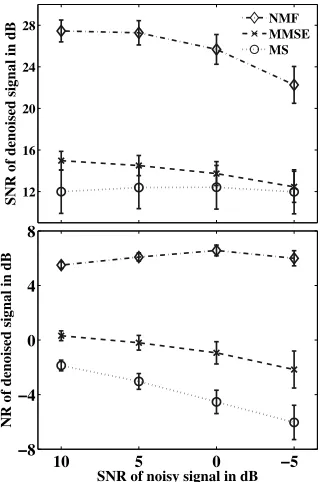
well been processed using a state-of-the-art single-channel noise reduction scheme, i.e. the decision-directed approach according to (Ephraim and Malah, 1985) based on two different noise estimation schemes, i.e. the minimum statistics approach (MS) as described in (Martin, 2001) and the minimum mean square error (MMSE) approach according to (Gerkmann and Hendriks, 2011).
5 Results
The achieved denoising is evaluated with the SNR of the denoised samples and with the noise reduc-tion (NR) as described in (Loizou, 2007). For both scores, the presented values are the mean of the achieved scores on all tested speech samples and the standard deviation along the corpus. The results are presented in Figure 7 for varying input SNR and spectrograms of a denoised speech sample using the three methods is shown in Figure 8. It appears that the NMF based method provides better results, both in term of signal enhancement and of reliability.
10 5 0 ï5
ï8
ï4 0 4 8
SNR of noisy signal in dB
NR of denoised signal in dB
12 16 20 24 28
SNR of denoised signal in dB
NMF MMSE MS
10 5 0 ï5
ï8
ï4 0 4 8
SNR of noisy signal in dB
NR of denoised signal in dB
12 16 20 24 28
SNR of denoised signal in dB
[image:5.612.331.516.64.451.2]NMF MMSE MS
Figure 7: Mean and standard deviation of the achieved SNR and NR for the three tested methods and for differ-ent noise levels (SNR).
Frequency in Hz
8000
7000
6000
5000
4000
3000
2000
1000
−30 −25 −20 −15 −10 −5 0
Frequency in Hz
8000
7000
6000
5000
4000
3000
2000
1000
−30 −25 −20 −15 −10 −5 0
Time in s
Frequency in Hz
0 1 2 3 4 5
8000
7000
6000
5000
4000
3000
2000
1000
[image:5.612.102.263.390.631.2]−30 −25 −20 −15 −10 −5 0
Figure 8: Spectrogram of a denoised signal using the three different methods, MS (top), MMSE (middle) and NMF.
6 Conclusion
A NMF based method to enhance speech signal when provided with spectral knowledge of the noise has been presented. This method has been applied to the reduction of the non stationary noise produced by the sensors of a robotic assistant. When tested on a corpus of speech signals, the proposed method achieved better performances than well known VAD based denoising.
7 Acknowledgement
This work was partially supported by the "Adapt-able Ambient Living Assistant" (ALIAS) project co-funded by the European Commission and the Fed-eral Ministry of Education and Research (BMBF).
References
The European Ambient Assisted Living Innovation
Al-liance. 2009. Ambient Assisted Living Roadmap.
VDI/VDE-IT AALIANCE Office.
G. Aragon-Camarasa, H. Fattah, and J. Paul Siebert. 2010. Towards a unified visual framework in a
binoc-ular active robot vision system. Robotics and
Au-tonomous Systems, 58(3):276–286.
S. Boll, W. Heuten, E.M. Meyer, and M. , Meis. 2010. Development of a Multimodal Reminder System for
Older Persons in their Residential Home. Informatics
for Health and Social Care, SI Ageing & Technology,
35(4).
Selene Chew, Willie Tay, Danielle Smit, and Christoph
Bartneck. 2010. Do social robots walk or roll? In
Shuzhi Ge, Haizhou Li, John-John Cabibihan, and
Yeow Tan, editors, Social Robotics, volume 6414 of
Lecture Notes in Computer Science, pages 355–361.
Springer Berlin / Heidelberg.
A. Cichocki, R. Zdunek, and S. Amari. New algorithms for non-negative matrix factorization in applications
to blind source separation. In Proc. of Acoustics,
Speech and Signal Processing, 2006. ICASSP 2006.,
volume 5, pages V–V, Toulouse, France.
C.V. Cotton and D.P.W. Ellis. 2011. Spectral vs.
spectro-temporal features for acoustic event detection. In
Proc. of 2011 IEEE Workshop on Applications of
Sig-nal Processing to Audio and Acoustics (WASPAA),
pages 69 –72, New Paltz, NY, USA, oct.
Y. Ephraim and D. Malah. 1985. Speech enhancement using a minimum mean-square error log-spectral
am-plitude estimator. IEEE Transactions on Acoustics,
Speech and Signal Processing, 33(2):443–445.
European Commision Staff. 2007. Working Document. Europes Demografic Future: Facts and Figures. Tech-nical report, Commission of the European Communi-ties.
T. Gerkmann and R.C. Hendriks. 2011. Noise power es-timation based on the probability of speech presence.
In Proc. of 2011 IEEE Workshop on Applications of
Signal Processing to Audio and Acoustics (WASPAA),
pages 145–148, New Paltz, NY, USA.
S. Goetze, N. Moritz, J.E. Appell, M. Meis, C. Bartsch,
and J. Bitzer. 2010. Acoustic user interfaces for
ambient-assisted living technologies. Informatics for
Health and Social Care.
S. Goetze, S. Fischer, N. Moritz, J.E. Appell, and F.
Wall-hoff. 2012. Multimodal human-machine interaction for service robots in home-care environments. Jeju, Republic of Korea.
X. Huang, A. Acero, H.W. Hon, et al. 2001. Spoken
language processing, volume 15. Prentice Hall PTR
New Jersey.
D.D. Lee and H.S. Seung. 2001. Algorithms for
non-negative matrix factorization. Advances in neural
in-formation processing systems, 13.
C. Lisetti, F. Nasoz, C. LeRouge, O. Ozyer, and K. Al-varez. 2003. Developing multimodal intelligent
affec-tive interfaces for tele-home health care.International
Journal of Human-Computer Studies, 59(1-2):245 –
255. Applications of Affective Computing in Human-Computer Interaction.
P.C. Loizou. 2007. Speech Enhancement: Theory and
Practice. CRC Press Inc., Boca Raton, USA.
R. Martin. 2001. Noise power spectral density estima-tion based on optimal smoothing and minimum
statis-tics.IEEE Transactions on Speech and Audio
Process-ing, 9(5):504–512.
Metralabs. 2010. Technical manual.
Metralabs. 2012. http://www.metralabs.com.
P.D. O’Grady and B.A. Pearlmutter. 2006. Convolu-tive non-negaConvolu-tive matrix factorisation with a
sparse-ness constraint. InProc. of the 2006 16th IEEE
Sig-nal Processing Society Workshop on Machine
Learn-ing for Signal ProcessLearn-ing, Maynooth, Ireland.
B. Pfister and Kaufmann T. 2008. Speech processing
Fundamentals and mthods for speech synthesis and speech recognition (German original title: Sprachver-arbeitun Grundlagen und Methoden der
Sprachsyn-these und Spracherkennung). Springer, Berlin
Heidel-berg.
M.N. Schmidt, J. Larsen, and F.T. Hsiao. Wind noise
re-duction using non-negative sparse coding. InProc. of
the 2007 17th IEEE Signal Processing Society
Work-shop on Machine Learning for Signal Processing,
Thessaloniki, Greece.
T. Virtanen. 2007. Monaural sound source
separa-tion by nonnegative matrix factorizasepara-tion with
tempo-ral continuity and sparseness criteria. IEEE
Trans-actions on Audio, Speech, and Language Processing,
15(3):1066–1074.
M. Wölfel, J.W. McDonough, and Inc Ebrary. 2009.
Dis-tant speech recognition. Wiley Online Library.
K. Youssef, S. Argentieri, and J.L. Zarader. Binaural
speaker recognition for humanoid robots. InProc. of
2010 11th International Conference on Control
Au-tomation Robotics & Vision (ICARCV), Singapore,
Re-public of Singapore.
V. Zue, S. Seneff, and J. Glass. 1990. Speech database
development at MIT: TIMIT and beyond. Speech