Constructing Parallel Corpora for Six Indian Languages via Crowdsourcing
Matt Post⋆ and Chris Callison-Burch⋆† and Miles Osborne‡ ⋆Human Langage Technology Center of Excellence, Johns Hopkins University
†Center for Language and Speech Processing, Johns Hopkins University ‡School of Informatics, University of Edinburgh
Abstract
Recent work has established the efficacy of Amazon’s Mechanical Turk for constructing parallel corpora for machine translation re-search. We apply this to building a collec-tion of parallel corpora between English and six languages from the Indian subcontinent: Bengali, Hindi, Malayalam, Tamil, Telugu, and Urdu. These languages are low-resource, under-studied, and exhibit linguistic phenom-ena that are difficult for machine translation. We conduct a variety of baseline experiments and analysis, and release the data to the com-munity.
1 Introduction
The quality of statistical machine translation (MT) systems is strongly related to the amount of paral-lel text available for the language pairs. However, most language pairs have little or no readily available bilingual training data available. As a result, most contemporary MT research tends to opportunisti-cally focus on language pairs with large amounts of parallel data.
A consequence of this bias is that language ex-hibiting certain linguistic phenomena are underrep-resented, including languages with complex mor-phology and languages with divergent word order-ings. In this paper, we describe our work gather-ing and refingather-ing document-level parallel corpora be-tween English and each of six verb-final languages spoken on the Indian subcontinent: Bengali, Hindi, Malayalam, Tamil, Telugu, and Urdu. This paper’s contributions are as follows:
• We apply an established protocol for using Amazon’s Mechanical Turk (MTurk) to collect parallel data to train and evaluate translation systems for six Indian languages.
• We investigate the relative performance of syn-tactic translation models over hierarchical ones, showing that syntax results in higher BLEU scores in most cases.
• We explore the impact of training data quality on the quality of the resulting model.
• We release the corpora to the research commu-nity under the Creative Commons Attribution-Sharealike 3.0 Unported License (CC BY-SA 3.0).1
2 Why Indian languages?
Indian languages are important objects of study for a number of reasons. These languages are low-resource languages in terms of the availability of MT systems2(and NLP tools in general) yet together they represent nearly half a billion native speakers (Table 1). Their speakers are well-educated, with many of them speaking English either natively or as a second language. Together with the degree of Inter-net peInter-netration in India, it is reasonably straightfor-ward to find and hire non-expert translators through crowdsourcing services like Amazon’s Mechanical Turk.
1joshua-decoder.org/indian-parallel-corpora 2
See sampark.iiit.ac.in/sampark/web/index.php/ contentfor a notable growing effort.
ெனட்டர் அவளை கருத்துக்கள் தயார்
senator her remarks prepared
Figure 1: An example of SOV word ordering in Tamil. Translation:The senator prepared her remarks.
হাত কি ল আম
walk CONT PAST 1p
Figure 2: An example of the morphology of the Bengali wordহাত্সিলাম, meaning[I] was walking. CONT denotes the continuous aspect, while PAST denotes past tense.
In addition to a general desire to collect suitable training corpora for low-resource languages, Indian languages demonstrate a variety of linguistic phe-nomena that are divergent from English and under-studied. One example is head-finalness, exhibited most obviously in a subject-object-verb (SOV) pat-tern of sentence structure, in contrast to the gen-eral SVO ordering of English sentences. One of the motivations underlying linguistically-motivated syntactic translation systems like GHKM (Galley et al., 2004; Galley et al., 2006) or SAMT (Zollmann and Venugopal, 2006) is to describe such transfor-mations. This difference in word order has the po-tential to serve as a better test bed for syntax-based MT3 compared to translating between English and European languages, most of which largely share its word order. Figure 1 contains an example of SOV reordering in Tamil.
A second important phenomenon present in these languages is a high degree of morphological com-plexity relative to English (Figure 2). Indian lan-guages can be highly agglutinative, which means that words are formed by concatenating morpholog-ical affixes that convey information such as tense, person, number, gender, mood, and voice. Mor-phological complexity is a considerable hindrance at all stages of the MT pipeline, but particularly align-ment, where inflectional variations mask patterns from alignment tools that treat words as atoms.
3
We usehierarchicalto denote translation grammars that use only a single nonterminal (Chiang, 2007), in contrast to syntac-ticsystems, which make use of linguistic annotations (Zollmann and Venugopal, 2006; Galley et al., 2006).
[image:2.612.314.536.56.156.2]language script family L1 Bengali বাংলা Indo-Aryan 181M Hindi मानक हिन्दी Indo-Aryan 180M Malayalam മലയാളം Dravidian 35M Tamil தமிழ் Dravidian 65M Telugu తెలుగు Dravidian 69M Urdu ودرا Indo-Aryan 60M
Table 1: Languages. L1 is the worldwide number of na-tive speakers according to Lewis (2009).
3 Data collection
The source of the documents for our translation task for each of the languages in Table 1 was the set of the top-100 most-viewed documents from each lan-guage’s Wikipedia. These lists were obtained us-ing page view statistics compiled fromdammit.lt/ wikistatsover a one year period. We did not apply any filtering for topic or content. Table 2 contains a manually categorized list of documents for Hindi, with some minimal annotations indicating how the documents relate to those in the other languages. These documents constitute a diverse set of topics, including culture, the internet, and sex.
We collected the parallel corpora using a three-step process designed to ensure the integrity of the non-professional translations. The first step was to build a bilingual dictionary (§3.1). These dictionar-ies were used to bootstrap the experimental controls in the collection of four translations of each source sentence (§3.2). Finally, as a measure of data qual-ity, we independently collect votes on the which of the four redundant translations is the best (§3.3).
3.1 Dictionaries
A key component of managing MTurk workers is to ensure that they are competently and conscientiously undertaking the tasks. As non-speakers of all of the Indian languages, we had no simple and scalable way to judge the quality of the workers’ translations. Our solution was to bootstrap the process by first building bilingual dictionaries for each of the datasets. The dictionaries were then used to produce glosses of the complete source sentences, which we compared to the translations produced by the workers as a rough means of manually gauging trust (§3.2).
PLACES PEOPLE PEOPLE TECHNOLOGY LANGUAGE AND RELIGION Agra A. P. J. Abdul Kalam Premchand Blog CULTURE Bhagavad Gita Bihar Aishwarya Rai Rabindranath Tagore Google Ayurveda Diwali China Akbar Rani Lakshmibai Hindi Web Resources Constitution of India Hanuman Delhi Amitabh Bachchan Sachin Tendulkar Internet Cricket Hinduism Himalayas Barack Obama Sarojini Naidu Mobile phone English language Hinduism India Bhagat Singh Subhas Chandra Bose News aggregator Hindi Cable News Holi Mumbai Dainik Jagran Surdas RSS Hindi literature Islam Nepal Gautama Buddha Swami Vivekananda Wikipedia Hindi-Urdu grammar Mahabharata Pakistan Harivansh Rai Bachchan Tulsidas YouTube Horoscope Puranas
Rajasthan Indira Gandhi Indian cuisine Quran
Red Fort Jaishankar Prasad THINGS SEX Sanskrit Ramayana Taj Mahal Jawaharlal Nehru Air pollution Anal sex Standard Hindi Shiva
United States Kabir Earth Kama Sutra Shiva
Uttar Pradesh Kalpana Chawla Essay Masturbation EVENTS Taj Majal: Shiva Temple?
Mahadevi Varma Ganges Penis History of India Vedas Meera General knowledge Sex positions World War II Vishnu Mohammed Rafi Global warming Sexual intercourse
Mohandas Karamchand Gandhi Pollution Vagina Mother Teresa Solar energy
[image:3.612.76.536.55.261.2]Navbharat Times Terrorism
Table 2: The 100 most viewed Hindi Wikipedia articles (titles translated to English using inter-language links and Google translate and manually categorized). Entries inboldwere present in the top 100 lists of at least four of the Indian top 100 lists.Earth,India,World War II, andWikipediawere in the top 100 lists of all six languages.
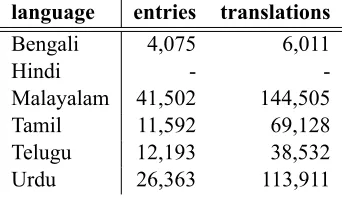
language entries translations Bengali 4,075 6,011
Hindi -
-Malayalam 41,502 144,505 Tamil 11,592 69,128 Telugu 12,193 38,532 Urdu 26,363 113,911
Table 3: Dictionary statistics. Entriesis the number of source-language types, whiletranslationslists the ber of words or phrases they translated to (i.e., the num-ber of pairs in the dictionary). Controls for Hindi were obtained using Google translate, the only one of these lan-guages that were available at the outset of this project.
task, in which workers were asked to translate sin-gle words and short phrases from the complete set of Wikipedia documents. For each word, MTurk work-ers were presented with three sentences containing that word, which provided context. The control for this task was obtained from the Wikipedia article ti-tles which are linked across languages, and can thus be assumed to be translations of each other. Workers who performed too poorly on these known transla-tions had their work rejected.
Table 3 lists the size of the dictionaries we con-structed.
3.2 Translations
With the dictionaries in hand, we moved on to trans-late the entire Wikipedia documents. Each human in-telligence task (HIT) posted on MTurk contained ten sequential source-language sentences from a doc-ument, and asked the worker to enter a free-form translation for each. We collected four translations from different translators for each source sentence. To discourage cheating through cutting-and-pasting into automatic translation systems, sentences were presented as images. Workers were paid $0.70 per HIT. We then manually determined whether to ac-cept or reject a worker’s HITs based on a review of each worker’s submissions, which included a com-parison of the translations to a monotonic gloss (pro-duced with the dictionary), the percentage of empty translations, the amount of time the worker took to complete the HIT, geographic location (self-reported and geolocated by way of the worker’s IP address), and by comparing different translations of the same source segments against one another.
[image:3.612.97.268.327.426.2]32 0 2 4 6 8 10 12 14 16 18 20 22 24 26 28 30 800,000
0 100,000 200,000 300,000 400,000 500,000 600,000 700,000
Mal aya
lam
Tam il
Telugu
Hindi
Urdu
[image:4.612.70.293.59.227.2]Benga li
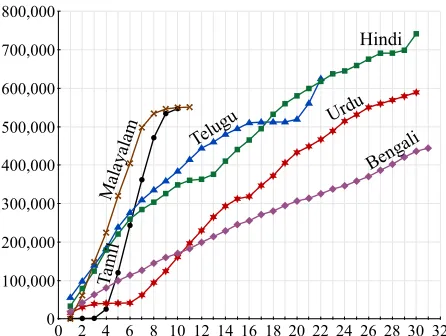
Figure 3: The total volume of translations (measured in English words) as a function of elapsed days. For Malay-alam, we collected half a million words of translations in just under a week.
week. For comparison, the Europarl corpus (Koehn, 2005) has about 50 million words of English for each of the Spanish and French parallel corpora.
As has been previously reported (Zbib et al., 2012), cost is another advantage of building train-ing data on Mechanical Turk. Germann (2001) puts the cost of professionally translated English at about $0.30 per word for translation from Tamil. Our trans-lations were obtained for less than $0.01 per word. The rate of collection could likely be increased by raising these payments, but it is unclear whether quality would be affected by raising the base pay (although it could be improved by paying for sub-sequent quality control HITs, like editing).
The tradeoff for low-cost translations is increased variance in translation quality when compared to the more consistently-good professional translations. Figure 4 contains some hand-picked examples of the sorts of translations we obtained. Later, in the Exper-iments section (§4), we will investigate the effects this variance in translation quality has on the qual-ity of the models that can be constructed. For now, the variance motivated the collection of an additional dataset, described in the next section.
3.3 Votes
A prevailing issue with translations collected on MTurk is the prevalence of low-quality translations. Quality suffers for a variety of reasons: Turkers
lack formal training, often translate into a nonna-tive tongue, may give insufficient attention to the task, and likely desire to maximize their throughput (and thus their wage). Unlike Zaidan and Callison-Burch (2011), who embed controls containing source language sentences with known professional trans-lations, we had no professionally translated data. Therefore, we could not measure the BLEU score of the Turkers.
Motivated by desire to have some measure of the relative quality and variance of the translations, we designed another task in which we presented an in-dependent set of Turkers with an original sentence and its four translations, and asked them to vote on which was best.4 Five independent workers voted on the translations of each source sentence. Tallying the resulting votes, we found that roughly 65% of the sentences had five votes cast on just one or two of the translations, and about 95% of the sentences had all the votes cast on one, two, or three sentences. This suggests both (1) that there was a difference in the quality of the translations, and (2) the voters were able to discern these differences, and took their task seriously enough to report them.
3.4 Data sets
For each parallel corpus, we created a standardized test set in the following manner. We first manu-ally assigned each of the Wikipedia documents for each language into one of the following nine cate-gories: EVENTS, LANGUAGE AND CULTURE, PEOPLE, PLACES, RELIGION, SEX, TECHNOL-OGY, THINGS, or MISC. We then assigned doc-uments to training, development, development test, and test sets in round-robin fashion using a ratio of roughly 7:1:1:1. For training data, each source sen-tence was repeated four times in order to allow it to be paired with each of its translations. For the development and test sets, the multiple translations served as alternate references. Table 4 lists sentence-and word-level statistics for the datasets for each lan-guage pair (these counts are prior to any tokeniza-tion).
மார்ச் 15,2007இல் ஆக்ஸ்ஃபோர்டு ஆங்கில அகராதி யில் விக்கி இடம்பெற்றது.
In March 15,2007 Wiki got a place in Oxford English dictionary.
On March 15, 2007 wiki was included in the Oxford English dictionary. (5)
[image:5.612.71.293.203.363.2]ON MARCH 15, 2007, WIKI FOUND A PLACE IN THE OXFORD ENGLISH DICTIONARY March 15, 2007 oxford english index of wiki’s place.
Figure 4: An example of the variance in translation quality for the human translations of a Tamil sentence; the format-ting of the translations has been preserved exactly. The parenthesized number indicates the number of votes received in the voting task (§3.3).
language dict train dev devtest test
Bengali 16k 539k 63k 61k 69k
6k 20k 914 907 1k
Hindi 0 1,249k 67k 98k 74k
0 37k 1k 993 1k
Malayalam 410k 664k 61k 68k 70k
144k 29k 1k 1k 1k
Tamil 189k 747k 62k 53k 54k
69k 35k 1k 1k 1k
Telugu 106k 951k 52k 45k 49k
38k 43k 1k 916 1k
Urdu 253k 1,198k 67k 49k 42k
113k 33k 736 777 605
Table 4: Data set sizes for each language pair: words in the first row, parallel sentences in the second. (The dictio-naries contains short phrases in addition to words, which accounts for the difference in dictionary word and line counts.)
4 Experiments
In this section, we present experiments on the col-lected data sets in order to quantify their perfor-mance. The experiments aim to address the follow-ing questions:
1. How well can we translate the test sets?
2. Do linguistically motivated translation models improve translation results?
3. What is the effect of data quality on model qual-ity?
4.1 Setup
A principal point of comparison in this paper is be-tween Hiero grammars (Chiang, 2007) and SAMT grammars (Zollmann and Venugopal, 2006), the lat-ter of which make use of linguistic annotations to
improve nonterminal reordering. These grammars were trained with the Thrax grammar extractor us-ing its default settus-ings, and translated usus-ing Joshua (Weese et al., 2011). We tuned with minimum error-rate training (Och, 2003) using Z-MERT (Zaidan, 2009) and present the mean BLEU score on test data over three separate runs (Clark et al., 2011). MBR reranking (Kumar and Byrne, 2004) was ap-plied to Joshua’s 300-best (unique) output, and eval-uation was conducted with case-insensitive BLEU with four references.
The training data was produced by pairing a source sentence with each of its four translations. We also added the dictionaries to the training data. We built five-gram language models from the target side of the training data using interpolated Kneser-Ney smoothing. We also experimented with a larger-scale language model built from English Gigaword, but, notably, found a drop of over a point in BLEU score. This points forward to some of the difficul-ties encountered with the lack of text normalization, discussed in §5.
4.2 Baseline translations
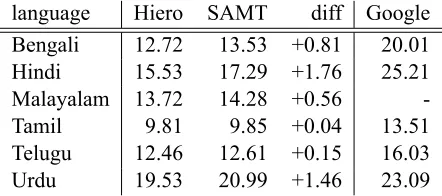
We begin by presenting BLEU scores for Hiero and SAMT translations of each of the six Indian language test sets (Table 5). For comparison purposes, we also present BLEU scores from Google translations of these languages (where available).
We observe that systems built with SAMT gram-mars improve measurably above the Hiero models, with the exception of Tamil and Telugu. As an ex-ternal reference point, the Google baseline transla-tion scores far surpass the results of any of our sys-tems, but were likely constructed from much larger datasets.
language Hiero SAMT diff Google Bengali 12.72 13.53 +0.81 20.01 Hindi 15.53 17.29 +1.76 25.21 Malayalam 13.72 14.28 +0.56 -Tamil 9.81 9.85 +0.04 13.51 Telugu 12.46 12.61 +0.15 16.03 Urdu 19.53 20.99 +1.46 23.09
Table 5: BLEU scores translating into English (four ref-erences). BLEU scores are the mean of three MERT runs.
the sorts of translations we obtained from our sys-tems. While anecdotal and not characteristic of over-all quality, together with the generover-ally good BLEU scores, these examples provide a measure of the abil-ity to obtain good translations from this dataset.
4.3 Voted training data
We noted above the high variance in the quality of the translations obtained on MTurk. For data col-lection efforts, there is a question of how much time and effort to invest in quality control, since it comes at the expense of simply collecting more data. We can either collect additional redundant translations (to increase quality) or translate more foreign sen-tences (to increase coverage).
To test this, we constructed two smaller datasets, each making use of only one of the four translations of each source sentence:
• Selected randomly
• Selected by choosing the translation that re-ceived a plurality of the votes (§3.3), breaking ties randomly (best)
We again included the dictionaries in the training data (where available). Table 7 contains results on the same test sets as before. These results do not clearly indicate that quality control through redun-dant translations are worth the extra expense. Novot-ney and Callison-Burch (2010) had a similar finding for crowdsourced transcriptions.
5 Further Analysis
The previous section has shown that reasonable BLEU scores can be obtained from baseline transla-tion systems built from these corpora. While trans-lation quality is an issue (for example, very
lit-இலங்கையில் சோழர் ஆட்சி
[image:6.612.72.293.58.156.2]in srilankasolar government cholarule in sri lanka in srilankachozhasruled cholareign in sri lanka
Figure 5: An example of inconsistent orthography. Words in bold are translations of the second Tamil word.
eral translations, etc), the previous section’s voted dataset experiments suggest this is not one of the most important issues to address.
In this section, we undertake a manual analysis of the collected datasets to inform future work. There are a number of issues that arise due to non-Roman scripts, high-variance translation quality, and the rel-atively small amount of training data.
5.1 Orthographic issues
Manual analysis demonstrates that inconsistencies with orthography are a serious problem. An exam-ple of this can be found in Figure 5, which contains a set of translations of a Tamil sentence. In particu-lar, the spelling of the Tamil wordசோழர்has three different realizations among the sentence’s transla-tions. The discrepancy between zha andla is due to phonetic variants (phonetic similarity may also account for the word solar). This discrepancy is present throughout the training and test data, where the-lavariant is preferred to-zhaby about 6:1 (the counts are 848 and 142, respectively).
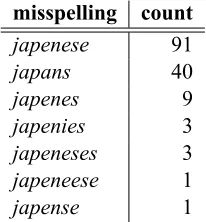
In addition to mistakes potentially caused by for-eign scripts, there are many mistakes that are sim-ply spelling errors. Table 8 contains examples of misspellings (along with their counts) in the train-ing portion of the Urdu-English dataset. As a point of comparison, there are no misspellings of the word in Europarl.
Bengali এই সময়ই ১৯২১ সালে ঢাকা বিশ্ববিদ্যালয় স্থাপিত হয় ।
Hiero in this time dhaka university was established on the year 1921 . SAMT in this time dhaka university was established in 1921 .
Malayalam സൂര്യന്റെ ദൃശ്യമാകുന്ന ഉപരിതലത്തി ൽ താപനില 5 , 700◦k ലേക്ക് താഴ്ന്നിരിക്കും . Hiero the surface temperature of sun 5 , 700 degree k to down to .
[image:7.612.76.291.179.277.2]SAMT temperature in the surface of the sun 5 , 700 degree k to down to .
Table 6: Some example translations.
Hiero SAMT
[image:7.612.131.234.360.471.2]language random best random best Bengali 9.43 9.29 9.65 9.50 Hindi 11.74 12.18 12.61 12.69 Tamil 7.73 7.48 7.88 7.76 Telugu 10.49 10.61 10.75 10.72 Urdu 13.51 14.26 14.63 16.03
Table 7: BLEU scores translating into English on a quar-ter of the training data (plus dictionary), selected in two ways: best (result of vote), and random. There is little difference, suggesting quality control may not be terribly important. We did not collect votes for Malayalam.
misspelling count
japenese 91
japans 40
japenes 9
japenies 3
japeneses 3
japeneese 1
japense 1
Table 8: Misspellings ofjapanese(947) in the training portion of the Urdu-English data, along with their counts.
5.2 Alignments
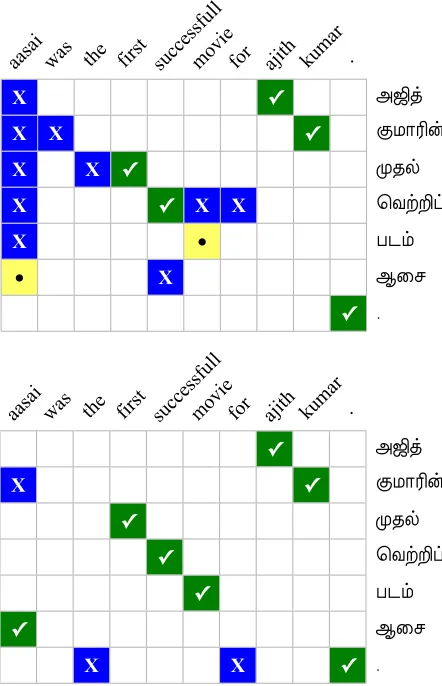
Inconsistent orthography fragments the training data, exacerbating problems already present due to morpohological richness. One place this is mani-fested is during alignment, where different spellings mask patterns from the standard alignment tech-niques. We observe a large number of poor align-ments, due to interactions among these problems, as well as the small size of the training data, well-documented alignment mistakes (such as garbage collecting), and the divergent sentence structures. In particular, it seems that the defacto alignment heuris-tics may be particularly ill-suited to these language
pairs and data conditions. Figure 6 (top) contains an example of a particularly poor alignment produced by the default alignment heuristic, the grow-diag-andmethod described in Koehn et al. (2003).
As a means of testing this, we varied the align-ment combination heuristics using five alternatives described in Koehn et al. (2003) and available in the
symal program distributed with Moses (Koehn et al., 2007). Experiments on Tamil produce a range of BLEU scores between 7.45 and 10.19 (each result is the average of three MERT runs). If we plot gram-mar size versus BLEU score, we observe a general trend that larger grammars seem to positively cor-relate with BLEU score. We tested this more gen-erally across languages using the Berkeley aligner5 (Liang et al., 2006) instead of GIZA alignments, and found a consistent increase in BLEU score for the Hiero grammars, often putting them on par with the original SAMT results (Table 9). Manual analysis suggests that the Berkeley aligner produces fewer, more reasonable-looking alignments than the Moses heuristics (Figure 6). This suggest a fruitful ap-proaches in revisiting assumptions underlying align-ment heuristics.
6 Related Work
Crowdsourcing datasets has been found to be helpful for many tasks in natural language processing. Ger-mann (2001) showed that humans could perform sur-prisingly well with very poor translations obtained from non-expert translators, in part likely because coarse-level translational adequacy is sufficient for the tasks they evaluated. That work was also pitched as a rapid resource acquisition task, meant to test our ability to quickly build systems in emergency set-tings. This work further demonstrates the ability to quickly acquire training data for MT systems with
X ✓
X X ✓
X X ✓
X ✓ X X
X
•
•
X✓
அ"# $மா'( )த+ ெவ./0 பட3 ஆைச
.
aasai was the first succe ssful
l
movi e
for ajith kum ar
.
✓
X ✓
✓ ✓
✓ ✓
X X ✓
aasai was the first succe
ssful l
movi e
for ajith kum ar
.
அ"# $மா'( )த+ ெவ./0 பட3 ஆைச
[image:8.612.308.539.57.171.2].
Figure 6: A bad Tamil alignment produced with the
grow-diag-andalignment combination heuristic (top); the Berkeley aligner is better (bottom). A ✓ is a correct guess, an X marks a false positive, and a • denotes a false negative. Hiero’s extraction heuristics yield 4 rules for the top alignment and 16 for the bottom.
reasonable translation accuracy.
Closely related to our work here is that of Novot-ney and Callison-Burch (2010), who showed that transcriptions for training speech recognition sys-tems could be obtained from Mechanical Turk with near baseline recognition performance and at a sig-nificantly lower cost. They also showed that redun-dant annotation was not worthwhile, and suggested that money was better spent obtaining more data. Separately, Ambati and Vogel (2010) probed the MTurk worker pool for workers capable of translat-ing a number of low-resource languages, includtranslat-ing Hindi, Telugu, and Urdu, demonstrating that such workers could be found and quantifying acceptable
grammar size
pair GIZA++ Berkeley BLEU gain
Bengali 15m 27m 13.54 +0.82 Hindi 34m 60m 16.47 +0.94
Malayalam 12m 27m 12.70 -1.02
Tamil 19m 30m 10.10 +0.29 Telugu 28m 46m 13.36 +0.90
[image:8.612.77.298.62.405.2]Urdu 38m 58m 20.41 +0.88
Table 9: Hiero translation results using Berkeley align-ments instead of GIZA++ heuristics. Thegaincolumns denotes improvements relative to the Hiero systems in Ta-ble 5. In many cases (boldgains), the BLEU scores are at or above even the SAMT models from that table.
wages and collection rates.
The techniques described here are similar to those described in Zaidan and Callison-Burch (2011), who showed that crowdsourcing with appropriate quality controls could be used to produce professional-level translations for Urdu-English translation. This pa-per extends that work by applying their techniques to a larger set of Indian languages and scaling it to training-data-set sizes.
7 Summary
We have described the collection of six parallel cor-pora containing four-way redundant translations of the source-language text. The Indian languages of these corpora are low-resource and understudied, and exhibit markedly different linguistic properties compared to English. We performed baseline exper-iments quantifying the translation performance of a number of systems, investigated the effect of data quality on model quality, and suggested a number of approaches that could improve the quality of models constructed from the datasets. The parallel corpora provide a suite of SOV languages for translation re-search and experiments.
References
Vamshi Ambati and Stephan Vogel. 2010. Can crowds build parallel corpora for machine translation systems? InProceedings of the NAACL HLT 2010 Workshop on Creating Speech and Language Data with Amazon’s Mechanical Turk, Los Angeles, California.
David Chiang. 2007. Hierarchical phrase-based transla-tion.Computational Linguistics, 33(2):201–228. Jonathan H. Clark, Chris Dyer, Alon Lavie, and Noah A.
Smith. 2011. Better hypothesis testing for statistical machine translation: Controlling for optimizer insta-bility. InACL, pages 176–181. Association for Com-putational Linguistics.
Michel Galley, Mark Hopkins, Kevin Knight, and Daniel Marcu. 2004. What’s in a translation rule? InProc. NAACL, Boston, Massachusetts, USA, May.
Michel Galley, Jonathan Graehl, Kevin Knight, Daniel Marcu, Steve DeNeefe, Wei Wang, and Ignacio Thayer. 2006. Scalable inference and training of context-rich syntactic translation models. In Proc. ACL, Sydney, Australia, July.
Ulrich Germann. 2001. Building a statistical ma-chine translation system from scratch: how much bang for the buck can we expect? In ACL work-shop on Data-driven methods in machine translation, Toulouse, France, July. Association for Computational Linguistics.
Philipp Koehn, Franz Josef Och, and Daniel Marcu. 2003. Statistical phrase-based translation. InProc. NAACL, Edmonton, Alberta, Canada, May–June. Philipp Koehn, Hieu Hoang, Alexandra Birch, Chris
Callison-Burch, Marcello Federico, Nicola Bertoldi, Brooke Cowan, Wade Shen, Christine Moran, Richard Zens, Chris Dyer, Ondřej Bojar, Alexandra Constantin, and Evan Herbst. 2007. Moses: Open source toolkit for statistical machine translation. InProceedings of the Annual Meeting of the ACL on Interactive Poster and Demonstration Sessions, Prague, Czech Republic, June.
Philipp Koehn. 2005. Europarl: A parallel corpus for statistical machine translation. InMachine translation summit.
Shankar Kumar and William Byrne. 2004. Minimum bayes-risk decoding for statistical machine translation. InProc. NAACL, Boston, Massachusetts, USA, May. M. Paul Lewis, editor. 2009. Ethnologue: Languages of
the World. SIL International, Dallas, TX, USA, six-teenth edition.
Percy Liang, Ben Taskar, and Dan Klein. 2006. Align-ment by agreeAlign-ment. InHLT-NAACL, pages 104–111. Association for Computational Linguistics.
Scott Novotney and Chris Callison-Burch. 2010. Cheap, fast and good enough: Automatic speech recognition
with non-expert transcription. InProc. NAACL, Los Angeles, California, June.
Franz Josef Och. 2003. Minimum error rate training in statistical machine translation. InProc. ACL, Sapporo, Japan, July.
Jonathan Weese, Juri Ganitkevitch, Chris Callison-Burch, Matt Post, and Adam Lopez. 2011. Joshua 3.0: Syntax-based machine translation with the thrax gram-mar extractor. InProceedings of the Sixth Workshop on Statistical Machine Translation.
Omar F. Zaidan and Chris Callison-Burch. 2011. Crowd-sourcing translation: professional quality from non-professionals. InProc. ACL, Portland, Oregon, USA, June.
Omar F. Zaidan. 2009. Z-MERT: A fully configurable open source tool for minimum error rate training of machine translation systems. The Prague Bulletin of Mathematical Linguistics, 91:79–88.
Rabih Zbib, Erika Malchiodi, Jacob Devlin, David Stallard, Spyros Matsoukas, Richard Schwartz, John Makhoul, Omar F. Zaidan, and Chris Callison-Burch. 2012. Machine translation of arabic dialects. InProc. NAACL, Montreal, June.
Andreas Zollmann and Ashish Venugopal. 2006. Syntax augmented machine translation via chart parsing. In