The UI System in the HOO 2012 Shared Task on Error Correction
Alla Rozovskaya Mark Sammons Dan Roth
Cognitive Computation Group University of Illinois at Urbana-Champaign
Urbana, IL 61801
{rozovska,mssammon,danr}@illinois.edu
Abstract
We describe the University of Illinois (UI) sys-tem that participated in the Helping Our Own (HOO) 2012 shared task, which focuses on correcting preposition and determiner errors made by non-native English speakers. The task consisted of three metrics: Detection, Recognition, and Correction, and measured performance before and after additional revi-sions to the test data were made. Out of 14 teams that participated, our system scored first in Detection and Recognition and second in Correction before the revisions; and first in Detection and second in the other metrics af-ter revisions. We describe our underlying ap-proach, which relates to our previous work in this area, and propose an improvement to the earlier method, error inflation, which results in significant gains in performance.
1 Introduction
The task of correcting grammar and usage mistakes made by English as a Second Language (ESL) writ-ers is difficult: many of these errors are context-sensitive mistakes that confuse valid English words and thus cannot be detected without considering the context around the word.
Below we show examples of two common ESL mistakes considered in this paper:
1. “Nowadays∅*/theInternet makes us closer and closer.”
2. “I can seeat*/onthe list a lot of interesting sports.”
In (1), the definite article is incorrectly omitted. In (2), the writer uses an incorrect preposition.
This paper describes the University of Illinois sys-tem that participated in the HOO 2012 shared task on error detection and correction in the use of prepo-sitions and determiners (Dale et al., 2012). Fourteen teams took part in the the competition. The scoring included three metrics: Detection, Recognition, and Correction, and our team scored first or second in each metric (see Dale et al. (2012) for details).
The UI system consists of two components, a de-terminer classifier and a preposition classifier, with a common pre-processing step that corrects spelling mistakes. The determiner system builds on the ideas described in Rozovskaya and Roth (2010c). The preposition classifier uses a combined system, build-ing on work described in Rozovskaya and Roth (2011) and Rozovskaya and Roth (2010b).
Both the determiner and the preposition systems apply the method proposed in our earlier work, which uses the error distribution of the learner data to generate artificial errors in training data. The orig-inal method was proposed for adding artificial er-rors when training on native English data. In this task, however, we apply this method when training on annotated ESL data. Furthermore, we introduce an improvement that is conceptually simple but very effective and which also proved to be successful in an earlier error correction shared task (Dale and Kil-garriff, 2011; Rozovskaya et al., 2011). We identify the unique characteristics of the error correction task and analyze the limitations of existing approaches to error correction that are due to these characteristics. Based on this analysis, we propose theerror infla-tionmethod (Sect. 6.2).
In this paper, we first briefly discuss the task
tion 2) and present our overall approach (Section 3. Next, we describe the spelling correction mod-ule (Section 4). Section 5 provides an overview of the training approaches for error correction tasks. We present the inflation method in Section 6. Next, we describe the determiner error correction system (Section 7), and the preposition error correction module (Section 8). In Section 9, we present the performance results of our system in the competi-tion. We conclude with a brief discussion (Section 10).
2 Task Description
The HOO 2012 shared task focuses on correcting determiner and preposition errors made by non-native speakers of English. These errors are some of the most common and also some of the most difficult for ESL learners (Leacock et al., 2010); even very advanced learners make these mistakes (Rozovskaya and Roth, 2010a).
The training data released by the task organizers comes from the publicly available FCE corpus (Yan-nakoudakis et al., 2011). The original FCE data set contains 1244 essays written by non-native English speakers and is corrected and error-tagged using a detailed error classification schema. The HOO train-ing data contains 1000 of those files.1 The test data for the task consists of an additional set of 100 stu-dent essays, different from the 1244 above.
Since the HOO task focuses on determiner and preposition mistakes, only annotations marking preposition and determiner mistakes were kept. Note that while the other error annotations were removed, the errors still remain in the HOO data. More details can be found in Dale et al. (2012).
3 System Overview
Our system consists of two components that address individually article2 and preposition errors and use the same pre-processing.
1In addition, the participating teams were allowed to use for training the remaining 244 files of this corpus, as well as any other data. We also use a publicly available data set of native English, Google Web 1T corpus (Brants and Franz, 2006), in one of our models.
2
We will use the terms ‘article-’ and ‘determiner errors’ in-terchangeably: article errors constitute the majority of deter-miner errors, and we address only article mistakes.
The first pre-processing step is correcting spelling errors. Since the essays were written by students of English as a Second language, and these essays were composed on-the-fly, they contain a large number of spelling errors. These errors add noise to the context around the target word (article or preposition). Good context is crucial for robust detection and correction of article and preposition mistakes.
After spelling errors are corrected, we run a sen-tence splitter, part-of-speech tagger3 and shallow parser4 (Punyakanok and Roth, 2001) on the data. Both the article and the preposition systems use fea-tures based on the output of these tools.
We made a 244-document subset of the FCE data a held-out set for development. The results in Sec-tions 7 and 8 give performance on this held-out set, where we use the HOO data (1000 files) for train-ing. The actual performance in the task (Section 9) reflects the system trained on the whole set of 1244 documents.
Our article and preposition modules build on the elements of the systems described in Rozovskaya and Roth (2010b), Rozovskaya and Roth (2010c) and Rozovskaya and Roth (2011). All article sys-tems are trained using the Averaged Perceptron (AP) algorithm (Freund and Schapire, 1999), im-plemented within Learning Based Java (Rizzolo and Roth, 2010). Our preposition systems combine the AP algorithm with the Na¨ıve Bayes (NB) classifier with prior parameters adapted to the learner data (see Section 5). The AP systems are trained using theinflationmethod (see Section 6.2).
We submitted 10 runs. All of our runs achieved comparable performance. Sections 7 and 8 describe our modules.
4 Correcting Spelling Errors
Analysis of the HOO data made clear the need for a variety of corrections beyond the immediate scope of the current evaluation. When a mistake occurs in the vicinity of a target (i.e. preposition or article) er-ror, it may result in local cues that obscure the nature of the desired correction.
3http://cogcomp.cs.illinois.edu/page/
software view/POS
4http://cogcomp.cs.illinois.edu/page/
The following example illustrates such a problem: “In my opinion your parents should be arrive in the first party of the month becouse we could be go in meeting with famous writer, travelled and journalist who wrote book about Ethiopia.”
In this sample sentence, there are multiple errors in close proximity: the misspelled wordbecouse; the verb formshould be arrive; the use of the wordparty
instead ofpart; the verbtravelledinstead of a noun form; an incorrect prepositionin(in meeting).
The context thus contains a considerable amount of noise that is likely to negatively affect system per-formance. To address some of these errors, we run a standard spell-checker over the data.
We use Jazzy5, an open-source Java spell-checker. The distribution, however, comes only with a US English dictionary, which also has gaps in its cov-erage of the language. The FCE corpus prefers UK English spelling, so we use a mapping from US to UK English6 to automatically correct the original dictionary. We also keep the converted US spelling, since our preposition module makes use of native English data, where the US spelling is prevalent.
The Jazzy API allows the client to query a word, and get a list of candidate corrections sorted in or-der of edit distance from the original term. We take the first suggestion and replace the original word. The resulting substitution may be incorrect, which may in turn mislead the downstream correc-tion components. However, manual evaluacorrec-tion of the spelling corrections suggested about 80% were appropriate, and experimental evaluation on the cor-pus development set indicated a modest overall im-provement when the spell-checked documents were used in place of the originals.
5 Training for Correction Tasks
The standard approach to correcting context-sensitive ESL mistakes follows the methodology of thecontext-sensitive spelling correctiontask that ad-dresses such misspellings astheir and there (Carl-son et al., 2001; Golding and Roth, 1999; Golding and Roth, 1996; Carlson and Fette, 2007; Banko and Brill, 2001).
Following Rozovskaya and Roth (2010c), we
dis-5
http://jazzy.sourceforge.net/ 6
http://www.tysto.com/articles05/q1/20050324uk-us.shtml
tinguish between two training paradigms in ESL er-ror correction, depending on whether the author’s original word choice is used in training as a feature. In the standardcontext-sensitive spelling correction
paradigm, the decision of the classifier depends only on the context around the author’s word, e.g. arti-cle or preposition, and the author’s word itself is not taken into consideration in training.
Mistakes made by non-native speakers obey cer-tain regularities (Lee and Seneff, 2008; Rozovskaya and Roth, 2010a). Adding knowledge about typ-ical errors to a model significantly improves its performance (Gamon, 2010; Rozovskaya and Roth, 2010c; Dahlmeier and Ng, 2011). Typical errors may refer both to speakers whose first language is L1and to specific authors. For example, non-native speakers whose first language does not have articles tend to make more articles errors in English (Ro-zovskaya and Roth, 2010a).
Since non-native speakers’ mistakes are system-atic, the author’s word choice (the source word) carries a lot of information. Models that use the
sourceword in training (Han et al., 2010; Gamon, 2010; Dahlmeier and Ng, 2011) learn which errors are typical for the learner and thus significantly out-perform systems that only look at context. We call these modelsadapted. Training adapted models re-quires annotated data, since in native English data the source word is always correct and thus cannot be used by the classifier.
In this work, we use two methods of adapting a model to typical errors that have been proposed ear-lier. Both methods were originally developed for models trained on native English data: they use a small amount of annotated ESL data to generate er-ror statistics. Theartificial errorsmethod is based on generating artificial errors7in correct native En-glish training data. The method was implemented within the Averaged Perceptron (AP) algorithm (Ro-zovskaya and Roth, 2010c; Ro(Ro-zovskaya and Roth, 2010b), a discriminative learning algorithm, and this is the algorithm that we use in this work. The NB-priorsmethod is a special adaptation technique for the Na¨ıve Bayes algorithm (Rozovskaya and Roth, 2011). While NB-priors improves both precision
and recall, the artificial errors approach suffers from low recall due to error sparsity (Sec. 6.1).
In this work, in the preposition correction task, we use theNB-priorsmethod without modifications (as described in the original paper). We use the ar-tificial errorsapproach both for article and prepo-sition error correction but with two important mod-ifications: we train on annotated ESL data instead of native data, and use the proposederror inflation
method (described in Section 6) to increase the error rate in training.
6 Error Inflation
In this section, we show why AP (Freund and Schapire, 1999), a discriminative classifier, is sen-sitive to the error sparsity of the data, and propose a method that addresses the problems raised by this sensitivity.
6.1 Error Sparsity and Low Recall
The low recall of the AP algorithm is related to the nature of the error correction tasks, which exhibit low error rates. Even for ESL writers, over 90% of their preposition and article usage is correct, which makes the errors very sparse (Rozovskaya and Roth, 2010c). The low recall problem is, in fact, a special case of a more general problem where there is one or a small group of dominant features that are very strongly correlated with the label. In this case, the system tends to predict the label that matches this feature, and tends to not predict it when that fea-ture is absent. In error correction, which tends to have a very skewed label distribution, this results in very few errors being detected by the system: when training on annotated data with naturally occurring errors and using the source word as a feature, the system will learn that in the majority of cases the source word corresponds to the label, and will tend to over-predict it, which will result in low recall.
In theartificial errors approach, errors are sim-ulated according to real observed mistakes. Ta-ble 1 shows a sample confusion matrix based on preposition mistakes in the FCE corpus; we show four rows, but the entire table contains 17 rows and columns, one for each preposition, and each entry showsP rob(pi|pj), the probability that the author’s preposition ispi given that the correct preposition
ispj. The matrix also shows the preposition count for each source and label in the data set. Given the entire matrix and the counts, it is also possible to generate the matrix in the other direction and obtain P rob(pj|pi), the probability that the correct prepo-sition ispj given that the author’s preposition ispi. This other matrix is used for adapting NB with the priors method.
The confusion matrix is sparse and shows that the distribution of alternatives for each source preposi-tion is very different from that of the others. This strongly suggests that these errors are systematic. Additionally, most prepositions are used correctly, so the error rate is very low (the error rate can be estimated by looking at the matrix diagonal in the table; for example, the error rate for the preposition
aboutis lower than forinto, since 94.4% of the oc-currences of labelaboutare correct, but only 76.8% of labelintoare correct).
The artificial errors thus model the two proper-ties that we mentioned: the confusability of differ-ent preposition pairs and the low error rate, and the artificial errors are similarly sparse.
6.2 The Error Inflation Method
Two extreme choices for solving the low recall prob-lem due to error sparsity are: (1) training without the
source wordfeature or (2) training with this feature, where the classifier relies on it too much. Models trained without the source feature have very poor precision. While theNB-priors method does have good recall, our expectation is that with the right ap-proach, a discriminative classifier will also improve recall, but maintain higher precision as well.
er-Label Sources
on about into with as at by for from in of over to
(648) (700) (54) (733) (410) (880) (243) (1394) (515) (2213) (1954) (98) (1418)
on (598) 0.846 0.003 0.003 0.008 0.013 - 0.003 0.022 - 0.076 0.013 0.001 0.009
about (686) 0.004 0.944 - 0.007 - - - 0.022 0.005 0.002 0.016 0.001
-into (55) 0.001 - 0.768 - - - 0.011 0.011 - 0.147 - - 0.053
[image:5.612.80.534.61.127.2]with (710) 0.001 0.006 - 0.934 - 0.001 0.007 0.004 0.001 0.027 0.003 - 0.015
Table 1: Confusion matrix for preposition errors. Based on data from the FCE corpus for top 17 most frequent English prepositions. The left column shows the correct preposition. Each row shows the author’s preposition choices for that label and
P rob(source|label). The sourcesamong,between,underandwithinare not shown for lack of space; they all have 0 probabilities in the matrix. The numbers next to the targets show the count of the label (or source) in the data set.
ror knowledge ensures that high precision is main-tained. This method causes the classifier to rely on the sourcefeature less and increases the contribu-tion of the features based on context. The learning algorithm therefore finds a more optimal balance be-tween thesourcefeature and the context features.
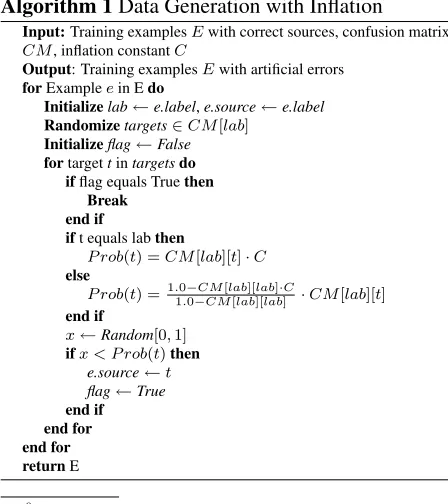
Algorithm 1 shows the pseudo-code for generat-ing traingenerat-ing data; it takes as input traingenerat-ing examples, the confusion matrixCM as shown in Table 1, and the inflation constant, and generates artificial source features for correct training examples.8 An infla-tion constant value of 1.0 simulates learner mistakes without inflation. Table 2 shows the proportion of artificial errors created in training using the inflation method for different inflation rates.
Algorithm 1Data Generation with Inflation
Input:Training examplesEwith correct sources, confusion matrix
CM, inflation constantC
Output: Training examplesEwith artificial errors
forExampleein Edo
Initializelab←e.label,e.source←e.label
Randomizetargets∈CM[lab]
Initializeflag←False
fortargettintargetsdo ifflag equals Truethen
Break end if
ift equals labthen
P rob(t) =CM[lab][t]·C
else
P rob(t) =11.0.−0−CMCM[lab[lab][][lablab]·]C·CM[lab][t]
end if
x←Random[0,1]
ifx < P rob(t)then
e.source←t
flag←True
end if end for end for returnE
8
When training on native English data, all examples are cor-rect. When training on annotated learner data, some examples will contain naturally occurring mistakes.
Inflation rate
1.0 (Regular) 0.9 0.8 0.7 0.6 0.5
[image:5.612.74.298.419.671.2]7.7% 15.1% 22.6% 30.1% 37.5% 45.0%
Table 2: Artificial errors. Proportion of generated artificial preposition errors in training using the inflation method (based on the FCE corpus).
7 Determiners
Table 4 shows the distribution of determiner errors in the HOO training set. Even though the majority of determiner errors involve article mistakes, 14% of errors are personal and possessive pronouns.9 Most of the determiner errors involve omitting an article. Similar error patterns have been observed in other ESL corpora (Rozovskaya and Roth, 2010a).
Our system focuses on article errors. Because the majority of determiner errors are omissions, it is very important to target this subset of mistakes. One approach would be to consider every space as a pos-sible article insertion point. However, this method will likely produce a lot of noise. The standard approach is to consider noun-phrase-initial contexts (Han et al., 2006; Rozovskaya and Roth, 2010c).
Error type Example
Repl. 15.7% “Can you send methe*/a letter back writing what happened to you recently.”
Omis. 57.5% “Nowadays∅*/theInternet makes us closer and closer.”
Unnec. 26.8% “One of my hobbies isthe*/∅photography.”
Table 4: Distribution of determiner errors in the HOO training data.
9
[image:5.612.314.539.564.623.2]Feature Type Description
Word n-grams wB, w2B, w3B, wA, w2A, w3A, wBwA, w2BwB, wAw2A, w3Bw2BwB, w2BwBwA, wBwAw2A,
wAw2Aw3A,w4Bw3Bw2BwB,w3w2BwBwA,w2BwBwAw2A,wBwAw2Aw3A,wAw2Aw3w4A
POS features pB,p2B,p3B,pA,p2A,p3A,pBpA,p2BpB,pAp2A,pBwB,pAwA,p2Bw2B,p2Aw2A,p2BpBpA,pBpAp2A,
pAp2Ap3A
N P1 headW ord,npWords,NC,adj&headWord,adjTag&headWord,adj&NC,adjTag&NC,npTags&headWord,npTags&NC
N P2 headWord&headPOS,headNumber
wordsAfterNP headWord&wordAfterNP, npWords&wordAfterNP, headWord&2wordsAfterNP, npWords&2wordsAfterNP, headWord&3wordsAfterNP,npWords&3wordsAfterNP
[image:6.612.77.539.59.177.2]wordBeforeNP wB&fi∀i∈N P1 Verb verb,verb&fi∀i∈N P1 Preposition prep&fi∀i∈N P1
Table 3: Features used in the article error correction system. wBandwAdenote the word immediately before and after the target, respectively; andpBandpAdenote the POS tag before and after the target. headWorddenotes the head of the NP complement.N Cstands for noun compound and is active if second to last word in the NP is tagged as a noun.Verbfeatures are active if the NP is the direct object of a verb.Prepositionfeatures are active if the NP is immediately preceded by a preposition.adj feature is active if the first word (or the second word preceded by an adverb) in the NP is an adjective.npWordsandnpTagsdenote all words (POS tags) in the NP.
7.1 Determiner Features
The features are presented in Table 3. The model also uses thesourcearticle as a feature.
7.2 Training the Determiner System
Model Detection Correction
AP (natural errors) 30.75 28.97
AP (inflation) 34.62 32.02
Table 5:Article development results: AP with inflation.The performance shows the F-Score for the 244 held-out documents of the original FCE data set. AP with inflation uses the constant value of 0.8.
The article classifier is based on the artificial er-rors approach (Rozovskaya and Roth, 2010c). The original method trains a system on native English data. The current setting is different, since the FCE corpus contains annotated learner errors. Since the errors are sparse, we use theerror inflationmethod (Section 6.2) to boost the proportion of errors in training using the error distribution obtained from the same training set. The effectiveness of this method is demonstrated by the system performance: we obtain the top or second result in every metric. Note also that the article system does not use addi-tional data for training.
Table 5 compares the performance of the system trained on natural errors with the performance of the system trained with the inflation method. We found that any value of the inflation constant between 0.9 and 0.5 will give a boost in performance. We use
several values; the top determiner model uses the in-flation constant of 0.8.
[image:6.612.105.265.362.392.2]8 Prepositions
Table 6 shows the distribution of the three types of preposition errors in the HOO training data. The FCE annotation distinguishes between preposition mistakes and errors involving the infinitive marker
to, e.g. “He wants∅*/to go there.”, which are anno-tated as verb errors. Since in the competition only article and preposition annotations are kept, these errors are not annotated, and thus we do not target these mistakes.
Error type Example
Repl. 57.9% “I can seeat*/onthe list a lot of interesting sports.”
Omis. 24.0% “I will be waiting∅*/foryour call.”
Unnec. 18.1% “Despiteof*/∅being tiring , it was rewarding”
Table 6:Distribution of preposition errors in the HOO training data.
To detect missing preposition errors, we use a set of rules, mined from the training data, to identify possible locations where a preposition might have been incorrectly omitted. Below we show examples of such contexts.
• “I will be waiting∅*/foryour call.”
• “But now we use planes to go∅*/tofar places.”
8.1 Preposition Features
Feature Type Description
Word n-ngram features in the 4-word window around the target
wB,w2B,w3B ,wA,w2A,w3A,wBwA,w2BwB,wAw2A,w3Bw2BwB,
w2BwBwA, wBwAw2A, wAw2Aw3A, w4Bw3Bw2BwB, w3w2BwBwA,
w2BwBwAw2A,wBwAw2Aw3A,wAw2Aw3w4A Preposition complement features compHead,wB&compHead,w2BwB&compHead
Table 7: Features used in the preposition error correction system. wBandwAdenote the word immediately before and after the target, respectively; the other features are defined similarly.compHeaddenotes the head of the preposition complement. wB&compHead,w2BwB&compHeadare feature conjunctions ofcompHeadwithwBandw2BwB, respectively.
the target preposition, and three features that use the head of the preposition complement (see Table 7). The NB-priors classifier, which is part of our model, can only make use of the word n-gram features; it uses n-gram features of lengths 3, 4, and 5. AP is trained on the HOO data and uses n-grams of lengths 2, 3, and 4, the head complement features, and the author’s preposition as a feature.
Model Detection Correction
AP (inflation) 34.64 27.51
NB-priors 38.76 26.57
[image:7.612.343.507.343.375.2]Combined 41.27 29.35
Table 8: Preposition development results: performance of individual and combined systems. The performance shows the F-Score for the 244 held-out documents of the original FCE data set.
8.2 Training the Preposition System
We train two systems. The first one is an AP model trained on the FCE data with inflation (similar to the article system). Correcting preposition errors re-quires more data to achieve performance compara-ble to article error correction, due to the task com-plexity (Gamon, 2010). Moreover, given that the development and test data are quite different,10 it
makes sense to use a model that is independent of those, to avoid overfitting. We combine the AP model with a model trained on native English data. Our second system is an NB-priors classifier trained on the the Google Web 1T 5-gram corpus (Brants and Franz, 2006). We use training data to replace the prior parameters of the model (see Rozovskaya and Roth, 2011 for more detail). The NB-priors model does not target preposition omissions.
10
The data contains essays written on prompts, so that the training data may contain several essays written on the same prompt and thus will be very similar in content. In contrast, we expected that the test data will likely contain essays on a different set of prompts.
The NB-priors model outperforms the AP classi-fier. The two models are also very different due to the different learning algorithms and the type of the data used in training. Our final preposition model is thus a combination of these two, where we take as the base the decisions of the NB-priors classifier and add the AP model predictions for cases when the base model does not flag a mistake. Table 8 shows the results. The combined model improves both the detection and correction scores. Our prepo-sition system ranked first in detection and recogni-tion and second in correcrecogni-tion.
Model Detection Correction
AP (natural errors) 13.50 12.73
AP (inflation) 21.31 32.02
Table 9: Preposition development results: AP with infla-tion.The performance shows the F-Score for the 244 held-out documents of the original FCE data set. AP with inflation uses the constant value of 0.7.
9 Test Performance
A number of revisions were made to the test data based on the input from the participating teams af-ter the initial results were obtained, where each team submitted proposed edits to correct annotation mis-takes. We show both results.
Table 10 shows results before the revisions were made. Row 1 shows the performance of the de-terminer system for the three metrics. This system achieved the best score in correction, and the second best scores in detection and recognition. The system is described in Section 7.2, with the exception that the final system for the article correction is trained on the entire FCE data set.
Model Detection Recognition Correction
Precision Recall F-Score Precision Recall F-Score Precision Recall F-Score
Articles 40.00 37.79 38.862 38.05 35.94 36.972 35.61 33.64 34.601
Prepositions 38.21 45.34 41.471 31.05 40.25 35.061 20.36 24.15 22.092
[image:8.612.118.498.30.80.2]Combined 37.22 43.71 40.201 34.23 36.64 35.391 26.39 28.26 27.292
Table 10: Performance on test before revisions. Results are shown before revisions were made to the data. The rank of the system is shown as a superscript.
Model Detection Recognition Correction
Precision Recall F-Score Precision Recall F-Score Precision Recall F-Score
Articles 43.90 39.30 41.472 45.98 34.93 39.702 41.46 37.12 39.172
Prepositions 41.43 47.54 44.271 37.14 42.62 39.691 26.79 30.74 28.632
[image:8.612.111.503.123.176.2]Combined 43.56 42.92 43.241 38.97 39.96 39.462 32.58 33.40 32.992
Table 11:Performance on test after revisions.Results are shown after revisions were made to the data. The rank of the system is shown as a superscript.
preposition system achieved the best scores in detec-tion and recognidetec-tion, scoring second in correcdetec-tion.
Row 3 shows the performance of the combined system. This system was ranked first in detection and recognition, and second in correction.
Table 11 shows our performance after the revi-sions were applied.
10 Discussion
The HOO 2012 shared task follows the HOO 2011 pilot shared task (Dale and Kilgarriff, 2011), where the data was fully corrected and error-tagged and the participants could address any types of mistakes. The current task allows for comparison of individ-ual systems for each error type considered. This is important, since to date it has been difficult to com-pare different systems due to the lack of a bench-mark data set.
The data used for the shared task has many errors besides the preposition and determiner errors; the annotations for these have been removed. One un-desirable consequence of this approach is that some complex errors that involve either an article or a preposition mistake but depend on other corrections on neighboring words, e.g. a noun of a verb, may result in ungrammatical sequences.
Clearly, the task of annotating all requisite correc-tions is a daunting task, and it is preferable to iden-tify subsets of these corrections that can be tackled somewhat independently of the rest, and these more complex cases present a problem.
To address these conflicting needs, we propose that the scope of all “final” corrections be marked, without necessarily specifying all individual correc-tions necessary to transform the original text into
correct English. Edits that plausibly require correc-tions to their context to resolve correctly could then be treated asout of scope, and ignored by spelling correction systems even though in other contexts, those same edits would beinscope.
11 Conclusion
We have demonstrated how a competitive system for preposition and determiner error correction can be built using techniques that address the error sparsity of the data and the overfitting problem. We built on our previous work and presented the error inflation method that can be applied to the earlier proposed artificial errors approach to boost recall. Our de-terminer system used error inflation and trained a model using only the annotated FCE corpus. Our preposition system combined the FCE-trained sys-tem with a native-data model that was adapted to learner errors, using the NB-priors approach pro-posed earlier. Both of the systems showed compet-itive performance, scoring first or second in every task ranking.
Acknowledgments
The authors thank Jeff Pasternack for his assistance and Vivek Srikumar for helpful feedback. This research is supported by a grant from the U.S. Department of Education and is partly supported by the Defense Advanced Research Projects Agency (DARPA) Machine Reading Program under Air Force Research Laboratory (AFRL) prime contract no. FA8750-09-C-018.
References
of 39th Annual Meeting of the Association for Com-putational Linguistics (ACL), pages 26–33, Toulouse, France, July.
T. Brants and A. Franz. 2006.Web 1T 5-gram Version 1. Linguistic Data Consortium, Philadelphia, PA. A. Carlson and I. Fette. 2007. Memory-based
context-sensitive spelling correction at web scale. InProc. of the IEEE International Conference on Machine Learn-ing and Applications (ICMLA).
A. Carlson, J. Rosen, and D. Roth. 2001. Scaling up context sensitive text correction. InProceedings of the National Conference on Innovative Applications of Ar-tificial Intelligence (IAAI), pages 45–50.
D. Dahlmeier and H. T. Ng. 2011. Grammatical er-ror correction with alternating structure optimization. InProc. of the 49th Annual Meeting of the Associa-tion for ComputaAssocia-tional Linguistics: Human Language Technologies (ACL), pages 915–923, Portland, Ore-gon, USA, June. Association for Computational Lin-guistics.
R. Dale and A. Kilgarriff. 2011. Helping Our Own: The HOO 2011 pilot shared task. InProc. of the 13th European Workshop on Natural Language Generation (ENLG), pages 242–249, Nancy, France.
R. Dale, I. Anisimoff, and G. Narroway. 2012. A re-port on the preposition and determiner error correction shared task. InProc. of the NAACL HLT 2012 Sev-enth WorkshopWorkshop on Innovative Use of NLP for Building Educational Applications, Montreal, Canada, June. Association for Computational Linguistics. Y. Freund and R. E. Schapire. 1999. Large margin
clas-sification using the perceptron algorithm. Machine Learning, 37(3):277–296.
M. Gamon. 2010. Using mostly native data to correct errors in learners’ writing. InProc. of the 2010 An-nual Conference of the North American Chapter of the Association for Computational Linguistics: Human Language Technologies (NAACL), pages 163–171, Los Angeles, California, June.
A. R. Golding and D. Roth. 1996. Applying Win-now to context-sensitive spelling correction. InProc. of the International Conference on Machine Learning (ICML), pages 182–190.
A. R. Golding and D. Roth. 1999. A Winnow based approach to context-sensitive spelling correction. Ma-chine Learning, 34(1-3):107–130.
N. Han, M. Chodorow, and C. Leacock. 2006. Detecting errors in English article usage by non-native speakers. Journal of Natural Language Engineering, 12(2):115– 129.
N. Han, J. Tetreault, S. Lee, and J. Ha. 2010. Us-ing an error-annotated learner corpus to develop and ESL/EFL error correction system. InProc. of the Sev-enth conference on International Language Resources
and Evaluation (LREC), Valletta, Malta, May. Euro-pean Language Resources Association (ELRA). C. Leacock, M. Chodorow, M. Gamon, and J. Tetreault.
2010. Automated Grammatical Error Detection for Language Learners. Morgan and Claypool Publish-ers.
J. Lee and S. Seneff. 2008. An analysis of grammatical errors in non-native speech in English. InProc. of the 2008 Spoken Language Technology Workshop, Goa. V. Punyakanok and D. Roth. 2001. The use of
classi-fiers in sequential inference. In The Conference on Advances in Neural Information Processing Systems (NIPS), pages 995–1001. MIT Press.
N. Rizzolo and D. Roth. 2010. Learning based java for rapid development of nlp systems. InProceedings of the International Conference on Language Resources and Evaluation (LREC), Valletta, Malta, 5.
A. Rozovskaya and D. Roth. 2010a. Annotating ESL er-rors: Challenges and rewards. InProc. of the NAACL HLT 2010 Fifth Workshop on Innovative Use of NLP for Building Educational Applications, pages 28–36, Los Angeles, California, June. Association for Com-putational Linguistics.
A. Rozovskaya and D. Roth. 2010b. Generating confu-sion sets for context-sensitive error correction. In Pro-ceedings of the 2010 Conference on Empirical Meth-ods in Natural Language Processing (EMNLP), pages 961–970, Cambridge, MA, October. Association for Computational Linguistics.
A. Rozovskaya and D. Roth. 2010c. Training paradigms for correcting errors in grammar and usage. InProc. of the Annual Conference of the North American Chap-ter of the Association for Computational Linguistics: Human Language Technologies (NAACL), pages 154– 162, Los Angeles, California, June. Association for Computational Linguistics.
A. Rozovskaya and D. Roth. 2011. Algorithm selec-tion and model adaptaselec-tion for ESL correcselec-tion tasks. In Proc. of the 49th Annual Meeting of the Associa-tion for ComputaAssocia-tional Linguistics: Human Language Technologies (ACL), pages 924–933, Portland, Ore-gon, USA, June. Association for Computational Lin-guistics.
A. Rozovskaya, M. Sammons, J. Gioja, and D. Roth. 2011. University of Illinois system in HOO text cor-rection shared task. In Proc. of the 13th European Workshop on Natural Language Generation (ENLG). H. Yannakoudakis, T. Briscoe, and B. Medlock. 2011. A