A Boundary-Oriented Chinese Segmentation Method Using
N-Gram Mutual Information
Ling-Xiang Tang
1, Shlomo Geva
1, Andrew Trotman
2, Yue Xu
11
Faculty of Science and Technology
Queensland University of Technology
Brisbane, Australia
{l4.tang,s.geva,yue.xu}@qut.edu.au
2
Department
of Computer Science
University of Otago
Dunedin, New Zealand
[email protected]
Abstract
This paper describes our participation in the Chinese word segmentation task of CIPS-SIGHAN 2010. We imple-mented an n-gram mutual information (NGMI) based segmentation algorithm with the mixed-up features from unsu-pervised, supervised and dictionary-based segmentation methods. This al-gorithm is also combined with a simple strategy for out-of-vocabulary (OOV) word recognition. The evaluation for both open and closed training shows encouraging results of our system. The results for OOV word recognition in closed training evaluation were how-ever found unsatisfactory.
1
Introduction
Chinese segmentation has been an interesting research topic for decades. Lots of delicate methods are used for providing good Chinese segmentation. In general, on the basis of the required human effort, Chinese word segmen-tation approaches can be classified into two categories: supervised and unsupervised.
Particularly, supervised segmentation meth-ods can achieve a very high precision on the targeted knowledge domain with the help of training corpus—the manually segmented text collection. On the other hand, unsupervised methods are suitable for more general Chinese segmentation where there is no or limited
training data available. The resulting segmen-tation accuracy with unsupervised methods may not be very satisfying, but the human ef-fort for creating the training data set is not ab-solutely required.
In the Chinese word segmentation task of CIPS-SIGHAN 2010, the focus is on the per-formance of Chinese segmentation on cross-domain text. There are in total two types of evaluations: closed and open. We participated in both closed and open training evaluation tasks and both simplified and traditional Chinse segmentation subtasks. For the closed training evaluation, the provided resource for system training is limited and using external resources such as trained segmentation soft-ware, corpus, dictionaries, lexicons, etc are forbidden; especially, human-encoded rules specified in the segmentation algorithm are not allowed.
For the bakeoff of this year, we imple-mented a boundary-oriented NGMI-based al-gorithm with the mixed-up features from su-pervised, unsupervised and dictionary-based methods for the segmentation of cross-domain text. In order to detect words not in the training corpus, we also used a simple strategy for out-of-vocabulary word recognition.
2
A Boundary-Oriented Segmentation
Method
2.1 N-Gram Mutual Information
good at the segmentation for the text that has been seen segmented before. On the other hand, unsupervised segmentation methods could help to discover words even if they are not in vo-cabularies. To conquer the goal of segmenting text that is out-of-domain and to take advan-tage of the training corpus, we use n-gram mu-tual information (NGMI)(Tang et al., 2009) — an unsupervised boundary-oriented segmenta-tion method and make it trainable for cross-domain text segmentation.
As an unsupervised segmentation approach, NGMI is derived from the character-based mu-tual information(Sproat & Shih, 1990), but unlike its ancestor it can additionally recognise words longer than two characters. Generally, mutual information is used to measure the as-sociation strength of two adjoining entities (characters or words) in a given corpus. The stronger association, the more likely it is that they should be together. The association score MI for the adjacent two entities (x and y) is calculated as:
(1) where freq(x) is the frequency of entity x oc-curring in the given corpus; freq(xy) is the fre-quency of entity xy (x followed by y) occurring in the corpus; N is the size of entities in the given corpus; p(x) is an estimate of the prob-ability of entity x occurring in corpus, calcu-lated as freq(x)/N.
NGMI separates words by choosing the most probable boundaries in the unsegmented text with the help of a frequency table of n-gram string patterns. Such a frequency table can be built from any selected text.
The main concept of NGMI is to find the boundaries between words by combining con-textual information rather than looking for just words. Any place between two Chinese char-acters could be a possible boundary. To find the most rightful ones, boundary confidence (BC) is introduced to measure the confidence of having words separated correctly. In other
words, BC measures the association level of the left and right characters around each possi-ble boundary to decide whether the boundary should be actually placed.
For any input string, suppose that we have: (2)
The boundary confidence of a possible boundary ( | ) is defined as:
(3)
where L and R are the adjoining left and right segments with up to two characters from each side of the boundary ( | ) and , ; and NGMImin is calculated as:
(4) Basically, NGMImin considers mutual
informa-tion of k (k=2, or k= 4) pairs of segments around the boundary; the one with the lowest value is used as the score of boundary confi-dence. Those segment pairs used in NGMImin
calculation are named adjoining segment pairs (ASPs). Each ASP consists of a pair of adjoin-ing segments.
For the boundary confidence of the bounda-ries at the beginning or end of an input string, we can retrieve only one character from one side of the boundary. So for these two kinds of boundaries differently we have:
(5)
2.2 Supervised NGMI
The idea of making NGMI trainable is to turn the segmented text into a word based fre-quency table. It is a table that records only words, adjoining word pairs and their frequen-cies. For example, given a piece of training text – ―A B C E B C A B‖ (where A, B, C and E are n-gram Chinese words), its frequency table should look like the following:
A|B 2 B|C 2 C|E 1 C|A 1 A 2 B 3 C 2 E 1
Also, when doing the boundary confidence computation, any substrings (children) of the words (parents) in this table are set to have the same frequency as their parents’.
3
Segmentation System Design
3.1 Frequency Table and Its Alignment
In order to resolve ambiguity and also recog-nise OOV terms, statistical information of n-gram string patterns in test files should be col-lected. There are in total two groups of fre-quency information used in the segmentation. One is from the training data, recording the frequency information of the actual words and the adjoining word pairs; the other is from the unsegmented text, containing frequency infor-mation of all possible n-gram patterns.
However, the statistical data collected from the unsegmented test file contains many noise patterns. It is necessary to remove those noise patterns from the table to avoid negative im-pact on the final BC computation. Therefore, an alignment of the pattern frequencies ob-tained from the test file is performed to reduce noise.
The frequency alignment is conducted in a few steps. First, build a frequency table of all string patterns for the unsegmented text includ-ing those havinclud-ing a frequency of one. Second, the frequency table is sorted by the frequency and the length of the patterns. Longer patterns have a higher ranking than the shorter ones; for
patterns of same length the ones having higher frequency are ranked higher than those having lower. Next, starting from the beginning of the table where the longest and the most frequent pattern have the highest ranking, retrieve one record each time and remove from the table all its sub-patterns which have the same frequency as its parent’s.
After such a frequency alignment is done, two frequency tables are merged into one and ready for the final boundary confidence calcu-lation.
3.2 Segmentation
In the training and the system testing stages, the segmentation results using boundary confi-dence alone for word disambiguation were found unsatisfactory. Trying to achieve as high performance as possible, the overall word segmentation for the bakeoff is done by using a hybrid algorithm which is a combination of NGMI for general word segmentation, and the backward maximum match (BMM) method for the final word disambiguation.
Since it is common for a Chinese document containing various types of characters: Chi-nese, digit, alphabet and characters from other languages, segmentation needs to be consid-ered for two particular forms of Chinese words: 1) words containing non-Chinese char-acters such as numbers or letters; and 2) words containing purely Chinese characters.
In order to simplify the process of overall segmentation, boundaries are automatically added to the places in which Chinese charac-ters precede non-Chinese characcharac-ters. Addition-ally, for words containing numbers or letters, we only search those begin with numbers or letters and end with Chinese character(s) against the given lexicons. If the search fails, the part with all non-Chinese characters re-mains the same and a boundary is added be-tween the non-Chinese character and the Chi-nese character.
For example, to segment a sentence
―一万多人喜迎1998年新春佳节‖, it
consists of there following main steps:
First, because of …迎 |1…, only ―一万多 人喜迎‖ requires initial segmentation.
Last, segment ―新春佳节‖.
So the critical part of the segmentation algo-rithm is to segment strings with purely Chinese characters.
By already knowing the actual word infor-mation (i.e. a vocabulary from the labelled training data), it can be set in our algorithm that when computing BCs each possible boundary is assigned with a score falling in one of the following four BC categories:
INSEPARATABLE
THRESHOLD
normal boundary confidence score
ABSOLUTE-BOUNDARY
INSEPARATABLE means the characters around the possible boundary are a part of an actual word; ABSOLUTE-BOUNDARY means the adjoining segments pairs are not seen in any words or string patterns. THRESHOLD is a threshold value that is given to a possible boundary for which only one of ASPs can be found in the word pair ta-ble, and its length is greater than two.
After finishing all BC computations for an input string, it then can be broken down into segments separated by the boundaries having a BC score that is lower than or equals to the threshold value. For each segment, it can be checked if it is a word in the vocabulary or if it is an OOV term using an OOV judgement formula that will be discussed in Section 3.3. If a segment is not a word or an OOV term, it means there is an ambiguity in that segment. For example, given a sentence ―…送行李…‖, the substring ―送行李‖ inside the sentence can be either segmented into ―送行 | 李‖ or ―送 |
行李‖.
To disambiguate it, a segment is divided into two chunks at the place having the lowest BC score. If one of the chunks is a word or OOV term, this two-chunk breaking-down op-eration continues on the remaining non-word chunk until both divided chunks are words, or none of them is a word or an OOV term. After this recursive operation is finished, if there are still non-word chunks left they will be further segmented using the BMM method.
The overall segmentation algorithm for an all-Chinese string can be summarised as fol-lows:
1) Compute BC for each possible boundary.
2) Input string becomes segments that are separated by the boundaries having a low BC score (not higher than the threshold).
3) For each remaining non-word segment resulting from step 2, it gets recursively broken down into two chunks at the place having the lowest BC among this segment based on the scores from step 1. This breaking-down-into-two-chunk loop continues on the non-word chunk if the other is a word or an OOV term; otherwise, all the remaining non-word chucks are further segmented using the backward maximum match method.
3.3 OOV Word Recognition
We use a simple strategy for OOV word detec-tion. It is assumed that an n-gram string pattern can be qualified as an OOV word if it repeats frequently within only a short span of text or a few documents. So to recognise OOV words, the statistical data extracted from the unseg-mented text needs to contain not only pattern frequency information but also document fre-quency information. However, the documents in the test data are boundary-less. To obtain document frequencies for string patterns, we separate test files into a set of virtual docu-ments by splitting them according size. The size of the virtual document (VDS) is adjust-able.
For a given non-word string pattern S, we then can compute its probability of being an OOV term by using:
(7)
where tf is the term frequency of the string pat-tern S; df is the virtual document frequency of the string pattern. Then S is considered an OOV candidate, if it satisfies:
4
Experiments
4.1 Experimental Environment
OS GNU/Linux 2.6.32.11-99.fc12.x86_64
CPU Intel(R) Core(TM)2 Duo CPU E6550 @ 2.33GHz
MEM 8G memory
BUILD DEBUG build without optimisation
Table 1. Software and Hardware Environ-ment.
The information of operating system and hardware used in the experiments is given in Table 1.
4.2 Parameters Settings
Parameter Value
N # of words in training corpus THRESHOLD log(1/N)
VDS 10,000bytes
OOV_THRES 2.3
Table 2. System settings used in both closed and open training evaluation.
Table 2 shows the parameters used in the sys-tem for segmentation and OOV recognition.
4.3 Closed and Open Training
For both closed and open training evaluations, the algorithm and parameters used for segmen-tation and OOV detection are exactly the same. This is true except for an extra dictionary - cc-cedict(MDBG) being used in the open training evaluation.
4.4 Segmentation Efficiency
SUBTASK DOMAIN TIME
simplified (closed)
A 2m19.841s
B 2m1.405s
C 1m57.819s D 1m54.375s
simplified (open)
A 3m52.726s B 3m20.907s C 3m10.398s D 3m22.866s
traditional (closed)
A 2m33.448s B 2m56.056s
C 3m7.103s
D 3m14.286s traditional A 3m14.595s
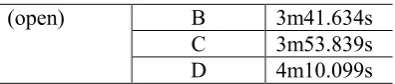
(open) B 3m41.634s
[image:5.595.306.504.69.111.2]C 3m53.839s D 4m10.099s
Table 3. The execution time of segmenta-tions for four different domains in both simplified and traditional Chinese subtasks.
Table 3 shows the execution time of all tasks for generating the segmentation outputs. The execution time listed in the table includes the time for loading the training frequency table, building the frequency table from the test file, and producing the actual segmentation results.
5
Evaluation
5.1 Segmentation Results
Simplified Chinese
Task R P F1 ROOV RROOV RRIV
A (c) 0.907 0.862 0.884 0.069 0.206 0.959 A (o) 0.869 0.873 0.871 0.069 0.657 0.885 B (c) 0.876 0.844 0.86 0.152 0.457 0.951 B (o) 0.859 0.878 0.868 0.152 0.668 0.893 C (c) 0.885 0.804 0.842 0.110 0.218 0.967 C (o) 0.865 0.846 0.855 0.110 0.559 0.903 D (c) 0.904 0.865 0.884 0.087 0.321 0.960 D (o) 0.853 0.850 0.851 0.087 0.438 0.893
Traditional Chinese
Task R P F1 ROOV RROOV RRIV
A (c) 0.864 0.789 0.825 0.094 0.105 0.943 A (o) 0.804 0.722 0.761 0.094 0.234 0.863 B (c) 0.868 0.85 0.859 0.094 0.316 0.926 B (o) 0.789 0.736 0.761 0.094 0.35 0.834 C (c) 0.871 0.815 0.842 0.075 0.115 0.932 C (o) 0.811 0.74 0.774 0.075 0.254 0.856 D (c) 0.875 0.834 0.854 0.068 0.169 0.926 D (o) 0.811 0.753 0.781 0.068 0.235 0.853
Table 4. The segmentation results for four domains in both closed and open training evaluations. (c) – closed; (o) – open; A - Lit-erature; B – Computer; C – Medicine; D –
Finance. ROOV is the OOV rate in the test
file.
[image:5.595.81.284.524.728.2]preci-sion (P), F-measure (F1), recall rate of OOV words (RROOV), and recall rate of words in vo-cabulary (RRIV).
The official results of our system for both open and closed training evaluation are given in Table 4. The recall rates, precision values, and F1-scores of all tasks show promising re-sults of our system in the segmentation for cross-domain text. However, the gaps between our scores and the bakeoff bests also suggest that there is still plenty of room for perform-ance improvements in our system.
The OOV recall rates (RRoov) showed in Table 4 demonstrate that the OOV recognition strategy used in our system can achieve a cer-tain level of OOV word discovery in closed training evaluation. The overall result for the OOV word recognition is not very satisfactory if comparing it with the best result from other bakeoff participants. But for the open training evaluation the OOV recall rate picked up sig-nificantly, which indicates that the extra dic-tionary - cc-cedict covers a fair amount of terms for various domains.
5.2 Possible Further Improvements
Due to finishing the implementation of our segmentation system in a short time, we be-lieve that there might be many program bugs which had negative effects on our system and leaded to producing results not as expected. In an analysis of the segmentation outputs, words starting with numbers were found incorrectly segmented because of the different encodings used in the training and test files for digits. Moreover, the disambiguation in breaking down a non-word segment which contains at least an n-gram word could lead to an all-single-character-word segmentation. This should certainly be avoided.
Also, the current OOV word recognition strategy may detect a few good OOV words, but also introduces incorrect segmentation consistently through the whole input text if OOV words are mistakenly identified. If this OOV word recognition used in our system can be further improved, it can help to alleviate the problem of performance deterioration.
For the open training, if language rules can be encoded in both word segmentation and OOV word recognition, it certainly is another
beneficial method to improve the overall preci-sion and recall rate.
6
Conclusions
In this paper, we describe a novel hybrid boundary-oriented NGMI-based segmentation method, which combines a simple strategy for OOV word recognition. The evaluation results show reasonable performance of our system in cross-domain text segmentation even with the negative effects from system bugs and the OOV word recognition strategy. It is believed that the segmentation system can be improved by fixing the existing program bugs, and hav-ing a better OOV word recognition strategy. Performance can also be further improved by incorporating language or domain specific knowledge into the system.
References
MDBG. CC-CEDICT download. from
http://www.mdbg.net/chindict/chindict.php?pag e=cc-cedict
Sproat, Richard, and Chilin Shih. 1990. A statistical method for finding word boundaries in Chinese text. Computer Processing of Chinese & Oriental Languages, 4(4): 336-351.