Proceedings of the EACL 2009 Workshop on GEMS: GEometical Models of Natural Language Semantics, pages 33–40,
BagPack: A general framework to represent semantic relations
Amaç Herda˘gdelen
CIMEC, University of Trento
Rovereto, Italy
[email protected]
Marco Baroni
CIMEC, University of Trento
Rovereto, Italy
[email protected]
Abstract
We introduce a way to represent word pairs instantiating arbitrary semantic relations that keeps track of the contexts in which the words in the pair occur both together and indepen-dently. The resulting features are of sufficient generality to allow us, with the help of a stan-dard supervised machine learning algorithm, to tackle a variety of unrelated semantic tasks with good results and almost no task-specific tailoring.
1
Introduction
Co-occurrence statistics extracted from corpora lead to good performance on a wide range of tasks that involve the identification of the semantic relation be-tween two words or concepts (Sahlgren, 2006; Turney, 2006). However, the difficulty of such tasks and the fact that they are apparently unrelated has led to the development of largelyad-hocsolutions, tuned to spe-cific challenges. For many practical applications, this is a drawback: Given the large number of semantic rela-tions that might be relevant to one or the other task, we need a multi-purpose approach that, given an appropri-ate representation and training examples instantiating an arbitrary target relation, can automatically mine new pairs characterized by the same relation. Building on a recent proposal in this direction by Turney (2008), we propose a generic method of this sort, and we test it on a set of unrelated tasks, reporting good performance across the board with very little task-specific tweaking. There has been much previous work on corpus-based models to extract broad classes of related words. The literature on word space models (Sahlgren, 2006) has focused on taxonomic similarity (synonyms, antonyms, co-hyponyms. . . ) and general association (e.g., find-ing topically related words), exploitfind-ing the idea that taxonomically or associated words will tend to occur in similar contexts, and thus share a vector of co-occurring words. The literature on relational similar-ity, on the other hand, has focused onpairsof words, devising various methods to compare how similar the contexts in which target pairs appear are to the contexts of other pairs that instantiate a relation of interest (Tur-ney, 2006; Pantel and Pennacchiotti, 2006). Beyond
these domains, purely corpus-based methods play an increasingly important role in modeling constraints on composition of words, in particular verbal selectional preferences – finding out that, say, children are more likely to eat than apples, whereas the latter are more likely to be eaten (Erk, 2007; Padó et al., 2007). Tasks of this sort differ from relation extraction in that we need to capture productive patterns: we want to find out that shabu shabu (a Japanese meat dish) is eaten whereas ink is not, even if in our corpus neither noun is attested in proximity to forms of the verbto eat.
Turney (2008) is the first, to the best of our knowl-edge, to raise the issue of a unified approach. In par-ticular, he treats synonymy and association as special cases of relational similarity: in the same way in which we might be able to tell that hands and arms are in a part-of relation by comparing the contexts in which they co-occur to the contexts of known part-of pairs, we can guess that cars and automobiles are synonyms by comparing the contexts in which they co-occur to the contexts linking known synonym pairs.
Here, we build on Turney’s work, adding two main methodological innovations that allow us further gen-eralization. First, merging classic approaches to taxo-nomic and relational similarity, we represent concept pairs by a vector that concatenates information about the contexts in which the two words occur indepen-dently, and the contexts in which they co-occur (Mirkin et al. 2006 also integrate information from the lexi-cal patterns in which two words co-occur and simi-larity of the contexts in which each word occurs on its own, to improve performance in lexical entailment acquisition). Second, we represent contexts as bag of words and bigrams, rather than strings of words (“pat-terns”) of arbitrary length: we leave it to the machine learning algorithm to zero in on the most interesting words/bigrams.
vectors are less sparse than dimensions based on longer strings of words. We show that our method produces reasonable results also on a corpus of 2 billion words, with many unseen pairs. Moreover, our bigram and unigram representation is general enough that we do not need to extract separate statistics nor perform ad-hocfeature selection for each task: we build the co-occurrence matrix once, and use the same matrix in all experiments. The bag-of-words assumption also makes for faster and more compact model building, since the number of features we extract from a context is linear in the number of words in the context, whereas it is ex-ponential for Turney. On the other hand, our method is currently lagging behind Turney’s in terms of perfor-mance, suggesting that at least some task-specific tun-ing will be necessary.
Following Turney, we focus on devising a suitably general featural representation, and we see the spe-cific machine learning algorithm employed to perform the various tasks as a parameter. Here, we use Sup-port Vector Machines since they are a particularly ef-fective general-purpose method. In terms of empirical evaluation of the model, besides experimenting with the “classic” SAT and TOEFL datasets, we show how our algorithm can tackle the selectional preference task proposed in Padó (2007) – a regression task – and we introduce to the corpus-based semantics community a challenge from the ConceptNet repository of common-sense knowledge (extending such repository by auto-mated means is the original motivation of our project). In the next section, we will present our proposed method along with the corpora and model parameter choices used in the implementation. In Section 3, we describe the tasks that we use to evaluate the model. Results are reported in Section 4 and we conclude in Section 5, with a brief overview of the contributions of this paper.
2
Methodology
2.1 Model
The central idea in BagPack (Bag-of-words represen-tation ofPaired conceptknowledge) is to construct a vector-based representation of a pair of words in such a way that the vector represents both the contexts where the two words co-occur and the contexts where the sin-gle words occur on their own. A straightforward ap-proach is to construct three different sub-vectors, one for the first word, one for the second word, and one for the co-occurring pair. The concatenation of these three sub-vectors is the final vector that represents the pair.
This approach provides us a graceful fall back mech-anism in case of data scarcity. Even if the two words are not observed co-occurring in the corpus – no syntag-maic information about the pair –, the corresponding vector will still represent the individual contexts where the words are observed on their own. Our hypothesis (and hope) is that this information will be representa-tive of the semantic relation between the pair, in the
sense that, given pairs characterized by same relation, there should be paradigmatic similarity across the first, resp. second elements of the pairs (e.g., if the relation is between professionals and the typical tool of their trade, it is reasonable to expect that that both profes-sionals and tools will tend to share similar contexts).
Before going into further details, we need to describe what a “co-occurrence” precisely means, define the no-tion of context, and determine how to structure our vec-tor. For a single wordW, the following pseudo regular expression identifies an observation ofoccurrence:
“C W D” (1)
where C andD can be empty strings or concatena-tions of up to 4 words separated by whitespace (i.e.
C1, . . . , CiandD1, . . . , Djwherei, j≤4). Each
ob-servation of this pattern constitutes asingle contextof
W. The pattern is matched with the longest possible substring without crossing sentence boundaries.
Let(W1, W2)denote an ordered pair of wordsW1
andW2. We say the two wordsoccur as a pair
when-ever one of the following pseudo regular expressions is observed in the corpus:
“C W1D W2E” (2)
“C W2D W1E” (3)
where C and E can be empty strings or concatena-tions of up to 2 words and similarly, D can be ei-ther an empty string or concatenation of up to 5 words (i.e. C1, . . . , Ci, D1, . . . , Dj, andE1, . . . , Ek where
i, j ≤ 2andk ≤5). Together, patterns 2 and 3 con-stitute thepair contextforW1andW2. The pattern is
matched with the longest possible substring while mak-ing sure thatDdoes not contain neitherW1norW2.
The number of context words allowed before, after, and between the targets are actually model parameters but for the experiments reported in this study, we used the aforementioned values with no attempt at tuning.
The vector representing(W1, W2)is a concatenation
v1v2v1,2, where, the sub-vectorsv1andv2are
con-structed by using the single contexts of W1 and W2
correspondingly (i.e. by pattern 1) and the sub-vector
v1,2 is built by using the pair contexts identified by
the patterns 2 and 3. We refer to the components as
single-occurrence vectorsandpair-occurrence vector
respectively.
The population of BagPack starts by identifying the
b most frequent unigrams and thebmost frequent bi-grams asbasis terms. LetT denote a basis term. For the construction ofv1, we create two features for each
termT:tprecorresponds to the number of observations
ofTin the single contexts ofW1occurring beforeW1
andtpostcorresponds to the number of observations of
T in the single occurrence ofW1whereToccurs after
W1(i.e. number of observations of the pattern 1 where
correspond to the number of times the basis term is ob-served before and after the target word W2 in single
contexts. The construction of the pair-occurrence sub-vectorv1,2proceeds in a similar fashion but in
addi-tion, we incorporate also the order ofW1 andW2 as
they co-occur in the pair context: The number of ob-servations of the pair contexts whereW1occurs before
W2andT precedes (follows) the pair, are represented
by featuret+pre(t+post). The number of cases where
the basis term is in between the target words is repre-sented byt+betw. The number of cases whereW2
oc-curs beforeW1andT precedes the pair is represented
by the feature t−pre. Similarly the number of cases
whereT follows (is in between) the pair is represented by the featuret−post(t−betw).
Assume that the words "only" and "that" are our ba-sis terms and consider the following context for the word pair ("cat", "lion"): "Lion is the only cat that lives in large social groups." The observation of the ba-sis terms should contribute to the pair-occurrence sub-vectorv1,2and since the target words occur in reverse
order, this context results in the incrementation of the featuresonly−betwandthat−postby one.
To sum up, we have2bbasis terms (bunigrams and
bbigrams). Each of the single-occurrence sub-vectors
v1 and v2 consists of 4b features: Each basis term
gives rise to 2 features incorporating the relative posi-tion of basis term with respect to the single word. The pair-occurrence sub-vector, v1,2, consists of12b
fea-tures: Each basis term gives rise to6new features;×3 for possible relative positions of the basis term with re-spect to the pair and ×2 for the order of the words. Importantly, the 2b basis terms are picked only once, and the overall co-occurrence matrix is built once and for all forallthe tasks: unlike Turney, we do not need to go back to the corpus to pick basis terms and collect separate statistics for different tasks.
The specifics of the adaptation to each task will be detailed in Section 3. For the moment, it should suffice to note that the vectorsv1 andv2 represent the
con-texts in which the two words occur on their own, thus encode paradigmatic information. However,v1,2
rep-resents the contexts in which the two words co-occur, thus encode sytagmatic information.
The model training and evaluation is done in a 10-fold cross-validation setting whenever applicable. The reported performance measures are the averages over all folds and the confidence intervals are calculated by using the distribution of fold-specific results. The only exception to this setting is the SAT analogy questions task simply because we consider each question as a separate mini dataset as described in Section 3.
2.2 Source Corpora
We carried out our tests on two different corpora: ukWaC, a Web-derived, POS-tagged and lemmatized collection of about 2 billion tokens,1 and the Yahoo!
1http://wacky.sslmit.unibo.it
database queried via the BOSS service.2 We will refer
to these corpora as ukWaC and Yahoo from now on. In ukWaC, we limited the number of occurrence and co-occurrence queries to the first 5000 observations for computational efficiency. Since we collect cor-pus statistics at the lemma level, we construct Yahoo! queries using disjunctions of inflected forms that were automatically generated with the NodeBox Linguistics library.3 For example, the query to look for “lion” and “cat” with 4 words in the middle is: “(lion OR lions) * * * * (cat OR cats OR catting OR catted)”. Each pair requires 14 Yahoo! queries (one forW1, one forW2,
6 for(W1, W2), in that order, with 0-to-5 intervening
words, 6 analogous queries for(W2, W1)). Yahoo!
re-turns maximally 1,000 snippets per query, and the latter are lemmatized with the TreeTagger4before feature
ex-traction.
2.3 Model implementation
We did not carry out a search for “good” parameter val-ues. Instead, the model parameters are generally picked at convenience to ease memory requirements and com-putational efficiency. For instance, in all experiments,
b is set to 1500 unless noted otherwise in order to fit the vectors of all pairs at our hand into the computer memory.
Once we construct the vectors for a set of word pairs, we get aco-occurrence matrixwith pairs on the rows and the features on the columns. In all of our exper-iments, the same normalization method and classifi-cation algorithm is used with the default parameters: First, a TF-IDF feature weighting is applied to the co-occurrence matrix (Salton and Buckley, 1988). Then following the suggestion of Hsu and Chang (2003), each featuret’s[ˆµt−2ˆσt,µˆt+ 2ˆσt]interval is scaled to
[0,1], trimming the exceeding values from upper and lower bounds (the symbols µˆt andσˆt denote the
av-erage and standard deviation of the feature values re-spectively). For the classification algorithm, we use the C-SVM classifier and for regression the-SVM regres-sor, both implemented in the Matlab toolbox of Canu et al. (2005). We employed a linear kernel. The cost parameter C is set to 1 for all experiments; for the re-gressor,= 0.2. For other pattern recognition related coding (e.g., cross validation, scaling, etc.) we made use of the Matlab PRTools (Duin, 2001).
For each task that will be defined in the next section, we evaluated our algorithm on the following represen-tations: 1) Single-occurrence vectors (v1v2condition)
2) Pair-occurrence vectors (v1,2 condition) 3) Entire
co-occurrence matrix (v1v2v1,2condition).
2http://developer.yahoo.com/search/
boss/
3http://nodebox.net/code/index.php/
Linguistics
4http://www.ims.uni-stuttgart.de/
3
Tasks
3.1 SAT Analogy Questions
The first task we evaluated our algorithm on is the SAT analogy questions task introduced by Turney et al. (2003). In this task, there are 374 multiple choice ques-tions with a pair of related words like (lion,cat) as the
stemand 5 other pairs as thechoices. The correct an-swer is the choice pair which has the relationship most similar to that in the stem pair.
We adopt a similar approach to the one used in Tur-ney (2008) and consider each question as a separate bi-nary classification problem with one positive training instance and 5 unknown pairs. For a question, we pick a pair at random from the stems of other questions as a pseudo negative instance and train our classifier on this two-instance training set. Then the trained classifier is evaluated on the choice pairs and the pair with the high-est posterior probability for the positive class is called thewinner. The procedure is repeated 10 times pick-ing a different pseudo-negative instance each time and the choice pair which is selected as the winner most of-ten is taken as the answer to that question. The perfor-mance measure on this task is defined as the percent-age of correctly answered questions. The mean score and confidence intervals are calculated over the perfor-mance scores obtained for all folds.
3.2 TOEFL Synonym Questions
This task, introduced by Landauer and Dumais (1997), consists of 80 multiple choice questions in which a word is given as the stem and the correct choice is the word which has the closest meaning to that of the stem, among 4 candidates. To fit the task into our frame-work, we pair each choice with the stem word and ob-tain 4 word pairs for each question. The word pair constructed with the stem and the correct choice is la-beled as positive and the other pairs are lala-beled as neg-ative. We consider all 320 pairs constructed for all 80 questions as our dataset. Thus, the problem is turned into a binary classification problem where the task is to discriminate the synonymous word pairs (i.e. pos-itive class) from the other pairs (i.e. negative class). We made sure that the pairs constructed for the same question were never split between training and test set, so that no question-specific learning is performed. The reason for this precaution is that the evaluation is done on a per-question basis. The estimated posterior class probabilities of the pairs constructed for the same ques-tion are compared to each other and the pair with the highest probability for the positive class is selected as the answer for the question. By keeping the pairs of a question in the same set we make sure their posteri-ors are calculated by the same trained classifier. The performance measure is the percentage of correctly an-swered questions and we report the mean performance over all 10 folds.
3.3 Selectional Preference Judgments
Linguists have long been interested in the semantic constraints that verbs impose on their arguments, a broad area that has also attracted computational mod-eling, with increasing interest in purely corpus-based methods (Erk, 2007; Padó et al., 2007). This task is of particular interest to us as an example of a broader class of linguistic problems that involve productive
constraints on composition. As has been stressed at least since Chomsky’s early work (Chomsky, 1957), no matter how large a corpus is, if a phenomenon is pro-ductive there will always be new well-formed instances that are not in the corpus. In the domain of selectional restrictions this is particularly obvious: we would not say that an algorithm learned the constraints on the pos-sible objects/patients of eating simply by producing the list of all the attested objects of this verb in a very large corpus; the interesting issue is whether the algorithm can detect if an unseen object is or is not a plausible “eatee”, like humans do without problems. Specifi-cally, we test selectional preferences on the dataset con-structed by Padó (2007), that collects average plausi-bility judgments (from 20 speakers) for nouns as either subjects or objects of verbs (211 noun-verb pairs).
We formulate this task as a regression problem. We train the -SVM regressor with 18-fold cross valida-tion: Since the pair instances are not independent but grouped according to the verbs, one fold is constructed for each of the 18 verbs used in the dataset. In each fold, all instances sharing the corresponding verb are left out as the test set. The performance measure for this task is the Spearman correlation between the hu-man judgments and our algorithm’s estimates. There are two possible ways to calculate this measure. One is to get the overall correlation between the human judg-ments and our estimates obtained by concatenating the output of each cross-validation fold. That measure al-lows us to compare our method with the previously re-ported results. However, it cannot control for a possi-ble verb-effect on the human judgment values: If the average judgment values of the pairs associated with a specific verb is significantly higher (or lower) than the average of the pairs associated with another verb, then any regressor which simply learns to assign the aver-age value to all pairs associated with that verb (regard-less of whether there is a patient or agent relation be-tween the pairs) will still get a reasonably high correla-tion because of the variacorrela-tion of judgment scores across the verbs. To control for this effect, we also calculated the correlation between the human judgments and our estimates for each verb’s plausibility values separately, and we report averages across these separate correla-tions (the “mean” results reported below).
3.4 Common-sense Relations from ConceptNet
Open Mind Common Sense5 is an ongoing project of
acquisition of common-sense knowledge from ordinary
Relation Pairs Relation Pairs
IsA 316 PartOf 139
[image:5.595.91.271.64.114.2]UsedFor 198 LocationOf 1379 CapableOf 228 Total 1943
Table 1: ConceptNet relations after filtering.
people by letting them carry out simple semantic and linguistics tasks. An end result of the project is Con-ceptNet 3, a large scale semantic network consisting of relations between concept pairs (Havasi et al., 2007). It is possible to view this network as a collection of se-mantic assertions, each of which can be represented by a triple involving two concepts and a relation between them, e.g.UsedFor(piccolo, make music). One moti-vation for this project is the fact that common-sense knowledge is assumed to be known by both parties in a communication setting and usually is not expressed explicitly. Thus, corpus-based approaches may have serious difficulties in capturing these relations (Havasi et al., 2007), but there are reasons to believe that they could still be useful: Eslick (2006) uses the assertions of ConceptNet as seeds to parse Web search results and augment ConceptNet by new candidate relations.
We use the ConceptNet snapshot released in June 2008, containing more than 200.000 assertions with around 20 semantic relations like UsedFor, Desirious-EffectOf, or SubEventOf. Each assertion has a confi-dence rating based on the number of people who ex-pressed or confirmed that assertion. For simplicity we limited ourselves to single word concepts and the re-lations between them. Furthermore, we eliminated the assertions with a confidence score lower than 3 in an attempt to increase the "quality" of the assertions and focused on the most populated 5 relations of the re-maining set, as given in Table 3.4. There may be more than one relation between a pair of concepts, so the to-tal number is less than the sum of the size of the indi-vidual relation sets.
4
Results
For the multiple choice question tasks (i.e. SAT and TOEFL), we say a question iscompletewhen all of the related pairs (stem and choice) are represented by vec-tors with at least one non-zero component. If a ques-tion has at least one pair represented by a zero-vector (missing pairs), then we say that the question ispartial. For these tasks, we report the worst-case performance scores where we assume that a random guessing per-formance is obtained on the partial questions. This is a strict lower bound because it discards all information we have about a partial question even if it has only one missing pair. We definecoverageas the percentage of complete questions.
4.1 SAT
In Yahoo, the coverage is quite high. In thev1,2only
condition, 4 questions had at least some choice/stem
pairs with all zero components. In all other cases, all of the pairs were represented by vectors with at least one non-zero component. The highest score is obtained for thev1v2v1,2condition with a 44.1% of correct
ques-tions, that is not significantly above the 42.5% perfor-mance ofv1,2(paired t-test,α= 0.05). Thev1v2only
condition results in a poorer performance of 33.9% cor-rect questions, statistically lower than the former two conditions.
For ukWaC, thev1,2only condition provides a
rel-atively low coverage. Only 238 questions out of 374 were complete. For the other conditions, we get a com-plete coverage. The performances are statistically in-distinguishable from each other and are 38.0%, 38.2%, and 39.6% forv1,2,v1v2, andv1v2v1,2respectively.
Condition Yahoo ukWaC
v1,2 42.5% 38.0%
v1v2 33.9% 38.2%
[image:5.595.352.483.260.309.2]v1v2v1,2 44.1% 39.6%
Table 2: Percentage of correctly answered questions in SAT analogy task, worst-case scenario.
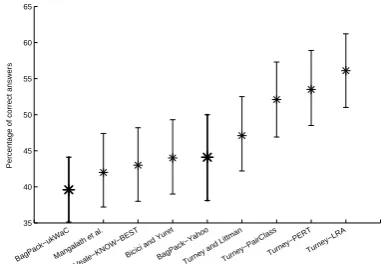
In Fig. 1, the best performances we get for Yahoo and ukWaC are compared to previous studies with 95% binomial confidence intervals plotted. The reported values are taken from the ACL wiki page on the state of the art for SAT analogy questions6. The algorithm
pro-posed by Turney (2008) is labeled as Turney-PairClass.
35 40 45 50 55 60 65
Percentage of correct answers
BagPack−ukWaCMangalath et al. Veale−KNOW−BEST
Bicici and YuretBagPack−YahooTurney and LittmanTurney−PairClassTurney−PERT Turney−LRA
Figure 1: Comparison with previous algorithms on SAT analogy questions.
Overall, the performance of BagPack is not at the level of the state of the art but still provides a reasonable level even in thev1v2only condition for which we do
not utilize the contexts where the two words co-occur. This aspect is most striking for ukWaC where the cov-erage is low and by only utilizing the single-occurrence sub-vectors we obtain a performance of 38.2% cor-rect answers (the comparable “attributional” models
re-6
[image:5.595.314.505.448.580.2]ported in Turney, 2006, have an average performance of 31%).
4.2 TOEFL
For thev1,2sub-vector calculated for Yahoo, we have
two partial questions out of 80 and the system answers 80.0% of the questions correctly. The single occur-rence casev1v2instead provides a correct percentage
of 41.2% which is significantly above the random per-formance of 25% but still very poor. The combined casev1v2v1,2provides a score of 75.0% with no
sta-tistically significant difference from thev1,2case. The
reason of the low performance for v1v2 is an open
question.
For ukWaC, the coverage for thev1v2case is pretty
low. Out of 320 pairs, 70 were represented by zero-vectors, resulting in 34 partial questions out of 80. The performance is at 33.8%. The v1v2 case on its
own does not lead to a performance better than random guessing (27.5%) but the combined case v1v2v1,2
provides the highest ukWaC score of 42.5%.
Condition Yahoo ukWaC
v1,2 80.0% 33.8%
v1v2 41.2% 27.5%
[image:6.595.313.521.373.435.2]v1v2v1,2 75.0% 42.5%
Table 3: Percentage of correctly answered questions in TOEFL synonym task, worst-case scenario.
To our knowledge, the best performance with a purely corpus-based approach is that of Rapp (2003) who obtained a score of 92.5% with SVD. Fig. 2 re-ports our results and a list of other corpus-based sys-tems which achieve scores higher than 70%, along with 95% confidence interval values. The results are taken from the ACL wiki page on the state of the art for TOEFL synonym questions.
30 40 50 60 70 80 90 100
Percentage of correct answers
[image:6.595.78.269.532.666.2]BagPack−ukWaCPado and LapataTurney−PMI−IRTurney−PairClassBagPack−YahooTerra and ClarkeBullinaria and LevyMatveeva et al. Rapp
Figure 2: Comparison with previous algorithms on TOEFL synonym questions with 95% confidence in-tervals.
We note that our results obtained for Yahoo are com-parable to the results of Turney but even the best re-sults obtained for ukWaC and the Yahoo’s rere-sults for
v1v2 only condition are very poor. Whether this is
because of the inability of the sub-vectors to capture synonymity or because the default parameter values of SVM are not adequate is an open question. Notice that our concatenated v1v2 vector does not exploit
infor-mation about the similarity ofv1 tov2, that,
presum-ably, should be of great help in solving the synonym task.
4.3 Selectional Preference
The coverage for this dataset is quite high. All pairs were represented by non-zero vectors for Yahoo while only two pairs had zero-vectors for ukWaC. The two pairs are discarded in our experiments. For Yahoo, the best results are obtained for thev1,2case. The
single-occurrence case,v1v2, provides an overall correlation
of 0.36 and mean correlation of 0.26. However low, in case of rarely co-occurring word pairs this data could be the only data we have in our hands and it is impor-tant that it provides reasonable judgment estimates.
For the ukWaC corpus, the best results we get are an overall correlation of 0.60 and a mean correlation of 0.52 for the combined casev1v2v1,2. The results for
v1,2andv1v2v1,2are statistically indistinguishable.
Yahoo ukWaC
Condition Overall Mean Overall Mean
v1,2 0.60 0.45 0.58 0.48
v1v2 0.36 0.26 0.33 0.22
v1v2v1,2 0.55 0.42 0.60 0.52
Table 4: Spearman correlations between the targets and estimations for selectional preference task.
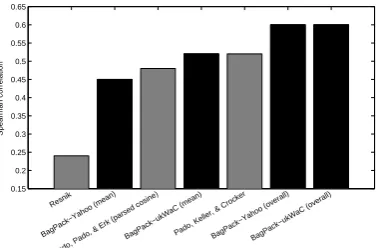
In Fig. 3, we present a comparison of our results with some previous studies reported in Padó et al. (2007). The best result reported so far is a correlation of 0.52. Our results for Yahoo and ukWaC are currently the highest correlation values reported. Even the verb-effect-controlled correlations achieve competitive per-formance.
0.15 0.2 0.25 0.3 0.35 0.4 0.45 0.5 0.55 0.6 0.65
Spearman correlation
Resnik
BagPack−Yahoo (mean) Pado, Pado, & Erk (parsed cosine)
BagPack−ukWaC (mean)Pado, Keller, & CrockerBagPack−Yahoo (overall)BagPack−ukWaC (overall)
[image:6.595.317.507.585.709.2]4.4 ConceptNet
Only for this task, (because of practical memory limita-tions) we reduced the model parameterbto 500, which means we used the 500 most frequent unigrams and 500 most frequent bigrams as our basis terms. For each of the 5 relations at our hand, we trained a different SVM classifier by labeling the pairs with the corre-sponding relation as positive and the rest as negative. To eliminate the issue of unbalanced number of nega-tive and posinega-tive instances we randomly down-sampled the positive or negative instances set (whichever is larger). For theIsA,UsedFor,CapableOf, andPartOf
relations, the down-sampling procedure means keep-ing some of the negative instances out of the trainkeep-ing and test sets while for theLocationOf relation it means keeping a subset of the positive instances out. We per-formed 5 iterations of the down-sampling procedure and for each iteration we carried out a 10-fold cross-validation to train and test our classifier. The results are test set averages over all iterations and folds. The per-formance measure we use is the area under thereceiver operating characteristic(AUC in short for area under the curve). The AUC of a classifier is the area under the curve defined by the corresponding true positive rate and false positive rate values obtained for varying the threshold of the classifier to accept an instance as posi-tive. Intuitively, AUC is the probability that a randomly picked positive instance’s estimated posterior probabil-ity is higher than a randomly picked negative instance’s estimated posterior probability (Fawcett, 2006).
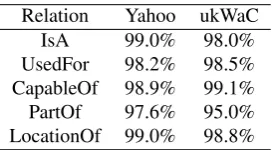
The coverage is quite high for both corpora: Out of 1943 pairs,only 3 were represented by a zero-vector in Yahoo while in ukWaC this number is 68. For sim-plicity, we discarded missing pairs from our analysis. We report only the results obtained for the entire co-occurrence matrix. The results are virtually identi-cal for the other conditions too: Both for Yahoo and ukWaC, almost all of the AUC values obtained for all relations and for all conditions are above 95%. Only the PartOf relation has AUC values above 90% (which is still a very good result).
[image:7.595.114.251.574.649.2]Relation Yahoo ukWaC IsA 99.0% 98.0% UsedFor 98.2% 98.5% CapableOf 98.9% 99.1% PartOf 97.6% 95.0% LocationOf 99.0% 98.8%
Table 5: AUC scores for 5 relations of ConceptNet, classifier trained forv1v2v1,2condition.
The very high performance we observe for the Con-ceptNet task is surprising when compared to the mod-erate performance we observe for other tasks. Our ex-tensive filtering of the assertions could have resulted in a biased dataset which might have made the job of the classifier easy while reducing its generalization
ca-pacity. To investigate this, we decided to use the pairs coming from the SAT task as a validation set.
Again, we trained an SVM classifier on the Concept-Net data for each of the 5 relations like we did previ-ously, but this time without cross-validation (i.e. after the down-sampling, we used the entire set as the train-ing dataset in each iteration). Then we evaluated the classifiers on the 2224 pairs of the SAT analogy task (removing pairs that were in the training data) and av-eraged the posterior probability reported by each SVM over each down-sampling iteration. The 5 pairs which are assigned the highest posterior probability for each relation are reported in Table 6. We have not yet quan-tified the performance of BagPack in this task but the preliminary results in this table are, qualitatively, ex-ceptionally good.
5
Conclusions
We presented a general way to build a vector-based space to represent the semantic relations between word pairs and showed how that representation can be used to solve various tasks involving semantic similarity. For SAT and TOEFL, we obtained reasonable perfor-mances comparable to the state of the art. For the es-timation of selective preference judgments about verb-noun pairs, we achieved state of the art performance. Perhaps more importantly, our representation format allows us to provide meaningful estimates even when the verb and noun are not observed co-occurring in the corpus – which is an obvious advantage over the mod-els which rely on sytagmatic contexts alone and cannot provide estimates for word pairs that are not seen di-rectly co-occurring. We also obtained very promising results for the automated augmentation of ConceptNet. The generality of the proposed method is also re-flected in the fact that we built a single feature space based on frequent basis terms and used the same fea-tures for all pairs coming from different tasks. The use of the same feature set for all pairs makes it pos-sible to build a single database of word-pair vectors. For example, we were able to re-use the vectors con-structed for SAT pairs as a validation set in the Con-ceptNet task. Furthermore, the results reported here are obtained for the same machine learning model (SVM) without any parameter tweaking, which renders them very strict lower bounds.
Another contribution is that the proposed method provides a way to represent the relations between words even if they are not observed co-occurring in the corpus. Employing a larger corpus can be an alternative solution for some cases but this is not always possible and some tasks, like estimating selectional preference judgments, inherently call for a method that does not exclusively depends on paired co-occurrence observa-tions.
Rank IsA UsedFor PartOf CapableOf LocationOf 1 watch,timepiece pencil,draw vehicle,wheel motorist,drive spectator,arena 2 emerald,gem blueprint,build spider,leg volatile,vaporize water,riverbed 3 cherry,fruit detergent,clean keyboard,finger concrete,harden bovine,pasture 4 dinosaur,reptile guard,protect train,caboose parasite,contribute benediction,church 5 ostrich,bird buttress,support hub,wheel immature,develop byline,newspaper
Table 6: Top 5 SAT pairs classified as positive for ConceptNet relations, classifier trained forv1v2v1,2condition.
can benefit from.
In future work, one of the most pressing issue we want to explore is how to better exploit the informa-tion in the single occurrence vectors: currently, we do not make any use of the overlapbetweenv1 andv2.
In this way, we are missing the classic intuition that taxonomically similar words tend to occur in similar contexts, and it is thus not surprising thatv1v2flunks
the TOEFL. We are currently looking at ways to aug-ment our concatenated vector with “meta-information” about vector overlap.
References
S. Canu, Y. Grandvalet, V. Guigue and A. Rakotoma-monjy. 2005. SVM and Kernel Methods Matlab Toolbox, Perception Systèmes et Information, INSA de Rouen, Rouen, France
N. Chomsky. 1957. Syntactic structures. Mouton, The Hague.
R. P. W. Duin. 2001. PRTOOLD (Version 3.1.7), A Matlab toolbox for pattern recognition. Pattern Recognition Group. Delft University of Technology.
K. Erk. 2007. A simple, similarity-based model for selectional preferences. Proceedings of ACL 2007.
K. Erk and S. Padó. 2008. A structured vector space model for word meaning in context. Proceedings of EMNLP 2008.
I. Eslick. 2006. Searching for commonsense. Master’s thesis, Massachusetts Institute of Technology.
T. Fawcett. 2006. An introduction to roc analysis.
Pattern Recogn. Lett., 27(8):861–874.
C. Havasi, R. Speer and J. Alonso. 2007. Concept-net 3: a flexible, multilingual semantic Concept-network for common sense knowledge. InRecent Advances in Natural Language Processing, Borovets, Bulgaria, September.
C.-W. Hsu, C.-C Chang. 2003. A practical guide to support vector classification. Technical report, Department of Computer Science, National Taiwan University.
T.K. Landauer and S.T. Dumais. 1997. A solution to Plato’s problem: The Latent Semantic Analysis theory of acquisition, induction and representation of knowledge. Psychological Review, 104(2): 211– 240.
H. Liu and P. Singh. 2004. ConceptNet — A practi-cal commonsense reasoning tool-kit. BT Technology Journal, 22(4) 211–226.
S. Mirkin, I. Dagan and M. Geffet. 2006. Integrat-ing pattern-based and distributional similarity meth-ods for lexical entailment acquisition. Proceedings of COLING/ACL 2006, 579–586.
S. Padó, S. Padó and K. Erk. 2007. Flexible, corpus-based modelling of human plausibility judgements.
Proceedings EMNLP 2007, 400–409.
U. Padó. 2007. The Integration of Syntax and Semantic Plausibility in a Wide-Coverage Model of Sentence Processing. Ph.D. thesis, Saarland University.
P. Pantel and M. Pennacchiotti. 2006. Espresso: Leveraging generic patterns for automatically har-vesting semantic relations. Proceedings of COL-ING/ACL 2006, 113–120.
R. Rapp. 2003. Word sense discovery based on sense descriptor dissimilarity. Proceedings of MT Summit IX: 315–322.
M. Sahlgren. 2006. The Word-space model. Ph.D. dis-sertation, Stockholm University, Stockholm.
G. Salton and C. Buckley. 1988. Term-weighting approaches in automatic text retrieval. Information Processing and Management, 24(5): 513–523.
R. Speer, C. Havasi and H. Lieberman. 2008. Anal-ogyspace: Reducing the dimensionality of common sense knowledge. In Dieter Fox and Carla P. Gomes, editors,AAAI, pages 548–553. AAAI Press.
P. Turney. 2006. Similarity of semantic relations.
Computational Linguistics, 32(3): 379–416.