System Building Cost vs. Output Quality in Data-To-Text Generation
Anja Belz Eric Kow
Natural Language Technology Group University of Brighton
Brighton BN2 4GJ, UK {asb,eykk10}@bton.ac.uk
Abstract
Data-to-text generation systems tend to be knowledge-based and manually built, which limits their reusability and makes them time and cost-intensive to create and maintain. Methods for automating (part of) the system building process ex-ist, but do such methods risk a loss in output quality? In this paper, we inves-tigate the cost/quality trade-off in gen-eration system building. We compare four new data-to-text systems which were created by predominantly automatic tech-niques against six existing systems for the same domain which were created by pre-dominantly manual techniques. We eval-uate the ten systems using intrinsic au-tomatic metrics and human quality rat-ings. We find that increasing the degree to which system building is automated does not necessarily result in a reduction in out-put quality. We find furthermore that stan-dard automatic evaluation metrics under-estimate the quality of handcrafted sys-tems and over-estimate the quality of au-tomatically created systems.
1 Introduction
Traditional Natural Language Generation (NLG) systems tend to be handcrafted knowledge-based systems. Such systems tend to be brittle, expen-sive to create and hard to adapt to new domains or applications. Over the last decade or so, in particular following Knight and Langkilde’s work on n-gram-based generate-and-select surface real-isation (Knight and Langkilde, 1998; Langkilde, 2000),NLGresearchers have become increasingly interested in systems that are automatically train-able from data. Systems that have a traintrain-able com-ponent tend to be easier to adapt to new domains
and applications, and increased automation is of-ten taken as self-evidently a good thing. The ques-tion is, however, whether reduced system building cost and increased adaptability are achieved at the price of a reduction in output quality, and if so, how great the price is. This in turn raises the ques-tion of how to evaluate output quality so that a po-tential decrease can be detected and quantified.
In this paper we set about trying to find answers to these questions. We start, in the following sec-tion, we briefly describing the SUMTIME corpus of weather forecasts which we used in our experi-ments. In the next section (Section 2), we outline four different approaches to building data-to-text generation systems which involve different combi-nations of manual and automatic techniques. Next (Section 4) we describe ten systems in the four cat-egories that generate weather forecast texts in the SUMTIME domain. In Section 5 we describe the human-assessed and automatically computed eval-uation methods we used to comparatively evalu-ate the quality of the outputs of the ten systems. We then present the evaluation results and discuss implications of discrepancies we found between the results of the human and automatic evaluations (Section 6).
2 Data
The SUMTIME-METEO corpus was created by the SUMTIMEproject team in collaboration withWNI Oceanroutes (Sripada et al., 2002). The corpus was collected byWNIOceanroutes from the com-mercial output of five different (human) forecast-ers, and each instance in the corpus consists of nu-merical data files paired with a weather forecast. The experiments in this paper focussed on the part of the forecasts that predicts wind characteristics for the next 15 hours.
Oil1/Oil2/Oil3_FIELDS 05-10-00
05/06 SSW 18 22 27 3.0 4.8 SSW 2.59 05/09 S 16 20 25 2.7 4.3 SSW 2.39 05/12 S 14 17 21 2.5 4.0 SSW 2.29 05/15 S 14 17 21 2.3 3.7 SSW 2.28 05/18 SSE 12 15 18 2.4 3.8 SSW 2.38 05/21 SSE 10 12 15 2.4 3.8 SSW 2.48 06/00 VAR 6 7 8 2.4 3.8 SSW 2.48 ...
Figure 1: Meteorological data file for 05-10-2000, a.m. (names of oil fields anonymised).
FORECAST FOR:-Oil1/Oil2/Oil3 FIELDS ...
2. FORECAST 06-24 GMT, THURSDAY, 05-Oct 2000
=====WARNINGS: RISK THUNDERSTORM. =======
WIND(KTS) CONFIDENCE: HIGH
10M: SSW 16-20 GRADUALLY BACKING SSE THEN FALLING VARIABLE 04-08 BY LATE EVENING 50M: SSW 20-26 GRADUALLY BACKING SSE THEN
FALLING VARIABLE 08-12 BY LATE EVENING ...
Figure 2: Wind forecast for 05-10-2000, a.m. (names of oil fields anonymised).
first column is the day/hour time stamp, the second the wind direction predicted for the corresponding time period; the third the wind speed at 10m above the ground; the fourth the gust speed at 10m; and the fifth the gust speed at 50m. The remaining columns contain wave data.
We used a version of the corpus reported pre-viously (Belz, 2008) which contains pairs of wind statements and the wind data that is actually in-cluded in the statement, e.g.:
Data: 1 SSW 16 20 0600 2 SSE -NOTIME 3 VAR 04 08 - - 2400
Text: SSW 16-20 GRADUALLY BACKING SSE THEN FALLING VARIABLE 4-8 BY LATE EVENING
The input vector represents a sequence of 7-tuples hi, d, smin, smax, gmin, gmax, ti where i is the tuple’s ID, d is the wind direction, smin and smax are the minimum and maximum wind speeds,gminandgmaxare the minimum and max-imum gust speeds, andtis a time stamp (indicat-ing for what time of the day the data is valid). The corpus consists of 2,123 instances, corresponding to a total of 22,985 words.
3 Four Ways to Build an NLG Systems
In this section, we describe four approaches to building language generators involving differ-ent combinations of automatic and manual tech-niques: traditional handcrafted systems (Sec-tion 3.1); handcrafted but trainable
probabilis-tic context-free grammar (PCFG) generators (Sec-tion 3.2); partly automatically constructed and trainable probabilistic synchronous context-free grammar (PSCFG) generators; and generators au-tomatically built with phrase-based statistical ma-chine translation (PBSMT) methods (Section 3.4). In Section 4 we explain how we used these tech-niques to build the ten systems in our evaluation.
3.1 Rule-based NLG
Traditional NLG systems are handcrafted as rule-based deterministic decision-makers that make de-cisions locally, at each step in the generation pro-cess. Decisions are encoded as generation rules with conditions for rule application (often in the form of if-then rules or rules with parameters to be matched), usually on the basis of corpus analysis and expert consultation. Reiter and Dale’s influen-tial paper (1997) recommended thatNLG systems be built largely “by careful analysis of the target text corpus, and by talking to domain experts” (p. 74, and reiterated on pp. 58, 61, 72 and 73).
Handcrafted generation tools have always formed the mainstay of NLG research, a situation virtually unchanged by the statistical revolution that swept through otherNLP fields in the 1990s. Well-known examples include the surface realis-ers Penman, FUF/SURGE and RealPro, the re-ferring expression generation components created by Dale, Reiter, Horacek and van Deemter, and content-to-text generators built in the PLANDoc andM-PIROprojects, to name but a very few.
3.2 PCFG generation
Context-free grammars are non-directional, and can be used for generation as well as for analy-sis (parsing). One approach that uses CFGs for generation is Probabilistic Context-free Represen-tationally Underspecified (pCRU) language gener-ation (Belz, 2008). As mentioned above, tradi-tional NLG systems tend to be composed of gen-eration rules that apply transformations to rep-resentations. The basic idea in pCRU is that as long as the generation rules are all of the form relation(arg1, ...argn) → relation1(arg1, ...argp) ... relationm(arg1, ...argq), m ≥ 1, n, p, q ≥ 0, then the set of all generation rules can be seen as defining a context-free language and a single probabilistic model can be estimated from raw or annotated text to guide generation processes.
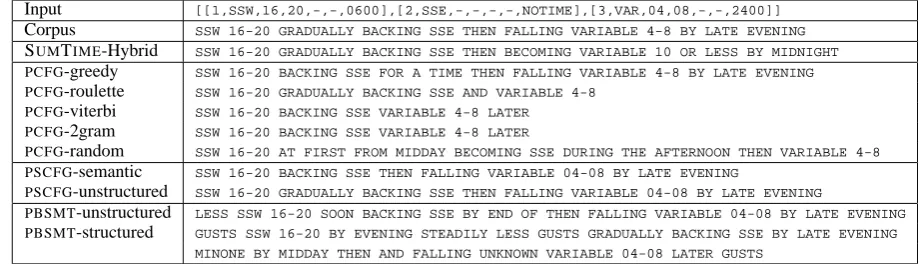
pro-Input [[1,SSW,16,20,-,-,0600],[2,SSE,-,-,-,-,NOTIME],[3,VAR,04,08,-,-,2400]]
Corpus SSW 16-20 GRADUALLY BACKING SSE THEN FALLING VARIABLE 4-8 BY LATE EVENING
SUMTIME-Hybrid SSW 16-20 GRADUALLY BACKING SSE THEN BECOMING VARIABLE 10 OR LESS BY MIDNIGHT
PCFG-greedy SSW 16-20 BACKING SSE FOR A TIME THEN FALLING VARIABLE 4-8 BY LATE EVENING
PCFG-roulette SSW 16-20 GRADUALLY BACKING SSE AND VARIABLE 4-8
PCFG-viterbi SSW 16-20 BACKING SSE VARIABLE 4-8 LATER
PCFG-2gram SSW 16-20 BACKING SSE VARIABLE 4-8 LATER
PCFG-random SSW 16-20 AT FIRST FROM MIDDAY BECOMING SSE DURING THE AFTERNOON THEN VARIABLE 4-8
PSCFG-semantic SSW 16-20 BACKING SSE THEN FALLING VARIABLE 04-08 BY LATE EVENING
PSCFG-unstructured SSW 16-20 GRADUALLY BACKING SSE THEN FALLING VARIABLE 04-08 BY LATE EVENING
PBSMT-unstructured LESS SSW 16-20 SOON BACKING SSE BY END OF THEN FALLING VARIABLE 04-08 BY LATE EVENING
[image:3.595.66.526.63.195.2]PBSMT-structured GUSTS SSW 16-20 BY EVENING STEADILY LESS GUSTS GRADUALLY BACKING SSE BY LATE EVENING MINONE BY MIDDAY THEN AND FALLING UNKNOWN VARIABLE 04-08 LATER GUSTS
Table 1: Example input with corresponding outputs by all systems and from the corpus (for 5 Oct 2000).
cesses from inputs to outputs, and has no decision-making ability. A probability distribution over this base CFG is estimated from a corpus, and this is what enables decisions between alternative gener-ation rules to be made. The pCRUpackage permits this distribution to be used in one of the follow-ing three modes to drive generation processes: (i) greedy – apply only the most likely rule at each choice point; (ii) Viterbi – apply all expansion rules to each nonterminal to create the generation forest for the input, then do a Viterbi search of the generation forest; (iii) greedy roulette-wheel – se-lect a rule to expand a nonterminal according to a non-uniform random distribution proportional to the likelihoods of expansion rules.
In addition there are two baseline modes: (i) random – where generation rules are randomly selected at each choice point; and (ii) n-gram – where all alternatives are generated and the most likely is selected according to an n-gram language model (as inHALOGEN).
For the simple SUMTIME domain, pCRU gen-erators trained on raw corpora have been shown to perform well (Belz, 2008), but for more com-plex domains it is likely that manually annotated corpora will be needed for training the CFGbase generator. As this is in addition to the manually constructed CFGbase generator, the manual com-ponent in PCFG generator building is potentially substantial.
3.3 PSCFG generation
Synchronous context-free grammars (SCFGs) are used in machine translation (Chiang, 2006), but have also been used for simple concept-to-text generation (Wong and Mooney, 2007). The sim-plest form ofSCFGcan be viewed as a pair ofCFGs
G1, G2 with paired production rules such that for
each rule inG1there is a rule inG2with the same
left-hand side, and the same non-terminals in the right-hand side. The order of non-terminals on the RHSs may differ, and each RHS may additionally contain any terminals in any order. SCFGs can be trained from aligned corpora to produce proba-bilistic (or ‘weighted’)SCFGs.
An SCFG can equivalently be seen as a single grammarG encoding a set of pairs of strings. A probabilistic SCFG is defined by the 6-tuple G =
hN,Te,Tf, L, S, λi, whereN is a finite set of non-terminals, Te, Tf are finite sets of terminal sym-bols, Lis a set of paired production rules, S is a start symbol∈ N, andλis a set of parameters that define a probability distribution of derivations un-derG. Each rule inLhas the form A → hα;βi, whereA∈ N,α ∈N∪ Te+,β ∈N ∪ Tf+, and
N ⊆ N.
InMT the two CFGs that make up an SCFG are used to encode (the structure of) the two languages which the MT system translates between. Trans-lation with an SCFG then consists of (i) parsing the input string with the source language CFG to produce a derivation tree, and then (ii) generating along the same derivation tree, but using the target languageCFGto produce the output string.
When using SCFGs for content-to-text genera-tion one of the pairedCFGs encodes the meaning representation language, and the other the (natu-ral) language in which text is supposed to be gen-erated. A generation process then consists in (i) ‘parsing’ the meaning representation (MR) into its constituent structure, and, in the opposite direc-tion, (ii) assembling strings of words correspond-ing to constituent parts of the inputMRinto a sen-tence or text that realises the entireMR.
provides a way in which a probabilistic SCFGcan be constructed for the most part automatically. The training process requires two resources as in-put: a CFG of MRs and a set of sentences paired with their MRs. As output, it produces a proba-bilistic SCFG. The training process works in two phases, producing a (non-probabilistic) SCFG in the ‘lexical acquisition phase’, and associating the rules with probabilities in the ‘parameter estima-tion phase’.
The lexical acquisition phase uses theGIZA++ word-alignment tool, an implementation (Och and Ney, 2003) ofIBM Model 5 (Brown et al., 1993) to construct an alignment ofMRs withNLstrings. AnSCFGis then constructed by using theMR CFG as a skeleton and inferring the NL grammar from the alignment.
For the parameter estimation phase, WASP−1 uses a log-linear model from Koehn et al. (2003) which defines a conditional probability distribu-tion over derivadistribu-tionsdgiven an inputMRf as
Pr
λ(
d|f)∝Pr(e(d))λ1 Y
d∈d
wλ(r(d))
where wλ(r(d)) is the weight an individual rule used in a derivation, defined as
wλ(A→ he, fi) =
P(f|e)λ2
P(e|f)λ3
Pw(f|e)λ4Pw(e|f)λ5exp(−|α|)λ6
where P(β|α) and P(α|β) are the relative fre-quencies of β and α, Pw(β|α) and Pw(α|β) are lexical weights, and exp(−|α|) is a word penalty to control output sentence length. The model pa-rameters λi are trained using minimum error rate training.
Compared to probabilistic CFGs, WASP−1 -trained probabilistic SCFGs have a much reduced manual component in system building. In the lat-ter, the NL grammar for the output language, the mapping from MRs to word strings and the rule probabilities are all created automatically, more-over from raw corpora, whereas in PCFGs, only the rule probabilities are created automatically.
3.4 SMT methods
A Statistical Machine Translation (SMT) system is essentially composed of a translation model and a language model, where the former translates source language substrings into target language substrings, and the language model determines
the most likely linearisation of the translated sub-strings. The currently most popular phrase-based SMT (PBSMT) approach translates phrases (an ar-bitrary sequence of words, rather than the lin-guistic sense), whereas the original ‘IBM models’ translated words. DifferentPBSMTmethods differ in how they construct the phrase translation table.
We used the phrase-based translation model proposed by Koehn et al. (2003) and implemented in theMOSEStoolkit (Koehn et al., 2007) which is based on the noisy channel model, where Bayes’s rule is used to reformulate the task of translat-ing a source language strtranslat-ing f into a target lan-guage stringeas finding the sentencee∗such that
e∗
= argmaxePr(e) Pr(f|e).
The translation model (which givesPr(f|e)) is
obtained from a parallel corpus of source and tar-get language texts, where the first step is automatic alignment using the GIZA++ word-level aligner. Word-level alignments are used to obtain phrase translation pairs using a set of heuristics.
A 3-gram language model (which givesPr(e))
for the target language is trained either on the same or a different corpus. For full details refer to Koehn et al. (2003; 2007).
PBSMT offers a completely automatic method for constructing generators, where all that is re-quired as input to the system building process is a corpus of pairedMRs and realisations, on the basis of which the PBSMT approach constructs a map-ping fromMSRs to realisations.
4 Ten Weather Forecast Text Generators
4.1 SUMTIME-Hybrid
We included the original SUMTIME system (Re-iter et al., 2005) in our evaluations. This rule-based system has two modules: a content-determination module and a microplanning and realisation module. It can be run without the content-determination module, taking content rep-resentations (tuple sequence as described in Sec-tion 2) as inputs, and is then called SUMTIME -Hybrid. SUMTIME-Hybrid is a traditional deter-ministic rule-based generation system, and took about one year to build.1 Table 1 shows an ex-ample forecast from the SUMTIME system (and corresponding outputs from the other systems, de-scribed below).
4.2 PCFG generators
We also included five pCRU generators for the SUMTIME domain created previously (Belz, 2008). The pCRU base generator for SUMTIME is a set of generation rules with atomic arguments that convert an input into a set of NL forecasts. To create inputs to the pCRU generators, the in-put vectors as they appear in the corpus (see Sec-tion 2) are augmented and converted into sequence of nonterminals: First, information is added to each of the 7-tuples in an automatic preprocessing phase encoding whether the change in wind direc-tion compared to the preceding 7-tuple was clock-wise or anti-clockclock-wise; whether change in wind speed was an increase or a decrease; and whether a 7-tuple was the last in the vector. Then, the aug-mented tuples are converted into a representation of nonterminals with 7 arguments.
A probability distribution over the base genera-tor was obtained by the multi-treebanking method (Belz, 2008) from the un-annotated SUMTIME corpus. This method first parses the corpus with the baseCFGand then obtains rule-application fre-quency counts from the parsed corpus which are used to obtain a probability distribution by straigh-forward maximum likelihood estimation. If there is more than one parse for a sentence then the fre-quency count increment is equally split over rules in alternative parses.
4.3 PSCFG generators
We created two probabilistic synchronous CFG (PSCFG) generators for the SUMTIMEdomain us-ing WASP−1. The main task here was to create a CFG for wind data representations. We used two different grammars (resulting in two different generators). The ‘unstructured’ grammar encodes raw corpus input vectors augmented as described in Section 4.2, whereas the ‘semantic’ grammar encodes representations with recursive predicate-argument structure that more resemble semantic forms. These were produced automatically from the raw input vectors.
Both the PSCFG-unstructured and the PSCFG -semantic generators were built in the same way, by feeding theCFG for wind data representations and the corpus of paired wind data representations and forecasts toWASP−1which then created prob-abilistic SCFGs from it.
System BLEU Homogeneous subsets corpus 1.00 A
PCFG-greedy .65 B
PSCFG-sem .637 B
PSCFG-unstr .617 B C
PCFG-viterbi .57 C D
PCFG-2gram .561 D
PCFG-roule .516 D E
PBSMT-unstr .500 E
SUMTIME .437 F
PBSMT-struc .338 G
[image:5.595.306.542.60.185.2]PCFG-rand .269 H
Table 2: Mean forecast-levelBLEUscores and ho-mogeneous subsets (Tukey HSD, alpha = .05) for SUMTIMEtest sets.
4.4 PBSMT generators
We also created two SUMTIME generators with the MOSES toolkit. The main question here was how to represent the ‘source language’ inputs. WhileSMT methods are often applied with no lin-guistic knowledge at all (and are therefore blind as to whether paired inputs and outputs areNLstrings or something else), it was not clear how well they would cope with the task of mapping from number/symbol vectors to NL strings. We tested two different input representations, one of which was simply the augmented corpus input vectors as described above (PBSMT-unstructured), and an-other in which the individual 7-tuples of which the vectors are composed are explicitly marked by predicate-argument structure (PBSMT-structured). For comparability with Wong & Mooney (2007) the structure markers were treated as tokens.
We built two different generators by feeding the two different versions of the paired corpus to MOSES. We did not use a factored translation model (the words used in weather forecasts did not vary sufficiently), or tuning.
5 Evaluation Methods
5.1 Automatic evaluation methods
The two automatic metrics used in the evaluations, NIST2 and BLEU3, have been shown to correlate well with expert judgments (Pearson’s r = 0.82
and 0.79 respectively) in the SUMTIME domain (Belz and Reiter, 2006).
2http://cio.nist.gov/esd/emaildir/ lists/mt_list/bin00000.bin
BLEU-x is an n-gram based string comparison measure, originally proposed by Papineni et al. (2001) for evaluation of MTsystems. It computes the proportion of word n-grams of length x and less that a system output shares with several refer-ence outputs. Settingx= 4(i.e. considering all n-grams of length≤4) is standard. NIST (Dodding-ton, 2002) is a version ofBLEU, but where BLEU gives equal weight to all n-grams,NISTgives more importance to less frequent (hence more informa-tive) n-grams, and the range of NIST scores de-pends on the size of the test set. Some research has shown NIST to correlate with human judgments more highly than BLEU (Doddington, 2002; Rie-zler and Maxwell, 2005; Belz and Reiter, 2006).
5.2 Human evaluation
We designed an experiment in which participants were asked to rate forecast texts for Clarity and Readability on scales of 1–7. Clarity was ex-plained as indicating how understandable a fore-cast was, and Readability as indicating how flu-ent and readable it was. After an introduction and detailed explanations, participants carried out the evaluations over the web. They were able to inter-rupt and resume the evaluation at any time.
We randomly selected 22 forecast dates and used outputs from all 10 systems for those dates (as well as the corresponding forecasts in the cor-pus) in the evaluation, i.e. a total of 242 forecast texts. We used a repeated Latin squares design where each combination of forecast date and sys-tem is assigned two trials. As there were 2 eval-uation criteria, there were 968 individual ratings in this experiment. An evaluation session started with three training examples; the real trials were then presented in random order.
We recruited 22 participants from among our university colleagues whose first language was English and who had no experience of NLP. We did not try to recruit master mariners as in earlier experiments reported by Reiter and Belz (2006), because these experiments also demonstrated that the correlation between the ratings by such ex-pert evaluators and lay-people is very strong in the SUMTIMEdomain (Pearson’sr= 0.845).
6 Results
For each evaluation method, we carried out a one-wayANOVAwith ‘System’ as the fixed factor, and the evaluation measure as the dependent variable.
System NIST Homogeneous subsets corpus 4.062 A
PCFG-greedy 3.361 B
PSCFG-sem 3.303 B
PSCFG-unstr 3.191 B C
PCFG-roule 3.033 C D
PBSMT-unstr 2.924 D
PCFG-viterbi 2.854 D E
PCFG-2gram 2.854 D E
SUMTIME 2.707 E F
PCFG-rand 2.540 F
[image:6.595.308.527.61.183.2]PBSMT-struc 2.331 G
Table 3: Mean forecast-level NIST scores and ho-mogeneous subsets (Tukey HSD, alpha = .05) for SUMTIMEtest sets.
In each case we report the main effect of System on the measure and (if it is significant) we also report significant differences between pairs of sys-tems in the form of homogeneous subsets obtained with a post-hoc TukeyHSDanalysis.
Tables 2 and 3 display the results for theBLEU and NIST evaluations, where scores were cal-culated on test data sets, using a 5-fold cross-validation set-up. System names (in abbrevi-ated form) are shown in the first column, mean forecast-level scores in the second, and the re-maining columns indicate significant differences between systems. The way to read the homoge-neous subsets is that two systems which do not have a letter in common are significantly different withp < .05.
For theBLEUevaluation, the main effect of Sys-tem on BLEU score was F = 248.274, at p < .001. PCFG-greedy, PSCFG-semantic andPSCFG -unstructured come out top, although only the first two are significantly better than all other systems. SUMTIME-Hybrid, PBSMT-structured and PCFG -random bring up the rear, with the remaining sys-tems distributed over the middle ground. A strik-ing result is that the handcrafted SUMTIME sys-tem comes out near the bottom, being signifi-cantly worse than all other systems exceptPCFG -structured andPBSMT-random.
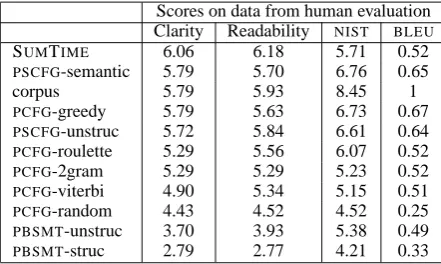
Scores on data from human evaluation Clarity Readability NIST BLEU
SUMTIME 6.06 6.18 5.71 0.52
PSCFG-semantic 5.79 5.70 6.76 0.65
corpus 5.79 5.93 8.45 1
PCFG-greedy 5.79 5.63 6.73 0.67
PSCFG-unstruc 5.72 5.84 6.61 0.64
PCFG-roulette 5.29 5.56 6.07 0.52
PCFG-2gram 5.29 5.29 5.23 0.52
PCFG-viterbi 4.90 5.34 5.15 0.51
PCFG-random 4.43 4.52 4.52 0.25
PBSMT-unstruc 3.70 3.93 5.38 0.49
[image:7.595.72.293.62.194.2]PBSMT-struc 2.79 2.77 4.21 0.33
Table 4: Mean Clarity and Readability ratings from human evaluation; NIST and BLEU scores on same 22 forecasts as used in human evaluation.
The main results from the automatic evalua-tions are that the twoPSCFGsystems and thePCFG system with the greedy generation algorithm are best overall. However, the human evaluations pro-duced rather different results.
Figure 3 is a series of bar charts representing the results of the human evaluation for Clarity. For each system (indicated by the labels on the x-axis), there are 7 bars, showing how many ratings of 1, 2, 3, 4, 5, 6 and 7 (7 being the best) a system was given. So the left-most bar for a system shows how many ratings of 1 a system was given, the second bar how many ratings of 2, etc. Systems are shown in descending order of mode (the value of the most frequently assigned rating, e.g. 7 for PSCFG-unstructured on the left, and 1 forPBSMT -structured on the right). The PSCFG-unstructured and SUMTIME systems come out top in this eval-uation, with PSCFG-semantic, PCFG-roulette and PCFG-greedy close behind. Conversely, PBSMT -structured clearly came out worst, with no ratings of 7 and a mode of 1 (=completely unclear).
Figure 4 consists of the same kind of bar charts, for the Readability ratings. Here the SUMTIME system is the clear winner, with no ratings of 1 and 2 and 22 ratings of 7 (=excellent, all parts read well). It is closely followed by PSCFG -unstructured, the corpus forecasts and PSCFG -semantic. Again, PBSMT-structured is clearly worst with no ratings of 7, although this time the mode is 3 (=fairly bad).
We also looked at the means of the ratings, and these are shown in the second and third columns of Table 4. The means have to be treated with
some caution, because ratings are ordinal data and it is not clear how meaningful it is to com-pute means. However, it is a simple way of ob-taining a system ranking for comparison with the two automatic scores (shown in the remaining two columns of Table 4, for the 22 dates in the human evaluation only). In terms of means, SUMTIME comes out top for both Clarity and Readability. In Clarity, it is followed by the two PSCFG sys-tems, the corpus files (the only forecasts actually written by humans), andPCFG-greedy which have virtually the same means. For Readability, cor-pus andPSCFG-unstructured are ahead ofPSCFG -semantic and PCFG-greedy (in this order). Bring-ing up the rear for both Clarity and Readability, as in theNISTevaluations, isPBSMT-structured, with PCFG-random and andPBSMT-unstructured faring somewhat better.
There are some striking differences between the automatic and human evaluations. For one, the human evaluators rank the SUMTIME system very high, whereas both automatic metrics rank it very low, just abovePCFG-random andPBSMT -structured. Furthermore, the metrics rankPBSMT -unstructured more highly than the human evalua-tors, placing it above the SUMTIME system and in the case of NIST, also above two of the PCFG systems (Table 3). The human and the automatic evaluations agree only that thePSCFGsystems and PCFG-greedy are equally good.
7 Conclusions
Reports of research on automating (part of) system building often take it as read that such automation is a good thing. The resulting systems are not of-ten compared to handcrafted alternatives in terms of output quality or other quality criteria, and little is therefore known about the loss of system qual-ity that results from automation. The existence of several independently developed systems for the SUMTIME domain of weather forecasts, to which we have added four new systems in the research reported in this paper, provides a unique opportu-nity to examine the system building cost vs. sys-tem quality trade-off in data-to-text generation.
automat-Figure 3: Clarity ratings: Number of times each system was rated 1, 2, 3, 4, 5, 6, and 7 on Clarity. Systems in descending order of mode (most frequent rating).
ically trained but manually crafted generator led to a loss of acceptability to human readers, but an im-provement in terms of n-gram similarity to corpus texts. Further increasing the automatic component to the point where only a CFGfor meaning repre-sentations is created manually did not result in a further reduction in quality in either acceptability to humans or corpus similarity. However, com-pletely removing the manual component resulted in a reduction in quality in both human acceptabil-ity and corpus similaracceptabil-ity (although this is more ap-parent in the former).
We found striking differences between the re-sults from tests of human acceptability and mea-surements of corpus similarity. Compared to the human ratings, the automatic metrics severely un-derestimated the quality of the handcrafted SUM -TIME system, but overestimated the quality of the automatically constructed SMT systems. This will not come as a surprise to those familiar with the machine translation evaluation literature where this is a major complaint about BLEU (Callison-Burch et al., 2006). From our results it seems clear that when the quality of diverse types of systems is compared, automatic metrics such asBLEUdo not give a complete and reliable picture, and carrying out additional evaluations is crucial.
Increased reusability and adaptability of sys-tems and components have cost and time bene-fits, and methods for automatically training sys-tems from data offer advantages in both these
re-spects. However, careful evaluation is needed to ensure that these advantages are not achieved at the price of a reduction in system quality that ren-ders systems unacceptable to human users.
Acknowledgments
The research reported in this paper was supported under EPSRC grant EP/E029116/1 (the Prodigy Project). We thank the anonymous reviewers for their helpful comments.
References
A. Belz and E. Reiter. 2006. Comparing automatic and human evaluation of NLG systems. In
Proceed-ings of the 11th Conference of the European Chap-ter of the Association for Computational Linguistics (EACL’06), pages 313–320.
A. Belz. 2008. Automatic generation of weather forecast texts using comprehensive probabilistic generation-space models. Natural Language
Engi-neering, 14(4):431–455.
P. F. Brown, V. J. Della Pietra, S. A. Della Pietra, and R. L. Mercer. 1993. The mathematics of statistical machine translation: parameter estimation.
Compu-tational Linguistics, 19(2):263–311.
D. Chiang. 2006. An introduction to synchronous grammars (part of the course materials for the ACL’06 tutorial on synchronous grammars).
G. Doddington. 2002. Automatic evaluation
[image:8.595.78.523.64.283.2]co-Figure 4: Readability ratings: Number of times each system was rated 1, 2, 3, 4, 5, 6, and 7 on Readabil-ity. Systems in descending order of mode (most frequent rating).
occurrence statistics. In Proceedings of the ARPA
Workshop on Human Language Technology.
K. Knight and I. Langkilde. 1998. Generation that exploits corpus-based statistical knowledge. In
Pro-ceedings of the 36th Annual Meeting of the Associ-ation for ComputAssoci-ational Linguistics and 17th Inter-national Conference on Computational Linguistics (COLING-ACL’98), pages 704–710.
P. Koehn, F. J. Och, and D. Marcu. 2003. Statisti-cal phrase-based translation. In Proceedings of
Hu-man Language Technologies: The Annual Confer-ence of the North American Chapter of the Associa-tion for ComputaAssocia-tional Linguistics on Human Lan-guage Technology (HLT-NAACL’03), pages 48–54.
P. Koehn, H. Hoang, A. Birch, C. Callison-Burch, M. Federico, N. Bertoldi, B. Cowan, W. Shen, C. Moran, R. Zens, C. Dyer, O. Bojar, A. Constantin, and E. Herbst. 2007. Moses: Open source toolkit for statistical machine translation. In Proceedings of
the 45th Annual Meeting of the Association for Com-putational Linguistics (ACL’07), pages 177–180.
I. Langkilde. 2000. Forest-based statistical sen-tence generation. In Proceedings of the 6th Applied
Natural Language Processing Conference and the 1st Meeting of the North American Chapter of the Association of Computational Linguistics (ANLP-NAACL ’00), pages 170–177.
F. J. Och and H. Ney. 2003. A Systematic Comparison of Various Statistical Alignment Models.
Computa-tional Linguistics, 29(1):19–51.
K. Papineni, S. Roukos, T. Ward, and W.-J. Zhu. 2001. BLEU: A method for automatic evaluation of ma-chine translation. IBM research report, IBM Re-search Division.
E. Reiter and R. Dale. 1997. Building applied natu-ral language generation systems. Natunatu-ral Langauge
Engineering, 3(1):57–87.
E. Reiter, S. Sripada, J. Hunter, and J. Yu. 2005. Choosing words in computer-generated weather forecasts. Artificial Intelligence, 167:137–169.
S. Riezler and J. T. Maxwell. 2005. On some pitfalls in automatic evaluation and significance testing for MT. In Proceedings of the ACL’05 Workshop on
Intrinsic and Extrinsic Evaluation Measures for MT and/or Summarization, pages 57–64.
S. Sripada, E. Reiter, J. Hunter, and J. Yu. 2002. SUMTIME-METEO: A parallel corpus of naturally occurring forecast texts and weather data. Technical Report AUCS/TR0201, Computing Science Depart-ment, University of Aberdeen.
Y. W. Wong and R. Mooney. 2006. Learning for semantic parsing with statistical machine transla-tion. In Proceedings of Human Language
Technolo-gies: The Annual Conference of the North Ameri-can Chapter of the Association for Computational Linguistics on Human Language Technology (HLT-NAACL’06), pages 439–446.
Y. W. Wong and R.J. Mooney. 2007. Generation by inverting a semantic parser that uses statisti-cal machine translation. In Proceedings of Human
[image:9.595.75.523.64.282.2]