More Languages, More MAP?: A Study of Multiple Assisting Languages
in Multilingual PRF
Vishal Vachhani Manoj K. Chinnakotla Mitesh M. Khapra Pushpak Bhattacharyya
Department of Computer Science and Engineering, Indian Institute of Technology Bombay
{vishalv,manoj,miteshk,pb}@cse.iitb.ac.in
Abstract
Multilingual Pseudo-Relevance Feedback (MultiPRF) is a framework to improve
the PRF of a source language by taking
the help of another language called
as-sisting language. In this paper, we
ex-tend the MultiPRF framework to include multiple assisting languages. We consider three different configurations to incorpo-rate multiple assisting languages - a) Par-allel - all assisting languages combined simultaneously b) Serial - assisting lan-guages combined in sequence one after another and c) Selective - dynamically se-lecting the best feedback model for each query. We study their effect on MultiPRF performance. Results using multiple as-sisting languages are mixed and it helps in boosting MultiPRF accuracy only in some cases. We also observe that MultiPRF be-comes more robust with increase in num-ber of assisting languages.
1 Introduction
Pseudo-Relevance Feedback (PRF) (Buckley et al., 1994; Xu and Croft, 2000; Mitra et al., 1998) is known to be an effective technique to im-prove the effectiveness of Information Retrieval
(IR) systems. In PRF, the top ‘k’ documents
from the ranked list retrieved using the initial
key-word query are assumed to be relevant. Later,
these documents are used to refine the user query and the final ranked list is obtained using the above refined query. Although PRF has been shown to improve retrieval, it suffers from the
following drawbacks: (a) Lexical and Semantic
Non-Inclusion: the type of term associations
ob-tained for query expansion is restricted to only co-occurrence based relationships in the feedback
documents and (b) Lack of Robustness: due to
the inherent assumption in PRF, i.e., relevance
of top k documents, performance is sensitive to
that of the initial retrieval algorithm and as a re-sult is not robust. Typically, larger coverage en-sures higher proportion of relevant documents in
the top k retrieval (Hawking et al., 1999).
How-ever, some resource-constrained languages do not have adequate information coverage in their own language. For example, languages like Hungarian and Finnish have meager online content in their own languages.
Multilingual Pseudo-Relevance Feedback
(MultiPRF) (Chinnakotla et al., 2010a) is a
novel framework for PRF to overcome the above limitations of PRF. It does so by taking the help of
a different language called theassisting language.
Thus, the performance of a resource-constrained language could be improved by harnessing the good coverage of another language. MulitiPRF showed significant improvements on standard CLEF collections (Braschler and Peters, 2004) over state-of-art PRF system. On the web, each language has its own exclusive topical coverage besides sharing a large number of common topics with other languages. For example, information about Saudi Arabia government policies and regulations is more likely to be found in Arabic language web and also information about a local event in Spain is more likely to be covered in
Spanish web than in English. Hence, using
multiple languages in conjunction is more likely to ensure satisfaction of the user information need and hence will be more robust.
the various possible ways of combining the mod-els learned from multiple assisting languages. We propose three different configurations for includ-ing multiple assistinclud-ing languages in MultiPRF - a) Parallel b) Serial and c) Selective. In Parallel com-bination, all the assisting languages are combined simultaneously using interpolation. In Serial con-figuration, the assisting languages are applied in sequence one after another and finally, in Selec-tive configuration, the best feedback model is dy-namically chosen for each query. We experiment with each of the above configurations and present both quantitative and qualitative analysis of the re-sults. Results using multiple assisting languages are mixed and it helps in boosting MultiPRF ac-curacy only in some cases. We also observe that MultiPRF becomes more robust with increase in number of assisting languages. Besides, we also study the relation between number of assisting languages, coverage and the MultiPRF accuracy.
The paper is organized as follows: Section 2, explains the Language Modeling (LM) based PRF approach. Section 3, describes the MultiPRF ap-proach. Section 4 explains the various configu-rations to extend MultiPRF for multiple assisting languages. Section 6 presents the results and dis-cussions. Finally, Section 7 concludes the paper.
2 PRF in the LM Framework
The Language Modeling (LM) Framework allows PRF to be modeled in a principled manner. In the LM approach, documents and queries are mod-eled using multinomial distribution over words
called document language model P(w|D) and
query language modelP(w|ΘQ)respectively. For
a given query, the document language models are ranked based on their proximity to the query lan-guage model, measured using KL-Divergence.
KL(ΘQ||D) =
X
w
P(w|ΘQ)·log
P(w|ΘQ) P(w|D)
Since the query length is short, it is difficult to
es-timate ΘQ accurately using the query alone. In
PRF, the top k documents obtained through the
initial ranking algorithm are assumed to be rele-vant and used as feedback for improving the
es-timation of ΘQ. The feedback documents
con-tain both relevant and noisy terms from which
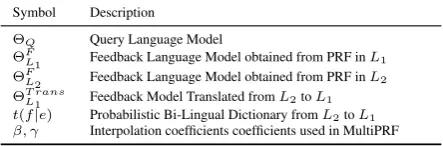
Symbol Description
ΘQ Query Language Model
ΘF
L1 Feedback Language Model obtained from PRF inL1
ΘF
L2 Feedback Language Model obtained from PRF inL2
ΘT rans
[image:2.595.297.519.78.151.2]L1 Feedback Model Translated fromL2toL1 t(f|e) Probabilistic Bi-Lingual Dictionary fromL2toL1 β, γ Interpolation coefficients coefficients used in MultiPRF
Table 1: Glossary of Symbols used in explaining MultiPRF
the feedback language model is inferred based on a Generative Mixture Model (Zhai and Lafferty, 2001).
Let DF = {d1, d2, . . . , dk} be the top k
doc-uments retrieved using the initial ranking algo-rithm. Zhai and Lafferty (Zhai and Lafferty, 2001)
model the feedback document setDF as a mixture
of two distributions: (a) the feedback language
modeland (b) thecollection modelP(w|C). The
feedback language model is inferred using the EM Algorithm (Dempster et al., 1977), which itera-tively accumulates probability mass on the most
distinguishing terms, i.e. terms which are more
frequent in the feedback document set than in the entire collection. To maintain query focus the
fi-nal converged feedback model,ΘF is interpolated
with the initial query modelΘQto obtain the final
query modelΘF inal.
ΘF inal = (1−α)·ΘQ+α·ΘF
ΘF inal is used to re-rank the corpus using the
KL-Divergence ranking function to obtain the fi-nal ranked list of documents. Henceforth, we refer
to the above technique asModel Based Feedback
(MBF).
3 Multilingual Pseudo-Relevance Feedback (MultiPRF)
Chinnakotla et al. (Chinnakotla et al., 2010a; Chinnakotla et al., 2010b) propose the MultiPRF approach which overcomes the fundamental limi-tations of PRF with the help of an assisting
collec-tion in a different language. Given a queryQ in
the source languageL1, it is automatically
trans-lated into the assisting language L2. The
docu-ments in the L2 collection are ranked using the
query likelihood ranking function (John Lafferty
and Chengxiang Zhai, 2003). Using the topk
the original query and the top k documents
re-trieved from the initial ranking in L1. Let the
re-sultant feedback models beΘFL2 andΘFL1
respec-tively. The feedback model estimated in the
as-sisting language ΘFL2 is translated back into
lan-guage L1 using a probabilistic bi-lingual
dictio-naryt(f|e)fromL2 →L1as follows:
P(f|ΘT ransL1 ) = X
∀e inL2
t(f|e)·P(e|ΘFL2) (1)
The probabilistic bi-lingual dictionaryt(f|e)is
learned from a parallel sentence-aligned corpora
inL1−L2 based on word level alignments. The
probabilistic bi-lingual dictionary acts as a rich source of morphologically and semantically re-lated feedback terms. Thus, the translation model
adds related terms inL1 which have their source
as the term from feedback model ΘF
L2. The final
MultiPRF model is obtained by interpolating the above translated feedback model with the original query model and the feedback model of language
L1as given below:
ΘM ultiL1 = (1−β−γ)·ΘQ+β·ΘFL1 +γ·Θ
T rans L1
(2) In order to retain the query focus during back
translation, the feedback model in L2 is
interpo-lated with the transinterpo-lated query before translation
of theL2 feedback model. The parametersβ and
γ control the relative importance of the original
query model, feedback model ofL1and the
trans-lated feedback model obtained from L1 and are
tuned based on the choice ofL1 andL2.
4 Extending MultiPRF to Multiple Assisting Languages
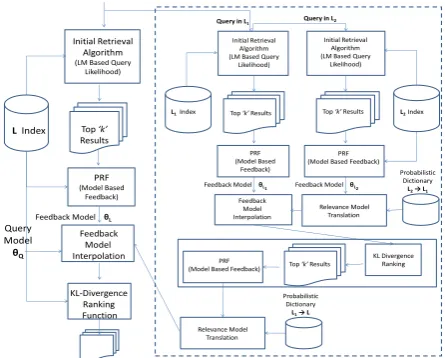
In this section, we extend the MultiPRF model described earlier to multiple assisting languages. Since each language produces a different feed-back model, there could be different ways of com-bining these models as suggested below.
Parallel: One way is to include the new assist-ing language model usassist-ing one more interpo-lation coefficient which gives the effect of
us-ing multiple assistus-ing languages inparallel.
Serial: Alternately, we can have a serial
combi-nation wherein language L2 is first assisted
Initial Retrieval (LM Based Query Likelihood)
Top ‘k’
Results
PRF (Model Based
Feedback) L Index
Final Ranked List Of Documents in L
Feedback Model Interpolation Relevance Model Translation KL-Divergence Ranking Function
Feedback Model θL1
Feedback Model θL
Query in L Translated Query to L1
Probabilistic Dictionary L1→ L
Query Model
θQ
Translated Query to Ln
Initial Retrieval (LM Based Query Likelihood)
Top ‘k’
Results
PRF (Model Based
Feedback)
L1Index
Relevance Model Translation Feedback Model θLn
Initial Retrieval
Top ‘k’
[image:3.595.303.521.76.254.2]Results PRF (Model Based Feedback) Ln Index Probabilistic Dictionary Ln→ L
Figure 1: Schematic of the Multilingual PRF Approach Us-ing Parallel Assistance
Initial Retrieval Algorithm (LM Based Query
Likelihood)
Top ‘k’
Results PRF (Model Based Feedback) Feedback Model Interpolation KL-Divergence Ranking Function LIndex Initial Retrieval Algorithm (LM Based Query
Likelihood)
Top ‘k’Results
PRF (Model Based Feedback)
L2 Index
Relevance Model Translation L1Index
Feedback Model θL1 Query in L1
Initial Retrieval Algorithm (LM Based Query
Likelihood)
Top ‘k’Results
PRF (Model Based Feedback) Feedback Model Interpolation
Feedback Model θL2 Query in L2
Top ‘k’Results PRF
(Model Based Feedback)
KL Divergence Ranking
Probabilistic Dictionary
L2→ L1
Relevance Model Translation
Probabilistic Dictionary
L1→ L
Feedback Model θL
Query Model
θQ
Figure 2: Schematic of the Multilingual PRF Approach Us-ing Serial Assistance
by languageL3 and then this MultiPRF
sys-tem is used to assist the source languageL1.
Selective: Finally, we can have selective assis-tance wherein we dynamically select which assisting language to use based on the input query.
Below we describe each of these systems in detail.
4.1 Parallel Combination
The MultiPRF model as explained in section 3
in-terpolates the query model of L1 with the MBF
of L1 and the translated feedback model of the
assisting language L2. The most natural
[image:3.595.296.519.292.471.2]re-Language CLEF Collection Identifier Description No. of Documents No. of Unique Terms CLEF Topics (No. of Topics)
English EN-02+03 LA Times 94, Glasgow Herald 95 169477 234083 91-200 (67)
French FR-02+03 Le Monde 94, French SDA 94-95 129806 182214 91-200 (67)
German DE-02+03 Frankfurter Rundschau 94, Der Spiegel 94-95,
German SDA 94-95 294809 867072 91-200 (67)
Finnish FI-02+03 Aamulehti 94-95 55344 531160 91-200 (67)
Dutch NL-02+03 NRC Handelsblad 94-95, Algemeen Dagblad 94-95 190604 575582 91-200 (67)
Spanish ES-02+03 EFE 94, EFE 95 454045 340250 91-200 (67)
Table 2: Details of the CLEF Datasets used for Evaluating the MultiPRF approach. The number shown in brackets of the final column CLEF Topics indicate the actual number of topics used during evaluation.
trieval of each of these languages. The translated feedback models resulting from each of these re-trievals can then be interpolated to get the final
parallel MultiPRF model. Specifically, ifL1is the
source language and L2, L3, . . . Ln are assisting
languages then final parallel MultiPRF model can be obtained by generalizing Equation 2 as shown below:
ΘM ultiAssistL1 = (1−β−
X
i
αi)·ΘQ+β·ΘF+
X
i
αi·ΘT ransLi
(3)
The schematic representation of parallel combina-tion is shown in Figure 1.
4.2 Serial Combination
LetL1 be the source language and letL2 andL3
be two assisting languages. A serial combination can then be achieved by cascading two MultiPRF systems as described below:
1. Construct a MultiPRF system with L2 as
the source language and L3 as the
assist-ing language. We call this system asL2L3
-MultiPRF system.
2. Next, construct a MultiPRF system with L1
as the source language andL2L3-MultiPRF
as the assisting system.
As compared to a single assistance system where
only L2 is used as the assisting language for
L1, here the performance of languageL2 is first
boosted using L3 as the assisting language. This
boosted system is then used for assistingL1. Also
note that unlike parallel assistance here we do not introduce an extra interpolation co-efficient in the original MultiPRF model given in Equation 2. The schematic representation of serial combina-tion is shown in Figure 2.
4.3 Selective Assistance
We motivate selective assistance by posing the
following question: “Given a source language
L1 and two assisting languages L2 and L3, is
it possible that L2 is ideal for assisting some
queries whereas L3 is ideal for assisting some
other queries?” For example, suppose L2 has a
rich collection of TOURISM documents whereas
L3 has a rich collection of HEALTH documents.
Now, given a query pertaining to TOURISM
do-main one might expectL2 to serve as a better
as-sisting language whereas given a query pertaining
to the HEALTH domain one might expect L3 to
serve as a better assisting language. This intuition can be captured by suitably changing the interpo-lation model as shown below:
ΘBestL =SelectBestM odel(ΘFL,ΘT ransL
1 ,Θ
T rans L2 ,Θ
T rans L12 )
ΘM ultiL1 = (1−α)·ΘQ+α·Θ
Best
L (4)
where, SelectBestM odel() gives the best
model for a particular query using the algorithm mentioned below which is based on minimizing
the query drift as described in (?):
1. Obtain the four feedback models, viz.,
ΘFL,ΘT ransL1 ,ΘT ransL2 ,ΘT ransL12
2. Build a language model (say, LM) using
queryQandtop-100 documents of initial
re-trieval in languageL.
3. Find the KL-Divergence between LM and
the four models obtained during step 1. 4. Select the model which has minimum
KL-Divergence score fromLM. Call this model
ΘBestL .
5. Get the final model by interpolating the
5 Experimental Setup
We evaluate the performance of our system us-ing the standard CLEF evaluation data in six lan-guages, widely varying in their familial relation-ships - Dutch, German, English, French, Spanish and Finnish. The details of the collections and their corresponding topics used for MultiPRF are given in Table 2. Note that, in each experiment, we choose assisting collections such that the top-ics in the source language are covered in the as-sisting collection so as to get meaningful feedback
terms. In all the topics, we only use thetitlefield.
We ignore the topics which have no relevant docu-ments as the true performance on those topics can-not be evaluated.
We use the Terrier IR platform (Ounis et al., 2005) for indexing the documents. We perform standard tokenization, stop word removal and stemming. We use the Porter Stemmer for English and the stemmers available through the Snowball package for other languages. Other than these, we do not perform any language-specific process-ing on the languages. In case of French, since
some function words likel’,d’ etc.,occur as
pre-fixes to a word, we strip them off during index-ing and query processindex-ing, since it significantly im-proves the baseline performance. We use standard
evaluation measures like MAP, P@5 andP@10
for evaluation. Additionally, for assessing robust-ness, we use the Geometric Mean Average Preci-sion (GMAP) metric (Robertson, 2006) which is also used in the TREC Robust Track (Voorhees, 2006). The probabilistic bi-lingual dictionary used in MultiPRF was learnt automatically by run-ning GIZA++: a word alignment tool (Och and Ney, 2003) on a parallel sentence aligned corpora.
For all the above language pairs we used the
Eu-roparl Corpus (Philipp, 2005). We use Google
Translate as the query translation system as it has been shown to perform well for the task (Wu et al., 2008). We use two-stage Dirichlet smooth-ing with the optimal parameters tuned based on the collection (Zhai and Lafferty, 2004). We tune
the parameters of MBF, specificallyλandα, and
choose the values which give the optimal perfor-mance on a given collection. We observe that the
optimal parameters γ and β are uniform across
collections and vary in the range 0.4-0.48. We
Source
Langs Assist.Langs MBF MultiPRF(L1)
MultiPRF (L2)
MultiPRF (L1,L2)
EN
DE-NL MAP 0.4495 0.4464 0.4471 0.4885(4.8)
†
P@5 0.4955 0.4925 0.5045 0.5164(2.4)
P@10 0.4328 0.4343 0.4373 0.4463(2.1)
DE-FI MAP 0.4495 0.4464 0.4545 0.4713(3.7)
†
P@5 0.4955 0.4925 0.5194 0.5224(1.2)
P@10 0.4328 0.4343 0.4373 0.4507(3.1)
NL-ES MAP 0.4495 0.4471 0.4566 0.4757(4.2)
†
P@5 0.4955 0.5045 0.5164 0.5224(0.6)
P@10 0.4328 0.4373 0.4537 0.4448(2.4)
ES-FR MAP 0.4495 0.4566 0.4563 0.48(5.1)
†
P@5 0.4955 0.5164 0.5075 0.5224(1.2)
P@10 0.4328 0.4537 0.4343 0.4388(-3.3)
ES-FI MAP 0.4495 0.4566 0.4545 0.48(5.1)
†
P@5 0.4955 0.5164 0.5194 0.5254(1.7)
P@10 0.4328 0.4537 0.4373 0.4403(-3.0)
FR-FI MAPP@5 0.44950.4955 0.45630.5075 0.45450.5194 0.4774(4.6)0.5284(4.1)†
P@10 0.4328 0.4343 0.4373 0.4373(0.7)
FI
EN-FR MAPP@5 0.35780.3821 0.34110.394 0.35530.397 0.3688(3.8)0.4149(4.5)†
P@10 0.3105 0.3463 0.3433 0.3433(0.1)
NL-DE MAPP@5 0.35780.3821 0.37220.406 0.37960.403 0.3929(3.5)0.4149(3.0)
P@10 0.3105 0.3478 0.3582 0.3597(0.4)
ES-DE MAP 0.3578 0.369 0.3796 0.4058(6.9)
†
P@5 0.3821 0.4119 0.403 0.4239(5.2)
P@10 0.3105 0.3448 0.3582 0.3612(0.8)
FR-DE MAP 0.3578 0.3553 0.3796 0.3988(5.1)
†
P@5 0.3821 0.397 0.403 0.406(0.7)
P@10 0.3105 0.3433 0.3582 0.3507(-2.1)
NL-ES MAP 0.3578 0.3722 0.369 0.3875(4.1)
†
P@5 0.3821 0.406 0.4119 0.4060.0)
P@10 0.3105 0.3478 0.3448 0.3537(1.7)
NL-FR MAP 0.3578 0.3722 0.3553 0.3875(4.1)
†
P@5 0.3821 0.406 0.397 0.409(0.7)
P@10 0.3105 0.3478 0.3433 0.3463(-0.4)
ES-FR MAPP@5 0.35780.3821 0.3690.4119 0.35530.397 0.3823(3.6)0.4119(0.0)
P@10 0.3105 0.3448 0.3433 0.3418(-0.9)
FR EN-ES MAPP@5 0.43560.4776 0.46580.4925 0.46340.4925 0.4803(3.1)0.4985(1.2)
[image:5.595.298.529.80.450.2]P@10 0.4194 0.4358 0.4388 0.4493(3.1)†
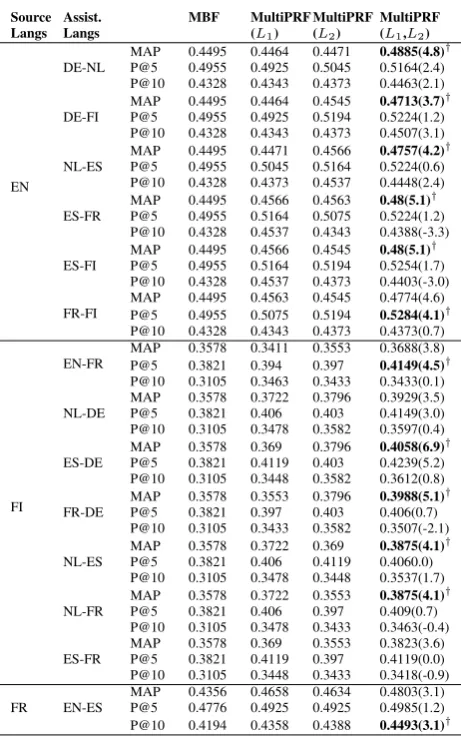
Table 3: Comparison of MultiPRF Multiple Assisting Lan-guages using parallel assistance framework with MultiPRF with single assisting language. Only language pairs where positive improvements were obtained are reported here.
Re-sults marked as ‡ indicate that the improvement was
sta-tistically significant over baseline (Maximum of MultiPRF
with single assisting language) at 90% confidence level (α=
0.01) when tested using a paired two-tailed t-test.
uniformly choose the top ten documents for feed-back.
6 Results and Discussion
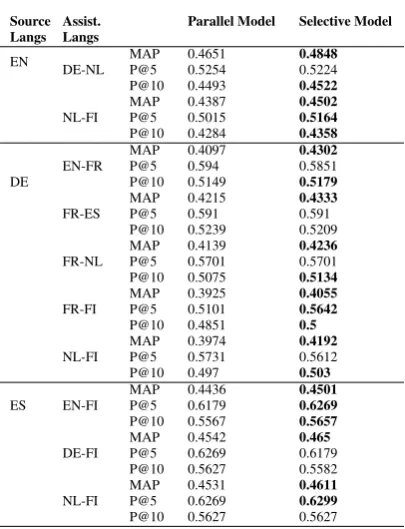
Tables ?? and ?? present the results for
Multi-PRF with two assisting languages using paral-lel assistance and selective assistance framework. Out of the total 60 possible combinations, in
Ta-ble ??, we only report the combinations where
lan-Source
Langs Assist.Langs Parallel Model Selective Model
EN DE-NL MAPP@5 0.46510.5254 0.48480.5224
P@10 0.4493 0.4522
NL-FI MAPP@5 0.43870.5015 0.45020.5164
P@10 0.4284 0.4358
DE EN-FR
MAP 0.4097 0.4302
P@5 0.594 0.5851
P@10 0.5149 0.5179
FR-ES MAPP@5 0.42150.591 0.43330.591
P@10 0.5239 0.5209
FR-NL MAPP@5 0.41390.5701 0.42360.5701
P@10 0.5075 0.5134
FR-FI MAPP@5 0.39250.5101 0.40550.5642
P@10 0.4851 0.5
NL-FI MAPP@5 0.39740.5731 0.41920.5612
P@10 0.497 0.503
ES EN-FI MAPP@5 0.44360.6179 0.45010.6269
P@10 0.5567 0.5657
DE-FI MAPP@5 0.45420.6269 0.4650.6179
P@10 0.5627 0.5582
NL-FI MAPP@5 0.45310.6269 0.46110.6299
[image:6.595.74.277.78.343.2]P@10 0.5627 0.5627
Table 4: Results showing the positive improvements of Mul-tiPRF with selective assistance framework over MulMul-tiPRF with parallel assistance framework.
guage. Hence, we do not report their results as the results were almost equivalent to single
as-sisting language. As shown in Table ??,
selec-tive assistance does give decent improvements in some language pairs. An interesting point to note in selective assistance is that it helps languages like Spanish whose monolingual performance and document coverage are both high.
6.1 Qualitative Comparison of Feedback Terms using Multiple Languages
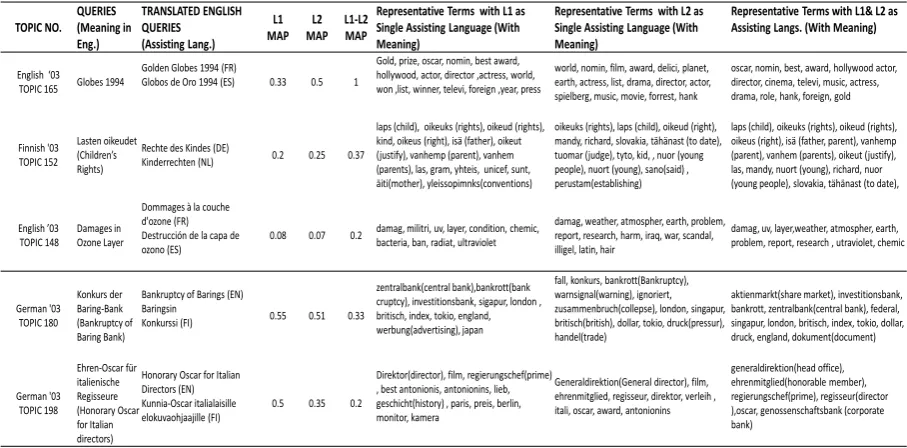
In this section, we qualitatively compare the re-sults of MultiPRF with two assisting languages with that of MultiPRF with single assisting lan-guage, based on the top feedback terms obtained by each model. Specifically, in Table 5 we com-pare the terms obtained by MultiPRF using (i)
OnlyL1as assisting language, (ii) OnlyL2as
as-sisting language and (iii) Both L1 and L2 as
as-sisting languages in a parallel combination. For example, the first row in the above table shows the terms obtained by each model for the
En-glish query “Golden Globes 1994”. Here,L1 is
French and L2 is Spanish. Terms like “Gold”
and“Prize”appearing in the translated feedback
model of L1 cause a drift in the topic towards
“Gold Prize” resulting in a lower MAP score
(0.33). Similarly, the terms like “forrest” and
“spielberg” appearing in the translated feedback
model of L2 cause a drift in topic towards
For-rest Gump and Spielberg Oscars resulting in a
MAP score (0.5). However, when the models from two languages are combined, terms which cause a topic drift get ranked lower and as a result the focus of the query is wrenched back. A sim-ilar observation was made for the English query
“Damages in Ozone Layer” using French (L1)
and Spanish (L2) as assisting languages. Here,
terms from the translated feedback model of L1
cause a drift in topic towards “militri bacteria”
whereas the terms from the translated feedback
model ofL2 cause a drift in topic towards“iraq
war”. However, in the combined model these
terms get lower rank there by bringing back the
focus of the query. For the Finnish query“Lasten
oikeudet” (Children’s Rights), in German (L1),
the topic drift is introduced by terms like “las,
gram, yhteis”. In case of Dutch (L2), the query
drift is caused by“mandy, richard, slovakia”(L2)
and in the case of combined model, these terms get less weightage and the relevant terms like
“laps, oikeuks, vanhemp” which are common in
both models, receive higher weightage causing an improvement in query performance.
Next, we look at a few negative examples where the parallel combination actually performs poorer than the individual models. This happens when
some drift-terms (i.e., terms which can cause
topic drift) get mutually reinforced by both the models. For example, for the German query
“Konkurs der Baring-Bank”(Bankruptcy of
Bar-ing Bank) the term“share market”which was
ac-tually ranked lower in the individual models gets boosted in the combined model resulting in a drift
in topic. Similarly, for the German query
“Ehren-Oscar f¨ur italienische Regisseure”(Honorary
Os-car for Italian directors) the term “head office”
TOPIC NO. QUERIES (Meaning in Eng.) TRANSLATED ENGLISH QUERIES (Assisting Lang.) L1 MAP L2 MAP L1-L2 MAP
Representative Terms with L1 as Single Assisting Language (With Meaning)
Representative Terms with L2 as Single Assisting Language (With Meaning)
Representative Terms with L1& L2 as Assisting Langs. (With Meaning)
English ‘03 TOPIC 165 Globes 1994
Golden Globes 1994 (FR)
Globos de Oro 1994 (ES) 0.33 0.5 1
Gold, prize, oscar, nomin, best award, hollywood, actor, director ,actress, world, won ,list, winner, televi, foreign ,year, press
world, nomin, film, award, delici, planet, earth, actress, list, drama, director, actor, spielberg, music, movie, forrest, hank
oscar, nomin, best, award, hollywood actor, director, cinema, televi, music, actress, drama, role, hank, foreign, gold
Finnish '03 TOPIC 152
Lasten oikeudet (Children’s Rights)
Rechte des Kindes (DE)
Kinderrechten (NL) 0.2 0.25 0.37
laps (child), oikeuks (rights), oikeud (rights), kind, oikeus (right), isä (father), oikeut (justify), vanhemp (parent), vanhem (parents), las, gram, yhteis, unicef, sunt, äiti(mother), yleissopimnks(conventions)
oikeuks (rights), laps (child), oikeud (right), mandy, richard, slovakia, tähänast (to date), tuomar (judge), tyto, kid, , nuor (young people), nuort (young), sano(said) , perustam(establishing)
laps (child), oikeuks (rights), oikeud (rights), oikeus (right), isä (father, parent), vanhemp (parent), vanhem (parents), oikeut (justify), las, mandy, nuort (young), richard, nuor (young people), slovakia, tähänast (to date),
English ’03 TOPIC 148
Damages in Ozone Layer
Dommages à la couche d'ozone (FR) Destrucción de la capa de ozono (ES)
0.08 0.07 0.2 damag, militri, uv, layer, condition, chemic, bacteria, ban, radiat, ultraviolet
damag, weather, atmospher, earth, problem, report, research, harm, iraq, war, scandal, illigel, latin, hair
damag, uv, layer,weather, atmospher, earth, problem, report, research , utraviolet, chemic
German '03 TOPIC 180 Konkurs der Baring-Bank (Bankruptcy of Baring Bank)
Bankruptcy of Barings (EN) Baringsin
Konkurssi (FI) 0.55 0.51 0.33
zentralbank(central bank),bankrott(bank cruptcy), investitionsbank, sigapur, london , britisch, index, tokio, england, werbung(advertising), japan
fall, konkurs, bankrott(Bankruptcy), warnsignal(warning), ignoriert, zusammenbruch(collepse), london, singapur, britisch(british), dollar, tokio, druck(pressur), handel(trade)
aktienmarkt(share market), investitionsbank, bankrott, zentralbank(central bank), federal, singapur, london, britisch, index, tokio, dollar, druck, england, dokument(document)
German '03 TOPIC 198 Ehren-Oscar für italienische Regisseure (Honorary Oscar for Italian directors)
Honorary Oscar for Italian Directors (EN) Kunnia-Oscar italialaisille elokuvaohjaajille (FI)
0.5 0.35 0.2
Direktor(director), film, regierungschef(prime) , best antonionis, antonionins, lieb, geschicht(history) , paris, preis, berlin, monitor, kamera
Generaldirektion(General director), film, ehrenmitglied, regisseur, direktor, verleih , itali, oscar, award, antonionins
[image:7.595.72.526.80.304.2]generaldirektion(head office), ehrenmitglied(honorable member), regierungschef(prime), regisseur(director ),oscar, genossenschaftsbank (corporate bank)
Table 5: Qualitative Comparison of MultiPRF Results using two assisting languages with single assisting language.
6.2 Effect of Coverage on MultiPRF Accuracy
A study of the results obtained for MultiPRF using single assisting language and multiple assisting languages with different source languages showed that certain languages are more suited to be ben-efited by assisting languages. In particular, lan-guages having smaller collections are more likely to be benefited if assisted by a language having a larger collection size. For example, Finnish which has the smallest collection (55344 documents) showed maximum improvement when supported by assisting language(s). Based on this observa-tion, we plotted a graph of the collection size of a source language v/s the average improvement ob-tained by using two assisting languages to see if their exists a correlation between these two fac-tors. As shown in Figure 3, there indeed exists a high correlation between these two entities. At one extreme, we have a language like Spanish which has the largest collection (454045 docu-ments) and is not benefited much by assisting lan-guages. On the other extreme, we have Finnish which has the smallest collection size and is ben-efited most by assisting languages.
454.045 (Spanish) 294.809 (German) 190.604 (Dutch) 169.477 (English) 129.806 (French) 55.344 (Finnish) 0 50 100 150 200 250 300 350 400 450 500
0 1 2 3 4 5 6 7
Coverage (No.of Docs
in Thousands)
Avg. Improvement in MAP of MultiPRF using two Assisting Languages (%)
Figure 3: Effect of Coverage on Average MultiPRF MAP using Two Assisting Languages.
6.3 Effect of Number of Assisting Languages on MultiPRF Accuracy
Another interesting question which needs to be
addressed is “Whether it helps to use more than
two assisting languages?” and if so“Is there an
optimum number of assisting languages beyond
which there will be no improvement?”. To
[image:7.595.301.509.339.468.2]0.35 0.37 0.39 0.41 0.43 0.45 0.47 0.49
0 2 4 6
MAP
No. of. Assisting Langs. English
Avg. MAP
MBF
0.35 0.37 0.39 0.41 0.43 0.45 0.47
0 2 4 6
MAP
No. of Assisting Langs. French
Avg. MAP
MBF
0.35 0.37 0.39 0.41 0.43 0.45
0 2 4 6
MAP
No. of Assisting Langs. Finnish
Avg. MAP
MBF
0.35 0.37 0.39 0.41 0.43 0.45
0 2 4 6
MAP
No. of Assisting Langs. German
Avg. MAP
MBF
0.35 0.37 0.39 0.41 0.43 0.45 0.47
0 2 4 6
MAP
No. of Assisting Langs. Dutch
Avg. MAP
MBF
0.35 0.37 0.39 0.41 0.43 0.45 0.47 0.49
0 2 4 6
MAP
No. of Assisting Langs. Spanish
Avg. MAP
[image:8.595.72.529.82.290.2]MBF
Figure 4: Effect of Number of Assisting Languages on Avg. MultiPRF Performance with Multiple Assistance.
0 0.05 0.1 0.15 0.2 0.25 0.3 0.35 0.4
English French German Spanish Dutch Finnish
A
vg
. G
M
A
P
Source Language
MBF 1 2 3 4
Figure 5: Effect of Number of Assisting Languages on Ro-bustness measured through GMAP.
performance drops as the number of assisting lan-guages is increased. This drop is counter intuitive and needs further investigation.
6.4 Effect of Number of Assisting Languages on Robustness
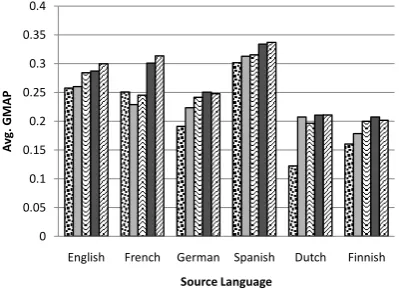
One of the primary motivations for including mul-tiple assisting languages in MultiPRF was to in-crease the robustness of retrieval through better coverage. We varied the number of assisting lan-guages for each source and studied the average GMAP. The results are shown in Figure 5. We observe that in almost all the source languages, the GMAP value increases with number of assist-ing languages and then reaches a saturation after reaching three languages.
7 Conclusion
In this paper, we extended the MultiPRF frame-work to multiple assisting languages. We pre-sented three different configurations for including multiple assisting languages - a) Parallel b) Serial and c) Selective. We observe that the results are mixed with parallel and selective assistance show-ing improvements in some cases. We also observe that the robustness of MultiPRF increases with number of assisting languages. We analyzed the influence of coverage of MultiPRF accuracy and observed that it is inversely correlated. Finally, increasing the number of assisting languages in-creases the MultiPRF accuracy to some extent and then it saturates beyond that limit. Many of the above results (negative results of serial, selective configurations etc.) require deeper investigation which we plan to take up in future.
References
Braschler, Martin and Carol Peters. 2004. Cross-language evaluation forum: Objectives, results, achievements. Inf. Retr., 7(1-2):7–31.
Buckley, Chris, Gerald Salton, James Allan, and Amit Singhal. 1994. Automatic query expansion using smart : Trec 3. In Proceedings of The Third Text REtrieval Conference (TREC-3, pages 69–80.
[image:8.595.74.274.324.469.2]pseudo-relevance feedback: English lends a helping hand. In ACM SIGIR 2010, Geneva, Switzerland, July. ACM.
Chinnakotla, Manoj K., Karthik Raman, and Push-pak Bhattacharyya. 2010b. Multilingual pseudo-relevance feedback: Performance study of assisting languages. InACL 2010, Uppsala, Sweeden, July. ACL.
Dempster, A., N. Laird, and D. Rubin. 1977. Maxi-mum Likelihood from Incomplete Data via the EM Algorithm. Journal of the Royal Statistical Society, 39:1–38.
Hawking, David, Paul Thistlewaite, and Donna Har-man. 1999. Scaling up the trec collection.Inf. Retr., 1(1-2):115–137.
John Lafferty and Chengxiang Zhai. 2003. Proba-bilistic Relevance Models Based on Document and Query Generation. InLanguage Modeling for Infor-mation Retrieval, volume 13, pages 1–10. Kluwer International Series on IR.
Mitra, Mandar, Amit Singhal, and Chris Buckley. 1998. Improving automatic query expansion. In
SIGIR ’98: Proceedings of the 21st annual interna-tional ACM SIGIR conference on Research and de-velopment in information retrieval, pages 206–214, New York, NY, USA. ACM.
Och, Franz Josef and Hermann Ney. 2003. A sys-tematic comparison of various statistical alignment models.Computational Linguistics, 29(1):19–51. Ounis, I., G. Amati, Plachouras V., B. He, C.
Macdon-ald, and Johnson. 2005. Terrier Information Re-trieval Platform. InProceedings of the 27th Euro-pean Conference on IR Research (ECIR 2005), vol-ume 3408 ofLecture Notes in Computer Science, pages 517–519. Springer.
Philipp, Koehn. 2005. Europarl: A parallel corpus for statistical machine translation. InMT Summit. Robertson, Stephen. 2006. On gmap: and other
trans-formations. InCIKM ’06: Proceedings of the 15th ACM international conference on Information and knowledge management, pages 78–83, New York, NY, USA. ACM.
Voorhees, Ellen. 2006. Overview of the trec 2005 robust retrieval track. In E. M. Voorhees and L. P. Buckland, editors, The Fourteenth Text REtrieval Conference, TREC 2005, Gaithersburg, MD. NIST. Wu, Dan, Daqing He, Heng Ji, and Ralph Grishman. 2008. A study of using an out-of-box commercial mt system for query translation in clir. In iNEWS ’08: Proceeding of the 2nd ACM workshop on Im-proving non english web searching, pages 71–76, New York, NY, USA. ACM.
Xu, Jinxi and W. Bruce Croft. 2000. Improving the ef-fectiveness of information retrieval with local con-text analysis. ACM Trans. Inf. Syst., 18(1):79–112. Zhai, Chengxiang and John Lafferty. 2001.
Model-based Feedback in the Language Modeling ap-proach to Information Retrieval. InCIKM ’01: Pro-ceedings of the tenth international conference on In-formation and knowledge management, pages 403– 410, New York, NY, USA. ACM Press.