Proceedings of the Second International Conference on Dependency Linguistics (DepLing 2013), pages 157–166,
A Deterministic Dependency Parser with Dynamic Programming for
Sanskrit
Amba Kulkarni Department of Sanskrit Studies
University of Hyderabad [email protected]
Abstract
We describe a Deterministic Dependency Parser for Sanskrit. The parse is devel-oped following a Depth First traversal of a graph whose nodes represent morpholog-ical analyses of the words in a sentence. During the traversal, relations at each node are checked for local compatibility, and fi-nally for each full path, the relations on the path are checked for global compatibil-ity. Stacking of intermediate results guar-antees dynamic programming. We also describe an interface that displays multi-ple parses compactly and facilitates users to select the desired parse among vari-ous possible solutions with a maximum of n−1choices for a sentence withnwords.
1 Introduction
Past decade has witnessed a lot of dynamism and upsurge of activities in the field of Sanskrit Computational Linguistics. Several computational tools became available to the Sanskrit community as a web service through the internet1. With the availability of a wide coverage grammar for San-skrit in the form ofAs.t.¯adhy¯ay¯ı, there was a nat-ural tendency to follow the grammar based ap-proach towards the development of these tools (Huet, 2009; Kulkarni et al., 2010; Kulkarni and Ramakrishnamacharyulu, 2013; Goyal and Huet, 2013). Nevertheless, there were also notable ef-forts to use pure machine learning approaches for building these tools with a small manually tagged corpus as a boot-strap (Hellwig, 2009). At the same time, a combination of the grammar based approach supported by the statistical evidences to push the most likely solution to the top were also
1http://sanskrit.uohyd.ernet.in/scl
http://tdil-dc.in/scl http://sanskrit.inria.fr
http://kjc-fs-cluster.kjc.uni-heidelberg.de/dcs/index.php
followed (Kumar et al., 2010; Kulkarni and Ku-mar, 2011).
Sanskrit being influenced by the oral tradition, Sanskrit texts are typically written as a continu-ous string of characters. Characters at the juncture of word boundaries undergo euphonic changes thereby merging the word boundaries. This makes it challenging to split a given string into gram-matically acceptable words before taking up the task of parsing. The task of joining two words is deterministic but splitting a string of charac-ters into well-formed words is non-deterministic. This non-determinism together with splits at more than one places in a given string leads to expo-nential possibilities. Huet (2002, 2009) proposed a novel way of augmenting the nodes of a Finite State Transducer with appropriate sandhi rules, and achieved the segmentation in linear transi-tions. He also developed a shallow parser using the sub-categorisation frames, and the agreement rules. This parser is useful to rule out the non-solutions before proceeding for the full fledged parsing. A purely statistical parser for Sanskrit also exists (Hellwig, 2009).
The first full fledged parser for Sanskrit based on P¯an.inian Grammar formalism is described in (Kulkarni et al., 2010). This parser is implemented as a constraint solver. In this model, a word in a sentence is represented as a node in a graphG, and the relations between the words as directed la-belled edges. The task of parsing a sentence is modelled as finding a sub-graphT ofGwhich is a directed labelled Tree. The problem of parsing is divided into three tasks:
1. The first task is to establish labelled edges between the nodes. The information of ex-pectancy and agreement is used to establish these labelled edges.
2. Next a sub-graphT ofGis identified, such that T is a directed Tree which satisfies the
following constraints.
• Every node can have at the most one in-coming arrow.
• No two edges emerging from the same node have the same label.
• There are no loops.
• The resulting Tree is projective, i.e. if the nodes are arranged linearly accord-ing to the word order, then no two links cross each other.
• It is ensured that certain relations
which always occur in pairs e.g. anuyog¯ı-pratiyog¯ı (1 and relata-2), kartr.sam¯an¯adhikaran.am-kart¯a (pred-icative adjective and subject2), etc. do have their counter-relatum present in the parse.
3. Finally in case there is more than one pos-sible directed Tree, the solutions are priori-tized.
The implementation of the parser is reported in Kulkarni et al. (2010). The graph G is repre-sented as a 5D matrix C with a typical element ([i, j], R,[l, m]), whereRis the relation from the mthanalysis of thelthword to thejthanalysis of
theith word. In order to prioritize the solutions,
every relation is assigned a weight. A simple Cost function is defined as Cost =Pw∗ |j−i|, where wis the weight of the relation between the nodesi andj.
The main disadvantage of this approach is the complexity. The size of the 5D matrix is N ∗ M∗K∗N∗M, whereN is the total number of words in a sentence,M is the maximum number of morph analyses for a word in a given sentence andK is the maximum number of distinct possi-ble relations among the words in a given sentence. Sanskrit words being overloaded with morpholog-ical analysis, frequently occurring words tend to have several analyses possible3. Similarly though the average length of the sentences4is around 10, 2We roughly translate kart¯a as a subject. This is not a
faithful translation. Kart¯a and other k¯araka relations represent the semantic information which can be extracted purely from the syntactic information available in the sentence.
3The wordtehas 16 possible analyses corresponding to its
inflectional analysis. If we take into account the derivational information, the possibilities explode further.
4This figure is based on the SHMT corpus developed
by the SHMT consortium project sponsored by DeitY, India (2008-12).
the sentences from literary texts tend to be longer with more than 20 words.
Sanskrit grammar texts discuss various rela-tions, among words, necessary to interpret the meaning of a sentence. All these relations were compiled and classified by Ramakrishna-macharyulu (2009) and further they were inves-tigated for their suitability for automatic pars-ing. Out of around 90 relations listed there, only those relations which one can predict based on the syntactico-semantic information available in a sentence are considered for automatic tagging (Kulkarni and Ramakrishnamacharyulu, 2013). There are around 35 of them. ThusRis one of these 35.
As the number of words in a sentence increases, or if a sentence has even a single word with con-siderable number of morph analyses, the size of the 5D matrix explodes, and the use of parser in real time applications becomes impractical.
Second disadvantage of the above method is that the constraints are applied globally to the ma-trix. However, we notice that some of the con-straints are local to a node. Separating the local constraints from the global, and applying the lo-cal constraints at an early stage to rule out non-solutions should increase the efficiency of the sys-tem.
The importance and advantage of Dependency Parser over a constituency parser has been well recognised by the computational linguistic com-munity and we see Dependency parsers for variety of languages such as English, Japanese, Swedish to name a few. More than half a dozen parsers exist for English alone that produce dependency parse. The existence of P¯an.inian grammar for San-skrit is the strong motivation behind developing a Dependency based parser for Sanskrit. The cur-rent trend towards developing dependency parsers is more towards following the data driven ap-proaches over the grammar based. However, we follow the grammar based approach. Some of the factors that motivated the design of the parser and choice of the approach are the following.
• Sanskrit does not have a tree bank of reason-able size so that we can use data driven ap-proaches for Sanskrit.
• Sanskrit has a free word order, and hence
and which have a fixed word order for the adjective-substantive sequences, Sanskrit al-lows even the adjectives and genitives to float around in a sentence. This makes the usabil-ity of POS tagger for Sanskrit doubtful.
• The existence of almost exhaustive grammar for Sanskrit also demands from the users a justification for the analysis in terms of gram-mar rules.
We describe below a Deterministic Parsing algo-rithm which applies the local constraints locally, and also uses Dynamic Programming for efficient parsing. This parser differs from the Determinis-tic Dependency Parsers for English developed by Yamada and Matsumoto (Yamada and Matsumoto, 2003) and Nivre (Nivre and Scholz, 2004) in three major ways. These parsers for English use ei-ther a bottom-up or a combination of bottom-up and top-down algorithm. Our parser traverses the sentence from left to right guided by the possible paths among the nodes. Second major difference is that these parsers use shift-reduce parsing, while we check the relations for compatibility at each node. The third major difference is that we fol-low the grammar based approach while the above parsers for English are data driven.
2 Left-Right Deterministic Parsing with Dynamic Programming
LetG1= (N1, E1)be a graph, whereN1is the set
of nodes corresponding to morphological analyses of the words in a given sentence.E1is the set of all
directed weighted arcs(i, j, r)such thatith node
is related tojth node through a relation r. With
every relationr a weight w is associated, which reflects the preferences of relations over the other. The total number of nodes =Pmi, wheremi is
the number of possible morphological analyses of theithword.
Since a node inN1 corresponds to a
morpho-logical analysis of a word, and not to the word, the constraint to choose only one analysis per word needs an information about how many analyses correspond to each word. This we specify through the adjacency information. For each word we pro-vide indices of the morphological analyses of the word to the left as well as to the right. For the first word, the index of the left word is marked as ‘S’ (the starting node), and for the last word, the index of the right word is marked as ‘F’ (the final node).
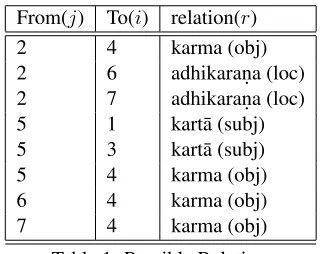
[image:3.612.336.496.51.178.2]From(j) To(i) relation(r) 2 4 karma (obj) 2 6 adhikaran.a (loc) 2 7 adhikaran.a (loc) 5 1 kart¯a (subj) 5 3 kart¯a (subj) 5 4 karma (obj) 6 4 karma (obj) 7 4 karma (obj) Table 1: Possible Relations
This information of adjacency is represented as a graphG2 = (N2, E2), whereN2 = N ∪ {S, F}
andE2is the set of directed edges(i, j)such that
iandj correspond to the morphological analyses of adjacent wordswk andwk+1. The direction of
the edge is fromitoj.
2.1 An example
We illustrate with an example the information content of the two graphsG1 and G2. Consider
the following sentence.
San:r¯amah. vana ˙m gacchati. (1) gloss: Ram forest{acc.}goes.
Eng: Ram goes to the forest.
In this sentence, each of the two wordsr¯amah. (Ram) andvana ˙m(forest) has two possible analy-ses, while the wordgacchati(goes) has 3 possible analyses as shown below.
1. r¯amah. = r¯ama{masc.} {sg.} {nom.}
2. r¯amah. = r¯a{pr.} {1p} {pl.}
3. vana ˙m = vana{neu.} {sg.} {nom.}
4. vana ˙m = vana{neu.} {sg.} {acc.}
5. gacchati = gam{pr.} {3p.} {sg.}
6. gacchati = gam{pr. part.} {masc.} {sg.} {loc.}
7. gacchati = gam{pr. part.} {neu.} {sg.} {loc.}
Thus,G1has 7 nodes. Edges marking the
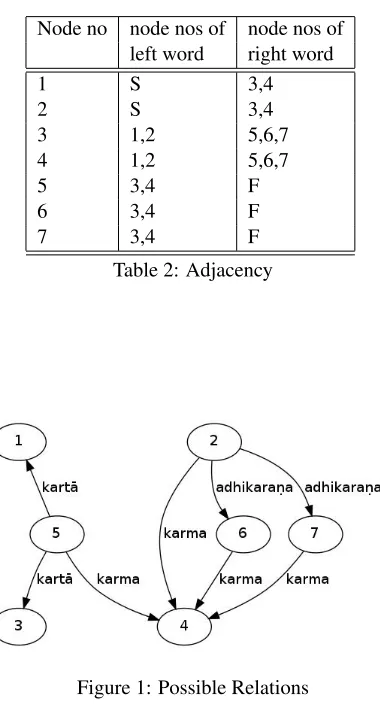
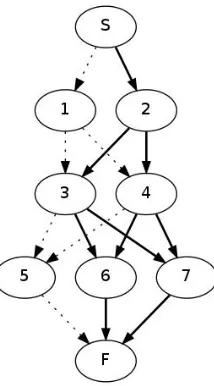
rela-tions are listed in Table 1. This is represented in the form of a graph as shown in Figure 1. The in-formation of adjacency is shown in Table 2 and as a graph in Figure 2.
2.2 Local and Global constraints
Apath P of a graphG2 is a sequence of edges
Node no node nos of node nos of left word right word
1 S 3,4
2 S 3,4
3 1,2 5,6,7
4 1,2 5,6,7
5 3,4 F
6 3,4 F
[image:4.612.100.290.74.428.2]7 3,4 F
Table 2: Adjacency
Figure 1: Possible Relations
Figure 2: Adjacency and Possible paths
A relation (I, J, R) is locally incompatible with a set of relations R ={(i, j, r)|(i, j, r) ∈ E ofG1}under the following circumstances.
a. If for some(i, j, r)∈ E andj=J andr=R, i6=I. This ensures that no two words satisfy the same semantic role of a verb.
b. If for some(i, j, r)∈Eandi=I, eitherj6=J orr6=R. This ensures that every word has at the most one semantic role5.
A set of relations R ={(i, j, r)|(i, j, r) ∈ E of G1} is said to be locally compatible, if no (I, J, R)∈Eis locally incompatible with the rest of the relations inR.
A set of labelled edges R ={(i, j, r)|(i, j, r)∈ E of G1} is globally compatible provided the
following conditions are satisfied.
a. If the nodes ofG1are arranged in an increasing
order of their index, then the links do not cross. b. For certain relations r such as
kartr.sam¯an¯adhikaran.am (predicative adjec-tive) there is a matching relationkart¯a(subject). c. The edges corresponding to the relations inR do not form a loop.
A sub-graphT ofG1is aparseif
a. The nodes inT correspond to some path ofG2.
This ensures that each node inT corresponds to a distinct word, and every word in the sentence is accounted for.
b. T is a Tree. This ensures that every word in a sentence is related directly to some other word. c. The set of relations corresponding to the edge labels in T are both locally as well as globally compatible.
2.3 Parsing Algorithm
1. Starting from the node ‘S’ of the graph G2
explore various paths of G2 following the
Depth-First-Traversal strategy. The stack keeps track of part of the paths visited so far.
2. At each node, refer toG1for various relations
this node can have with other nodes. The stack, in our case, in addition to the informa-tion of paths visited so far, also keeps track of compatible relations at various nodes on this path.
5This condition is applied to only a few relations such as
[image:4.612.111.280.79.211.2]3. For each of these relations
• If the relation is locally compatible with the relations encountered on this path so far, add this relation to the stack and continue with the next node. The set of relations, at any point of time on the stack provides the current status of the partial solution / Tree explored.
• If the relation is incompatible, declare this path to be incompatible, and pro-ceed with other path, leaving this path further unexplored.
4. When you reach the node ‘F’, check the rela-tions on this path for ‘global compatibility’.
5. Each globally compatible set of relations, which is a sub-set of edges in G1, forms a
Tree and hence is a possible solution.
6. For each possible solution, compute the Cost = Pw ∗ |j − i|, where w is the weight associated with the relation between the nodes corresponding thejthandithword.
Traversing of the graph G2 from ‘S’ to ‘F’ is
equivalent to traversing the sentence from left to right for various combinations of morphological analyses. The parser is deterministic, and it is guaranteed to terminate afterQmi paths are
ex-plored. At each node ofG2, the number of
com-patibility checks is equal to the number of incom-ing arrows at that node in graphG1. Stacking of
intermediate results ensures the dynamic program-ming. A Cost function is used to prioritize the so-lutions. Salient features of this algorithm are:
• We follow lattice programming to explore all possible paths.
• The parser deals with one word at a time starting from the first word. This is motivated by an approach6in the Indian theories of ver-bal cogniton and also confirms with Abney’s (Abney, 1989) findings that the human oper-ates this way.
• Since we do not want to miss any possible parse, we use dynamic programming which is upto 5 times faster than the conventional beam search (Huang and Sagae, 2010). 6¯adyam. padam. v¯akyam.
• Unlike the traditional based parsing which are typically breadth first, we follow a depth first strategy, stacking the intermediate re-sults ensuring the effective dynamic pro-gramming.
• At each node we use constraints to check the compatibility of new relations with the stacked one.
• The weights for each relation are determined
heuristically manually in the absence of any manually tagged reasonable sized data. The n-v relations expressing the k¯araka (case) re-lations are given preferences over the non-k¯araka relations.
2.4 Evaluation
Sanskrit Tree bank corpus is developed under Government of India sponsored project ‘Develop-ment of Sanskrit Computational Toolkit and San-skrit Hindi Machine Translation system (2008-2012)’. The corpus consists of around 3000 sen-tences, a substantial part of it being modern short stories. A small part of the corpus contains sen-tences addressing various syntactic phenomena. The complete tagged corpus is still being cross checked for correctness. Hence the parser was tested only on 1316 sentences. We have a hier-archical tagset with 35 tags. Among these the sub-classification of 4 types of location (adhikaran.a) and 3 types of objects (karma) is collapsed into one each resulting into a flat tagset of 30 tags. Our parser produces all possible parses, ordered on cost. The one with minimum cost is shown as the first parse. For evaluation, we consider only the first parse. The correctness of parses is judged on several well established parameters.
• Relations with correct label and attachment (LAS)
With 35 relations, the labelled attachments were correct in 63.1% cases, while with 30 relations, the score was 67.4%.
• Relations with correct attachment (UAS) If only attachments were considered, ignor-ing the labels, 80.26% attachments matched with the GOLD data.
• Sentences with matching dependency trees
(MDT)
tagged tree. Out of 1316 sentences, the first parse matched exactly in 569 (43.20%) sen-tences with a tagset of 35 tags, while with 30 tags, the first parse matched in 647 (49.1%) cases.
• Sentences with correct unlabelled depen-dency trees (UDT)
Instead of complete tree match, now we check only for the attachments, and not the labels. Among 1316, the unlabelled depen-dency trees matched in 870 (66.05%) cases.
• Sentences with one wrong attachment (OWAS)
It was found that out of 1316 sentences, 285 (21.6%) sentences had only one wrong labelled attachment. If this is rectified, the performance of the system for correct matches increases drastically.
3 Compact Display of Multiple Solutions Sanskrit being a classical language demands cer-tain special features with respect to its computa-tional tools. Being an old classical language, most of the important texts in Sanskrit have been trans-lated manually into several modern languages. So naturally, machine translation takes a back seat for Sanskrit. What a user needs is an access to the original text with the help of various online lin-guistic tools and resources so that he can him-self interpret and understand the texts in origi-nal. From this aspect, displaying only the first parse does not serve the purpose. In fact, in more than 50% of the cases, the first parse is wrong. User might like to examine various possibilities and choose his own interpretation. It is also pos-sible that the text is ambiguous with two or more readings, and user would like to go through each of them. Displaying all the parse trees would not serve any purpose, since the trees look almost sim-ilar with either a change in one or two branches, or with a change in the label.
In what follows we present a compact way of presenting all the solutions. This is an adaptation of the slim interface of Heritage segmenter (Huet and Goyal, 2013).
LetTi=(Ni, Ei), wherei= 1tonbenparses
of a given sentence. LetN =∪Ni, andE=∪Ei.
The display consists of 3 rows. The top row lists the words with their positions. The second row
consists of morphological analyses corresponding to all the nodes inN. Analyses are written inn columns corresponding to each word. The third row consists of edges fromEagain displayed be-low the corresponding word/node.
The user can now choose either a node from the second row or an edge from the third row. Each choice calls the compatibility checker to remove the incompatible nodes and edges corresponding to the user’s choice. Each choice results in the re-duction of possible parses. At any point in time, a user can choose to display the graphs of current possible parses.
Here is an illustration of the interface. The input sentence is an anvaya of a ´sloka from Bhagvadg¯ıt¯a (8th´sloka from the4thchapter). The
original ´sloka is
paritr¯an.¯aya s¯adh¯un¯am vin¯a´s¯aya ca dus.kr.t¯am dharma-samsth¯apan¯arth¯aya sambhav¯ami yuge yuge. (Bh.G.4.8)
The anvaya, an input to the parser, is:
s¯adh¯un¯am paritr¯an.¯aya dus.kr.t¯am vin¯a´s¯aya dharma-samsth¯apan¯aya7 ca yuge yuge
samb-hav¯ami.
Fig 3 shows the summary of parses as a compact display8. The union of relations from all parses for each word are shown. User can choose either the correct morphological analysis or correct relation corresponding to the node. When he chooses the correct morphological analysis, all the relations in the relations row that are incompatible with this choice are removed from the display. Similarly, if a user chooses a relation in the relation row, all the relations that are incompatible with this relation, and all the morphological analyses that are incom-patible with this choice of a relation are removed from the display. Thus, for example, the word
s¯adh¯un¯amhas two morphological analyses in Fig 3. But, after selecting the appropriate analysis, in Fig 4, we notice that the relations under this word are also reduced. All those relations which has
s¯adh¯un¯amas one of the relata are removed from the display. Similarly, selecting the role of this word askarma,2,2 (karma of the second analysis of the second word), not only removes all other re-lations below this word, but also removes the first 7The original word is dharma-samsth¯apan¯arth¯aya, which
we changed to dharma-samsth¯apan¯aya, since the former is still not recognised by the morphological analyser.
Figure 3: compact display of solutions
Figure 4: Selection of a morphological analysis
Figure 5: selection of a relation
[image:7.612.84.525.449.538.2] [image:7.612.94.506.626.674.2]Figure 7: Dependency Graph
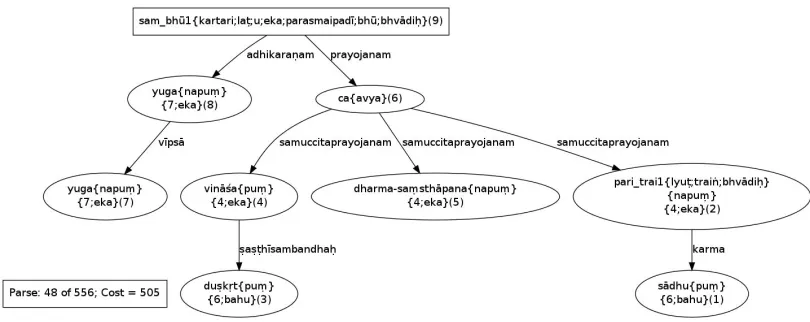
morph analysis of the second word, and all the re-lations having this analysis as one of the relata. The result of this is shown in Fig 5. Finally when we make all the choices, a unique parse is obtained (see Fig 6). Clicking on the check sign of unique parse, we get the rendering of the relations in the form of a dependency graph (see Fig 7).
The parse of a sentence withnwords hasn−1
edges corresponding to the relations. Hence one can choose the correct parse from this compact display in maximum n−1 choices. This
inter-face thus can also be used for developing a tree bank for Sanskrit semi-automatically. Due to the limitations on space, we do not give the technical details of this interface here.
4 Using Shallow Parser for pruning Normally the parsers for positional languages like English use a POS tagger to choose the morpho-logical analysis in context before proceeding for the parsing. This reduces the search space of the parser substantially resulting in increase in the per-formance metric.
In case of Sanskrit which is morphologically rich and carries very little information in posi-tion, the POS taggers based on the positional information are of little value. On the other hand a shallow parser such as one developed by (Huet, 2007) makes sense. Because such a shal-low parser, based on the agreement rules, sub-categorisation of verbs into transitive and intran-sitive, co-ordination information, and certain re-strictions on grammatical constructions rules out various possibilities and produces a sub-set of pos-sible solutions. Thus it is desirable to use a shal-low parser to filter out nonsensical combinations
of the solutions before proceeding to a full fledged parsing. This shallow parser, in addition to resolv-ing POS ambiguities, also does a little parsresolv-ing to aid the full fledged parser.
As an example, consider the sentence (1) above. We have seen that there are 12 possible paths (Fig 2) for this sentence. The shallow parser produces two splits.
1. First split
• 1. r¯amah. = r¯ama{masc.} {sg.} {nom.} • 3. vana ˙m = vana{neu.} {sg.} {nom.} • 4. vana ˙m = vana{neu.} {sg.} {acc.} • 5. gacchati = gam{pr.} {3p.} {sg.}
This corresponds to 2 paths: S-1-3-5-F and S-1-4-5-F (See Fig 8).
2. Second split
• 2. r¯amah. = r¯a{present tense} {1 per.} {pl.}
• 3. vana ˙m = vana{neu.} {sg.} {nom.} • 4. vana ˙m = vana{neu.} {sg.} {acc.} • 6. gacchati = gam{pr. part.} {masc.}
{sg.} {loc.}
• 7. gacchati = gam {pr. part.} {neu.} {sg.} {loc.}
Figure 8: Partitioning of a graph
Thus the shallow parsing has reduced the num-ber of paths from 12 to 6. Note that the POS am-biguities in the wordsr¯amah.andgacchatiare re-solved. But the case ambiguity in the wordvanam
is not yet resolved.
5 Conclusion
The performance of the parser has confirmed our intuition that application of local constraints at an early stage improves the performance. The search space is further reduced by the use of shallow parser. Compact display is useful for a reader who wants to understand the text in original. This dis-play can also be used for developing Sanskrit Tree bank semi-automatically. The algorithm described above is tested on Sanskrit. However it is general one and should work well for the modern Indian languages as well.
References
Steven P Abney. 1989. A computational model of hu-man parsing. Journal of Psycholinguistic Research, 18:129–144.
V¯aman Shivar¯am Apte. 1885. The Student’s Guide to Sanskrit Composition. A Treatise on Sanskrit Syn-tax for Use of Schools and Colleges. Lokasamgraha Press, Poona, India.
Akshar Bharati, Vineet Chaitanya, and Rajeev Sangal. 1995. Natural Language Processing. A Paninian Perspective. Prentice-Hall of India, New Delhi. Pawan Goyal and G´erard Huet. 2013. Completeness
analysis of a Sanskrit reader. InProceedings, 5th
In-ternational Symposium on Sanskrit Computational Linguistics. D. K. Printworld(P) Ltd.
Pawan Goyal, Vipul Arora, and Laxmidhar Behera. 2009. Analysis of Sanskrit text: Parsing and se-mantic relations. In G´erard Huet, Amba Kulkarni, and Peter Scharf, editors, Sanskrit Computational Linguistics 1 & 2, pages 200–218. Springer-Verlag LNAI 5402.
Oliver Hellwig. 2009. Extracting dependency trees from Sanskrit texts. In Amba Kulkarni and G´erard Huet, editors,Sanskrit Computational Linguistics 3, pages 106–115. Springer-Verlag LNAI 5406. L. Huang and K. Sagae. 2010. Dynamic
program-ming for linear-time incremental parsing. InIn Pro-ceedings of the 48th Annual Meeting of the Associ-ation for ComputAssoci-ational Linguistics Uppsala, Swe-den, July. Association for Computational Linguis-tics, page 10771086.
Ge´rard Huet and Pawan Goyal. 2013. Design of a lean interface for sanskrit corpus annotation. Inpersonal communication.
G´erard Huet, Amba Kulkarni, and Peter Scharf, edi-tors. 2009. Sanskrit Computational Linguistics 1 & 2. Springer-Verlag LNAI 5402.
G´erard Huet. 2007. Shallow syntax analysis in San-skrit guided by semantic nets constraints. In Pro-ceedings of the 2006 International Workshop on Re-search Issues in Digital Libraries, New York, NY, USA. ACM.
G´erard Huet. 2009. Formal structure of Sanskrit text: Requirements analysis for a mechanical San-skrit processor. In G´erard Huet, Amba Kulkarni, and Peter Scharf, editors, Sanskrit Computational Linguistics 1 & 2. Springer-Verlag LNAI 5402. S.D. Joshi, J.A.F. Roodbergen, and Bhandarkar
Orien-tal Research Institute. 1990.Pata˜njali’s Vy¯akaran.a-Mah¯abh¯as.ya Sth¯anivadbh¯av¯ahnika: introduction, text, translation and notes. Number v. 1 in Research Unit series. Bhandarkar Oriental Research Institute. S.D. Joshi, J.A.F. Roodbergen, and S¯ahitya Ak¯adem¯ı. 2004. The As.t.¯adhy¯ay¯ı of P¯an.ini with Translation and Explanatory Notes. Number v. 11 in The As.t.¯adhy¯ay¯ı of P¯an.ini. Sahitya Akademi.
Amba Kulkarni and G´erard Huet, editors. 2009. San-skrit Computational Linguistics 3. Springer-Verlag LNAI 5406.
Amba Kulkarni and Anil Kumar. 2011. Statistical con-stituency parser for Sanskrit compounds. In Pro-ceedings of ICON 2011. Macmillan Advanced Re-search Series, Macmillan Publishers India Ltd. Amba Kulkarni and K. V. Ramakrishnamacharyulu.
Amba Kulkarni and Devanand Shukl. 2009. Sanskrit morphological analyser: Some issues. Indian Lin-guistics, 70(1-4):169–177.
Amba Kulkarni, Sheetal Pokar, and Devanand Shukl. 2010. Designing a constraint based parser for San-skrit. In G N Jha, editor, Proceedings of the 4th International Sanskrit Computational Linguis-tics Symposium. Springer-Verlag LNAI 6465. Anil Kumar, Vipul Mittal, and Amba Kulkarni. 2010.
Sanskrit compound processor. In G N Jha, editor, Proceedings of the 4th International Sanskrit Com-putational Linguistics Symposium. Springer-Verlag LNAI 6465.
J. Nivre and M. Scholz. 2004. Deterministic depen-dency parsing of english text. In Proceedings of COLING 2004, Geneva, Switzerland, 64-70. H. Yamada and Y. Matsumoto. 2003. Statistical