Sentence Processing in a Vectorial Model of Working Memory
William Schuler Department of Linguistics The Ohio State University [email protected]
Abstract
This paper presents a vectorial incremen-tal parsing model defined using indepen-dently posited operations over activation-based working memory and weight-activation-based episodic memory. This model has the at-tractive property that it hypothesizes only one unary preterminal rule application and only one binary branching rule applica-tion per time step, which allows it to be smoothly integrated into a vector-based recurrence that propagates structural am-biguity from one time step to the next. Predictions of this model are calculated on a center-embedded sentence processing task and shown to exhibit decreased pro-cessing accuracy in center-embedded con-structions.
1 Introduction
Current models of memory (Marr, 1971; Ander-son et al., 1977; Murdock, 1982; McClelland et al., 1995; Howard and Kahana, 2002) involve a continuousactivation-based(or ‘working’) mem-ory, typically modeled as a vector representing the current firing pattern of neurons or neural clus-ters in the cortex. This activation-based memory is then supported by a durable but rapidly mu-table weight-based (or ‘episodic’) memory, typi-cally modeled as one or more matrices formed by summed outer-products of cue and target vectors and cued by simple matrix multiplication, repre-senting variable synaptic connection strengths be-tween neurons or neural clusters.
The lack of discrete memory units in such mod-els makes it difficult to imagine a neural imple-mentation of a typical e.g. chart-based computa-tional account of sentence processing. On the other hand, superposition in vectorial models sug-gests a natural representation of a parallel incre-mental processing model. This paper explores
how such an austere model of memory not only might be used to encode a simple probabilistic in-cremental parser, but also lends itself to naturally implement a vectorial interpreter and coreference resolver. This model is based on the left-corner parser formulation of van Schijndel et al. (2013a), which has the attractive property of generating ex-actly one binary-branching rule application after processing each word. This property greatly sim-plifies a vectorial implementation because it al-lows these single grammar rule applications to be superposed in cases of attachment ambiguity.
Predictions of the vectorial model described in this paper are then calculated on a simple center-embedded sentence processing task, producing a lower completion accuracy for center-embedded sentences than for right-branching sentences with the same number of words. As noted by Levy and Gibson (2013), this kind of memory effect is not easily explained by existing information-theoretic models of frequency effects (Hale, 2001; Levy, 2008).
seman-tic representation, and language acquisition. 2 Related Work
The model described in this paper is based on the left-corner parser formulation of van Schijndel et al. (2013a), which is an implementation of a fully parallel incremental parser. This parser differs from chart-based fully parallel incremental parsers used by Hale (2001), Levy (2008) and others in that it enforces a cognitively-motivated bound on center-embedding depth. This bound allows the parser to represent a tractable set of incremental hypotheses in an explicitly enumerated list as a factored hidden Markov model, without necessi-tating the use of a parser chart. This model has the attractive property that, in any context, it hypoth-esizes exactly one binary-branching rule applica-tion at each time step.
The model described in this paper extends the van Schijndel et al. (2013a) parser by maintain-ing possible store configurations as superposed sequence states in a finite-dimensional state vec-tor. The model then exploits the uniformity of its parsing operations to integrate probabilistically weighted grammar rule applications into this su-perposed state vector. These superposed states are then used to cue more superordinate sequen-tial states as ‘continuations’ whenever subordinate states conclude. Interference in this cueing pro-cess is then observed to produce a natural center-embedding limit.
This model is defined as a recurrence over an activation vector, similar to the simple recurrent network of Elman (1991) and others, but unlike an SRN, which does not encode anything in weight-based memory during processing, this model en-codes updates to a processing hierarchy in weight-based memory at every time step. The model is also similar to the ACT-R parser of Lewis and Va-sishth (2005) in that it maintains a single state which is updated based on content-based cued association, but unlike the ACT-R parser, which cues category tokens on category types and there-fore models memory limits as interference among grammar rules, this model cues category tokens on other category tokens, and therefore predicts memory limits even in cases where grammar rules do not involve similar category types. Also unlike Lewis and Vasishth (2005), this model is defined purely in terms of state vectors and outer-product associative memory and therefore has the capacity
S
VP NP
N N
N N
mud
D
the
V
shook
NP N
wind
D
the
S/N
)
[image:2.595.316.515.63.206.2]N/N
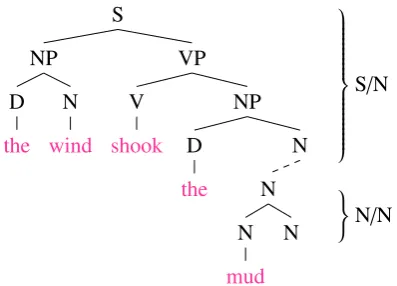
Figure 1: Example incomplete category during processing of the sentence The wind shook the mud room door.
to maintain parallel states in superposition. 3 Background: Non-vectorial
Incremental Parsing
The model defined in this paper is based on the left-corner parser formulation of van Schijndel et al. (2013a). This parser maintains a set of incom-plete categoriesa/b at each time step, each con-sisting of an active categorya lacking an awaited category b yet to come. For example, Figure 1 shows an incomplete category S/N consisting of a sentence lacking a common noun yet to come, which non-immediately dominates another incom-plete category N/N consisting of a common noun lacking another common noun yet to come.
Processing in this model is defined to alternate between two phases:
1. a ‘fork’ phase in which a word is either used to complete an existing incomplete category, or forked into a new complete category; and 2. a ‘join’ phase in which one of these complete
categories is used as a left child of a grammar rule application and then either joined onto a superordinate incomplete category or kept disjoint.
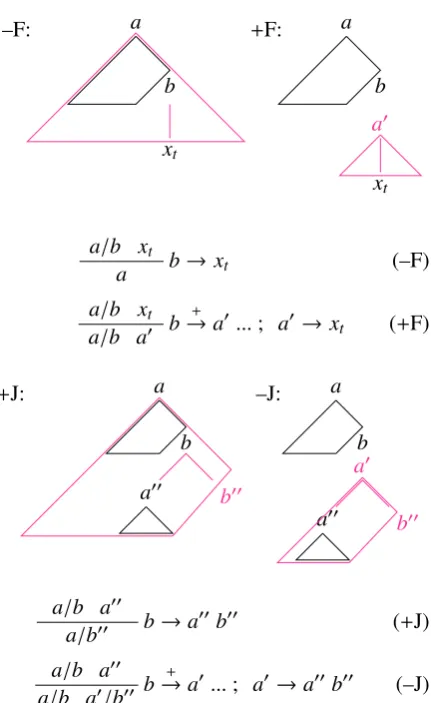
In any case, only one grammar rule is applied af-ter each word. These fork and join operations are shown graphically and as natural deduction rules in Figure 2.
–F: a
b
xt
+F: a
b
a0
xt
a/b xt
a b→xt (–F)
a/b xt
a/b a0 b +
→a0...; a0→xt (+F)
+J: a
b
a00 b00
–J: a
b
a0
a00 b00
a/b a00
a/b00 b→a
00
b00 (+J)
a/b a00 a/b a0/b00 b
+
[image:3.595.75.291.57.409.2]→a0...; a0→a00b00 (–J)
Figure 2: Fork and join operations from the van Schijndel et al. (2013a) left-corner parser formu-lation. During the fork phase, wordxeither com-pletes an existing incomplete categorya, or forks into a new complete categorya0. During the join phase, complete categorya00 becomes a left child of a grammar rule application, then either joins onto a superordinate incomplete category a/b or remains disjoint.
probabilistic version of this incremental parser can reproduce the results of a state-of-the-art chart-based parser (Petrov and Klein, 2007).
4 Vectorial Parsing
This left corner parser can be implemented in a vectorial model of working memory using vec-tors as activation-based memory and matrices as weight-based memory. Following Anderson et al. (1977) and others, vectors v in activation-based memory are cued from other vectors u through weight-based memory matrices Musing ordinary
T/T the
T/T, D +F
T/T, NP/N –J wind
T/T, NP –F
T/T, S/VP –J shook
T/T, S/VP, V +F
T/T, S/NP +J the
T/T, S/NP, D +F
T/T, S/N +J mud
T/T, S/N, N +F
T/T, S/N, N/N –J room
T/T, S/N, N –F
T/T, S/N +J door
T/T, S –F
[image:3.595.314.522.65.237.2]T/T +J
Figure 3: Processing steps in parsing the sentence
The wind shook the mud room door. matrix multiplication:1
v= M u (1)
This representation has been used to model the in-fluence of activation in antecedent neurons on ac-tivation in consequent neurons (Marr, 1971; An-derson et al., 1977).
Unless they are cued from some other source, all vectors in this model are initially randomly generated by sampling from an exponential distri-bution, denoted here simply by:
v∼Exp (2)
Also following Anderson et al. (1977), weight-based memory matricesMare themselves defined and updated by simply adding outer products of desired cueuand targetvvectors:2
Mt = Mt−1+v⊗u (3)
This representation has been used to model rapid synaptic sensitization in the hippocampus (Marr, 1971; McClelland et al., 1995), in which synapses of activated antecedent neurons that impinge on activated consequent neurons are strengthened.
1That is, multiplication of an associative memory
ma-trixMby a state vectorvyields:
(M v)[i] def
=PJ
j=1M[i,j]·v[j] (10)
2An outer productv⊗udefines a matrix by multiplying
each combination of scalars in vectorsvandu:
(v⊗u)[j,i] def
a) NP N D
the
b) S
VP NP
N
wind
D
the
c) S
VP NP V
shook
NP N
wind
D
the
d) S
VP NP
N D
the
V
shook
NP N
wind
D
the
e) S
VP NP
N N
N N
mud
D
the
V
shook
NP N
wind
D
the
f) S
VP NP
N N N
N
room
N
mud
D
the
V
shook
NP N
wind
D
[image:4.595.97.504.62.312.2]the
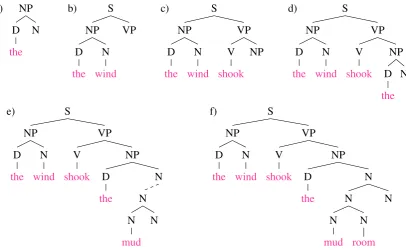
Figure 4: Processing steps in parsing the sentenceThe wind shook the mud room door.
Finally, cued associations can be combined us-ing pointwise or diagonal products:3
w=diag(u)v (4) Unlike a symbolic statistical model, a vectorial model must explicitly distinguish token represen-tations from types in order to define structural rela-tions that would be implicit in the posirela-tions of data structure elements in a symbolic model. Thus, the active or awaited distinction is applied to category tokens rather than types, but grammar rule appli-cations are defined over category types rather than tokens.
The vectorial left-corner parser described in this paper is therefore defined on a single category to-ken vectorbt which encodes the awaited category token of the most subordinate incomplete category at the current time stept. A hierarchy of nested in-complete category tokens is then encoded in two ‘continuation’ matrices:
• At, which cues the active category token a
of the same incomplete category as a given awaited tokenb; and
3A diagonal product diag(v)udefines a vector by
multi-plying corresponding scalars in vectorsvandu:
(diag(v)u)[i] def
=v[i]·u[i] (30)
• Bt, which cues the awaited category to-ken b of the incomplete category that non-immediately dominates any active category tokena.
Together, the cued associations in these continua-tion matrices trace a path up from the most sub-ordinate awaited category tokenbto the most su-perordinate category token currently hypothesized as the root of the syntactic tree. Vectors for cate-gory typesccan then be cued from any category tokenaorbthrough an associative matrixCt. All three of these matrices may be updated from time step to time step by associating cue and target vec-tors through outer product addition, as described above.
The model also defines vectors for binary-branching grammar rules g, which are associ-ated with parent, left child, or right child cat-egory types via ‘accessor’ matrices G, G0, or
G00.4 These accessor matrices are populated from binary-branching rules in a probabilistic context-free grammar (PCFG) in Chomsky Nor-mal Form (CNF). For example, the PCFG rule P(S → NP VP) = 0.8 may be encoded using a
4This use of reification and accessor matrices for
grammar rule vectorgS→NP VPand category
vec-torscS,cVP,cNP with the following outer-product
associations:
Gdef=gS→NP VP⊗cS·0.8 G0def=gS→NP VP⊗cNP
G00 def=gS→NP VP⊗cVP
Grammars with additional rules can then be en-coded as a sum of outer products of rule and cat-egory vectors. Grammar rules can then be cued from category types by matrix multiplication, e.g.:
gS→NP VP=G0cNP
and category types can be cued from grammar rules using transposed versions of accessor matri-ces:
cNP=G0>gS→NP VP
The model also defines:
• vectorsxtfor observation types (i.e. words), • a matrixPcueing category types from
obser-vation types, populated from unary rules in a CNF PCFG, and
• a matrixD=DKof leftmost descendant cate-gories cued from ancestor catecate-gories, derived from accessor matricesGandG0byK itera-tions of the following recurrence:5
D00def= diag(1) (5)
D0 def
= diag(0) (6)
D0kdef= G0>G D0k−1 (7)
Dk
def
= Dk−1+D0k (8) where each D0k cues a probabilistically-weighted descendant at distance k from its cue, and Dk is the superposition of all such descendant associations from length 1 to lengthK. This produces a superposed set of category types that may occur as leftmost de-scendants of a (possibly superposed) ancestor category type.
In order to exclude active category types Ctat that are not compatible with awaited category typesCtbt in the same incomplete category, the model also defines:
5Here1and0denote vectors of ones and zeros,
respec-tively.
• a matrix E = EK of rightmost descendant categories cued from ancestor categories, de-rived in the same manner as D, except us-ingG00 in place ofG0.
The parser proceeds in two phases, generating a complete category token vectora00t frombt−1
dur-ing the F phase, then generatdur-ing an awaited cat-egory token vector bt of an incomplete category during the J phase. Since the parser proceeds in two phases, this paper will distinguish variables updated in each phase using a subscript for time stept−.5 at the end of the first phase andtat the end of the second phase.
The vectorial parser implements the F phase of the left-corner parser (the ‘fork/no-fork’ decision) by first defining two new category tokens for the possibly forked or unforked complete category:
at−.5, a0t−.5 ∼Exp The parser then obtains:
• the category type of the most subordinate awaited category token at the previous time step:Ct−1bt−1(which involves no fork), and
• a superposed set of non-immediate descen-dants of the category type of this most sub-ordinate awaited category token: D Ct−1bt−1
(which involves a fork),
These fork and no-fork categories are then diag-onally multiplied (intersected) with a superposed set of preterminal categories for the current obser-vation (P xt):
c−t =diag(P xt)Ct−1bt−1 c+t =diag(P xt)D Ct−1bt−1
The BandC continuation and category matrices are then updated with a superordinate awaited cat-egory token and catcat-egory type foraanda0:
at−1= At−1bt−1
Bt−.5= Bt−1+bt−1⊗a0t−.5+Bt−1at−1⊗at−.5
Ct−.5=Ct−1+c+t ⊗a 0
t−.5+diag(Ct−1at−1)E >
c−t ⊗at−.5
where the updated category for at−.5 results from an intersection (diagonal product) of the current category atat−1with the set of categories that can
–F: at−1(=a
00
t )
bt−1
xt
+F: at−1 bt−1
a0t−.5(=a00t )
xt
[image:6.595.313.521.64.166.2]B
Figure 5: Updates to continuation matrices during the ‘fork’ phase of a left-corner parser.
the complete category token a00t that will result from this phase of processing, and thebvector is updated to encode the category token:6
a00t = at−.5||c
−
t ||+a0t−.5||c+t || ||at−.5||c−t ||+a0t−.5||c+t ||||
bt−.5= Bt−.5a00t
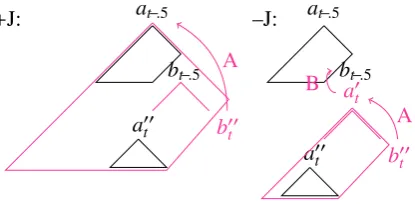
These updates can be represented graphically as shown in Figure 5.
The vectorial parser then similarly implements the J phase (the ‘join/no-join’ decision) of the left-corner parser by first defining a new category to-ken a0 for a possible new active category of the most subordinate incomplete category, andb00for a new awaited category token:
a0t, b00t ∼Exp The parser then obtains:
• a superposed set of grammar rules with par-ent category matching the category of the most subordinate awaited category token at the previous time step:G Ct−.5bt−.5(which as-sumes a join), and
• a superposed set of grammar rules with parent category non-immediately descended from the category of this most subordinate awaited category token:G D Ct−.5bt−.5(which assumes no join)
These join and no-join grammar rule vectors are then diagonally multiplied (intersected) with 6This uses the two norm||v||, which is the magnitude of
vectorv, defined as the square root of the sum of the squares of its scalar values:
||v||def= pP
i(v[i])2 (40)
Dividing a vector by its two norm has the effect of normaliz-ing it to unit length.
+J: at−.5
bt−.5
a00t b00t
A
–J: at−.5
bt−.5 a0t
a00t b00t
B
A
Figure 6: Updates to continuation matrices during the ‘join’ phase of a left-corner parser.
the superposed set of grammar rules whose left child category type matches the category type of the most subordinate complete category to-ken (G0Ct−.5a00t ):
g+t =diag(G 0
Ct−.5a00t )G Ct−.5bt−.5
g−t =diag(G0Ct−.5a00t )G D Ct−.5bt−.5 These intersected join and no-join grammar rule vectors are then used to weight superposed hy-potheses for the incomplete category that will re-sult from this phase of processing in updates to the continuation and category matricesA,B, andC:
At =At−1+
At−1bt−.5||g+t||+a0t||g−t|| ||At−1bt−.5||gt+||+a0t||g−t||||
⊗b00t
Bt =Bt−.5+bt−.5⊗a0t
Ct =Ct−.5+G>g−t ⊗a 0 t +
G00>g+t +G00>g−t
||G00>g+
t +G00>g − t||
⊗b00t
These updates can be represented graphically as shown in Figure 6. Finally the the most subordi-nate awaited category token is updated for the next word:
bt =b00t
5 Predictions
In order to assess the cognitive plausibility of the memory modeling assumptions in this vectorial parser, predictions of the implementation defined in Section 4 were calculated on center-embedding and right-branching sentences, exemplified by: (1) If either Kim stays or Kim leaves then Pat
leaves. (center-embedded condition)
[image:6.595.80.292.65.163.2]P(T→S T)=1.0 P(S→NP VP)=0.5 P(S→IF S THEN S)=0.25 P(S→EITHER S OR S)=0.25 P(IF→if)=1.0 P(THEN→then)=1.0 P(EITHER→either)=1.0
P(OR→or)=1.0
P(NP→kim)=0.5
P(NP→pat)=0.5
P(VP→leaves)=0.5 P(VP→stays)=0.5
Figure 7: ‘If . . . then . . . ’ grammar used in sen-tence processing experiment. Branches with arity greater than two are decomposed into equivalent right-branching sequences of binary branches.
both of which contain the same number of words. These sentences were processed using the gram-mar shown in Figure 7, which assigns the same probability to both center-embedding and right-branching sentences. The if . . . then . . . and ei-ther . . . or . . . constructions used in these ex-amples are taken from the original Chomsky and Miller (1963) paper introducing center-embedding effects, and are interesting because they do not in-volve the same grammar rule (as is the case with familiar nested object relative constructions), and do not involve filler-gap constructions, which may introduce overhead processing costs as a possible confound.
This assessment consisted of 500 trials for each sentence type. Sentences were input to an imple-mentation of this model using the Numpy package in Python, which consists of the equations shown in Section 4 enclosed in a loop over the words in each sentence. Each trial initially sampled a, b,
c, and g vectors from random exponential distri-butions of dimension 100, and the parser initial-izedb0with category type T as shown in Figure 3, with the active category token at A0b0 also
asso-ciated with category type T.
Accuracy for this assessment was calculated by finding the category type with the maximum co-sine similarity for the awaited category bT at the end of the sentence. If this category type was T
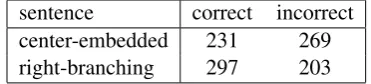
[image:7.595.323.509.63.105.2]sentence correct incorrect center-embedded 231 269 right-branching 297 203
Table 1: Accuracy of vectorial parser on each sen-tence type.
(as it is in Figure 3), the parser was awarded a point of accuracy; otherwise it was not. The re-sults of this assessment are shown in Table 1. The parser processes sentences with right-branching structure substantially more accurately than sen-tences with center-embedded structure. These re-sults are strongly significant (p< .001) using aχ2
test.
These predictions seem to be consistent with observations by Chomsky and Miller (1963) that center-embedded structures are more difficult to parse than right-branching structures, but it is also important to note how the model arrives at these predictions. The decreased accuracy of center-embedded sentences is not a result of an ex-plicit decay factor, as in ACT-R and other models (Lewis and Vasishth, 2005), or distance measures as in DLT (Gibson, 2000), nor is it attributable to cue interference (as modeled by Lewis and Vasishth for nested object relative constructions), since the inner and outer embeddings in these sentences use different grammar rules. The de-creased accuracy for center-embedding is also not attributable to frequency effects of grammar rules (as modeled by Hale, 2001), since the rules in this grammar are relatively common and equally weighted.
6 Extensions
This model is also interesting because it allows se-mantic relations to be constructed using the same outer product associations used to define contin-uation and category matrices in Section 4. First, discourse referent instances and numbered relation types are defined as vectors iandn, respectively. Then relation tokens are reified as vectorsr, simi-lar to the reification of grammar rules described in Section 4, and connected to relation type vectorsn
by cued associationRand to source and target dis-course referentsiby cued associationsR0andR00. Semantic relation types can then be cued from grammar rules g using associative matrix N, al-lowing relations of various types to be constructed in cases of superposed grammar rules. In future work, it would be interesting to see whether this representation is consistent with observations of local syntactic coherence (Tabor et al., 2004).
This model can also constrain relations to dis-course referents introduced in a previous sentence or earlier in the same sentence using a vector of
temporal features (Howard and Kahana, 2002). This is a vector of featureszt, that has a randomly chosen selection of features randomly resampled at each time step, exponentially decreasing the co-sine similarity of the current version of thezt vec-tor to earlier versions zt0. If discourse referents i are cued from the current temporal featureszt in an outer product associative matrix Z, it will cue relatively recently mentioned discourse referents more strongly than less recently mentioned refer-ents. If discourse referents for eventualities and propositions jare connected to explicit predicate type referents k (say, cued by a relation of type ‘0’), and if temporal cues are combined in a diag-onal product with cues by semantic relations from a common predicate type, the search for a consis-tent discourse referent can be further constrained to match the gender of a pronoun or other rela-tions from a definite reference. In future work, it would be interesting to compare the predictions of this kind of model to human coreference resolu-tion, particularly in the case of parsing conjunc-tions with reflexive pronouns, which has been used to argue for fully connected incremental parsing (Sturt and Lombardo, 2005).
7 Conclusion
This paper has presented a vectorial left-corner parsing model defined using independently
posited operations over activation-based working memory and weight-based episodic memory. This model has the attractive property that it hypoth-esizes only one unary branching rule application and only one binary branching rule application per time step, which allows it to be smoothly inte-grated into a vector-based recurrence that propa-gates structural ambiguity from one time step to the next. Predictions of this model were calcu-lated on a center-embedded sentence processing task and the model was shown to exhibit decreased processing accuracy in center-embedded construc-tions, as observed by Chomsky and Miller (1963), even in the absence of repeated grammar rules or potential confounding overhead costs that may be associated with filler-gap constructions.
This model is particularly interesting because, unlike other vectorial or connectionist parsers, it directly implements a recursive probabilistic grammar with explicit categories of syntactic con-text. This explicit implementation of a probabilis-tic grammar allows variations of this processing model to be evaluated without having to also posit a human-like model of acquisition. For example, the model can simply be defined with a PCFG de-rived from a syntactically annotated corpus.
The model is also interesting because it serves as an existence proof that recursive grammar is not incompatible with current models of human mem-ory.
Finally, the fact that this model predicts mem-ory effects at boundaries between incomplete cat-egories, in line with predictions of fully paral-lel left-corner parsers (van Schijndel and Schuler, 2013; van Schijndel et al., 2013b), suggests that measures based on incomplete categories (or based on connected components of other kinds of syntactic or semantic structure) are not simply ar-bitrary but rather may naturally emerge from the use of associative memory during sentence pro-cessing.
References
James A. Anderson, Jack W. Silverstein, Stephen A. Ritz, and Randall S. Jones. 1977. Distinctive fea-tures, categorical perception and probability learn-ing: Some applications of a neural model.
Psycho-logical Review, 84:413–451.
Peter beim Graben, Sabrina Gerth, and Shravan Va-sishth. 2008. Towards dynamical system models of language-related brain potentials. Cognitive
Neu-rodynamics, 2(3):229–255.
Noam Chomsky and George A. Miller. 1963. Intro-duction to the formal analysis of natural languages.
In Handbook of Mathematical Psychology, pages
269–321. Wiley, New York, NY.
Jeffrey L. Elman. 1991. Distributed representations, simple recurrent networks, and grammatical struc-ture. Machine Learning, 7:195–225.
Edward Gibson. 2000. The dependency locality the-ory: A distance-based theory of linguistic complex-ity. InImage, language, brain: Papers from the first
mind articulation project symposium, pages 95–126,
Cambridge, MA. MIT Press.
John Hale. 2001. A probabilistic earley parser as a psycholinguistic model. InProceedings of the sec-ond meeting of the North American chapter of the
Association for Computational Linguistics, pages
159–166, Pittsburgh, PA.
Marc W. Howard and Michael J. Kahana. 2002. A dis-tributed representation of temporal context. Journal
of Mathematical Psychology, 45:269–299.
Roger Levy and Edward Gibson. 2013. Surprisal, the pdc, and the primary locus of processing difficulty in relative clauses. Frontiers in Psychology, 4(229).
Roger Levy. 2008. Expectation-based syntactic com-prehension. Cognition, 106(3):1126–1177.
Richard L. Lewis and Shravan Vasishth. 2005. An activation-based model of sentence processing as skilled memory retrieval. Cognitive Science, 29(3):375–419.
David Marr. 1971. Simple memory: A theory for archicortex. Philosophical Transactions of the
Royal Society (London) B, 262:23–81.
J. L. McClelland, B. L. McNaughton, and R. C. O’Reilly. 1995. Why there are complementary learning systems in the hippocampus and neocortex: Insights from the successes and failures of connec-tionist models of learning and memory.
Psychologi-cal Review, 102:419–457.
B.B. Murdock. 1982. A theory for the storage and retrieval of item and associative information.
Psy-chological Review, 89:609–626.
Slav Petrov and Dan Klein. 2007. Improved inference for unlexicalized parsing. InProceedings of NAACL
HLT 2007, pages 404–411, Rochester, New York,
April. Association for Computational Linguistics.
Paul Smolensky. 1990. Tensor product variable bind-ing and the representation of symbolic structures in connectionist systems. Artificial intelligence, 46(1-2):159–216.
Patrick Sturt and Vincent Lombardo. 2005. Processing coordinate structures: Incrementality and connect-edness.Cognitive Science, 29:291–305.
W. Tabor, B. Galantucci, and D Richardson. 2004. Effects of merely local syntactic coherence on sen-tence processing. Journal of Memory and
Lan-guage, 50(4):355–370.
Marten van Schijndel and William Schuler. 2013. An analysis of frequency- and recency-based processing costs. InProceedings of NAACL-HLT 2013. Associ-ation for ComputAssoci-ational Linguistics.
Marten van Schijndel, Andy Exley, and William Schuler. 2013a. A model of language processing as hierarchic sequential prediction. Topics in
Cogni-tive Science, 5(3):522–540.