OpenWordNet-PT: A Project Report
Alexandre Rademaker IBM Research Brazil / FGV/EMAp
Rio de Janeiro, Brazil [email protected]
Valeria de Paiva Nunance Communications
Sunnyvale, CA, USA
Gerard de Melo Tsinghua University
Beijing, China [email protected]
Livy Maria Real Coelho Univ. Federal do Paran´a
Curitiba, Brazil [email protected]
Maira Gatti IBM Research Brazil Rio de Janeiro, Brazil [email protected]
Abstract
This paper presents OpenWordNet-PT, a freely available open-source wordnet for Portuguese, with its latest developments and practical uses. We provide a detailed description of the RDF representation de-veloped for OpenWordnet-PT. We high-light our efforts to extend the coverage of our resource and add nominalization rela-tions connecting nouns and verbs. Finally, we present several real-world applications where OpenWordnet-PT was put to use, including a large-scale high-throughput sentiment analysis system.
1 Introduction
Semantic relationships between words are crucial in many forms of natural language processing. Computational systems are not aware of the fact thatcarroandautom´ovelboth refer to cars, or that caminh˜ao(truck) is related to these words as well in that they all share a common more general hy-pernym.
OpenWordnet-PT (or OpenWN-PT for short) is a lexical-semantic resource describing (Brazil-ian) Portuguese words and their relationships. It is modelled after and fully interoperable with the original Princeton WordNet for English (Fell-baum, 1998), relying on the same identifiers as WordNet 3.0. This means that one can easily find Portuguese equivalents for specific English word senses and vice versa. This also means that OpenWN-PT is part of a large ecosystem of compatible resources, including domain identi-fiers (Magnini and Cavaglia, 2000) and mappings to Wikipedia (de Melo and Weikum, 2010).
In this paper, we specify the RDF-based repre-sentation chosen for OpenWN-PT (Section 2) and describe our recent efforts to extend this resource (Sections 3 to 5), most notably with nominaliza-tion relanominaliza-tions connecting nouns and verbs (Sec-tion 4). We also highlight several important ap-plications of OpenWN-PT (Section 6).
2 RDF Representation
Wordnets have been distributed in a wide range of different incompatible data formats. An increas-ingly popular way of addressing the issue of in-teroperability is to rely on Linked Data and Se-mantic Web standards such as RDF (Cyganiak and Wood, 2003) and OWL (Hitzler et al., 2012), which have led to the emergence of a number of Linked Data projects for lexical resources (de Melo and Weikum, 2008; Chiarcos et al., 2012).
We believe that OpenWN-PT should best be en-coded and distributed in RDF/OWL. Not only do these standards allow us to publish both the data model and the actual data in the same format. They also provide for instant compatibility with a vast range of existing data processing tools, in-cluding databases (so-called “triple stores”) pro-viding SQL-like query interfaces based on the SPARQL standard (Harris and Seaborne, 2013).
without interpretation. Comparing with previous RDF translations of WordNet, the main features of this version are: (1) It does not model the hy-ponym hierarchy as a subclass hierarchy. (2) It represents words and word senses as separate en-tities with their own URI which makes it possi-ble to refer to them directly. (3) It contains all relations that are present in Princeton WordNet. (4) It provides OWL semantics in the form of in-verse properties, definition of property character-istics and property restrictions on classes that can be used by both the RDFS and OWL infrastruc-tures.
The schema of the conversion has three main classes:Synset,WordandWordSense. There are three kinds of properties in the schema. A first set of properties connects instances of the main classes together. The class Synset is linked to its WordSenses with the prop-erty containsWordSense, and WordSense to its Word with the property word. A sec-ond set of properties represents the WordNet re-lations such as hyponymy and meronymy, in-cluding those that relate two Synsets to each other (e.g. hyponymOf), those that relate two WordSenses to each other (e.g. antonymOf), and a miscellaneous set containing gloss and frame. Finally, a third set of properties pro-vides additional information about entities using literals. Examples aresynsetId, which records the original ID given in Princeton WordNet to a synset, and the tagCount of a WordSense. The actual lexical form of aWordis recorded with the propertylexicalForm. Each synset has an rdfs:labelthat is filled with the lexical form of the first word sense in the synset.
OpenWN-PT is completely aligned to Prince-ton WordNet. This means that each OpenWN-PT synset is a translation of an original Prince-ton WordNet synset, with no additional synsets or relations so far. Given this direct relation, we decided that our RDF representation does not re-quire a full redundant modeling of all relations and information in Princeton WordNet. Instead, we chose to model our RDF as an add-on to Word-Net 3.0 that extends it with information about the Portuguese language. For this, we simply add newSynsetandWordSenseinstances that are linked to the English WordNet.
OpenWN-PT’s RDF will thus only be useful to-gether with an RDF version of Princeton WordNet.
While there is a previous RDF version of WordNet 3.0 online, 1 we wanted to ensure that all infor-mation in the WordNet 3.0 distribution was trans-formed to RDF. To this end, we wrote our own Common Lisp code to translate the WordNet 3.0 data files to RDF, following the W3C model (van Assem et al., 2006) with a few modifications as follows.
1. We add two more classes named BaseConcept and CoreConcept to identify the synsets that are base con-cepts (Vossen, 2002) or core concon-cepts (Boyd-Graber et al., 2006), respectively.
2. We have added properties to capture infor-mation from WordNet 3.0 not available in the Prolog distribution nor in the “database files only” distribution. To this end, we have parsed and read the filessents.vrb, sent-idx.vrb and lexnames. A WordSense can have alexFile,lexId,senseKey, and an example sentence (for a WordSense of a VerbSynset). A synset can have a lexicographerFile and a frame (in the case of aVerbSynset).
3. We omitted redundant subclasses of WordSense like NounWordSense, as the part-of-speech can be derived from the corresponding synset. A subclass of Word calledCollocationis also omitted, as the lexical form ofWordinstances can easily be examined to check for collocations.
4. We have adopted a different schema for nam-ing the resources identifiers (URIs).
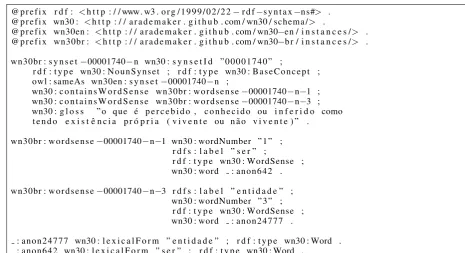
In Figure 1, we show the synset 00001740-n en-coded in RDF in its more readable N3 notation variant (Berners-Lee and Connolly, 2011). Word instances are blank resources, that is, resources without a URI or unnamed resources. In Figure 2, we present the same synset in a graphical way, ad-ditionally showing its connection with the corre-sponding synset in the Princeton WordNet, includ-ing relevant semantic relations. Our code for this RDF version of WordNet 3.0 is freely available.2
1Seehttp://bit.ly/1cVExvj.
2Seehttp://bit.ly/1ctbGSL. The code requires
@ p r e f i x r d f : <h t t p : / / www. w3 . o r g / 1 9 9 9 / 0 2 / 2 2−r d f−s y n t a x−n s#> . @ p r e f i x wn30 : <h t t p : / / a r a d e m a k e r . g i t h u b . com / wn30 / schema /> .
@ p r e f i x wn30en : <h t t p : / / a r a d e m a k e r . g i t h u b . com / wn30−en / i n s t a n c e s /> . @ p r e f i x wn30br : <h t t p : / / a r a d e m a k e r . g i t h u b . com / wn30−b r / i n s t a n c e s /> .
wn30br : s y n s e t−00001740−n wn30 : s y n s e t I d ” 0 0 0 0 1 7 4 0 ” ;
r d f : t y p e wn30 : N o u n S y n s e t ; r d f : t y p e wn30 : B a s e C o n c e p t ; owl : sameAs wn30en : s y n s e t−00001740−n ;
wn30 : c o n t a i n s W o r d S e n s e wn30br : w o r d s e n s e−00001740−n−1 ; wn30 : c o n t a i n s W o r d S e n s e wn30br : w o r d s e n s e−00001740−n−3 ; wn30 : g l o s s ” o que ´e p e r c e b i d o , c o n h e c i d o ou i n f e r i d o como t e n d o e x i s t ˆe n c i a p r ´o p r i a ( v i v e n t e ou n ˜a o v i v e n t e ) ” .
wn30br : w o r d s e n s e−00001740−n−1 wn30 : wordNumber ” 1 ” ; r d f s : l a b e l ” s e r ” ;
r d f : t y p e wn30 : WordSense ; wn30 : word : a n o n 6 4 2 .
wn30br : w o r d s e n s e−00001740−n−3 r d f s : l a b e l ” e n t i d a d e ” ; wn30 : wordNumber ” 3 ” ; r d f : t y p e wn30 : WordSense ; wn30 : word : a n o n 2 4 7 7 7 .
[image:3.595.62.528.112.365.2]: a n o n 2 4 7 7 7 wn30 : l e x i c a l F o r m ” e n t i d a d e ” ; r d f : t y p e wn30 : Word . : a n o n 6 4 2 wn30 : l e x i c a l F o r m ” s e r ” ; r d f : t y p e wn30 : Word .
Figure 1: The synset 00001740-n in N3 notation
[image:3.595.121.479.515.684.2]3 Extending the Coverage
The first version of OpenWN-PT was created us-ing a semi-automated process drawus-ing on UWN (de Melo and Weikum, 2009) and on manual re-visions and gloss translations (Rademaker et al., 2012). Table 1 summarizes how OpenWN-PT has increased over the last two years. The number of synsets should be understood as the number of synsets with at least one Portuguese word. The sources of the new data were (Bond and Foster, 2013) and some manual addition of entries while working on projects that make use of the resource. These use cases are described later in Section 6.
2011 2013 increase synsets 41,810 43,895 5%
[image:4.595.93.270.254.311.2]words 52,220 54,125 3% senses 68,285 74,054 8%
Table 1: OpenWN-PT’s coverage development
Among resources that we can use to expand OpenWN-PT, we are considering (Dias-Da-Silva and de Moraes, 2003) and (Gonc¸alo Oliveira, 2013). Both projects are also concerned with the construction of a WordNet-like lexical resource for Portuguese. The former is more limited, of-fering around 19,888 synsets without any links to the Princeton WordNet and no relations between synsets, other than synonymy. The latter has al-ready incorporated OpenWN-PT and is also en-coded in RDF following the same vocabulary of (van Assem et al., 2006). This means that it should be straightfoward to obtain data from Onto.PT.
Besides the continuous work on increasing the number of translated synsets, we have also in-vested some time to expand the relations. All semantic relations in Princeton WordNet 3.0 are included in our RDF export. Figure 2 shows how one can navigate from a OpenWN-PT synset in the graph to the Princeton WordNet synset. Most semantic relations also apply to the Por-tuguese words. However, since the first version of OpenWN-PT came from the UWN, which does not have word sense-specific relations, we do not have any generic way to map the lexical relations (relations between word senses) from Princeton WordNet to specific words in OpenWN-PT.
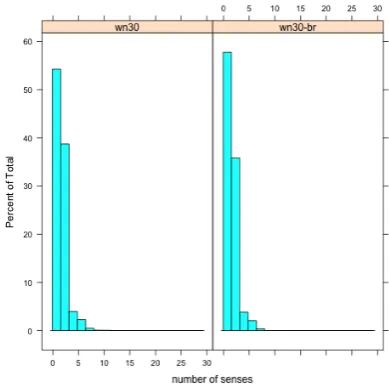
Mainly because of the sentiment analysis project described later in Section 6, we focused in particular on antonomy relationships. Study-ing the plot in Figure 3, which shows the
dis-tribution of the number of senses per synset in both wordnets, it is clear that we could take ad-vantage of the fact that the majority of synsets in both wordnets have only one sense to propagate the antonoym pairs in Princeton WordNet to the senses in OpenWN-PT with also only one sense. We search for synsets A in Princeton WordNet with only one sense, where this specific sense is related to another sense that is also unique in its synset in Princeton WordNet, sayB. We can prop-agate this antonymy relation to OpenWN-PT if synset A and B in OpenWN-PT also have only one sense each. Using this idea, we were able to add 707 antonymy relation instances to OpenWN-PT (only about 10% of the number of pairs in the antonym relation of Princeton WordNet 3.0). In the future, we plan to additionally use common prefixes like “des”, “in” to match senses.
Figure 3: distribution of senses per synset
4 Nominalizations and NomLex-BR
[image:4.595.314.509.325.519.2]that the event is described in terms of its nominal-izationdestruction instead of its verbal form de-stroy. A proper handling of nominalizations (we are especially interested here in nominalizations of verbs, also called deverbal nouns) is important in numerous natural language understanding and in-ference tasks (Gurevich et al., 2008).
For English, NOMLEX (Macleod et al., 1998) has provided extensive descriptions of nominal-izations. The original NOMLEX was constructed starting out with nominalizations with the suffixes -ion, -mentand-er, relying on frequent words in a corpus. NOMLEX sought not only to describe the possible complements for a nominalization, but also to relate the nominal complements to the ar-guments of the corresponding verb.
Our NomLex-BR project (Coelho et al., 2014) started with a manual translation of NOMLEX to Brazilian Portuguese, as NOMLEX is rela-tively small but still covers the most salient vo-cabulary. Many cases were very straightforward, due to the morphology of the words with sim-ilar nominalizer morphemes in both languages, e.g. pairs like adjournment/adiamento, ben-eficiary/benefici´ario,corrosion/ corros˜ao.
Overall, we have created over 1,000 entries. These have been integrated into OpenWN-PT, which we hope will facilitate their use for lin-guistic research of the traditional kind. For now, most of the words from NomLex-BR are linked to Word instances of OpenWN-PT. Eventually, we would like to have entries of NomLex-BR linked to specific WordSense instances of OpenWN-PT to the extent possible. We are currently also devising strategies to create entries and model phe-nomena specific to Portuguese.
Incorporating NomLex-BR data into OpenWN-PT has shown itself useful in pinpointing some is-sues with the coherence and richness of OpenWN-PT. In particular, it seems that 20% of words in NomLex-BR (which were manually chosen) are missing in OpenWN-PT. For instance, the word abasement corresponds in NOMLEX to the verb abase, and thus we would like a similar correspon-dence between the Portuguese noun aviltamento and the verb aviltar(our suggested translations). However, while abasement in English is present in two synsets with Portuguese equivalents, the synsets for the verb abase have a repetition in Portuguese. OpenWN-PT simply has two synsets humilhar, abaixar and humilhar, rebaixar. The
more common verb humilhar is repeated, while the uncommonaviltarwas left out. Thus by veri-fying that verb-noun pairs in English are mapped to verb-noun pairs in Portuguese, we help ensure that the richness of synonyms in Portuguese is not lost in OpenWN-PT, which, being automatically derived from connectivity graphs, often gives pref-erence to more commonly used words.
Other useful kinds of relationships between parts of speech (say the connections between ad-jectives and adverbs) are likely to also help to improve the accuracy and richness of our auto-matically derived resource. Altogether we reckon that by examining at random relationships that we know hold in the English WordNet in its translated Portuguese version, we should be able to both check the accuracy of OpenWordNet-PT and si-multaneously investigate the parallelism between the two languages. From this perspective, one of the more interesting relationships, as far as knowl-edge representation is concerned, is the relation-ship of entailment between synsets. We have a goal of checking some 200 random English rela-tionships in their translated forms as a way of mea-suring accuracy of the OpenWN-PT in the very immediate future.
5 Accuracy
cases, the linguist was able to give detailed feed-back like indicating misspelt words or providing a more specific reason for why the sentence was considered wrong. There were also trivial pairs in which the same word was chosen from both synsets. We hope to improve our tests in these cases.
Finally, some data mining could also help us to improve the accuracy of OpenWN-PT. For in-stance, synsets with an uncommonly high number of senses or words with an unexpected number of senses should be reviewed.
6 Usage Reports
6.1 Word Sense Disambiguation
OpenWN-PT has been incorporated into Freel-ing (Padr´o and Stanilovsky, 2012), a well-known suite of NLP tools. With OpenWN-PT’s data and Freeling’s word sense disambiguation framework, a given Portuguese text can automatically be an-notated with word senses, and we can use these annotations in the projects below.
6.2 Sentiment Analysis
We have been investigating the OpenWN-PT us-age in one of our projects at IBM Research-Brazil. In this project the main concern is to gather the sentiment of microblogging posts about football matches in Portuguese in real-time. The most famous microblogging online social network is Twitter3. As of 2013, there are more than 550 mil-lion active registered users and 58 milmil-lion tweets are posted per day on average. These tweets are short messages that people send to provide up-dates on their activities, observations, or other in-teresting content, directly or indirectly to others. In sports, for instance, a lot of sentiment is ex-pressed during a game match. Recently there have been several approaches that tackle the problem of classifying tweet sentiments using supervised or semi-supervised machine learning approaches (Celikyilmaz et al., 2010; Bakliwal et al., 2012) or lexicon-based methods, which are mostly unsu-pervised approaches (Li et al., 2011; Hogenboom et al., 2013).
As people react to events and generate a large Twitter stream of data, it is impossible to manu-ally process and analyze all these data during the event’s lifespan. There are several challenges re-lated to analyzing all this data as quickly as
possi-3Seehttp://twitter.com
ble. First, the system must be reliable: no informa-tion should be lost. This means that a highly avail-able system is called for, with redundancy and ac-tive fault tolerance mechanisms. Second, it must have a high throughput, which leads us to an in-frastructure that allows parallelism. Thirdly, sen-timent classifiers should be able to work with lim-ited resources in both time and space. The training phase should handle an unbalanced distribution of sentiments and in real time, it should be adaptive.
can produce others tweets with synonym words which are likely to retain the same semantics and thus also the same sentiment with high probability.
6.3 Historical Biographic Dictionary
The second project we used OpenWN-PT for is related to the digitalization of a dictionary of his-torical biographies. The Getulio Vargas Founda-tion (FGV) maintains the Brazilian DicFounda-tionary of Historical Biographies (DHBB), a resource with 7,000 entries, the majority of which are biograph-ical entries about politicians in Brazil’s recent his-tory. The FGV would like to transform this static collection of entries into new methods of learning, teaching, acquiring, storing, and using informa-tion. Thus we decided that this knowledge would be more actionable if we could operate on it with semantic tools.
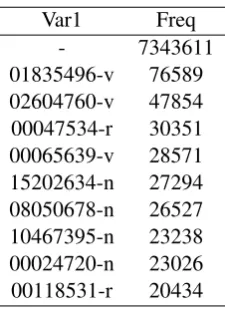
We used Freeling to automatically process this data by performing tokenization, sentence split-ting, part-of-speech tagging, and finally word sense disambiguation with respect to OpenWN-PT. The DHBB corpus has a vocabulary size of 247,063 words. Table 2 shows the most frequent synsets in the corpus. The first line refers to the number of tokens without any associated synset. For instance, synset00024720-nrefers to “the way something is with respect to its main at-tributes” and synset 08050678-nis about “the organization that is the governing authority of a political unit” which, in OpenWN-PT, contains the word “governo”. Note that synset10467395-n is about “ the person who holds the office of head of state of the United States government”, for which OpenWN-PT contains the word “pres-idente” (president) as one of its words.
[image:7.595.339.493.211.431.2]Var1 Freq - 7343611 01835496-v 76589 02604760-v 47854 00047534-r 30351 00065639-v 28571 15202634-n 27294 08050678-n 26527 10467395-n 23238 00024720-n 23026 00118531-r 20434
Table 2: Frequent synsets in DHBB entries
Table 3 presents some of the most frequent
to-kens (after lemmatization) that could not be found in OpenWN-PT. The entries are not very surpris-ing, as our efforts have not focused on domain-specific vocabulary from the political/historical domain.4 The exercise of running FreeLing on the DHBB entries gave us good insights about the coverage of OpenWN-PT and we plan to extend the translations of synsets from the most frequent missing words in OpenWN-PT to the less frequent ones.
Token Freq
[??:??/1/??:??.??:??] 15294
partido 15292
durante 10962
contra 10180
tornar 9991
militar 9906
outro 9739
segundo 9577
s˜ao paulo 8803
estadual 8727
voto 8287
pmdb 6615
cˆam 6271
direito 6170
cˆamara dos deputados 5849
Table 3: Frequent tokens without synset
7 Conclusion
We have discussed the implementation and some applications of OpenWordNet-PT, an open Word-Net for Brazilian Portuguese. Recent improve-ments include better coverage and nominaliza-tion links connecting nouns and verbs. The resource has been used in developing a high-throughput commercial system as well as in a cultural heritage project, and we anticipate that numerous further applications will follow. The data is freely available fromhttp://github. com/arademaker/wordnet-br/ and via a SPARQL endpoint5. We are also grateful to Fran-cis Bond for providing an online interface via the Open Multilingual Wordnet website6.
4
The first entry is the January encoded as a date template.
5
Seehttp://logics.emap.fgv.br:10035
[image:7.595.125.238.564.719.2]References
Stefano Baccianella, Andrea Esuli, and Fabrizio Sebas-tiani. 2010. Sentiwordnet 3.0: An enhanced lexical resource for sentiment analysis and opinion mining.
InLREC, volume 10, pages 2200–2204.
Akshat Bakliwal, Piyush Arora, Senthil Madhappan, Nikhil Kapre, Mukesh Singh, and Vasudeva Varma.
2012. Mining sentiments from tweets. InProc. of
the 3rd Workshop in Computational Approaches to Subjectivity and Sentiment Analysis, pages 11–18.
Tim Berners-Lee and Dan Connolly. 2011. Notation3
(N3): A readable RDF syntax. http://bit.ly/
1bYAs8y.
Francis Bond and Ryan Foster. 2013. Linking and
ex-tending an open multilingual wordnet. InProc. of
ACL 2013, pages 1352–1362, Bulgaria. ACL.
Jordan Boyd-Graber, Christiane Fellbaum, Daniel Os-herson, and Robert Schapire. 2006. Adding dense,
weighted connections to wordnet. In Proc. of the
3th Global WordNet Conf., pages 29–36, Jeju Island, Korea, January.
Asli Celikyilmaz, Dilek Hakkani-Tur, and Junlan Feng. 2010. Probabilistic model-based sentiment
analy-sis of twitter messages. InIEEE Spoken Language
Technology Workshop (SLT), pages 79–84.
Christian Chiarcos, Sebastian Nordhoff, and Sebastian
Hellmann. 2012. Linked data in linguistics:
Repre-senting and connecting language data and language metadata. Springer.
Livy Maria Real Coelho, Alexandre Rademaker,
Valeria De Paiva, and Gerard de Melo. 2014.
Embedding NomLex-BR nominalizations into
OpenWordnet-PT. In Proc. of Global WordNet
Conf. 2014. to appear.
Alan Cruse. 1986.Lexical semantics. Cambridge
Uni-versity Press.
Richard Cyganiak and David Wood. 2003. RDF
1.1 concepts and abstract syntax. Technical Report Draft 23 July 2013, W3C.
Gerard de Melo and Gerhard Weikum. 2008. Lan-guage as a foundation of the Semantic Web. InProc. of ISWC 2008, volume 401.
Gerard de Melo and Gerhard Weikum. 2009. Towards a universal wordnet by learning from combined
evi-dence. InProc. of CIKM 2009, pages 513–522, New
York, USA. ACM.
Gerard de Melo and Gerhard Weikum. 2010. MENTA: inducing multilingual taxonomies from Wikipedia. InProc. of CIKM 2010, pages 1099–1108. ACM.
Bento Carlos Dias-Da-Silva and Helio Roberto de Moraes. 2003. A construc¸ao de um thesaurus eletrˆonico para o portuguˆes do brasil.ALFA: Revista de Lingu´ıstica, 47(2).
Christiane Fellbaum. 1998. WordNet: An electronic
lexical database. The MIT press.
Hugo Gonc¸alo Oliveira. 2013. Onto.PT: Towards the
Automatic Construction of a Lexical Ontology for Portuguese. Ph.D. thesis, University of Coimbra.
Olga Gurevich, Richard Crouch, Tracy Holloway King,
and Valeria de Paiva. 2008. Deverbal nouns in
knowledge representation. J. Log. and Comput.,
18(3):385–404.
Steve Harris and Andy Seaborne. 2013. SPARQL
1.1 query language. Technical Report W3C Recom-mendation 21 March 2013, W3C.
Pascal Hitzler, Markus Krotzsch, Bijan Parsia, Peter F.
Patel-Schneider, and Sebastian Rudolph. 2012.
OWL 2 web ontology language primer. Technical Report W3C Rec 11 Dec 2012, W3C.
Alexander Hogenboom, Daniella Bal, Flavius Frasin-car, Malissa Bal, Franciska de Jong, and Uzay Kay-mak. 2013. Exploiting emoticons in sentiment
anal-ysis. In Proc. of the ACM Symposium on Applied
Computing, pages 703–710, New York, NY, USA. ACM.
Lin Li, Yunqing Xia, and Pengzhou Zhang. 2011. An unsupervised approach to sentiment word extraction
in complex sentiment analysis. International
Jour-nal of Knowledge and Language Processing, 2(1).
Catherine Macleod, Ralph Grishman, Adam Meyers, Leslie Barret, and Ruth Reeves. 1998. Nomlex:
A lexicon of nominalizations. InProc. of Euralex
1998, pages 187–193, Liege, Belgium.
Bernardo Magnini and Gabriela Cavaglia. 2000. Inte-grating subject field codes into WordNet. InProc. of
LREC, pages 1413–1418.
Palmira Marrafa. 2002. Portuguese wordnet:
gen-eral architecture and internal semantic relations.
DELTA: Documentac¸˜ao de Estudos em Ling¨u´ıstica Te´orica e Aplicada, 18(SPE):131–146.
Llu´ıs Padr´o and Evgeny Stanilovsky. 2012. Freeling 3.0: Towards wider multilinguality. InProc. of the 8th Intern. Conf. on Language Resources and Eval-uation (LREC’12), pages 23–25, Istanbul, Turkey, may.
Alexandre Rademaker, Valeria De Paiva, and Gerard de Melo. 2012. Openwordnet-pt: An open brazilian
wordnet for reasoning. In Proc. of COLING 2012,
pages 353–360, Mumbai.
Mark van Assem, Aldo Gangemi, and Guus Schreiber. 2006. RDF/OWL representation of WordNet. Tech-nical Report W3C Working Draft 19 June 2006, W3C. http://bit.ly/1jtGsA8.