On shape classifiers, their metaphorical extension(s) and
wordnet potentials
Francesca Quattri
The Hong Kong Polytechnic University
Hong Kong
Abstract
This paper aims at highlighting the com-plex lexico-semantic information entailed in Chinese shape classifiers. The study is based on a selection of the same as derived from extensive literature. The goal is to introduce shape information in wordnets in a comprehensive way starting by shape classifiers. The suggestion is to map them not just as information coercers, but also as lexical items (nouns, verbs, adjectives). The paper also explores the metaphorical implications that can be derived from clas-sifiers in this double function.
1 Introduction
Classifiers belong to some of the most com-plex issues in the grammars of the languages that own them (e. g. Japanese, Chinese, Korean, Thai). The approach to classifiers as not just grammati-cal, but also lexical items, has already been paved. (Mok, Huini and Bond, 2012; Paik and Bond, 2002) and (Bond and Paik, 2000) have for instance conducted research on classifiers and Wordnet® (WN), mainly focusing on the generation / predic-tion of classifiers from WN or from a common on-tology.
In this paper, some Chinese shape classifiers are taken into account. Upon the claim made in lit-erature that they enhance shape-related properties entailed in the nouns they collocate with (as de-scribed in Section 2), three major claims are made. (I) Classifiers (as for this study, shape ones) can trigger shape-related information from the noun they accompany, but (II) they can also pass the shape-related information they already contain to the nouns that follow (which makes this informa-tion transfer bi-, and not just mono-direcinforma-tional).
In order to understand point II, it needs to be pointed out that, although classifiers are defined
as morphemes specifying the semantic class of the nouns that follows, they can be nouns, verbs and adjectives at the same time (a fact that re-mains rather unmentioned in the referred litera-ture). Once this fact is acknowledged, the afore as-sumed bi-directionality of lexico-semantic infor-mation from classifier to noun sounds feasible.
In the proposed examples, cases are also shown in which the liason between classifier and noun may be shallow (meaning that it is unclear how the shape-related classifier can possibly match with a certain noun). For these cases, it is suggested that (III) the bond between shape classifier and noun that follows is justifiable through metaphorical ex-tension.
The author believes that the introduction of classifiers as elements of meaning derivation and meaning extension can be of interest for the word-net community.
All the points in the research stress the need to consider classifiers and shape-related information in wordnets in greater detail. The research also tries to justify the use of classifiers in common-sense language.
The choice of selecting shape over other kinds of classifiers, as well as the hypothesis of a metaphorical justification in their use in language are inscribed in the bigger frame of current re-search (Quattri, 2013a; Quattri, 2013b).
2 Shape classifiers as lexico-semantic
information carriers
ShapeAt-tributes, such as length, or roundness, or flatness.1 Although not explicitly stated, it seems that other authors apply the similar value to classifiers, i. e. of being elements that coerce or extract in-formation from the event or object that comes af-ter them. For instance, according to ((Sera, John-son and Yichun, 2013):5–7), the Chinese classi-fier條 tiáo reflects the length and flexibility en-tailed in the objects it carries (e. g. a rope, or a snake). 支zhī stresses length and rigidity, while
個 ge is a more universal classifier, thus partly a shape-related one. For (Sera, Johnson and Yichun, 2013), the use of條,支and個in Chinese, counts, among other shape classifiers in their research, for 56.5% of general use.
Once the monodirectionality between classifier
yand nounxis implied, some authors either cate-gorically deny, or hardly prove,2the existence of a hierarchical relations among the different mor-phemes.
In this paper, a new approach to classifiers is proposed, with the following assumptions: (I) Classifiers can trigger information from the noun they accompany but (II) they are not just mor-phemes, but also proper words (nouns, verbs and / or adjectives) with proper meaning/s. This ac-knowledged, it is assumed that the meaning that a classifier coerces from a noun may be contained in the classifier itself and transferred to the word it accompanies. (III) When the matching between classifier and noun appears shallow, there might exist a metaphorical motivation that enables to jus-tify the use of that specific morpheme for that spe-cific noun.
Let’s propose some examples as evidence. Take for instance the classifier張zhāng. When used as a verb, the word means ‘to spread up’, ‘to stretch’, ‘to expand’, while when used as a noun it means ‘string’. Not surprisingly, when acting as morpheme, 張 accompanies nouns which define long, flat objects, such as bows, tables, or pieces of paper (II). Yet,張 also matches to words like
1The upper ontology SUMO (www.
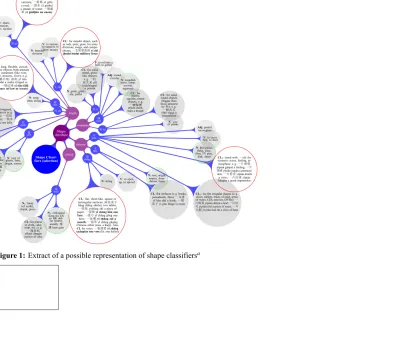
ontologyportal.com) maps these shape features differently. Length is for istance mapped as LengthMeasure, roundness as ShapeAttribute, flatness as VisualAttribute or SpatialRelation. The author has decided to represent all these shape-related features as subsumed to the self-defined upper concept ShapeAttribute (as in fig. 1).
2For reference: Adams and Conklin (1973), Allan (1977),
Croft (1994), Denny (1986), Downing (1996), also cited un-der ((Imai, Saalbach and Stern, 2010):485ff.)
‘mouth’ (一張嘴yī zhāngzuǐ) or ballot (一張選
票yī zhāng xuǎnpiào). One feasible justification is that both the body part and the vote are visu-ally synthesized, the first as something flat (sort of string), the second as the real instrument that en-ables a vote to be casted. Since both objects stand in the mental eye for something else, we call them metaphorical extension of the real meaning, trig-gered by the classifier張(III).
管(兒) guǎn(r) stands in Chinese for ‘tube’ or ‘pipe’. The word also acts as classifier for tube-shaped objects, such as flutes and toothpaste tubes. Literature does not provide a precise specification of the association of管to these nouns, so it may be possible to assume that the ShapeAttribute length is triggered either by the noun (I), or by the classi-fier (II).
Another case of vagueness in the determination of what coerces what is provided by the case of片
piàn. In一片吐司yī piàn tǔsī , a piece of bread, the ShapeAttribute flatness is entailed in, and can therefore derived from either片piàn as word (also meaning ‘slice’), or from土司tǔsī, ‘sliced bread’. In this uncertainty, one might use this example as evidence for (I). On the contrary, in the case of in 一片地 yī piàn dì, a (flat) piece of land, one can state with almost no doubt that the ShapeAt-tribute flatness derives from片 and not from 地
(II), since the latter simply means ‘land’, ‘place’, ‘earth’, ‘ground’.
團tuán corresponds to the English verb ‘to roll’, ‘to roll into a ball’, ‘to gather’. As a noun, it trans-lates into ‘regiment’, ‘group’, ‘society’, ‘body’ (which metaphorically can all stand for conglom-eration of substance, or “mass” of people). As adjective, 團 stands for ‘circular’, ‘round’, ‘col-lective’. As a classifier,團collocates with round objects, such as doughs (一團麵團yī tuán miàn-tuán).3 Cases like this, where the metaphorical ex-tension is assumed to be found in the classifier as a noun, have been marked separately in fig. 1, and could be considered a further extension of point (III) (IIIa).
In some cases, metaphorical extensions can be more than assumed. Their justification may lie in the lexical derivation that the word / classifier has inherited from another meaning which conceptu-ally stands in a higher position (as in the case of a node-synset relation).
3Notice the presence of團as suffix of the Chinese word
One example for these cases is the Chinese cor-respondent for English ‘tree’,木mù. The radical can be a semantic or a phonetic component. From
木 derive at least four shape classifiers (which carry木in their character): 本běn,根gēn and株
zhū. When used as proper nouns, all three mean ‘root’. The part_of relation between classifier and radical is quite straightforward; the metaphor-ical extension (III) might lie in the fact that from the physical ‘root’ derives a virtual root, or ‘ba-sis’, ‘foundation’ (both words count among the meanings of the three classifiers as nouns). The metaphorization process does not stop at the level of radical-classifier, but seems to continue in some of the expressions generated by the word (e. g.我
們必須找到問題的根源 wǒmen bìxū zhǎodào wèntí de gēnyuán, literally “we must find the root of the problem”, with 根 源 gēnyuán meaning ‘root’ - for ‘cause’ and ‘origin’).
Another important aspect regarding classifiers that has been noticed from thorough investiga-tions of several shape ones, is the fact that clas-sifiers (when acting either as coercer or bor-rower of shape information) select specific infor-mation within the wide range of possible ShapeAt-tribute(s). For instance, although本běn, 根gēn and株zhū are all used as classifiers for plants and trees, each of them highlight a particular shape, position, or size of the plants and trees they col-locate with.
The same observation on selective information can be drawn from the use, in commonsense lan-guage, of the word / classifier顆 kē (e. g. 一颗 西瓜yī kē xīguā, one melon), when for instance compared to 粒 lì (e. g. 一 粒 子 彈 yī lì zǐdàn one bullet). Although both classifiers are used to enhance the shape attribute of roundness, they collocate with different sized objects. 顆 classi-fies “solid round objects” (such as small spheres, pearls, corn grains, teeth, hearts and satellites),
粒on the contrary classifies “small round things” (such as peas, bullets, peanuts, pills, grains).4
Eventually, what needs to be reminded with re-gards to classifiers (that should be further stressed in the case shape classifiers are introduced in wordnets) is their “conceptual polysemy”. An ex-ample can be 條 tiáo. 條 classifies long, flexi-ble, bendable objects, both animate and inanimate.
4Information partially retrieved from CEDICT,
Chinese-English dictionary,http://cdict.net/
When combined to nouns, this cluster of shape at-tributes is not evoked by 條 all at once. For in-stance, when combined with ‘shorts’ (一條短褲 yī tiáo duǎnkù), only the length of the shorts is highlighted, not their flexibility or viscosity. The selected information retrieved by條appears even clearer when compared to個ge, most probably the most generic Chinese classifier, usable to classify people and objects in general.
This process of selective information retrieval shows that classifiers act upon the noun they carry with a sort of “selective inference” (Hobbs, 1983a; Hobbs, 1983b). Hobbs associates this to the think-ing process and in particular to metaphors, claim-ing that the meanclaim-ing of metaphors is only fully understandable if retrieved within their context of use.
A disclaimer needs to be made on the selected examples. The Chinese language is an upper con-cept itself, and stands for a conundrum of different languages and dialects which constitute the World Chineses. It derives that what sounds as a natu-ral linguistic combination for some might sound exotic for others. The classifiers presented in this study have been extracted from a long list of aca-demic articles and books on the matter, hereby only partially cited (selected reference). The shape classifies that have been selected represent the ones that are mostly cited in examples and that have been consensually defined as shape ones by the majority of the consulted authors. There still remains some disagreement among mother tongue speakers. For instance, according to some of them, the Chinese classifier 枝 zhī, presented by some authors as shape classifier for non-living objects and therefore also reported in fig. 1, is used in commonsense language in rare or specific cases. Other colleagues have claimed that the use of 顆 kē as classifier for ‘melon’ sounds unnatural, since the shape classifier seems to match with round yet small objects (e. g. 一顆蘋果yī kē píngguǒ one apple).
Eventually, given the short nature of this paper, implications about the distinction between classi-fiers, measure words and quantifiers5, or
shape-based and shape-relatedclassifiers6could not be
5For measure words, classifiers, quantifiers, also see:
(Her and Hsieh, 2010)(Shi, 1996)(Zhang and Schmitt, 1998)(Aikhenvald, 2000), Li (1924), Wang (1937), Lü (1953) (in (Song, 2009), ((Chao, 1968): 584– 620) and Tao (1990:312, in (Huang and Ahrens, 2003)).
shape-further deepened.
3 Future work
Current wordnets do not encode shape informa-tion, and lack a comprehensive mapping of classi-fiers.
This svelte research aims to show how much lexico-semantic knowledge can be retrieved from these small units of language and their possible metaphorical implications. Its inclusion in word-nets (also married with an ontological analysis, as fig. 1 tries to show) can be beneficiary for both lan-guage users and lanlan-guage learners.
The project can be framed within a bigger ef-fort to collect comprehensive information on clas-sifiers (not just shape ones), provided general con-sensus on their use and meanings. For instance, Hantology (Chou and Huang, 2010)7could be fur-ther tailored by inserting classifiers. Because the database currently mainly focuses on radicals and characters, classifiers (e. g. 團), are mapped as characters. Since characters are then linked to all the words they respectively generate, it results that one character is often mapped to several upper concepts. The author is aware that the metaphor-ical extensions of meaning hereby presented are subject to personal interpretation, but this should be nevertheless valued as a primary attempt to try to justify the collocational structure that exists be-tween Chinese classifiers and nouns. Also, given the apparent discrepancy between the use of classi-fiers in commonsense language and in written lan-guage, as mentioned above, it might also be in-teresting to draw a comparison between real-word and formal use of classifiers in Chinese (starting by普通話pǔtōnghuà or Mandarin).
Another already initiated extension of the study can include the cross-linguistic comparison of classifiers, in the search for common patterns, starting by ground literature such as (Matsumoto, 1993; Matsumoto, 1986; Paik and Bond, 2002).
Acknowledgments
The author greatly thanks Dr. Jiajuan Xiong for the revision of the Chinese entries. Any remaining errors are of the author.
basedand shape-relatedclassifiers are: (Shi, 1996), Tai and Chao (1995, in (Shi, 1996)), (Yichun, Wu and Chung, 2011) and (Sera, Johnson and Yichun, 2013).
7Seehttp://hantology.sinica.edu.tw/
.
.
For條,間,座: ((Song, 2009):27), citing Li (1924/1925). For 條 and 枝、支 also (Sera, Johnson and Yichun, 2013). For條
also(Imai, Saalbach and Stern, 2010)
For 筐and 抽屜: ((Song, 2009):17), cit-ing (Chao, 1968). Also ((Song, 2009): 103): ”As a classifier, it is used in front of the nouns denoting objects or things in the shape of a long and hollow cylinder, such as writing brush, a gun, a flute, or a tube of toothpaste”.
For 張: ((Song, 2009): 18), citing (Chao, 1968). Chao defines classifiers like
張”temporary” measures, because the clas-sifier can be used as both word (with the classifier 個) and classifier. For 張 also (Liang, 2008), ((Srinivasan, 2010): 179) and (Imai, Saalbach and Stern, 2010). No-tice that although張,抽屉,筐are defined by Chao as ”measure word”, they all pass the的testa, and are therefore hereby con-sidered classifiers.
For 條: ((Song, 2009): 100): ”[…] long objects, such as long benches, long sofas, sausages, boats; long shapes in landscapes and mountain ranges; rivers, watercourses, and pipelines; roads, paths and ways; items and articles in written documents; certain body parts of humans, such as arms, legs, tails, tongues, intestines and people’s lives; and certain animals, such as snakes, fish, dogs and cows.” For 條also ((Srinivasan, 2010): 179) and ((Gao and Malt, 2009): 1125).
For 枝: ((Song, 2009): 91): ”As a clas-sifier, it is used for classifying sticks and long shaped objects such as writing brushes, pens, pencils, candles, rifles; mili-tary troops; songs and music; measurement of light and electronic power […]”.
For股: ((Song, 2009):88).
For顆kē,糰tuán,粒 lì,塊kuài,片piàn and 張 zhāng (exception cases) : (Liang, 2008).
For根gēn : ((Srinivasan, 2010): 179).
aMore on的as distinguisher between classifier
and measure word: (Her and Hsieh, 2010)
.
Further notes on fig. 1
. .
Shape Classi-fiers (selection).
Shape Attribute . . roundness . .
顆kē
.
.
CL: for solid, round objects (bigger than those denoted by粒); e. g. 一顆西瓜 yīkē xīguā a watermelon
.
.
N: size of plants
.
.
團 tuán
.
.
CL: for mushy, squishy, round
objects, e. g. 一糰麵團 yītuán miàn-tuán a dough
.
.
N: roundish mass, lump, society, regiment
.
.
Adj: round, circular
.
.
V: to roll into a ball, to gather
.
.
粒lì
.
.
CL: for solid, round, grain-like objects; e. g.一粒
花生米yīlì
huāshēngmǐ a peanut
.
.
N: grain, gran-ule, pellet . . cubical . .
塊 kuài
.
.
CL: for pieces of cloth, cake, soap, etc.; e. g. 一塊蛋糕 yīkuài dàngāo a piece of cake
.
.
N1: lump
(of earth), chunk, piece
.
.
N2: colloquial form for US or HK dol-lar (yuan), usually塊 錢kuài qián
.
.
length
.
.
支zhī
.
.
CL: for slender object, such as rods, pens, guns, for army divisions, songs, and
compo-sitions;一支軍事部隊yī zhī
jūnshì bùduì military force
.
.
V: to sustain, to support, to draw money
.
.
N: branch, division
.
.
股gú
.
.
CL: for elongated objects, such as spirals, or electric
currents;一股路yī gúlù
a road;一股水yī gúshuǐ
a stream of water;一股敵
軍yī gúdíjūn an enemy
.
.
N: share, portion, part, section
.
. 條 tiáo
.
.
CL: long, flexible, curved, slender objects, both animate and inanimate (like wire, rope, trousers, river); e. g.
一條有蛇/游蛇yī tiáo
yǒushé a snake (ringed or
not);一條法律yī tiào fǎlǜ
a clause (of law or treaty)
.
.
N: strip, item, string .
.
枝zhī .
.
CL: branch-like, elongated, rigid, non-living objects (e. g. rope, pencil, sticks):一枝铅 笔yī zhī qiānbǐ a pen;一枝冰 棒yī zhī bīng bàng one lolly
.
. 管 guǎn
.
.
CL: elongated object, e. g.
一管牙膏yī guan yágāo a
tube of toothpaste;一管長 笛yī guǎng chángdí a flute
.
.
N: bam-boo pipe
.
. 根 gēn
.
.
CL: classifier for slender objects (e. g. cigarettes, guitar
strings):一根紙煙yī gēn
zhǐyān a cigarette;一根蠟 燭yī gēn làzhú a candle
.
.
N: root of plants, base, origin, source . . flatness .
. zhāng張
.
.
CL: flat, sheet-like, square or
rectangular surfaces;兩张桌子
liǎng zhāng zhuōzi, two tables; 一張紙yìzhāng zhǐ a piece of paper;一張臉yī zhāng liǎn one face;一張弓yī zhāng gōng one
bow;一张嘴yī zhāng zuǐ a
mouth;一張琴yī zhāng gǔqíng
Chinese zither (mus. a harp). Also
CLfor votes:一張選票yī zhāng
xuǎnpiào one vote(lit. one ballot)
.
.
N: string
.
.
V: to open up, to spread
.
.
本 běn
.
.
CL: flat surfaces (e. g. books, periodicals, files):一本書
yī běn shū a book;一間 房子yí jiān fángzi a room .
.
N: root, origin, source, foun-dation, basis
.
.
片 piàn
.
.
CL1: for flat irregular shapes (e. g. slices, tablets, tracts of land, areas of water, CDs, movies, DVDs):一
片樹葉yípiàn shùyè a leaf;一片吐
司yípiàn tǔsī a piece of toast;一片 火腿yī piàn huǒ tuǐ a slice of ham
.
. CL2: (used with一yī): for
scenario, scene, feeling,
at-mosphere: e. g.一片感覺
yīpiàn gǎnjué a feeling;一片 預感yīpiàn yùgǎn a
premoni-tion;一片看法yīpiàn kànfǎ
a view;一片好感yīpiàn
hǎogǎn a good impression .
.
N: thin piece, flake, slice, film, TV play,
disk, sheet
.
.
V: to carve thin, to slice
.
.
Adj: partial, incomplete
[image:5.595.200.647.68.438.2].
Figure 1:Extract of a possible representation of shape classifiersa
.
.
. .. Upper Concept..
. .. kinds of ShapeAttribute..
. .. selected Chinese shape classifiers..
. .. metaphorical extension contained in the classifier acting as noun (N)..
. .. metaphorical extension contained in the classifier acting as classifier (CL)..
Selected References
Alexandra Y. Aikhenvald. 2000. Classifiers: A Typology of Noun Categorization Devices.
Oxford University Press, Oxford, NY.
Francis Bond and Kyonghee Paik. 2000. Reusing an ontology to generate numeral classifiers. Proceedings of the 18th Inter-national Conference on Computational Lin-guistics (COLING 2000), 90-96.
Yuen-Ren Chao. 1968. A Grammar of Spoken Chinese. University of California, Califor-nia.
Ya-Min Chou and Chu-Ren Huang. 2010. Hantology: Conceptual system discovery based on orthographic convention. In: Chu-Ren Huang, Nicoletta Calzolari, Aldo Gangemi, Alessandro Lenci, Alessandro Oltramari and Laurent Prévot,Ontology and the Lexicon: A Natural Language Process-ing Perspective. Cambridge University Press, Cambridge, London.
Ming Y. Gao and Barbara C. Malt. 2009. Mental representation and cognitive conse-quences of Chinese individual classifiers.
Language and Cognitive Processes, 24(7/8): 1124–1179.
One-Soon Her and Chen-Tien Hsieh. 2010. On the semantic distinction between classifiers and measure words in Chinese. Language and Linguistics, 11(2):527–551.
Jerry Hobbs. 1983a. Metaphor interpreta-tion and selective inferencing, cognitive pro-cesses in understanding metaphors (part I).
Empirical Studies of the Arts, 1(1):17–33.
Jerry Hobbs. 1983b. Metaphor interpreta-tion and selective inferencing, cognitive pro-cesses in understanding metaphor (part II).
Empirical Studies of the Arts, 1(2):125–141.
Chu-Ren Huang and Kathleen Ahrens. 2003. Individuals, kinds and events: Classifier co-ercion of noun. Language Sciences, 25(4): 353–373.
Chu-Ren Huang, Ke-Jiann Chen and Ching-Hsiung Lai (eds.). 1997. Mandarin Daily Dictionary of Chinese Classifiers. Mandarin Daily Press, Taipei, Taiwan.
Chu-Ren Huang, Ru-Yng Chang and Hsiang-Bin Lee. 2010. In: Chu-Ren Huang, Nicoletta Calzolari, Aldo Gangemi, Alessan-dro Lenci, AlessanAlessan-dro Oltramari and Laurent Prévot,Ontology and the Lexicon: A Natu-ral Language Processing Perspective. Cam-bridge University Press, CamCam-bridge, Lon-don.
Mutsumi Imai, Henrik Saalbach and Elsbeth Stern. 2010. Are Chinese and German children taxonomic, thematic, or shape bi-ased? Influence on classifiers and cultural contexts. Frontiers in Cultural Psychology, 1(194) (unspecified page no.).8
Neal Szu-Yen Liang. 2008. The acquisition of Chinese shape classifiers by L2 adult learn-ers. Proceedings of the 20thNorth American
Conference on Chinese Linguistics NACCL-20, volume 1:309–326. Columbus, Ohio, The Ohio State University, April 2008.
Yō Matsumoto. 1993. Japanese numeral clas-sifiers: A study of semantic categories and lexical organization. Linguistics, 31(1993): 667–713.
Yō Matsumoto. 1986. The Japanese classifier -hon. A prototype-semantic analysis.Sophia Linguistica, 20(21):73–81.
Hazel Shu Wen Mok, Heshley Gao Huini and Francis Bond. 2012. Using WordNet to predict numeral classifiers in Chinese and Japanese. Proceedings of the 6th Global WordNet Conference, January 9-13, 2012, Matsue, JP.
Kyonghee Paik and Francis Bond. 2012. Spa-tial representation and shape classifiers in Japanese and Korean. In: David Beaver, Ste-fan Kaufmann, Brady Clark and Louis Casil-las (eds.), The Construction of Meaning. CSLI Publications, Stanford, 163–180.
Kyonghee Paik and Francis Bond. 2001. Mul-tilingual general of numeral classifiers us-ing a common ontology. Proceedings of the 19th International Conference on Computer
8Further reference under:
Processing of Oriental Languages (ICCPOL 01), 141–147.
Francesca Quattri 2013a. Square, zero, kitchen, start: Insights on cross-linguistic conceptual encoding.Proceedings of the 2nd International Workshop on Computational Creativity, Concept Invention and General Intelligence (C3GI 13), volume 2.
Francesca Quattri 2013b. The misanderstand-ing about shapes: What we think shapes are and what they are not.The 21stAnnual Con-ference of the International Association of Chinese Linguistics (IACL 13).
Maria D. Sera, Kaitlin R. Johnson and Jenny Yichun. 2013. Classifiers augment and maintain shape-based categorization in Man-darin speakers. Language and Cognition, 5(1):1–23.
Yu-Zhi Shi. 1996. Proportion of extensional dimensions: The primary cognitive basis for shape-based classifiers in Chinese. Journal of the Chinese Language Teachers Associa-tion31(2):37–59.
Jiang Song. 2009. The Semantic Structure of Chinese Classifiers and Its Implications for Linguistic Relativity. Doctoral dissertation, University of Hawai’i.
Mahesh Srinivasan. 2010. Do classifiers pre-dict differences in cognitive processing? A study of nominal classification in Mandarin Chinese. Language and Cognition, 2(2): 177–190.
Shi Zhang and Bernd Schmitt. 1998. Language-dependent classification: The mental representation of classifiers in cog-nition, memory and evaluation. Journal of Experimantal Psychology4(3):375–385.