Proceedings of the 10th Workshop on Multiword Expressions (MWE 2014), pages 10–16,
A Supervised Model for Extraction of Multiword Expressions Based on
Statistical Context Features
Meghdad Farahmand The Computer Science Center
University of Geneva Switzerland
Ronaldo Martins UNDL Foundation Geneva - Switzerland [email protected]
Abstract
We present a method for extracting Multi-word Expressions (MWEs) based on the immediate context they occur in, using a supervised model. We show some of these contextual features can be very discrim-inant and combining them with MWE-specific features results in a relatively ac-curate extraction. We define context as a sequential structure and not a bag of words, consequently, it becomes much more informative about MWEs.
1 Introduction
Multiword Expressions (MWEs) are an important research topic in the area of Natural Language Processing (NLP). Efficient and effective extrac-tion and interpretaextrac-tion of MWEs is crucial in most NLP tasks. They exist in many types of text and cause major problems in all kinds of natural lan-guage processing applications (Sag et al., 2002). However, identifying and lexicalizing these im-portant but hard to identify structures need to be improved in most major computational lexicons (Calzolari et al., 2002). Jackendoff (1997) esti-mates that the number of MWEs is equal to the number of single words in a speaker’s lexicon, while Sag et al. (2002) believe that the number is even greater than this. Moreover, as a lan-guage evolves, the number of MWEs consistently increases. MWEs are a powerful way of extending languages’ lexicons. Their role in language evolu-tion is so important that according to Baldwin and Kim (2010), “It is highly doubtful that any lan-guage would evolve without MWEs of some de-scription”.
The efficient identification and extraction of MWEs can positively influence many other NLP tasks, e.g., part of speech tagging, parsing, syntactic disambiguation, semantic tagging, ma-chine translation, and natural language generation.
MWEs also have important applications outside NLP. For instance in document indexing, informa-tion retrieval (Acosta et al., 2011), and cross lin-gual information retrieval (Hull and Grefenstette, 1996).
In this paper we present a method of extracting MWEs which is relatively different from most of the state of the art approaches. We characterize MWEs based on the statistical properties of the immediate context they occur in. For each pos-sible MWE candidate we define a set of contex-tual features (e.g., prefixes, suffixes, etc.). The contextual feature vector is then enriched with a few MWE-specific features such as the frequency of its components, type frequency of the candi-date MWE, and the association between these two (which is learned by a supervised model). Subse-quently the MWEhood of the extracted candidates is predicted based on this feature representation, using a Support Vector Machine (SVM). The sys-tem reaches a relatively high accuracy of predict-ing MWEs on unseen data.
1.1 Previous Work
Attempts to extract MWEs are of different types. The most common techniques are primarily fo-cused on collocations. Some of these techniques are rule-based and symbolic e.g., (Seretan, 2011; Goldman et al., 2001; Nerima et al., 2003; Bald-win, 2005; Piao et al., 2003; McCarthy et al., 2003; Jacquemin et al., 1997). Some rely on lexi-cons (Michiels and Dufour, 1998; Li et al., 2003) and (Pearce, 2001) that uses WordNet to evalu-ate the candidevalu-ate MWE based on anti-collocations. Other approaches are hybrid in the sense that they benefit from both statistical and linguistic information. For instance (Seretan and Wehrli, 2006; Baldwin and Villavicencio, 2002; Piao and McEnery, 2001; Dias, 2003).
There are also fully statistical approaches. For instance (Pecina, 2010; Evert, 2005; Lapata and
Lascarides, 2003; Smadja et al., 1996), or the early
workXtract(Smadja, 1993).
Other approaches consider all types of MWEs (Zhang et al., 2006). Some of these approaches build upon generic properties of MWEs, for in-stance semantic non-compositionality (Van de Cruys and Moir´on, 2007).
A different approach is presented in (Widdows and Dorow, 2005). The authors present a graph-based model to capture and assess fixed expres-sions in form ofNoun and/or Noun.
There are also bilingual models which are mostly based on the assumption that a translation of the MWE in a source language exists in a tar-get language. For instance (de Medeiros Caseli et al., 2010; Ren et al., 2009), and (Moir´on and Tiedemann, 2006) which measures MWEs candi-dates’ idiomaticity based on translational entropy. Another example is (Duan et al., 2009) which is a hybrid model that aims at extracting bilingual (English-Chinese) MWEs . It combines Multi-ple Sequence Alignment Model with some filter-ing based on hard rules to obtain an improved ex-traction.
A more generic model is presented in (Ramisch, 2012) where the author develops a flexible plat-form that can accept different types of criteria (from statistical to deep linguistic) in order to ex-tract and filter MWEs. However, in this work, as the author claims, the quality of the extracted MWEs is highly dependent on the level of deep linguistic analysis, and thereby, the role of statisti-cal criterion is less significant.
1.2 Motivation
We propose an original method to extract multi-word expressions based on statistical contextual features, e.g., a set of immediate prefixes, suffixes, circumfixes, infixes to circumfixes, etc., (see Sec. 2). These features are used to form a feature repre-sentation, which together with a set of annotations train a supervised model in order to predict and extract MWEs from a large corpus.
We observed some discriminant behavior in contextual features (such as prefixes, suffixes, cir-cumfixes, etc.) of a set of manually selected MWEs. A supervised model is then applied to learn MWEhood based on these features.
In general, modeling lexical and syntactic (and not semantic) characteristics of continuous MWEs is the focus of this paper. In order for the MWE
de-composability condition to hold, we consider bi-grams and above (up to size 4). Idiomaticity at some level is a necessary prerequisite of MWEs. Hereby, we consider idiomaticity at lexical, syn-tactic and statistical levels, and leave the semantic idiomaticity to the future work.
Relatively similar models have been previously applied to problems similar to MWEs, for instance named entity recognition (Nadeau and Sekine, 2007; Ratinov and Roth, 2009).
The focus on contextual features allows some degree of generalization, i.e., we can apply this model to a family of languages.1 However, this work focuses only on English MWEs.
2 Proposed System
We prepared a corpus that comprises 100K Wikipedia documents for each of the mentioned languages.1 After cleaning and segmenting the corpus, we extracted all possible n-grams (up to size 7) and their token and type frequencies. Then two basic statistical filters were applied in order to systematically decrease the size of our immense n-gram set: (i) Frequency filter, where we filter an n-gram if its frequency is less than the ratio betweentokensandtypes, where for a given size of n-grams, the total number of n-grams and the number of distinct n-grams of that size, are con-sideredtokensandtypes, respectively. (ii) Redun-dancy filter where we consider an n-gram to be redundant if it is subsumed by any othern0-gram,
where n0 > n. This gives us a pruned set of
n-grams which we refer to as thestatistically signifi-cantset. Table 1 presents a count-wise description of the filtering results on the English corpus.
raw frq flt rdund flt
1-grams 1782993 64204 64204
2-grams 14573453 1117784 1085787 3-grams 38749315 3797456 3394414 4-grams 53023415 5409794 3850944 5-grams 53191941 2812650 2324912 6-grams 47249534 1384821 568645 7-grams 39991254 757606 757606
1We are adapting our model so that it can handle clusters
Table 1: Number of extracted n-grams for EN. First column indicates raw data, second and third columns indicate the number of n-grams after fre-quency and redundancy filters respectively.
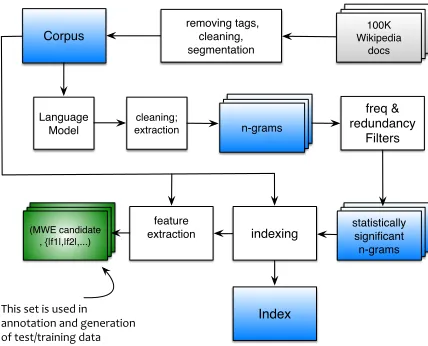
For the set of significant n-grams a set of statis-tical features are extracted which will be described shortly. Fig. 1 illustrates the workflow of the sys-tem.
removing tags, cleaning, segmentation
Language Model
100K Wikipedia
docs
Corpus
cleaning;
extraction n-grams
freq & redundancy
Filters
statistically significant n-grams
indexing
[image:3.612.90.304.175.348.2]Index (MWE candidate
, {|f1|,|f2|,...)
feature extraction
This%set%is%used%in% annotation%and%generation% of%test/training%data%
Figure 1: Schematic of pre-processing, n-gram ex-traction and filtering. Blended and plain nodes represent resources, and operations respectively.
While studying the English corpus and different MWEs therein, it was observed that often, MWEs (as well as some other types of syntactic units) are followed, preceded or surrounded by a lim-ited number of high frequency significant n-gram types. Moreover, our manual evaluation and con-stituency tests reveal that generally when a fre-quent significant prefix co-occurs with a frefre-quent significant suffix, they form a circumfix whose sig-nificant infixes are (i) many, (ii) can mostly be con-sidered syntactic unit, specifically when it comes to bi/trigrams. Table 2 illustrates a randomly se-lected sample of infixes of such circumfix (the..of). Remarkably, the majority of them are idiomatic at least at one level.
franz liszt academy official list most important albums closest relatives ministry of commerce protestant church executive vice president peak period famous italian architect manhattan school blessed virgin mary rise and fall world cup winner former head
Table 2: Examples of bi/trigrams surrounded by the circumfixthe..of
The immediate proximity of these particular con-text features to MWEs keeps emerging while eval-uating similar circumfixes. We believe it sug-gests the presence of a discriminant attribute that we model with features 5-8 (see Table 3) and learn using a supervised model. Nevertheless, the fact that MWEs share these features with other types of syntactic units encourages introduc-ing more MWE-specific features (namely, MWE’s frequency, the frequency of its components, and their associations), then enforcing the learning model to recognize a MWE based on the combi-nation of these two types of features. Note that the association between the type frequency of a MWE, and the frequency of its components is im-plicitly learned by the supervised model through-out the learning phase. A candidate MWE can be represented as:
y= (x1, ..., xm, xm+1, ..., xn)∈N0 (1)
Where x1, ..., xm are contextual, and
xm+1, ..., xn are specific features (m = 8,
and n = 11). These features are described in Table 3.
contextual features
x1 # set of all possible prefixes ofy
x2 # set of distinct prefixes ofy
x3 # set of all possible suffixes ofy
x4 # set of distinct suffixes ofy
x5 # set of all possible circumfixes ofy
x6 # set of distinct circumfixes ofy(C)
x7 # set of all possible infixes to members ofC
x8 # set of distinct infixes to members ofC
specific features
x9 the size ofy
x10 number of occurrences ofyin the corpus
x11 list of frequencies of the components ofy
A prefix ofyis the longest n-gram immediately beforey, if any or the boundary marker #, other-wise. A suffix of yis the longest n-gram imme-diately aftery, if any or the boundary marker #, otherwise. A circumfix (ci ∈ C) ofy is the pair
(p, s)wherepandsare respectively the prefix and the suffix of a given occurrence ofy. An Infix of
ciis an n-gram that occurs betweenpands.
Components to generate candidate MWEs, fil-ter them and extract their relevant features were very memory and CPU intensive. To address the performance issues we implemented parallel pro-grams and ran them on a high performance cluster. 3 Experimental Results
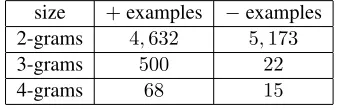
A set of ≈ 10K negative and positive English MWE examples were annotated. This set does not particularly belong in any specific genre, as the examples were chosen randomly from across a general-purpose corpus. This set comprises an equal number of positive and negative annotations. Part of it was annotated manually at UNDL foun-dation,2and part of it was acquired from the man-ually examined MWE lexicon presented in (Ner-ima et al., 2003). The set of positive and negative annotated n-grams is detailed in Table 4. The bias toward bigrams is due to the fact that the majority of manually verified MWEs that could be obtained are bigrams.
size +examples −examples 2-grams 4,632 5,173
3-grams 500 22
[image:4.612.315.527.71.148.2]4-grams 68 15
Table 4: Annotations’ statistics
This set was divided into1/3test and 2/3 train-ing data, which were selected randomly but were evenly distributed with respect to positive and neg-ative examples. The test set remains completely unseen to the model during the learning phase. We then train a linear SVM:
h(y) =w|y+b (2) Where h(y) is a discriminant hyperplane, w is the weight vector, andyis a set of MWE exam-ples, where each example is defined as: yj =
x1, ..., x11. Table 5 shows the results of the
model’s multiple runs on five different pairs of training and test sets.
2The Universal Networking Digital Language
Founda-tion:http://www.undlfoundation.org/
precision (%) recall (%) accuracy(%)
run 1 84.8 96.8 89.7
run 2 82.5 97.4 88.4
run 3 83.6 97.8 89.3
run 4 84.1 97.5 89.5
run 5 83.4 97.1 88.9
Table 5: Performance of the SVM which learns the MWEhood based on contextual and specific fea-tures (x1−x11)
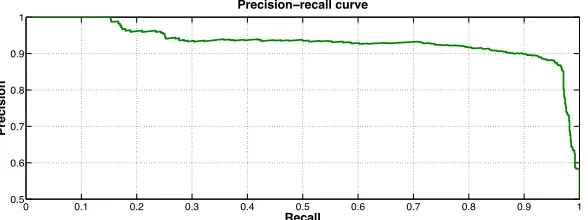
Table 6 illustrates the trained model’s predic-tions on a set of randomly selected test examples. The overall performance of the model is shown in the form of a precision-recall curve in Fig. 2.
n-grams classified as MWE
spend time genetically modified hijack a plane fish tank
top dog toy car
factory outlet motorcycle racing season nine vintage car video conference chestnut tree
kill your entry fee
safety precaution quantum leap version shown make an appeal flood damage drug dealer bargaining chip lung transplant
grant her tone like
postgraduate student make a phone call raise the price ozone layer
n-grams classified as non-MWE
score is and dartmouth
the tabular capped a
on sale clarified his
liver was the cancan
the regulating an ending
the rabi warns the
this manuscript a few an exponential an institution
the petal blades are
or ended difficulties he
and workmen the guidance
the eyelids the examined
the vices the episodes
[image:4.612.321.512.268.652.2]they work monument is
[image:4.612.113.282.432.487.2]0 0.1 0.2 0.3 0.4 0.5 0.6 0.7 0.8 0.9 1 0.5
0.6 0.7 0.8 0.9 1
Recall
Precision
[image:5.612.161.455.61.171.2]Precision−recall curve
Figure 2: Precision-recall curve
important features are the size of examples (x9),
and the frequencies of their components (x11).
The significance of x9 is due to the fact that in
the training set majority of MWEs are bigrams. Therefore, by the SVM, being a bigram is consid-ered as a substantial feature of MWEs. Neverthe-less since the number of negative and positive ex-amples which are bigrams are approximately the same, the bias towardx9in discriminating MWEs
from non-MWE balances out. However its as-sociation with other features which is implicitly learned still has an impact on discriminating these two classes. x7andx8are the next two important
features, as we expected. These two are the fea-tures whose magnitude suggests the presence or lack of contexts such as (the..of).
x1 x2 x3 x4 x5 x6 x7 x8 x9 x10 x11(avg rnk)
0 5 10 15 20
Features
[image:5.612.310.528.221.313.2]Ranks
Figure 3: Ranks of the features that represent their discriminant impact.
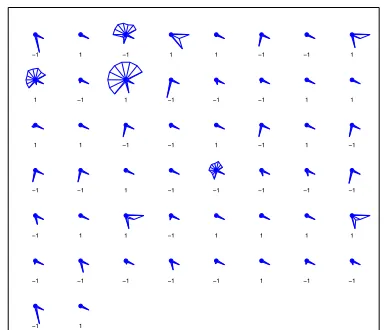
The class separability of MWE (1), and non-MWE (−1) examples can be seen in Fig. 4, where the bidimentional projection of the examples of two classes is visualized. A star plot of a sample of 50 manually annotated examples is shown in Fig. 5. In many cases, but not always, non-MWEs can be discriminated from MWEs, in this eleven dimensional visualization. Same pattern was ob-served in the visualization of 500 examples (which would be hard to demonstrate in the present pa-per’s scale).
0 0.1 0.2 0.3 0.4 0.5 0.6 0.7 0.8 0.9 1
−3
−2
−1 0 1 2 3x 10
6
t
f(t)
−1 1
Figure 4: Andrews curve for the training exam-ples. Bold line in the middle, and bold dotted line represent the median of MWE and non-MWE classes respectively.
4 Conclusions and Future Work
[image:5.612.92.306.431.521.2]−1 1 −1 1 1 −1 −1 1
1 −1 1 −1 −1 −1 1 1
1 1 −1 −1 1 −1 1 −1
−1 −1 1 −1 −1 −1 −1 −1
−1 1 1 −1 1 1 1 1
−1 −1 −1 −1 −1 1 −1 −1
[image:6.612.101.295.59.224.2]−1 1
Figure 5: Star plot of 50 MWE (1), and non-MWE (−1) examples
References
Otavio Acosta, Aline Villavicencio, and Viviane Mor-eira. 2011. Identification and treatment of multi-word expressions applied to information retrieval. Kordoni et al, pages 101–109.
Timothy Baldwin and Su Nam Kim. 2010. Multiword expressions. Handbook of Natural Language Pro-cessing, second edition. Morgan and Claypool. Timothy Baldwin and Aline Villavicencio. 2002.
Ex-tracting the unextractable: A case study on verb-particles. Inproceedings of the 6th conference on Natural language learning-Volume 20, pages 1–7. Association for Computational Linguistics. Timothy Baldwin. 2005. Deep lexical acquisition of
verb–particle constructions. Computer Speech & Language, 19(4):398–414.
Nicoletta Calzolari, Charles J Fillmore, Ralph Gr-ishman, Nancy Ide, Alessandro Lenci, Catherine MacLeod, and Antonio Zampolli. 2002. Towards best practice for multiword expressions in computa-tional lexicons. InLREC.
Helena de Medeiros Caseli, Carlos Ramisch, Maria das Grac¸as Volpe Nunes, and Aline Villavicencio. 2010. Alignment-based extraction of multiword expres-sions. Language resources and evaluation, 44(1-2):59–77.
Ga¨el Dias. 2003. Multiword unit hybrid extrac-tion. In Proceedings of the ACL 2003 workshop on Multiword expressions: analysis, acquisition and treatment-Volume 18, pages 41–48. Association for Computational Linguistics.
Jianyong Duan, Mei Zhang, Lijing Tong, and Feng Guo. 2009. A hybrid approach to improve bilin-gual multiword expression extraction. InAdvances in Knowledge Discovery and Data Mining, pages 541–547. Springer.
Stefan Evert. 2005. The statistics of word cooccur-rences. Ph.D. thesis, Dissertation, Stuttgart Univer-sity.
Jean-Philippe Goldman, Luka Nerima, and Eric Wehrli. 2001. Collocation extraction using a syn-tactic parser. InProceedings of the ACL Workshop on Collocations, pages 61–66.
David A Hull and Gregory Grefenstette. 1996. Query-ing across languages: a dictionary-based approach to multilingual information retrieval. In Proceed-ings of the 19th annual international ACM SIGIR conference on Research and development in infor-mation retrieval, pages 49–57. ACM.
Ray Jackendoff. 1997. The architecture of the lan-guage faculty. Number 28. MIT Press.
Christian Jacquemin, Judith L Klavans, and Evelyne Tzoukermann. 1997. Expansion of multi-word terms for indexing and retrieval using morphology and syntax. InProceedings of the eighth conference on European chapter of the Association for Com-putational Linguistics, pages 24–31. Association for Computational Linguistics.
Mirella Lapata and Alex Lascarides. 2003. Detect-ing novel compounds: The role of distributional ev-idence. InProceedings of the tenth conference on European chapter of the Association for Computa-tional Linguistics-Volume 1, pages 235–242. Asso-ciation for Computational Linguistics.
Wei Li, Xiuhong Zhang, Cheng Niu, Yuankai Jiang, and Rohini Srihari. 2003. An expert lexicon ap-proach to identifying english phrasal verbs. In Pro-ceedings of the 41st Annual Meeting on Associa-tion for ComputaAssocia-tional Linguistics-Volume 1, pages 513–520. Association for Computational Linguis-tics.
Diana McCarthy, Bill Keller, and John Carroll. 2003. Detecting a continuum of compositionality in phrasal verbs. InProceedings of the ACL 2003 workshop on Multiword expressions: analysis, ac-quisition and treatment-Volume 18, pages 73–80. Association for Computational Linguistics. Archibald Michiels and Nicolas Dufour. 1998. Defi,
a tool for automatic multi-word unit recognition, meaning assignment and translation selection. In Proceedings of the first international conference on language resources & evaluation, pages 1179–1186. Begona Villada Moir´on and J¨org Tiedemann. 2006. Identifying idiomatic expressions using automatic word-alignment. InProceedings of the EACL 2006 Workshop on Multi-wordexpressions in a multilin-gual context, pages 33–40.
Luka Nerima, Violeta Seretan, and Eric Wehrli. 2003. Creating a multilingual collocation dictionary from large text corpora. InProceedings of the tenth con-ference on European chapter of the Association for Computational Linguistics-Volume 2, pages 131– 134. Association for Computational Linguistics. Darren Pearce. 2001. Synonymy in collocation
ex-traction. InProceedings of the Workshop on Word-Net and Other Lexical Resources, Second meeting of the North American Chapter of the Association for Computational Linguistics, pages 41–46. Citeseer. Pavel Pecina. 2010. Lexical association measures
and collocation extraction.Language resources and evaluation, 44(1-2):137–158.
Scott Songlin Piao and Tony McEnery. 2001. Multi-word unit alignment in english-chinese parallel cor-pora. Inthe Proceedings of the Corpus Linguistics 2001, pages 466–475.
Scott SL Piao, Paul Rayson, Dawn Archer, Andrew Wilson, and Tony McEnery. 2003. Extracting mul-tiword expressions with a semantic tagger. In Pro-ceedings of the ACL 2003 workshop on Multiword expressions: analysis, acquisition and treatment-Volume 18, pages 49–56. Association for Computa-tional Linguistics.
Elias Ponvert, Jason Baldridge, and Katrin Erk. 2011. Simple unsupervised grammar induction from raw text with cascaded finite state models. InACL, pages 1077–1086.
Carlos Ramisch. 2012. A generic framework for mul-tiword expressions treatment: from acquisition to applications. In Proceedings of ACL 2012 Student Research Workshop, pages 61–66. Association for Computational Linguistics.
Lev Ratinov and Dan Roth. 2009. Design challenges and misconceptions in named entity recognition. In Proceedings of the Thirteenth Conference on Com-putational Natural Language Learning, pages 147– 155. Association for Computational Linguistics. Zhixiang Ren, Yajuan L¨u, Jie Cao, Qun Liu, and Yun
Huang. 2009. Improving statistical machine trans-lation using domain bilingual multiword expres-sions. InProceedings of the Workshop on Multiword Expressions: Identification, Interpretation, Disam-biguation and Applications, pages 47–54. Associa-tion for ComputaAssocia-tional Linguistics.
Ivan A Sag, Timothy Baldwin, Francis Bond, Ann Copestake, and Dan Flickinger. 2002. Multiword expressions: A pain in the neck for NLP. In Compu-tational Linguistics and Intelligent Text Processing, pages 1–15. Springer.
Violeta Seretan and Eric Wehrli. 2006. Accurate col-location extraction using a multilingual parser. In Proceedings of the 21st International Conference on Computational Linguistics and the 44th annual
meeting of the Association for Computational Lin-guistics, pages 953–960. Association for Computa-tional Linguistics.
Violeta Seretan. 2011. Syntax-based collocation ex-traction, volume 44. Springer.
Frank Smadja, Kathleen R McKeown, and Vasileios Hatzivassiloglou. 1996. Translating collocations for bilingual lexicons: A statistical approach. Compu-tational linguistics, 22(1):1–38.
Frank Smadja. 1993. Retrieving collocations from text: Xtract. Computational linguistics, 19(1):143– 177.
Tim Van de Cruys and Begona Villada Moir´on. 2007. Semantics-based multiword expression extraction. InProceedings of the Workshop on a Broader Per-spective on Multiword Expressions, pages 25–32. Association for Computational Linguistics. Dominic Widdows and Beate Dorow. 2005. Automatic
extraction of idioms using graph analysis and asym-metric lexicosyntactic patterns. InProceedings of the ACL-SIGLEX Workshop on Deep Lexical Acqui-sition, pages 48–56. Association for Computational Linguistics.