Evaluating Distant Supervision for Subjectivity and Sentiment Analysis
on Arabic Twitter Feeds
Eshrag Refaee and Verena Rieser
Interaction Lab, School of Mathematical and Computer Sciences, Heriot-Watt University,
EH14 4AS Edinburgh, United Kingdom.
[email protected],[email protected]
Abstract
Supervised machine learning methods for automatic subjectivity and sentiment anal-ysis (SSA) are problematic when applied to social media, such as Twitter, since they do not generalise well to unseen topics. A possible remedy of this problem is to ap-ply distant supervision (DS) approaches, which learn from large amounts of auto-matically annotated data. This research empirically evaluates the performance of DS approaches for SSA on Arabic Twitter feeds. Results for emoticon- and lexicon-based DS show a significant performance gain over a fully supervised baseline, es-pecially for detecting subjectivity, where we achieve 95.19% accuracy, which is a 48.47% absolute improvement over previ-ous fully supervised results.
1 Introduction
Subjectivity and sentiment analysis (SSA) aims to determine the attitude of an author with respect to some topic, e.g. objective or subjective, or the overall contextual polarity of an utterance, e.g. positive or negative. Previous work on automatic SSA has used manually annotated gold standard data sets to analyse which feature sets and mod-els perform best for this task, e.g. (Wilson et al., 2009; Wiebe et al., 1999). Most of this work is in English, but there have been first attempts to apply similar techniques to Arabic, e.g. (Abdul-Mageed et al., 2011; Mourad and Darwish, 2013). While these models work well when tested using cross-validation on limited static data sets, our previ-ous results reveal that these models do not gen-eralise to new data sets, e.g. collected at a later point in time, due to their limited coverage (Refaee and Rieser, 2014). While there is a growing inter-est within the NLP community in building Arabic corpora by harvesting the web, e.g. (Al-Sabbagh
and Girju, 2012; Abdul-Mageed and Diab, 2012; Zaidan and Callison-Burch, 2013), these resources have not been publicly released yet and only small amounts of these data-sets are (manually) anno-tated. We therefore turn to an approach known as distant supervision (DS), as first proposed by (Read, 2005), which uses readily available fea-tures, such as emoticons, as noisy labels in or-der to efficiently annotate large amounts of data for learning domain-independent models. This ap-proach has been shown to be successful for En-glish SSA, e.g. (Go et al., 2009), and SSA for under-resourced languages, such as Chinese (Yuan and Purver, 2012).
The contributions of this paper are as follows: we first collect two large corpora using emoticons and lexicon-based features as noisy labels, which we plan to release as part of this submission. Sec-ond, this work is the first to apply and empirically evaluate DS approaches on Arabic Twitter feeds. We find that DS significantly outperforms fully su-pervised SSA on our held-out test set. However, compared to a majority baseline, predicting nega-tive sentiment proves to be difficult using DS ap-proaches. Third, we conduct an error analysis to critically evaluate the results and give recommen-dations for future directions.
2 Arabic Twitter SSA Corpora
We start by collecting three corpora at different times over one year to account for the cyclic ef-fects of topic change in social media (Eisenstein, 2013). Table 1 shows the distributions of labels in our data-sets:
1. A gold standard data-set which we use for training and evaluation (spring 2013); 2. A data-set for DS using emoticon-based
queries (autumn 2013);
3. Another data-set for DS using a lexicon-based approach (winter 2014).
Data set Neutral Polar Positive Negative Total Gold standard training 1,157 937 470 467 3,031 Emoticon-based training 55,076 62,466 32,842 33,629 184,013 Lexicon-based training 55,076 55,538 18,442 5,013 134,069 Manually labelled test 422 579 278 301 1,580
Table 1: Sentiment label distribution of the gold standard manually annotated and distant supervision data sets.
Gold Standard Data-set: We harvest two gold standard data sets at different time steps, which we label manually. We first harvest a data set of 3,031 multi-dialectal Arabic tweets randomly re-trieved over the period from February to March 2013. We use this set as a training set for our fully supervised approach. We also manually label 1,580 tweets collected in autumn 2013, which we use as an independent held-out test set. Two na-tive speakers were recruited to manually annotate the collected data for subjectivity and sentiment, where we define sentiment as a positive or nega-tive emotion, opinion or attitude, following (Wil-son et al., 2009). Our gold standard annotations reached a weightedκ= 0.76, which indicates re-liable annotations (Carletta, 1996). We also auto-matically annotate the corpus with a rich set of lin-guistically motivated features using freely avail-able processing tools for Arabic, such as MADA (Nizar Habash and Roth, 2009), see Table 2. For more details on gold standard corpus annotation please see (Refaee and Rieser, 2014).1
Type Feature-sets
Morphological diacritic, aspect, gender, mood, per-son, part of speech (POS), state, voice, has morphological analysis.
Syntactic n-grams of words and POS, lem-mas, including bag of words (BOW), bag of lemmas.
Semantic has positive lexicon, has negative lexicon,
has neutral lexicon, has negator, has positive emoticon,
has negative emoticon.
Table 2: Annotated Feature-sets
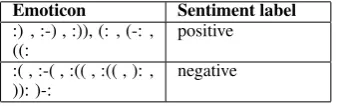
Emoticon-Based Queries: In order to investi-gate DS approaches to SSA, we also collect a much larger data set of Arabic tweets, where we use emoticons as noisy labels, following e.g. (Read, 2005; Go et al., 2009; Pak and Paroubek, 2010; Yuan and Purver, 2012; Suttles and Ide, 2013). We query Twitter API for tweets with vari-ations of positive and negative emoticons to ob-tain pairs of micro-blog texts (statuses) and using
Emoticon Sentiment label
:) , :-) , :)), (: , (-: ,
((: positive
:( , :-( , :(( , :(( , ): ,
[image:2.595.307.476.172.225.2])): )-: negative
Table 3: Emoticons used to automatically label the training data-set.
emoticons as author-provided emotion labels. In following (Purver and Battersby, 2012; Zhang et al., 2011; Suttles and Ide, 2013), we also utilise some sentiment-bearing hash tags to query emo-tional tweets, e.g.
hQ ¯
happiness andà Q k
sadness. Note that emoticons and hash-tags are merely used to collect and build the training set and were replaced by the standard (positive/ neg-ative) labels. In order to collect neutral instances, we query a set of official news accounts, following an approach by (Pak and Paroubek, 2010). Exam-ples of the accounts queried are: BBC-Arabic, Al-Jazeera Arabic, SkyNews Arabia, Reuters Arabic, France24-Arabic, and DW Arabic. We then au-tomatically extract the same set of linguistically motivated features as for the gold standard corpus.Lexicon-Based Annotation: We also inves-tigate an alternative approach to DS, which combines rule-driven lexicon-based SSA, e.g. (Taboada et al., 2011), with machine learning ap-proaches, following (Zhang et al., 2011). We build a new training dataset by combining three lexica. We first exploit two existing ity lexica: a manually annotated Arabic subjectiv-ity lexicon (Abdul-Mageed and Diab, 2012) and a publicly available English subjectivity lexicon, MPQA (Wilson et al., 2009), which we automati-cally translate using Google Translate, following a
1This GS data-set has been shared via
[image:2.595.71.293.476.598.2]similar technique to (Mourad and Darwish, 2013). The translated lexicon is manually corrected by re-moving translations with neutral or no clear senti-ment indicator.2 This results in 2,627 translated in-stances after correction. We then construct a third dialectal lexicon of 484 words that we extracted from an independent Twitter development set and manually annotated for sentiment. All lexicons were merged into a combined lexicon of 4,422 an-notated sentiment words (duplicates removed). In order to obtain automatic labels for positive and negative instances, we follow a simplified version of the rule-based aggregation approach of Taboada et al. (2011). First, all lexicons and tweets are lem-matised. For each tweet, matched sentiment words are marked with either (+1) or (-1) to incorporate the semantic orientation of individual constituents. This achieves a coverage level of 76.62% (which is computed as a percentage of tweets with at least one lexicon word) using the combined lexicon. The identified sentiment words are replaced by place-holders to avoid bias. To account for nega-tion, we reverse the polarity (switch negation) fol-lowing (Taboada et al., 2011). The sentiment ori-entation of the entire tweet is then computed by summing up the sentiment scores of all sentiment words in a given tweet into a single score that au-tomatically determines the label as being: positive or negative. Instances where the score equals zero are excluded from the training set as they represent mixed-sentiment instances with an even number of sentiment words. We validate this lexicon-based labelling approach against a separate development set by comparing the automatically computed la-bels against manually annotated ones, reaching an accuracy of 69.06%.
3 Classification Experiments Using Distant Supervision
We experiment with a number of machine learn-ing methods and we report the results of the best performing scheme, namely Support Vector Ma-chines (SVMs), where we use the implementation provided by WEKA (Witten and Frank, 2005). We report the results on two metrics: F-score and ac-curacy. We use paired t-tests to establish signifi-cant differences (p < .05). We experiment with different feature sets and report on the best results (Bag-of-Words (BOW) + morphological +
seman-2For instance,the day of judgementis assigned with a
neg-ative label while its Arabic translation is neutral considering the context-independent polarity.
tic). We compare our results against a majority baseline and against a fully supervised approach. It is important to mention the most prominent pre-vious work on SSA of Arabic tweets like (Abdul-Mageed et al., 2012) who trained SVM classifiers on a nearly 3K manually labelled data-set to curry out two-stage binary classification attaining accu-racy up to 65.87% for the sentiment classification task. In a later work, (Mourad and Darwish, 2013) employ SVM and Naive Bayes classifiers trained on a set of 2,300 manually labelled Arabic tweets. With 10-fold cross-validation settings, the author reported an accuracy score of 72.5% for the senti-ment classification task (positive vs. negative).
We evaluate the approaches on a separate held-out test-set that is collected at a later point in time, as described in Section 2.
3.1 Emoticon-Based Distant Supervision
We first evaluate the potential of exploiting train-ing data that is automatically labelled ustrain-ing emoti-cons. The results are summarised in Table 4.
Polar vs. neutral: The results show a signifi-cant improvement over the majority baseline, as well as over the classifier trained on the gold stan-dard data set: We achieve 95.19% accuracy on the held-out set, which is a 48.47% absolute im-provement over our previous fully supervised re-sults. We attribute this improvement to two fac-tors. First, the emoticon-based data set is about 60 times bigger than the gold standard data set (see Table 1) and thus the emoticon-based model better generalises to unseen events. Note that this perfor-mance is comparable with (Suttles and Ide, 2013) who achieved up to 98% accuracy using emoticon-based DS on English tweets using 5.9 million tweets. Second, neutral instances were sampled from news accounts, which are mainly written in modern standard Arabic (MSA), whereas we as-sume that tweets including emoticons (which we use for acquiring polar instances) are mainly writ-ten in dialectal Arabic (DA). In future work, we plan to investigate this hypothesis further by au-tomatically detecting MSA/DA for a given tweet, e.g. (Zaidan and Callison-Burch, 2013). Abdul-Mageed et al. (2012) show that having such a fea-ture can result in no significant impact on the over-all performance of both subjectivity and sentiment analysis tasks.
Data-set majority
baseline fullyvised super- emoticon DS lexicon-presence lexicon-aggr.
F Acc. F Acc. F Acc. F Acc. F Acc.
[image:4.595.74.527.62.117.2]polar vs. neutral 0.69 53.0 0.43 46.62 0.95 95.19 0.95 95.09 0.91 91.09 positive vs. negative 0.67 50.89 0.41 49.65 0.51 51.25 0.53 57.06 0.52 52.98
Table 4: 2-level and single-level SSA classification using distant supervision (DS).
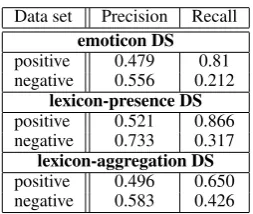
[image:4.595.308.525.298.463.2]significantly better that the fully supervised base-line, but nevertheless worse than a simple majority baseline. These results are much lower than previ-ous results on emoticon-based sentiment analysis on English tweets by (Go et al., 2009; Bifet and Frank, 2010) which both achieved around 83% ac-curacy. The confusion matrix shows that mostly negative instances are misclassified as positive, with a very low recall on negative instances, see Table 5. Next, we investigate possible reasons in a detailed error analysis.
Data set Precision Recall emoticon DS positive 0.479 0.81 negative 0.556 0.212
lexicon-presence DS positive 0.521 0.866 negative 0.733 0.317
lexicon-aggregation DS positive 0.496 0.650 negative 0.583 0.426
Table 5: Recall and precision for Sentiment Anal-ysis
3.1.1 Error Analysis for Emoticon-Based DS
In particular, we investigate the use of sarcasm and the direction emoticons face in right-to-left alpha-bets.
Use of sarcasm and irony: Using an emoticon as a label is naturally noisy, since we cannot know for sure the intended meaning the author wishes to express. This is especially problematic when emoticons are used in a sarcastic way, i.e. their intended meaning is the opposite of the expressed emotion. An example from our data set is:
(1)
): úÎë@ AK ÉJÔg.
great job Ahli :( — refer-ring to a famous football team.Research in psychology shows that up to 31% of the time, emoticons are used sarcastically (Wolf, 2000). In order to investigate this hypothesis we manually labelled a random sample of 303 misclassified instances for neutral, positive, nega-tive, as well as sarcastic, mixed and unclear sen-timents, see Table 6. Interestingly, the
sarcas-tic instances represent only 4.29%, while tweets with mixed (positive and negative) sentiments rep-resent 5.94% of the manually annotated sub-set. In 34.32% of the instances, the manual labels have matched the automatic emoticon-based bels. Surprisingly, automatic emoticon-based la-bel contrasts the manual lala-bels in 36.63% of the instances. Instances labelled as neutral represent 4.95%. The rest of the instances were assigned ‘unclear sentiment orientation’.
Emoticon
Label Predictedlabel Manual label #stances
in-Positive Negative Mixed 8
Negative Positive Mixed 10
Positive Negative Negative 59 Negative Positive Negative 42 Positive Negative Neutral 29 Negative Positive Neutral 7 Positive Negative Positive 62 Negative Positive Positive 52 Positive Negative Sarcastic 8 Negative Positive Sarcastic 5 Positive Negative Unclear
senti-ment indicator 19 Negative Positive Unclear
senti-ment indicator 2
Table 6: Results of labelling sarcasm, mixed emo-tions and unclear sentiment for misclassified in-stances.
Facing of emoticons: We therefore investigate another possible error source following (Mourad and Darwish, 2013), who claim that the right-to-left alphabetic writing of Arabic might result in emoticons being mistakenly interchanged while typing. On some Arabic keyboards, typing “ )” will produce the opposite “ (” parentheses. The following example (2) illustrates a case of a mis-classified instance, where we assume that the fac-ing of emoticons might have been interchanged or mistyped.
(2)
(: ÉÓ@ ú ¯AÓ C
g
no hope anymore :)3.2 Lexicon-Based Distant Supervision
[image:4.595.118.245.311.418.2]utilise the adjectives in our sentiment lexicon as noisy labels. We experiment with two different settings for the lexicon-based DS approach. First, we experiment with a lexicon-presence approach that automatically labels a tweet as a positive in-stance if it only includes positive lexicon(s) and the same for the negative class. Data instances having mixed positive and negative lexicons or no sentiment lexicons are excluded from the training set. The second approach is based on assigning a numerical value to sentiment words and aggre-gating the value into a single score, see Section 2. The results are summarised in Table 4.
Polar vs. neutral: We can observe that the mod-els trained with the lexicon-presence approach sig-nificantly outperform the majority baseline, the fully supervised learning, as well as the lexicon-aggregation approach. The lexicon-presence and the emoticon-based DS approaches reach almost identical performance on our test set.
Positive vs. negative: Again, we observe that it is difficult to discriminate negative instances for both based approaches. The lexicon-presence approach significantly outperforms the majority baseline, the fully supervised learn-ing, and the lexicon-aggregation approach. But this time it also significantly outperforms the emotibased approach, which allows us to con-clude that lexicon-based labelling introduces less noise for sentiment analysis. However, our re-sults are significantly worse than the lexicon-based approach of Taboada et al. (2011), with up to 80% accuracy, and the learning-based approach of Zhanh et al. (2011), with up to 85% accu-racy on English tweets. The lexicon-presence ap-proach achieves the highest precision for negative tweets, see table 5, but still has a low recall. The lexicon-aggregation approach has the highest re-call for negative tweets, but its precision is almost identical to the emoticon-based approach.
3.2.1 Error Analysis for Lexicon-Based DS
We conduct an error analysis in order to fur-ther investigate the difference in performance between the presence and the lexicon-aggregation approach. We hypothesise that the lexicon-aggregation might perform better on in-stances with mixed emotions, i.e. tweets with positive and negative indicators, but a clear over-all sentiment. We therefore manuover-ally add 36 in-stances to the test set which contain mixed emo-tions (but a unique sentiment label). However, the
results on the new test set confirm the superiority of the lexicon-presence approach. In general, both lexicon-based approaches perform worse for sen-timent classification. Taboada et al. (2011) high-light the issue of “positive bias” associated with lexicon-based approaches of sentiment analysis, as people tend to prefer using positive expressions and understate negative ones.
4 Conclusion and Future Work
We address the task of subjectivity and sentiment analysis (SSA) for Arabic Twitter feeds. We em-pirically investigate the performance of distant su-pervision (DS) approaches on a manually labelled independent test set, in comparison to a fully su-pervised baseline, trained on a manually labelled gold standard data set. Our experiments reveal:
(1) DS approaches to SSA for Arabic Twitter feeds show significantly higher performance in ac-curacy and F-score than a fully supervised ap-proach. Despite providing noisy labels, they allow larger amounts of data to be rapidly annotated, and thus, can account for the topic shifts observed in social media.
(2) DS approaches which use a subjectivity lex-icon for labelling outperform approaches using emoticon-based labels for sentiment analysis, but achieve a very similar performance for subjectiv-ity detection. We hypothesise that this can be at-tributed to unclear facings of the emoticons.
References
Muhammad Abdul-Mageed and Mona Diab. 2012. AWATIF: A multi-genre corpus for modern standard Arabic subjectivity and sentiment analysis. In Pro-ceedings of the Eight International Conference on Language Resources and Evaluation (LREC’12), Is-tanbul, Turkey. European Language Resources As-sociation (ELRA).
Muhammad Abdul-Mageed, Mona T. Diab, and Mo-hammed Korayem. 2011. Subjectivity and
senti-ment analysis of modern standard Arabic. In
Pro-ceedings of the 49th Annual Meeting of the Associ-ation for ComputAssoci-ational Linguistics: Human Lan-guage Technologies: short papers - Volume 2, HLT ’11, pages 587–591, Stroudsburg, PA, USA. Associ-ation for ComputAssoci-ational Linguistics.
Muhammad Abdul-Mageed, Sandra Kuebler, and Mona Diab. 2012. SAMAR: A system for subjec-tivity and sentiment analysis of Arabic social
me-dia. In Proceedings of the 3rd Workshop in
Com-putational Approaches to Subjectivity and Sentiment Analysis, pages 19–28. Association for Computa-tional Linguistics.
Rania Al-Sabbagh and Roxana Girju. 2012. YADAC:
Yet another dialectal Arabic corpus. In
Proceed-ings of the Eight International Conference on Lan-guage Resources and Evaluation (LREC’12), Istan-bul, Turkey. European Language Resources Associ-ation (ELRA).
Albert Bifet and Eibe Frank. 2010. Sentiment knowl-edge discovery in twitter streaming data. In Discov-ery Science, pages 1–15. Springer.
J. Carletta. 1996. Assessing agreement on classifica-tion tasks: the kappa statistic. Computational Lin-guistics, 22(2):249–254.
Jacob Eisenstein. 2013. What to do about bad
lan-guage on the internet. In Proceedings of
NAACL-HLT, pages 359–369.
Alec Go, Richa Bhayani, and Lei Huang. 2009. Twit-ter sentiment classification using distant supervision.
CS224N Project Report, Stanford, pages 1–12. Lichan Hong, Gregorio Convertino, and Ed H Chi.
2011. Language matters in twitter: A large scale
study. InICWSM.
Ahmed Mourad and Kareem Darwish. 2013. Sub-jectivity and sentiment analysis of modern
stan-dard Arabic and Arabic microblogs. WASSA 2013,
page 55.
Owen Rambow Nizar Habash and Ryan Roth. 2009. MADA+TOKAN: A toolkit for Arabic tokenization, diacritization, morphological disambiguation, pos tagging, stemming and lemmatization. In Khalid
Choukri and Bente Maegaard, editors,Proceedings
of the Second International Conference on Arabic Language Resources and Tools, Cairo, Egypt, April. The MEDAR Consortium.
A. Pak and P. Paroubek. 2010. Twitter as a corpus for
sentiment analysis and opinion mining. In
Proceed-ings of LREC.
Matthew Purver and Stuart Battersby. 2012. Experi-menting with distant supervision for emotion
classi-fication. In Proceedings of the 13th Conference of
the European Chapter of the Association for Com-putational Linguistics (EACL), pages 482–491, Avi-gnon, France, April. Association for Computational Linguistics.
Jonathon Read. 2005. Using emoticons to reduce de-pendency in machine learning techniques for senti-ment classification. InProceedings of the ACL Stu-dent Research Workshop, pages 43–48. Association for Computational Linguistics.
Eshrag Refaee and Verena Rieser. 2014. An Arabic twitter corpus for subjectivity and sentiment
anal-ysis. In Proceedings of the Ninth International
Conference on Language Resources and Evalua-tion (LREC’14), Reykjavik, Iceland, may. European Language Resources Association (ELRA).
Asad Sayeed. 2013. An opinion about opinions about opinions: subjectivity and the aggregate reader. In
Proceedings of NAACL-HLT, pages 691–696. Jared Suttles and Nancy Ide. 2013. Distant
supervi-sion for emotion classification with discrete binary values. InComputational Linguistics and Intelligent Text Processing, pages 121–136. Springer.
Maite Taboada, Julian Brooke, Milan Tofiloski, Kim-berly Voll, and Manfred Stede. 2011.
Lexicon-based methods for sentiment analysis.
Computa-tional linguistics, 37(2):267–307.
Janyce M. Wiebe, Rebecca F. Bruce, and Thomas P. O’Hara. 1999. Development and use of a gold-standard data set for subjectivity classifications. In
Proceedings of the 37th annual meeting of the As-sociation for Computational Linguistics on Com-putational Linguistics, ACL ’99, pages 246–253, Stroudsburg, PA, USA. Association for Computa-tional Linguistics.
Theresa Wilson, Janyce Wiebe, and Paul Hoffmann. 2009. Recognizing contextual polarity: An explo-ration of features for phrase-level sentiment analy-sis.Computational Linguistics, 35(3):399–433.
Ian H Witten and Eibe Frank. 2005. Data Mining:
Practical machine learning tools and techniques. Morgan Kaufmann.
Alecia Wolf. 2000. Emotional expression online:
Gen-der differences in emoticon use. CyberPsychology
& Behavior, 3(5):827–833.
Zheng Yuan and Matthew Purver. 2012. Predicting emotion labels for chinese microblog texts. In Pro-ceedings of the 1st International Workshop on Senti-ment Discovery from Affective Data (SDAD), pages 40–47, Bristol, UK, September.
Omar F. Zaidan and Chris Callison-Burch. 2013.
Ara-bic dialect identification. Computational
Linguis-tics.
Ley Zhang, Riddhiman Ghosh, Mohamed Dekhil, Me-ichun Hsu, and Bing Liu. 2011. Combining lex-iconbased and learning-based methods for twitter
sentiment analysis. HP Laboratories, Technical