The Tel Aviv University System
for the Code-Switching Workshop Shared Task
Kfir Bar
School of Computer Science Tel Aviv University
Ramat Aviv, Israel [email protected]
Nachum Dershowitz School of Computer Science
Tel Aviv University Ramat Aviv, Israel [email protected]
Abstract
We describe our entry in the EMNLP 2014 code-switching shared task. Our system is based on a sequential classifier, trained on the shared training set using various character- and word-level features, some calculated using a large monolingual cor-pora. We participated in the Twitter-genre Spanish-English track, obtaining an accu-racy of 0.868 when measured on the tweet level and 0.858 on the word level.
1 Introduction
Code switching is the act of changing language while speaking or writing, as often done by bilin-guals (Winford, 2003). Identifying the transition points is a necessary first step before applying other linguistic algorithms, which usually target a single language. A switching point may occur be-tween sentences, phrases, words, or even bebe-tween certain morphological components. Code switch-ing happens frequently in informal ways of com-munication, such as verbal conversations, blogs and microblogs; however, there are many exam-ples in which languages are switched in formal settings. For example, alternating between Collo-quial Egyptian Arabic and Modern Standard Ara-bic in modern Egyptian prose is prevalent (Rosen-baum, 2000).
This shared task (Solorio et al., 2014),1the first of its kind, challenges participants with identify-ing those switchidentify-ing points in blogs as well as in microblog posts. Given posts with a mix of a specific pair of languages, each participating sys-tem is required to identify the language of ev-ery word. Four language-pair tracks were offered by the task organizers: Spanish-English, Nepali-English, Modern Standard Arabic and Colloquial
1http://emnlp2014.org/workshops/
CodeSwitch/call.html
Arabic, and Mandarin-English. For each language pair, a training set of Twitter2 statuses was pro-vided, which was manually annotated with a label for every word, indicating its language. In addi-tion to the two language labels, a few addiaddi-tional labels were used. Altogether there were six labels: (1) lang1—the first language; (2)lang2—the sec-ond language; (3) ne—named entity; (4) ambigu-ous—for ambiguous words belonging to both lan-guages; (5) mixed—for words composed of mor-phemes in each language; and (6)other—for cases where it is impossible to determine the language. For most of the language pairs, the organizers sup-plied three different evaluation sets. The first set was composed of a set of unseen Twitter statuses, provided with no manual annotation. The other two sets contained data from a “surprise genre”, mainly composed of blog posts.
We took part only in the Spanish-English track. Both English and Spanish are written in Latin script. The Spanish alphabet contains some addi-tional letters, such as those indicating stress (vow-els with acute accents: ´a, ´e, ´ı, ´o, ´u), a u adorned with a diaeresis (¨u), the additional letter ˜n (e˜ne), and inverted question and exclamation punctua-tion marks ¿ and ¡ (used at the beginning of ques-tions and exclamatory phrases, respectively). Al-though social-media users are not generally con-sistent in their use of accents, their appearance in a word may disclose its language. By and large, algorithms for code switching have used the character-based k-mer feature, introduced by (Cavnar and Trenkle, 1994).3
Our system is an implementation of a multi-class multi-classifier that works on the word level, con-sidering features that we calculate using large Spanish as well as English monolingual corpora. Working with a sequential classifier, the predicted
2http://www.twitter.com
3We propose the term “k-mer” for characterk-grams, in contradistinction to wordn-grams.
labels of the previous words are used as features in predicting the current word.
In Section 2, we describe our system and the features we use for classification. Section 3 con-tains the evaluation results, as published by the or-ganizers of this shared task. We conclude with a brief discussion.
2 System Description
We use a supervised framework to train a classifier that predicts the label of every word in the order written. The words were originally tokenized by the organizers, preserving punctuation, emoticons, user mentions (e.g., @emnlp2014), and hashtags (e.g., #emnlp2014) as individual tokens. The in-formal language, as used in social media, intro-duces an additional challenge in predicting the lan-guage of every word. Spelling mistakes as well as grammatical errors are very common. Hence, we believe that predicting the language of a given word merely using dictionaries for the two lan-guages is likely to be insufficient.
Our classifier is trained on a learning set, as pro-vided by the organizers, enriched with some addi-tional features. Every word in the order written is treated as a single instance for the classifier, each including features from a limited window of pre-ceding and successive words, enriched with the predicted label of some of the preceding words. We ran a few experiments with different window sizes, based on 10-fold cross validation, and found that the best token-level accuracy is obtained us-ing a window of size 2 for all features, that is, two words before the focus word and two words after.
The features that we use may be grouped in three main categories, as described next.
2.1 Features
We use three main groups of features:
Word level: The specific word in focus, as well
as the two previous words and the two following ones are considered as features. To reduce the sparsity, we convert words into lowercase. In ad-dition, we use a monolingual lexicon for English words that are typically used in Twitter. For this purpose, we employ a sample of the Twitter Gen-eral English lexicon, released by Illocution, Inc.,4 containing the top 10K words and bigrams from a relatively large corpus of public English tweets
4http://www.illocutioninc.com
they collected over a period of time, along with frequency information. We bin the frequency rates into 5 integer values (with an additional value for words that do not exist in the lexicon), which are used as the feature value for every word in focus, and for the other four words in its window. This feature seems to be quite noisy, as some common Spanish words appear in the lexicon (e.g.,de,no, a, me); on the other hand, it may capture typi-cal English misspellings and acronyms (e.g.,oomf, noww,lmao). We could not find a similar resource for Spanish, unfortunately.
To help identify named entities, we created a list of English as well Spanish names of various en-tity types (e.g., locations, family and given names) and used it to generate an additional boolean fea-ture, indicating whether the word in focus is an en-tity name. The list was compiled out of all words beginning with a capital letter in relatively large monolingual corpora, one for English and another for Spanish. To avoid words that were capitalized because they occur at the beginning of a sentence, regardless of whether they are proper names, we first processed the text with a true-casing tool, pro-vided as part of Moses (Koehn et al., 2007)— the open source implementation for phrase-based statistical machine translation. Our list contains about 146K entries.
Intra-word level: Spanish, as opposed to
indi-cating which of the two models returned a lower log probability.
Inter-word level: We capture the level of
un-certainty of seeing specific sequences of words in each language. We used 3-gram word-level lan-guage models, trained over large corpora in each of the languages. We apply the models to the fo-cus word, considering it to be the last in a sequence of three words (with the two previous words) and calculate log probabilities. Like before, we bin the values into ten discrete values, which are then used as the features’ values. An additional boolean fea-ture is used, indicating which of the two models returned a lower log probability.
2.2 Supervised Framework
We designed a sequential classifier running on top of the Weka platform (Frank et al., 2010) that is capable of processing instances sequentially, sim-ilar to YamCha (Kudo and Matsumoto, 2003). We use LibSVM (Chang and Lin, 2011), an im-plementation of Support Vector Machines (SVM) (Cortes and Vapnik, 1995), as the underlying tech-nology, with a degree 2 polynomial kernel. Since we work on a multi-class classification problem, we take the one-versus-one approach. As men-tioned above, we use features from a window of
±2words before and after the word of interest. In addition, for every word, we consider as features the predicted labels of the two prior words.
3 Evaluation Results
We report on the results obtained on the unseen task evaluation sets, which were provided by the workshop organizers.5 There are three evaluation sets. The first is composed of a set of unseen Twit-ter statuses and the other two contain data from a “surprise genre”. The results are available online at the time of writing only for the first and second sets. The results of the third set will be published during the upcoming workshop meeting.
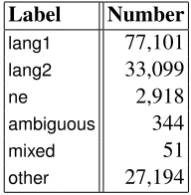
The training set contains 11,400 statuses, com-prising 140,706 words. Table 1 shows the distri-bution of labels.
The first evaluation set contains 3,060 tweets. However, we were asked to download the statuses directly from Twitter, and some of the statuses were missing. Therefore, we ended up with only 1,661 available statuses, corresponding to 17,723
5http://emnlp2014.org/workshops/
CodeSwitch/results.php
Label Number
lang1 77,101 lang2 33,099
ne 2,918
[image:3.595.368.464.62.160.2]ambiguous 344 mixed 51 other 27,194
Table 1: Label distribution in the training set.
Accuracy 0.868
Recall 0.720
Precision 0.803
F1-Score 0.759
Table 2: Results for the first evaluation set, mea-sured on tweet level.
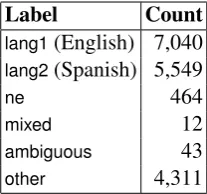
words. According to the organizers, the evaluation was performed only on the 1,626 tweets that were available for all the participating groups. Out of the 1,626, there are 1,155 monolingual tweets and 471 code-switched tweets. Table 2 shows the eval-uation results for the Tel Aviv University (TAU) system on the first set, reported on the tweet level. In addition, the organizers provide evaluation results, calculated on the word level. Table 3 shows the label distribution among the words in the first evaluation set, and Table 4 shows the ac-tual results. The overall accuracy on the word level is 0.858.
The second evaluation set contains 1,103 words of a “surprise” (unseen) genre, mainly blog posts. Out of the 49 posts, 27 are monolingual and 22 are code-switched posts. Table 5 shows the results for the surprise set, calculated on the post level.
As for the first set, Table 6 shows the distribu-tion of the labels among the words in the surprise set, and in Table 7 we present the results as mea-sured on the word level. The overall accuracy on the surprise set is 0.941.
4 Discussion
Label Count
lang1(English) 7,040 lang2(Spanish) 5,549
ne 464
mixed 12
[image:4.595.129.233.62.159.2]ambiguous 43 other 4,311
Table 3: Label distribution in the first evaluation set.
Label Recall Precision F1-Score
lang1(English) 0.900 0.830 0.864 lang2(Spanish) 0.869 0.914 0.891
ne 0.313 0.541 0.396
[image:4.595.365.468.169.267.2]mixed 0.000 1.000 0.000 ambiguous 0.023 0.200 0.042 other 0.845 0.860 0.853
Table 4: Results for the first evaluation set, mea-sured on word level.
their language; however, identifying named enti-ties did not work as well. We plan to further in-vestigate this issue. The results on the surprise genre are similar to that for the genre the system was trained on. However, since the surprise set is relatively small in size, we refrain from draw-ing conclusions about this. Trydraw-ing the same code-switching techniques on other pairs of languages is part of our planned future research.
References
William B. Cavnar and John M. Trenkle. 1994. N-gram-based text categorization. In Proceedings of the 3rd Annual Symposium on Document Analysis and Information Retrieval (SDAIR-94), pages 161– 175.
Chih C. Chang and Chih J. Lin. 2011. LIBSVM: A Library for Support Vector Machines. ACM Transactions on Intelligent Systems and Technology, 2(27):1–27, May.
Corinna Cortes and Vladimir Vapnik. 1995. Support-vector networks. Machine Learning, 20:273–297.
Eibe Frank, Mark Hall, Geoffrey Holmes, Richard Kirkby, Bernhard Pfahringer, Ian H. Witten, and Len Trigg. 2010. Weka—A machine learning work-bench for data mining. In Oded Maimon and Lior Rokach, editors,Data Mining and Knowledge Dis-covery Handbook, chapter 66, pages 1269–1277. Springer US, Boston, MA.
Accuracy 0.864
Recall 0.708
Precision 0.803
F1-Score 0.753
Table 5: Results for the second, “surprise” evalua-tion set, measured on the post level.
Label Count
lang1(English) 636 lang2(Spanish) 306
ne 38
mixed 1
[image:4.595.83.283.204.306.2]ambiguous 1 other 120
Table 6: Label distribution in the “surprise” eval-uation set.
Label Recall Precision F1-Score
lang1(English) 0.883 0.824 0.853 lang2(Spanish) 0.864 0.887 0.876
ne 0.293 0.537 0.379
mixed 0.000 1.000 0.000 ambiguous 0.022 0.200 0.039 other 0.824 0.843 0.833
Table 7: Results for the “surprise” evaluation set, measured on the word level.
Philipp Koehn, Hieu Hoang, Alexandra Birch, Chris Callison-Burch, Marcello Federico, Nicola Bertoldi, Brooke Cowan, Wade Shen, Christine Moran, Richard Zens, Chris Dyer, Ondˇrej Bojar, Alexandra Constantin, and Evan Herbst. 2007. Moses: Open source toolkit for statistical machine translation. In
Proceedings of the Interactive Poster and Demon-stration Sessions of the 45th Annual Meeting of the ACL (ACL ’07), pages 177–180, Stroudsburg, PA, USA. Association for Computational Linguistics.
Taku Kudo and Yuji Matsumoto. 2003. Fast methods for kernel-based text analysis. InProceedings of the 41st Annual Meeting of the Association for Compu-tational Linguistics (ACL), pages 24–31, Sapporo, Japan.
Gabriel M. Rosenbaum. 2000. Fushammiyya: Alter-nating style in Egyptian prose. Journal of Arabic Linguistics (ZAL), 38:68–87.
[image:4.595.316.517.313.412.2]on Computational Approaches to Code-Switching. EMNLP 2014, Conference on Empirical Methods in Natural Language Processing, Doha, Qatar. Donald Winford, 2003. Code Switching: Linguistic