Online Polylingual Topic Models for Fast Document Translation Detection
Kriste Krstovski
School of Computer Science University of Massachusetts Amherst
Amherst, MA, 01003
David A. Smith
School of Computer Science University of Massachusetts Amherst
Amherst, MA, 01003
Abstract
Many tasks in NLP and IR require ef-ficient document similarity computations. Beyond their common application to ex-ploratory data analysis, latent variable topic models have been used to represent text in a low-dimensional space, indepen-dent of vocabulary, where documents may be compared. This paper focuses on the task of searching a large multilingual col-lection for pairs of documents that are translations of each other. We present (1) efficient, online inference for repre-senting documents in several languages in a common topic space and (2) fast ap-proximations for finding near neighbors in the probability simplex. Empirical evalu-ations show that these methods are as ac-curate as—and significantly faster than— Gibbs sampling and brute-force all-pairs search.
1 Introduction
Statistical topic models, such as latent Dirich-let allocation (LDA) (Blei et al., 2003), have proven to be highly effective at discovering hid-den structure in document collections (Hall et al., 2008, e.g.). Often, these models facilitate ex-ploratory data analysis, by revealing which col-locations of terms are favored in different kinds of documents or which terms and topics rise and fall over time (Blei and Lafferty, 2006; Wang and McCallum, 2006). One of the greatest advan-tages in using topic models to analyze and process large document collections is their ability to rep-resent documents as probability distributions over a small number of topics, thereby mapping doc-uments into a low-dimensional latent space—the
T-dimensional probability simplex, whereTis the number of topics. A document, represented by some point in this simplex, is said to have a par-ticular “topic distribution”.
Representing documents as points in a low-dimensional shared latent space abstracts away from the specific words used in each document, thereby facilitating the analysis of relationships between documents written using different vocab-ularies. For instance, topic models have been used to identify scientific communities working on re-lated problems in different disciplines, e.g., work on cancer funded by multiple Institutes within the NIH (Talley et al., 2011). While vocabulary mis-match occurs within the realm of one language, naturally this mismatch occurs across different languages. Therefore, mapping documents in dif-ferent languages into a common latent topic space can be of great benefit when detecting document translation pairs (Mimno et al., 2009; Platt et al., 2010). Aside from the benefits that it offers in the task of detecting document translation pairs, topic models offer potential benefits to the task of creat-ing translation lexica, aligncreat-ing passages, etc.
The process of discovering relationship be-tween documents using topic models involves: (1) representing documents in the latent space by in-ferring their topic distributions and (2) comparing pairs of topic distributions to find close matches. Many widely used techniques do not scale ef-ficiently, however, as the size of the document collection grows. Posterior inference by Gibbs sampling, for instance, may make thousands of passes through the data. For the task of comparing topic distributions, recent work has also resorted to comparing all pairs of documents (Talley et al., 2011).
This paper presents efficient methods for both
of these steps and performs empirical evaluations on the task of detected translated document pairs embedded in a large multilingual corpus. Unlike some more exploratory applications of topic mod-els, translation detection is easy to evaluate. The need for bilingual training data in many language pairs and domains also makes it attractive to mit-igate the quadratic runtime of brute force transla-tion detectransla-tion. We begin in §2 by extending the online variational Bayes approach of Hoffman et al. (2010) to polylingual topic models (Mimno et al., 2009). Then, in §3, we build on prior work on efficient approximations to the nearest neighbor problem by presenting theoretical and empirical evidence for applicability to topic distributions in the probability simplex and in§4, we evaluate the combination of online variational Bayes and ap-proximate nearest neighbor methods on the trans-lation detection task.
2 Online Variational Bayes for Polylingual Topic Models
Hierarchical generative Bayesian models, such as topic models, have proven to be very effective for modeling document collections and discover-ing underlydiscover-ing latent semantic structures. Most current topic models are based on Latent Dirich-let Allocation (LDA) (Blei et al., 2003). In some early work on the subject, Blei and Jordan (2003) showed the usefulness of LDA on the task of auto-matic annotation of images. Hall et al. (2008) used LDA to analyze historical trends in the scientific literature; Wei and Croft (2006) showed improve-ments on an information retrieval task. More re-cently Eisenstein et al. (2010) modeled geographic linguistic variation using Twitter data.
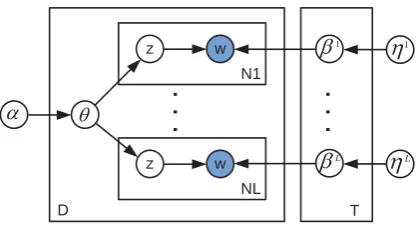
Aside from their widespread use on monolin-gual text, topic models have also been used to model multilingual data (Boyd-Graber and Blei, 2009; Platt et al., 2010; Jagarlamudi and Daum´e, 2010; Fukumasu et al., 2012), to name a few. In this paper, we focus on the Polylingual Topic Model, introduced by Mimno et al. (2009). Given a multilingual set of aligned documents, the PLTM assumes that across an aligned multilingual doc-ument tuple, there exists a single, tuple-specific, distribution across topics. In addition, PLTM as-sumes that for each language–topic pair, there ex-ists a distribution over words in that languageβl.
As such, PLTM assumes that the multilingual cor-pus is created through a generative process where
D T
T
...
D
w z
N1
w z
NL
...
1
E
L
E
1
K
L
[image:2.595.311.520.65.180.2]K
Figure 1: Polylingual topic model (PLTM)
first a document tuple is generated by drawing a tuple-specific distribution over topicsθ1which, as it is the case with LDA, is drawn from a Dirich-let priorθ∼Dir(α). For each of the languages lin the tuple and for each of the N words wnl in the document the generative process: first chooses a topic assignmentzln∼M ultinomial(θ)which is then followed by choosing a word wnl from a multinomial distribution conditioned on the topic assignment and the language specific topics distri-bution over wordsβl∼Dir(ηl). Bothαandη1,...,L
are symmetric priors, i.e. the priors are exchange-able Dirichlet distributions. Finally, each word is generated from a language- and topic-specific multinomial distributionβl
tas selected by the topic
assignment variablezl n:
wnl ∼pwnl |znl, βnl (1)
Figure 1 shows a graphical representation of the PLTM using plate notation. In their original work Mimno et al. (2009) used the Gibbs sam-pling approach as a posterior inference algorithm to assign topics distributions over their test collec-tion. While more straightforward to implement, this sampling approach is inherently slow when applied to large collections which makes the orig-inal PLTM work practically infeasible to be used on real-world data sets.
In general, performing posterior inference over the latent variables of a Bayesian model is usu-ally done with two of the three approximate ap-proaches, Gibbs sampling, variational Bayes (VB) and expectation-propagation. While Gibbs Sam-pling is a variation of Markov Chain Monte Carlo method (MCMC) which generates a sample from the true posterior after converging to a stationary
1In the traditional LDA modelθ is used to specify the
distribution; in VB, a set of free variational param-eters characterizes a simpler family of probabil-ity distributions. These variational parameters are then optimized by finding the minimum Kullback-Leibler (KL) divergence between the variational distribution q(θ, z, β|γ, φ, λ) and the true pos-terior P(θ, z, β|w, α, η). From an algorithmic perspective, the variational Bayes approach fol-lows the Expectation-Maximization (EM) proce-dure where for a given document, the E-step up-dates the per document variational parameters γd
andφdwhile holding the per words-topic
distribu-tion parameter λfixed. It then updates the vari-ational parameter λusing the sufficient statistics computed in the E step. In order to converge to a stationary point, both approaches require going over the whole collection multiple times which makes their time complexity to grown linearly with the size of the data collection. The mere fact that they require continuous access to the whole collection makes both inference approaches im-practicable to use on very large or streaming col-lections. To alleviate this problem, several algo-rithms have been proposed that draws from belief propagation (Zeng et al., 2012), the Gibbs sam-pling approach such as (Canini et al., 2009), vari-ational Bayes (Hoffman et al., 2010) as well as a combination of the latter two (Hoffman et al., 2012) to name a few. In this paper we use Hoff-man et al. (2010) approach. HoffHoff-man et al. (2010) proposed a new inference approach called Online LDA which relies on the stochastic gradient de-scent to optimize the variational parameters. This approach can produce good estimates of LDA pos-teriors in a single pass over the whole collection.
2.1 Algorithmic Implementation
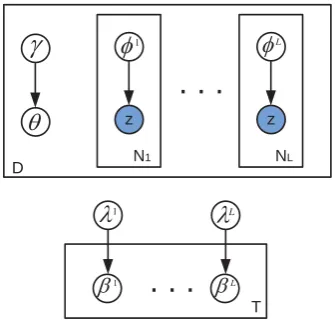
We now derive an online variational Bayes algo-rithm for PLTM to infer topic distributions over multilingual collections. Figure 2 shows the vari-ational model and free parameters used in our ap-proach. As in the case of Hoffman et al. (2010), our algorithm updates the variational parameters γdl andφldon each batch of documents while the variational parameterλis computed as a weighted average of the value on the previous batch and its approximate version λ˜. Averaging is performed using a decay function whose parameters control the rate at which old values of λl are forgotten.
Within the E step of the VB approach, we com-pute the updates over the variational parameterφl
T
. . .
D
T
zN1
z
NL
. . .
J
I
1I
L1
E EL
1
[image:3.595.331.499.64.226.2]O
O
LFigure 2: Graphical model representation of the free variational parameters for the online varia-tional Bayes approximation of the PLTM posterior
for each languageLpresent in our document tuple while the update on theγ parameter accumulates the language specific sufficient statistics:
γkm = α+
l
w
φmlwknmlw (2)
We detail these steps in Algorithm 1.
2.2 Performance Analysis
Algorithm 1Online variational Bayes for PLTM initializeλlrandomly
obtain thetth mini-batch of tuplesMt
fort= 1to∞do
ρt←
1
t0+t
κ
E step:
initializeγtrandomly
for each document tuple in mini-batcht
forminMtdo
repeat
forl∈1, . . . ,Ldo φmlwk∝
exp{Eq[logθmk]} ∗
expEqlogβkwml
end for
γm
k =α+ l wφmlwknmlw
untilconvergence
end for
M step:
forl∈1, . . . ,Ldo
˜
λlkw =η+D mφmlwknmlw
λlt
kw ←(1−ρt)λkwl(t−1)+ρtλ˜lkw
end for end for
0 2000 4000 6000 8000 10000 12000 0
10 20 30 40 50 60 70 80 90 100
Accuracy [% @ Rank 1.]
Running time [sec] Accuracy vs. Running time
Gibbs sampling Online VB
T=50 T=100
T=200 T=500 T=200 T=500 T=100
[image:4.595.313.501.66.199.2]T=50
Figure 3: Speed vs. accuracy comparison between Online VB PLTM and Gibbs Sampling PLTM at T=50,100, 200 and 500. We used a Python mentation of Online VB and Mallet’s Java imple-mentation of PLTM with in-memory Gibbs Sam-pling using 1000 iterations.
0 50 100 250 500 750 1,000
0 20,000 40,000 60,000 80,000 100,000 120,000 140,000 160,000 180,000 200,000
Collection size [k]
Training time [sec]
Collection size vs. training time
Gibbs sampling T=50 Online VB T=50 Gibbs sampling T=500 Online VB T=500
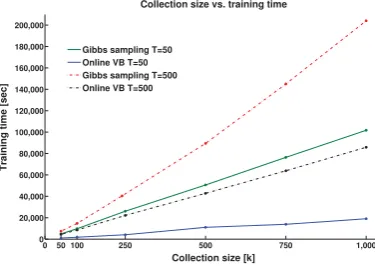
Figure 4: Collection size vs. training time compar-ison between Online VB PLTM and Gibbs Sam-pling PLTM using multilingual collections of 50k, 100k, 250k, 500k, 750k and 1M speech pairs.
digamma function (Asuncion et al., 2009) whose time complexity increases linearly with the num-ber of topics.
While a multilingual collection of∼64k docu-ment pairs is considered relatively big, our goal of deriving the Online VB PLTM approach was to be able to utilize PLTM on very large multilingual collections. To analyze the potential of using On-line VB PLTM on such collections we ran speed comparisons within the training step by creating multilingual collections of different lengths multi-plying the original English-Spanish Europarl col-lection. Speed comparisons using collections of length 50K, 100K, 250K, 500K, 750K and 1M are shown in Figure 4. Training was performed with the number of topics T set to T=50 and T=500.
As we increase the collection size we observe the real benefit of using Online VB compared to Gibbs sampling. This is mostly attributed to the fact that the Gibbs sampling approach requires multiple iterations over the whole collection in or-der to achieve a convergence point. For collec-tion sizes of 50k and 100k the training time for the Online VB PLTM with T=500 approaches the training time of Gibbs sampling with T=50 and as we increase the collection size this proximity dis-sipates.
[image:4.595.71.290.98.613.2]! " # " # $ % " % & # & # # & $ $ % ! ' ( % ) "% % # ! # ! ( ! ( ( ! & # "# * & " %
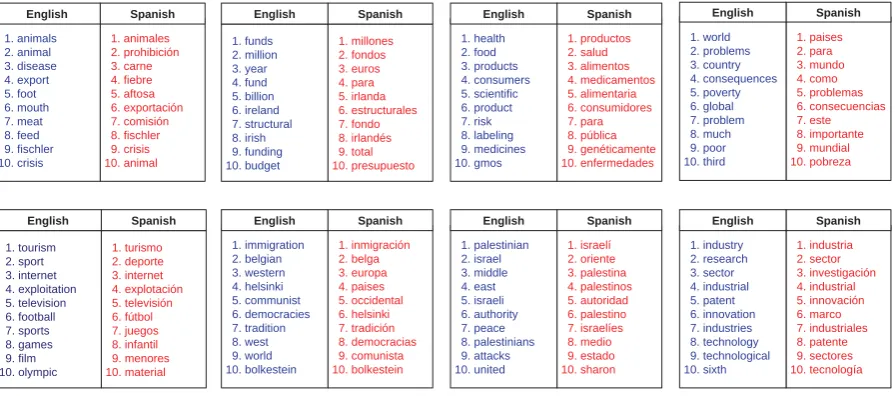
Figure 5: Sample set of topics extracted from Europarl English-Spanish collection of 64k speeches using Online PLTM with T=400 ordered based on their probability of occurrence within the topic.
3 Approximate NN Search in the Probability Simplex
One of the most attractive applications for topic models has involved using the latent variables as a low-dimensional representation for document similarity computations (Hall et al., 2008; Boyd-Graber and Resnik, 2010; Talley et al., 2011). Af-ter computing topic distributions for documents, however, researchers in this line of work have al-most always resorted to brute-force all-pairs simi-larity comparisons between topic distributions.
In this section, we present efficient methods for approximate near neighbor search in the proba-bility simplex in which topic distributions live. Measurements for similarity between two proba-bility distributions are information-theoretic, and distance metrics, typical for the metric space, are not appropriate (measurements such as Euclidean, cosine, Jaccard, etc.). Divergence metrics, such as Kullback-Leibler (KL), Jensen-Shannon (JS), and Hellinger distance are used instead. Shown in Fig-ure 6 are the formulas of the divergence metrics along with the Euclidean distance. When dealing with a large data set ofN documents, theO(N2) time complexity of all-pairs comparison makes the task practically infeasible. With some distance measures, however, the time complexity on near neighbor tasks has been alleviated using approxi-mate methods that reduce the time complexity of each query to a sub-linear number of comparisons. For example, Euclidean distance (3) has been effi-ciently used on all-pairs comparison tasks in large
data sets thanks to its approximate based versions developed using locality sensitive hashing (LSH) (Andoni et al., 2005) and k-d search trees (Fried-man et al., 1977). In order to alleviate the all-pairs computational complexity in the probability sim-plex, we will use a reduction of the Hellinger di-vergence measure (4) to Euclidean distance and therefore utilize preexisting approximation tech-niques for the Euclidean distance in the probability simplex.
This reduction comes from the fact that both measurements have similar algebraic expressions. If we discard the square root used in the Euclidean distance, Hellinger distance (4) becomes equiva-lent to the Euclidean distance metric (3) between √p
i and√qi. The task of finding nearest
Eu(p, q) =
n
i=1
(pi−qi)2 (3)
He(p, q) =
n
i=1
p(xi)−
q(xi)
2 (4)
KL(p, q) =
n
i=1
p(xi) log
p(xi)
q(xi) (5)
JS(p, q) = 1 2KL
p,p+q 2
+
1 2KL
q,p+q 2
(6)
1
[image:6.595.314.509.72.224.2]2He(p, q)≤JS(p, q)≤2 ln(2)He(p, q) (7)
Figure 6: Distance measures and bounds
(Guha et al., 2006). The constant factor relation-ship provides us with the theoretical guarantees necessary for this approximation.
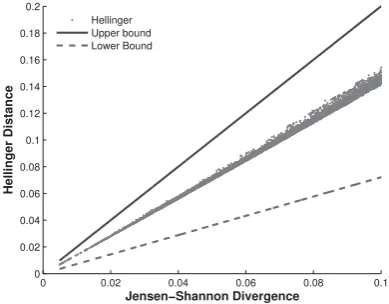
In practice, we can often do much better than this theoretical bound. Figure 7 shows the empiri-cal relation of JS and Hellinger on a translation-detection task. As will be described in §4, we computed the JS and Hellinger divergences be-tween topic distributions of English and Spanish Europarl speeches for a total of 1 million docu-ment pairs. Each point in the figure represents one Spanish-English document pair that might or might not be translations of each other. In this figure we emphasize the lower left section of the plot where the nearest neighbors (i.e., likely trans-lations) reside, and the relationship between JS and Hellinger is much tighter than the theoretical bounds and from pratical perspective as we will show in the next section. As a summary for the reader, using the above approaches, we will ap-proximate JS divergence by using the Euclidean based representation of the Hellinger distance. As stated earlier, the Euclidean based representation is computed using well established approximation approaches and in our case we will use two such approaches: the Exact Euclidean LSH (E2LSH) (Andoni et al., 2005) and the k-d trees implemen-tation within the Approximate Nearest Neighbor (ANN) library (Mount and Arya, 2010).
0 0.02 0.04 0.06 0.08 0.1 0
0.02 0.04 0.06 0.08 0.1 0.12 0.14 0.16 0.18 0.2
Hellinger Distance
Jensen−Shannon Divergence
[image:6.595.91.295.76.266.2]Hellinger Upper bound Lower Bound
Figure 7: Empirical evidence of the bounds pre-sented in Eq. 7 on 1 million document pairs— zoomed section where nearest neighbors reside. The lower bound is He(p, q) = 2 ln(2)1 JS(p, q) while the upper bound isHe(p, q) = 2JS(p, q).
4 Efficient Approximate Translation Detection
sen-tences.
In this section, we empirically show how to uti-lize approaches that deal with representing docu-ments in the probability simplex without a signif-icant loss in accuracy while significantly improv-ing the processimprov-ing time. We use PLTM represen-tations of bilingual documents. In addition, we show how the results as reported by Platt et al. (2010) can be obtained using the PLTM represen-tation with a significant speed improvement.
As in (Platt et al., 2010) and (Mimno et al., 2009) the task is to find document translation pairs in a multilingual collection of documents by rep-resenting documents in the probability simplex and computing similarity between their probabil-ity distribution representation across all document pairs. For this experimental setup, accuracy is de-fined as the number of times (in percentage) that the target language document was discovered at rank 1 (i.e. % @Rank 1.) across the whole test collection.
4.1 Experimental Setup
We use Mallet’s (McCallum, 2002) implementa-tion of the PLTM to train and infer topics on the same data set used in Platt et al. (2010). That paper used the Europarl (Koehn, 2005) multilin-gual collection of English and Spanish sessions. Their training collection consists of speeches ex-tracted from all Europarl sessions from the years 1996 through 1999 and the year 2002 and a devel-opment set which consists of speeches from ses-sions in 2001. The test collection consists of Eu-roparl speeches from the year 2000 and the first nine months of 2003. While Platt et al. (2010) do offer absolute performance comparison between their JPLSA approach and previous results pub-lished by (Mimno et al., 2009), these performance comparisons are not done on the same training and test sets—a gap that we fill below.
We train PLTM models with number of topicsT set to 50, 100, 200, and 500. In order to compare exactly the same topic distributions when comput-ing speed vs. accuracy of various approximate and exhaustive all-pairs comparisons we focus only on one inference approach - the Gibbs sampling and ignore the online VB approach as it yields sim-ilar performance. For all four topic models, we use the same settings for PLTM (hyperparame-ter values and number of Gibbs sampling i(hyperparame-tera-
itera-tions) as in (Mimno et al., 2009)2. Topic distribu-tions were then inferred on the test collection us-ing the trained topics. We then performed all-pairs comparison using JS divergence, Hellinger dis-tance, and approximate, LSH and kd-trees based, Hellinger distance. We measured the total time that it takes to perform exhaustive all-pairs com-parison using JS divergence, the LSH and kd-trees version on a single machine consisting of a core 2 duo quad processors with a clock speed of 2.66GHz on each core and a total of 8GB of mem-ory. Since the time performance of the E2LSH de-pends on the radius R of data set points considered for each query point (Indyk and Motwani, 1998), we performed measurements with different values of R. For this task, the all-pairs JS code implemen-tation first reads both source and target sets of doc-uments and stores them in hash tables. We then go over each entry in the source table and compute di-vergence against all target table entries.We refer to this code implementation as hash map implemen-tation.
4.2 Evaluation Task and Results
Performance of the four PLTM models and the performance across the four different similarity measurements was evaluated based on the percent-age of document translation pairs (out of the whole test set) that were discovered at rank one. This same approach was used by (Platt et al., 2010) to show the absolute performance comparison. As in the case of the previous two tasks, in order to eval-uate the approximate, LSH based, Hellinger dis-tance we used values of R=0.4, R=0.6 and R=0.8. Since in (Platt et al., 2010) numbers were reported on the test speeches whose word length is greater or equal to 100, we used the same subset (to-tal of 14150 speeches) of the original test col-lection. Shown in Table 1 are results across the four different measurements for all four PLTM models. When using regular JS divergence, our PLTM model with 200 topics performs the best with 99.42% of the top one ranked candidate trans-lation documents being true transtrans-lations. When using approximate, kd-trees based, Hellinger dis-tance, we outperform regular JS and Hellinger divergence across all topics and for T=500 we achieve the best overall accuracy of 99.61%. We believe that this is due to the small amount of error
2We start off by first replicating the results as in (Mimno
Divergence T=50 100 200 500
JS 94.27 98.48 99.42 99.33
He 94.30 98.45 99.40 99.31
[image:8.595.71.295.62.160.2]He LSH R=0.4 93.95 97.46 98.27 98.01 He LSH R=0.6 94.30 98.46 99.40 99.31 He LSH R=0.8 94.30 98.45 99.34 99.31 He kd-trees 94.86 98.90 99.50 99.61
Table 1: Percentage of document pairs with the correct translation discovered at rank 1: compari-son of different divergence measurements and dif-ferent numbers T of PLTM topics.
Divergence T=50 100 200 500
JS 7.8 4.6 2.4 1.0
He LSH R=0.4 511.5 383.6 196.7 69.7 He LSH R=0.6 142.1 105.0 59.0 18.6 He LSH R=0.8 73.8 44.7 29.5 16.3 He kd-trees 196.7 123.7 76.7 38.5
Table 2: Relative speed improvement between all-pairs JS divergence and approximate He diver-gence via kd-trees and LSH across different values of radius R. The baseline is brute-force all-pairs comparison with Jensen-Shannon and 500 topics.
in the search introduced by ANN, due to its ap-proximate nature, which for this task yields pos-itive results. On the same data set, (Platt et al., 2010) report accuracy of 98.9% using 50 topics, a slightly different prior distribution, and MAP in-stead of posterior inference.
Shown in Table 2 are the relative differences in time between all pairs JS divergence, approximate kd-trees and LSH based Hellinger distance with different value of R. Rather than showing abso-lute speed numbers, which are often influenced by the processor configuration and available memory, we show relative speed improvements where we take the slowest running configuration as a refer-ent value. In our case we assign the referrefer-ent speed value of 1 to the configuration with T=500 and all-pairs JS computation. Results shown are based on comparing running time of E2LSH and ANN against the all-pairs similarity comparison imple-mentation that uses hash tables to store all docu-ments in the bilingual collection which is signifi-cantly faster than the other code implementation.
For the approximate, LSH based, Hellinger dis-tance with T=100 we obtain a speed improve-ment of 24.2 times compared to regular all-pairs
JS divergence while maintaining the same per-formance compared to Hellinger distance metric and insignificant loss over all-pairs JS divergence. From Table 2 it is evident that as we increase the radius R we reduce the relative speed of perfor-mance since the range of points that LSH consid-ers for a given query point increases. Also, as the number of topics increases, the speed benefit is re-duced for both the LSH and k-d tree techniques.
5 Conclusion
Hierarchical Bayesian models, such as Polylin-gual Topic Models, have been shown to offer great potential in analyzing multilingual collec-tions, extracting aligned topics and finding docu-ment translation pairs when trained on sufficiently large aligned collections. Online stochastic opti-mization inference allows us to generate good pa-rameter estimates. By combining these two ap-proaches we are able to infer topic distributions across documents in large multilingual document collections in an efficient manner. Utilizing ap-proximate NN search techniques in the probability simplex, we showed that fast document translation detection could be achieved with insignificant loss in accuracy.
6 Acknowledgments
This work was supported in part by the Center for Intelligent Information Retrieval and in part by NSF grant #IIS-0910884. Any opinions, findings and conclusions or recommendations expressed in this material are those of the authors and do not necessarily reflect those of the sponsor.
References
Alexandr Andoni, Mayur Datar, Nicole Immorlica, Pi-otr Indyk, and Vahab Mirrokni. 2005. Locality-sensitive hashing using stable distributions. In G. Shakhnarovich, T. Darrell, and P. Indyk, editors, Nearest Neighbor Methods in Learning and Vision: Theory and Practice, pages 61–72. MIT Press.
Arthur Asuncion, Max Welling, Padhraic Smyth, and Yee Whye Teh. 2009. On smoothing and inference for topic models. InProceedings of the Twenty-Fifth Conference on Uncertainty in Artificial Intelligence, UAI ’09, pages 27–34, Arlington, Virginia, United States. AUAI Press.
and development in informaion retrieval, SIGIR ’03, pages 127–134, New York, NY, USA. ACM.
David M. Blei and John D. Lafferty. 2006. Dynamic topic models. InProceedings of the 23rd interna-tional conference on Machine learning, ICML ’06, pages 113–120, New York, NY, USA. ACM.
David M. Blei, Andrew Y. Ng, and Michael I. Jordan. 2003. Latent dirichlet allocation. J. Mach. Learn. Res., 3:993–1022, March.
Jordan Boyd-Graber and David M. Blei. 2009. Multi-lingual topic models for unaligned text. In Proceed-ings of the Twenty-Fifth Conference on Uncertainty in Artificial Intelligence, UAI ’09, pages 75–82, Ar-lington, Virginia, United States. AUAI Press.
Jordan Boyd-Graber and Philip Resnik. 2010. Holis-tic sentiment analysis across languages: multilin-gual supervised latent dirichlet allocation. In Pro-ceedings of the 2010 Conference on Empirical Meth-ods in Natural Language Processing, EMNLP ’10, pages 45–55, Stroudsburg, PA, USA. Association for Computational Linguistics.
Kevin R. Canini, Lei Shi, and Thomas L. Griffiths. 2009. Online inference of topics with latent dirichlet allocation. InProceedings of the 12th International Conference on Artificial Intelligence and Statistics (AISTATS).
Jacob Eisenstein, Brendan O’Connor, Noah A. Smith, and Eric P. Xing. 2010. A latent variable model for geographic lexical variation. InProceedings of the 2010 Conference on Empirical Methods in Natu-ral Language Processing, EMNLP ’10, pages 1277– 1287, Stroudsburg, PA, USA. Association for Com-putational Linguistics.
J. H. Friedman, J. L. Bentley, and R. A. Finkel. 1977. An algorithm for finding best matches in logarithmic expected time. ACM Transactions on Mathematical Software, 3(3):209–226.
Kosuke Fukumasu, Koji Eguchi, and Eric Xing. 2012. Symmetric correspondence topic models for multi-lingual text analysis. In P. Bartlett, F.C.N. Pereira, C.J.C. Burges, L. Bottou, and K.Q. Weinberger, ed-itors, Advances in Neural Information Processing Systems 25, pages 1295–1303.
Sudipto Guha, Andrew McGregor, and Suresh Venkatasubramanian. 2006. Streaming and sublin-ear approximation of entropy and information dis-tances. InACM-SIAM Symposium on Discrete Al-gorithms, pages 733–742.
David Hall, Daniel Jurafsky, and Christopher D. Man-ning. 2008. Studying the history of ideas using topic models. InProceedings of the Conference on Empirical Methods in Natural Language Process-ing, EMNLP ’08, pages 363–371, Stroudsburg, PA, USA. Association for Computational Linguistics.
Matthew Hoffman, David Blei, and Francis Bach. 2010. Online learning for latent dirichlet allocation. In J. Lafferty, C. K. I. Williams, J. Shawe-Taylor, R.S. Zemel, and A. Culotta, editors, Advances in Neural Information Processing Systems 23, pages 856–864.
Matt Hoffman, David M. Blei, and David M. Mimno. 2012. Sparse stochastic inference for latent dirichlet allocation. In John Langford and Joelle Pineau, ed-itors,Proceedings of the 29th International Confer-ence on Machine Learning (ICML-12), pages 1599– 1606, New York, NY, USA. ACM.
Piotr Indyk and Rajeev Motwani. 1998. Approximate nearest neighbors: towards removing the curse of di-mensionality. InProceedings of the thirtieth annual ACM symposium on Theory of computing, STOC ’98, pages 604–613, New York, NY, USA. ACM.
Jagadeesh Jagarlamudi and Hal Daum´e. 2010. Ex-tracting multilingual topics from unaligned compa-rable corpora. In Proceedings of the 32nd Euro-pean conference on Advances in Information Re-trieval, ECIR’2010, pages 444–456, Berlin, Heidel-berg. Springer-Verlag.
Philipp Koehn. 2005. Europarl: A parallel corpus for statistical machine translation. InMT Summit, pages 79–86.
Kriste Krstovski and David A. Smith. 2011. A mini-mally supervised approach for detecting and ranking document translation pairs. InProc. Workshop on Statistical MT, pages 207–216.
Andrew Kachites McCallum, 2002. MALLET: A Ma-chine Learning for Language Toolkit. http://
mallet.cs.umass.edu.
David Mimno, Hanna M. Wallach, Jason Naradowsky, David A. Smith, and Andrew McCallum. 2009. Polylingual topic models. In Proceedings of the 2009 Conference on Empirical Methods in Nat-ural Language Processing: Volume 2 - Volume 2, EMNLP ’09, pages 880–889, Stroudsburg, PA, USA. Association for Computational Linguistics.
David M. Mount and Sunil Arya, 2010. ANN: A Li-brary for Approximate Nearest Neighbor Searching.
http://www.cs.umd.edu/˜mount/ANN/.
John C. Platt, Kristina Toutanova, and Wen-tau Yih. 2010. Translingual document representations from discriminative projections. In Proceedings of the 2010 Conference on Empirical Methods in Natural Language Processing, EMNLP ’10, pages 251–261, Stroudsburg, PA, USA. Association for Computa-tional Linguistics.
Flemming Topsøe. 2000. Some inequalities for in-formation divergence and related measures of dis-crimination. IEEE Trans. Information Theory, 44(4):1602–1609.
Xuerui Wang and Andrew McCallum. 2006. Top-ics over time: a non-markov continuous-time model of topical trends. InProceedings of the 12th ACM SIGKDD international conference on Knowledge discovery and data mining, KDD ’06, pages 424– 433, New York, NY, USA. ACM.
Xing Wei and W. Bruce Croft. 2006. Lda-based doc-ument models for ad-hoc retrieval. InProceedings of the 29th annual international ACM SIGIR confer-ence on Research and development in information retrieval, SIGIR ’06, pages 178–185, New York, NY, USA. ACM.