Wordnet-Based Cross-Language Identification of Semantic Relations
Ivelina Stoyanova Svetla Koeva Svetlozara Leseva
Department of Computational Linguistics, IBL, BAS, Sofia, Bulgaria
{iva,svetla,zarka}@dcl.bas.bg
Abstract
We propose a method for cross-language identification of semantic relations based on word similarity measurement and mor-phosemantic relations in WordNet. We transfer these relations to pairs of deriva-tionally unrelated words and train a model for automatic classification of new in-stances of (morpho)semantic relations in context based on the existing ones and the general semantic classes of collocated verb and noun senses. Our experiments are based on Bulgarian-English parallel and comparable texts but the method is to a great extent language-independent and particularly suited to less-resourced lan-guages, since it does not need parsed or se-mantically annotated data. The application of the method leads to an increase in the number of discovered semantic relations by58.35%and performs relatively consis-tently, with a small decrease in precision between the baseline (based on morphose-mantic relations identified in wordnet) – 0.774, and the extended method (based on the data obtained through machine learn-ing) –0.721.
1 Introduction
Natural language semantics has begun to receive due attention as many areas of natural language processing have recognized the need for address-ing both the syntactic structure and the semantic representation of sentence constituents. Modelling conceptual and syntactic relationships such as se-mantic roles, sese-mantic and syntactic frames, or semantic and syntactic dependencies is known as semantic role labeling – SRL (Gildea and Juraf-sky, 2002), (shallow) semantic parsing (Pradhan et al., 2004), semantic role tagging (Xue and Palmer,
2004), extraction of predicate-argument structures (Moschitti and Bejan, 2004), automatic extraction of semantic relations (Swier and Stevenson, 2005), among others.
We propose a method for automatic semantic labeling based on the morphosemantic relations in Princeton WordNet (PWN). A morphoseman-tic relation associates a verb synsetSvand a noun synsetSnif there is a derivational relation between a literal Lv in Sv and a literal Ln in Sn. Mor-phosemantic relations inherit the semantics of the derivation. Consider, for instance, the morphose-mantic relations agent, instrument, location, and
vehicle, which link a verb to its agent ( adminis-trate– administrator), instrument (collide– col-lider), location (settle–settlement), vehicle (bomb
–bomber).
We apply word and clause similarity measure-ment to parallel and comparable texts in order to perform partial word sense disambiguation and to identify candidates for labeling with semantic in-formation. We enhance the WordNet morphose-mantic relations with semorphose-mantic generalizations de-rived from the general semantic word classes of the synsets and use this knowledge to learn and assign different types of semantic information: • semantic relations associated with the noun col-locates of a particular verb sense;
• general semantic noun classes that are eligible to collocate with a particular verb sense.
We apply this method to English and Bulgarian using PWN and the Bulgarian WordNet (BulNet). An advantage of the proposed approach is that it is able to assign semantic labels to unstructured text. The paper is organised as follows. We out-line the background against which we approach the identification of semantic relations in Section 2 where we present in brief groundbreaking and influential recent work in semantic role labeling (SRL). In Section 3 we discuss the linguistic mo-tivation for the proposed approach. In Section 4
we describe the method for wordnet-based iden-tification of semantic information and its imple-mentation. Section 5 presents assessment of the results, followed by conclusions and an outline of directions for future research in Section 6.
2 Related Work
Many applications treat the assignment of seman-tic roles, semanseman-tic frames, and dependencies as a classification problem that involves the training of models on (large) manually annotated corpora, such as FrameNet text annotation (Ruppenhofer et al., 2010), the Prague Dependency Treebank (Ha-jic, 1998), or PropBank (Palmer et al., 2005), and the subsequent assignment of semantic labels to appropriate sentence constituents.
A number of models have been developed us-ing the FrameNet corpus. Undoubtedly the most influential one has been Gildea and Jurafsky’s machine learning method (Gildea and Jurafsky, 2002), which is based on the training of a SRL classifier on a set of lexical, morpho-syntactic, syntactic and word order features extracted from the parsed FrameNet corpus in conjunction with knowledge of the predicates, prior probabilities of various combinations of semantic roles, etc.
PropBank spurred a lot of research in SRL (Pradhan et al., 2004; Pradhan et al., 2008; Toutanova et al., 2008; Surdeanu et al., 2003; Xue and Palmer, 2004), to mention but a few. For in-stance, Pradhan et al. (2004) and Pradhan et al. (2008) propose SRL algorithms that augment pre-viously developed systems, such as Gildea and Ju-rafsky’s (2002) by replacing earlier classifiers with SVMs. Xue and Palmer (2004) train a Maximum Entropy classifier on the PropBank using linguis-tic features that can be directly extracted from syn-tactic parse trees and achieve results comparable to the best performing system at the time (Pradhan et al., 2004).
Semantic role labeling based on (large) anno-tated corpora need to deal with a number of issues, such as the situation specificity of semantic roles, the manual selection of annotated examples, vari-ability in the sets of roles used across the compu-tational resources, among others (Marquez et al., 2008). Pradhan et al. (2008) have also shown that the transfer of such models to other domains leads to substantial degradation in the results.
Some researchers employ other resources as an alternative. Swier and Stevenson (2005) describe
an unsupervised SRL system that combines infor-mation from a verb lexicon – VerbNet with a sim-ple probability model. Shi and Mihalcea (2005) propose the integration of VerbNet, WordNet and FrameNet into a knowledge base and use it in the building of a semantic parser. The system iden-tifies the FrameNet frame best corresponding to a parsed sentence either as a direct match, or via VerbNet and/or WordNet relations.
Despite these alternatives the dominant trend has remained the corpus-based SRL, with un-supervised approaches gaining popularity as a way of overcoming the deficiencies of supervised methods (Lang and Lapata, 2011a; Lang and Lap-ata, 2011b), among others. Syntactic analysis has been considered a prerequisite in SRL, with full parsing winning over partial parsing, as demon-strated by the results in the CoNLL-2004 (Carreras and Marquez, 2004) and the CoNLL-2005 (Car-reras and Marquez, 2005) shared tasks. Syntac-tic analysis and SRL have been dealt with within two general frameworks. In the “pipeline” ap-proach the systems first perform syntactic pars-ing followed by SRL, while In the joint parspars-ing approach syntactic and semantic parsing are per-formed together. Joint parsing of syntactic and semantic dependencies has been the focus of the 2008 (Surdeanu et al., 2008) and CoNLL-2009 (Hajiˇc et al., CoNLL-2009) shared tasks.
To sum up, a classical SRL system takes a parsed input and assigns semantic roles on the basis of: i) a language model learnt from a pre-annotated semantically labeled corpus; ii) a frame lexicon; or iii) a combination of different re-sources. In the systems using annotated corpora the syntactically parsed sentences are usually se-mantically annotated using classifiers trained on the corpus on the basis of linguistic features de-rived from the parses. In the case of lexicon-based systems semantic roles are directly or indirectly assigned from the lexicon.
3 Motivation
semantic roles. In fact, many of the noun-verb morphosemantic links in WordNet designate typi-cal relations between a participant and a predicate, such asagent,instrument,material, location, un-dergoer,destination, etc.
For instance the verb literal send (cause to be directed or transmitted to another place) is re-lated to the nounsender(someone who transmits a message) through the morphosemantic relation
agentand to the nounsendee(the intended recip-ient of a message) throughdestination;train (ed-ucate for a future role or function) is connected to
trainer (one who trains other persons or animals) throughagentand totrainee(someone who is be-ing trained) throughundergoer. The noun mem-bers of these morphosemantic relations can func-tion as arguments of the particular verbs and bear the respective semantic roles, i.e. agentforsender
andtrainer,destinationforsendee, andundergoer
fortrainee.
Further, we assume that if a noun and a verb enter into the same morphosemantic relation in-dividually, they are licensed for it and therefore, when they collocate, they enter into this relation if there is no other appropriate noun candidate for the same relation. As an example, consider the sentence: The author used the method of cost-effectiveness analysis. The verb use is linked to
user through the morphosemantic relation agent. The nounauthoris connected with the verbauthor
(be the author of) by means of the same relation. By virtue of the above assumption we assign the relationagentbetweenuseandauthorin this par-ticular sentence. In such a way the morphoseman-tic relation identified between the derivationally related verb and noun may be inherited by syn-onyms, direct hypernyms, hypsyn-onyms, sister terms, etc. Thus, given a morphosemantic relation and words in the context that participate in such a re-lation independently of each other, we are able to discover certain types of semantic relations.
4 Method for Cross-Language Learning of Semantic Relations
The goal of the study is to identify semantic rela-tions between a verb and collocated nouns1within similar clauses in Bulgarian and English (often but not necessarily translational equivalents) and to assign a semantic matrix to the verb based on
1Collocated here means that nouns are found within the
same clause as the verb.
Bulgarian English
Administrative
Politics 28,148 27,609 Economy 25,800 28,436 Health 26,912 30,721 Ecology 27,886 36,227
News
Politics 25,016 25,010 Economy 25,010 25,127 Culture 25,319 25,355 Military 25,283 25,328
Fiction
Adventure 25,053 29,241 Humour 30,003 26,992
Love 32,631 25,459
[image:3.595.323.512.62.305.2]Fantasy 30,200 32,393 TOTAL 327,261 337,898
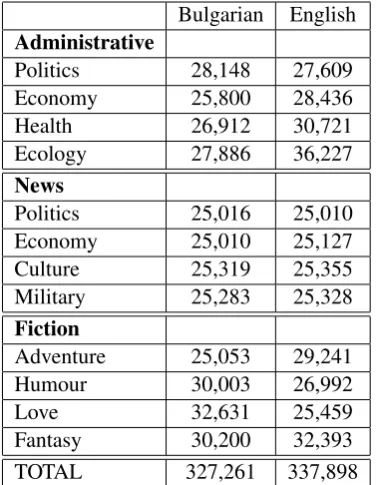
Table 1: Distribution of texts (in terms of num-ber of words) in the Bulgarian-English compara-ble corpus applied in the study
collocational evidence and the WordNet hierarchy. The method is developed and tested on a Bulgarian-English comparable corpus (Table 1) which is an excerpt from the Bulgarian National Corpus (Koeva et al., 2012).
4.1 WordNet Enhancement with Morphosemantic Relations
The interest in morphosemantic relations has been motivated by the fact that they overlap to a great extent across wordnets (Bilgin et al., 2004) and thus improve the internal connectivity of the in-dividual wordnets, as well as by the fact that the derivational subnets reflect certain cognitive struc-tures in natural languages (Pala and Hlavackova, 2007). n approach to wordnet development based on enrichment with morphosemantic relations has been adopted for English (Fellbaum et al., 2009), as well as for a number of other languages – Turk-ish (Bilgin et al., 2004), Czech (Pala and Hlavack-ova, 2007), Bulgarian (Koeva et al., 2008), Serbian (Koeva, 2008), Polish (Piasecki et al., 2009), Ro-manian (Barbu Mititelu, 2012), to mention a few.
lan-guage, even if the latter language does not exhibit a derivational relation between members of these particular synsets.
We automatically expand BulNet with mor-phosemantic relations in the following two ways:
(1) Morphosemantic relations are mapped from the morphosemantic database distributed with the PWN2 to the corresponding Bulgarian synsets. The morphosemantic relations currently encoded in Princeton WordNet 3.0.3have relatively limited coverage – 14,876 verb-noun synset pairs, which involve 7,960 verb synsets and 9,704 noun synsets. The automatic transfer of morphosemantic links to BulNet resulted in the association of 5,002 verb-noun pairs involving 3,584 verb synsets and 4,938 noun synsets.
For example, the PWN synset hammer:2 (beat with or as if with a hammer) is related to the noun synsethammer:4 (a hand tool with a heavy rigid head and a handle; used to deliver an impulsive force by striking) through the morphosemantic re-lation instrument. We map this relation to the corresponding pair in BulNet – the verb synset
chukam:1; kova:1and the noun synsetchuk:1. In the particular case a derivational relation exists in Bulgarian, as well, betweenchukandchukam.
(2) In general, the task of detection and clas-sification of the identified relations includes au-tomatic generation of derivational pairs based on knowledge of language-specific derivational pat-terns followed by filtering of the results through automatic and/or manual validation. Specific methods are described in more detail in the re-search cited at the beginning of this subsection, as well as in more recent proposals, such as the ma-chine learning approach to generation and classifi-cation of derivational pairs made by Piasecki et al. (2012b) and Piasecki et al. (2012a), respectively.
We identify new pairs of verb-noun literals in BulNet that are potentially derivationally (and thus morphosemantically) related by means of a set of rules that describe the verb-noun and noun-verb derivational patterns in Bulgarian (we focus on patterns affecting the end of the word, thus ig-noring prefixation) and assign the respective mor-phosemantic relations to the synsets that include the related pairs.
2
http://wordnetcode.princeton.edu/ standoff-files/morphosemantic-links.xls
3http://wordnet.princeton.edu/wordnet/
download/standoff/
We identified 89 derivational noun endings (morphophonemic variants of suffixes) and 183 derivational patterns (verb ending to noun ending correspondences), and associated them with the morphosemantic relation they indicate. Only 39 of the selected derivational endings were found to be unambiguous. Moreover, many of them proved to be highly ambiguous, denoting up to 10 of the 14 morphosemantic relations. In order to disam-biguate at least partially the possible morphose-mantic relations associated with a particular suf-fix, we filtered those meanings with the general semantic classes derived from the PWN lexicog-rapher files. The PWN synsets are organized in 45 lexicographer files based on syntactic category and general semantic word classes (26 for nouns and 15 for verbs)4.
For instance, the Bulgarian noun suffix -nik is associated with the following relations
agent,instrument,location,undergoer, andevent. By virtue of the fact that the synsets denot-ing locations are found in the lexicographer file
noun.location, the synset denoting agents – in noun.person, and the instruments – in
noun.artifact, we were able to disambiguate the suffix at least partially.
Initially, 57,211 new derivational relations were found in BulNet. These relations were eval-uated automatically on the basis of the mor-phosemantic relations transferred from PWN. Each triple <verb.label, noun.label, relation>5 was assigned a probability based on the frequency of occurrence in the set of morphosemantic relations transferred from PWN. Those relations with a probability below1%were filtered out. As a result 34,677 morphosemantic relations between a noun literal and a verb lit-eral were assigned among 7,456 unique noun-verb synset pairs, which involved 2,537 verb synsets and 1,708 noun synsets.
For example the noun synset kovach:1 (corre-sponding toblacksmith:1) is derivationally related with the verb literalkova:1through the suffix-ach, which is associated either with anagentor with an
instrumentrelation depending on the semantics of the noun – a person or an inanimate object. In this case the meaning of the suffix is disambiguated
4http://wordnet.princeton.edu/wordnet/
man/lexnames.5WN.html
5Theverb.labeland noun.labelare descriptive
by virtue of the fact thatkovach:1is found in the
noun.person lexicographer file. We link the literalskova:1andkovach:1 via a derivational re-lationsuffixand assign the synsets the morphose-mantic relationagent.
4.2 Preprocessing and Clause Splitting
The preprocessing of the Bulgarian-English cor-pus used in the study includes sentence-splitting, tokenization, POS-tagging and lemmatization, us-ing the Bulgarian Language Processus-ing Chain6 (Koeva and Genov, 2011) for the Bulgarian part and Stanford CoreNLP7for the English part.
The clause serves as the minimal context for the realization of verb semantics, and hence – the scope within which we carry out the cross-linguistic analysis and the assignment of relations. Clause splitting is applied using a general method based on POS tagging, lists of clause delimiters (clause linking words, multiword expressions, and punctuation) and a set of language-specific rules. We define the clause as a sequence of words be-tween two potential clause delimiters where ex-actly one predicate (a simple or a complex verb form, which may be a lexical verb, an auxiliary, a copula, or a combination of a lexical verb or a copula with one or more auxiliaries) occurs. We identify the predicates in each sentence us-ing language-specific rules for Bulgarian and En-glish. Each clause is labeled by a clause opening and a clause end. The clause splitting algorithm marks subordinating and coordinating clause link-ing words and phrases and punctuation clause de-limiters. If no clause boundary has been identified between two predicates, a clause boundary is in-serted before the second one. The nested clauses are detected, as well.
4.3 Word-to-Word and Text-to-Text Semantic Similarity
WordNet has inspired the elaboration of metrics for word similarity and relatedness that quantify the degree to which words (concepts) are related using properties of the WordNet structure. The so-called path-length based measures rely on the length of the path between two nodes (synsets), possibly normalized. For instance, the Leacock-Chodorow metric (Leacock and Leacock-Chodorow, 1998) finds the shortest path between two concepts and
6http://dcl.bas.bg/services/
7http://nlp.stanford.edu/software/
corenlp.shtml
scales the path length by the overall depthDof the WordNet taxonomy, while Wu-Palmer (Wu and Palmer, 1994) calculates the depth of the concepts and their least common subsumer in the WordNet taxonomy.
Information content based metrics augment the path information with corpus statistics. Resnik (1995) measures the similarity of two concepts by calculating the information content (IC) of their least common subsumer (LCS). Jiang-Conrath (Jiang and Conrath, 1997) and Lin (Lin, 1998) combine the information content of the LCS with the information content of the individual concepts. Several relatedness metrics have also been pro-posed, such as Hirst-St-Onge (Hirst and St-Onge, 1998), which measures semantic relatedness based on the path length and its nature (the changes of di-rection in the path), and the algorithms proposed by Banerjee and Pederson (2002) and Patwardhan et al. (2003), which rely on information obtained from the synsets glosses.
A number of researchers have addressed WSD based on cross-lingual semantic similarity mea-surement, such as the application of monolingual WSD graph-based algorithms to multilingual co-occurrence graphs based on WordNet (Silberer and Ponzetto, 2010), or of multilingual WSD al-gorithms based on multilingual knowledge from BabelNet (Navigli and Ponzetto, 2012).
For the purposes of the extraction of seman-tic relations we are interested in corresponding pairs of clauses in Bulgarian and English satisfy-ing the followsatisfy-ing conditions: (a) the verbs in the clauses are similar (with respect to a certain simi-larity measure and threshold); and (b) the clauses are similar in meaning (with respect to a certain similarity measure and threshold). Similar pairs of verbs and nouns are identified on the basis of the Wu-Palmer word-to-word similarity measure (Wu and Palmer, 1994). Clause similarity is com-puted by means of the text similarity measurement proposed by Mihalcea et al. (2006).
Measuring semantic similarity cross-linguistically enables us to filter some of the senses of a particular word in one language since potential semantic similarity of words within similar clauses strongly suggests that these words are semantically related – translation equivalents, close synonyms, hypernyms, or hyponyms.
el-ements of similar clauses in a comparable, not nec-essarily parallel, Bulgarian-English corpus. More-over, we identify semantically similar rather than parallel clauses, which enables us to experiment with a greater number and diversity of contexts for the identification of semantic relations.
4.4 Method outline
We select corresponding (comparable) pairs of texts from the corpus –T1 in Bulgarian andT2 in English on the basis of their detailed metadata de-scription (Koeva et al., 2012), including parame-ters such as style, domain and genre. For each pair of corresponding textsT1andT2we apply the fol-lowing algorithm:
Step 1. We identify semantically similar pairs of verbs and consider similarity between their re-spective clauses – v1 ∈ cl1 andv2 ∈ cl2, where cl1 ∈ T1 andcl2 ∈ T2 and cl1 are also seman-tically similar (cf. Section 4.3 for word-to-word and clause-to-clause similarity).
Step 2. We identify semantically similar pairs of collocated nouns in the bi-clause (cl1,cl2) in the same way as for verbs.
Step 3. We assign morphosemantic relations to the verb and its collocated nouns using the en-hanced set of relations (cf. Section 4.1) and map all matching candidates (v1, n1, rel) in cl1(v1) and(v2, n2, rel)incl(v2).
Step 4. Since co-occurrence of members of a single instance of a morphosemantic relation are relatively rare, we transfer the morphosemantic re-lations to non-derivationally related words, pro-vided a noun and a verb participate in the same type of morphosemantic relation independently of each other. In Example 1 the noun director en-ters into a morphosemantic relation (agent) with the verb direct, while the verb send enters inde-pendently into the same type of relation with the nounsender. Since bothdirector andsendare li-censed foragent, we assign the relation.
Example 1.
Croatian director Zrinko Ogresta sent an invita-tion for the internainvita-tional film festival.
send, 01437254-v, verb.contact
{to cause or order to be taken directed or transmit-ted to another place}
director, 10015215-n, noun.person
VERBsend: agent, NOUNdirector: agent inv
Step 5. We hierarchize the candidates for a particular morphosemantic relation and select the
most probable one based on the general semantic word classes (verb.labelandnoun.label) and the relations they participate in. Where two or more morphosemantic relations are assigned be-tween a pair of words, priority is given to the re-lation which is most compatible with the general semantic class of the noun in the relation.
Some relations, such asevent, are very general and therefore are not considered even if their prob-ability is higher, provided a more meaningful rela-tion is available. Moreover, we incorporate some syntactic and word-order dependencies. For in-stance, a noun which is a complement of a prepo-sitional phrase and is thus found in the following configurations: p(A)N (with any number of ad-jectives preceding the noun) is not licensed for the morphosemantic relation agent if the verb is ac-tive.
Step 6. Based on the general semantic class of the noun and/or the verb, some additional poten-tial relations are added to the respective synsets in the model (Example 2). For example, a noun be-longing to the classnoun.locationcan poten-tially enter into alocationrelation with the verb, although the respective noun synset might not en-ter into this morphosemantic relation.
Example 2. Newly added relations
verb.label role
contact agent motion location
noun.label role
person agent inv location location inv attribute property inv
Step 7. We extend the number of relations by learning from previous occurrences. Learning is performed on the News subcorpus (see Table 1), and further experiments extend the information ac-quired in the learning phase with data from the en-tire corpus.
Example 3 shows how learning is applied: based on the occurrences of verbs from the same synset (ID: 00974367-v, announce:2; de-clare:2) in a morphosemantic relation of type
agentwith nouns belonging to the semantic class
noun.group (in 60.4% of the cases), we asso-ciate the verb announce with the noun Ministry
(noun.group) through the agent relation de-spite the fact thatMinistryis not linked to any verb through a morphosemantic relation.
Example 3.
Learned:
Verb ID relation noun.label freq 00974367-v by-means-of noun.artifact 5 00974367-v by-means-of noun.act 14 00974367-v agent noun.person 9 00974367-v agent noun.group 16
The Ministry of Defense announced on Wednesday its new plans.
announce, 00974367-v, verb.communication {make known, make an announcement} Ministry, 08114004-n, noun.group VERBannounce: agent
NOUNMinistry: agent inv
At a next stage of generalization we consider only the general semantic classes of a verb and a noun which are candidates to enter in a morphose-mantic relation. This step relies on the assumption that verbs from the same semantic class (e.g. per-ception verbs) show preference to similar semantic patterns. The learned information is in a general-ized form, as presented in Example 4.
Example 4. A sample of semantic compatibil-ity information learned from the News subcorpus.
verb.label relation noun.label freq verb.perception undergoer noun.person 15 verb.perception undergoer noun.group 3 verb.perception state noun.state 12 verb.perception by-means-of noun.state 12 verb.perception by-means-of noun.act 6 verb.perception uses noun.group 3 verb.perception agent noun.person 3
4.5 Implementation
We implement the word-to-word similarities with thews4jpackage for Java8, which is based on the original Perl packageWordnet::Similarity
(Pedersen et al., 2007).
We use the Princeton WordNet 3.0 and access it through Java libraries such as JAWS9 and JWI10.
8https://code.google.com/p/ws4j/
9
http://lyle.smu.edu/˜tspell/jaws/
10http://projects.csail.mit.edu/jwi/
api/
We also employ a list of morphosemantic relations available for WordNet 3.0. The access to BulNet is modeled roughly on PWN. The corresponding synsets in the two wordnets are linked by means of synset IDs.
5 Results and Evaluation
Evaluation was performed with respect to the cov-erage of the morphosemantic relations, the preci-sion of the assigned relations, and the informa-tiveness of the extracted semantic patterns. Test-ing was carried out on the News subcorpus (Ta-ble 1) totaling 100,628 tokens distributed in four subdomains: Politics, Economy, Culture, and Mil-itary. The corpus comprises 3,362 sentences and 7,535 clauses for Bulgarian and 3,678 sentences and 8,624 clauses for English.
Method # clauses # relations 1 Baseline 0 920 1,183
2 Baseline 951 1,246
3 Learned and transferred to synsets
1,032 1,353
4 Learned and transferred to semantic classes
1,395 1,973
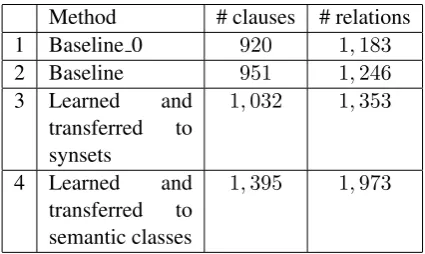
[image:7.595.310.523.308.435.2]Table 2: Coverage of relations in the News subcor-pus using the baseline method (2) and the extended method (4)
Table 2 presents: (1) the number of mor-phosemantic relations covered by the baseline 0 method, i.e. applying only the Princeton WordNet morphosemantic relations; (2) the number of mor-phosemantic relations after adding those specific to Bulgarian; and (3, 4) the number of morphose-mantic relations learnt with the method described in Step 7 (Section 4.4). The results show that the extended method leads to an increase in coverage by58.35%(compare the extended method (4) with the baseline (2)).
To assess the precision of the automatic relation assignment, we performed evaluation on five rela-tions: agent,undergoer,location,result, andstate
(Table 3). The overall precision based on these relations is 0.774 for the baseline and 0.721 for the extended method, which shows that the per-formance of the method is relatively consistent.
Relation Precision (baseline)
[image:8.595.82.285.62.174.2]Precision (extended method) Agent 0.963 0.950 Undergoer 0.575 0.577 Location 0.857 0.750 Result 0.303 0.316 State 0.750 0.667
Table 3: Precision of the results for five seman-tic relations – baseline (Princeton and Bulgarian morphosemantic relations) and extended method (transfer of morphosemantic relations to pairs of nouns and verbs one of which does not participate in morphosemantic relations)
data that can be used for further classification. The first one represents the combinatorial properties of general semantic verb classes with particular (morpho)semantic relations. For example a verb of communication is more likely linked to an
agentrather than to aresult(Example 5).
Example 5. Frequency of relations in WordNet and the entire corpus.
verb.label relation fr wn fr cor
verb.com agent 744 555
verb.com undergoer 306 362 verb.com by-means-of 244 560 verb.com result 192 283
Moreover, the nouns that are eligible to collo-cate as agents with a communication verb belong to a limited set of classes – noun.person or
noun.group(Example 6).
Example 6. Frequency of relations in WordNet and the entire corpus.
verb.label relation noun label fr wn fr cor verb.com agent noun.person 473 333 verb.com agent noun.group 271 220
The second generalization refers to the prob-ability of the association of a given verb sense with a particular set of semantic relations and the general noun classes eligible for these relations. For instance, the communication verb order
(Example 7) in the sense of give instructions to or direct somebody to do something with authority connects with the highest probability with an undergoer (noun.person) and an
agent(noun.person).
Example 7. Relations of the verb order in WordNet and the entire corpus.
verb.label relation noun label fr wn fr cor verb.com undergoer noun.person 33 8
verb.com agent noun.person 12 6
verb.com by-means-of noun.phen 9 7 6 Conclusions and Future Work
In this paper we have explored the applicability of the morphosemantic relations in WordNet for cross-language identification of semantic and in some cases syntactic dependencies between col-located verbs and nouns. As morphosemantic re-lations are valid cross-linguistically, the method is applicable for any language or a pair of languages. The limitations of the proposed method lie in the insufficient connectivity of the nodes (synsets and literals). We have described an approach to automatic wordnet enhancement, which has re-sulted in a substantial increase in the number of morphosemantic relations. Another inherent weakness is that some of the relations are very general or vaguely defined. We have addressed this problem by considering relations jointly with the general semantic classes associated with the synsets in WordNet.
The method has the advantage of using lim-ited linguistic annotation. It does not require text alignment, syntactic parsing or word-sense disam-biguation. The cross-linguistic similarity partially disambiguates the target words, so that the senses for which the clauses are not similar are discarded; the semantic restrictions imposed by the general semantic classes and their compatibility also con-tribute to semantic disambiguation. The method is thus to a large extent language-independent and well suited to less-resourced languages.
In order to improve the performance and over-come the limitations of the method, we plan to explore deeper into the possibilities of predicting the roles of the verb participants from their gen-eral semantic class and the semantic compatibility of verb and noun classes, as well as from the com-patibility of the different types of morphosemantic relations with the general semantic classes.
References
Satanjeev Banerjee and Ted Pedersen. 2002. An adapted lesk algorithm for word sense disambigua-tion using wordnet. Lecture Notes In Computer Sci-ence, 2276:136–145.
Verginica Barbu Mititelu. 2012. Adding Morpho-Semantic Relations to the Romanian Wordnet. In
Proceedings of the Eight International Conference on Language Resources and Evaluation (LREC’12), pages 2596–2601.
Orhan Bilgin, ¨Ozlem Cetinou˘glu, , and Kemal Oflazer. 2004. Morphosemantic Relations In and Across Wordnets – A Study Based on Turkish. In P. So-jka, K. Pala, P. Smrz, C. Fellbaum, and P. Vossen, editors,Proceedings of the Global Wordnet Confer-ence, pages 60–66.
Xavier Carreras and Lluis Marquez. 2004. Intro-duction to the CoNLL-2004 Shared Task: Semantic Role Labeling. InProceedings of CoNLL-2004.
Xavier Carreras and Lluis Marquez. 2005. Intro-duction to the CoNLL-2005 Shared Task: Semantic Role Labeling. InProceedings of CoNLL-2005.
Christine Fellbaum, Anne Osherson, and Peter E. Clark. 2009. Putting Semantics into Word-Net’s ”Morphosemantic” Links. In Z. Vetulani and H. Uszkoreit, editors,Proceedings of the Third Lan-guage and Technology Conference, Poznan, Poland. Reprinted in: Responding to Information Society Challenges: New Advances in Human Language Technologies, volume 5603 of Springer Lecture Notes in Informatics, pages 350–358.
Daniel Gildea and Daniel Jurafsky. 2002. Automatic labeling of semantic roles. Computational Linguis-tics, 28(3):245–288, September.
Jan Hajic. 1998. Building a syntactically annotated corpus: The prague dependency treebank. Issues of Valency and Meaning, pages 106–132.
Jan Hajiˇc, Massimiliano Ciaramita, Richard Johans-son, Daisuke Kawahara, Maria Antnia Mart´ı, Llu´ıs M´arquez, Adam Meyers, Joakim Nivre, Sebastian Pad´o, Jan ˇStˇep´anek, Pavel Straˇn´ak, Mihai Surdeanu, Nianwen Xue, and Yi Zhang. 2009. The CoNLL-2009 Shared Task: Syntactic and Semantic Depen-dencies in Multiple Languages. InProceedings of the Thirteenth Conference on Computational Nat-ural Language Learning (CoNLL 2009): Shared Task, pages 1–18.
Graeme Hirst and David St-Onge. 1998. Lexical chains as representations of context for the detec-tion and correcdetec-tion of malapropisms. In Christiane Fellbaum, editor, WordNet: An electronic lexical database, page 305332. MIT Press.
Jay J. Jiang and David W. Conrath. 1997. Seman-tic similarity based on corpus statisSeman-tics and lexical
taxonomy. In Proceedings on International Con-ference on Research in Computational Linguistics, page 1933.
S. Koeva and A. Genov. 2011. Bulgarian language processing chain. InProceedings of Integration of multilingual resources and tools in Web applica-tions. Workshop in conjunction with GSCL 2011, University of Hamburg.
Svetla Koeva, Cvetana Krstev, and Dusko Vitas. 2008. Morpho-semantic relations in wordnet - a case study for two slavic langages. In Proceedings of the Fourth Global WordNet Conference, pages 239–254.
Svetla Koeva, Ivelina Stoyanova, Svetlozara Leseva, Tsvetana Dimitrova, Rositsa Dekova, and Ekaterina Tarpomanova. 2012. The Bulgarian National Cor-pus: Theory and Practice in Corpus Design. Journal of Language Modelling, 0(1):65–110.
Svetla Koeva. 2008. Derivational and morphosemantic relations in bulgarian wordnet. Intelligent Informa-tion Systems, XVI:359–369.
Joel Lang and Mirella Lapata. 2011a. Unsupervised Semantic Role Induction via Split-Merge Cluster-ing. InProceedings of ACL 2011, pages 1117–1126.
Joel Lang and Mirella Lapata. 2011b. Unsupervised Semantic Role Induction with Graph Partitioning. InProceedings of EMNLP 2011, pages 1320–1331.
Claudia Leacock and Michael Chodorow. 1998. Com-bining local context and WordNet similarity for word sense identification. In C. Fellbaum, edi-tor,WordNet: An electronic lexical database, pages 265–283. MIT Press.
Dekang Lin. 1998. An information-theoretic defini-tion of similarity. In Proceedings of the Interna-tional Conference on Machine Learning.
Lluis Marquez, Xavier Carreras, Kenneth C. Litkowski, and Suzanne Stevenson. 2008. Se-mantic role labeling: An introduction to the special issue.Computational Linguistics, 34(2):145–159.
Rada Mihalcea, Courtney Corley, and Carlo Strappa-rava. 2006. Corpus-based and Knowledge-based Measures of Text Semantic Similarity. In Proceed-ings of the American Association for Artificial Intel-ligence (AAAI 2006), Boston.
Alessandro Moschitti and Cosmin Adrian Bejan. 2004. A semantic kernel for predicate argument classica-tion. InIn Proceedings of CONLL 2004, pages 17– 24.
K. Pala and D. Hlavackova. 2007. Derivational rela-tions in Czech Wordnet. InProceedings of the Work-shop on Balto-Slavonic Natural Language Process-ing, pages 75–81.
Martha Palmer, Paul Kingsbury, and Daniel Gildea. 2005. The proposition bank: An annotated cor-pus of semantic roles. Computational Linguistics, 31(1):71–106.
Siddharth Patwardhan, Satanjeev Banerjee, and Ted Pedersen. 2003. Using measures of semantic re-latedness for word sense disambiguation. In Pro-ceedings of the Fourth International Conference on Intelligent Text Processing and Computational Lin-guistics, pages 241–257.
Ted Pedersen, Serguei Pakhomov, Siddharth Patward-han, and Christopher G. Chute. 2007. Measures of semantic similarity and relatedness in the biomed-ical domain. Journal of Biomedical Informatics, 40(3):288–299.
Maciej Piasecki, Stanisaw Szpakowicz, and Bartosz Broda. 2009. A wordnet from the ground up. In
Wroclaw: Oficyna Wydawnicza Politechniki Wro-clawskiej.
Maciej Piasecki, Radoslaw Ramocki, and Pawel Minda. 2012a. Corpus-based semantic filtering in discovering derivational relations. InAIMSA, pages 14–22.
Maciej Piasecki, Radosaw Ramocki, and Marek Maziarz. 2012b. Automated Generation of Deriva-tive Relations in the Wordnet Expansion Perspec-tive. InProceedings of the 6th Global Wordnet Con-ference, Matsue, Japan, January.
Sameer Pradhan, Wayne Ward, Kadri Hacioglu, James Martin, and Daniel Jurafsky. 2004. Shallow Seman-tic Parsing Using Support Vector Machines. In Pro-ceedings of NAACL-HLT 2004.
Sameer Pradhan, Wayne Ward, and James Martin. 2008. Towards Robust Semantic Role Labeling.
Computational Linguistics, (34):289–310.
Philip Resnik. 1995. Using information content to evaluate semantic similarity in a taxonomy. In Pro-ceedings of the 14th International Joint Conference on Artificial Intelligence, pages 448–453.
Josef Ruppenhofer, Michael Ellsworth, Miriam R. L. Petruck, Christopher R. Johnson, and Jan Scheczyk. 2010. Framenet ii: Extended theory and practice. Web Publication. http://framenet.icsi.
berkeley.edu.
Lei Shi and Rada Mihalcea. 2005. Putting Pieces To-gether: Combining FrameNet, VerbNet and Word-Net for Robust Semantic Parsing. In A. Gelbukh, editor,CICLing 2005, LNCS 3406, page 100111.
Carina Silberer and Simone Paolo Ponzetto. 2010. UHD: Cross-lingual Word Sense Disambiguation using multilingual co-occurrence graphs. In Pro-ceedings of the 5th International Workshop on Se-mantic Evaluations (SemEval-2010), pages 134– 137.
Mihai Surdeanu, Sanda Harabagiu, John Williams, and Paul Aarseth. 2003. Using predicate-argument structures for information extraction. In Proceed-ings of ACL-2003, pages 8–15.
Mihai Surdeanu, Richard Johansson, Adam Meyers, Llu´ıs M´arquez, and Joakim Nivre. 2008. The CoNLL-2008 Shared Task on Joint Parsing of Syn-tactic and Semantic Dependencies. InCoNLL 2008: Proceedings of the Twelfth Conference on Natural Language Learning, pages 159–177.
Robert Swier and Suzanne Stevenson. 2005. Exploit-ing a Verb Lexicon in Automatic Semantic Role Labelling. InIn Proceedings of Human Language Technology Conference and Conference on Empiri-cal Methods in Natural Language Processing 2005, pages 883–890.
Kristina Toutanova, Aria Haghighi, and Christopher Manning. 2008. A global joint model for seman-tic role labeling.Computational Linguistics.
Piek Vossen. 2004. EuroWordNet: A Multilingual Database of Autonomous and Language-Specific Wordnets Connected via an Inter-Lingual Index.
International Journal of Lexicography, 17(1):161– 173, June.
Zhibiao Wu and Martha Palmer. 1994. Verb seman-tics and lexical selection. In Proceedings of the 32nd Annual Meeting of the Association for Com-putational Linguistics, pages 133–138.