Why is “SXSW” trending? Exploring Multiple Text Sources for
Twitter Topic Summarization
Fei Liu1 Yang Liu1 Fuliang Weng2
1Computer Science Department, The University of Texas at Dallas 2Research and Technology Center, Robert Bosch LLC
{feiliu, yangl}@hlt.utdallas.edu1 [email protected]
Abstract
User-contributed content is creating a surge on the Internet. A list of “buzzing topics” can effectively monitor the surge and lead people to their topics of interest. Yet a topic phrase alone, such as “SXSW”, can rarely present the information clearly. In this paper, we propose to explore a variety of text sources for summarizing the Twitter topics, includ-ing the tweets, normalized tweets via a ded-icated tweet normalization system, web con-tents linked from the tweets, as well as inte-gration of different text sources. We employ the concept-based optimization framework for topic summarization, and conduct both au-tomatic and human evaluation regarding the summary quality. Performance differences are observed for different input sources and types of topics. We also provide a comprehensive analysis regarding the task challenges.
1 Introduction
User contributed content has become a major source of information in the Web 2.0 era. People follow their topics of interest, share their experience or opinions on a variety of interactive platforms, in-cluding forums, blogs, microblogs, social network-ing sites, etc. To keep track of the trends online and suggest topics of interest to the general public, many leading websites provide a “buzzing” service by publishing the current most popular topics on their entrance page and update them regularly, such as the “popular now” column on Bing.com, “trend-ing topics” on Twitter.com, “trend“trend-ing now” on Ya-hoo.com, Google Trends, and so forth. Often
pop-ular topics are in the form of a list of keywords or phrases1. Take Twitter.com as an example. Clicking on a trending topic phrase will return a set of relevant Twitter posts (tweets) or web pages. Nonetheless, whether this is a convenient way for users to navi-gate through the popular topic information is still ar-guable. For example, when “SXSW” was listed as a trending topic, it seems difficult to understand at the first glance. A condensed topic summary would be extremely helpful for the users before diving into the massive search results to figure out what this topic phrase is about and why it is trending. In this paper, our goal is to generate a short text summary for any given topic phrase. Note that the proposed approach is not limited to trending topics, but can be applied to arbitrary Twitter topics.
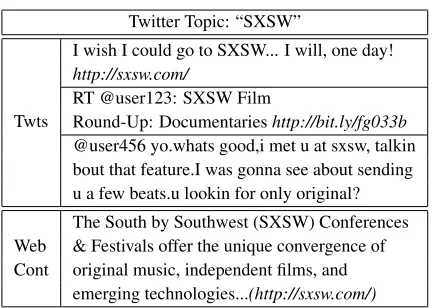
There are a lot of differences between tweets and traditional written text that has been widely used for automatic summarization. In Table 1, we show example tweets for the topic “SXSW”. The tweets were extracted by searching the Twitter site using the topic phrase as a query. We also provide an ex-cerpt of the linked web content to help understand the topic. The tweets present some unique charac-teristics:
• All tweets are limited to 140 characters. Some tweets are news headlines from the official me-dia, others are generated by users with vari-ous degrees of familiarity with the social me-dia. The resulting tweets can be very different regarding the text quality and word usage.
1They are referred to as topic phrases hereafter, with no dis-tinction between keywords and key phrases.
Twitter Topic: “SXSW”
Twts
I wish I could go to SXSW... I will, one day! http://sxsw.com/
RT @user123: SXSW Film
Round-Up: Documentarieshttp://bit.ly/fg033b @user456 yo.whats good,i met u at sxsw, talkin bout that feature.I was gonna see about sending u a few beats.u lookin for only original? The South by Southwest (SXSW) Conferences Web & Festivals offer the unique convergence of Cont original music, independent films, and
[image:2.612.78.295.53.207.2]emerging technologies...(http://sxsw.com/)
Table 1: Example tweets and an excerpt of the linked web content for Twitter topic “SXSW”.
• Tweets lack structure information, contain var-ious ill-formed sentences and grammatical er-rors. There are lots of noisy nonstandard to-kens, such as abbreviations (“feelin” for “feel-ing”), substitutions (“Pr1mr0se” for “Prim-rose”), emoticons, etc.
• Twitter invented its own markup language. “@user” is used to reply to a specific user or call for attentions. The hashtag “#topic” aims to assign a topic label to the tweet, and is fre-quently employed by the twitter users.
• Tweets frequently contain embedded URLs that direct users to other online content, such as news web pages, blogs, organization home-pages (Wu et al., 2011). According to Twitter’s news release in September 2010 (Rao, 2010), 25% of tweets contain an URL. These linked web pages provide a much richer source of in-formation than is possible in the 140-character tweet.
These Twitter-specific characteristics may pose challenges to the automatic summarization systems for identifying the essential information. In this pa-per, we focus on two such characteristics that are not studied in previous literature, the web content link and the non-standard tokens in tweets. Specif-ically, we ask two questions: (1) Is the web content linked from the tweets useful for summarization? Can we integrate different text sources, including the tweets and linked web pages, to generate more informative Twitter topic summaries? (2) what is the effect of nonstandard tokens on summarization
performance? Will the summaries be improved if the noisy tweets were pre-normalized into standard English sentences? We investigate these two ques-tions under a concept-based summarization frame-work using integer linear programming (ILP). We utilize text input that has various quality and is orig-inated from multiple sources, and thoroughly ana-lyze the resulting summaries using both automatic and human evaluation metrics.
2 Related Work
There is not much previous work on summarizing the Twitter topics. Most previous summarization lit-erature focused on the written text domain, as driven by the annual evaluation tracks of the DUC (Doc-ument Understanding Conference) and TAC (Text Analysis Conference). To some extent, Twitter topic summarization is related to spoken document sum-marization, since both tasks deal with the conver-sational text that is contributed by multiple par-ticipants and contains lots of ill-formed sentences, colloquial expressions, nonstandard word tokens or high word error rate, etc. To summarize the spo-ken text, (Zechner, 2002) aimed to address prob-lems related to disfluencies, extraction units, cross-speaker coherence, etc. (Maskey and Hirschberg, 2005; Murray et al., 2006; Galley, 2006; Xie et al., 2008; Liu and Liu, 2010a) incorporated lexical, structural, speaker, and discourse cues to generate textual summaries for broadcast news and meeting conversations.
bet-ter than the PR algorithm and other traditional sum-marization systems. Our approach of summarizing the Twitter topics is different from the above stud-ies in that, we focus on exploring richer informa-tion sources (such as the online web content) and in-vestigating effect of non-standard tokens. There are also studies working on visualizing Twitter topics by identifying a set of topic phrases and presenting the related tweets to users (O’Connor et al., 2010; Marcus et al., 2011). Our proposed approach can be beneficial to these systems by providing informative topic summaries generated from rich text sources.
3 Data Collection
We collected 5,537 topic phrases and the reference topic descriptions by crawling the Twitter.com and WhatTheTrend.com simultaneously during the pe-riod of Aug 22th, 2010 to Oct 30th, 2010 (about 70 days). The Twitter API was queried every 5 min-utes for the current top ten trending topics. For each of these topics, a search query was submitted to the Twitter Search API to retrieve only English tweets related to this topic. If any tweet contains embedded URLs linked to the other web pages, the contents of these web pages were retrieved. For each topic, we limit the maximum number of retrieved tweets to 5,000 and webpages to 100. An example is shown in Table 1 for a topic phrase, some related tweets, and an excerpt of the linked webpage. WhatTheTrend API provides short topic descriptions contributed and constantly updated by the Twitter users. There is also a manually assigned category tag for each topic phrase. We found the top categories among the collected topics are “Entertainment (29.26%)”, “Sports (25.58%)”, and “Meme (15.69%, pointless babble)”. We divided the collected topics into two groups: the general topics (e.g., “Chilean miners”, “MTV VMA”) and the hashtag topics that start with the “#” (e.g., “#top10rappers”, “#octoberwish”).
To generate reference summaries for the Twit-ter topics, two human annotators were asked to pick the topic descriptions/sentences (collected from WhatTheTrend.com) that are appropriate and valu-able to be included in the summary. This is per-formed on a selected set of 1,511 topics with both trending duration and number of tweets greater than our predefined thresholds. For each of the topic sen-tences, we ask the annotators to label its category:
(1) the sentence is a general description of the topic; (2) the sentence is trying to explain why the topic is trending; (3) it is hard to tell the difference. Over-all, the two annotators have good agreement (Kappa = 0.67) regarding whether or not to include a sen-tence in the summary. Among the selected summary sentences, 22.58% of them were assigned with con-flicting purpose tags such as (1) or (2). To form a reference summary, we concatenate all the topic sentences selected by both annotators. Since some reference descriptions are simply repetition of oth-ers with very minor changes, we reduce the dupli-cates by iteratively removing the oldest sentences if all the consisting words are covered by the remain-ing sentence collection, until no sentence can be re-moved. On average, the reference summary for gen-eral and hashtag topics contains 44 and 40 words respectively.
4 Summarization System
For each of the topic phrases, our goal is to gener-ate a short textual summary that can best convey the main ideas of the topic contents. We explore and compare multiple text sources as summarization in-put, including the user-contributed tweets, web con-tents linked from the tweets, as well as combination of the two sources. The concept-based optimization approach (Gillick et al., 2009; Xie et al., 2009; Mur-ray et al., 2010) was employed for selecting informa-tive summary sentences and minimizing the redun-dancy. Note that our focus of this paper is not devel-oping new summarization systems, but rather utiliz-ing and integratutiliz-ing different text sources for gener-ating more informative Twitter topic summaries.
4.1 Concept-based Optimization Framework
Concept-based summarization approach first ex-tracts a set of important concepts for each topic, then selects a collection of sentences that can cover as many important concepts as possible, while within the specified length limit. This idea is realized us-ing the integer linear programmus-ing-based (ILP) op-timization framework, with objective function set to maximize the sum of the weighted concepts:
max X
whereci is a binary variable indicating whether the concept i is covered by the summary; wi is the weight assigned toci.
We enforce two sets of length constraints to the summary: sentence- or word-based. Sentence con-straint requires the total number of selected sum-mary sentences to not to exceed a length limitL1; while word constraint requires the total words of selected sentences not to exceed length limit L2.
These two constraints are: X
j
sj < L1 or X
j
ljsj< L2
wheresjis a binary variable indicating whether sen-tencej was selected in the summary; lj represents the number of words insj.
Further, we connect conceptiwith sentencej us-ing two sets of constraints. For all the sentences that contain concept i, if any sentence was selected in the summary, the conceptishould be covered by the summary; reversely, if conceptiwas covered by the summary, at least one of the sentences containing conceptishould be selected.
∀i ci≤
X
j oijsj
∀i, j ci≥oijsj
where the binary variable oij is used to indicate whether conceptiexists in sentencej.
The concepts are selected by extracting n-grams (n=1, 2, 3) from the input documents corresponding to each topic. Similar to (Xie et al., 2009), we re-move (1) n-grams that appear only once in the docu-ments; (2) n-grams that have a consisting word with inverse document frequency (IDF) value lower than a threshold; (3) n-grams that are enclosed by higher order n-grams with the same frequency. These fil-ters are designed to exclude insignificant n-grams from the concept set. The IDF scores were calcu-lated from a large background corpus corresponding to the input text source, using individual sentences or tweets as pseudo-documents; words with low IDF scores (such as stopwords) tend to appear in many sentences and therefore should be removed from the concept set. We assign a weight wi to an n-gram concept as follows:
wi=tf(ngrami)×n×max
j idf(wij)
wheretf(ngrami)is the term frequency ofngrami in the input document of the topic; n denotes the order of ngrami; wij are the consisting words of
ngrami; idf(wij) represents IDF value of word
wij. This approach aims to extract n-grams that ap-pear frequently in each topic, but do not apap-pear fre-quently in a large background corpus. The weights are also biased towards longer n-grams since they carry more information.
4.2 Summarization Input
In this section, we explore different text sources as input to the summarization system. Different from previous studies that take input from a sin-gle text source, we propose to utilize both the user-contributed tweets and the linked web con-tents for Twitter topic summarization, since these two sources provide very different text quality and may contain complementary information regarding the topic. These text sources also pose great chal-lenges to the summarization system: the tweets are short and extremely noisy; while the online contents linked from the tweets may have vastly different lay-outs and contain a variety of information.
4.2.1 Original Tweets
As shown in Table 1, the initially collected tweets are very noisy. They are passed through a set of pre-processors to remove non-ascii characters, HTML special characters, URLs, emoticons, punctuation marks, retweet tags (RT @user), etc. We also re-move the reply (@) and hashtag (#) tokens that do not carry important syntactic roles (such as in the subject or object position) by using a set of regular expressions. These preprocessed tweets are sorted by date and taken as the first input source to the sum-marization system (denoted by “OrigTweets”).
4.2.2 Normalized Tweets
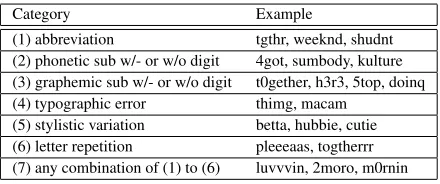
The original tweets contain various nonstandard word tokens. In Table 2, we list the possible to-ken categories and corresponding examples. We hy-pothesize that normalizing these nonstandard tokens into standard English words and using the normal-ized tweets as input can help boost the summariza-tion performance.
Category Example
(1) abbreviation tgthr, weeknd, shudnt (2) phonetic sub w/- or w/o digit 4got, sumbody, kulture (3) graphemic sub w/- or w/o digit t0gether, h3r3, 5top, doinq (4) typographic error thimg, macam
[image:5.612.76.296.56.148.2](5) stylistic variation betta, hubbie, cutie (6) letter repetition pleeeaas, togtherrr (7) any combination of (1) to (6) luvvvin, 2moro, m0rnin
Table 2: Nonstandard token categories and examples.
2011). Given a noisy tweet T, our goal is to nor-malize it into a standard English word sequenceS. Under the noisy channel model, this is equivalent to finding the sequenceSˆthat maximizesp(S|T):
ˆ
S= arg maxSp(S|T) = arg maxS(Q i
p(Ti|Si))p(S)
where we assume that each non-standard token Ti is dependent on only one English word Si, that is, we are not considering acronyms (e.g., “bbl” for “be back later”) in this study. p(S) can be calculated using a language model (LM). We formulate the process of generating a nonstandard tokenTi from dictionary word Si using a letter transformation model, and use the model confidence as the prob-abilityp(Ti|Si). This transformation process will be learned automatically through a sequence labeling framework. To form a nonstandard token, each let-ter in the dictionary word can be labeled with: (a) one of the 0-9 digits; (b) one of the 26 characters including itself; (c) the null character “-”; (d) a let-ter combination. We integrate characlet-ter-, phonetic-, and syllable-level features in the model that can ef-fectively characterize the formation process of non-standard tokens. In general, the letter transforma-tion approach will handle the nonstandard tokens listed in Table 2 yet without explicitly categorizing them. The proposed system also achieved robust performance using the automatically collected train-ing word pairs. On a test set of 3,802 distinct non-standard tokens collected from Twitter, our system achieved 68.88% 1-best normalization word accu-racy and 78.27% 3-best accuaccu-racy.
We identify the nonstandard tokens that need to be normalized using the following criteria: (1) it is not in the CMU dictionary2; (2) it does not contain capitalized letter; (3) it appears infrequently in the
2
http://www.speech.cs.cmu.edu/cgi-bin/cmudict
topic (less than a threshold); (4) it is not a popular chat acronyms (such as “lol”, “omg”); (5) it contains letters/digits/apostrophe, but should not be numbers only. These criteria are designed to avoid normaliz-ing the named entities, frequently appearnormaliz-ing out-of-vocabulary terms (such as “itunes”), chat acronyms, usernames, and hashtags. The selected nonstandard tokens in the original tweets will be replaced by the system generated 1-best candidate word. Note that we do not discriminate the context when replacing each nonstandard token. This will be addressed in the future work. We use these normalized tweets as a second source of summarization input and name them “NormTweets”.
4.2.3 Linked Web Contents
For each Twitter topic, we collect a set of web pages linked by the topic tweets and use them as another source of summarization input. For each topic, we select up ton(n= 10) URLs that appear most frequently in the topic tweets and infrequently across different Twitter topics. This scheme is sim-ilar to the TF-IDF measure. This way we can se-lect the salient URLs for each topic while avoiding the spam URLs. The contents of these URLs were collected and only distinct web pages were retained. We use an HTML parser3to extract the textual con-tents, and perform sentence segmentation (Reynar and Ratnaparkhi, 1997) on the parsed web pages. All the pages corresponding to the same topic were sorted by the date they were first cited in the tweets. These web pages were taken as another input text source for the summarization system, denoted as “Web”.
4.2.4 Combining Tweets and Web Contents
We expect that taking advantage of both tweets and linked web contents would benefit the topic summarization system. Consolidating the distinct text sources may help boost the weight of key con-cepts and eliminate the spam information. As a pre-liminary study, we investigate concatenating either the original tweets or the normalized tweets with the linked web pages as input to the concept-based summarization system. This results in two inputs “Web + OrigTweets” and “Web + NormTweets”. We will explore other ways of combining the two text
3
sources in future work.
5 Experiments
5.1 Experimental Setup
Among the collected topics, we select 500 general topics (such as “Chilean miners”) and 50 hashtag topics (such as “#octoberwish”, “#wheniwasakid”) for experimentation. On average, a general topic contains 1673 tweets and 3.43 extracted linked web pages; while a hashtag topic contains 3316 tweets but does not have meaningful linked web pages.
The concept-based optimization system was con-figured to extract a collection of sentences/tweets for each topic, using either the sentence- or word-constraint (denoted as “#Sent” and “#Word”). We opt to set individual length constraint for each topic rather than using a uniform length limit for all the topics, since the topics can be very different in length and duration. We use the number of tences/words in the reference summary as the sen-tence/word constraint for each topic. Note that in practice this reference summary length information may not be available. We use the length constraints obtained from the reference summary in this ex-ploratory study, since our focus is to first evaluate if twitter trending summarization is feasible, and what are the effects of different information sources and non-standard tokens. For a comparison to our ap-proach, we implement the Hybrid TF-IDF approach in (Sharifi et al., 2010b; Inouye, 2010) as a baseline using “OrigTweets” as input. For the baseline, the summary length is altered according to the sentence-or wsentence-ord-constraint. The last summary tweet is cut in the middle if it exceeds the word limit.
The ROUGE-1 F-scores (Lin, 2004) are used to measure the n-gram (n=1) overlap between the sys-tem summaries and reference summaries. Since the ROUGE scores may not correlate well with the hu-man judgments (Liu and Liu, 2010b), we also per-formed human evaluation by asking annotators to score both the system and reference summaries re-garding the linguistic quality and content respon-siveness, in the hope this will benefit future research in this direction.
5.2 Automatic Evaluation
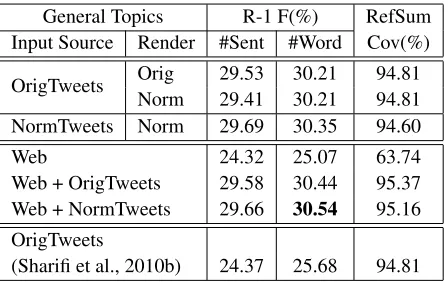
We present the results (ROUGE-1 F-measure) for the general topics in Table 3. ROUGE-2 and
General Topics R-1 F(%) RefSum Input Source Render #Sent #Word Cov(%)
OrigTweets Orig 29.53 30.21 94.81 Norm 29.41 30.21 94.81 NormTweets Norm 29.69 30.35 94.60 Web 24.32 25.07 63.74 Web + OrigTweets 29.58 30.44 95.37 Web + NormTweets 29.66 30.54 95.16 OrigTweets
[image:6.612.316.540.56.197.2](Sharifi et al., 2010b) 24.37 25.68 94.81
Table 3: ROUGE-1 F-measure and reference summary coverage scores for general topics.
ROUGE-4 scores show similar trends and thus are not presented. Five different text sources were ex-ploited as the system inputs, as described in Sec-tion 4.2. To measure the quality of the input for summarization, we also include reference summary coverage score in the table, defined as the percent-age of words in the reference summary that are cov-ered by the input text source. When using tweets as input, we also investigate whether we should ap-ply tweet normalization before or after the summa-rization process, that is “pre-normalization” (using “NormTweets” as input), or “post-normalization” (using “OrigTweets” as input, and rendering the nor-malized summary tweets).
useful information for generating summaries. Re-garding normalization, results show that the “pre-normalization” (using normalized tweets as input) can generally improve the summary tweet selec-tion. For general topics, the best performance was achieved by combining the normalized tweets and linked web pages as input source and using the word-level constraint.
Hashtag Topics R-1 F(%) RefSum Input Source Render #Sent #Word Cov(%)
OrigTweets Orig 9.08 7.19 93.93 Norm 9.09 7.16 93.93 NormTweets Norm 9.35 7.14 93.71 OrigTweets
[image:7.612.316.538.364.463.2](Sharifi et al., 2010b) 7.03 7.72 93.93
Table 4: ROUGE-1 F-measure and reference summary coverage scores for hashtag topics.
Results for hashtag topics were shown in Table 4 using tweets as input (there are no linked web-pages for these topics). We notice the reference cov-erage scores are satisfying, yet the system output barely matches the reference summaries (very low ROUGE-1 scores). Looking at the reference and system generated summaries for the hashtag top-ics, we found the system output is more specific (e.g., “#octoberwish everything goes well.”), while the reference summaries are often very general (e.g., “people tweeting about their wishes for October.”). The human annotators also noted that most hashtag topics (such as “#octoberwish”, “#wheniwasakid”) are self-explainable and may require special atten-tion to redefine an appropriate summary. Using sentence constraints yields better performance than word-based one, with larger performance difference than that for the general topics. We found the word-constraint summaries tend to include tweets that are very short and noisy. Our system with sentence-based length constraint also significantly outperforms the Hybrid TF-IDF approach (Sharifi et al., 2010b; Inouye, 2010). For hashtag topics, the best performance was achieved using the “pre-normalization” with sentence constraint.
For an analysis, we generate oracle system per-formance by using the reference summaries to ex-tract a set of unweighted concepts to use in the ILP optimization framework for sentences/tweets selec-tion. This results in 61.76% ROUGE-1 F-score for
the general topics and 40.34% for the hashtag topics, indicating abundant space for future improvement. We also notice that though there is some perfor-mance gain using normalized tweets and linked web contents, the improvement is not statistically signifi-cant as compared to using the original tweets. Upon closer examination, we found the normalization sys-tem replaced 1.08% and 1.8% of the total word to-kens for the general and hashtag topics respectively; these tokens spread in 13.12% and 16.85% of the total tweets. The relatively small percentage of the normalized tokens partly explains the marginal per-formance gain when using the normalized tweets as input. Similarly for linked web content, though it contains some sentences that can provide more de-tails of the topic, but they can also take more space in the summary as compared to the short and con-densed tweets. Therefore using the combined tweets and linked webpages does not significantly outper-form using just the tweets.
5.3 Human Evaluation
General Hashtag Tweet Web Ref Tweet Ref Gram. 3.13 3.42 4.52 3.04 4.24 NRedun. 3.93 4.64 4.30 4.82 3.62 Clarity 4.07 3.91 4.77 4.06 4.60 Focus 3.64 3.03 4.75 3.22 4.72 Content 2.82 2.55 n/a 2.60 n/a ExtraInfo n/a 2.63 n/a n/a n/a
Table 5: Linguistic quality, content coverage, and useful-ness scores judged by human assessors.
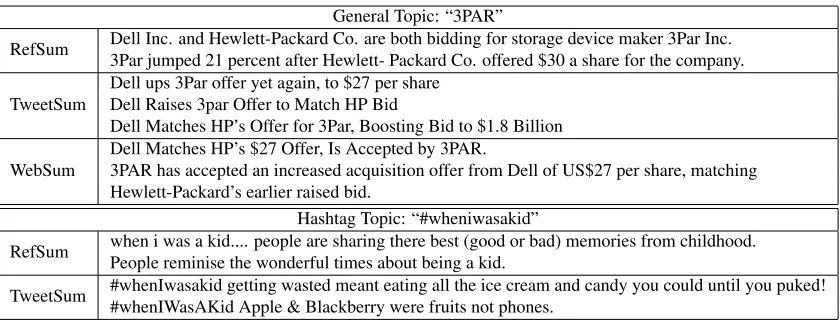
General Topic: “3PAR”
RefSum Dell Inc. and Hewlett-Packard Co. are both bidding for storage device maker 3Par Inc. 3Par jumped 21 percent after Hewlett- Packard Co. offered $30 a share for the company. TweetSum
Dell ups 3Par offer yet again, to $27 per share Dell Raises 3par Offer to Match HP Bid
Dell Matches HP’s Offer for 3Par, Boosting Bid to $1.8 Billion WebSum
Dell Matches HP’s $27 Offer, Is Accepted by 3PAR.
3PAR has accepted an increased acquisition offer from Dell of US$27 per share, matching Hewlett-Packard’s earlier raised bid.
Hashtag Topic: “#wheniwasakid”
RefSum when i was a kid.... people are sharing there best (good or bad) memories from childhood. People reminise the wonderful times about being a kid.
[image:8.612.97.517.55.216.2]TweetSum #whenIwasakid getting wasted meant eating all the ice cream and candy you could until you puked! #whenIWasAKid Apple & Blackberry were fruits not phones.
Table 6: Example system and reference summaries for both general and hashtag topics.
asked to judge all the summaries and assign a score for each criterion on a 1 to 5 Likert scale (5 being the best quality). The average scores of the two as-sessors were presented in Table 5.
For general topics, the “Web” summaries outper-form the “Tweet” summaries on both grammatical-ity and non-redundancy, confirming the advantage of using the high-quality linked web pages. The referential clarity and focus scores of the “Web” summaries are not very high, since the summary sentences were extracted simultaneously from sev-eral web pages, and the system subjects to simi-lar challenges as in multi-document summarization. The content coverage scores of both system sum-maries seem to correlate well with the ROUGE-1 F-measure, with a higher score for “Tweet” sum-maries. The assessors also rated that 48% of the “Web” summaries contain “Somewhat Useful” ex-tra topic information, and 21% are “Very Useful”. Note that this could be just because of the inherent difference of the two summaries, regardless of the input source, but in general we believe the linked web pages (such as the news documents) can pro-vide more detailed and coherent stories as compared to the 140-character tweets. For hashtag topics, the “Tweet” summaries yield worse grammaticality and focus scores, but have very high non-redundancy score. On the contrary, the reference summaries often contain redundant information. The content match score between the system and reference sum-maries (2.6) does not seem to reflect the ROUGE scores. We hypothesize that even though the speci-ficity of the two summaries is different, the
asses-sors may still think the system summaries match the reference ones to some extent. A larger scale human evaluation is needed to study the correlation between human and automatic evaluation.
5.4 Discussions
We show an example of reference and system gen-erated summaries for a general and a hashtag topic in Table 6, and summarize some challenges for this summarization task below:
• Gold standard summaries are difficult and
time-consuming to obtain. The reference de-scriptions from WhatTheTrend.com were cre-ated by Twitter users, which vary a lot in word usage and would be unavoidably biased to the information available in Twitter. The user-contributed descriptions may also contain spam descriptions, repetitions, nonstandard to-kens, etc. It would be better to have a con-cise non-redundant sentence collection for de-veloping future summarization systems. In particular, hashtag topics need special atten-tion. They account for 40% of the total trend-ing topics in 2010 accordtrend-ing to the statistics in WhatTheTrend.com4. Yet there still lacks standard definition regarding a good hashtag summary. From the example topic “#wheni-wasakid” in Table 6, we can see they are very different in nature from general topics, thus fu-ture efforts are needed to define an appropriate summary.
4
• Evaluation issues. Word based evaluation measures will rarely consider semantic relat-edness between concepts, or name entity vari-ations, such as “Hewlett-Packard” vs. “HP”, “Dell ups 3Par offer” vs. “Dell Raises 3par Offer”, etc. When comparing the system summaries with short human-written reference summaries, the word overlap varies a lot for different human summarizers.
• Dynamically changing topics/events. Some
general topics are related to events that are con-stantly changing. Take the “3PAR” topic in Table 6 as an example, where two companies take turns to raise the bid for 3Par Inc. A good topic summary should be able to develop a se-ries of sub-events and show the topic evolving process.
6 Conclusion
In this paper, we proposed to explore a variety of text sources for summarizing the Twitter topics. We em-ployed the concept-based optimization framework with multiple input text sources to generate the sum-maries. We conducted both automatic and human evaluation regarding the summary quality. Better performance is observed when using the normalized tweets as input, indicating special treatment should be performed before feeding the noisy tweets to the summarization system. We also found the linked web contents can provide extra useful topic infor-mation. In future work, we will compare our sys-tem with other dedicated microblog summarization systems, as well as address some of the challenges identified in this study.
Acknowledgments
This work is partly supported by NSF award IIS-0845484. Any opinions expressed in this work are those of the authors and do not necessarily reflect the views of NSF.
References
Michel Galley. 2006. A skip-chain conditional random field for ranking meeting utterances by importance. In
Proc. of EMNLP.
Dan Gillick, Korbinian Riedhammer, Benoit Favre, and Dilek Hakkani-T¨ur. 2009. A global optimization
framework for meeting summarization. In Proc. of ICASSP.
David Inouye. 2010. Multiple post microblog summa-rization. REU Research Final Report.
Chin-Yew Lin. 2004. ROUGE: A package for automatic evaluation of summaries. InWorkshop on Text Sum-marization Branches Out.
Fei Liu and Yang Liu. 2010a. Exploring speaker char-acteristics for meeting summarization. InProc. of
IN-TERSPEECH.
Feifan Liu and Yang Liu. 2010b. Exploring correlation between ROUGE and human evaluation on meeting summaries. IEEE Transactions on Audio, Speech, and Language Processing, 18(1):187–196.
Fei Liu, Fuliang Weng, Bingqing Wang, and Yang Liu. 2011. Insertion, deletion, or substitution? Normaliz-ing text messages without pre-categorization nor su-pervision. InProc. of ACL-HLT.
Adam Marcus, Michael S. Bernstein, Osama Badar, David R. Karger, Samuel Madden, and Robert C. Miller. 2011. TwitInfo: Aggregating and visualizing microblogs for event exploration. InProc. of CHI. Sameer Maskey and Julia Hirschberg. 2005.
Compar-ing lexical, acoustic/prosodic, structural and discourse features for speech summarization. In Proc. of Eu-rospeech.
Gabriel Murray, Steve Renals, Jean Carletta, and Johanna Moore. 2006. Incorporating speaker and discourse features into speech summarization. InProc. of HLT-NAACL.
Gabriel Murray, Giuseppe Carenini, and Raymond Ng. 2010. Interpretation and transformation for abstract-ing conversations. InProc. of NAACL.
Brendan O’Connor, Michel Krieger, and David Ahn. 2010. Tweetmotif: Exploratory search and topic sum-marization for twitter. In Proc. of the International AAAI Conference on Weblogs and Social Media. Leena Rao. 2010. Twitter seeing 90
mil-lion tweets per day, 25 percent contain links.
http://techcrunch.com/2010/09/14/twitter-seeing-90-million-tweets-per-day/.
Jeffrey C. Reynar and Adwait Ratnaparkhi. 1997. A maximum entropy approach to identifying sentence boundaries. InProc. of the Fifth Conference on Ap-plied Natural Language Processing.
Beaux Sharifi, Mark-Anthony Hutton, and Jugal Kalita. 2010a. Summarizing microblogs automatically. In
Proc. of HLT/NAACL.
Shaomei Wu, Jake M. Hofman, Winter A. Mason, and Duncan J. Watts. 2011. Who says what to whom on twitter. InProc. of WWW.
Shasha Xie, Yang Liu, and Hui Lin. 2008. Evaluating the effectiveness of features and sampling in extractive meeting summarization. In Proc. of IEEE Workshop on Spoken Language Technology.
Shasha Xie, Benoit Favre, Dilek Hakkani-T¨ur, and Yang Liu. 2009. Leveraging sentence weights in a concept-based optimization framework for extractive meeting summarization. InProc. of INTERSPEECH.
Klaus Zechner. 2002. Automatic summarization of open-domain multiparty dialogues in diverse genres.