Predictive FTF Adaptive Algorithm for
Mobile Channels Estimation
Qassim Nasir
Department of Electrical and Computer Engineering, University of Sharjah, Sharjah, UAE Email: [email protected]
Received January 27,2012; revised March 9, 2012; accepted July 25, 2012
ABSTRACT
The aim of this research paper is to improve the performance of Fast Transversal Filter (FTF) adaptive algorithm used for mobile channel estimation. A multi-ray Jakes mobile channel model with a Doppler frequency shift is used in the simulation. The channel estimator obtains the sampled channel impulse response (SIR) from the predetermined training sequence. The FTF is a computationally efficient implementation of the recursive least squares (RLS) algorithm of the conventional Kalman filter. A stabilization FTF is used to overcome the problem caused by the accumulation of roundoff errors, and, in addition, degree-one prediction is incorporated into the algorithm (Predictive FTF) to improve the estimation performance and to track changes of the mobile channel. The efficiency of the algorithm is confirmed by simulation results for slow and fast varying mobile channel. The results show about 5 to 15 dB improvement in the Mean Square Error (Deviation) between the estimated taps and the actual ones depending on the speed of channel time variations. Slow and fast vehicular channels with Doppler frequencies 100 Hz and 222 Hz respectively are used in these tests. The predictive FTF (PFTF) algorithm give a better channel SIR estimation performance than the conventional FTF algorithm, and it involves only a small increase in complexity.
Keywords: Mobile Channel Estimation; Fast Transversal Filter; Prediction; Adaptive Filtering Algorithms
1. Introduction
The time varying multi-path fading channel that exists in mobile communications environment lead to severe In- ter-symbol Interference (ISI). In order to achieve high speed reliable communication, channel estimation is ne- cessary to combat ISI [1]. Channel estimators estimates SIR by periodically adjusting an adaptive linear filter ac- cording to an algorithm so as to minimize the error between the output of the channel estimator and the received sig- nal [2,3]. There are two major families of adaptive algo- rithms. The first family is around the stochastic gradient or least mean-square (LMS) algorithm which works well if the communications channel is fixed or slow time vary- ing [4]. LMS is popular because of its low complexity, which is 2N (N is the number of adaptive filter length) and its robustness. For fast time varying mobile channel, the performance of LMS tracking scheme is poor [4]. The second family is based on recursive least squares (RLS) algorithm that minimizes a deterministic sum of squared error [2]. The RLS algorithm is known to be capable of performing better performance than LMS, but suffers from computational complexity of O(N2) opera- tions per symbol [5,6]. When channel estimator has no prior knowledge of the channel, a algorithm gives better convergence rate compared to that of LMS [2]. The RLS
computational complexity restrict its use, so a number of fast RLS algorithms have been presented such as Fast Transversal Filter (FTF) [7,8], and fast a posteriori error sequential technique (FAEST) [9]. They reduce the com- putational complexity from O(N2) to O(N) operations per symbol by using shifting and avoiding matrix-by-vector multiplications. This paper studies the application of the improved FTF algorithm to mobile channel estimation. A lower computational complexity FTF has been introduced in [10] which reduces the computation to O(7N).
Prediction is coupled with LMS to improve chhanel estimation of the VHF radio links channel taps as in [15] and for also for mobile channels estimation as in [16]. Shimamura et al. [17] applied the same technique to de- sign estimation based equalizers. Multistep adaptive al- gorithm has been presented by Gazor as Second Order LMS (SOLMS) for slow time varying channel to im- prove the tracking capabilities when some prior informa- tion is available on the time variation of the channel [18]. To track time varying channels, he applied a simple smoothing on the increments of the estimated weights to estimate the speed of the weights. The estimated speed is then used to predict the weights of the next iteration [18].
In this paper stabilized FTF with degree-1 Least Square (LS) fading expanded memory prediction (Predictive FTF-PFTF) is proposed for mobile channel estimation. The prediction technique in [19] is applied to update the estimates of the sampled impulse response (SIR) of mobile channel.
The performance of conventional FTF, PFTF is dem- onstrated by simulations. The results show that PFTF provides superior steady state performance relative to the conventional FTF.
2. FTF Algorithm for Mobile Channel
Estimation
The mobile channel is assumed to follow Jakes fading Model [20]. The Jakes fading model is a deterministic method for simulating multi-path fading channels. The model assumes that multiple rays arrive at a mobile re- ceiver with uniformly distributed arrival angles (αn). Every ray experiences a Doppler shift of fd = fmcos(αn), where fm vf cc , v is the speed of the mobile receiver,
fc is transmitter carrier frequency, c is the speed of light
(c= 3 108m
s
).
The fading in each path of the channel follows Rayleigh distribution and has U-shaped power spectral density as given by Jakes [20].
21
( ) = ,
1
m m
S f
f f f
fm f fm
r ' Y = = = i i i
i i i
r n
r
e r r
T i i T i i Y S Y S
= y ,y , ,y
(1)
The relative strength of the paths has assumed to have an exponential power delay profile. For simulation pur-pose, the mobile channel is modeled as three tap finite impulse response (FIR) filter with delay between succes-sive filter taps is assumed to be symbol period. The filter taps or coefficients, Yi, are time varying and generated as complex Gaussian according to the Jakes model for fad-ing channel simulator [20]. The performance of proposed channel estimator algorithm is evaluated for doppler fre-quencies of 100 Hz and 222 Hz, corresponding to a
ve-hicular channels with speeds of 54 km/hr and 120 km/hr respectively.
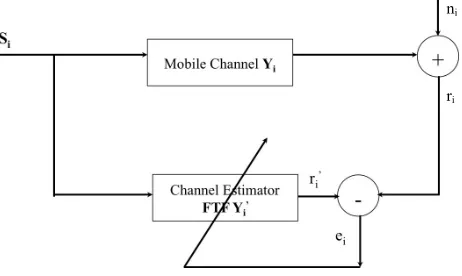
Assume that Si is the transmitted sequence (assumed stationary), Yi is channel sampled impulse response, ni is the noise, ri is the received symbol, i is the i-th esti-mate of the received symbol and i is the estimate of the channel impulse response. All of the above quantities are measured at iT time instant, where T is the sampling time. The received signal (ri) is given by
(2)
where i i,0 i,1 i N, 1, and Si = [si, si–1, ···,
si–N]. Yi, Si are N component vector, where N is the number of paths in the multi-ray mobile channel. Si is a pseudo-random signal with values of either +1 or –1. The channel output signal is corrupted by an additive white Gaussian noise (AWGN), ni, with variance σ2 and zero mean, which is assumed to be uncorrelated to Si. Adap-tive digital filter can be used to estimate the sampled channel impulse response. It consists of Finite Impulse Response (FIR) filter with variable tap weights. These tap weights are adjusted according to FTF method of updating weights as shown in the estimator block dia-gram in Figure 1.
Y
r
The conventional FTF algorithm forms an estimate of the received sample i. The estimator next forms the error signal ei. The estimated channel sampled impulse response i is obtained recursively in such a way that the cumulative squared error measure ci is minimized [2,7].
Y
2
=1 = i i h
i h
h
c
e (3)The quantity ci is the cumulative sum of the weighted squared errors. The parameter λis a real-valued constant in the range 0 to 1. λ is a weighting factor that introduces an exponential window into the processed samples and is, therefore, sometimes called the fade factor or the for-
ni
[image:2.595.309.540.584.722.2]ri
getti ing
i
i i 1 i
Y Y )
where ki , is the Kalman gain vecto th
n estimate of the sampled impulse- re
i
ivation of fundamental fast trans-ve
explain this diver- ng factor for the filter. It is similar to pre-window except that one fixed λ slightly less than unity to track time variations. Yi is determined recursively as in [7].
= e
k (4
r. FTF which will be used in is paper as a recursive computation of Kalman gains shows a complexity of O(N) where N is the number of taps of the channel ( number of mobile channel rays in this paper) [7]. The FTF algorithm uses four transversal filters in order to obtain the channel estimate [7,8] as shown in Figure 2.
One filter gives a
sponse of the HF channel. The other three filters, called the forward predictor filter, the backward predictor filter, and the gain transversal filter are used in the estimation of the Gain Transversal Filter gain vector (k, in (4)).
For each of the four filters an estimation error is first evaluated followed by the updating of the tap coefficients (tap gains) of the filter. All of the four filters share the same input data vector. The complete derivation of the algorithm is beyond the scope of this paper and is given elsewhere [2] and [7].
In [2] and [7], a der
rsal filter equations comes to a 7N fast RLS algorithm for system identification. The prediction part of the algo-rithm uses a system of four different filters that are cou-pled by the recursions A, B are, respectively, forward and backward prediction error filters, and is K is Gain Transversal Filter. αi, and βi are real valued scalars rep-resent the weighted sum of squares of forward and back-ward prediction errors. γi is a real valued scalar which gives a measure of error in adjustment of gain transversal filter weights.
3. Stabilized FTF Algorithm
Four main reasons can be given to
gence: erroneous or approximate equation (inclusion of
[image:3.595.307.538.353.738.2]f(n) rf αi b(n) rb βi γ(n) ε(n) ei
Figure 2. FTF estimator transversal filters components.
th d
de to stabilize the FFT by rescue m
r γ(n) di
e forgetting factor), ill conditioning of the compute correlation matrices, effects of the suboptimal initializa-tion procedure, and accumulainitializa-tion of finite precision er-rors [21]. There exits a tradeoff exists in the selection of the forgetting factor λ. Decreasing λ stabilizes the RLS algorithm, however, at the cost of increasing noise due to round-off error [21].
Attempts were ma
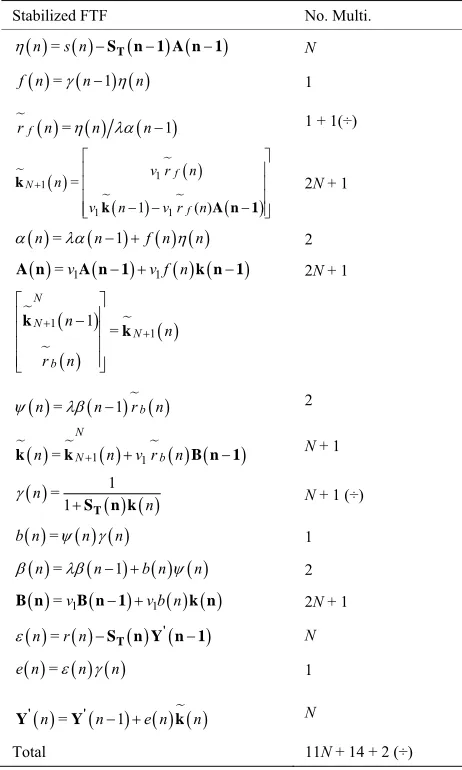
ethods [23]. [23] has introduced a rescue method that effectively monitors the rescue variable until a point just prior to the sign reversal, and then rescues the algorithm by restarting with a weighted initial condition. Alterna-tive methods for stabilizing the FTF algorithm have been introduced in [22-25]. These algorithms use a multiplica-tive leakage factor (v1) in the forward and backward pre-dictor updates, such that the numerical errors associated with their calculations decay to zero over time. Table 1 shows the FTF algorithm with leakage correction.
The algorithm computes the convergence facto rectly using the normalized Kalman gain vector K
nTable 1. FTF algorithm with leakage correction. Stabilized FTF No. Multi.
n =s n
ST n 1 A n 1 N
= 1
f n n n
1
= 1
f
r n n n
1 + 1(÷)
1 1 1 1 =
1 ( ) f N
f
v r n
n
v n v r n
k
k A n 1
2N + 1
n = n 1 f n n
2
=v1 v f n1
A n A n 1 k 1 + 1
1 1 1 = N N N b n n r n k k
n = n 1 rb n
2
= 1 1 N
N b
n n v r n
n 2N
k k B n 1 N + 1
= 1 1
n
n
ST n k
N + 1 (÷)
=
b n n n 1
n = n 1 b n n
2
=v1 v b n1
B n B n 1 k n + 1
n =r n
2N
' T
S n Y n 1 N
=
e n n n
n = n 1 e n n
' '
Y Y k N
Total 11N + 14 + 2 (÷)
[image:3.595.58.289.560.721.2]a put signal vector X(n). The m kage
To erformance of FTF algorithm for track-
b
nd in ultiplicative lea
factor (v1) has to be in the rage 0 ≤ v1≤λ for stable op-eration. This algorithm has O(11N) computational com-plexity if leakage is employed at each time instant. While simulations in [25] indicate the useful behavior of the new stabilized algorithm. [24] analyze the stabilized FTF algorithm and show that the FTF algorithm employing the leakage-based update in Table 1 is numerically stable if v1 is chosen in the range 0 < v1 < λ. Computer simula-tions indicate the level of accuracy and show the useful-ness of the stabilized FTF algorithm with leakage correc-tion to track mobile channel estimacorrec-tion.
4. Proposed Predictive FTF (PFTF)
Algorithm
improve the p
ing time varying channel a prediction scheme is used. In [19], so called “degree-1 Least Square fading memory prediction” was employed to take a priori information about the channel into the estimation scheme. The meth- od of least square fading memory prediction is based on the fact that a better prediction of Yi+1 from the se-quence of vectors Yi, Yi 1 , ···, is o tained by deter-mining the set of n + 1 pol omials of given degree (0, 1 or 2) each of which gives the LS fit to the components in the corresponding locations in the vectors Yi,
yn
i01
Y , ···,
and then using the values of the polynomial at tim
t = (i + 1)T to determine the i-th component of e
i+1 st f
ve shown that degree-1 polynomial
Y .
Each chosen polynomial is such that it gives the be it to the sequence of past measurements, in the sense that the exponentially weighted sum of the squares of the pre- diction errors is minimized, for the given degree of the polynomial [26,27].
Extensive tests ha
filters generally give the best overall performance, and, in spite of the additional coupling (feedback) introduced here by using updated estimates in place of independent measurements, the technique substantially improves the overall performance of the estimator, without any sign of instability. Further details of the polynomial filters are given elsewhere [26,27].
Thus, it behaves as a coefficient prediction filter. So, FTF with LS expanded fading memory prediction algo-rithm (PFTF) which is proposed in this paper to improve mobile channel estimation is given by the following set of equations [16,26,27]:
=
i i 1
1 i
i 1 i i
Y E Y E (5)
where α = (1 – θ2) andβ= (1 – θ2) are real-valued scalars,
n by equation 5, for use with the FTF al
esults
ons were carried out to com- conventional FTF, proposed
i i
Y = Y Y = Y
i
E Y
and θ is the smoothing constant (should be between 0 and 1) that controls the forgetting amount of the past in a
compromise with an accurate estimate. θhas to be tuned depending on signal to noise ratio (SNR) and channel behavior (speed of variation). PFTF algorithm assumes that the sampled impulse-response of the channel varies linearly with time.
Computer-simulation tests, on the accuracy of the one step prediction give
gorithm, have shown a useful improvement in the per-formance of the channel estimator without any sign of instability. The additional complexity is only 2N opera-tions per symbol.
5. Simulation R
Extensive computer simulati pare the performance of the
predictive FTF (PFTF) for tracking mobile channels. The input to the channel is a pseudo random sequence of +1, –1 and white Gaussian noise of different variances is used through out the test. In these simulations, slow and fast vehicular mobile channels with doppler frequency of 100 Hz, and 222 Hz respectively is used (equivalent to the mobile speed of 54 km/hr, and 120 km/hr at 2 GHz carrier frequency and signal rate of 15 ksymbol/sec). The mobile channels are assumed to have three paths. The variations of theses taps against time is shown in Figure 3. The Signal to Noise Ratio (SNR) used is
2
10
10log 1 where σ2 is the noise variance. Each transmission burst consist of 10000 symbo
rror (MSE) between the estimated chan-nel taps and the actual once is obtained as average of 10 independent trials. The MSE is a measure of actual error in channel estimation. During the first 500 of these tests, the estimator is in startup, so no measurements is done s it is in a transient period. MSE is defined as
ls and the Mean Square E
100000
2 10
MSE = 10log
Yi Yi 1 50(6)
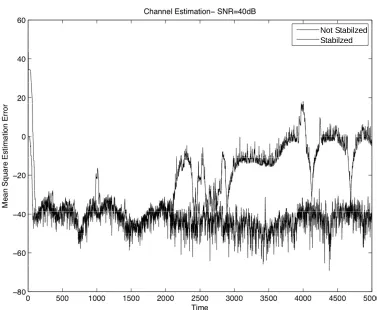
Figure 4 shows and for SNR = 40 dB a
mobile channel, the conventional and stabilized FTF pe
5 and 6. Th
othing constant) as
nd fast varying
rformance. It is clear that and after few thousands of received symbols, the unstabilized estimators got a di-vergence operation when used for such channels.
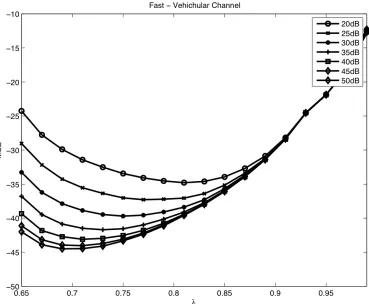
The MSE has been collected for different values of λ
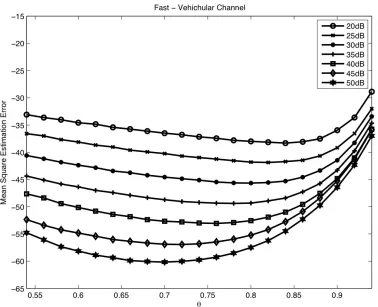
(weighting factor) and SNRs is shown in Figures e purpose of these tests is to collect the optimum val-ues of λ. These values which correspond to minimum MSE will be used in comparisons with PFTF perform-ance. It is clear that optimum values of λ decrease as the speed of channel variations is increases.
Using these optimum values, the MSE of PFTF is plotted against different values of θ (smo
Figure 3. Mobile channel taps weights variations according to Jakes’ Model.
Not St
Stabilzed abilzed
[image:5.595.107.484.409.719.2]Figure 5. FTF performance against weighting factor (λ) for slow channel.
[image:6.595.116.485.416.720.2]Figure 7. PFTF performance against smoothing constant (θ) for slow channel.
[image:7.595.111.489.413.720.2]Figure 9. PFTF and FTF transient channel estimation performance.
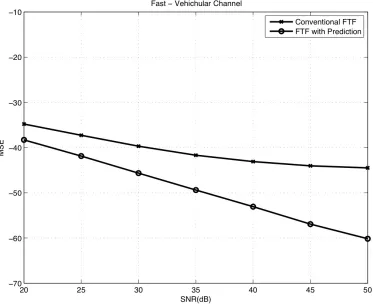
[image:8.595.111.487.406.717.2]Figure 11. PFTF and FTF performance against SNR for slow channel. for performance comparisons.
longer than for FTF as shown in Figure 9, so it is rec-ommend that the receiver starts with FTF for a few hun-dreds and then switch to PFTF.
Figures 10 and 11 compares the performance of mobile channel estimation using conventional FTF and PFTF schemes. It can be seen that the steady state performance of the proposed PFTF compared with the conventional FTF is improved by about 5 dB for poor SNR (20 dB) while it gains around 15 dB for a SNR of 50 dB. PFTF achieve considerable improvements in mobile channel estimation performance compared to conventional FTF, this due to prediction used in PFTF within the channel estimator operation.
6. Conclusion
Mobile Channel estimation based on FTF with degree-1 Least Square fading memory prediction (PFTF) has been explored. Based on a steady state mean performance PFTF offers a quite distinct benefit in comparison with the conventional FTF—based method. Simulation results show that under the well accepted Jakes’ fading channel model, the PFTF based offers about 5 dB to 15 dB bene-fit vehicular mobile channel estimation over FTF based algorithm when SNR is 20 dB and 50 dB respectively. It is shown that the algorithm has the capability of tracking
le channels. Also PFTF does not add any substantial computation complexity.
REFERENCES
[1] J. G. Proakis, “Digital Communications,” McGraw Hill Inc., Boston, 1995.
[2] S. Haykin, “Adaptive Filter Theory,” 3rd Edition, Pren-tice Hall, Upper Saddle River, 1996.
[3] A. Benveniste, M. Metivier and P. Priouret, “Adaptive Al- gorithms and Stochastic Approximation,” Springer-Ver- lag, New York, 1990.
[4] L. Lindbom, A. Ahlen, M. Sternad and M. Falkenstrom, “Tracking of Time-Varying Mobile Radio Channels. I. The Wiener LMS Algorithm,” IEEE Transactions on Com- munications, Vol. 49, No. 12, 2001, pp. 2207-2217. doi:10.1109/26.974267
The setup time for PFTF is slow and fast time varying mobi
[5] E. Eleftheriou and D. Falconer, “Tracking Properties and Steady-State Performance of RLS Adaptive Filter Algo- rithms,” IEEE Transactions on Acoustics, Speech and Signal Processing, Vol. 34, No. 5, 1986, pp. 1097-1110. doi:10.1109/TASSP.1986.1164950
[6] S. F. A. Shah and Q. Nasir, “Tracking of Mobile Fading Channels by Predictive Type RLS Algorithm,” Interna- tional Symposium on Wireless Systems and Networks, Dhahran, 24-26 March 2003.
actions onAcoustics, S
32, No. 2, 1984, pp. 304-337.
peech and Signal Processing, Vol.
doi:10.1109/TASSP.1984.1164334
[8] J. M. Cioffi and T. Kailath, “Windowed Fast Transversal Filters Adaptive Algorithms with Normalization,” IEEE Transactions onAcoustics, Speech and Signal Processing, Vol. 33, No. 3, 1985, pp. 607-625.
doi:10.1109/TASSP.1985.1164585
[9] G. Carayannis, D. Manolakis and N. Kalouptsidis, “A Fast Sequential Algorithm for Least Squares Filtering and Pre-diction,” IEEE Transactions on Acoustics, Speech and Signal Processing, Vol. 31, No. 6, 1983, pp. 1394-1402. doi:10.1109/TASSP.1983.1164224
[10] M. Arezki, A. Benallal, A. Guessoum and D. Berkani, “Im- provement of the Simplified FTF-Type Algorithm,” Jour- nal of Computer Science, Vol. 5, No. 5, 2009, pp. 347- 354.
[11] J. M. Cioffi, “Limited Precision Effect in Adaptive
Fil-ransactions on Circuits and Systems, Vol. pp. 1097-1100.
tering,” IEEE T
34, No. 7, 1987,
doi:10.1109/TCS.1987.1086209
[12] Y. H. Wang, K. Ikeda and K. Nakayama, “A Numerically Stable Fast Newton-Type Adaptive Filter Based on Order Recursive Least Squares Algorithm,” IEEE Transactions on Signal Processing, Vol. 51, No. 9, 2003, pp. 2357- 2368. doi:10.1109/TSP.2003.815357
[13] J. L. Botto and G. V. Moustakides, “Stabilization of Fast RLS Transversal Filters,” Institute de Recherche en In-formatique et en Automatique, Paris, 1986.
[14] D. T. M. Slock and T. Kailath, “Numerically Stable Fast Recursive Least-Squares Transversal Filters,” Proceed-ings of International Conference on Acoustics, Speech,
and Signal Processing, New York, 11-14 April 1988, pp.
, 1365-1368.
[15] A. P. Clark an l Estimation for an HF Radio Link,”
d S. Hariharan, “Channe
IEEE Transactions on Communications
Vol. 37, No. 9, 1989, pp. 213-218. doi:10.1109/26.35371 [16] Q. Nasir, “Predictive LMS for Mobile Channel Tra
0
ck- ing,” Journal of Applied Sciences, Vol. 5, No. 2, 2005, pp. 337-340. doi:10.3923/jas.2005.337.34
C. F. N. Cowan, “Equali- zation of Time-Variant Communications Channels via
Adaptive Algorithms nments,” IEEE Tran-
[17] T. Shimamura, S. Semnani and
Channel Estimation Based Approaches,” Signal Process- ing, Vol. 60, No. 2, 1997, pp. 181-193.
[18] S. Gazor, “Prediction in LMS-Type for Smoothly Time Varying Enviro
sactions on Signal Processing, Vol. 47, No. 6, 1999, pp. 1735-1739. doi:10.1109/78.765152
[19] A. P. Clark, “Channel Estimation for an HF Radio Link,”
IEEE Proceedings of Communicatio
Processing, Vol. 128, No. 1, 1981, pp. 33-42. ns, Radar and Signal [20] W. C. Jakes, “Microwave Mobile Communication,” Wiley,
New York, 1974.
[21] S. M. Kuo and L. Chen, “Stabilization and Implementa- tion of the Fast Transversal Filter,” Proceedings of the
32nd Midwest Symposium on Circuits and Systems, Cham- paign, 14-16 August 1989, pp. 1139-1142.
[22] D. Lin, “On Digital Implementation of the Fast Kalman Algorithms,” IEEE Transactions on Acoustics, Speech and Signal Processing, Vol. 32, No. 5, 1984, pp. 998- 1005. doi:10.1109/TASSP.1984.1164427
[23] E. Eleftheriou and D. Falconer, “Restart Methods for Stabilizing FRLS Adaptive Equa
HF Transmission,” IEEE Global Communications Con-lizer Filters in Digital ference, Atlanta, 26-29 November 1984.
[24] J. K. Soh and S. C. Douglas, “Analysis of the Stabilized FTF Algorithm with Leakage Correction,” Conference Re- cord of the Thirtieth Asilomar Conference on Signals,
Systems and Computers, Pacific Grove, 3-6 November 1996, pp. 1088-1092. doi:10.1109/97.388912
[25] S. Binde, “A Numerically Stable Fast Transversal Filter with Leakage Correction,” IEEE Signal Processing Let- ters, Vol. 2, No. 6, 1995, pp. 114-116.
[26] N. Morrison, “Introduction to Sequential Smoothing and Prediction,” McGraw Hill, Boston, 1969.
[27] E. Brookner, Tacking and Kalman Filtering Made Easy,” John Wiley and Sons Inc., Hoboken, 1998.