iScrum: Effective Innovation Steering using Scrum
Methodology
Maruthi Rohit Ayyagari
College of Business, University of Dallas Texas, USA
ABSTRACT
Youth people are full-fledged with novel ideas. However, youth face several problems due to issues related to idea’s complexity and ambiguity, and youth lack of experience. An idea passes several steps to become mature. Afterward, it gains success. Therefore, mentoring youth people probably reduces complexity, ambiguity, and risk of idea failure. This paper proposes a Scrum software methodology, called the idea Scum (iScrum) model. The iScrum model mines initiatives guided by institution goals. The initiatives also called the idea backlog, traverses the idea during its incubation. At each step of the iScrum model, an idea drawn from the backlog is explored in phases. Once the idea becomes mature, it gets executed and evaluated, otherwise the iScrum iterate again for another phase of idea elaboration. The proposed model was compared with chosen creativity models over a set of innovative criteria. Results showed that the proposed model is superior. The iScrum model was also applied to a group of students. The model is considered applicable under organizational assets.
General Terms
Software Engineering, Creativity, innovation, development
Keywords
Scrum methodology, Innovation incubation, Creativity, Software Engineering
1. INTRODUCTION
Innovation refers to a brand-new idea, innovative thoughts, new imaginations in the shape of a tool or an approach. Therefore, innovation looks for better solutions or evolution of existing requirement or unarticulated needs in the context environment [1]. The innovation takes place through the provision of more-effective processes, technology, or enterprise methods which are made available to markets, governments, and society. Innovation is generally taken into consideration to be the result of a procedure that brings together diverse novel thoughts in any manner that they affect society.
Generating an innovative idea is not a methodological approach, but extra-ordinary thoughts combination that is integrated efficiently. To our knowledge, there is no single accurate way to innovate. Most often the innovation is guided by a set of strategies shared by experts and entrepreneurs [2]. Therefore, innovation is seen as a qualitative non-systematic process. The youth takes their favorite innovation a challenging task; however, many innovators may fail because of their lack of mentoring[3], cooperation [4], and idea agility. The student diversity and other contextual factors increase workload and reduce productivity [5]. Uncontrolled supplementary ideas increase the time of execution and are cost ineffective. Therefore, a proper process to manage and control youth innovations could increase productivity and gains of the individuals and society.
One major problem that faces innovation execution is managing scope elaboration. During the sensing process at early stages of innovation, the gaps between current and expected results are identified. Although innovators see the process as a playfulness, avoiding premature closure and sensitivity to the environment is crucial. A mentor could help to reduce tolerance of idea complexity, ambiguity, and risk. In the education domain, innovation is a bi-directional diffusion process, where participants have a direct effect on the overall idea [6]. The process of evolving and validating students’ innovation capacities are challenging [7].
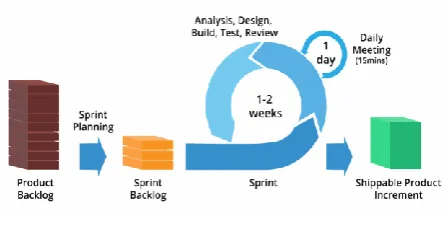
Therefore, this paper proposes to adopt and modify the Scrum software development methodology to overcome research problems [8]. The Scrum methodology, used in software development, controls software product delivery in increments. The method has been applied to extend simulation of urban mobility tools[9], workflow management [10], and teaching programming courses [11]. The Scrum methodology shown in Figure 1 starts with user requirements represented as user stories. Stories are split into phases based on priority with the help of the project owner and the Scrum Master. Once a phase (called an Sprint) is completed it gets verified by the team, and a call to next release is triggered. Usually, the team meets daily to handle upcoming issues.
[image:1.595.317.539.569.685.2]The objective of this work is to elicit, manage, and execute ideas of innovations systematically guided with an institution goal. Therefore, this paper proposes to apply and extend the original Scrum model with precise execution, called the idea Scrum (iScrum) model. The inputs to the iScrum model are organization goals, and the outputs are set of generated operational inventions — the model iterate and increment ideas to evolve an innovation to the organization goals.
Fig. 1.Scrum Software Model.
2. BACKGROUND OF SOFTWARE
SCRUM MODEL
Scrum encourages teams to learn through stories and self-arrange while working on a problem, and thus reflecting issues to enhance continually [8]. Scrum development often reduce the development time and increase the flexibility and quality of the product [12]. The Scrum methodology values the team players in terms of commitment, respect, openness while the Sprint goal gets a focus by all the team. The Scrum has the following components:
1. Product Backlog. The list of user stories that a product owner needs.
2. Sprint. Amount of work to be done during the allotted time which is usually 2-4 weeks. The Sprint Backlog is the series of Sprints collected from the Product Backlog.
3. Release Planning. It is about Planning the user stories that need to be taken in the next Sprint and estimating efforts of user stories.
4. Roles. The product owner is responsible for user stories; the Scrum Master is responsible for managing and controlling the execution of the project, as well as the team who do the work.
5. Reviews. After every Sprint a review is conducted where the development team meets to get what was completed and what is missing. During the Sprint development, a daily time-boxed 15 minutes meeting is also conducted to face upcoming issues of development. When the final version of the product is available another meeting called the retrospective is conducted to see what went wrong and what went correct during the development process.
The Scrum methodology is flexible and best-suited for a relatively uncertain environment. It emphasizes creativity and innovation to maximize the business value of the solution over planning and control. The model results in faster time-to-market, lower costs, increased quality, higher customer satisfaction, and more effective solutions.
3. RELATED WORK
Innovations cover areas in business, technology, and marketing. The Business innovation model is all about the capacity to reconsider cutting-edge enterprise to locate new sales streams and preserve competitive benefits. It can be carried out either through improving current business models or by looking for new value-added methods. The business model has four systematic steps – analyze and provoke current business, ensure consistency, and build and test a pilot project.
The usage of new or old technology may help in generating new ideas to resolve existing problems that can help in accelerating and experimenting with new products. The marketing is essential to integrate business and technology to discover new markets and create new value propositions that others are not capable of
The technology adoption life cycle [13] focuses on the specifics of high marketing technology during the early start-up period based on the diffusions of innovations model. The earlier model explains why companies with disruptive innovations and technology, often have difficulties in succeeding in the mainstream marketplace. Moore believes that technology adopters are categorized and that the most difficult transition is from the early adopters to an early majority (the chasm). The chasm happens because the
expectancies between those two adopter categories are extensively different.
The paper categorizes the related work in logical groups for readability purpose.
3.1. Types of Innovations
Disruptive innovation [14] tries to create new market value by disturbing the current market or creating a new market. However, radical innovation happens when a brand-new product disrupts existing enterprise while incremental innovation, refers to a series of gradually built improvements to existing products. An innovation matrix can be used to classify disruptive and radical innovation [15]. The architectural innovation is described as the reconfiguration of existing product technologies by changing the relationships between components which affects the overall design [16]. In contrast, the modular design changes one component keeping the same overall design.
3.2. Innovation Frameworks
The Innovator’s Dilemma [17] demonstrates how successful and extraordinary organizations can innovate and yet nevertheless lose their market management as unexpected competition rises. Sustaining innovation, on the contrary, refers to the type of innovations that makes evolution and enhancements the current market.Competitors utilize the least demanding customers of disruptive huge risk innovations over most demanding customers on sustaining low-risk innovation.
The Ten Innovation model [18] constructs breakthroughs and goals to provide a manner to discover new capability opportunities beyond products or revisit existing techniques to develop viable innovations. The model has three categories- configuration, offering, and experience. Instead of focusing on producing a new product the model aims to get the best results by using these categories.
The triple helix model is based on the interactions between roles of research universities, industries that produce commercial products, and governments that are regulating markets [19]. The linear model of innovation describes a linear relationship between science and technology. It starts with basic research followed by applied research, development, and diffusion [20]. The Three Horizons of Growth model [21] structures organization initiatives as an appropriate balance between three horizons. Horizon 1 with zero to one year working on core business, Horizon 2 one to three years developing evolving business, and Horizon 3 with more than three years creating a transformational business. Companies need to simultaneously work on all three of the horizons to maximize profit. Most often the resources are allocated between horizons using the 70-20-10 innovation rule[22].
However, none of the discussed models can capture the essence of innovation alone.
4. PROPOSED ISCRUM MODEL
[image:3.595.60.255.220.306.2]Youth, especially students, tend to change their mind commonly due to their lack of experience and little or improper mentoring. Therefore, without mentoring ideas outputs are at risk and tend to be ambiguous. This paper propagates ideas incubation over time. Accordingly, the aim of the paper is to manage collaboration as innovation evolves as a series of sparks [24]. Therefore, the paper manages and integrates ideas iteratively and incrementally until the desired behavior or goal is achieved.
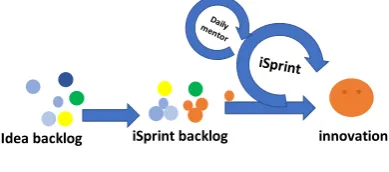
Fig. 2. iScrum Model
Therefore, the above issues can be resolved by a modified version of Scrum methodology. Figure 2 shows the proposed iScrum model. The figure shows how the objectives get converted to innovations. Goals get selected from a Backlog of institution goals based on priority. As goals are interrelated, they get converted to a combinatorial Sprint Backlog. The iScrum Master (mentor) select an idea one at a time and control the collaboration between the team to execute it. Each day the iScrum Master meets the team (innovators) and guide them to the institution goal direction, resolving current issues. At the end of the innovation, the team makes a retrospect meeting to archive lesson learned. Therefore, the original Scrum model is tuned for overall innovation execution.The iScrum model has the following components:
4.1. Innovation backlog
Like the software product Backlog, the innovation Backlog contains a list of unfinished innovations, restricted or undefined ideas, institution goals, and standard business methods. If the innovation is in the university environment, then the Backlog could have the followings: previous successful projects, failed projects, risk register, lesson learned, organization goals per year and code of ethics.
4.2. iSprint Backlog
The combinations of several ideas that have in common properties are grouped and placed in a new Backlog so that they can be explored and executed. The combination of ideas is guided by the iScrum Master and the idea’s owners and is carried out at every change on the system state. The goal is to remove redundancy, elaborate ideas, and reduce risks. The generated ideas are collected through a brainstorming session held weekly.
4.3. iSprint
Although the original Scrum looks for Sprints of short period, in the iSprint the duration is a cumbersome problem that needs input from the idea owner, the iScrum Master, the
potential end users, the current organization process assets, and constraints of time and cost. Each iSprint is subject to daily meetings with the iScrum Master to discuss current innovation and remove barriers if they face the idea direction. At each iSprint, the team meets to decide to wither the current state of the iSprint is ready and acceptable, or there is a need for another approach.
At the end of each iSprint backlog, the team reviews the previously executed innovations in a meeting known as the iSprint retrospective. The idea is reviewed by the idea owner the iScrum Master to take a decision. If the idea is deemed complete, then the idea is considered a complete innovation, however, if the idea is not mature another round is needed to the iSprint to reduce ambiguity and flourish the idea as needed.
5.
EVALUATION AND DISCUSSION
5.1. Evaluating iScrum Model
Although many research models have been implemented for innovation, most work target marketing, and business models. To the best of our knowledge, no complete innovation model exists. The proposed iScumr is an overarching approach intended to discover and mature an innovative idea from initiation to evolution.
Measuring innovation is not a straightforward process; often it is subjective. This paper evaluates the iScrum model by comparison against the selected list of innovation models through the following criteria:
A. Complexity Tolerance: The innovation model should tolerate complex ideas by splitting and integrating ideas systematically without losing user interests and productivity. The criteria also reduce idea ambiguity.
B. Premature Closure: while innovation looks for productivity at the earliest possible time, a good innovation should maximize the idea for better efficiency and performance.
C. Collaboration: Generate novel ideas from the integration of the list of available ideas’ patterns. Correlating various skilled team structures with organizational performance will increase innovation[25].
D. Change and Control: the ability to mentor ideas and divert thinking towards institution goals. Good governance powers innovation [26].While mentoring an idea during incubation, it should be clear to adopt new changes and improvements into innovations at any level of incubation.
E. Innovators’ Morale: youth can stop innovation at any level of innovation due to lack of morale; therefore, a good innovation model should show interim results and guide innovation for success.
F. Triangle of Project Management: assuming an innovation is a project, an eye to the project management triangle (time, cost, scope) should be balanced for proper innovation with the lowest cost, less time, minimum requirement, higher productivity, and highest possible quality.
innovation
Table 1. Comparison of our iScrum approach with related innovation frameworks.
Criterion iScrum Model
[17] [18] [19] [20] [21] [23]
A
B
C
D
E
F
Table 1 shows the comparison of iScrum and a list of chosen innovation models from the literature as a proof of concept. The designates that the criterion is fully available, while indicates non-applicability of the criterion. The jobs-to-be-done model [23] does not allow complexity tolerance as it sees innovation as a job and leaves the execution strategy to the innovator (A). The linear and the triple helix models[19] [20] allow control of premature closure by applying enough research before an innovation is finalized (B). Most models support collaboration except [23] which assign a job to a resource individually (C). The models [18][19] [20] does not provide a systematic technique for change and control management of innovation (D). The table shows that the iScrum is superior to enhance the innovator morale (E) by getting his innovation incrementally and appraising results daily, weekly and at the end of the innovation. The three properties of the successful project (time, cost, scope) did not apply to the works of [17] [18] since they are general frameworks and does not target innovation implementation.
From the table, it could be deduced that all models agree on the importance of collaboration, but they do not provide an implementation approach towards enhancing the innovator’s morale. Moreover, all models agree to the importance of change and control of changing environments and market trends. However, all models are not complete and vary across comparison criteria.
5.2. A Case Study of iScrum Model
The iScrum model was applied to a set of students from a private university last year. The mentor educated and trained students on the iScrum model before they commenced the model. Then the known students applied the model smoothly under the guidance and mentoring of a senior creativity professor (iScrum Master). The iScrum Master measured the performance of the students before and after the application of the iScrum model as shown in Table 2.
[image:4.595.310.548.255.446.2]The proposed iScrum model was evaluated by an interview with a software engineer, an entrepreneur manager, and a researcher. The software engineer admits the applicability of the iScrum over any iterative process; however, the entrepreneur-manager likes the idea but was willing to see its practice in a broader domain. The researcher thinks that the integration of software engineering Scrum with a real-life problem is beneficence.
Table 2 iScurm Practical Evaluation
Criteria Before iScrum After iScrum
Innovations Unplanned and not controlled
innovations
Reports entrepreneurs have shown acceptable
innovations.
Productivity Almost one innovation per
semester
Multi innovations that are guided by the university
goals
Collaboration Few uncontrolled
More than five teams each working on a separate
domain.
Innovations Uncontrolled Disruptive, radical, and architectural innovations
Skillset Not measured Skillset over a wide range of domains.
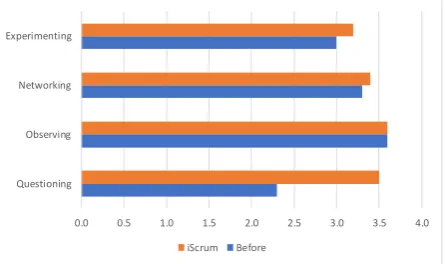
[image:4.595.318.541.618.750.2]Furthermore, this study runs another experiment to see the student behavior towards innovation using the Innovator’s DNA model [27]. A simple survey was conducted over 130 students before and after the execution of the iScrum model. The survey has four questions one for each category of the innovator’s DNA-Questioning, Observing, Networking, and Experimenting. Using a Likert scale (1-5), the survey results were combined in one diagram as shown in Figure 3. After filtering and removing unanswered questions, (a total of 111 students). The experiment selected 100 students at random and then the weighted average for each Likert scale over the four questions are recorded separately. As Figure 3 shows, the student behavior tends to increase innovation which verifies the proposed model.
Fig. 3. iScrum Student Behavior Evaluation
0.0 0.5 1.0 1.5 2.0 2.5 3.0 3.5 4.0
Questioning Observing Networking Experimenting
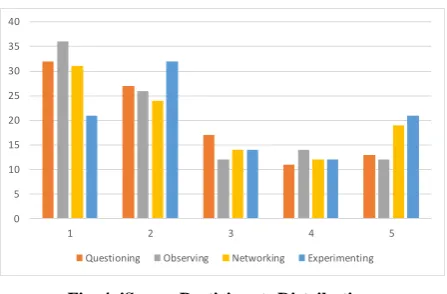
Fig. 4. iScrum Participants Distributions
Figure 4 shows the distribution of the participants over Likert scale and the Innovation DNA model. The distribution shows relatively significant distribution with standard deviation of 1.1 for Likert scale 2 up to 5.5 for Likert scale 5. The Innovation model statistics are shown in Table 3.
Table 3 Statistics of iScrum over Likert (Students DNA)
Likert/Statistics 5 4 3 2 1
Mean 30.0 27.3 14.3 12.3 30.0
StDev 5.5 2.9 1.8 1.1 5.5
95%
Confidence 5.4 5.1 3.7 3.4 5.4
However, the proposed model may be not enough to be generalized on other non-academic domains. Moreover, the mentor skillset, current organization regulations, and standards, budgets, administrative support were not measured or tracked in this study which may have a direct effect on innovation success.
6.
CONCLUSIONS
This paper applied Scrum software development model to elicit innovation systematically. The proposed iScrum model directs and manage innovations during its incubation. The proposed approach is easy to implement given availability of skilled iScrum Master, innovators, and administrative support. The paper deduced a set of innovation models evaluation criteria to measure the proposed model. The comparison of the iScrum showed that the iScrum model increases the innovator morale, increase productivity, reduce cost and time of innovations. Consequently, the model cultivates goal-oriented ideas into novel innovations.
7.
REFERENCES
[1] S. Maranville, “Entrepreneurship in the business curriculum,” J. Educ. Bus., vol. 68, no. 1, pp. 27–31, 1992.
[2] D. Henriksen et al., “Creativity and Technology in Education: An International Perspective,” Technol. Knowl. Learn., vol. 23, no. 3, pp. 409–424, 2018.
[3] J. F. Uen, H.-C. Chang, D. McConville, and S.-C. Tsai, “Supervisory mentoring and newcomer innovation performance in the hospitality industry,” Int. J. Hosp. Manag., vol. 73, pp. 93–101, 2018.
[4] F. Szücs, “Research subsidies, industry--university cooperation and innovation,” Res. Policy, vol. 47, no. 7, pp. 1256–1266, 2018.
[5] M.-M. Judd and H. C. Blair, “Leveraging Agile Methodology to Transform a University Learning and Teaching Unit,” in Agile and Lean Concepts for Teaching and Learning, Springer, 2019, pp. 171–185.
[6] S. E. Carlson, D. G. Rees Lewis, E. M. Gerber, and M. W. Easterday, “Challenges of peer instruction in an undergraduate student-led learning community: bi-directional diffusion as a crucial instructional process,” Instr. Sci., vol. 46, no. 3, pp. 405–433, Jun. 2018.
[7] B. S. Selznick and M. J. Mayhew, “Measuring Undergraduates’ Innovation Capacities,” Res. High. Educ., vol. 59, no. 6, pp. 744–764, Sep. 2018.
[8] K. Schwaber, “Scrum development process,” in Business object design and implementation, Springer, 1997, pp. 117–134.
[9] A. F. Acosta, J. E. Espinosa, and J. Espinosa, “Application of the SCRUM Software Methodology for Extending Simulation of Urban MObility (SUMO) Tools,” in Simulating Urban Traffic Scenarios, Springer, 2019, pp. 3–15.
[10] L. B. Carneiro, A. Silva, and L. H. Alencar, “Scrum Agile Project Management Methodology Application for Workflow Management: A Case Study,” in 2018 IEEE International Conference on Industrial Engineering and Engineering Management (IEEM), 2018, pp. 938–942.
[11] M. Madeja and M. Biňas, “Implementation of SCRUM Methodology in Programming Courses,” in 16th International Conference on Emerging eLearning Technologies and Applications (ICETA), 2018, pp. 333– 340.
[12] J. Erickson, K. Lyytinen, and K. Siau, “Agile modeling, agile software development, and extreme programming: the state of research,” J. Database Manag., vol. 16, no. 4, pp. 88–100, 2005.
[13] G. A. Moore, Crossing the chasm: Marketing and selling technology project. Harper Collins, 2009.
[14] C. Christensen, M. Raynor, and R. McDonald, “Disruptive innovation.” Perseus Book LLC (Ingram), 2011.
[15] S. Kyffin and P. Gardien, “Navigating the innovation matrix: An approach to design-led innovation,” Int. J. Des., vol. 3, no. 1, 2009.
[16] R. Henderson and K. B. Clark, “Architectural innovation: The reconfiguration of existing product technologies and the failure of established firms,” Adm. Sci. Q., 1990.
[17] C. M. Christensen, The innovator’s dilemma: when new technologies cause great firms to fail. Harvard Business Review Press, 2013.
[18] L. Keeley, H. Walters, R. Pikkel, and B. Quinn, Ten types of innovation: The discipline of building breakthroughs. John Wiley & Sons, 2013.
[19] L. Leydesdorff, “The triple helix: an evolutionary model of innovations,” Res. Policy, vol. 29, no. 2, pp. 243–255, 2000.
0 5 10 15 20 25 30 35 40
1 2 3 4 5
[20] B. Godin, “The linear model of innovation: The historical construction of an analytical framework,” Sci. Technol. Hum. Values, vol. 31, no. 6, pp. 639–667, 2006.
[21] M. Baghai, S. Coley, and D. White, The alchemy of growth. Basic Books, 2000.
[22] S. Eric, “The 70/20/10 Rule for Innovation.” 2015.
[23] C. M. Christensen, T. Hall, K. Dillon, and D. S. Duncan, “Know your customers’ jobs to be done,” Harv. Bus. Rev., vol. 94, no. 9, pp. 54–62, 2016.
[24] K. Sawyer, Group genius: The creative power of collaboration. Basic Books, 2017.
[25] P. A. Gloor, M. Paasivaara, D. Schoder, and P. Willems, “Finding collaborative innovation networks through correlating performance with social network structure,” Int. J. Prod. Res., vol. 46, no. 5, pp. 1357–1371, 2008.
[26] A. Mungiu-Pippidi, “Corruption: Good governance powers innovation,” Nat. News, vol. 518, no. 7539, p. 295, 2015.