ABSTRACT
Evolutionary modeling applications are the best way to provide full information to support in-depth understanding of evaluation of or-ganisms. These applications mainly depend on identifying the evo-lutionary history of existing organisms and understanding the rela-tions between them, which is possible through the deep analysis of their biological sequences. Multiple Sequence Alignment (MSA) is considered an important tool in such applications, where it gives an accurate representation of the relations between different bio-logical sequences. In literature, many efforts have been put into presenting a new MSA algorithm or even improving existing ones. However, little efforts on optimizing parallel MSA algorithms have been done. Nowadays, large datasets become a reality, and big data become a primary challenge in various fields, which should be also a new milestone for new bioinformatics algorithms.
This survey presents four different parallel MSA algorithms, T-Coffee, MAFFT,MSAProbs, andM2Align. We provide a de-tailed discussion of each algorithm including its strengths, weak-nesses, and implementation details and the effectiveness of its par-allel implementation compared to the other algorithms, taking into account the MSA accuracy on two different datasets,BAliBASE andOXBench.
Keywords
Bioinformatics; Multiple Sequence Alignment; Parallel Process-ing; Multicore Systems.
1. INTRODUCTION
For several years, studying the evolution of organisms plays an important role to understand their life, development, and physi-cal structure. This kind of study requires an in-depth analysis of existing biological data to gain more information about different organisms. Thus, bioinformatics science is arisen as a new compu-tation field to define a set of algorithms, methods, and techniques for understanding biological data [34]. Biological data is usually massive and requires developing and applying computationally in-tensive techniques.
One of the most challenging problem in bioinformatics is to extract the evolutionary relationship between different organisms.
Assum-ing a set of biological sequences protein, DNA, or RNA sequences, the relation between two or more sequences can be shown as a se-quence alignment process. Such a process is a fundamental tool in several applications, molecular function prediction, intermolecular interactions, residue selection, and phylogenetic analysis.
In this study, we concentrate on the Multiple Sequence Align-ment (MSA) problem. In the literature, different sequential al-gorithms have been proposed to solve such a problem based on different methods. For example, progressive methods (ex., T-Coffee [24], Clustal), Multiple Alignment using Fast Fourier Trans-form (MAFFT) [17], Iterative methods (ex., MUSCLE [10]), Con-sensus methods (ex., M-COFFEE [32]), Hidden Markov models (i.e., HMMER [13]), and the intuitive methods (ex. PoMSA [27]). With the rapid growth of sequence databases, which now contains enough representatives of larger protein families to exceed the ca-pacity of most current programs, the complexity of existing sequen-tial algorithms is increased even in the case of two sequences align-ment. For example, computations of current homologous sequence datasets could take several days.
In fact, the best methods sometimes fail to deal with these com-plexities efficiently and obtain biologically accurate alignments at the same time. The present studies overcome these obstacles by using two main approaches. The first is the vectorization, where all matrices are compensated by vectors, which in turn reduces the memory requirement and speed up execution without affecting the accuracy. The second approach is parallelism, the widespread gramming method nowadays that allows multiple independent pro-cesses which share the same resources, to be executed concurrently at less time.
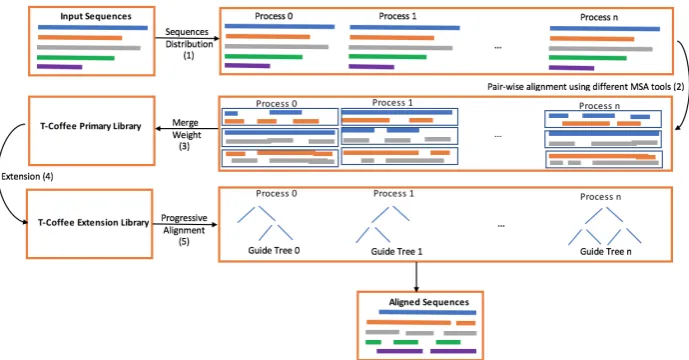
Fig. 1: Parallel T-coffee algorithm.
2. PARALLEL ALIGNMENT ALGORITHMS
OVERVIEW
Although dynamic programming is the most optimal MSA solution according to the accuracy levels it can obtain, alignment several numbers of sequences is prohibitive because of the high compu-tation requirement of such a solution [21, 23, 27]. Therefore, in literature, many heuristics provide a more practical solution with less computation complexity, such as progressive alignment [12], iterative alighnment [2], and alignment based on the profile Hidden Markov Models (HMM) [9]. Parallel algorithms also suffer from the memory bound restrictions that are provided by each algorithm. Thus, existing parallel implementations on shared memory mostly use MSA progressive alignment strategy to avoid memory overflow problems.
Here, a deep overview of four different parallel algorithms is given, T-Coffee, MAFFT, MSAProbs, andM2Align. The overview will cover both the sequential and parallel implementations for each al-gorithm.
2.1 T-Coffee Algorithm
Tree-based Consistency Objective Function for Alignment Evalua-tion algorithm (T-Coffee), is a progressive MSA algorithm, which optimizes the original progressive alignment in Clustalw algo-rithm [29]. The optimization involves using pre-aligned pair-wise sequences output (i.e.,T-Coffeeinitial sources) from two or more pre-selected algorithms to improve the overall alignment operation. Even in the case of inconsistent pair-wise alignments in different sources,T-Coffeeis able to differentiate the alignments of the same residue pairs by associating them with different weights.
The earliest implementation ofT-Coffeealgorithm has been pro-posed by [24, 29]. The propro-posed implementation has used two dif-ferent pairwise alignment algorithms to initially aligned the given sequences,ClustalW, i.e., global pairwise aligner, andlalign, i.e., local pairwise aligner. Both algorithms generate a separate source of pairwise aligned sequences.T-Coffeeassigns a separate weight to each aligned residue pair, which represents the correctness of the alignment before merging different sources as one primary li-brary. During the merging step,T-Coffeecan find the same residue pair with different alignment coming from different sources, in this
case, each distinguish alignment should be represented as a sep-arate entry in theT-Coffeeprimary library. However, if the same residue pair appears more than once in different sources with the same alignments, it should be added once to the primary library with a weight equals to the sum of the two weights.
TheT-Coffeeprimary library can be used directly to perform MSA for the given sequences, however, more optimization can improve the whole alignment operation. For instance, another extension step can be applied to the primary library by adding another weight score that shows how a residue pair align is consistent with other sequences. In this case, the most consistent residue alignments are selected to be used in the MSA alignment step. The extended li-brary now contains all the information that can improve the overall MSA alignment operation by using a traditional progressive align-ment process.
In the progressive alignment technique, pairwise alignment library should be built first. In the case of theT-Coffeealgorithm, the ex-tension library can be used directly.T-Coffeedepends on the dy-namic programming to apply the progressive alignment strategy. TheT-Coffeealgorithm generates a distance matrix based on the extension library. The distance matrix is used to generate the guide tree that helps in generating the final list of aligned sequences. In this study, we concentrate on the parallel implementations. In [8], a parallel implementation of theT-Coffeealgorithm has been presented. The proposed parallel implementation targets four main parts of the algorithm, template selection, library computation, li-brary extension, and progressive alignment. Template selection is a new feature added to most advanced modes of T-Coffee (i.e., R-Coffee, 3D-Coffee [1], and PSI-Coffee [4]) where input sequences are associated with structural templates [8]. In this study, we con-centrate on the last three parts which are shown in theT-Coffeebase algorithm.
The library computation step is related to the use of different pair-wise alignment algorithms to provide a set of initial libraries to theT-Coffeealgorithm. This step can be parallelized by dividing the alignment task into several tasks that are equal to the number of available cores. The master process merges the outputs coming from different cores into a single library.
generating the distance matrix and the guide tree to better align the given set of sequences. This option usually used in the case of a very large number of sequences and fast computation priority from the user. In the iterative refinement method, accurate align-ment is considered a priority and several alignalign-ment iterations are required. Further, structural alignment method is more suitable for RNA alignment proteins with low sequence similarity.
SequentialMAFFThas three main steps, all-to-all comparison, pro-gressive alignment, and iterative refinement. The all-to-all compar-ison can be considered as a part of the progressive alignment step where a set of pairwise comparisons are conducted to generate the initial distance matrix and the guide tree that are used by the pro-gressive alignment step. Propro-gressive alignment is the main MSA process while iterative refinement step is used to improve the accu-racy of the final result.
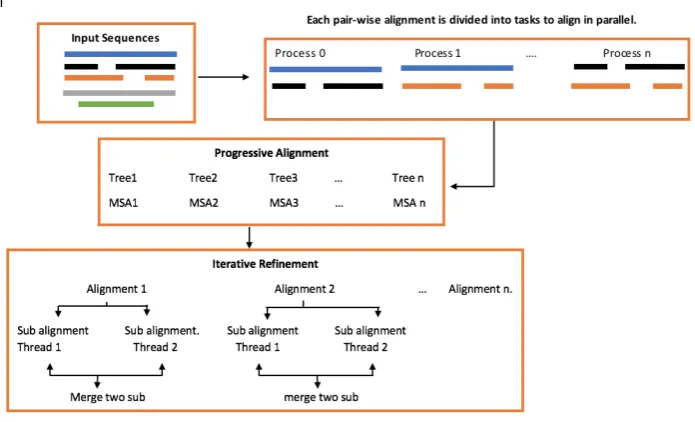
In [18] a parallelMAFFTalgorithm has been proposed. The given implementation is based on POSIX Threads library and targets the three main steps of theMAFFTalgorithm. All-to-all compar-ison has been parallelized by distributing the pairwise alignment to the available physical cores. In progressive alignment, parsing the guide tree is parallelized every level, i.e., each tree parent de-pends on its child which prevents parallelization over the whole tree nodes. Finally, if iterative refinement is used, two different ap-proaches have been proposed,best-first approachandhill-climbing approach, where both of them aim at dividing each alignment into two sub-alignments and the two sub-alignments are realigned. The realignment step is performed according to the tree dependent iter-ative strategy proposed in [14].
In thebest-first approach, The realignments are performed for all possible alignments on the iterative tree. The alignment with the highest objective score is selected for another iteration. Once no high score alignment is found, the algorithm terminates. In the hill-climbingapproach, each process has its local realignments of the original alignment and the better score is replaced the original alignment is kept locally by each process. In this case, many re-alignments of the same alignment are used in the next iteration [18]. Figure 1 gives an overview of parallel MAFFTalgorithm.
2.3 MSAProbs
MSAProbs is a progressive algorithm which provides an effective solution to perform MSA by combining both Hidden Markov Mod-els (HMM) technique with partition functions to calculate poste-rior alignment probabilities. MSAProbs is able to provide a higher alignment accuracy through two new techniques, weighted
prob-sents the average length of sequences.
Current implementation of parallel MSAProbs is mostly bases on parallizing these two most consuming steps in the algorithm using OpenMP, i.e., a compiler-directive-based API for shared-memory parallelism [6]. Figure 3 shows an overview of parallel MSA-Probs algorithm.
2.4 M2Align
Multi-objective metaheuristics methods is another approach to deal with MSA problems. In such methods, a non-exact stochastic opti-mization function is used to highly optimized two or more objec-tives concurrently. A Matlab-based tool called MO-SAStrE is an example of applying such an approach to the MSA problem [25]. This tool depends on genetic algorithms through a set of mutation and crossover operations to the expected alignment results to find the best alignment solution for a set of given sequences. NSGA-II genetic algorithm is the backbone of MO-SAStrE tool [7]. TheM2alignalgorithm is a parallel multiple sequence alignment algorithm based on MO-SAStrE. Besides exploiting the multi-core architecture of current computing devices to parallelize the MO-SAStrE algorithm, it optimizes the functionality of the algorithm by using a better storage mechanism to store gaps information during the optimization phase.
The M2align algorithm is working as follows. A set of pre-determined MSA algorithms is used to generateN alignment so-lutions which are used as the initial population in the optimiza-tion phase. Another set of soluoptimiza-tions can be added to the popu-lation through applying genetic crossover operators (i.e., Single-Point Crossover) to each pair of the initial N solutions. later, a set ofN solutions is selected based on its dominance ranking [33]. An initial evaluation step is applied to assign a dominance rank for each set of sequences. Figure 4 illustrates the whole functionality ofM2alignalgorithm over a given set of sequences.
Fig. 2: Parallel MAFFT algorithm.
Fig. 3: Parallel MSA-Probs algorithm.
3. PERFORMANCE EVALUATION
In this section, we present a detailed performance evaluation of the four parallel MSA algorithms:T-Coffee,T-MAFFT,MSAProbs, and M2Align. The evaluation involves execution time and the obtained accuracy of these algorithms using a different number of cores on two different datasets.
3.1 Setup
3.1.1 Experimental Testbed. We evaluate the performance of the target software packages on a dual-socket 14-core Intel Broadwell E5-2680 V4 processor running at 2.4 GHz. The software packages are compiled with gcc v4.8 on Ubuntu 16.04.3 LTS.
Two datasets have been used for the evaluation, BAliBASE [31], and OXBench [26]. To validate the accuracy of different MSA al-gorithms, we useBench[3], which provides different benchmarks for several proteins datasets.
3.2 Accuracy Assessment
We uses Three different metrics to evaluate the alignment accuracy of the given MSA algorithms,
divided by the number of columns in the reference align-ment [10].
(2) The Cline’s score (CS) or shift score, this score mainly rep-resents a distance-based scoring. It is negatively impacted by both over-alignment where non-homologous regions are aligned or under-alignment where homologous regions are not aligned improbably [5]. CS is considered as the best accuracy metric compared to existing scoring metrics [11, 22].
(3) The modeler’s scorerepresents the number of correctly aligned pairs in the aligned file divided by the number of pairs in the reference file [22].
3.3 Performance Comparison
Most of the existing MSA studies concentrate on the alignment accuracy level that can be obtained by the given MSA algorithm. However, in this study, we are mostly focusing on the parallel ex-ecution time which should be associated with an acceptable scala-bility trait. Scalascala-bility is considered an important factor that shows the ability of a software to handle a growing amount of work with a larger number of processes.
The following experiments show the performance of our target par-allel MSA algorithms using a different number of threads (i.e., 2, 4, 8, and 16) besides the sequential implementation of each algo-rithm. We assume each core hosts only one running thread (i.e., hyper-threading is disabled). Our target Broadwell multi-core sys-tem has a total of 28 cores. However, due to the scalability issue of the existing software implementations, we perform our experi-ments with up to 16 threads.
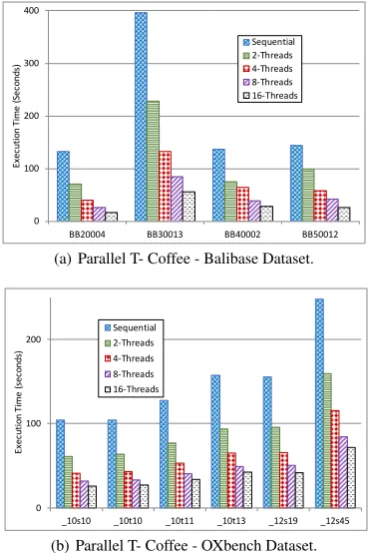
3.3.1 Parallel T-Coffee Algorithm Performance. We evaluate T-Coffee implementation using 1, 2, 4, 8, and 16 threads. Fig-ures 5(a) and 5(b) show the execution scalability using Balibase and OXbench datasets, respectively. The figures show linear scalability of T-Coffee with a larger number of threads. For example, in the case of BAliBASE dataset, the speedup from sequential execution to 16 threads execution are6.8X,6.1X,3.9X,4.5XinBB20004,
BB30013,BB40002,BB50012files, respectively. The same
ob-servation can be drawn from Figure 5(b). The speedup in the case of OXbench datasets are3X,2.8X,2.8X,2.7X,2.7X,2.4X in _10s10, _10t10, _10t11, _10t13, _12s19, _12s45files, respec-tively.
0 100 200 300 400
BB20004 BB30013 BB40002 BB50012
Ex
ec
ut
io
n
Ti
m
e
(S
ec
on
ds
)
Sequential 2-Threads 4-Threads 8-Threads 16-Threads
(a) Parallel T- Coffee - Balibase Dataset.
0 100 200
_10s10 _10t10 _10t11 _10t13 _12s19 _12s45
Ex
ec
ut
io
n
Ti
m
e
(s
ec
on
ds
)
Sequential 2-Threads 4-Threads 8-Threads 16-Threads
[image:5.595.160.451.73.226.2](b) Parallel T- Coffee - OXbench Dataset.
Fig. 5: Parallel T- Coffee total execution time with different number of threads.
3.3.2 Parallel MAFFT Algorithm Performance. The same set of experiments have been conducted using parallelMAFFT. Fig-ure 6 shows the execution time using both Balibase and OXbench datasets.
[image:5.595.344.529.268.545.2]2.56X,3.32X,and4.02X in BB20004, BB30013,BB40002,
BB50012files, respectively. Figure 6(b) shows the execution time
using OXbench dataset. The speedup from sequential to 16 threads execution is4.22X, 5.01X,5.34X,4.68X, 4.17X, and1.44X in _10s10, _10t10, _10t11, _10t13, _12s19, _12s45files, respec-tively. The parallelMAFFTscalability can be shown by both fig-ures. 0 10 20 30 40 50 60 70 80 90 100 110 120 130 140
BB20004 BB30013 BB40002 BB50012
Ex ec ut io n Ti m e (s ec on ds ) Sequential 2-Threads 4-Threads 8-Threads 16-Threads
(a) Parallel MAFFT - Balibase dataset.
0 1 2 3 4 5 6 7
_10s10 _10t10 _10t11 _10t13 _12s19 _12s45
Ex ec ut io n Ti m e (s ec on ds ) Sequential 2-Threads 4-Threads 8-Threads 16-Threads
[image:6.595.345.528.64.343.2](b) Parallel MAFFT - OXbench dataset.
Fig. 6: Parallel MAFFT total execution time with different number of Threads.
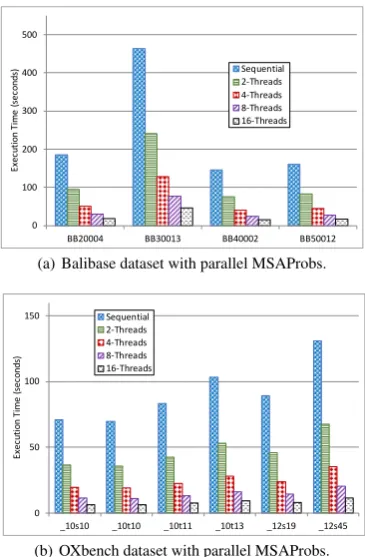
3.3.3 Parallel MSAProbs Algorithm Performance. The MSAProbs algorithm also shows a high scalability with a different number of threads on the given set of files. Figure 7 shows the performance on both Balibase data files, i.e., Figure 7(a), and OXbench data files, i.e., Figure 7(b).
Figure 7(a) shows thatMSAProbsis able to achieve around 9X speedup using 16 threads compared to sequential implementation across different files from the Balibase dataset. Further, Figure 7(b) shows an average speedup of11X across theOXbenchdataset’s files.
3.3.4 M2Align. Figure 8 shows the parallel execution perfor-mance of M2Align algorithm on Balibase dataset. The speedup from sequential execution to 16 threads executions are 7.85X,
9.41X,7.50X, and10.55XinBB20004,BB30013,BB40002,
BB50012files, respectively. As shown,the parallelM2Align
satis-fies a higher speedup with larger number of threads compared to bothT-Coffee,MAFFT, andMSAprobsalgorithms.
The same case can also be shown by Figure 8(b), where MSAProbs is used on OXbench dataset. The speedup is 7.43X, 4.22Xm
3.91X, 7.79X, 0.82X, and 0.91 in _10s10, _10t10, _10t11, _10t13, _12s19, _12s45files, respectively.
0 100 200 300 400 500
BB20004 BB30013 BB40002 BB50012
Ex ec ut io n Ti m e (s ec on ds ) Sequential 2-Threads 4-Threads 8-Threads 16-Threads
(a) Balibase dataset with parallel MSAProbs.
0 50 100 150
_10s10 _10t10 _10t11 _10t13 _12s19 _12s45
Ex ec ut io n Ti m e (s ec on ds ) Sequential 2-Threads 4-Threads 8-Threads 16-Threads
(b) OXbench dataset with parallel MSAProbs.
Fig. 7: Parallel MSAProbs total execution time with different number of threads.
An important observation can be shown in Figure 8(b). With less sequential execution time, the scalability becomes worse and the speedup decreases, i.e., _12s19, _12s45files.
3.4 Accuracy Comparison
Evaluating the efficiency of an MSA algorithm is related to the final alignment score it able to obtain. As mentioned before, in this study we use three different scoring metrics,Q/T C,cline,modeler. All the scoring metrics useBenchbenchmark to estimate the accuracy score of different algorithms.
Table 1 shows theQ/T Caccuracy using our four target algorithms on nine different files from BAliBASE and OXBench datasets. The average scoring values show thatT-Coffeealgorithm is the most ef-ficient algorithm.MSAProbsalgorithm comes in the second order followed by theMAFFTalgorithm and finally theM2align algo-rithm.
Table 2 shows the average accuracy scores of each algorithm using the same set of files. The tables show that MSAProbs outperforms all other algorithms and T-Coffee algorithm is coming second fol-lowed by the MAFFT and the M2align algorithms.
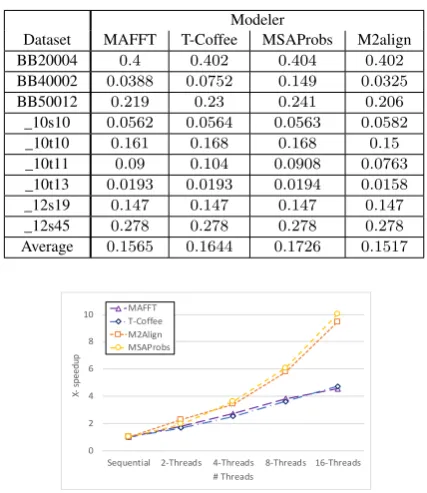
Table 3 also shows the averagemodelerscore of the algorithms over the same set of files. The scores show that theMSAProbs al-gorithm satisfies the highest average score through all files. The T-Coffeealgorithm satisfies the second highest score followed by theMAFFTand theM2alignalgorithms.
3.5 Speedup Comparison
[image:6.595.82.266.143.422.2]0 100 200 300 400 500 600 700 800 900 1000 1100 1200 1300 1400 1500 1600 1700
BB20004 BB30013 BB40002 BB50012
Ex
ec
ut
io
n
Ti
m
e
(s
ec
on
ds
)
Sequential 2-Threads 4-Threads 8-Threads 16-Threads
(a) Balibase dataset with parallel M2Align.
0 50 100 150 200 250 300 350 400 450 500
_10s10 _10t10 _10t11 _10t13 _12s19 _12s45
Ex
ec
ut
io
n
Ti
m
e
(s
ec
on
ds
)
Sequential 2-Threads 4-Threads 8-Threads 16-Threads
(b) OXbench dataset with parallel M2Align.
Fig. 8: M2Align total execution time with different number of threads.
[image:7.595.80.291.76.513.2]this subsection, we evaluate the gained speedup of increasing the number of cores. BecauseM2Alignalgorithm gives the lowest ex-ecution time through all given data files, we use it as a benchmark of the performance of the other algorithms. The main goal of this experiment is to show if a particular algorithm speedup increases with a larger number of cores.
Figure 9 illustrates the average gained speedup using a different number of threads compared to the sequential version of each algo-rithm on different data files.
As shown, bothMSAProbsand M2Align algorithms can respec-tively gain up to 1.93X and 2.27X speedup using 2-threads, 3.61X and 3.41X speedup using 4-threads, 6.07X and 5.79X speedup us-ing 8-threads, and 10.04X and 9.46X speedup usus-ing 16-threads.
Cline
Dataset MAFFT T-Coffee MSAProbs M2align
BB20004 0.572 0.576 0.578 0.576
BB40002 0.1 0.25 0.317 0.113
BB50012 0.38 0.399 0.406 0.378
_10s10 0.11 0.11 0.11 0.109
_10t10 0.281 0.291 0.292 0.262
_10t11 0.178 0.201 0.185 0.164
_10t13 0.0386 0.0386 0.0387 0.0332
_12s19 0.257 0.257 0.257 0.257
_12s45 0.434 0.434 0.436 0.434
Average 0.2611 0.2840 0.2910 0.258
Table 3. : Accuracy comparison usingModeler score.
Modeler
Dataset MAFFT T-Coffee MSAProbs M2align
BB20004 0.4 0.402 0.404 0.402
BB40002 0.0388 0.0752 0.149 0.0325
BB50012 0.219 0.23 0.241 0.206
_10s10 0.0562 0.0564 0.0563 0.0582
_10t10 0.161 0.168 0.168 0.15
_10t11 0.09 0.104 0.0908 0.0763
_10t13 0.0193 0.0193 0.0194 0.0158
_12s19 0.147 0.147 0.147 0.147
_12s45 0.278 0.278 0.278 0.278
Average 0.1565 0.1644 0.1726 0.1517
0 2 4 6 8 10
Sequential 2-Threads 4-Threads 8-Threads 16-Threads
X-sp
ee
du
p
# Threads MAFFT
T-Coffee M2Align MSAProbs
Fig. 9:T-Coffee,MAFFT,MSAProbs, andM2Alignaverage speedup
[image:7.595.331.543.250.382.2] [image:7.595.328.542.413.660.2]Both algorithms show super-linear scalability with a larger number of threads.
Further,T-CoffeeandMAFFTalgorithms can respectively gain up to 1.67X and 1.80X speedup using 2-threads, 2.52X and 2.73X speedup using 4-threads, 3.62X and 3.82X speedup using 8-threads, and 4.72X and 4.56X speedup using 16-threads. Both al-gorithms show linear scalability with a larger number of threads. The figures show the strong scalability of both MSAProbs and M2Aligncompared to bothT-CoffeeandMAFFTalgorithms.
4. CONCLUSION
The literature reveals a lack of providing a detailed comparison be-tween existing parallel MSA algorithms to show their strengths and weaknesses. Thus, this study mainly aims at studying the state-of-the-art multicore-based MSA algorithms from two different per-spectives, performance, and accuracy. Four different algorithms have been picked up for this study,T-Coffee,MAFFT,MSAProbs, andM2Align. A detailed explanation of each algorithm has been given associated with its parallel implementation on multicore sys-tems. Several software packages have been also introduced to show the effectiveness of the given algorithms on parallel platforms. Further, this work shows an intensive performance evaluation on Intel Broadwell 14-core system using up to 16 threads. The per-formance comparison shows a linear scalability of the four algo-rithms using a different number of threads. Moreover, A compre-hensive qualitative assessment of the accuracy score of each algo-rithm has been conducted using three different metrics,Q/TC,cline, andmodeler. The accuracy comparison shows better results using both T-Coffee andMSAProbscomparing toMAFFTandM2Align algorithms.
In the future, we aim at extending this survey to include both dis-tributed and GPU based parallel MSA algorithms by covering the alignment of a large number of sequences on large-scale systems. The study should cover the impact of the availability of large-scale hardware resources on the performance of existing MSA solutions.
References
[1] Fabrice Armougom, Sebastien Moretti, Olivier Poirot, Stephane Audic, Pierre Dumas, Basile Schaeli, Vladimir Ke-duas, and Cedric Notredame. Expresso: automatic incorpora-tion of structural informaincorpora-tion in multiple sequence alignments using 3d-coffee.Nucleic acids research, 34(suppl_2):W604– W608, 2006.
[2] Geoffrey J Barton and Michael JE Sternberg. A strategy for the rapid multiple alignment of protein sequences: confidence levels from tertiary structure comparisons. Journal of molec-ular biology, 198(2):327–337, 1987.
[3] Bench. Multiple Sequence Alignment (MSA) benchmark, 1999.
[4] Jia-Ming Chang, Paolo Di Tommaso, Jean-François Taly, and Cedric Notredame. Accurate multiple sequence alignment of transmembrane proteins with psi-coffee. BMC bioinformat-ics, 13(4):S1, 2012.
[5] Melissa Cline, Richard Hughey, and Kevin Karplus. Predict-ing reliable regions in protein sequence alignments. Bioinfor-matics, 18(2):306–314, 2002.
[6] Leonardo Dagum and Ramesh Menon. Openmp: an industry standard api for shared-memory programming.IEEE compu-tational science and engineering, 5(1):46–55, 1998.
[7] Kalyanmoy Deb, Amrit Pratap, Sameer Agarwal, and TAMT Meyarivan. A fast and elitist multiobjective genetic algo-rithm: Nsga-ii. IEEE transactions on evolutionary compu-tation, 6(2):182–197, 2002.
[8] Paolo Di Tommaso, Miquel Orobitg, Fernando Guirado, Fer-nado Cores, Toni Espinosa, and Cedric Notredame. Cloud-coffee: implementation of a parallel consistency-based mul-tiple alignment algorithm in the t-coffee package and its benchmarking on the amazon elastic-cloud. Bioinformatics, 26(15):1903–1904, 2010.
[9] Sean R. Eddy. Profile hidden markov models.Bioinformatics (Oxford, England), 14(9):755–763, 1998.
[10] Robert C Edgar. Muscle: multiple sequence alignment with high accuracy and high throughput. Nucleic acids research, 32(5):1792–1797, 2004.
[11] Robert C Edgar and Kimmen Sjölander. A comparison of scoring functions for protein sequence profile alignment. Bioinformatics, 20(8):1301–1308, 2004.
[12] Da-Fei Feng and Russell F Doolittle. Progressive sequence alignment as a prerequisitetto correct phylogenetic trees. Journal of molecular evolution, 25(4):351–360, 1987. [13] Robert D Finn, Jody Clements, and Sean R Eddy. Hmmer
web server: interactive sequence similarity searching.Nucleic acids research, 39(suppl_2):W29–W37, 2011.
[14] Osamu Gotoh. Optimal alignment between groups of se-quences and its application to multiple sequence alignment. Bioinformatics, 9(3):361–370, 1993.
[15] X Huang and W Miller. Lalign-find the best local alignments between two sequences. Adv. Appl. Math, 12:373, 1991. [16] Kazutaka Katoh, Kazuharu Misawa, Kei-ichi Kuma, and
Takashi Miyata. Mafft: a novel method for rapid multiple sequence alignment based on fast fourier transform. Nucleic acids research, 30(14):3059–3066, 2002.
[17] Kazutaka Katoh and Daron M Standley. Mafft multiple se-quence alignment software version 7: improvements in per-formance and usability. Molecular biology and evolution, 30(4):772–780, 2013.
[18] Kazutaka Katoh and Hiroyuki Toh. Parallelization of the mafft multiple sequence alignment program. Bioinformatics, 26(15):1899–1900, 2010.
[19] Carsten Kemena and Cedric Notredame. Upcoming chal-lenges for multiple sequence alignment methods in the high-throughput era.Bioinformatics, 25(19):2455–2465, 2009. [20] Yongchao liu. MSAProbs - Parallel and accurate multiple
se-quence alignment.http://msaprobs.sourceforge.net/ homepage.htm, 2018. [Online; accessed 25-May-2018]. [21] Yongchao Liu, Bertil Schmidt, and Douglas L Maskell.
Msaprobs: multiple sequence alignment based on pair hidden markov models and partition function posterior probabilities. Bioinformatics, 26(16):1958–1964, 2010.
[22] Dimitrios P Lyras and Dirk Metzler. Reformalign: improved multiple sequence alignments using a profile-based meta-alignment approach.BMC bioinformatics, 15(1):265, 2014. [23] Cédric Notredame. Recent progress in multiple sequence
alignment: a survey. Pharmacogenomics, 3(1):131–144, 2002.
tiple sequence alignment using clustalw and clustalx.Current protocols in bioinformatics, pages 2–3, 2002.