© 2019, IRJET | Impact Factor value: 7.211 | ISO 9001:2008 Certified Journal
| Page 3139
“LABORATORY STUDY ON EFFECT OF GBSF AND LIME ON SUBGRADE”
Dhiraj S. Gangurde
1, Prof. Girish S. Gadve
2, Prof. Satish S. Barmade
31
M. Tech Research Scholar, Department of Civil Engineering (Transportation Engineering and Planning),
Sandip University, SOET, Nashik, Maharashtra, India
2
Prof. Girish S. Gadve, Assistant Professor Department of Civil Engineering (Transportation Engineering and
Planning), Sandip University, SOET, Nashik, Maharashtra, India
3
Prof.Satish S. Barmade, Assistant Professor Department of Civil Engineering, Sandip Foundation’s, SIEM, Nashik,
Maharashtra, India
---***---Abstract - The large quantities of wastes are being generatedworldwide due to rapid industrialization and excessive urbanization. The utilization of waste materials like coal ash, copper slag, steel slag, zinc slag etc. in road construction industries is gradually gaining significant importance in India considering the disposal, environmental problems and gradual depletion of natural resources like soil and aggregates. Huge quantities of slag, is being generated in the steel plants during the extraction of iron from iron ores, normally they are dumped occupying a large land area and causing significant environmental problems. This Slag resembles to cohesion less granular soil and is observed to contain mostly the sand-size particles. Therefore, Granular Blast Furnace Slag (GBFS) if used as a substitute to good quality borrow soils for base/ sub-base course in flexible pavements or as subgrade material. It may significantly decrease the construction cost apart from improving its engineering properties. This review paper deals with some of the previous studies made regarding use of GBFS in various layers of flexible pavement to improve its engineering properties.
Key Words: GBFS, lime, Soil, flexible pavement, subgrade
1. INTRODUCTION
Portfolio The utilization of waste materials like coal ash, copper slag, steel slag, zinc slag etc. in road utilization aspects of these wastes particularly in construction for bulk consumption.
The Jindal saw steel sinner MIDC sinner nashik produce Granular Blast Furnace Slag (GBFS) and Electric-arc Furnace Slag (EAF) approximately 45,000 tone/month each (Source: Jindal saw steel sinner). This is huge amount of slag has been used by company in various construction work going inside the company campus. The work of filling of land to stabilizing of the parent soil is done inside the campus.
This study is carried out to utilize the slag in subgrade construction. Being cohesion less material, it is mixed with local soil collect from mhasarul near nashik. As, the subgrade/subgrade having high strength, can resist to deformation and increase the stability of the pavement. If the parent soil does not have good engineering properties can achieved with the use of additives/stabilizer. This additives/stabilizer mixed with the soil materials to get
desired improvement. This study focus on mechanical stabilization of parent soil using GBFS and LIME. The CBR tests are conducted to check the four day soak strength of the soil mixed with the GBFS in different range (0 %,5 %,10%,15% and 20% by mass). The results of these tests are comparing with soil stabilized with lime 0% ,3%,6%,9% and 12% with different proportion Material
1.1 Material used
1.1.1 Soil
Soil properties in North Maharashtra region is mainly consist of intermediate to highly compressible clay, The collected sample tested in the laboratory for the investigation of engineering properties like specific gravity of soil solids, grain size distribution, Atterberg’s limits, Swelling potential, soil classification, compaction characteristics and CBR
1.1.2 Lime
Lime is a calcium-containing inorganic mineral in which oxides, and hydroxides predominate. In the strict sense of the term, lime is calcium oxide or calcium hydroxide. CaO which occurs as a product of coal seam fires and in altered limestone xenoliths in volcanic ejecta
1.1.3 GBFS
GBFS is formed when molten blast furnace slag (BFS) is rapidly quenched from the furnace, rather than left to slowly solidify by air-cooling. The chemical composition of GBFS is shown in table 3.2. The result of chemical composition shows it contain 12.74% silica and 32.29 % CaO content. It is found that aluminium content is maximum in the GBFS i.e. 42.44%
1.2 Need for study
© 2019, IRJET | Impact Factor value: 7.211 | ISO 9001:2008 Certified Journal
| Page 3140
problematic and not good for the subgrade material due tohigh compressibility, less bearing capacity, high swelling properties, etc. To stunned the problems of compressibility, less bearing capacity, high swelling properties the soil can be replaced, reinforced or the properties can be upgraded either by mechanical blending of different soil types or by integration of additives. This study focus on and chemical stabilization using with LIME in parent soil.
2. LITERATURE SURVEY
2.1 OSMAN SIVRIKAYA, SELMAN YAVASCAN and EMRE CECEN
The significant quantities of slag are being generated as a solid waste material or as a by-product of the iron-steel industry every day, from an energy-conservation point of view, slag can be considered as an environment-friendly material in terms of resource saving, and CO2 reduction in the 21st century. However, these products pose a great threat to the environment unless they are stored or exploited for use in various sectors studies have been performed on the possible utilization of ground granulated blast-furnace slag (GGBFS) as a binder in the stabilization of clayey soils and its effect on the volume change of expansive soils [3, 6, 7, 15]. The authors noticed that there is limited work on the usage of GBFS in comparison with other industrial by-products, such as fly ash and silica fume on the stabilization of soils
In this study, the effect of ground granulated blast-furnace slag (GGBFS) on the index and compaction parameters of two clayey soils with different elasticities has been exam- ined and the following conclusions have been derived
2.2 D. Koteswara Rao G.V.R. Prasada Raju N. L. Manikanta Kumar 2011
The natural water content of the marine clays is always greater than its liquid limit. The comprehensive review of literature shows that a considerable amount of work is related for the determination of engineering behaviour of marine clay has been carried out worldwide almost since last 50 years. From the various contributions, the investigations on physical, chemical and mineralogical properties of marine clay conducted by Shridharan et al.(1989). Improving the strength of the marine clay by the stabilization technique was performed by Supakij Nontananandh et al. (2004). Marine clay deposits of Kakinada were used for the testing with the aim to investigate its engineering properties and further make suitable for foundation constructions over it. The soil was collected at shallow depths i.e. 0.3 to 06m from the Kakinada Sea Ports limited, Kakinada, A.P, India and used for the investigation. Those soils are soft, highly saturated, of low density, low shear strength, sensitive, and normally consolidated. Natural water content of the marine clays is always greater than its liquid limit. The comprehensive
review of literature shows that a considerable amount of work is related for the determination of engineering behaviour of marine clay has been carried out worldwide almost since last 50 years. From the various contributions, the investigations on physical, chemical and mineralogical properties of marine clay conducted by Shridharan et al.(1989). Improving the strength of the marine clay by the stabilization technique was performed by Supakij Nontananandh et al. (2004). Marine clay deposits of Kakinada were used for the testing with the aim to investigate its engineering properties and further make suitable for foundation constructions over it. The soil was collected at shallow depths i.e. 0.3 to 06m from the Kakinada Sea Ports limited, Kakinada, A.P, India and used for the investigation. Those soils are soft, highly saturated, of low density, low shear strength, sensitive, and normally consolidated.
2.3 U Arun Kumar, K V Subrahmanyam 2014
The iron and steel slag that is generated as a byproduct of iron and steel manufacturing Industries can be broadly categorized into blast furnace slag and steel making slag. Blast furnace slag is recovered by melting separation from blast furnaces that produce molten pig iron. It consists of non-ferrous components contained in the iron ore together with limestone as an auxiliary materials and ash from coke. Blast furnace slag is dependent on method of cooling. There are four main types of blast furnace slag: i.e. granulated; air-cooled; expanded and palletized. Chemically, the blast furnace slag mainly contains silica (30–35 %), calcium oxide (28–35 %), magnesium oxide (1–6 %), and Al2O3/Fe2O3 1.8– 2.5 %. Granulated Blast Furnace Slag can be used for the partial replacement of unmodified aggregate upto 20-30% in the construction of granular sub base layer.
2.4 Ibtehaj Taha Jawad, Mohd Raihan Taha 2014
© 2019, IRJET | Impact Factor value: 7.211 | ISO 9001:2008 Certified Journal
| Page 3141
to lime treated soil, proposing an alternative material wasdiscussed.
2.5 Saleh Abd El-Aleem Mohamed Aug2015
The creation of waste materials, combined with a growing consumer population has resulted in a waste disposal crisis leading to an economic and environmental problem. These wastes that produced today will remain in the environment for hundreds of years. The magnitude of environmental problems like air, surface and ground water pollution and economic problem like landfilling maintenance cost, etc., is very high for wastes. the investigations on physical, chemical and mineralogical properties of marine clay conducted by Shridharan This rapidly increasing waste stream remains a significant environmental issue and needs to manage in an economic and environmentally sustainable manner. One solution to this crisis lies in recycling waste into useful products to replace the natural/commercial products wherever possible, which will reduce the economic and environmental problem of waste disposal and also reduce the depletion of natural resources, As the amount of LRS increases the chemically combined water and free lime contents increases, -The compressive strengths of GBFS-LRS mixes increase with the amount of LRS up to 20%, and then decrease at 30% of LRS.
[image:3.595.28.287.409.546.2]3. Methodology of the work
Figure 1 Methodology Flowchart
4. DATA ANALYSIS
4.1 Granular Blast Furnace Slag (GBFS)
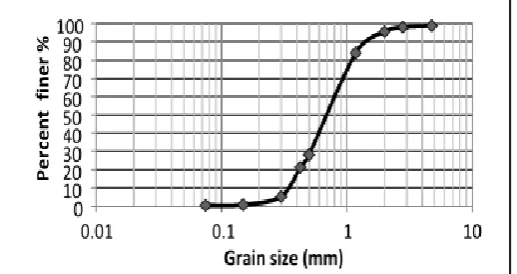
The result of sieve analysis are drawn for GBFS. This shows it is uniformly graded material. The specific gravity is 2.28 of GBFS. This material is used in mechanical stabilization with CH soil to increase its engineering property for subgrade stabilization.
The chemical composition of GBFS analies the result of chemical composition shows it contain 12.74% silica and 32.29 % CaO content. It is found that aluminium content is maximum in the GBFS i.e. 42.44%
4.2 Lime
© 2019, IRJET | Impact Factor value: 7.211 | ISO 9001:2008 Certified Journal
| Page 3142
4.3 SoilSoil properties in Maharashtra region is mainly consist of intermediate to highly compressible clay , The collected sample tested in the laboratory for the investigation of engineering properties like specific gravity of soil solids, grain size distribution, Atterberg’s limits, Swelling potential, soil classification, compaction characteristics and CBR
5. RESULTS AND DISCUSSION
5.1 The optimum combination of stabilizers pH meter test has been done from pH meter test for GBFS
5.2 The optimum combination of stabilizers pH meter test has been done from pH meter test for lime
5.3 Consistency limit for soil treated with GBFS
5.4 Consistency limit for soil treated with Lime
5.5 Compaction characteristics of GBFS
5.6 Compaction characteristics of Lime
© 2019, IRJET | Impact Factor value: 7.211 | ISO 9001:2008 Certified Journal
| Page 3143
5.8 Unconfined Compressive Strength Of soil with LIME5.9 California bearing ratio test for optimum % of GBFS
The CBR test is conducted for 4 days soaked test , for comparison the CBR test is tested for natural soil and the optimum result obtain of 10% GBFS in UCS test . The result for CBR of natural soil is 1.9 and for oprimum result of 10% of GBFS in UCS is 3.56
5.10 California bearing ratio test optimum % of LIME
The CBR test is conducted for 4 days soaked test , for comparison the CBR test is tested for natural soil and the optimum result obtain of 6% lime in UCS test . The result for CBR of natural soil is 1.9 and for oprimum result of 6% of Lime in UCS is 3.95
6. CONCLUSIONS
I. The sp. Gravity of GBFS and LIME is found to be 2.60 and2.45respectively
II. GBFS found non plastic in nature
III. Optimum % of GBFS and LIME is found to be 10% and 6%
IV. A MDD and OMC for optimum % GBFS is found to be 17.3 and 16.2 respectively
V. A MDD and OMC for optimum % LIME is found to be 17.7 and 16.5 respectively
VI. As per IRC:60 1976 the laboratory value of UCS testing of GBFS and LIME after 28 days curing should be 1500 kpa for the used of sub grade course
VII. It was also found that the unconfined compressive strength value of GBFS and LIME is increases as curing period increases
VIII. The material GBFS is gives the best result in UCS test as compare to used of lime
IX. The optimum % of GBFS mix give best result in CBR test as compare to used of % lime mix as consider point of economy
X. The used of GBFS in soil subgrade is economical as compare to used of lime in soil subgrade
XI. By using GBFS waste will be utilized in productive manner and pollution will be minimies with effective used of waste products
XII. Construction of road using these replecements can be executed to build rural roads
7. REFERENCES
[1] Osman Sivrikaya, Selman Yavasvan and Emre Cecen,on “Effect of ground granulated blast-furnace slag on the index and compaction parameter of clay soils” ACTA GEOTECHNICA SLOVENICA O. SIVRIKAYA ET AL. 01/2014
[2] D. Koteswara Rao G.V.R. Prasada Raju N. L. Manikanta Kumar on” The effect of reinforcement on the GBFS and lime treated marine clay for foundation soil bed” ISSN Vol. 3 No.March 2011, pp.0975-5462
[3] U Arun Kumar, K V Subrahmanyam, “Utilization of Industrial Waste Material in GSB Layer” ISSN Vol. 4, Issue 8( Version 3) August 2014, pp.61-64
[4] Ibtehaj Taha Jawad, Mohd aihan Taha, aid Hameed Majeed and Tanveer A. Khan, “Soil Stabilization Using Lime,” ISSN 4 -7467 March 4, 2014 pp. 510-520
[5] Saleh Abd El-Aleem Mohamed, “Activation of Granulated Blast-Furnace Slag Using Lime Rich Sludge in Presence and Absence of ice Husk Ash “ISSN Volume-5 Issue-3 August 2015, 2278-3075
[6] S.Chakraborty, S.P.Mukherjee, S.Chakrabarti and B.C.Chattopadhyay “Improvement of Sub Grade by Lime and ice Husk Ash Admixturers,” 4/ 14
[7] Prof.D.K.Sony, “Effect Of Ground Granulated Blast Furnace Slag (ggbs) And Lime Mix On The Hydraulic Conductivity Of Expansive Soil” 5/ 15
[8] Magdi M. E. Zumrawi, “Pavement Design for oads on Expansive Clay Subgrades”, UofKEJ, Vol.3, Issue 1, pages5 -58, 2013.