Object Oriented Query Response Time for UML Models
Vipin Saxena, Santosh Kumar
Department of Computer Science, Babasaheb Bhimrao Ambedkar University, Lucknow, India. Email: [email protected],[email protected]
Received April 17th, 2012; revised May 25th, 2012; accepted June 7th, 2012
ABSTRACT
Nowadays, the size of database of any business organization is increasing and many of the companies are shifted the old structured database into the object oriented database. Due to increase of size of database complexity of database is in-creasing therefore, it is necessary to optimize the object oriented query response time from the complex object oriented database. In the present paper, a real case study of Life Insurance Corporation of India is taken and sample object ori-ented database is designed by the use of SQL Server 2008. A UML model is designed for computing the object oriori-ented query response time. Table and graph are also represented for the computed records in five runs.
Keywords: UML; Object Orientation; Class Diagram; Sequence Diagram; SQL Server
1. Introduction
The Unified Modeling Language (UML) is a universal visual modeling language used to represent static and dynamic behavior of system. In 1997-OMG has ap-proved the UML which is an open-industry standard vis-ual modeling language. UML is standard language for writing software blueprints; it also used to visualize, specify, construct and document the artifacts of a soft-ware-intense system. it is a very popular language ad-dressing all the views needed develop and then deployed for the system and also it is a process independent al-though optimally it should be used in a process i.e. use case driven architecture-centric, iterative and incremental. UML does not provide any kind of modeling methodol-ogy but some aspects of methodolmethodol-ogy are implied, it just provides a visual syntax that is used to construct the UML models.
The object oriented database was proposed to meet the need of more complex applications and this approach offers a flexibility to handle some of the complex re-quirements without being limited by the data types and query languages available in traditional database systems. The key feature of object oriented database is the power as they give the design to specify the structure of com-plex objects and the operations that can be applied to these objects. The queries related to object oriented da-tabases support the object oriented features. Any query which returns the result in particular time is called as response time of the query. The response time of an ob-ject-oriented query is the time in which the requested output is deployed on computer screen.
2. Related Work
Let us briefly explain the literature related with the cur-rent work. Blaha and Rumbaugh [1] have defined the object-oriented modeling and design with UML. Booch
tions. P. Mohankumar [18] has optimized and analyzed the parallel queries in databases through multicores. Vipin et al. [19,20] have proposed an object oriented distributed architecture system and protection of domain based system through UML. Wang et al. [21] suggested that the dynamic data migration policies for query-inten- sive distributed data environments. Liang et al. [22] ad-dressed the issues explicitly by studying the top-k query problem in sensor networks with the response time con-straint. Muruganathan et al. [23] have analytically evalu-ated the average query response time of the two-level Hierarchical Clustering based Hybrid-routing Protocol (THCHP) proposed recently for wireless sensor networks (WSNs). Wei and Ming [24] presented a preliminary design for a P2P object-oriented database on the open Chord which supports multi-attribute and range queries. Yfoulis et al. [25] have presented an efficient and effec-tive MPC-based solution, which improves upon previous work. Tavenard et al. [26] have proposed to modify k-means centroids to produce clusters with more compa-rable sizes without sacrificing the desicompa-rable properties. Zhenyou et al. [27] have described the structure of the distributed heterogeneous database system of query op-timization system based on the Hibernate technical for the B/S structure, and analysis the calculation of the re-sponse time. Liang et al. [28] have addressed the query response time and its effect on the network lifetime through the study of the top-k query problem in sensor networks with the response time constraint. Murray and Rosenthal [29] have structured dual to ri-tries, the re-duced implicant tries are investigated, and the dual prob-lem—determining the implicants of a formula—is con-sidered.
3. UML Modeling for Query Response Time
3.1. UML Class Diagram
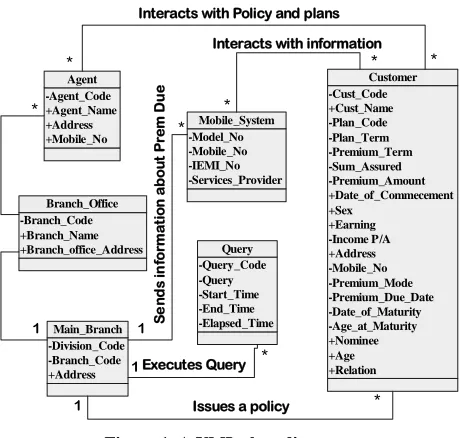
[image:2.595.309.539.83.302.2]The Query Response Time (QRT) system is modeled with the help of UML class concept. The QRT system contains the six major classes with their major attributes as shown in
Figure 1 below. In the present work, the complete process of computing the object-oriented query response time for UML models is explained in the form of UML class dia-gram. The Agent class has multiple associations with the Customer class, the Agent class is used to describe about the policy plan with premium amount and sum assured for Customer who has to fill the policy form. The Agent class has also multiple associations with Branch_Office class; the Agent class sends filled form to the Branch_Office class. The Branch_Office class has single association with the Main_Branch class, the Main_Branch class issued the requested policy plan to the Customer; the Main_Branch has multiple association with the Customer class. The Main_Branch class has also multiple associations with the Query class, the Main_Branch class executes a query to
-Cust_Code +Cust_Name -Plan_Code -Plan_Term -Premium_Term -Sum_Assured -Premium_Amount +Date_of_Commecement +Sex +Earning -Income P/A +Address -Mobile_No -Premium_Mode -Premium_Due_Date -Date_of_Maturity -Age_at_Maturity +Nominee +Age +Relation Customer -Model_No -Mobile_No -IEMI_No -Services_Provider Mobile_System -Agent_Code +Agent_Name +Address +Mobile_No Agent -Division_Code -Branch_Code +Address Main_Branch -Branch_Code +Branch_Name +Branch_office_Address Branch_Office -Query_Code -Query -Start_Time -End_Time -Elapsed_Time Query
Interacts with information
Issues a policy Executes Query
Interacts with Policy and plans
S e nd s in fo rm a tio n ab o ut P re m D u e 1 1 1 1 * * * * * * * *
Figure 1. A UML class diagram.
find the customers whose premium due date of issued pol-icy plan is scheduled and sends an information about pre-mium due to the Mobile_System class. This information is automatically sent to the Mobile_System within fifteen days before the due date; the Mobile_System class has the single association with the Main_Branch class. The Mo-bile_System class associates with the Customer class and the customer interacts with the Mobile_System to know about the premium due date.
3.2. UML Sequence Diagram
A UML sequence diagram represents the dynamic be-havior of system which is shown in Figure 2. It shows the sequence of executions represented through object life line. In the current work a UML sequence diagram is designed which shows that the complete process of sending information about the premium due of the issued policy plan through executing a query whose premium is due. The four main objects are Main_Branch, Query, Mobile_System and Customer. Arrow along the commu-nication message shows the commucommu-nication between two objects. The vertical line alongwith the pipe shows that the life line of an object. The Main_Branch executes a query to get the list of customers whose premium of the issued policy is due, the Main_Branch send information on the Customer’s Mobile_System; the Customer inter-acts with that information and deposit the due premium amount. The main purpose of this diagram is to check whether the designed model is functioning or not.
4. Experimental Results
4.1. A Sample Object-Oriented Database
Main_Branch Query Mobile_System Customer
Execute Query
Intract with that information Return the result of Query
Send an information regarding premium due
[image:3.595.311.534.82.403.2]Deposit the premium Ammount
Figure 2. A UML sequence diagram.
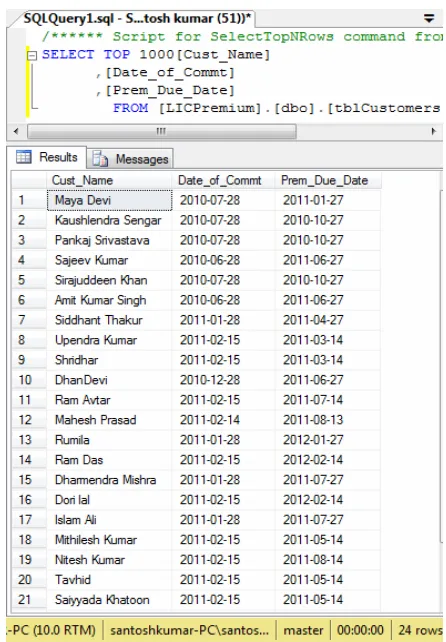
SQL Server Management utility of SQL Server 2008. The main database table contains the overall database fields related to customers with their issued policy plan. The purpose of this table is to perform a query and to get quickly the list of customers whose premium of issued policy is due. A list of the customers is shown in the fol-lowing Figure 3.
4.2. Computation of Query Response Time
In an object oriented database the query processor proc-essed the requested query; the query processor is a pro-cedure that selects the suitable strategy which executes and generates the result. The query processing is the stepwise process, it transformed the requested query into the SQL standard form, while the transformation is per-forming the parser checks the syntax and verify the rela-tional attributes used in the query that are defined in the data-base. When the query translated into the relational algebraic expression, the query optimization is performed that substitute the equivalent expression and the number of strategies called access plans are generated for evalu-ating the query, the optimal access plan and executed.
The query response time is a time in which the query processor executes and generates a result in the response of requested data-base by the user. The query response time (QRT) is the part of the query processing strategy (QPS); it is treated as an elapsed time of a query from the execution to end. The given Figure 3 shows the com-plete process for executing the query requested by the user. The application forwards the requested query to the database server, then it optimize query and retrieve any user defined routines, add or updates the appropriate re-cords and performs any back-ground input/output opera-tions; then the database server return the result to the application which display on the user device.
Figure 3. A sample object-oriented database.
For computing the query response time, the authors have used query analyzer in SQL Server Management Studio. The code segment for computing the query re-sponse time is developed in SQL Server 2008 query analyzer. The code segment is given below:
DECLARE@EndTime DATETime DECLARE@StartTime DATETIME DECLARE@I INT
SET@I= 0
SET@StartTime = GETDATE() SET@EndTime = GETDATE() While(@I<10)
Begin
PRINT 'StartTime = ' + CONVERT(VARCHAR(30), @StartTime,121)
Select Cust_Name,Date_of_Commt,Prem_Due_Date from tblCustomers
SET @I= @I+1
PRINT' EndTime = ' + CONVERT (VARCHAR(30), @EndTime,121)
PRINT 'RESPONSETIME = '+ CONVERT (VAR CHAR (30),@ENDTIME-@STARTTIME,114)+''
End
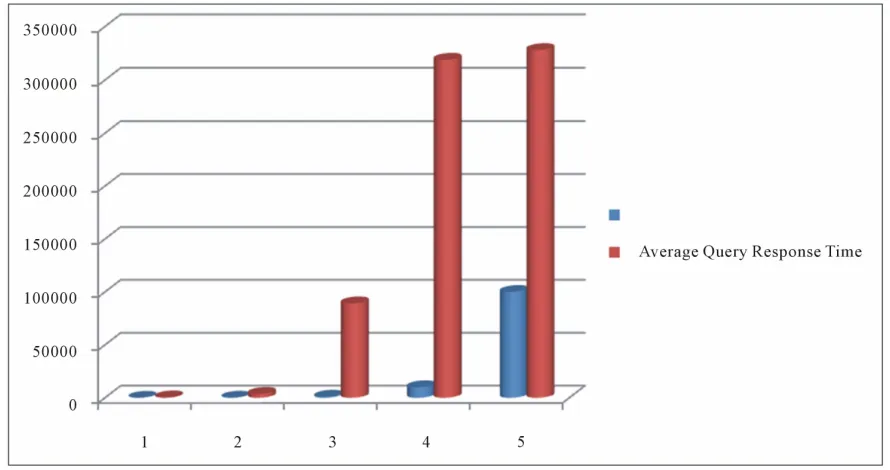
[image:3.595.60.283.82.282.2]compute on the basis of five runs. It is computed in mil-lisecond and on the basis of five runs, average response time is evaluated. In query, lines of codes are increase from 10 to 105. As depicted in the graph, it is increasing as the lines of code increasing, which is shown as in Ta-ble 1.
oriented database. It is also noted from the literature that UML is not much applied for creating the object oriented database; therefore, it is necessary to construct more building blocks for the object oriented database as soft-ware professionals are converting the old structured based technology towards object oriented technology. In this paper, query response time is computed after de-signing of the UML class and the steps of executions in the form of sequence diagram, the work further can be extended for comparision of search time for various hand move system supported by the SQL Server 2008 and can be optimized the search time for complex query to be executed on the object-oriented databse.
The graphical representation of the average query re-sponse time and query run is given in Figure 4.
Thus from the above analysis the query response time is directly proportional to the line of codes which are executed.
QRT α LOC (Line of codes)
5. Conclusion
6. Acknowledgements
Form the presented work, it is observed that the UML is [image:4.595.75.520.305.540.2]a powerful modeling language for presentation of object Thanks are due to University Grant Commission New
Figure 4. Line of code v/s query response time.
Table 1. Query response time and average response time (in milliseconds).
Line of code
Number of runs 10 10
2 103 104 105
1 430 3205 89,847 318,504 321,792
2 349 3843 89,066 318,770 340,130
3 385 3783 89,301 317,921 322,039
4 546 3740 89,494 319,942 323,202
5 382 3911 88,525 319,679 323,905
[image:4.595.58.540.589.735.2]Delhi, for financial support to carry out the above re-search work.
REFERENCES
[1] M. Blaha and J. Rumbaugh, “Object Oriented Modeling,” 2nd Edition, Prentice Hall, Upper Saddle River, 2005. [2] G. Booch, J. Rumbaugh and I. Jacobson, “The Unified
Modeling Language User Guide,” 12th Indian Reprint, Pearson Education, Upper Saddle River, 2004.
[3] G. Booch, J. Rumbaugh and I. Jacobson, “The Unified Modeling Language User Guide,” Addison Wesley, Read-ing, 1999.
[4] G. Booch, “Object-Oriented Analysis and Design with Ap-plications,” 2nd Edition, Addison Wesley, Reading, 1994.
[5] S. Cranefiel and M. Purvis ,“UML as an Ontology Mod-eling Language,” Proceedings of the Workshop on
Intel-ligent Information Integration, 16th International Joint
Conference on Artificial Intelligence, Barcelona, 16-22 July 1999.
[6] U. Dayal, “Of Nests and Trees: A Unified Approach to Processing Queries That Contain the Nested Sub Queries, Aggregates and Quantifiers,” Proceedings of 13th VLDB Conference, Brighton, 1-4 September 1987, pp. 197-208. [7] A. Deshpande, S. Nath, B. P. Gibbons and S. Seshan,
“Cache-and-Query for Wide Area Sensor Databases,”
SIGMOD’03, San Diego, 8 June 2003, pp. 503-514. [8] R. Ganski and H. K. T. Wong, “Optimization of Nested
SQL Queries Revisited,” Proceedings of SIGMOD
Con-ference, Vol. 16, No. 3, 1987, pp. 23-33.
doi:10.1145/38714.38723
[9] H. Gomaa, “Designing Concurrent, Distributed, and Real- Time Applications with UML,” Proceedings of the 23rd International Conference on Software Engineering, To-ronto, 12-19 May 2001, p. 829.
[10] E. Holz, “Application of UML within the Scope of New Telecommunication Architectures,” GROOM Work-shop
on UML, Physicaverlag, Mannheim, 1997.
[11] S. Huaiming, W. Yang, A. Mingyuan, W. Weiping and S. Ninghui, “Query Prediction in Large Scale Data Intensive Event Stream Analysis Systems,”7th International
Con-ference on Grid and Cooperative Computing, Shenzhen, 24-26 October 2008.
[12] W. Kim, “On Optimizing a SQL-like Nested Query,”
ACMTODS, Vol. 7, No. 3, 1982, pp. 443-469.
[13] OMG, “UML Profile for Schedulability, Performance and Time,” OMG Document Ptc/03-02-03, Needham, 2002. [14] OMG, “UML Superstructure Specification v 2.0,” 2005.
http://www.omg.org/cgi-bin doc? Formal/
[15] OMG, “Unified Modeling Language (UML)—Version
1.5,” OMG Document Formal/2003-03-01, Needham, 2003.
[16] OMG, “Unified Modeling Language Specification,” 2011. http://www.omg.org
[17] S. Pllana and T. Fahringer, “UML Based Modeling of Performance Oriented Parallel and Distributed Applica-tions,” Winter Simulation Conference USA, Vol. 1, 2002,
pp. 497-505.
[18] P. M. Kumar, P. Kumarsen and J. Vaideeswasam, “Opti-mism Analysis of Parallel Queries in Databases through Multicores,” International Journal of Database
Man-agement Systems, Vol. 3, No. 1, 2011, 156 p.
[19] V. Saxena, D. Arora and S. Ahmad, “Object Oriented Distributed Architecture System through UML,” IEEE International Conference on Advanced in Computer Vi-sion and Information Technology, Aurangabad, 28-30 November 2007, pp. 305-310.
[20] V. Saxena and G. A. Ansari, “UML Modeling & Protec-tion of Domain Based System,” International Journal of
Computer Science and Network Security, Vol. 8, No. 7, 2008, pp. 338-344.
[21] T. Wang, B. Yang, A. Huang, Q. Zhang, J. Gao, D. Yang, S. Tang and J. Niu, “Dynamic Data Migration Policies for Query-Intensive Distributed Data Environments,” AP-Web/WAIM 2009, LNCS 5446, Springer-Verlag, Berlin, 2009, pp. 63-75.
[22] W. Liang, B. Chen and J. X. Yu, “Response Time Con-strained Top-k Query Evaluation in Sensor Networks,” 14th IEEE International Conference on Parallel and
Dis-tributed Systems, Melbourne, 8-10 December 2008, pp. 575-582. doi:10.1109/ICPADS.2008.65
[23] S. D. Muruganathan, A. B. Sesay and W. A. Krzymien, “Analytical Query Response Time Evaluation for a Two-Level Clustering Hierarchy Based Wireless Sensor Network Routing Protocol,” Communications Letters,
IEEE, Vol.14, No. 5, 2010, pp. 486-488.
doi:10.1109/LCOMM.2010.05.091473
[24] G. C. Wei and L. T. Ming, “A P2P Object-Oriented Da-tabase System That Supports Multi-Attribute and Range Queries with Improved Query Response Time,”
Informa-tion Technology (ITSim), 2010 International Symposium, Kuala Lumpur, 15-17 June 2010, pp. 1250-1255.
[25] C. A. Yfoulis, A. Gounaris and D. Tzolas, “Minimization of the Response Time in Parallel Database Queries: An Adaptive Cost-Aware MPC-Based Solution,” 19th
Medi-terranean Conference on Control & Automation (MED), Corfu, 20-23 June 2011, pp. 813-818.
[26] R. Tavenard, H. Jegou and L. Amsaleg, “Balancing Clus-ters to Reduce Response Time Variability in Large Scale Image Search,” 9th International Workshop on
Con-tent-Based Multimedia Indexing (CBMI), Madrid, 13-15 June 2011, pp. 19-24. doi:10.1109/CBMI.2011.5972514
[27] Z. Y. Zhang, L. Bin and C. Zhi, “The Research on the Query Optimization on the Distributed Heterogeneous Database Based on the Response Time,” Computer
Sci-ence and Network Technology, International ConferSci-ence, Harbin, 24-26 December 2011, pp. 1541-1544.
[28] W. Liang, B. Chen and J. X. Yu, “Top-k Query Evalua-tion in Sensor Networks under Query Response Time Constraint,” Information Sciences: An International
Jour-nal, Vol. 181, No. 4, 2011, pp. 869-882.
doi:10.1016/j.ins.2010.10.006
[29] N. V. Murray and E. Rosenthal, “Linear Response Time for Implicate and Implicant Queries,” Knowledge and
In-formation Systems, Vol. 22, No. 3, 2010, pp. 287-317.