Comparative Study on Rebar Tying Tools with Different Parameters
Vaibhav Badgujar
1, Himanshu Divekar
2, Sagar Chaudhari
3, Nilesh Lende
41,2,3
Student, Dept. of Civil Engineering, Datta Meghe College of Engineering, Maharashtra, India
4
Asst. Professor, Dept. of Civil Engineering, Datta Meghe College of Engineering, Maharashtra, India
---***---Abstract -In construction, 80 percent of material constitute of concrete, reinforcement and finishing materials. The structure wholly cannot be constructed only by concrete even having high compressive strength as the tension cannot be resisted by concrete alone. So proper placing of reinforcements play a vital role in increasing tension, strain, flexural properties of concrete reducing tension cracks, leakages and corrosion after many years also reducing the maintenance of structure. In this paper we have listed the methods of tying rebar using various tools and to compare the cost, quality of the experiment pragmatically.
Key Index Terms- Rebar tying tools, musculoskeletal
disorders,Gauge of binding wire,Quality,Cost
1. INTRODUCTION
History of construction in India:-From the past 50 years India as reported 40 percent of development investment and over 30 million people are engaged in construction industry and hence considered as an important factor for development of India. The main activities subsumed in construction are excavation, Reinforced concrete work (RCC), Finishing work, Services provision etc. RCC work has the tasks such as shuttering of slab columns etc. steel bar bending, Laying and tying of bars and concreting, de- shuttering. These undertakings have a requisition of cash flow, time, quality and labor efforts so in order to make construction sites safer and workers more efficient. There is much advancement made in technologies, tools, equipment to increase productivity, improve performance, collaboration and tackle many bottlenecks in high end projects. The modern technology/ equipment have their pros cons i.e. The modern construction techniques may increase the cash flow of the project by 25% but quality of construction or construction speed can be boosted as compared to the conventional method.
Concrete, by itself, is a material with high compressive strength and low tensile strength. Steel, a material that is strong in tension as well as compression, is used as tension reinforcement for concrete [1]. But if the reinforcements are not in proper position the structural part can be found weak in tension also the capricious behavior of rebar due to high pressure of concrete while concreting or the foot fall has made indispensible to deploy proper methods and tools.
2. REBAR TYING TOOLS
2.1 Conventional Hook
This conventional hook is preferably used all over India due to its continuous use since decades and also its availability in market. This tool is usually made from mild steel andapproximately half kilograms in weight. This tool has a hook at the tip by which the fitter twists the binding wire, as this requires twisting the tool again and again requires more time in tying one tie and the most concerning factor is the musculoskeletal disorders hindering the performance of fitter. Also it has a smooth and glossy body requiring more strength for the fitter to hold the hook in position. New methods and technologies have been used worldwide but for adapting them mindset needs to be changed.
Fig.1 Conventional Hook
2.2 Semi-automatic rebar tying hook
Fig. 2 Semi-automatic rebar tying hook
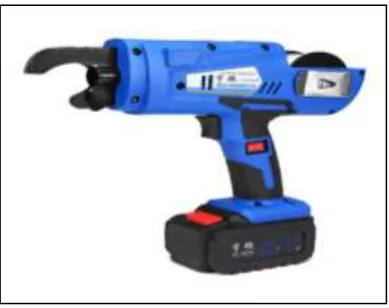
Fig. 3 Rebar tying machine
2.3 Rebar tying machine
For reducing the musculoskeletal disorders of the labors a new innovation in technology has been brought into practice. The basic components are the body, battery, wire spool. The machine is operated by rechargeable Li-ion/Ni-Cd batteries allowing a continuous work front of approximately 2000-3000 ties per charge depending on the manufacturer. The weight of the machine is approximately 2-2.7 kilograms. The manufacturers set a suitable applicable range for binding the bars. For example 4-28 mm i.e. two bars should have thickness less than 28mm.
The spool used has a GI 100 meter binding wire which usually is of 21 gauge i.e. 0.813 mm in diameter as compared to conventionally used which is of 17 or 18 gauge i.e. 1.422 and 1.219 mm in diameter respectively. The initial cost incurred for the machine and cost of spool is expensive but the productivity and benefitting on a larger scale.
3. METHOLOGIES FOR REBAR TYING
Binding wire plays an important role in holding the reinforcements in place when there is foot movement and even while concreting, immense pressure on the bars can displace them making them unrecognized. Nowadays,
17-gauge wire is preferably used to tie rebar. Regular practice on an average we need 10-13 kilograms of binding wire per ton of reinforcement used. These binding wires do not provide any strength to the structure.
Fitters have many methods to tie rebar together which depends on the purpose or circumstances, some of them are:-
A. Snap tie or simple tie-In current scenario this type of tie is widely used in construction industry. Encasing a single wire around the transverse bars of steel and then twisting the two ends of wire with a conventional hook which is made of mild steel until they are tight enough.
B. Double-strand simple tie-This tie is similar to simple tie but instead of using a single wire we use double binding wire and tie in a similar way.
C. Snap tie with a round turn or wall tie-As the name suggests this tie is used for tying the horizontal bars in long shear walls, compound walls where the simple tie is not capable of holding the horizontal ones.
D. Saddle or U tie-This type of tie is intricate than other ties but is favorable in some locations such as for tying foundation reinforcements/shear walls. The productivity is lessened as this tie is more time consuming.
E. Cross tie or figure eight tie-. This tie can provide the maximum resistance to twisting of the bars and permitting huge load on the reinforcements. With the use of such ties, intermittent ties can be provided.
[image:2.595.321.545.536.710.2]F. Saddle or U tie with a twist-These ties are similar to U tie but one and half excess turn is wrapped which provides extra stiffness to the reinforcements used mainly for heavy rafts or in case where precast reinforcements are done.
4. MUSCULOSKELETAL DISORDERS
Musculoskeletal injuries (MSDs) are commonly found in labors who face lot of physical exertions by lifting heavy loads or repetitive unusual postures which causing strain in muscles, ligaments, cartilages and all the joints leading to weakness, pain and noise in joints and indirectly affecting the labor output, efficiency and reducing the productivity. It is found that in United States sixteen million such disorders were treated in year 2004 and as they have increased with increase in demand of construction activities.
Workplace controls-Employers can also utilize engineering controls and administrative controls to prevent injury that cannot be detected in short course of action. So various tools and technologies have been taken into practice to avoid such disorders and taking these disorders in consideration we have conducted a mock up for rebar tying machine to monitor the quality, time and cost with respect to conventional methods.
5. EXPERIMENTAL PROCEDURE
[image:3.595.304.563.156.681.2]A demonstration was conducted on site by considering a slab of 2x2 meter. Conventional tools, Semi-Automatic Rebar tier and Automatic rebar tier were compared by recording parameters such as time cost and quality. For the best results and experience the task was allotted to the labors on site. Before the experiment the technical specifications, previous articles and the vendors for the same were explored for the availability of the tools and the game plan for the demo was set up and the results were noted accordingly. This trial was conducted on a small scale and snap type of tie was used for all tools as rebar tier had the snap tie by default. The time noted for tying 1 tie and cost is shown in Table 1.
Table 1 Time and cost comparison of tools
Sr.
No. Method of tying adopted Time needed to tie 1 knot
Cost per tool
1 Conventional
tying hook 8-9 seconds 100 rupees
2 30cm
Semi-automatic fast rebar tier tool
6-7
seconds 1020rupees
3 Rebar tying
machine 4-5 seconds 22000 rupees
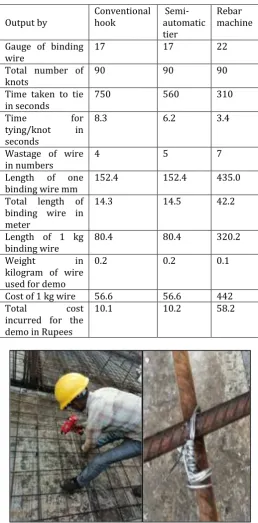
As mentioned earlier, 3 tools were used for tying the bars on a slab of 2 by 2 meters for each tool and the spacing of rebar was 220 mm in X direction and 200 in Y direction having 90 joints. The only difference was the thickness of binding wire as the coil of rebar tying machine had wire of 21 gauge =0.813mm and conventionally 17 gauge=1.422 mm is used. The thickness and gauge of wire are inversely proportional [4]. Proper training about how to use the
rebar tier was given to the fitter and the cost required for the demo was worked out taking the actual wastages during working which is shown in table 2 below
Table 2 Cost for demo incurred by rebar tying machine
Output by Conventional hook Semi-automatic tier
Rebar machine
Gauge of binding
wire 17 17 22
Total number of
knots 90 90 90
Time taken to tie
in seconds 750 560 310
Time for
tying/knot in seconds
8.3 6.2 3.4
Wastage of wire
in numbers 4 5 7
Length of one
binding wire mm 152.4 152.4 435.0 Total length of
binding wire in meter
14.3 14.5 42.2
Length of 1 kg
binding wire 80.4 80.4 320.2
Weight in
kilogram of wire used for demo
0.2 0.2 0.1
Cost of 1 kg wire 56.6 56.6 442
Total cost
incurred for the demo in Rupees
[image:3.595.303.565.161.679.2]10.1 10.2 58.2
Fig.5 Labor using rebar tying machine on site and enlarged image of a knot by the machine
5.1 Feedback from labors
[image:3.595.49.274.549.673.2]hook has been a regular practice fitters are comfortable but the new fitters complained about hand paining and for rebar tying machine, initially the fitter was comfortable and tying was quick but later he complained about hand paining due to weight of the machine. He also commented about the quality of knots mentioning that the knots were not that rigid and stiff due to less thickness of wire but the load movement on the slab was resisted.
5.2 Advantages and Disadvantages
Advantages
a) Slab tying time can be reduced up to three times by which we can speed up our construction b) Manpower can be optimized as time is saved c) Musculoskeletal disorder, Ergonomic risks, hand
pain can be reduced
d) The cut length binding wires are wasted due to falling form the bundles, carrying of them by birds as observed on site and can be reduced by using rebar tying machine
Disadvantages
a) Initial cost of the machine is incurred.
b) Weight of the machine is 1.5-2 kilogram more than the conventional tool and semi-automatic rebar tier tool which weighs 220-300 grams c) The cost of the approx. 400 grams spool
measuring 100 meters is more than that of cut sized conventional binding wires
d) Different activities such as slab, column, beam require dedicated tying machine depending upon the dimensions of reinforcements
e) The rebar tying machine is not guaranteed for use during rains
f) The cut length of one binding wire by machine is fixed so more wastage is observed where the length is more than required
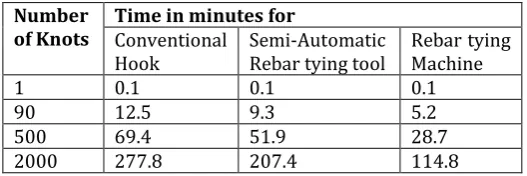
[image:4.595.310.560.113.227.2]Comparison between time and number of ties and cost and number of ties can show us a broad scope and hence refinement in our way of choosing the work method. The table 3 below shows the time and cost that will be required for assumed number of ties.
Table 3 Time required for tying knots Number
of Knots Time in minutes forConventional
Hook Semi-Automatic Rebar tying tool Rebar tying Machine
1 0.1 0.1 0.1
90 12.5 9.3 5.2
500 69.4 51.9 28.7
[image:4.595.311.559.321.493.2]2000 277.8 207.4 114.8
Table 4 Cost required for tying knots
Number
of Knots Cost in Rupees forConventional Hook Semi-Automatic
Rebar tying tool
Rebar tying Machine
1 0.1 0.1 0.8
90 10.1 10.2 75
500 56.1 56.7 415
2000 224.4 226.7 1660
Further from the graph 1, it can be inferred that by using semi-automatic rebar tying tool can reduce the time by 25% and by using Rebar tying machine can reduce the time by 58% as compared to the conventional hook for 2000 ties and time savings will increase with increase in number of ties.
Graph 1 Comparing time vs. ties
[image:4.595.30.294.645.733.2]Graph 2 Comparing cost vs. ties
6. CONCLUSIONS
Based on the above results we can conclude that for small scale constructions Semi-Automatic rebar tying tool which need not be changed for rebar with varying thickness i.e. for slabs, columns whereas Rebar tying machine is beneficial for a large span and by using rebar tying machine human efforts and health disorders can be reduced and the productivity can be increased after proper training to the labors. The human repetitive, monotonous actions can be minimized. Studying the thickness of the binding wire used in rebar tying machine was 22 gauge but in IS 2502 -1963 it is mentioned that the minimum thickness of binding wire must be more than 0.9 mm and as the rebar tying machine uses wire of gauge 21 i.e. less than 0.9 mmwe can also choose wire of 20/19 gauge for tying of slabs even while tying them in a conventional way thus effectively cutting down the cost.
Consider the demo results which incurred cost of 10 rupees by using 17 gauge binding wire but if the same demonstration had been done by 20 gauge binding wire, the cost of demo would be cut down to 6 rupees i.e. 40 percent saving which would be considerable amount for the whole project but trials regarding the same will have to be conducted.
REFERENCES
[1] Dr. Santosh K Patil , Akshay Manesh Sancheti, 2019, Replacement of Steel Reinforcement with Glass Fiber Reinforcement, International Journal of Engineering Research & Technology (IJERT), Volume 08, Issue 07 (July 2019)
[2] Tying of reinforcement bars from IS:2502-1963 Code for practice for bending and fixing of bars for concrete reinforcement, New Delhi Publication.
[3] Tony Almeida and Peter Vi Briand, "Reducing Risk of Musculoskeletal Disorders and Promoting Return-To-Work Through The Use Of Rebar Tying Machines", Construction Safety Association of Ontario, WSIB Grant #01023, September, 2004.
[4] Central Service Association of Ontario, "An effective way to reduce upper limb MSIs", Winter 2001.
[5] Choi, Sang D. Ergonomic assessment of musculoskeletal discomfort of iron workers in highway construction. Work 36.1, 47-53, 2010.
[6] Bureau of Labor Statistic. Occupational Employment and Wages. 47-2171 Reinforcing Iron and Rebar Workers, 2014.
[7] Albers JT, Estill CF. Simple solutions ergonomics for construction workers, Edited by National Institute for Occupational Safety and Health, Cincinnati, 2007
[8] Safety Agency Compares Injury Trends In Rebar Tying Methods, Concrete Products, 109, 4, p. PC26, Small Business, Reference Center, EBSCOhost, 2016.