Robust Quantization for General Similarity Search
Yuchen Guo
∗, Guiguang Ding
∗, and Jungong Han
Abstract—The recent years have witnessed the emerging of vec-tor quantization (VQ) techniques for efficient similarity search. VQ partitions the feature space into a set of codewords and encodes data points as integer indices using the codewords. Then the distance between data points can be efficiently approximated by simple memory lookup operations. By the compact quantiza-tion, the storage cost and searching complexity are significantly reduced, thereby facilitating efficient large-scale similarity search. However, the performance of several celebrated VQ approaches degrades significantly when dealing with noisy data. Additionally, it can barely facilitate a wide range of applications as the distortion measurement only limits to ℓ2 norm. To address the
shortcomings of the squared Euclidean (ℓ2,2 norm) loss function
employed by the VQ approaches, in this paper, we propose a novel robust and general VQ framework, named RGVQ, to enhance both robustness and generalization of VQ approaches. Specifically, aℓp,q-norm loss function is proposed to conduct the
ℓp-norm similarity search, rather than theℓ2 norm search, and
the q-th order loss is used to enhance the robustness. Despite the fact that changing the loss function toℓp,q norm makes VQ approaches more robust and generic, it brings us a challenge that a non-smooth and non-convexorthogonality constrainedℓp,q -norm function has to be minimized. To solve this problem, we propose a novel and efficient optimization scheme and specify it to VQ approaches and theoretically prove its convergence. Extensive experiments on benchmark datasets demonstrate that the proposed RGVQ is better than the original VQ for several approaches, especially when searching similarity in noisy data.
Index Terms—Vector quantization, similarity search, efficiency, large scale, robustness, generalization, optimization, experiment
I. INTRODUCTION
S
IMILARITY search, a.k.a., nearest neighbor (NN) search, is of great importance in various applications, such as data mining [1], machine learning [2], information retrieval [3], and etc. Formally, NN search is defined as follows: given a setSof points in a metric spaceMand a query pointq∈ M, find the closest point in S toq. One straightforward way is to linearly scan S and compute the distance d(q, xi) between q andany point xi ∈ S. However, when dealing with a large-scale
dataset, linear scanning is time consuming due to the expensive distance computing operations. Therefore, how to perform efficient NN search in large-scale dataset is an important and practical problem, which has drawn considerable research interest from both academia and industry in the past decades.
Yuchen Guo and Guiguang Ding are with the School of Software, Ts-inghua University, Beijing 100084, China. Email: [email protected], [email protected].
Jungong Han is with the School of Computing and Communica-tions, Lancaster University, Lancaster, LA1 4YW, UK. Email: [email protected].
∗Yuchen Guo and Guiguang Ding contributed equally to this paper.
Corresponding author: Guiguang Ding.
This research was supported by the National Natural Science Foundation of China Grant No. 61571269, and the Royal Society Newton Mobility Grant IE150997.
ܿଵ ܿଶ
ܿଷ
ܿସ ܿହ
ܿ
Vector Quantization
ݔ ݍ
݀(ݍ,ܿଵ) 1.74
݀(ݍ,ܿଶ) 1.56
݀(ݍ,ܿଷ) 0.62
݀(ݍ,ܿସ) 0.41
݀(ݍ,ܿହ) 1.32
݀(ݍ,ܿ) 1.01 Distance
Table
݀ ݍ,ݔ ൎ ݀ ݍ,ܿସ = 0.41 Memory Look-up
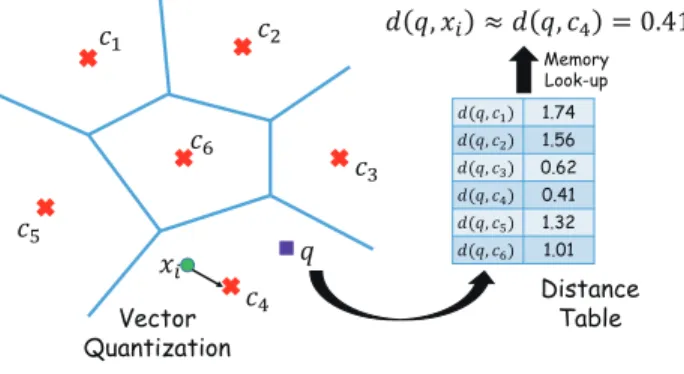
Fig. 1: Illustration of vector quantization based ANN search.
Considering the difficulty of exact NN search for large-scale dataset, approximate NN (ANN) search is regarded as a more practical solution which can simultaneously achieve orders of magnitude speed-ups than exact NN search and near optimal accuracy with proper designs [4]. One paradigm is to utilize the tree structure, such as k-d tree [5]. Theoretically, by recursively bi-partitioning the feature space, tree structure can reduce the frequency of distance computation toO(logn). However, because of thecurse of dimensionality, tree structure may degenerate to sub-linear complexity in high-dimensional spaces since it needs to visit too many branches [6]. Al-ternatively, vector quantization (VQ) emerges recently which is capable of handling high-dimensional data. Different from tree structure that reduces the number of scanned points, the aim of VQ is to speed up the exhausting distance computing. Specifically, VQ partitions the space into a set of codewords, i.e., a codebook C (|C| ≪ |S|), and then quantizes each pointxiinto the codewords. After the quantization, the feature
vector of each point is no longer needed and only an integer index denoting which codeword the point is quantized into is stored. Given a query, its distanced(q, cj)to all codewords can
be pre-computed and stored in a distance table. The distance
0 1 2 3 4 5 0.4
0.5 0.6 0.7
Noise ratio (%)
Recall@1000
ITQ
(a) SIFT1M,64bits
0 1 2 3 4 5 0.4
0.5 0.6 0.7
Noise ratio (%)
Recall@1000
OPQ
(b) SIFT1M,32bits
0 10 20 30 40 50 1.85
1.9 1.95 2 2.05
#Iterations
Distortion (
×
10
7)
ITQ
(c) SIFT1M,64bits,p= 1
0 10 20 30 40 50 1.4
1.6 1.8 2
#Iterations
Distortion (
×
10
3)
OPQ
(d) SIFT1M,32bits,p= 1
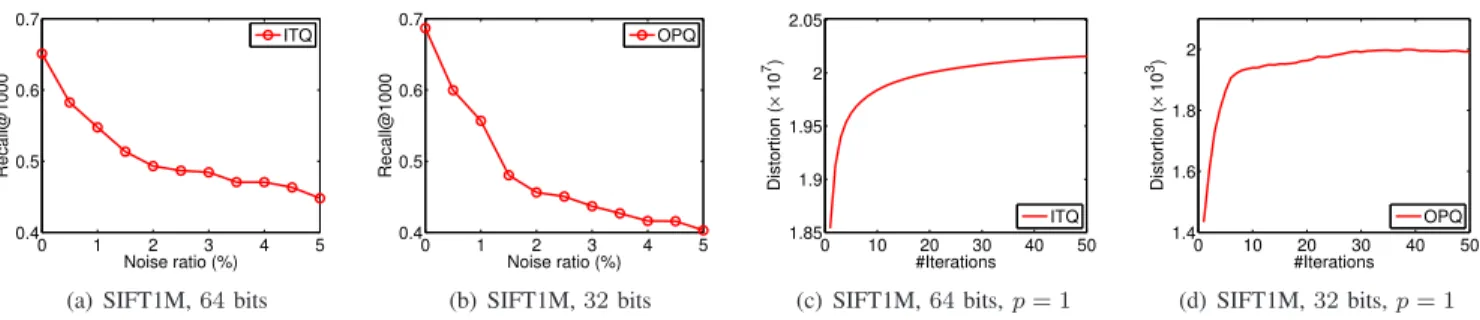
Fig. 2: Traditional VQ approaches perform bad with the noisy data and can not deal with some other similarity measures.
the quantization is performed in each subspace independently, and Additive Quantization (AQ) [13], [14], [15], [16] which constructs several independent codebooks and each point is approximated by summing up the selected codewords from each codebook. As VQ approaches can achieve extreme data compression and support efficient ANN search for large-scale dataset, they have been adopted by many applications, such as image retrieval [17], [18], [19], [20] and many other tasks [21].
A. Problem Statement
The extraordinary performance and widely usage of the VQ approaches motivate as to closely investigate these algorithms. Though specific formulations may have tiny differences, these VQ approaches can be all formulated as a general problem:
min
R,Q,C n X
i=1
kxiR−Q(xi,C)k22, s.t.RR′ =I (1)
where xi ∈Rd is the d-dimensional feature vector, Qis the
quantization function with the codebook C, R ∈ Rd×d is a
rotation matrix which can optimize the quantization [8], [10], [16], andIis the identity matrix. A close look at the objective function reveals that a squaredℓ2loss is applied to measure the
distortion. But unfortunately, this sort of distance measurement comes with certain vulnerabilities. For instance, there are noise and outliers in real-world datasets but the squared loss is sensitive to them because their large distortion will dominate the sum of the squared loss [22], [23], [24], which may markedly degrade the quality of quantization codes. Solving this problem becomes important when we need to search nearest neighbors for data in the wild, such as Flickr images and YouTube videos, as the noises are commonly existed. To verify our observation, we carried out an experiment based on SIFT1M [25] dataset, in which the noise is manually added into the training data and we plot the ANN search performance of two representative VQ approaches, ITQ [8] and OPQ [10], w.r.t. the noise ratio, which is shown in Fig. 2(a) and 2(b) respectively. Obviously, the performance of VQ degrades significantly in the noisy environment, even with only 1% noisy data. Secondly, existing VQ approaches work well for
ℓ2-norm similarity search, i.e.,d(q,xi) =kq−xik2 because
they focus on minimizing ℓ2-norm distortion defined in Eq.
(1). However, when other measurements, such as Manhattan distancedM(q,xi) =kq−xik1[26], are used, their
optimiza-tion objective may fail to well preserve the similarity structure.
In practice, the preferred measure means may need to be defined by users depending on the specific applications, which indicates that a good similarity search algorithm should be generic enough to deal with different distance measurements. Again, to demonstrate this, we plot theℓ1-norm distortion (i.e.,
P
ikxiR−Q(xi,C)k11) w.r.t. the number of iterations of ITQ
and OPQ in Fig. 2(c) and 2(d) respectively. It can be observed that the distortion keeps increasing with more iterations, rather than decreasing, because their optimization algorithms are designed for ℓ2-norm distortion instead of the ℓ1-norm one.
This inevitably leads to less effective quantization function, thereby resulting in worse search performance.
B. Contributions
The two problems mentioned above are important for VQ approaches from both theoretical and practical perspectives, but underestimated by the previous works. This motivates us to develop an improved VQ framework with dual goal to enhance both algorithm robustness and generalization. Recently, several works have demonstrated that theq-th order (q <2, especially
q≤1) ofℓ2loss, i.e.,kxiR−Q(xi,C)kq2, is less susceptible to
the noise and outliers in data than the squared loss [27], [28]. In addition, according to the triangle inequality, preserving the ℓp-norm distance can be achieved by minimizing theℓp
-norm distortion, i.e., kxiR−Q(xi,C)kp. Therefore, in this
paper, we propose a general VQ framework using a ℓp,q
-norm loss function for learningℓp-norm similarity-preserving
quantization function with more robustness, termed asRGVQ. In summary, this paper makes the following contributions:
• We put forward a newℓp,q-norm loss function for vector
quantization based ANN search. It is robust to noise and outliers by adopting a smallq(e.g.,q≤1) and supports
ℓp-norm (p≤2) similarity search with theℓp-norm loss. • To minimize the obtained orthogonality constrainedℓp,q
-norm function, a novel and efficient iterative optimization algorithm is proposed and its convergence property is theoretically investigated. To our best knowledge, it is the first work that provides the theoretical solution to this challenging non-smooth and non-convex problem.
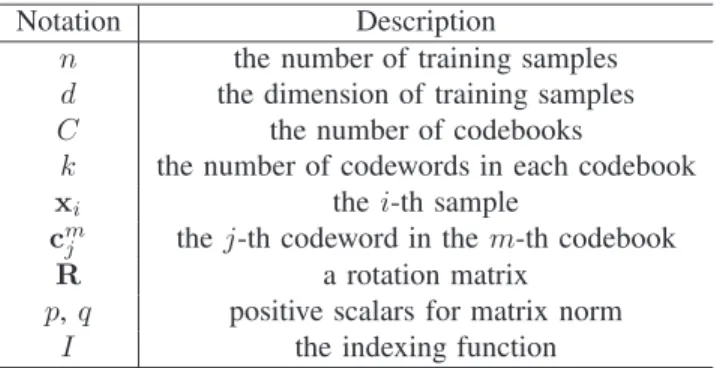
TABLE I: Some notations and descriptions in this paper.
Notation Description
n the number of training samples
d the dimension of training samples
C the number of codebooks
k the number of codewords in each codebook
xi the i-th sample
cm
j the j-th codeword in them-th codebook
R a rotation matrix
p,q positive scalars for matrix norm
I the indexing function
• RGVQ is robust to the noise, enabling us to search
sim-ilarity in wild data. Such an framework is favorably de-manded by the applications like Internet image retrieval. Extensive image retrieval experiments on benchmarks collected from the Internet demonstrate the effectiveness.
• Our algorithm is more generic in the sense that multiple
distortion measurements are implemented in one frame-work, allowing us to facilitate a wide range of applica-tions in which various measurements may be requested.
II. PRELIMINARIES ANDRELATEDWORK A. Vector Quantization Approaches
In this paper, we focus on three celebrated VQ approaches, Iterative Quantization (ITQ) [8], [9], (Optimized) Product Quantization (PQ) [10], [11], [12], and Additive Quantization (AQ) [13], [14], [15], [16]. As was mentioned above, these approaches share a general learning objective presented in Eq. (1) but they have different specific formulations and basic ideas. In this section, we will introduce them in details.
ITQ focuses on binary quantization defined as Q(xi,C) =
sign(xiR), wheresign(x) = 1 ifx >0 or−1 otherwise. Its
learning objective is to find the optimal rotation matrix Rto minimize the distortion between the original features and the binary embedding as follows:
min
R OITQ = n X
i=1
kxiR−sign(xiR)k22, s.t. RR′=I (2)
After the binarization, the original distance is approximated by the Hamming distance which is defined as the number of different bits between binary codes (a.k.a., hashcodes), and its computation can be accelerated by either memory look-up or the bit operations (like bit XOR), both of which are efficient. PQ is a k-means clustering like quantization approach. Its basic idea is to cluster the samples into a set of codewords
C ={cj}kj=1 and the distanced(q,xi)can be approximated
by d(q,cI(xi)) which can be pre-computed and stored in a
distance table. Obviously, increasing the codebook size (i.e.,
k) can partition the space more finely, which improves the distance approximation accuracy. In the extreme case where
k=n, each training sample is quantized to itself such that the distance is precisely approximated. However, whenkis large, computing the distance table, i.e., d(q,cj), becomes a
time-consuming step. Therefore, it is preferable to construct a large
codebook while the extra distance computation is not heavy. To address this issue, PQ proposes to partition the space intoC
orthogonal subspace and the quantization is performed in each subspace independently. Specifically, after the segmentation, each subspace isds=d/C dimension and the final codeword
is constructed by the concatenation of the sub-codeword from each subspace, i.e., cI(xi)= [c1I1(xi), ...,c
C
IC(xi)] where
cmj ∈ Cm is a codeword from the m-th subspace. Suppose
there are k codewords for each subspace, i.e.,|Cm| =k, the
total number of codewords in the original space iskC
, which is extremely large. In addition, the distance is approximated by kxi −qk22 ≈
PC
m=1kq
m −cm Im(xi)k
2
2 where qm is
the component of q in the m-th subspace. In this way, the distance table, i.e., d(qm,cm
j ), can be computed in each
subspace independently, which reduces the total complexity to
O(C·k· d
C) =O(kd). For good ANN results, PQ minimizes
the distortion between the original features and the codewords:
min R,cm
j ,Im
OPQ=
n X
i=1
kxiR−[c1
I1(xi), ...,
cC
IC(xi)]k 2
2,s.t.RR′=I (3)
whereRis to optimize the quantization, whose effectiveness has been demonstrated by several works [10], [16]. Suppose ˆ
xi =xiRis the rotated data, in PQ, each sub-codebookCm
is learned by k-means clustering in the m-th subspace over
{ˆxi}ni=1and the quantization function is defined asQ(xi,C) =
[c1
I1(xi), ...,c
C
IC(xi)]whereIm(xi) =argminjkˆx
m
i −cmj k22. At
the searching/testing phase, the queryqis also rotated byR. AQ is motivated by the multi-codebook idea of PQ. Differ-ent from PQ which constructs the final codeword by concate-nation, AQ constructs the final codeword by the summation of sub-codewords. In addition, the sub-codeword in PQ isds
dimension while AQ directly constructs sub-codewords in the original space which leads to d-dimensional sub-codeword. Formally, AQ constructsC codebooksCm={cmj }kj=1 where
cmj ∈Rd. The quantization function is defined asQ(xi,C) =
PC
m=1cmIm(xi). Because we havekq−xik
2
2=kqk22+kxik22−
2hq,xii, it is straightforward to approximate the distance by
kq−xik2
2 ≈ kqk22+kxik22−2
PC
m=1hq,cmIm(xi)iusing the pre-computed table hq,cm
j i∀m,j. Analogous to PQ, AQ can
also construct kC
codewords in the original space and the complexity to construct the distance table is only O(Ckd). Moreover, AQ attempts to minimize the distortion as follows:
min
R,cm j ,Im
OAQ=
n X
i=1
kxiR−
C X
m=1
cmI
m(xi)k
2
2, s.t.RR′=I (4)
Theoretically, AQ can be regarded as the generalization of PQ by removing the orthogonal constraints on the sub-codebooks. Because more flexible codeword combination is given, smaller distortion and more accurate quantization can be achieved such that AQ performs better than PQ to some extent [14], [16].
Based on the VQ approaches, the storage cost is markedly compressed and the distance computation is accelerated. For example, in PQ, if we set k = 256 for each sub-codebook, it requires only1 byte (8 bits) to store the index Im(xi)for
8 gigabytes are required for a 1-billion-size dataset, which can be can be easily handled by only one single machine. During searching, the complexity to compute the distance table is O(Ckd) at most. Since we have Ck ≪ n (in the above example, Ck = 8×256 = 2,048 and n = 1B), the com-plexity is almost ignorable. When computingd(xi,q), onlyC
memory look-up operations andC−1addition operations are required which is far fewer than directly computing d(xi,q)
in an element-wise way, especially for high-dimensional data.
B. Other Related Works
The main focus of this paper is on enhancing the robustness and generalization of existing VQ approaches by introducing theℓp,q-norm loss function to evaluate the quantization
distor-tion. However, we notice several works for some other prob-lems are related to our work [28], [29], [30]. Therefore, it is necessary to introduce them and discuss their difference. Gen-erally, their difference comes from three folds. Firstly, the tasks are different. We focus on vector quantization for efficient and general similarity search including image retrieval, while the others mainly focus on tasks like dictionary learning [28], representation learning [29], and projection learning [30]. In fact, we are the first to introduce a robust loss function and consider the generalization simultaneously in the field of VQ, which motivates us to propose the ℓp,q-norm loss. Moreover,
we specify the general framework to three celebrated VQ approaches, ITQ, PQ, and AQ, which is also very useful in practice. Secondly, the formulations are different. Generally, the ℓ2,q-norm (especiallyℓ2,1-norm) loss is adopted in many
robust learning approaches [28], [29], [30]. But theℓp,q-norm
is more general and complicated than them and it seems that it is difficult to directly apply their optimization algorithm to ℓp,q-norm loss. Some works also consider the ℓp-norm
term. For example, the ℓ1-norm term is considered in sparse
coding [31] and the ℓp-norm is considered in [28]. But it
should be pointed out that our formulation employsℓp-norm
to evaluate the reconstruction distortion while their approaches use it only as a sparsity regularization term for coefficients which element-wise decoupled. Obviously, our formulation is more difficult and general especially when coupling with the
q-th order upon theℓp norm and the orthogonality constraint.
Thirdly, the solutions are different. As stated, our problem is an orthogonality constrainedℓp,q-norm minimization problem.
Unlike some works considering parts of the problem, e.g.,ℓ2,q
-norm minimization is considered in [28], we systematically solve the general problem and provide the theoretical analysis for the solution. In addition, in Section V, we demonstrate that that the optimization algorithm is consistently effective and efficient under different settings.
III. THEPROPOSEDFRAMEWORK A. Overall Objective Function
The first goal of this paper is to enhance the robustness of VQ approaches. In the current framework, squared Euclidean (i.e.,ℓ2,2-norm) loss is adopted. In fact, because of the square
operation, the loss function tends to assign large weight to large-loss samples. However, in practice, the large loss is
often caused by noise and outliers. The loss function, in such a situation, will focus on the noise but fail to capture the intrinsic structure of samples, i.e., it is sensitive to noise, which has been empirically demonstrated in Fig. 2(a) and 2(b). To address this issue, we should reduce the weight of large-loss samples. In this paper, we propose to replace the squared loss by theq-th order loss. It has been demonstrated in several literatures [22], [23], [24], [32] that the loss function is more robust (less sensitive) to the noise and outliers in data in case ofq <2, especiallyq≤1. Motivated by this idea, we reformulate Eq. (1) from squared loss intoq-th order loss as:
min
R,Q,C ORQ= n X
i=1
kxiR−Q(xi,C)kq2, s.t.RR′ =I (5)
whereq <2. It is not difficult to observe the following fact.
When q >1, the objective prefers to decrease the distortion
of large-loss entries because it is obvious that the largerx(the distortion) is, the larger|xq−(x−∆x)q|
(the change in loss) is if ∆xis identical, which indicates the loss is encouraged to fit the noisy data. On the other hand, when q ≤ 1, the situation is different where the loss focuses more on the small-loss entries which are normal data. In this way, we can enhance the robustness of functions by settingq <2, especiallyq≤1. Although theℓ2,q-norm loss function is more robust to the
noise, it is still questionable whether it works well for the other similarity/distance measurements, like Manhattan distance. In fact, just like the results shown in Fig. 2(c) and 2(d), the ℓ2
-norm loss may fail when dealing withℓ1-norm based similarity
search. To address this issue, we firstly revisit one important theoretical building block of VQ, i.e., the triangle inequality:
|kx−ykp− kQ(x)−Q(y)kp| ≤K1kx−y−Q(x) + Q(y)kp
≤K2(kx−Q(x)kp+ky−Q(y)kp) (6)
where kxkp = (Pj|xj|p)
1
p is the ℓp-norm of a vector,
K1 = K2 = 1 for normal vector norm (i.e., p > 1) and
they are some constants for quasi-norm (i.e., 0 < p ≤ 1), andQ(x)denotes the quantization result of x. The first term denotes the distance approximation error between the original feature based distance (kx−ykp) and the quantized feature
based distance (kQ(x)−Q(y)kp), in which we expect the error
to be as small as possible, i.e., the distance approximation using the quantized vectors is more accurate. The last term is exactly the distortion caused by the quantization function (kx−Q(x)kp). Obviously, the distortion provides an upper
bound for the distance approximation. Therefore, decreasing the distortion leads to more accurate distance approximation and further results in better ANN performance [8], [10], [15]. Fortunately, based on the triangle inequality, it is straightfor-ward to observe that learning ℓp-norm similarity preserving
quantization function can be achieved by minimizing theℓp
-norm distortion. In the extreme case where the distortion is0 (i.e., Q(x) =x), the distance is perfectly approximated (i.e.,
kx−ykp = kQ(x)−Q(y)kp). Theoretically, existing VQ
rewrite the loss in Eq. (5) from theℓ2-norm loss to theℓp-norm
loss, leading to the overall objective function of RGVQ:
min
R,Q,C ORG=kXR−Q(X,C)k q p,q =
n X
i=1
kxiR−Q(xi,C)kqp
s.t.RR′ =I (7)
wherekAkp,qdenotes the entrywise (in row) matrixℓp,qnorm
of matrixA. So far, we derive theℓp,q-norm loss function for
RGVQ framework from the original ℓ2,2-norm loss of VQ.
B. Optimization Algorithm
The motivation of changing theℓ2,2-norm loss into theℓp,q
-norm loss is clear and reasonable, which makes VQ more robust to noisy data and generalizable for different distance measurements. However, it is challenging to minimize the ob-tained orthogonality constrainedℓp,q-norm function because it
becomes a non-smooth and non-convex optimization problem when p ≤ 1 or q ≤ 1. Solving this problem is much more difficult than minimizing theℓ2,2-norm in the original VQ, for
which many solutions are available [8], [10], [14]. To solve it, we propose an efficient optimization algorithm shown below. It should be noticed that there are a rotation matrix R, quantization functionQ and the codebookC in the objective function, and it is very difficult, if not impossible, to optimize them as a whole. Therefore, following the traditional VQ framework, we adopt an iterative optimization scheme to update any of them while keeping the others fixed as follows.
Update R. This is the most difficult part in the entire
solution, which is also an important theoretical contribution of this paper. The ℓp,q-norm is neither smooth nor convex,
and meanwhile, the orthogonality constraint limits the feasible set, therefore making the problem more difficult. First, we denote yi = Q(xi,C)as the quantized vector, which is fixed
when updatingR. Then, to solve the problem, we rewrite the complicatedℓp,q-norm loss into a weightedℓ2,2-norm loss as:
min RR′=IO=
n X
i=1
kwi◦(yi−xiR)k22 =kW◦(Y−XR)k2F (8)
whereX= [x1;...;xn]∈Rn×drepresent the original training
vectors, Y = [y1;...;yn] ∈Rn×d are the quantized vectors,
W= [w1;...;wn]∈Rn×d is the weighting matrix,k · kF is
the Frobenius norm of a matrix, and “◦” denotes the element-wise multiplication operation. Specifically, the elements of the weighting matrix in our algorithm are computed as follows:
fi=kyi−xiRkqp−p, gij=|yij−xiR∗j|p−2
wij = (figij)0.5 (9)
Based on the above definition, it is easy to verify that Eq. (8) is numerically equivalent to Eq. (7). Now if we keep W fixed, the problem is transformed into a weighted ℓ2,2-norm
problem. Fortunately, solving this problem is much easier than solving the original as it is smooth and convex. The only challenge left in this problem is to address the orthogonality constraint which limits the feasible set. In this paper, we adopt the framework proposed by Wen et al. [33] which is a gradient-descent based algorithm but takes the orthogonality
constraint into consideration. In particular, we first compute the derivative ofOw.r.t. the variableRas:
G= ∂O
∂R =X
′(W◦W◦(XR−Y))
(10)
In the conventional gradient descent method, we just need to update R along the direction given by the derivative with a tiny step. However, this strategy will violate the orthogonality constraint which moves Rout of the feasible set. Therefore, more operations on the gradient are required to address the orthogonality constraint. Following the framework [33], a skew-symmetric matrix is constructed based onGas below:
A=GR′−RG′ (11)
Having obtainedGandA, the following step is to search the next point using the Crank-Nicolson-like scheme [34], [35]:
Rt+1=Rt−τA(
Rt+1+Rt
2 ) (12)
whereτ is a tiny step size. The solution to the problem is:
Rt+1= (I+τ
2A)
−1(I−τ
2A)Rt (13) The objective function value in Eq. (8) will keep decreasing w.r.t. the updating rule in Eq. (13) until the stationary point is achieved andRt+1 also satisfies the orthogonality constraint.
Please refer to [33] for the detailed proof. We update R by fixingWas we can seeWdepends on R. Therefore, we can update R and W in an iterative manner. This strategy can decrease the loss in Eq. (7), whose proof will be given later.
UpdateQandC. When the rotation matrixRis fixed, we
can update the quantization functionQand the corresponding codebookC. In this paper, we focus on three celebrated VQ approaches, ITQ, PQ, and AQ, which achieve state-of-the-art ANN performance, and therefore we specify our RGVQ framework into these approaches. As they have different formulations and codebook construction methods, the updating rules should be different, each being discussed below. For simplicity, we denote ˆxi=xiR in the following derivation.
ITQ. ITQ focuses on binary quantization and the sign function is adopted, so it does not have a codebookC. Thus, extending it from theℓ2,2normal loss in the original VQ to the
ℓp,q norm loss in RGVQ is the easiest one. Moreover, we can
observe that the quantization in ITQ is element-wise decoupled even with theℓp,q-norm loss. Therefore, the quantized vector
isyij= sign(ˆxij), which is the quantization function for ITQ.
PQ. In the original PQ withℓ2,2-norm loss,it only requires
performing k-means clustering in each subspace to learn each sub-codebookCmand the corresponding function Im. In the
RGVQ framework with the ℓp,q-norm loss, its loss function
for this step is more complicated, which is written as follows:
min
cm j ,Im
ORGPQ=
n X
i=1
(
C X
m=1
ds
X
j=1
(ˆxmij−c m Im(xi)j)
p
)qp (14)
Algorithm 1 Optimization Algorithm for RGVQ
Input: Training dataX; Parametersp≤2 andq≤p;
Output: Orthogonal matrix R; CodebooksCm;
1: InitializeR=I,ˆxi=xiR;
2: repeat
3: Update weights by Eq. (9);
4: For ITQ: updateyij = sign(xiR∗j);
5: For PQ: solve Eq. (17) for each subspace by Minkowski weighted kmeans clustering [36];
6: For AQ: solve Eq. (19) by sequential residual minimiza-tion [13], [16] for each sub-codebook;
7: Compute quantized vectoryi with currentQ;
8: Update weights by Eq. (9);
9: UpdateRby Eq. (13) and xˆi=xiR;
10: untilConvergence.
11: ReturnRandCm;
loss in one subspace has influence on the decision in the other subspaces. To simplify the problem, we also adopt the weighting method in Eq. (9) and rewrite the loss function as:
min
cm j ,Im
O=
n X
i=1
fi(
C X
m=1
kˆxmi −cmI
m(xi)k
p
p) (15)
Obviously, after the transformation, each subspace becomes decoupled. To clarify it, we can rewrite Eq. (15) as follows:
min
cm j ,Im
O=
C X
m=1
Om=
C X
m=1
(
n X
i=1
fikˆxmi −c
m Im(xi)k
p p) (16)
Therefore, in each subspace we solve the problem below:
min
cm j ,Im
Om=
n X
i=1
fikxˆmi −cmIm(xi)k
p
p (17)
which leads to a Minkowski weighted kmeans clustering[36] problem similar to the original kmeans clustering but with
ℓp-norm loss and weighted samples. It can be easily solved in
the EM framework by iteratively updating the indexIm(xi) =
argminjkxˆmi −cmj kand the centerscmj by the simple gradient
descent algorithm. Such a procedure can be performed in each subspace mindependently. In this way, the function value in Eq. (15) is decreased until convergence is achieved, which also decreases the function value ORGPQ in Eq. (14).
AQ. In the RGVQ framework, the objective function to updateQandCof AQ withℓp,q-norm loss is written as below:
min
cm j ,Im
ORGAQ=
n X
i=1
kxˆi−
C X
m=1
cmI
m(xi)k
q
p (18)
In order to simplify the problem, we also adopt the weighting method mentioned before, which leads to the following loss:
min
cm j ,Im
O=
n X
i=1
fikˆxi−
C X
m=1
cmI
m(xi)k
p
p (19)
To solve this problem, we adopt the sequential learning scheme [13], [16] which is widely utilized in many opti-mization problems, such as matching pursuit [37], sparse
coding [38], and binary learning [39]. In particular, each sub-codebookCm is optimized to minimize the residual
sequen-tially by fixing the other sub-codebooks. Denote the residual vector as rm
i = ˆxi−Pm′6=mc m′
Im′(xi). When the other sub-codebooks are fixed, the problem w.r.t.Cm is reduced to:
min
cm j ,Im
Om=
n X
i=1
fikri−cmIm(xi)k
p
p (20)
which is a Minkowski weighted kmeans clustering, of which the updating rules forcm
j andImare introduced in PQ. In this
way, we can repeat the residual vector computing and sub-codebook updating for each sub-sub-codebooks until convergence.
IV. THEORETICALANALYSIS
A. Convergence Analysis
In the above section, we introduce how to optimize the challengingℓp,q-norm loss defined by Eq. (7) in the specific
situations of ITQ, PQ, and AQ, which is summarized in Algorithm 1. To simplify the complicated problem, we propose a weighting method shown in Eq. (9) and optimize the transformed problems in Eq. (8), (15), and Eq. (19). From the definition of the weights in Eq. (9), it can be observed that the weights are related to the variablesR,Cm, andImwhich are
to be optimized. In our algorithm, we iteratively update the weights and the variables by fixing the other one. However, it is not easy to figure out why decreasing the transformed loss can decrease the original loss in Eq. (7) since they are not strictly equivalent. In this section, we will theoretically and rigourously prove that the loss function in Eq. (7) is non-increasing at each iteration of Algorithm 1, which implies that the algorithm can reach a stationary point of Eq. (7) finally.
At the first of the proof, we introduce the following lemma: Lemma 1: Given anya >0and0< b≤a, for∀x≥0, we have the inequality:axb−bxa+b−a≤0.
Proof 1: Denote c = b/a and f(x) = xc −cx+c−1.
Apparently, f(1) = 0. Then, we have f′(x) = cxc−1−c,
leading tof′(1) = 0. In addition,f′′(x) =c(c−1)xc−2≤0
whenx≥0because0< c≤1. This impliesf′(x)≥0 ∀x∈
[0,1]andf′(x)≤0whenx >1. Therefore,f(x)≤f(1) = 0.
Finally, we can obtainaf(xa) =axb−bxa+b−a≤0.
Based on Lemma 1, we can prove the following theorem: Theorem 1: The objective functionORG in Eq. (7) is non-increasing under the updating rules for R in Eq. (13), and
CmandImwhich can minimize Eq. (15) and (19).
Proof 2:LetS=Y−XRt,Z=Y−XRt+1, we have:
Ot
RG=
n X
i=1
(
d X
j=1
|sij|p)
q p,Ot+1
RG =
n X
i=1
(
d X
j=1
|zij|p)
q
p (21)
Based on the proof in [33], we know that the updating rule in Eq. (13) can decrease the value ofOin Eq. (8), i.e., we have
X
ij
figijzij2 ≤
X
ij
Now if we set a = 2,b =p, xwill be |zij|/|sij|. Based on
the Lemma 1 above, we can obtain the following inequalities
2(|zij|
|sij|
)p−p(|zij|
|sij|
)2+p−2≤0
⇒|zij|p−
p
2|sij|
p−2|z
ij|2≤ |sij|p− p
2|sij|
p−2|s
ij|2
⇒X
ij
fi(|zij|p−
p
2gijz
2
ij)≤ X
ij
fi(|sij|p−
p
2gijs
2
ij)
(23)
Combining inequalities (22) with (23) will bring us
X
i
fikzikpp=
X
ij
fi|zij|p≤
X
ij
fi|sij|p=
X
i
fiksikpp
(24) Denote a=p,b=q, andx=kzikp/ksikp, then we get
p(kzikp
ksikp
)q−q(kzikp
ksikp
)p+q−p≤0
⇒kzikqp−
q
pksik
q−p
p kzikpp≤ ksikqp− q
pksik
q−p p ksikpp
⇒X
i
(kzikqp− q
pfiksik
p p)≤
X
i
(ksikqp− q
pfiksik
p p)
(25)
Again, if we combine inequalities (24) with (25), we obtain
OtRG+1=
X
i
kzikqp≤
X
i
ksikqp=O
t
RG (26)
which meansORGin Eq. (7) is non-increasing w.r.t. Eq. (13). Denote S= Qt(X,Ct)−XR,Z= Qt+1(X,Ct+1)−XR.
We can also have Eq. (21). In addition, by minimizing the loss function value in Eq. (15) and (19), we can obtain Eq. (24) directly. Then together with Eq. (25) we obtain Eq. (26), which indicates that ORG in Eq. (7) is non-increasing when we updateCm andIm by minimizing Eq. (15) and (19).
We have the following inequalities with the above proofs:
ORG(Qt,Rt)≥ ORG(Qt+1,Rt)≥ ORG(Qt+1,Rt+1) (27)
which states thatORG is non-increasing with Algorithm 1.
B. Complexity Analysis
Apparently, our optimization is more complicated than that of the original VQ approaches, it is worthwhile to analyze the algorithm complexity. In fact, since VQ approaches are applied to large-scale dataset, we care more about the relationship between the complexity and the training set size n. When updating R, only the gradient computation in Eq. (10) is related to n, whose complexity is O(n). For ITQ, updating the binary codes requires O(n) time. For PQ, we need to solve C sub-problems in each subspace given by Eq. (17). In the originalℓ2,2-norm loss, updatingCmjust needs to compute
the average of samples belonging to the same cluster, which can be achieved in only one step. In our method, we have to adopt the gradient descent algorithm to update cmj which needs more steps to reach the optimum. Fortunately, we can adopt the mini-batch based stochastic gradient descent (SGD) where a small batch of training samples (e.g., 256), rather than the whole set, are required to compute the gradient in one single step. Although many steps are required, each step only utilizes a small number of samples such that reaching the
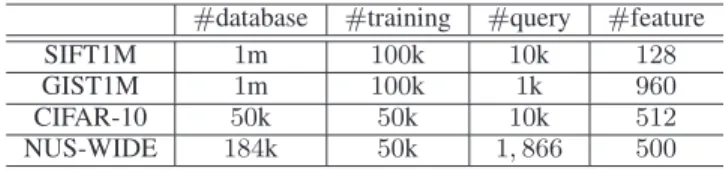
TABLE II: The statistics of datasets.
#database #training #query #feature
SIFT1M 1m 100k 10k 128
GIST1M 1m 100k 1k 960
CIFAR-10 50k 50k 10k 512
NUS-WIDE 184k 50k 1,866 500
optimum needs to traverse the whole set for just a few times. In our experiment, we empirically find out that when trained with100k samples and256mini batch, traversing the training set once (i.e., ≈ 400steps) can result in good performance. In fact, we can notice that the mini-batch SGD has achieved great success recently for gradient based optimization, such as deep model training [40], [41]. Wen et al. [42] also demonstrate that the mini-batch SGD works well for kmeans clustering loss. Therefore, training by mini-batch SGD has a comparable complexity to the original kmeans in our case. For AQ, we can also adopt the mini-batch SGD to solve the sub-problem in Eq. (20) whose complexity is O(n). In addition, as will be demonstrated in the experiment section, Algorithm 1 can always converge within about200iterations. In summary,the increase in complexity due to the use of a more complicated optimization is very limited, meaning that the overall complexity of RGVQ is comparable to that of VQ.
V. EXPERIMENT ANDDISCUSSION
A. Datasets
VQ approaches are so general that can be applied to different kinds of features, including features for image [43], [44], video [45], text [46], [47], or sensing data [48], [49]. To better compare our framework with previous VQ approaches, we mainly focus on image features in the experiment below.
0 1 2 3 4 5 0.1
0.2 0.3 0.4 0.5
Noise ratio (%)
Recall@1000
ITQ+ ITQ
(a) SIFT1M, 32 bits
0 1 2 3 4 5
0.4 0.5 0.6 0.7 0.8
Noise ratio (%)
Recall@1000
ITQ+ ITQ
(b) SIFT1M, 64 bits
0 1 2 3 4 5
0.8 0.83 0.86 0.89 0.92
Noise ratio (%)
Recall@1000
ITQ+ ITQ
(c) SIFT1M, 128 bits
0 1 2 3 4 5
0.5 0.55 0.6 0.65 0.7
Noise ratio (%)
Recall@10000
ITQ+ ITQ
(d) GIST1M, 32 bits
0 1 2 3 4 5
0.65 0.7 0.75 0.8 0.85
Noise ratio (%)
Recall@10000
ITQ+ ITQ
(e) GIST1M, 64 bits
0 1 2 3 4 5
0.74 0.78 0.82 0.86 0.9
Noise ratio (%)
Recall@10000
ITQ+ ITQ
(f) GIST1M, 128 bits
Fig. 3: Performance comparison between ITQ+ and ITQ w.r.t. the noise ratio. We set l= 10for ground truth.
users. The 500-dimensional bag-of-visual-word feature based on SIFT is utilized for image representation. 1% (1,866) images are used as the queries and the other as the database. From the construction methods of these real-world datasets (search engine returned images or user uploaded and annotated images), we can see they are very noisy, making them ideal benchmarks for testing the robustness of various approaches. The statistics of the datasets are summarized in TABLE II.
B. Settings
Since the primary purpose of this paper is to enhance the robustness and the generalization of existing state-of-the-art VQ approaches, we therefore consider three representa-tive approaches, Iterarepresenta-tive Quantization (ITQ) [8], (Optimized) Product Quantization (PQ) [10], [12], and Additive Quan-tization (AQ) [13], [14], [15]. Specifically, we extend the original approaches from theℓ2,2-norm based VQ framework
into the proposed ℓp,q-norm based RGVQ framework and
then optimize them based on Algorithm 1. When no further statement is given and no ambiguity is triggered, we setp= 2 and q= 1 for most experiment scenarios and we denote the enhanced versions as ITQ+, OPQ+, and AQ+ respectively.
For each sample, we can adopt VQ or RGVQ approaches to quantize it into a fixed-length codes, whose length is denoted as L. When constructing the codes, the below settings are adopted. For ITQ which focuses on learning binary hashcodes, following [8], the original sample is firstly projected into a
L-dimensional space by PCA and the rotation matrix R ∈
RL×L is learned in the L-dimensional space. Then we use the sign function on the rotated data to get the hashcodes and the distance between a query and a sample is given by the Hamming distance (the number of different bits). For PQ and AQ, following [10], [14] the size of each sub-codebook is set as k = 256 such that the integer index Im(xi) needs
exact 1 byte (8 bits). Therefore, to learn 64-bit codes, we should construct C = 64/8 = 8 sub-codebooks. Moreover, we adopt the asymmetric distance computation for computing the distance as we introduced in the previous part of this paper. For all approaches, including both VQ and RGVQ, iterative optimization algorithms are adopted for learning quantization models. As suggested by the original literatures [10], [14], [21], their learning procedures can converge with 200 itera-tions. In the upcoming parts, we will show that RGVQ can also converge fast. Therefore, for all VQ and RGVQ approaches, the maximum number of iterations is consistently set to200.
C. Robustness Study
We firstly investigate the robustness of RGVQ against the noise and outliers. Specifically, we adopt the ANN search task using the SIFT1M and GIST1M datasets. To better investigate this property we have manually added some noise to the training data. In particular, each dimension of each manually added noisy point is sampled from 100× N(0,1) whereN
denotes a Gaussian distribution. Obviously, the distribution of noisy data is different from the that of the original data. A robust algorithm should pay more attention to the normal data. To understand the boundary of the algorithm, we continuously change the noise ratio (NR: the ratio between the manually added noise points and the original points), and evaluate the
ℓ2-norm similarity search performance of different approaches.
Following the settings in [10], [15], [21], we use Recall@R
0 1 2 3 4 5 0.1
0.2 0.3 0.4 0.5
Noise ratio (%)
Recall@1000
OPQ+ OPQ
(a) SIFT1M, 16 bits
0 1 2 3 4 5
0.4 0.5 0.6 0.7 0.8
Noise ratio (%)
Recall@1000
OPQ+ OPQ
(b) SIFT1M, 32 bits
0 1 2 3 4 5
0.75 0.8 0.85 0.9 0.95
Noise ratio (%)
Recall@1000
OPQ+ OPQ
(c) SIFT1M, 64 bits
0 1 2 3 4 5
0.4 0.5 0.6 0.7 0.8
Noise ratio (%)
Recall@10000
OPQ+ OPQ
(d) GIST1M, 16 bits
0 1 2 3 4 5
0.5 0.6 0.7 0.8 0.9
Noise ratio (%)
Recall@10000
OPQ+ OPQ
(e) GIST1M, 32 bits
0 1 2 3 4 5
0.6 0.7 0.8 0.9 1
Noise ratio (%)
Recall@10000
OPQ+ OPQ
(f) GIST1M, 64 bits
Fig. 4: Performance comparison between OPQ+ and OPQ w.r.t. the noise ratio. We set l= 100for ground truth.
0 1 2 3 4 5
0.1 0.2 0.3 0.4 0.5
Noise ratio (%)
Recall@1000
AQ+ AQ
(a) SIFT1M, 16 bits
0 1 2 3 4 5
0.4 0.5 0.6 0.7 0.8
Noise ratio (%)
Recall@1000
AQ+ AQ
(b) SIFT1M, 32 bits
0 1 2 3 4 5
0.76 0.82 0.88 0.94 1
Noise ratio (%)
Recall@1000
AQ+ AQ
(c) SIFT1M, 64 bits
0 1 2 3 4 5
0.4 0.5 0.6 0.7 0.8
Noise ratio (%)
Recall@10000
AQ+ AQ
(d) GIST1M, 16 bits
0 1 2 3 4 5
0.6 0.7 0.8 0.9 1
Noise ratio (%)
Recall@10000
AQ+ AQ
(e) GIST1M, 32 bits
0 1 2 3 4 5
0.6 0.7 0.8 0.9 1
Noise ratio (%)
Recall@10000
AQ+ AQ
(f) GIST1M, 64 bits
Fig. 5: Performance comparison between AQ+ and AQ w.r.t. the noise ratio. We setl= 100for ground truth.
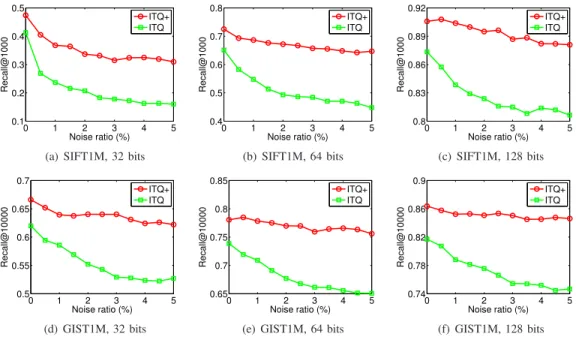
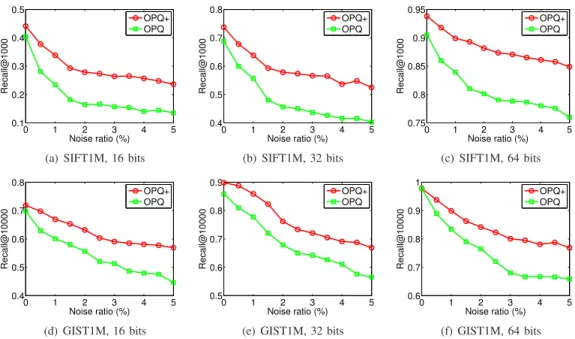
The comparison between RGVQ (ITQ+, OPQ+, and AQ+) and VQ (ITQ, OPQ, and AQ) under different code lengths and noise ratios is shown in Fig. 3, 4, and 5. It can be observed that RGVQ is better than VQ at all situations, including different approaches, code lengths, and noise ra-tios, in terms of the Recall. On average, ITQ+, OPQ+ and AQ+ have improved the recall over ITQ, OPQ, and AQ by 12.2%, 10.8%, and9.85% when NR= 5%, demonstrating that RGVQ withℓp,q-norm (q= 1) loss is indeed more robust
to the noise than the original VQ with squared loss. Moreover, it is worthwhile to point out that the results actually reveal the following properties of the proposed RGVQ framework.
Firstly, RGVQ performs observably better than VQ in most
8 16 32 64 128 0.18
0.2 0.22 0.24
Code length (bits)
mean Average Precision
ITQ+ ITQ OPQ+ OPQ AQ+ AQ
(a) mean Average Precision
0 0.5 1 0.1
0.15 0.2 0.25 0.3 0.35
Recall
Precision
ITQ+ ITQ OPQ+ OPQ AQ+ AQ
(b) Precision-recall curve, 16 bits
0 0.5 1 0.1
0.2 0.3 0.4
Recall
Precision
ITQ+ ITQ OPQ+ OPQ AQ+ AQ
(c) Precision-recall curve, 64 bits
Fig. 6: Performance comparison between RGVQ and VQ on CIFAR-10.
8 16 32 64 128
0.38 0.4 0.42 0.44
Code length (bits)
mean Average Precision
ITQ+ ITQ OPQ+ OPQ AQ+ AQ
(a) mean Average Precision
0 0.5 1 0.34
0.36 0.38 0.4 0.42 0.44 0.46
Recall
Precision
ITQ+ ITQ OPQ+ OPQ AQ+ AQ
(b) Precision-recall curve, 16 bits
0 0.5 1 0.34
0.38 0.42 0.46 0.5
Recall
Precision
ITQ+ ITQ OPQ+ OPQ AQ+ AQ
(c) Precision-recall curve, 64 bits
Fig. 7: Performance comparison between RGVQ and VQ on NUS-WIDE.
similarity search performance of all VQ approaches degrades rapidly. This phenomenon once again demonstrates that VQ is sensitive to noise and outliers in data because of the squared loss, as we have mentioned before. On the contrary, RGVQ approaches show relatively more stable performance in most cases when we increase NR. More importantly, it can be seen that the performance gap between the corresponding ap-proaches from RGVQ framework and VQ framework becomes even larger when increasing NR. This again demonstrates the superior robustness of the proposed RGVQ against the noise. Moreover, it is observed that ITQ+ is more robust than OPQ+ and AQ+ since the performance drop of ITQ+ when NR raises from0to5%is less significant. One possible reason is that ITQ+ focuses on binary quantization while OPQ+ and AQ+ adopt real-value quantization. As we will show later, ITQ+ has larger distortion because the binary quantization is not that flexible. In this case, the influence of large-distortion entries is relatively smaller in ITQ+ as the majority of entries has large distortion to some extent. Moreover, as OPQ+ and AQ+ have better performance at first, it is more likely that their performance drops more significantly.
D. Image Retrieval Results
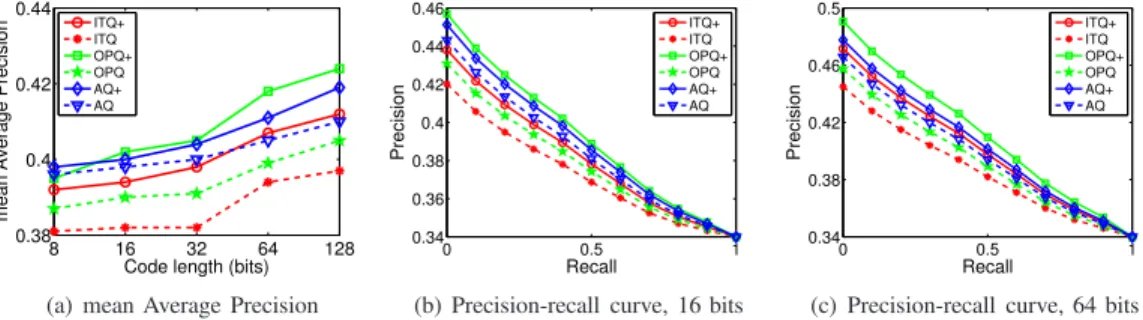
From the application perspective, the robustness of RGVQ enables us to search similarity in wild data such as Internet images. To demonstrate the superiority of RGVQ over VQ, we adopt two widely used image benchmark datasets collected from Web, CIFAR-10 and NUS-WIDE, for the image retrieval task. In particular, in this task, the true positives for each query are defined as the images in the database which share at least one semantic labels/concepts with the query, following [8], [17], [55]. To evaluate the performance, we adopt the
Precision-recall curve as the metric, which reflects the pre-cision (the ratio between the number of true positives and that of retrieved images) at different recall levels. Generally, a higher curve indicates that the true positives have higher ranks which is desired for image retrieval task. Moreover, mean Average Precision (mAP) is also utilized as a numeric evaluation metric. It is defined as the area under the Precision-recall curve and a larger value stands for a better performance.
The results of RGVQ approaches and VQ approaches on CIFAR-10 and NUS-WIDE are presented in Fig. 6 and Fig. 7 respectively. It can be seen that RGVQ consistently outperforms VQ with observable margins with different code length on two datasets. In fact, the real-world image sets are always noisy. Unfortunately, existing approaches fail to consider the influence of noise data. As we have analyzed around Eq. (5), whenqis large, the learning procedure prefers to decrease the loss of large-distortion entries, while it focuses more on the small-distortion entries when q is small. In the VQ approaches, the squared Euclidean distance is employed to measure the loss to which the noisy samples may contribute significantly since the square operation puts larger weight to the entries with larger distance which are more likely to be noise. Consequently, the models pay too much attention to the noise such that the intrinsic structure of data is not well exploited. On the other hand, by utilizing theq-th order
(q <2) of the Euclidean distance, the noisy samples contribute
0.5 1 1.5 2 0.4
0.5 0.6 0.7 0.8
q
Recall@1000
NR=0% NR=1% NR=5%
(a) SIFT1M, 64 bits, ITQ+
0.5 1 1.5 2 0.4
0.5 0.6 0.7 0.8
q
Recall@1000 NR=0% NR=1% NR=5%
(b) SIFT1M, 32 bits, OPQ+
0.5 1 1.5 2 0.4
0.5 0.6 0.7 0.8
q
Recall@1000
NR=0% NR=1% NR=5%
(c) SIFT1M, 32 bits, AQ+
0.5 1 1.5 2 0.18
0.2 0.22 0.24
q
mean Average Precision
ITQ+ OPQ+ AQ+
(d) CIFAR-10, 64 bits
0.5 1 1.5 2 0.6
0.65 0.7 0.75 0.8
q
Recall@10000 NR=0% NR=1% NR=5%
(e) GIST1M, 64 bits, ITQ+
0.5 1 1.5 2 0.5
0.6 0.7 0.8 0.9
q
Recall@10000
NR=0% NR=1% NR=5%
(f) GIST1M, 32 bits, OPQ+
0.5 1 1.5 2 0.6
0.7 0.8 0.9 1
q
Recall@10000
NR=0% NR=1% NR=5%
(g) GIST1M, 32 bits, AQ+
0.5 1 1.5 2 0.38
0.4 0.42 0.44
q
mean Average Precision
ITQ+ OPQ+ AQ+
(h) NUS-WIDE, 64 bits
Fig. 8: The effect ofq on RGVQ.
10 20 50 100 200 500 1000 0
0.2 0.4 0.6 0.8 1
#Retrieved points
Recall
ITQ+,128 ITQ,128 ITQ+,64 ITQ,64 ITQ+,32 ITQ,32
(a) SIFT1M,p= 2
10 20 50 100 200 500 1000 0
0.2 0.4 0.6 0.8 1
#Retrieved points
Recall
ITQ+,128 ITQ,128 ITQ+,64 ITQ,64 ITQ+,32 ITQ,32
(b) SIFT1M,p= 1.5
10 20 50 100 200 500 1000 0
0.2 0.4 0.6 0.8 1
#Retrieved points
Recall
ITQ+,128 ITQ,128 ITQ+,64 ITQ,64 ITQ+,32 ITQ,32
(c) SIFT1M,p= 1
1000 200 500 1000 2000 5000 10000 0.2
0.4 0.6 0.8 1
#Retrieved points
Recall
ITQ+,128 ITQ,128 ITQ+,64 ITQ,64 ITQ+,32 ITQ,32
(d) GIST1M,p= 2
1000 200 500 1000 2000 5000 10000 0.2
0.4 0.6 0.8 1
#Retrieved points
Recall
ITQ+,128 ITQ,128 ITQ+,64 ITQ,64 ITQ+,32 ITQ,32
(e) GIST1M,p= 1.5
1000 200 500 1000 2000 5000 10000 0.2
0.4 0.6 0.8 1
#Retrieved points
Recall
ITQ+,128 ITQ,128 ITQ+,64 ITQ,64 ITQ+,32 ITQ,32
(f) GIST1M,p= 1
Fig. 9: Performance comparison between ITQ+ and ITQ forℓp-norm similarity search.
E. Effect of Parameterq
There is one important parameterqin RGVQ which controls the order of the distortion. Here, we investigate how the approaches will behave when varyingq. To do so, we change the value of q and plot the corresponding performance of RGVQ approaches on the benchmark datasets with different binary code length and noise ratios. The results are illustrated in Fig. 8. It is noticed that VQ is a special case of RGVQ whenq= 2. We have the observations below from the results. Firstly, in all settings, we can find a Bell-shape curve for all approaches. Basically, the model is affected by both noise and normal data. With a largeq(say,q >1.5), RGVQ will increase the weight of those large-distortion entries such that the model
will be biased by them. Unfortunately, due to the existence of noisy entries and their large distortions, the learned model will deviate significantly to fit the outliers from the one which best suits to the normal data. Therefore, the performance of all RGVQ approaches degrades significantly when we increaseq
10 20 50 100 200 500 1000 0
0.2 0.4 0.6 0.8 1
#Retrieved points
Recall
OPQ+,64 OPQ,64 OPQ+,32 OPQ,32 OPQ+,16 OPQ,16
(a) SIFT1M,p= 2
10 20 50 100 200 500 1000 0
0.2 0.4 0.6 0.8 1
#Retrieved points
Recall
OPQ+,64 OPQ,64 OPQ+,32 OPQ,32 OPQ+,16 OPQ,16
(b) SIFT1M,p= 1.5
10 20 50 100 200 500 1000 0
0.2 0.4 0.6 0.8 1
#Retrieved points
Recall
OPQ+,64 OPQ,64 OPQ+,32 OPQ,32 OPQ+,16 OPQ,16
(c) SIFT1M,p= 1
1000 200 500 1000 2000 5000 10000 0.2
0.4 0.6 0.8 1
#Retrieved points
Recall
OPQ+,64 OPQ,64 OPQ+,32 OPQ,32 OPQ+,16 OPQ,16
(d) GIST1M,p= 2
1000 200 500 1000 2000 5000 10000 0.2
0.4 0.6 0.8 1
#Retrieved points
Recall
OPQ+,64 OPQ,64 OPQ+,32 OPQ,32 OPQ+,16 OPQ,16
(e) GIST1M,p= 1.5
1000 200 500 1000 2000 5000 10000 0.2
0.4 0.6 0.8 1
#Retrieved points
Recall
OPQ+,64 OPQ,64 OPQ+,32 OPQ,32 OPQ+,16 OPQ,16
(f) GIST1M,p= 1
Fig. 10: Performance comparison between OPQ+ and OPQ forℓp-norm similarity search.
10 20 50 100 200 500 1000 0
0.2 0.4 0.6 0.8 1
#Retrieved points
Recall
AQ+,64 AQ,64 AQ+,32 AQ,32 AQ+,16 AQ,16
(a) SIFT1M,p= 2
10 20 50 100 200 500 1000 0
0.2 0.4 0.6 0.8 1
#Retrieved points
Recall
AQ+,64 AQ,64 AQ+,32 AQ,32 AQ+,16 AQ,16
(b) SIFT1M,p= 1.5
10 20 50 100 200 500 1000 0
0.2 0.4 0.6 0.8 1
#Retrieved points
Recall
AQ+,64 AQ,64 AQ+,32 AQ,32 AQ+,16 AQ,16
(c) SIFT1M,p= 1
1000 200 500 1000 2000 5000 10000 0.2
0.4 0.6 0.8 1
#Retrieved points
Recall
AQ+,64 AQ,64 AQ+,32 AQ,32 AQ+,16 AQ,16
(d) GIST1M,p= 2
1000 200 500 1000 2000 5000 10000 0.2
0.4 0.6 0.8 1
#Retrieved points
Recall
AQ+,64 AQ,64 AQ+,32 AQ,32 AQ+,16 AQ,16
(e) GIST1M,p= 1.5
1000 200 500 1000 2000 5000 10000 0.2
0.4 0.6 0.8 1
#Retrieved points
Recall
AQ+,64 AQ,64 AQ+,32 AQ,32 AQ+,16 AQ,16
(f) GIST1M,p= 1
Fig. 11: Performance comparison between AQ+ and AQ for ℓp-norm similarity search.
data. This interprets why RGVQ approaches perform worse when we decrease qfrom 0.5 to0.25, especially when there is less noise, e.g., NR= 0. In Fig. 8, we can see that RGVQ approaches perform stably good when q∈[0.75,1.25]where the effect of outliers on the model is effectively suppressed and that a model which can well fit to the normal data is learned.
Secondly, we can observe that the performance-vs-qcurve behaves differently at different noise levels. Specifically, given a small NR, e.g., NR = 0, RGVQ approaches seem more sensitive to q when q < 1, because the the performance changes dramatically when varying q in this range. On the other hand, given a large NR, e.g., NR = 5%, they become
more sensitive when q > 1. The reason is analogous to our analysis in the last paragraph. When there is little noise, the primary target of RGVQ is to fit the normal data. In this case, the performance may degrade rapidly ifqis too small because the the loss is too indiscriminative. On the other hand, as a result of the increasing noise, the primary target of RGVQ becomes to suppress the influence of noise. Thus, increasing the value ofq whenq >1 leads to much worse performance.
F. ℓp-norm Similarity Search
0 20 40 60 80 100 1.7
1.75 1.8 1.85 1.9
#Iterations
Distortion (
×
10
7)
(a)p= 2, q= 1.5
0 20 40 60 80 100 3.05
3.1 3.15 3.2 3.25 3.3
#Iterations
Distortion (
×
10
6)
(b)p= 2, q= 1
0 20 40 60 80 100 4.94
4.95 4.96 4.97 4.98 4.99
#Iterations
Distortion (
×
10
6)
(c)p= 1.5, q= 1
0 20 40 60 80 100 1.4
1.5 1.6 1.7 1.8 1.9
#Iterations
Distortion (
×
10
7)
(d)p=q= 1
Fig. 12: Convergence study, ITQ+, SIFT1M, 64 bits.
0 20 40 60 80 100 8.5
8.6 8.7 8.8 8.9 9
#Iterations
Distortion (
×
10
6)
(a)p= 2, q= 1.5
0 20 40 60 80 100 1.92
1.94 1.96 1.98 2
#Iterations
Distortion (
×
10
6)
(b)p= 2, q= 1
0 20 40 60 80 100 3.6
3.65 3.7 3.75 3.8
#Iterations
Distortion (
×
10
6)
(c)p= 1.5, q= 1
0 20 40 60 80 100 1.4
1.45 1.5 1.55
#Iterations
Distortion (
×
10
7)
(d)p=q= 1
Fig. 13: Convergence study, OPQ+, SIFT1M, 32 bits.
0 20 40 60 80 100 8.2
8.4 8.6 8.8 9
#Iterations
Distortion (
×
10
6)
(a)p= 2, q= 1.5
0 20 40 60 80 100 1.8
1.85 1.9 1.95 2
#Iterations
Distortion (
×
10
6)
(b)p= 2, q= 1
0 20 40 60 80 100 3.55
3.6 3.65 3.7 3.75 3.8
#Iterations
Distortion (
×
10
6)
(c)p= 1.5, q= 1
0 20 40 60 80 100 1.35
1.4 1.45 1.5
#Iterations
Distortion (
×
10
7)
(d)p=q= 1
Fig. 14: Convergence study, AQ+, SIFT1M, 32 bits.
specified by the users while the original VQ only focuses on the ℓ2-norm similarity search. In this subsection, we will
demonstrate the effectiveness of RGVQ for general ℓp-norm
similarity search. For RGVQ, we can set the parameter p
depending on the specific task and we set q= 1 consistently. Specifically, we consider the ℓ2-norm (Euclidean distance),
ℓ1.5-norm, andℓ1-norm (Manhattan distance) similarity search.
In the specific task, the ground truth is obtained by running a brute-force linear scan measured by the ℓp-norm (p= 2,1.5
and1) distance in the three tasks respectively.
The recall curves (which reflects the recall level w.r.t. the number of retrieved points) of RGVQ approaches and VQ approaches for three different tasks on two datasets with different code length are summarized in Fig. 9, 10, and 11. Here, we use ℓ2-norm retrieval performance as the reference
as the original VQ approaches are designed for this task. We can observe that RGVQ approaches have relatively more stable performance on different tasks whereas VQ approaches perform much worse on other two tasks than onℓ2-norm task.
For example, the Recall@1000 of ITQ drops from 0.651for
ℓ2-norm to 0.474for ℓ1-norm on SIFT1M with 64 bits, that
of OPQ drops from 0.690forℓ2-norm to0.527forℓ1-norm,
and that of AQ drops from 0.774 for ℓ2-norm to 0.619 for
ℓ1-norm on SIFT with32bits. Consequently, the performance
gap between the corresponding RGVQ approaches and VQ approaches becomes much larger when we change pfrom 2 to1.5 and 1. In addition, combining with the results in Fig. 2(c) and 2(d), we can see that the learning algorithms of VQ approaches may unavoidably lead to largerℓp-norm distortion,
which is the minimizing objective, with more iterations since it adoptsℓ2 loss, thus resulting in worse ANN search
perfor-mance. Fortunately, the RGVQ framework takes the issue into consideration and it is formulated as a more generalℓp,q-norm
loss function which can be applied to different settings such that it can well support the generalℓp-norm similarity search.
G. Convergence Study
As an important theoretical contribution of this paper, we propose an efficient optimization algorithm, Algorithm 1, for optimization the challenging orthogonality constrained ℓp,q
empirically investigate its convergence property by conducting the experiment on SIFT1M dataset. Because Algorithm 1 is designed for the general ℓp,q-norm loss function, we assign
different values topandqand plot the function value of three specific approaches. The objective function value for ITQ+, OPQ+, and AQ+ w.r.t. the number of iterations with different settings are plotted in Fig. 12, 13, and 14 respectively. As can be seen, the objective value decreases steadily with more iterations and can achieve a nearly stable value within less than 100iterations, which verifies the effectiveness of Algorithm 1.
VI. CONCLUSION
In this paper, we have presented an enhanced VQ frame-work, termed RGVQ, which changes theℓ2,2-norm loss in the
original VQ framework to a more generalℓp,q-norm loss. The
benefits are twofold. On the one hand, the algorithm becomes more robust to the noise, which potentially makes RGVQ better suited to search similarity in the real-world data. On the other hand, promoting to ℓp,q-norm loss allows RGVQ
to handle various applications, where different distance mea-surements are requested. The major technical challenge comes from minimizing the newℓp,q-norm loss function, which is a
non-smooth and non-convex optimization problem. To solve this orthogonality constrained ℓp,q-norm minimization
prob-lem, we propose an efficient algorithm and rigorously prove its convergence. We specify the algorithm to three celebrated approaches. Comprehensive experiments on two NN search benchmarks demonstrate that RGVQ performs significantly better than VQ, and validate that RGVQ is robust to noise and works well forℓp-norm similarity search. Moreover, from
the application perspective, the extensive results on two image retrieval benchmarks also verify that RGVQ works better than VQ on real-world scenarios as it is more general and robust.
REFERENCES
[1] N. S. Altman, “An introduction to kernel and nearest-neighbor nonpara-metric regression,”The American Statistician, vol. 46, no. 3, pp. 91–110, 1992.
[2] C. M. Bishop et al., Pattern recognition and machine learning. Springer, New York, 2006, vol. 1.
[3] G. W. Furnas, S. C. Deerwester, S. T. Dumais, T. K. Landauer, R. A. Harshman, L. A. Streeter, and K. E. Lochbaum, “Information retrieval using a singular value decomposition model of latent semantic structure,” inProceedings of the 11th Annual International ACM SIGIR Conference on Research and Development in Information Retrieval, 1988, pp. 465– 480.
[4] J. Moraleda, “Gregory shakhnarovich, trevor darrell and piotr indyk: Nearest-neighbors methods in learning and vision. theory and practice,” Pattern Anal. Appl., vol. 11, no. 2, pp. 221–222, 2008.
[5] J. L. Bentley, “Multidimensional binary search trees used for associative searching,”Communications of the ACM, 1975.
[6] E. Ch´avez, G. Navarro, R. A. Baeza-Yates, and J. L. Marroqu´ın, “Searching in metric spaces,”ACM Comput. Surv., vol. 33, no. 3, pp. 273–321, 2001.
[7] Y. Matsui, T. Yamasaki, and K. Aizawa, “Pqtable: Fast exact asymmetric distance neighbor search for product quantization using hash tables,” in IEEE International Conference on Computer Vision, 2015, pp. 1940– 1948.
[8] Y. Gong, S. Lazebnik, A. Gordo, and F. Perronnin, “Iterative quanti-zation: A procrustean approach to learning binary codes for large-scale image retrieval,”IEEE Trans. Pattern Anal. Mach. Intell., vol. 35, no. 12, pp. 2916–2929, 2013.
[9] A. Gordo, F. Perronnin, Y. Gong, and S. Lazebnik, “Asymmetric distances for binary embeddings,” IEEE Trans. Pattern Anal. Mach. Intell., vol. 36, no. 1, pp. 33–47, 2014.
[10] T. Ge, K. He, Q. Ke, and J. Sun, “Optimized product quantization,” IEEE Trans. Pattern Anal. Mach. Intell., vol. 36, no. 4, pp. 744–755, 2014.
[11] H. J´egou, M. Douze, and C. Schmid, “Product quantization for nearest neighbor search,”IEEE Trans. Pattern Anal. Mach. Intell., vol. 33, no. 1, pp. 117–128, 2011.
[12] M. Norouzi and D. J. Fleet, “Cartesian k-means,” inIEEE Conference on Computer Vision and Pattern Recognition, 2013, pp. 3017–3024. [13] Y. Chen, T. Guan, and C. Wang, “Approximate nearest neighbor search
by residual vector quantization,” Sensors, vol. 12, pp. 11 259–11 273, 2010.
[14] T. Zhang, C. Du, and J. Wang, “Composite quantization for approximate nearest neighbor search,” in Proceedings of the 31th International Conference on Machine Learning, 2014, pp. 838–846.
[15] A. Babenko and V. S. Lempitsky, “Additive quantization for extreme vector compression,” in IEEE Conference on Computer Vision and Pattern Recognition, 2014, pp. 931–938.
[16] J. Wang, J. Wang, J. Song, X. Xu, H. T. Shen, and S. Li, “Optimized cartesian k-means,”IEEE Trans. Knowl. Data Eng., vol. 27, no. 1, pp. 180–192, 2015.
[17] X. Lu, X. Zheng, and X. Li, “Latent semantic minimal hashing for image retrieval,”IEEE Trans. Image Processing, vol. 26, no. 1, pp. 355–368, 2017.
[18] Y. Guo, G. Ding, L. Liu, J. Han, and L. Shao, “Learning to hash with optimized anchor embedding for scalable retrieval,”IEEE Trans. Image Processing, vol. 26, no. 3, pp. 1344–1354, 2017.
[19] G. Ding, Y. Guo, J. Zhou, and Y. Gao, “Large-scale cross-modality search via collective matrix factorization hashing,”IEEE Trans. Image Processing, vol. 25, no. 11, pp. 5427–5440, 2016.
[20] X. Lu, Y. Chen, and X. Li, “Hierarchical recurrent neural hashing for image retrieval with hierarchical convolutional features,” IEEE Trans. Image Processing, vol. 27, no. 1, pp. 106–120, 2018.
[21] Y. Gong, L. Liu, M. Yang, and L. D. Bourdev, “Compressing deep convolutional networks using vector quantization,” CoRR, vol. ab-s/1412.6115, 2014.
[22] J. Huang, F. Nie, H. Huang, and C. H. Q. Ding, “Robust manifold nonnegative matrix factorization,” TKDD, vol. 8, no. 3, p. 11, 2013. [23] Q. Pan, D. Kong, C. H. Q. Ding, and B. Luo, “Robust non-negative
dic-tionary learning,” inProceedings of the Twenty-Eighth AAAI Conference on Artificial Intelligence, 2014, pp. 2027–2033.
[24] W. Jiang, F. Nie, and H. Huang, “Robust dictionary learning with capped l1-norm,” in Proceedings of the Twenty-Fourth International Joint Conference on Artificial Intelligence, 2015, pp. 3590–3596. [25] H. Jegou, M. Douze, C. Schmid, and P. P´erez, “Aggregating local
descriptors into a compact image representation,” inThe Twenty-Third IEEE Conference on Computer Vision and Pattern Recognition, 2010, pp. 3304–3311.
[26] U. P. Singh and S. Jain, “Content based image retrieval using euclidean and manhattan metrics,”Journal of Math. Sciences: Advances and Appl., vol. 4, no. 1, pp. 217–226, 2010.
[27] J. Wright, A. Ganesh, S. R. Rao, Y. Peng, and Y. Ma, “Robust principal component analysis: Exact recovery of corrupted low-rank matrices via convex optimization,” in23rd Annual Conference on Neural Information Processing Systems, 2009, pp. 2080–2088.
[28] H. Wang, F. Nie, W. Cai, and H. Huang, “Semi-supervised robust dictionary learning via efficient ℓ2,0+-norms minimization,” in IEEE International Conference on Computer Vision, 2013, pp. 1145–1152. [29] M. Yang, L. Zhang, J. Yang, and D. Zhang, “Robust sparse coding for
face recognition,” inIEEE Conference on Computer Vision and Pattern Recognition, CVPR, 2011.
[30] H. Wang, F. Nie, and H. Huang, “Learning robust locality preserving projection via p-order minimization,” inProceedings of the Twenty-Ninth AAAI Conference on Artificial Intelligence, 2015, pp. 3059–3065. [31] H. Lee, A. Battle, R. Raina, and A. Ng, “Efficient sparse coding
algorithms,” in Advances in Neural Information Processing Systems, 2006.
[32] C. H. Q. Ding, D. Zhou, X. He, and H. Zha, “R1-pca: rotational invariant L1-norm principal component analysis for robust subspace factorization,” in Machine Learning, Proceedings of the Twenty-Third International Conference, 2006, pp. 281–288.
[33] Z. Wen and W. Yin, “A feasible method for optimization with orthog-onality constraints,” Math. Program., vol. 142, no. 1-2, pp. 397–434, 2013.