© 2019, IRJET | Impact Factor value: 7.211 | ISO 9001:2008 Certified Journal
| Page 348
STATIC ANALYSIS AND DESIGN OF RETAINING WALL WITH AND
WITHOUT SHELVE USING SOFTWARE
Prachi S. Bhoyar
1, Dr. G. D. Awachat
21M. Tech. Student, Department of Civil Engineering, Gurunanak Institute of Technology, Nagpur, India.
2Professor, Department of Civil Engineering, Gurunanak Institute of Technology, Nagpur, India.
---***---Abstract - This paper presents the results of Static analysis and Design of retaining wall with and without shelves. Cantilever retaining wall with pressure relief shelves is considered as a special type of retaining wall. The concept of providing pressure relief shelves on the backfill side of a R.C.C retaining wall reduces the total earth pressure on the wall, which results in a reduced thickness of the wall and ultimately in an economic design of a cantilever wall. The conclusions in this thesis drawn based on the discussion and results obtained analytically and using Staad-Pro. model study. The pressure distribution diagram changes much due to addition of shelves. The pressure relief shelves have been extend up to the failure plane to achieve the stability of the structure. In practice, there is limitation of using more number of shelves, but up to three shelve may be used economically for high retaining walls. It is also observed that, the average saving in cost of construction is 15% to 25% by the provision of relief shelves over the conventional cantilever retaining wall. Analytical results of active earth pressure, nodal reactions, and bending moments with pressure relief shelves have been close agreement with the Staad-Pro. Software result.
Key Words:Special retaining wall, Relief shelves, Earth pressure, Stability of wall, Bearing pressure, Overturning moment and
bending moment.
1. INTRODUCTION
1.1. General
Retaining walls are generally built to hold back soil mass. Retaining walls are structures that are constructed to retain such materials which are unable to stand vertically by themselves. They are also provided to maintain the grounds at two different levels. The study in this thesis is carried out mainly for improvisation of the 'retaining structure' as it is an indispensable features of civil construction projects, especially all types of bridges, high walls in hilly terrain, etc. with suitable type, proper design and reasonable estimation. A retaining wall with pressure relief shelve is uncommon type of retaining wall. The pressure relief shelf towards the backfill side of retaining wall reduces the total earth pressure on the stem wall which results in increasing the overall stability of wall. The less material goes into the stem wall due to provision of shelves to the retaining wall and some material acts vertically on the pressure relieving shelves and ultimately this result into the economical design.
1.2. Objective of Case Study
1. To analyze and design the modal retaining wall with and without shelf by Conventional Method.
2. To compare the results obtained from analysis and design of retaining wall with and without shelf and discuss the results.
3. To analyze of modal retaining wall with and without shelf using Software. Cost comparison between retaining wall with and without shelf.
4. To make the retaining wall stable so that soil bearing pressure gives equal pressure distribution on both sides.
2. Literature Review
Mikio Futaki, Osamu SakaguchiI (1992) [1]:This paper concerned with the experimental study on a real scale cantilever retaining wall for seismic loadings. In this paper, Soil-Structure Interaction has been done by model test. The present paper intends to investigate the safety and to evaluate the force acting on the wall for the seismic loadings.
© 2019, IRJET | Impact Factor value: 7.211 | ISO 9001:2008 Certified Journal
| Page 349
Scotto Di santolo, A. Pennna, A. Evangelista G.E. Mylonakis, S. Bhattacharya , C.A. Taylor (2012) [4]: Reinforced concrete cantilever retaining walls represent a popular type of retaining system. It is extensively considered as advantageous over conventional gravity walls as it gives economy and ease in construction and installation.3. METHODOLOGY
3.1. Analysis and Design of cantilever Retaining wall without shelves:
This chapter concerned with stability of the cantilever retaining wall without shelves. The stability check for cantilever retaining wall without shelves is very important to study. The principle of design of cantilever retaining wall without shelves, various forces are acting on structure and the stability of cantilever retaining wall should be checked for sliding, overturning, bearing capacity failure, and tension has been explained below,
1. No Sliding: The retaining wall must be safe against sliding. The factor of safety against sliding must be greater than 1.5. In other words, µ Rv > Rh, where Rv and Rh are vertical and horizontal component of R respectively & µ is friction factor between wall base and foundation soil.
2. No Overturning: The retaining wall must be safe against overturning about toe. The factor of safety against overturning must be greater than 2.
3. No Bearing capacity failure:The pressure caused by Rv at the toe of the wall must not exceed the allowable bearing capacity of the soil. The pressure distribution at base is assumed to be linear.
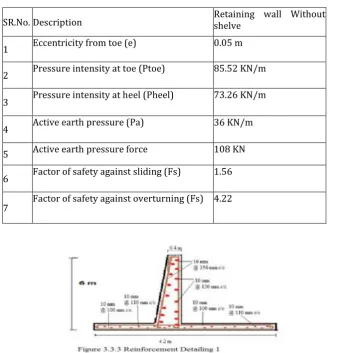
[image:2.595.133.486.400.754.2]4. No Tension: There should be no tension at the base of the wall. When the eccentricity (e) is greater than B/6, tension develops at the heel.
Table No. 1: Analysis results of cantilever retaining wall without shelves
SR.No. Description Retaining wall Without shelve
1 Eccentricity from toe (e) 0.05 m
2 Pressure intensity at toe (Ptoe) 85.52 KN/m
3 Pressure intensity at heel (Pheel) 73.26 KN/m
4 Active earth pressure (Pa) 36 KN/m
5 Active earth pressure force 108 KN
6 Factor of safety against sliding (Fs) 1.56
© 2019, IRJET | Impact Factor value: 7.211 | ISO 9001:2008 Certified Journal
| Page 350
3.2. Analysis and Design of cantilever Retaining wall with shelves: (Reducing its dimension up to some extent)
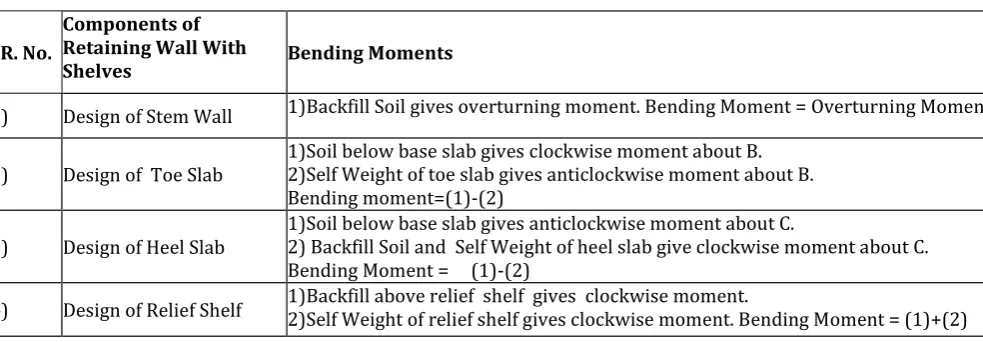
This chapter deals with the analysis and design of retaining wall with single shelve, and analysis of retaining wall with multi shelves. The results of analysis and design of retaining wall with shelves has been discussed in this chapter. The shelve should be extend up to the failure plane for achieving economy and stable structure. The pressure relief shelves divide the soil in two parts and it is used to reduce the active earth pressure force. Hence we can reduce the overturning moment due to backfill soil. The position of pressure relief shelves on stem wall and width of pressure relief shelves can decide the economical and stable structure.
[image:3.595.41.533.249.420.2]A simple problem of cantilever retaining wall with and without shelves is explained. Basics of bending moment calculation shall be explained in this chapter.
Table No. 2: Analysis results of cantilever retaining wall with shelves
Table No. 3: Analysis results of cantilever retaining wall with shelves
SR. No.
Components of Retaining Wall With
Shelves Bending Moments
1) Design of Stem Wall 1)Backfill Soil gives overturning moment. Bending Moment = Overturning Moment
2) Design of Toe Slab 1)Soil below base slab gives clockwise moment about B. 2)Self Weight of toe slab gives anticlockwise moment about B. Bending moment=(1)-(2)
3) Design of Heel Slab 1)Soil below base slab gives anticlockwise moment about C. 2) Backfill Soil and Self Weight of heel slab give clockwise moment about C. Bending Moment = (1)-(2)
4) Design of Relief Shelf 1)Backfill above relief shelf gives clockwise moment. 2)Self Weight of relief shelf gives clockwise moment. Bending Moment = (1)+(2)
SR.No. Description Retaining wall Without shelve
1 Eccentricity from toe (e) 0.09 m
2 Pressure intensity at toe (Ptoe) 108.31 KN/m
3 Pressure intensity at heel (Pheel) 79.11 KN/m
4 Active earth pressure (Pa) 36 KN/m
5 Active earth pressure force 53.85 KN
6 Factor of safety against sliding (Fs) 3.13
© 2019, IRJET | Impact Factor value: 7.211 | ISO 9001:2008 Certified Journal
| Page 351
[image:4.595.51.555.454.793.2]3.3 Analysis and Design of cantilever Retaining wall with shelves : (Reducing its dimension up to maximum value)
Table No. 4: Analysis results of cantilever retaining wall with shelves
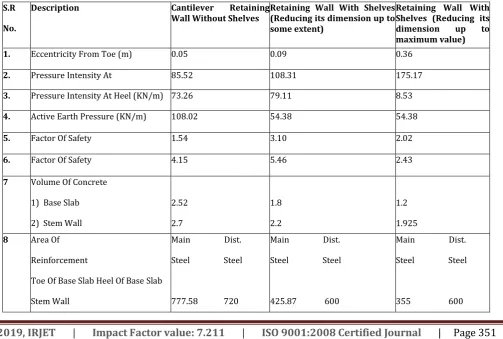
3.4. Compare the results obtained from analysis & design of Retaing wall with and without shelves.
S.R
No.
Description Cantilever Retaining
Wall Without Shelves Retaining Wall With Shelves (Reducing its dimension up to some extent)
Retaining Wall With Shelves (Reducing its
dimension up to
maximum value)
1. Eccentricity From Toe (m) 0.05 0.09 0.36
2. Pressure Intensity At
Toe (KN/m)
85.52 108.31 175.17
3. Pressure Intensity At Heel (KN/m) 73.26 79.11 8.53
4. Active Earth Pressure (KN/m) 108.02 54.38 54.38
5. Factor Of Safety
Against Sliding
1.54 3.10 2.02
6. Factor Of Safety
Against Overturning
4.15 5.46 2.43
7 Volume Of Concrete
1) Base Slab
2) Stem Wall
3) Relief Shelf
Total Volume Of Concrete Required 2.52 2.7 - 5.22 1.8 2.2 1.925 4.25 1.2 1.925 0.25 3.375
8 Area Of
Reinforcement
Toe Of Base Slab Heel Of Base Slab
Stem Wall
Relief Shelf
Total Area Of
Reinforcement
Main Dist.
Steel Steel
777.58 720
795.26 720
292.26 600
- - 4905.1 Main Dist. Steel Steel 425.87 600
608 600
986.56 480
466 300
4466.43 Main Dist. Steel Steel 355 600
600 600
986.56 420
466 300
4327.56
SR.No Description Retaining wall With shelve
shelves
1 Eccentricity from toe (e) 0.36 m
2 Pressure intensity at toe (Ptoe) 175.17 KN/m
3 Pressure intensity at heel (Pheel) 8.53 KN/m
4 Active earth pressure (Pa) 36 KN/m
5 Active earth pressure force 53.85 KN
6 Factor of safety against sliding (Fs) 2.04
© 2019, IRJET | Impact Factor value: 7.211 | ISO 9001:2008 Certified Journal
| Page 352
Discussion on the results:Case 1: Cantilever retaining wall without shelves.
Case 2: Retaining wall with pressure relief shelves.
(Reducing its dimensions up to some extent)
Case 3: Retaining wall with pressure relief shelves.
(Reducing its dimensions up maximum extent)
It is observed that, the eccentricity has been increased in third case (0.36 m) as compared to first case (0.05 m) and second case (0.09 m) as in first case the soil bearing pressure at toe side and heel side has been nearly equal, and in third case the soil bearing pressure at toe and heel side are changes by large amount. Less eccentricity give economical structure. The active earth pressure force has been reduced to half (54.38 KN/m) in case of retaining wall with shelves as compared to cantilever retaining wall as less material goes on stem wall due to provision of pressure relief shelves on backfill side of retaining wall.
It is observed that the given retaining wall without shelves and retaining wall with shelves are safe in sliding and overturning as the factor of safety in sliding and factor of safety in overturning are exceeded the limiting values. In retaining wall with shelves, the factor of safety in overturning is more than cantilever retaining wall without shelves as the overturning moment gets reduced due to less backfill soil material goes on stem walland restoring moment has been increased due to increasing backfill soil load on heel slab and increasing self weight of wall.
4. ANALYSIS OF RETAINING WALL WITH AND WITHOUT SHELVE USING STAAD-PRO SOFTWARE
© 2019, IRJET | Impact Factor value: 7.211 | ISO 9001:2008 Certified Journal
| Page 353
4.1. Compare the results obtained Manually and using Stadd-Pro
Table No. 5: Comparison of manual and staad-pro results of retaining
Discussions on the results:
It is observed that, the joint reactions calculated manually are close agreement with the staad-pro results in case of retaining wall with and without shelves. Its means that, the retaining wall is stable and the summations of all the forces across the joint are balance with each other.
The overturning moment calculated manually for stem wall is close agreement with the staad-pro. results. The bending moment calculated manually for pressure relief shelf is nearly equal to the staad-pro result.
For load combination, the total vertical reactions are balanced at the joint and the total vertical reaction is found to be 0 KN.
5. CONCLUSIONS
1. The manual results of bending moment of retaining wall with and without shelve have to be close agreement with Staad-Pro. Results
2. The pressure distribution diagram changes substantially due to addition of shelves. To have optimum reduction in active earth pressure force the shelve should have width up to the failure plane.
4. The maximum active earth pressure force reduction is obtained between location H/3 to 2H/3. The maximum value of active earth pressure force is considerably found at H/2 height.
5. The overturning moment get reduced due to provision of relief shelves.
6. The concrete and steel is reduced by providing relief shelve to the cantilever retaining wall.
7. It is also observed that the saving in cost of construction is 15% to 25% by the provision of relief shelves over the conventional cantilever retaining wall. There is 35% saving in concrete and 11% saving in steel.
SR.
No. Parameters Retaining wall without shelves
Manually Staad-pro.
Retaining wall with shelves
Manually Staad-pro.
1 Joint ReactionsFx (KN) Fy
(KN) 48.74 48.726
102.06 102.06
25.12 24.76
23.625 23.625
2 Bending Moment (KN-m)
Stem wall Relief shelves 185.19 180.23 - -
116.41 109.02
26.75 24.249
© 2019, IRJET | Impact Factor value: 7.211 | ISO 9001:2008 Certified Journal
| Page 354
6. REFFERENCES
1. Futaki M. , Sakaguchi O. , (1992), "BEHAVIOUR OF CANTILEVER RETAINING WALL UNDER SEISMIC LOADING" , Earthquake Engineering, Tenth World Conference, (1992), Balkema, Rotterdam, ISBN 9054100605
2. Upadhyay A. , Krishna A. M. , Singh K. D. , (2011) , "BEHAVIOR OF CANTILEVER RETAINING WALLS UNDER SEISMIC CONDITIONS”, 5ICEGE5th International Conference on Earthquake Geotechnical Engineering January 2011, 10-13, Santiago, Chile
3. Padhye R. D. (2010), Ph.D. thesis on “ANALYSIS AND DESIGN OF RETAINING WALL WITH PRESSURE RELIEF SHELVES”. www.ijergs.org
4. 4.Shinde D. N, Watve R. R., (2015), "OPTIMUM STATIC ANALYSIS OF RETAINING WALL WITH AND WITHOUT SHELF AT DIFFERENT LEVEL USING FINITE ELEMENT ANALYSIS" Research paper, Global Journal of Engineering Science and Research Management" July 2015.
5. 5.Padhye R. D. & Ullagaddi P. B., (2005), “RETAINING WALL WITH PRESSURE RELIEF SHELF – A Review Study”, All India Seminars on, Advances in Geotechnical Engineering. National Institute of Technology, Rourkela. pp 62 – 68
6. I. S Code 14458(Part 1)-1998, DESIGN OF RETAINING/BREAST WALLSI. S Code 14458(Part 9), Design of RCC cantilever wall/buttressed walls/L-type walls
7. I. S Code 14458(Part 10), Design and construction of reinforced earth retaining walls
8. I. S Code 456-2000, PLAIN AND REINFORCED CONCRETE - CODE OF PRACTICE, Tenth Reprint APRIL 2007