© 2019, IRJET | Impact Factor value: 7.211 | ISO 9001:2008 Certified Journal
| Page 1385
A research paper on a Centralized Multipurpose Transportation
System
Aishwarya Dekhane
, Akansha Gore, Sakshi Gatagat
Aishwarya Dekhane - BE (Computer), Sadashiv Peth, Pune.
Akansha Gore -BE (Computer), Pimple Gurav, Pune.
Sakshi Gatagat - BE (Computer), Wadgaonsheri, Pune.
Mr. Santosh Nagargoje , Dept. of Computer Engineering , P.E.S Modern college, Maharashtra, India.
---***---Abstract - Nowadays, the use of the transportation services is a necessity of human living. With the trends in Modernization, all the facilities and services also need to be dynamic. Though there are many transportation modes available in the market, not everyone can have vehicles. For this the innovation of transportation services projects came into name. With this, those who don’t have vehicles can also use them and gain the services at a low budget. To make these services and facilities reach every home these services are made available as mobile applications so that the facilities can be made handy. One solution for this is use of android applications that are designed for smart phones. The explosive growth of the Android platforms has been a large win for consumers with respect to market competition and features. The Centralized Multipurpose Transportation System project aims to develop an android application for android operating system (OS) platform that can be used for all transportation facilities required in day-to-day routines. From a two-wheeler bike to a 10 wheeler truck, it can be accessed with ease. Location of mobile devices is in the form of latitude and longitude which is converted into full address by the application that includes country/state, city, and street number details. The Centralized Multi-purpose Transportation System’s design shows how to perform and develop this application and has been tested on few mobile devices it will be tested on huge number of mobile devices later.
The barrier of languages has made many users unable to access various services available online. This project aims to discard this language barrier by enabling the native language feature by which every user can understand and use the services made available by this project. With the help of One Time Password (OTP) the customer security can be maintained and any case of fraud between the driver and the customer can be easily handled and good services can be provided.
Key Words: Android, Transport, OTP, Native languages, Shortest Path Algorithm, Maps
1. INTRODUCTION
Transportation in simple terms is the movement or migration of humans, goods and animals from one location to other. A road is an identifiable route, way or path between two places or multiple places. The most common road vehicle is the automobile; a wheeled passenger vehicle. Other users of roads include motorcycles, bicycles, buses, trucks, auto-rickshaws, and pedestrians. Road transport offers a complete freedom to road users to transfer the vehicle from one lane to the other and from one road to another according to the need and convenience. This flexibility of changes in location, speed, direction, and timings of travel is not available to other any modes of transport. It is possible to provide easy, flexible and door to door service only by road transportation.
Transportation is an important necessity for specialization — allowing production and consumption of products at different locations. Economic growth has always been dependent on increasing the capacity and rationality of transportation.
With the emerging trends in the technology, all types of services have become very easy and handy. Use of mobile phones facilitates various services like food, medicals, transportation etc. Mobile phones have played an essential role in the development of various life trends. Using mobile phones people can learn, play, teach and showcase their skills, start businesses and much more. English language being a prominent language all over the world is a barrier for the ones where the language is not accessible by the common crowd. Focusing on the population of India, native languages foster most of the communication. To facilitate this feature, services can be made available as per native languages so that a larger part of crowd can grab the benefits of the services available.
© 2019, IRJET | Impact Factor value: 7.211 | ISO 9001:2008 Certified Journal
| Page 1386
1.1 Modes of Transportation
Different modes of transportation are:
Air Land Water Cable Pipeline Space
Transport is important because it enables trade between the people, which is essential for the development of countries and the nation. Vehicles traveling may include bicycles, buses, trains, automobiles, trucks, helicopters, watercraft, spacecraft and aircraft etc. In the transport industry, operations, and ownership of transportation infrastructure can be either public or private, depending on the country and mode.
A mode of transport is a solution that makes use of any particular type of vehicle, infrastructure or operation. The transportation of a person or of a cargo may involve one mode or several modes, with the latter case being called as inter-modal or multi-inter-modal transportation.
1.2 Modernization
With the changing lifestyle, transportation services too need to be dynamic. Using of multiple modes of road transport simultaneously can help accessing transportation services very easily. The model described can help to destroy the language barrier and also help every local person to use the transportation facilities quite easily as well as in a short period of time. Users have the choice to select the type of transportation vehicle i.e. from a range of 2 wheeler – 10 wheelers. Vehicles can also be chosen as per the number of passengers. For example, if the car option is considered the consumer can select car for 4, 6 or 8 people as per his/her convenience.
2. EXISTING SYSTEM
Nowadays as the life is dynamic and competitive each and every person is in need to travel for work and is in hope that they should get to the designated place on time, so people expect to have a cab or taxi to travel which is possible by using the existing taxi apps, but people might also want to carry their goods or luggage through the vehicle by booking a macro taxi or truck so in our sector of system the above services can be provided, so the people can book two-to-ten wheeler as their need and travel to their designated place. As no every person understands English language so, this may create the barrier when using the existing system, so we are enhancing the proposed system by providing native languages to the customers, so as they can use the proposed system in the language they know and understand. Disadvantage of existing system is it is not customizable, so as to attract more customers we are making the proposed system more customizable by providing the services from two-ten wheeler as per their needs and the customer can use the proposed system in the language the customer knows and understand.
3. OBJECTIVE AND SCOPE
Considering the growing number of online cab users in the city this system is designed to enhance the existing system and increase customer satisfaction rates. The objectives of this system are:
To understand the use and the limitations of various modes of transportation.
To improve the customer satisfaction rates by 90-100 percent by providing flexible customer services and security. To Compare the existing technologies (applications available) for transportation and enhance the features and
© 2019, IRJET | Impact Factor value: 7.211 | ISO 9001:2008 Certified Journal
| Page 1387
4. PROPOSED SYSTEM
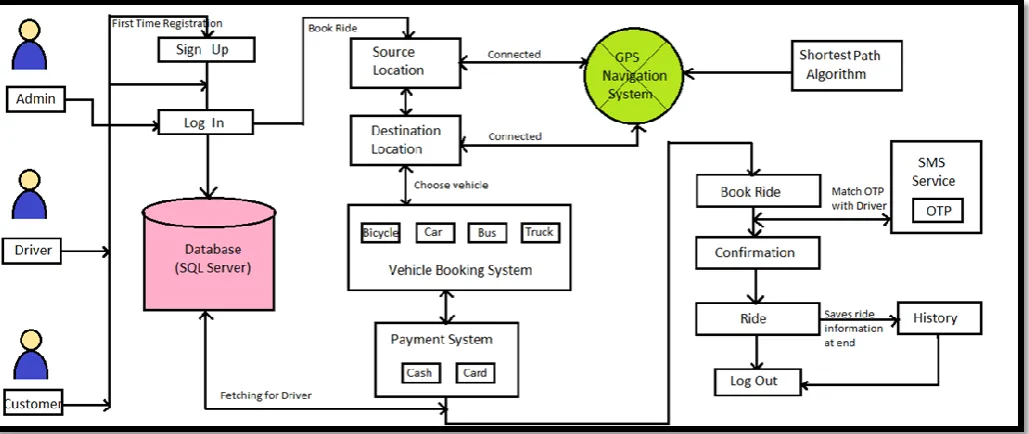
Fig -1: Generalized model of the system
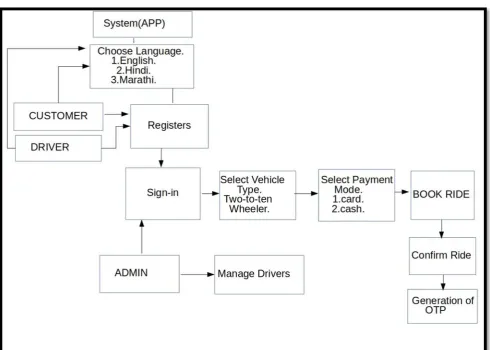
Above block diagram depicts the overall description of the system to be implemented. Inputs needed during implementation are stated in the above figure like; the option of Native languages will be available for smooth communication between customer and driver. The various modes of transportation will be available on the user Interface ranging from two to ten wheelers; so there is no need to download multiple apps for various transportation modes.
Fig -2: Architectural block diagram
[image:3.595.69.529.112.350.2] [image:3.595.41.556.443.660.2]© 2019, IRJET | Impact Factor value: 7.211 | ISO 9001:2008 Certified Journal
| Page 1388
truck etc. For the payment system there are two options cash and card. You need to enter Account number and CVV for card payment and confirm your ride. The request will be send to driver automatically and then system will fetch for driver. Appropriate generation of OTP (SMS Service) to start the ride, once driver accept your ride, you need to confirm the OTP with driver and as soon as you get confirmation your ride begins. After completion of ride, history will be saved in the system automatically.
5. ALGORITHMS
Google Map Calculates Shortest Path
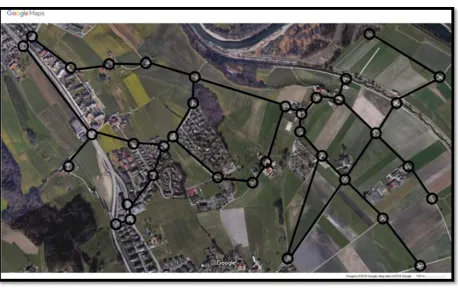
Google uses algorithms to determine our best routes. In order for these algorithms to work properly, it needs the correct form of input. Let us first consider what concept makes the most sense to apply to the problem of finding the shortest path. A network of roads is the best displayed in a top-down view, such as in a satellite image.
Every intersection and every location of interest can be regarded as a vertex of the graph and the roads that connect vertices are then the edges.
Fig -3: The edges of the graph and the circles are the nodes
Denote the set of edges by E and the set of vertices by V. For each edge e∈E we denote its edge weight by Ce. In the case of a road and maps network, the edge weights represent the time it takes to go from one vertex u to its neighbor v is the edge {u, v}, which represents road that leads from u to v.
The task of finding the shortest way from point A to point B can thereby be reduced to finding the shortest path on a weighted graph. There are a lot of different algorithms that can do this but we only want to discuss the one introduced by Dijkstra. (Google Maps most likely uses A∗ search.)
Dijkstra’s algorithm was published in 1959 by Edsger W. Dijkstra. The algorithm is important in the area of path finding.
As some have mentioned computing a route a long way across a large map can be expensive and slow. So optimizations of the Dijkstra are needed:
[image:4.595.69.528.278.566.2]© 2019, IRJET | Impact Factor value: 7.211 | ISO 9001:2008 Certified Journal
| Page 1389
other applications in Artificial Intelligence, the graphs might be very different in such a way the A* provides a larger performance advantage, but not much for road networks.
Bi-directional is a more effective optimization and almost all route calculation algorithms in the industry use it but not primarily for the performance advantage it brings. It means that the route is computed both forward from the origin (with Dijkstra, A*, reach-based routing, highway hierarchies, contraction hierarchies, or other methods) and backward from the destination. Like A*, the technique reduces the area searched, but more importantly, some more important algorithms require to work. But bi-directional route in the network computations bring their own complications – the algorithm must determine when the two searches have met at a point on an optimum or near optimum route and that’s more complex than it sounds.
Using the road network hierarchy, this is the most important performance optimization. Reach based routing brought concept into academia and spawned further research producing algorithms like Highway Hierarchies and Contraction Hierarchies.
At each iteration of its main loop, A* needs to determine its partial paths to expand into one or longer paths; so based on an estimate of the cost (total time taken) to go to the goal node. Specifically, A* selects the path that minimise.
f (n) = g(n) + h(n) f(n) = g(n) + h(n)
where, n is the destination node on the path, g(n) is the cost of the path from the start node to n, and h(n) is a heuristic that estimates the shortest path from source to the destination. The heuristic is problem-specific.
6. IMPLEMENTATION DETAILS
1. Customer data gathering.
Customer has to register his details, like name, email-id, mobile number, address and create password. The email-id and password created by the customer during registration will be used by him to sign-in to the system. The customer once registered those details will be saved for later use and that details will be stored in our database. This includes information such as the user-id, password, name, and email-id.
2. Customer account.
Once the customer gets registered, customer has his own account, and customer can login anytime and check the details, and can book the ride any time when required. The customer can also view his trips via trip history icon. The customer can book the vehicle ranging from two-to-ten wheeler.
3. Driver Registration.
Driver has to register his details, like name, email-id, mobile number, address and create password. The driver has to also enter driving license number, and aadhar number which will be used for further processing. The email-id and password created by the driver during registration will be used by him to sign-in to the system. The Driver once registered those details will be saved for later use and that details will be stored in our database. This includes information such as the id, name, email, password, mobile number, address, aadhar number, driving license number.
4. Driver account.
Once the driver gets registered, driver have his own account, and driver can login anytime and check the details, and can accept and decline the ride any time when according to the conditions.
5. Admin account.
© 2019, IRJET | Impact Factor value: 7.211 | ISO 9001:2008 Certified Journal
| Page 1390
6. Language selection.
To enhance customizable system, the customer can choose the convenient language by using the radio buttons available on the GUI, as the proposed system is providing native languages support it is implemented in strings.xml files and accessed throughout the app by choosing convenient language.
7. Payment methods.
For convenience of the customer the system has the choices of payment mode i.e. the customer can pay by cash or card as per his convenient.
8. Book ride.
The customer has to enter the Origin address and the destination address and select the transportation mode ranging from two-to-ten wheeler as per the requirement and then button appears “BOOK RIDE” then the request is sent to the database and the ride is booked and confirmed.
9. OTP generation.
When the ride is confirmed, by using random function algorithm random OTP is generated every time and after entering the correct generated OTP it is matched successfully.
[image:6.595.52.543.331.681.2]© 2019, IRJET | Impact Factor value: 7.211 | ISO 9001:2008 Certified Journal
| Page 1391
7. RESULTS
Proper interpretation of the native language selected.
Generation of path from source to destination.
Generation of fare for the ride by analysing the distance.
Generation and confirmation of OTP for the driver and the user.
8. CONCLUSIONS
As, we have growing number of online cab users and taxi aggregators in the current scenario. We are proposing a system which can enhance the existing system and to overcome the drawbacks of the existing system to increase the customer satisfaction and convenience.
The system provides:
A centralized approach for consumers to access all types of vehicles.
Increase the usability.
The drivers/consumers who are unable to communicate in English also can use the system efficiently.
The system is organization specific so can be transformed as per the need.
9. REFERENCES
[1] ”A secure tracking mobile app development”. Bharath Sai Pochampally; Jiangbo Liu 2017 12th IEEE Conference on
Industrial Electronics and Applications (ICIEA) Year: 2017.
[2] ”A Research On Mobile Applications For Location Tracking Through Web Server And Short Messages Services (SMS)”
November 2015.
[3] ”Research And Application Of A Transportation Information System Using Ubiquitous Terminal.” Junhan WANG, Fei QIAO,
Jianfeng LU CIMS Research Center of Tongji University, Shanghai 200092, P. R. China. IEEE -2013.
[4] Transportation Problems Applications. ANDRE VILAC A MOREIRA .Thesis - July 2012.
[5] IOSR Journal of Business and Management (IOSR-JBM) e-ISSN: 2278-487X, p-ISSN: 23197668. Volume 20, Issue 2. Ver. II
(February. 2018),PP 30 www.iosrjournals.org
[6] Han, Jiawei, Kamber, Micheline Pei and Jian, ”Data Mining Concepts And Techniques”, Elsevier Publishers.
[7] deMelo, L.L., Zorzo, S.D. (2012). PUPDroid - Personalized user privacy mechanics for android, Systems, Man, and
Cybernetics (SMC), 2012 IEEEInternational Conference on, 14- 17, 1479, 1484.
[8] Stirparo, Pasquale.,Fovino, Igor Nai., Taddeo, Marco., Kounelis, Ioannis. (2013). In-memory credentials robbery on android
phones, Internet Security (WorldCIS), 2013 World Congress on 88, 93, 9-12.
[9] Mabroukeh, Ezeife,”A Taxonomy of Sequential Pattern Mining Algorithms,”ACM,2010.
[10] EzeifeC,LiuY,”Fast Incremental Mining of Web Sequential Patternswith PLWAP Tree,”Data Mining and Knowledge
© 2019, IRJET | Impact Factor value: 7.211 | ISO 9001:2008 Certified Journal
| Page 1392
BIOGRAPHIES
Aishwarya Dekhane
PES Modern College of Engineering, Pune
Akansha Gore
PES Modern College of Engineering, Pune
Sakshi Gatagat
PES Modern College of Engineering, Pune