ISSN Online: 2327-5960 ISSN Print: 2327-5952
DOI: 10.4236/jss.2018.66015 Jun. 20, 2018 159 Open Journal of Social Sciences
Does Retirement Affect Residency Model?
Huaxia Jin
College of Economics, Jinan University, Guangzhou, China
Abstract
This paper explores the impact of retirement on individual’s residency model based on the data from the China Health and Retirement Longitudinal Study (CHARLS) of 2013 and 2015. The results show that retirement significantly reduces the probability of individual’s sharing co-residence with their child-ren, and the male individuals are more affected. China has entered an aging society, the welfare of the elderly has received widespread attention, and children should pay more attention to the elderly so that they can live happily in their old age.
Keywords
Retirement, Co-Residence, CHARLS
1. Introduction
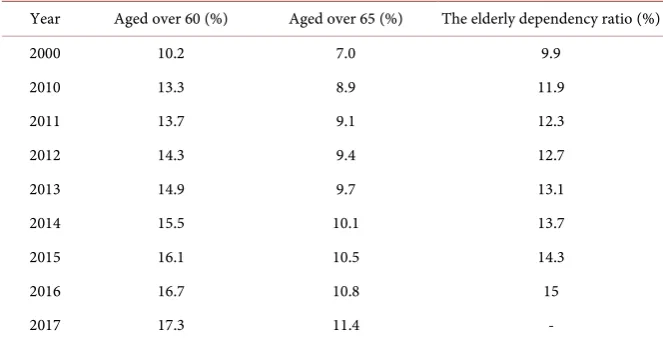
By 2000, people aged over 60 and 65 were 10% and 7% of the population in China respectively (China Statistical Yearbook, 2001), indicating that China had entered an aging society, and the proportion of the elderly had increased year by year. By the end of 2017, people aged over 60 had exceeded to 241 million, ac-counting for 17.3% of the total population, people aged over 65 had a population of more than 158 million, accounting for 11.4% of the total population, higher than the international “aging society” standard; both aging population and the elderly dependency ratio are increasing year by year (Table 1).
Since China had entered an aging society in 2000, the size and proportion of the elderly population have grown at a relatively rapid rate, and their residency model has received more and more attention. Based on the data of the China Health and Retirement Longitudinal Study (CHARLS), this paper analyzes the impact of retirement on the individual’s residency model of the elderly, what’s more, the impact from the perspective of overall and different genders will be conducted, and it explores ways to improve their lives and welfare of the elderly.
How to cite this paper: Jin, H.X. (2018) Does Retirement Affect Residency Model? Open Journal of Social Sciences, 6, 159-166. https://doi.org/10.4236/jss.2018.66015
Received: May 15, 2018 Accepted: June 17, 2018 Published: June 20, 2018
Copyright © 2018 by author and Scientific Research Publishing Inc. This work is licensed under the Creative Commons Attribution International License (CC BY 4.0).
DOI: 10.4236/jss.2018.66015 160 Open Journal of Social Sciences Table 1. Aging population and the elderly dependency ratio.
Year Aged over 60 (%) Aged over 65 (%) The elderly dependency ratio (%)
2000 10.2 7.0 9.9
2010 13.3 8.9 11.9
2011 13.7 9.1 12.3
2012 14.3 9.4 12.7
2013 14.9 9.7 13.1
2014 15.5 10.1 13.7
2015 16.1 10.5 14.3
2016 16.7 10.8 15
2017 17.3 11.4 -
Source of data: China Statistical Yearbook 2017.
For ease of analysis, this paper defines retirement as an activity which requires a retirement procedure. Based on the data from CHARLS of 2013 and 2015, indi-viduals aged 45 to 75 who have retired or may retire later are selected as the study subjects; this paper investigates the influence of retirement on residency model of the elderly.
2. Literature Review
There are many factors that influence the residency model of the elderly. The probability of individual’s sharing co-residence with their children will increase with the increasing of individual’s age based on the Japanese micro-survey da-ta in 1986 [1]. The individuals aged between 65 with 75 are more likely to shar-ing co-residence with their children than the individuals aged over 75 years old
[2]. There are gender differences in the probability of individual’s sharing co-residence with their children. The male individuals are more likely to sharing co-residence with their children than the female individuals [2][3]. Marital sta-tus has a great impact on individual’s residency model. Individuals are more likely to sharing co-residence with their children when they do not have a spouse
DOI: 10.4236/jss.2018.66015 161 Open Journal of Social Sciences
share co-residence with their children [8]. The elderly without children are more likely to live alone [9].
There are three main aspects of research on retirement. The first is the influ-ence of retirement on consumption. It is confirmed that retirement led to a de-cline in food consumption of urban residents in China [10]. The second is the effect of retirement on the well-being of the elderly. Retirement has significantly increased the sense of happiness of the residents based on the CHARLS survey data [11]. The third is the impact of retirement on health. Retirement at the normal retirement age has a significant negative impact on health condition among the male individuals based on the 1% national sample survey of 2005, no effect for female individuals, and early retirement has no effect on health condi-tion of both male and female individuals [12]. Retirement has a negative impact on self-rated health condition based on the data from the CHARLS, and the in-dividuals with low level of education are more likely to be influenced [13].
There are few existing literatures that specifically study the impact of retire-ment on residency model. This paper examines the influence on the individual’s residency model from the angle of retirement.
3. Empirical Analysis
3.1. Data and Variables
The data used in this paper comes from CHARLS of 2013 and 2015. The main survey individuals of CHARLS are aged over 45. The survey mainly includes personal basic information, medical services and medical insurance, health sta-tus, family structure and financial support, basic community conditions, job, re-tirement, and pensions. The survey covers 150 districts and counties across China, and then draws 3 village-level units (or communities) from each district and county to a total of 450 villages (or communities). Based on the types of ac-counts shown in the survey, this paper deleted the agricultural acac-counts and the accounts which used to be agricultural accounts in the past years. Considering that most of the elderly aged over 75 may have very different characteristics, the sample of the elderly aged over 75 is deleted. At last, the sample is consist of non-agricultural residents aged 45 to 75.
Whether the individuals share co-residence with their children is the inde-pendent variable of this paper, and it is a dummy variable. According to the CHARLS questionnaire, if the respondent has at least one child who lives at home, the individual will be entitled to share co-residence with their children, and the value of the independent variable takes 1, otherwise, the value takes 0. Considering that children still attending school do not have significant support for the elderly, the resident information of adult children without attending school in the questionnaire is used to determine the residency model of the el-derly.
DOI: 10.4236/jss.2018.66015 162 Open Journal of Social Sciences
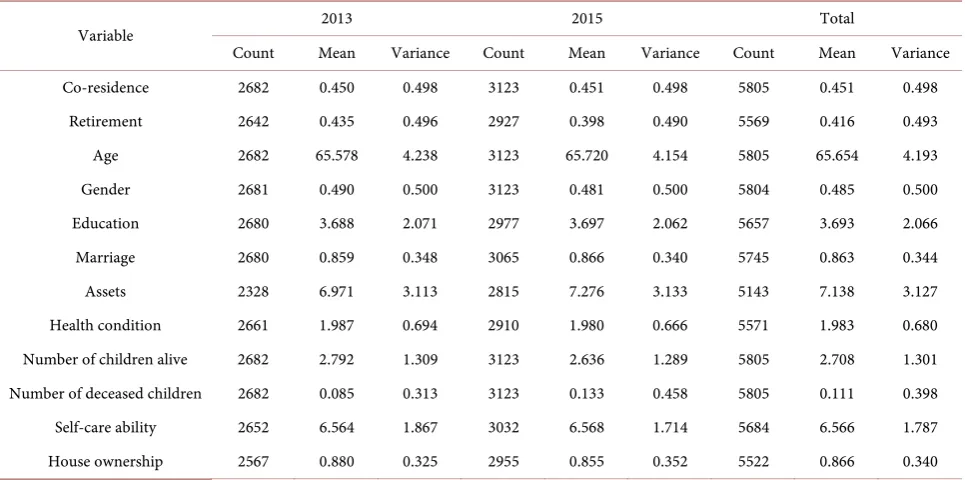
retirement procedures (including early retirement)” and “If you have gone through retirement”, it means that the individual has retired, and the value is 1; otherwise it is not retired, and the value is 0. The results of literature studies have shown that whether the elderly sharing co-residence with their children is also affected by other factors such as age, gender, marital status, education level, number of children alive, and number of deceased children. Therefore, these characteristics will be introduced in the analysis of this paper to control their potential influence. The age statistics are calculated according to the question-naire provided by the respondent’s birth date; set the gender as a dummy varia-ble, the value of the male takes 1, and the female takes 0; the marital status is also set as a dummy variable, the value of those who has a spouse (married or coha-biting) will take 1, and no spouse (married but separated, divorced, widowed or unmarried) takes 0. The level of education is measured by the highest degree which the individual has obtained. The higher the level of education, the bigger the value; the number of children alive and the number of deceased children are counted based on the children’s information. In addition, other factors which reflect individual’s characteristics such as house ownership, assets, health condi-tion, and self-care ability may also affect the residency model. When the house is owned by a family member, the value takes 1; otherwise, it is 0; assets refers to the cash amount and bank deposit status of the elderly which takes a logarithmic conduction; according to the questionnaire survey results, the better of the health condition is, the bigger of the value is. The better of the self-care ability is, the smaller of the value is. Descriptive statistics are shown in Table 2.
3.2. Econometric Model
This paper analyzes the impact of retirement on individual’s residency model based on the following equation.
0 1 Retirement
it it it year province it
y =β +β ⋅ + ⋅α Z +γ +γ +ε (1)
it
y is the independent variable of this paper. It indicates whether the individuals share co-residence with their children after retirement. When yit = 1, it means that they share co-residence with their children. When yit = 0, it indicates that they do not share co-residence with their children. Retirementit = 1 indicates that they have retired. Retirementit = 0 means that there is no retirement, and then the coefficient β1 represents the impact of retirement on the probability
of individual’s sharing co-residence with their children. Zit is a control varia-ble vector used to control the influence of the factors such as age, gender, educa-tion, health, and asset status.
α
is the coefficient vector.Considering that the sample is panel data, the fixed-effect model is used to control the influence of time and regional factors on the estimation results. γyear
represents the annual fixed effects, used to control the impact of the undetected variables that do not change with the individuals but change over time; γprovince
DOI: 10.4236/jss.2018.66015 163 Open Journal of Social Sciences Table 2. Descriptive statistics.
Variable 2013 2015 Total
Count Mean Variance Count Mean Variance Count Mean Variance
Co-residence 2682 0.450 0.498 3123 0.451 0.498 5805 0.451 0.498
Retirement 2642 0.435 0.496 2927 0.398 0.490 5569 0.416 0.493
Age 2682 65.578 4.238 3123 65.720 4.154 5805 65.654 4.193
Gender 2681 0.490 0.500 3123 0.481 0.500 5804 0.485 0.500
Education 2680 3.688 2.071 2977 3.697 2.062 5657 3.693 2.066
Marriage 2680 0.859 0.348 3065 0.866 0.340 5745 0.863 0.344
Assets 2328 6.971 3.113 2815 7.276 3.133 5143 7.138 3.127
Health condition 2661 1.987 0.694 2910 1.980 0.666 5571 1.983 0.680
Number of children alive 2682 2.792 1.309 3123 2.636 1.289 5805 2.708 1.301 Number of deceased children 2682 0.085 0.313 3123 0.133 0.458 5805 0.111 0.398 Self-care ability 2652 6.564 1.867 3032 6.568 1.714 5684 6.566 1.787
House ownership 2567 0.880 0.325 2955 0.855 0.352 5522 0.866 0.340
Source of data: CHARLS of 2013 and 2015.
provinces. εit represents the random error term used to control the effects of other factors not included in the model.
4. Empirical Results
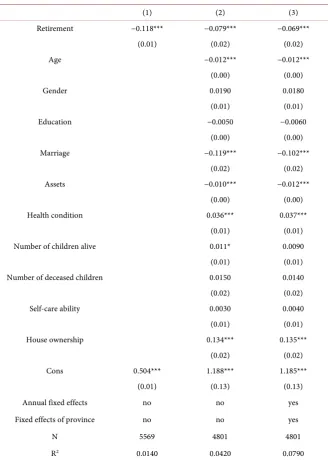
The entire sample is examined based on regression Equation (1). The regression results are shown in Table 3. From column (1) in Table 3, it can be seen that without adding any control variables and without controlling the annual fixed effects and the fixed effects of the province, retirement reduces the probability of individual’s sharing co-residence with their children by 11.8%, the result is sig-nificant at 1% level of significance; From column (2), it is shown that under the condition of adding the control variables but without controlling the annual fixed effects and the fixed effects of the province, retirement reduces the proba-bility of individual’s sharing co-residence with their children by 7.9%, the result is significant at 1% level of significance; From column (3), it is shown that under the condition of adding control variables and controlling annual fixed effects and fixed effects of the province, retirement reduces the probability of individu-al’s sharing co-residence with their children by 6.9%, the result is significant at 1% level of significance. It follows that retirement will significantly reduce the probability of individual’s sharing co-residence with their children.
DOI: 10.4236/jss.2018.66015 164 Open Journal of Social Sciences Table 3. Overall regression.
(1) (2) (3)
Retirement −0.118*** −0.079*** −0.069***
(0.01) (0.02) (0.02)
Age −0.012*** −0.012***
(0.00) (0.00)
Gender 0.0190 0.0180
(0.01) (0.01)
Education −0.0050 −0.0060
(0.00) (0.00)
Marriage −0.119*** −0.102***
(0.02) (0.02)
Assets −0.010*** −0.012***
(0.00) (0.00)
Health condition 0.036*** 0.037***
(0.01) (0.01)
Number of children alive 0.011* 0.0090
(0.01) (0.01)
Number of deceased children 0.0150 0.0140
(0.02) (0.02)
Self-care ability 0.0030 0.0040
(0.01) (0.01)
House ownership 0.134*** 0.135***
(0.02) (0.02)
Cons 0.504*** 1.188*** 1.185***
(0.01) (0.13) (0.13)
Annual fixed effects no no yes
Fixed effects of province no no yes
N 5569 4801 4801
R2 0.0140 0.0420 0.0790
Notes: Standard errors in parentheses *p < 0.1, **p < 0.05, ***p < 0.01; Source of data: CHARLS of 2013 and 2015.
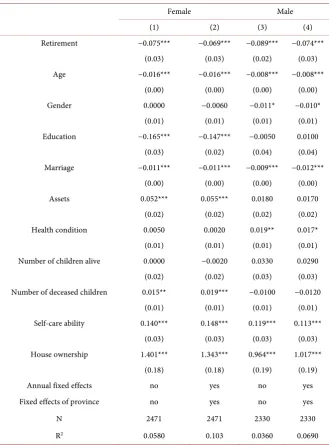
children by 6.9%, the result is significant at 1% level of significance; From col-umn (4), it is shown that under the condition of adding control variables and controlling annual fixed effects and fixed effects of the province, retirement re-duces the male individual’s probability of sharing co-residence with their child-ren by 7.4%, the result is significant at 1% level of significance.
DOI: 10.4236/jss.2018.66015 165 Open Journal of Social Sciences Table 4. The difference caused by gender.
Female Male
(1) (2) (3) (4)
Retirement −0.075*** −0.069*** −0.089*** −0.074*** (0.03) (0.03) (0.02) (0.03) Age −0.016*** −0.016*** −0.008*** −0.008***
(0.00) (0.00) (0.00) (0.00)
Gender 0.0000 −0.0060 −0.011* −0.010*
(0.01) (0.01) (0.01) (0.01) Education −0.165*** −0.147*** −0.0050 0.0100 (0.03) (0.02) (0.04) (0.04) Marriage −0.011*** −0.011*** −0.009*** −0.012***
(0.00) (0.00) (0.00) (0.00)
Assets 0.052*** 0.055*** 0.0180 0.0170
(0.02) (0.02) (0.02) (0.02)
Health condition 0.0050 0.0020 0.019** 0.017*
(0.01) (0.01) (0.01) (0.01) Number of children alive 0.0000 −0.0020 0.0330 0.0290 (0.02) (0.02) (0.03) (0.03) Number of deceased children 0.015** 0.019*** −0.0100 −0.0120
(0.01) (0.01) (0.01) (0.01) Self-care ability 0.140*** 0.148*** 0.119*** 0.113***
(0.03) (0.03) (0.03) (0.03) House ownership 1.401*** 1.343*** 0.964*** 1.017***
(0.18) (0.18) (0.19) (0.19)
Annual fixed effects no yes no yes
Fixed effects of province no yes no yes
N 2471 2471 2330 2330
R2 0.0580 0.103 0.0360 0.0690
Notes: Standard errors in parentheses *p < 0.1, **p < 0.05, ***p < 0.01; Source of data: CHARLS of 2013 and 2015.
5. Conclusions
Based on the data from CHARLS of 2013 and 2015, this paper explores the im-pact of retirement on individual’s residency model. The full-sample regression results show that retirement reduces the probability of individual’s sharing co-residence with their children by 6.9%; regression analysis of male and female samples indicates that retirement has a greater impact on male individuals.
DOI: 10.4236/jss.2018.66015 166 Open Journal of Social Sciences
China. However, the results of this study show that retirement will significantly reduce the probability of individual’s sharing co-residence with their children. Faced with this situation, the children should respect the elderly’s own life wish-es, and take good care of the elderly, so that the elderly can have a happy life in their old age.
References
[1] Budak, M.-A. and Kawabe, H.L.K.-L. (1996) Co-Residence of Household Heads with Parents in Japan: A Multivariate Explanation. International Journal of Popula-tion Geography, 2, 133.
https://doi.org/10.1002/(SICI)1099-1220(199606)2:2<133::AID-IJPG16>3.0.CO;2-4
[2] Evans, B. and Palacios, R. (2015) An Examination of Elderly Co-Residence in the Developing World. Social Protection & Labor Policy & Technical Notes. World Bank, Washington DC.
[3] Bongaarts, J. and Zimmer, Z. (2002) Living Arrangements of Older Adults in the Developing World: An Analysis of Demographic and Health Survey Household Surveys. Journals of Gerontology, 57, S145.
https://doi.org/10.1093/geronb/57.3.S145
[4] Qu, J.Y. and Sun, L.J. (2011) The Arrangement and Change of Old People in China: 2000-2006. Journal of Population Sciences, No. 2, 40-45.
[5] Shah, N.M., Badr, H.E. and Yount, K. (2011) Decline in Co-Residence of Parents and Children among Older Kuwaiti Men and Women: What Are the Significant Correlates? Journal of Cross-Cultural Gerontology, 26, 157.
https://doi.org/10.1007/s10823-011-9138-x
[6] Lin, M.X., Jin, Y.J. and Liu, Y.C. (2009) A Comparative Study on the Choice of Ha-bits for Older People in China and Korea. Journal of Northwest Normal University (Social Science), 46, 71-79.
[7] Yang, E.Y., Qi, J.S. and Ma, G.R. (2012) An Empirical Analysis of the Influencing Factors of Residential Arrangement for the Elderly in Rural China. Agricultural Economic Issues, No. 1, 37-44.
[8] Isengard, B. and Szydlik, M. (2012) Living Apart (or) Together? Coresidence of El-derly Parents and Their Adult Children in Europe. Research on Aging, 34, 449-474.
https://doi.org/10.1177/0164027511428455
[9] Qu, J.Y. and Du, P. (2014) The Influence of Residents’ Willingness of Living in Ur-ban China on Empty Nest Residence. Population and Development, 20, 87-94. [10] Zhang, K.Z. and Jiang, Q.C. (2013) Ageing, Retirement, and Consumption: Does
China Exist “The Retirement-Consumption Riddle”? Population and Economy, No. 5, 10-18.
[11] Wang, Q. and Zeng, G. (2015) The Influence of Retirement and Pension Income on Subjective Well-Being—An Empirical Research Based on CHARLS. Insurance Stu-dies, No. 11, 95-109.
[12] Lei, X., Strauss, J. and Tian, M. (2015) Living Arrangements of the Elderly in China: Evidence from the CHARLS National Baseline. China Economic Journal, 8, 191.
https://doi.org/10.1080/17538963.2015.1102473