RESEARCH ARTICLE
PHYSICOCHEMICAL ACTIVATION OF OIL PALM SHELLS USING RESPONSE SURFACE
METHODOLOGY: OPTIMIZATION OF ACTIVATED CARBONS PREPARATION
1,2
Kouotou D.,
1Ngomo Manga H.,
2Baçaoui A.,
2Yaacoubi A. and
1,*Ketcha Mbadcam J.
1
Physical and Theoretical Chemistry Laboratory, Department of Inorganic Chemistry, Faculty of Science,
P.O Box 812 Yaoundé, University of Yaoundé I - Cameroon
2
Applied Organic Chemistry Laboratory, Department of Chemistry, Faculty of Science – Semlalia Marrakech,
P.O Box 2390 Marrakech, University Cadi Ayyad - Morocco
ARTICLE INFO ABSTRACT
The preparation of activated carbons derived from oil palm shells, chemically activated by potassium hydroxide and physically activated by steam was investigated in this paper. The Methodology of Experimental Design (MED) was used to optimize the preparation conditions. The effects of two preparation variables: the activation temperature ranging from 601 to 799°C and the impregnation ratio ranging from 0.6 to 3.4 were studied on the
activated carbon yield (R/AC-KOH), the iodine adsorption capacities (I2/AC-KOH) and methylene blue
adsorption capacities (MB/AC-KOH) results. The experimental results from the analysis of variance (ANOVA) permits to identified the significant factors on each experimental design response. The optimum conditions for activated carbons physicocshemically activated by KOH and steam (AC-KOH) were activation temperature of
630°C, and impregnation ratio of 1/1 which lead to the activated carbon yield of 38.71%, I2/AC-KOH of 803.72
mg/g and MB/AC-KOH of 457.36 mg/g. The morphologies of the raw material and activated carbon obtained under optimum conditions were visualized using Scanning Electron Microscopy.
Copyright, IJCR, 2013, Academic Journals. All rights reserved.
INTRODUCTION
The progressive increase of wastes is becoming a major environmental problem due to the growing use of industrials technologies. It is proof that, the wastes discharged are very difficult to be managed, since some of them are resistant to biodegradation. Many industries processing extract their main products and discharge large amount of wastes which cause serious ecological problems. Therefore, wastes pollution is remaining a major environmental problem. The ways of managing this kind of pollution, is for example to find or prepare new adsorbents, from various lignocellulosic materials or agricultural wastes such as coconut shell (Laine et al., 1989 ; Daud et al., 2004;Ru-Ling Tseng et al., 2007;Rosas et al., 2007;Azevedo et al., 2007; Afrane et al., 2008;Tan et al., 2008(a);
Tan et al., 2008(b); Ioannidou et al., 2010), dates or peach stones
(Haimour et al., 2006; Veksha et al., 2009; Débora et al., 2010), corn cob (Narges Bagheri et al., 2009,Yong Sun et al., 2010), rice straw (Kumagai et al., 2007 ; Kalderis et al., 2008), oil palm stones and shells (Lua et al., 2006; Guo et al., 2007; Tan et al., 2007; Allwar et al., 2008). In fact, the manufacture of activated carbons is mainly to combat environmental pollution (Ahmad et al., 2007; Donni Adinata
et al., 2007(a); Qipeng et al., 2008; Tan et al., 2008; Alcaniz-Monge
et al., 2009; Foo et al., 2009; Qipeng et al., 2009; Zahangir Alam et al., 2009; Piotr Nowicki et al., 2010; Sumathi et al., 2010(a) Sumathi
et al., 2010(b)).Thuslignocellulosic materials are gaining more and
more interest in manufacture of adsorbents. As interesting set of characteristics, including, a greater diversity, inexpensive cost, largely available, currently no economic value and physicochemical properties such as high density. This material also exhibits remarkable amount of carbon and low ash contents. In the present study, we prepared activated carbons from oil palm shells by physicochemical
*Corresponding author: [email protected]
activation. Oil palm shells containing high carbonaceous materials are generated in large quantity as a major by-product of the oil palm milling industry. Oil palm shells are usually burned as a low-value energy resource or discarded in the field, both of which are unfavorable to the environment. It was reported earlier that, oil palm shells consisted of high amount of lignocellulosic materials with high carbonaceous materials are used as the precursor in the production of activated carbons. Thus, they should be possible to be pyrolysed to form a porous material that is suitable to be used as adsorbents (Tan et al., 2004; Tan et al., 2008; Tan et al., 2009; Bakhtiar et al., 2010; Arami-Niya et al., 2011). In the literature, there are two methods to produce activated carbons, namely physical activation and chemical activation. Previous works on these methods of preparation had been reported. Their advantages are simplicity, a short production time, lower temperature of activation and good development of the porous structure, thus a higher yield (Donni Adinata et al., 2007(b); Ahmadpour et al., 1996).
Particularly in the chemical activation process, the carbonization and the activation steps proceed simultaneously by carrying out thermal decomposition of the raw material impregnated with certain chemical agent such as phosphoric acid (Hayashi et al., 2000; Haimour et al., 2006; Rosas et al., 2007; Solange et al., 2010), potassium hydroxide (Ahmadpour et al.,1996; Yang et al., 2004; Fierro et al., 2006; Baocheng Jiang et al., 2008; Abdel-Nasser A. El-Hendawy, 2009; Carrott et al., 2010; Feng-Chin Wu et al., 2010) or zinc chloride (Chen et al., 2002; Qingrong Qian et al., 2007; Zhaolian Zhu et al., 2007; Sait Yorgun et al., 2009; Suat Uçar et al., 2009) in an inert atmosphere. These impregnate are used as dehydrating agents and oxidants that influence pyrolytic decomposition and inhibit formation
of tar, thus enhancing the yield of carbon (Solange et al., 2010).
The quality of activated carbons obtained depends mainly of the precursor used and the preparation conditions. The factors like, the
ISSN: 0975-833X
International Journal of Current Research
Vol. 5, Issue, 03, pp.431-438, March, 2013
INTERNATIONAL JOURNAL
OF CURRENT RESEARCH
Article History:
Received 28th December, 2012
Received in revised form
15th January, 2013
Accepted 23rd February, 2013
Published online 19th March, 2013
Key words:
Activated carbons, Methodology of
impregnation ratio, the activation time and temperature, the carbonization time and temperature, activators used, and particles sizes interact between them. In many studies, one factor is fixed at a certain level, varying another to determine the best condition. This procedure has disadvantages such as: the lack of research on the interactive effects on the factors studied, and the large number of experiments required, which consequently require more time with a higher cost and consumption of reagents (Bezerra et al.,2008). The comprehension of these interactions between factors is essential in determining the characteristics of prepared activated carbons (Derbyshire et al., 1971; Matson et al., 1971; Hassler Wiley, 1974; Suarez-Garcia et al., 2002(a); Suarez-Garcia, 2002(b)). And it is also a useful tool to optimize the preparation conditions.The aim of this paper is to explore the effect of these factors cited up on the preparation conditions of the activated carbon by physicochemical activation in order to optimize them, by using the Methodology of Experimental Design. This method consists of diverse mathematical models and statistical techniques based on the adjustment of equations models to the experiment data to describe the behavior of the independent variables (Bezerra et al., 2008). In recent years, some authors have applied this optimization method to the production of activated carbons (Baçaoui et al., 2002; Hameed et al., 2008; Hameed
et al., 2009; Sumathi et al., 2009; Hui Deng et al., 2010; Kunquan Li
et al., 2010; Vargas et al., 2010). Rare were the studies using oil palm
shells chemically activated with KOH, and physically activation with steam through The MED for optimization.
MATERIALS AND METHODS
Sample collection and preparation of activated carbon
The raw material for the preparation of activated carbon was the oil palm shells collected from an oil palm mill company Socaplam in the locality of Bongo-Cameroon. The oil palm shells was washed several times using tap water and finally with distilled water to reduce oil impurities and then dried in the oven at 110°C to remove excess water, until constant weight. The dried oil palm shells samples were grinded in a porcelain mortar and sieved to a particle size of 1.0 –2.0 mm and stored at room temperature for further used.
Experimental methods
The oil palm shells with particle size of 1.0 – 2.0 mm, was first carbonized in a furnace at 800°C for 1 hour with the nitrogen flow rate of 100mL/min and maintained until the cooling of the furnace. After carbonization process, an exact amount of the carbonized material obtained was weighed and added into beakers containing a saturated solution of potassium hydroxide at the ratio desired. Each mixture was mixed throughout 02 hours at 60°C, and then was dried at 120°C overnight for complete evaporation of water. The reactor was loaded with 10g of impregnated sample and then placed into the graphite furnace. The furnace was raised at the pre-determined activation temperatures desired from 601 to 799oC. It was held at this temperature for a period of 02 hours under steam activation, at a constant flow rate of 0.1 mL/ min. After cooling to the ambient temperature, the samples were washed with 0.1N hydrochloric acid, then with distilled water for several times. The washing process was done until the absence of chloride ions in the washing water such as its pH ranged 6 –7(Moreno-Castilla et al., 2001), and then dried in the oven at 110oC for 24 hours. The weight lost was obtained from the weight before and after pyrolysis to calculate the yield. The samples obtained were crushed into powder form and kept well for further tests.
Methodology of Experimental Design
The methodology of experimental Design is a statistical technique for modeling and analysis of problems in which a response of interest is influenced by several factors (Baçaoui et al., 2001) The MED is utilized to optimize the effective parameters with a minimum number of experiments, as well as to analyze the interactions between the parameters (Azargohar et al., 2005). The two parameters investigated
in the present study were coded as the activation temperature(X1) and
the impregnation ratio (X2). The experimental design matrix of 12
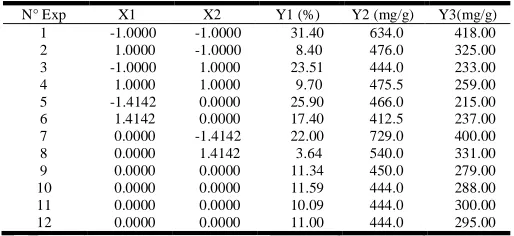
experiments and results are given in the table 1 below. Each row represents an experimental run, and each column represents the variables tested. The three responses analyzed were the activated carbons yield, (Y1), the iodine and methylene blue adsorption
capacities of activated carbons impregnated with KOH noted respectively by: R/AC-KOH (Y1), I2/AC-KOH (Y2) and
MB/AC-KOH (Y3). Each response was used to develop a model which
correlates the responses to the two variables using a polynomial equation given by the following equation:
Y = b0 + b1X1 + b2X2 + b1X1X1 + b2X2X2 + b12X1X2 ………. (1)
Where Y is the predicted response, b0 a constant coefficient, bi a linear
coefficient; bii, a quadratic coefficient; bij an interaction coefficient,
X1 and X2, the coded values of the activated carbons preparation
variables. The experimental data were analyzed using a statistical software design expert named NEMROD, for regression analysis to fit the equations developed and also to evaluate the statistical significance of the equations obtained.
Activated carbons yield: R/AC-KOH (Y1)
The activated carbons yield was calculated using the following formula:
Yield (%) = x100 ………….. (2)
Where m and m0 are the dry weight of final activated carbon (g) and
dry weight of precursor (g), respectively.
Iodine adsorption capacity of the activated carbons: I2/AC-KOH
(Y2)
Iodine was considered as probe molecule for assessing the adsorption capacity of adsorbent for solutes of molecular sizes <10 Å. The iodine number is defined as the milligrams of iodine adsorbed by 1g of carbon. The iodine adsorption was determined using the sodium thiosulfate volumetric method (ASTM D4607-94, 2006). The iodine number was estimated by mixing the activated carbon with 0.02 N iodine solution shaken occasionally and then by titration of the solution against Na2S2O3.
Methylene blue adsorption capacity of the activated carbons: MB/AC-KOH (Y3)
Methylene blue was considered as probe molecule for assessing the adsorption capacity of adsorbent for solutes of molecular sizes >15A˚. The methylene blue number is the milligrams of methylene blue adsorbed by 1g of carbon (Hassler, 1974). The concentration of methylene blue was measured by using a beam UV–visible spectrophotometer Anthelie data at the maximum absorbance wavelength of 660 nm.
The iodine and methylene blue numbers Cads (mg/g) were calculated using the following formula:
Cads =( ) ………….. (3)
Where C0 and Ce (mg/L) are the liquid-phase concentrations of iodine
at initial and at equilibrium, respectively. V is the volume of the solution (L) and mis the mass of dry adsorbent used (g).
RESULTS AND DISCUSSION
Responses analysis and interpretation
Table 1. Experimental Design Matrix and the Corresponding Experimental Responses
N° Exp X1 X2 Y1 (%) Y2 (mg/g) Y3(mg/g)
1 -1.0000 -1.0000 31.40 634.0 418.00
2 1.0000 -1.0000 8.40 476.0 325.00
3 -1.0000 1.0000 23.51 444.0 233.00
4 1.0000 1.0000 9.70 475.5 259.00
5 -1.4142 0.0000 25.90 466.0 215.00
6 1.4142 0.0000 17.40 412.5 237.00
7 0.0000 -1.4142 22.00 729.0 400.00
8 0.0000 1.4142 3.64 540.0 331.00
9 0.0000 0.0000 11.34 450.0 279.00
10 0.0000 0.0000 11.59 444.0 288.00
11 0.0000 0.0000 10.09 444.0 300.00
12 0.0000 0.0000 11.00 444.0 295.00
X1 = coded value of the activation temperature
X2 = coded value of the impregnation ratio
Y1 = activated carbons yield, R/AC-KOH
Y2 = iodine adsorption capacities, I2/AC-KOH
Y3 = methylene blue adsorption capacities, MB/AC-KOH
capacities of I2/AC-KOH from 412.5 to 729mg/g and the adsorption
capacities of MB/AC-KOH ranged from 215 to 418mg/g. The yield and the adsorption capacity of methylene blue of highest values were obtained at 630°C and a ratio of 1/1(experiment 1). However, their lowest values were obtained at 700°C with a higher ratio of 3.4 for the yield(experiment 8) and a lowest temperature of 601°C with a ratio of 2/1 for methylene blue adsorption (experiment 5). Whereas for iodine adsorption, the highest value of 729mg/g was obtained at 700°C corresponding with the lowest ratio of 0.6 (experiment 7). The lowest value of 412.5 mg/g was obtained at the highest temperature of 799°C with a ratio of 2/1 (experiment9). The polynomial model equations in terms of coded factors are given as:
Y1 = 11.005 - 6.104 X1 – 4.069 X2 + 5.577X1X1+ 1.162X2X2 +
2.297X1X2 …..(4)
Y2 = 445.5 – 25.27 X1 – 57.22 X2 – 10.5X1X1+ 87.13X2X2 +
47.38X1X2 …….(5)
Y3 = 290.5 - 6.104 X1 – 43.573 X2 – 29.001X1X1 +40.751X2X2
+29.75X1X2 ………(6)
A positive sign in front of the coefficients indicates synergistic effects, whereas negative sign indicates antagonistic effects. So, we can see that, for all the three responses, the effects of the two variables (activation temperature and impregnation ratio) were antagonistic on the three responses. So, the increase of any of these factors should result in the reduction of responses studied. From the ANOVA, the suitability of a model equation is evaluated using the correlation coefficients R2.The proximity of R2 value to unity, indicated the suitability of the model equation. The R2 values were 0.837, 0.971 and 0.891 for Y1, Y2 and Y3 respectively. It indicated that 83.7%, 97.1%
and 89.1% of the total variation in the activated carbon yield, adsorption capacities of iodine and methylene blue respectively were due to the experimental data analyzed. The R2 value of 0.971 for Y2 was considered relatively high indicating that there was a good agreement between the experimental and predicted iodine adsorption capacity (I2/AC-KOH) from the model. The R2 values of 0.837 and
0.891 were considered as moderate to validate the fit, this can be attributed to larger variation in the activation carbon yield and methylene blue adsorption capacity (MB/AC-KOH) predicted from the model. The ANOVA for Y1 for activated carbon yield is listed in Table 2 below:
From the ANOVA of results obtained, the coefficients of the
activation temperature (b1 = -6.104), of the impregnation ratio
(b2 = -4.069) and of the quadratic term of the activation temperature
(b11 = 5.577) were found to have significant effects on the activated
carbons yield. The coefficient of the activation temperature imposing the greater effect on activated carbons prepared. The coefficient of the interaction term (b12 =2.297) was considered moderated, however the
coefficient of the quadratic term of the impregnation ratio (b22 = 1.162) imposed the least effect on the yield. The ANOVA
revealed that, the coefficients of the quadratic term of the
impregnation ratio (b22 =87.13), of the impregnation ratio
(b2 =-57.22) and of the interaction term (b12 =47.38) were found to
have significant effects on the iodine number. The coefficient of the quadratic term of the impregnation ratio imposing the greater effect on
the iodine number. The coefficients of the activation temperature (b1 = -25.27) and its quadratic term (b11 =-10.50) were considered
[image:3.595.61.538.476.534.2]moderated, with the coefficient of the quadratic term of the activation
Table 2. Analysis of variance of the activated carbon yield, R/AC-KOH (Y1)
Source of variation Sum of squares Degree of freedom square mean Rapport Signif
Regression 650.7137 5 130.1427 302.2592 0.0305 ***
Residual 127.0977 6 21.1829
Validity 125.8060 3 41.9353 97.3957 0.156 **
Error 1.2917 3 0.4306
[image:3.595.83.519.522.777.2]Total 777.8114 11
Table 3. Statistical Estimations of coefficients: R/AC-KOH(Y1)
Name Coefficient F.Inflation Ecart-Type t.exp. Signif. %
b0 11.005 0.328 33.54 < 0.01 ***
b1 -6.104 1.00 0.232 -26.31 < 0.01 ***
b2 -4.069 1.00 0.232 -17.54 0.0253 ***
b11 5.577 1.04 0.259 21.50 0.0141 ***
b22 1.162 1.04 0.259 4.48 1.91 *
b12 2.297 1.00 0.328 7.00 0.479 **
Table 4. Analysis of variance of iodine adsorption, I2/AC-KOH (Y2)
Source of variation Sum of square Degree of freedom square mean Rapport Signif
Regression 9.406E+0004 5 1.881E+0004 39.9158 0.0361 ***
Residual 2.827E+0003 6 4.713E+0002
Total 9.688E+0004 11
Table 5. Statistical Estimations of coefficients: I2/AC-H3PO4 (Y2)
Name Coefficient F.Inflation Ecart-Type t.exp. Signif. %
b0 445.50 10.85 41.04 < 0.01 ***
b1 -25.27 1.00 7.68 -3.29 1.66 *
b2 -57.22 1.00 7.68 -7.46 0.0451 ***
b11 -10.50 1.04 8.58 -1.22 26.7
b22 87.13 1.04 8.58 10.15 0.0121 ***
temperature imposing the least effect on the iodine number. The ANOVA for MB/AC-KOH (Y3) is listed in the following Table 6: Based on the ANOVA, the coefficients of the impregnation ratio (b2 =-43.573) and its quadratic term (b22 = 40.751) were found to have
significant effects on the BM/AC-KOH. The coefficient of the impregnation ratio revealed to impose the greatest effect on activated carbons prepared. The coefficients of the quadratic term of activation temperature (b11 =-29.001) and of the interaction term (b12 = 29.750)
were found to have same and opposite values which were found to have moderated effect. Whereas the coefficient of the activation temperature (b1 =-4.486) have the least effect on the BM/AC-KOH.
Activated carbon Yield: R/AC-KOH (Y1)
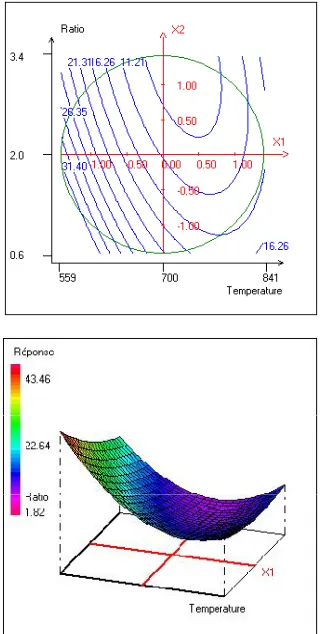
[image:4.595.102.513.75.134.2]The Figures 1 below presented the two and three dimensional responses surface constructed to show the most important variable on the response Y1.
Figure 1. Variation of the activated carbon yield (Y1) in the plan
Temperature-Ratio
The analysis of the Figures 1 above showed that, the activated carbon yield was found to decrease from 31.40 to 11.21% when the activation temperature increased from 559 to 841°C. This was expected because, the increase in activation temperature would involved the release of volatiles compounds as the result of intensifying dehydration and elimination reactions as well as increasing the C-KOH reaction rate, thus the decrease in activated carbons yield (Yang and Lua, 2003; Lua and Yang, 2004; Donni Adinata et al., 2007(b)). The yield was also affected by the impregnation ratio. We noticed that, when the ratio increased from 0.6 to the values up to 2/1, the yield also decreased from 31.40 to 11.21%. The increase of the impregnation ratio decreased the yield and increased the burn-off of oil palm shells. Donni Adinata et al., have observed the same trend with activation of palm shells with K2CO3 (Donni Adinata et al., 2007(b)). This same
observation was carried out by Sudaryanto et al. (Sudaryanto et al., 2006) which reported that the pore structure of activated carbon produced from cassava peel, changed significantly with the activation temperature and also with the KOH impregnation ratio. We also saw that, for higher ratio and temperature up or equal to 700°C, the yield had very low values (experiments 4 and 8). It can be justify by the fact that, at higher impregnation ratio, the movement of volatiles compounds towards the pores is facilitated. Juan Yang et al. (Juan Yang et al., 2010) observed the similar effect with the walnut shells. The ANOVA above shown that, the activation temperature had an antagonistic effect on the yield. Juan Yang et al. (Juan Yang et al., 2010) also revealed that, the activation temperature had a negative influence on the yield of activated carbons from walnut shells. This can be owing to the fact that, when the activation temperature increased, it intensified the gasification reactions of carbon which liberate the entrances of the pores blocked by amorphous components, thus the decrease in the activated carbons yield (Baçaoui et al., 2001). Both, increasing activation temperature and impregnation ratio conducted to increase the carbon burn off, this weight loss were attributed to huge elimination reactions (Donni Adinata et al., 2007 (b)), which affected significantly our materials and reduced the yield.
Iodine adsorption capacities: I2 /AC-KOH (Y2)
The Figures 2 below presented the two and three dimensional responses surface constructed to show the most important variable on the response Y2.’
[image:4.595.123.489.163.231.2]The quality of our activated carbon, AC-KOH, was examined in terms of his iodine adsorption capacity, which is related to the surface area available for adsorption. From the analysis of our graphs above, we found that, the iodine adsorption on AC-KOH decreased from 613.9 to 441.3mg/g when the impregnation ratio increased from 1/1 to 3/1. This implies that the impregnation of the raw materials with KOH affected the adsorption characteristics of the oil palm shell based activated carbons. It can be attributed to the increased in potassium ion provide to the sample during impregnation process. Achaw and Osei-Wu have observed the same trend with the coconut shell based
Table 6. Analysis of variance of methylene blue adsorption, MB/AC-KOH (Y3)
Source of variation Sum of squares Degree of freedom Square mean Rapport Signif
Regression 3.8718E+0004 5 7.7436E+0003 93.2971 0.166 **
Residual 4.7327E+0003 6 7.8872E+0002
Validity 4.4837E+0003 3 1.4944E+0003 18.0055 2.00 *
Error 2.4900E+0002 3 8.3000E+0001
Total 4.34507E+0004 11
Table 7. Statistical Estimations of coefficients: MB/AC-H3PO4 (Y3)
Name Coefficient F.Inflation Ecart-Type t.exp. Signif. %
b0 290.500 4.555 63.77 < 0.01 ***
b1 -4.486 1.00 3.221 -1.39 25.8
b2 -43.573 1.00 3.221 -13.53 0.0561 ***
b11 -29.001 1.04 3.601 -8.05 0.304 **
b22 40.751 1.04 3.601 11.32 0.0995 ***
[image:4.595.84.244.428.745.2]activated carbons (Afrane et al., 2008). It was noticed that, for the lowest values of the impregnation ratio (0.6 and 1/1), their adsorption capacities of iodine were found to be have the higher values (experiments 1 and 7). The high impregnation ratio seems to high occupation of the pores sites by potassium ion, hence reduced adsorption of the iodine molecules, used to measure adsorptive capacity of the activated carbon materials. This observation was consistent with the work done by Afrane (Afrane et al., 2008). We also had known from recent work that, the impregnation with KOH, permit the intercalation of potassium ion within the materials network. Since potassium is the most dominant mineral in the sample, its influence will be to overshadow the free sites and therefore reduce the surface area, thus decrease the iodine adsorption. Achaw revealed that there was a definite relationship between the iodine adsorption characteristics of activated carbons and the levels of potassium in the sample. Consequently, samples with lower impregnation ratio recorded higher iodine adsorption capacities (Afrane et al., 2008). From the polynomial equation (Y2) above, we saw that, the activation
temperature and the impregnation ratio have antagonistic effects on the iodine adsorption.
Figure 2. Variation of the iodine adsorption, I2/AC-KOH (Y2) in the plan
Temperature-Ratio
This can be attributed to the fact that, as well as the activation temperature increased, the devolatization rate and the decomposition of the materials increased, thus the specific surface area decreased and consequently, the iodine adsorption decreased. Currently, a higher iodine adsorption indicated a higher surface area and also a largely micro and mesopores structure (Gergova et al., 1993). In the present work, the increased length of activation temperature probably caused a decrease in the microporous volume, thus the decreased of the iodine adsorption. This might be due to the conversion of micropores to mesopores or macropores. In the adsorption procedure, we know that, macropores are used as access ways to micropores, where the effective adsorption took place. Chemical activation with KOH, the influence of the activation temperature and the impregnation ratio used to modify the structure of the sample and this had been observed
by many authors (Baocheng Jiang et al., 2008). Activated carbons that can remove a high quantity of iodine normally have a high surface area and subsequently a microporous structure. The iodine adsorption by an activated carbon is an indicative of its ability to adsorb low-molecular weight compounds. So, we can suppose that, there was a widening of micropores to meso and macropores, to justify the decreased in iodine adsorption with an increased in the activation temperature.
Methylene blue adsorption capacities: MB/AC-KOH (Y3)
[image:5.595.65.263.269.603.2]Figures show the two and three dimensional response surface which were constructed to present the most important factors on the BM/AC-KOH
Figure 3. Variation of the methylene blue adsorption, MB/AC-KOH (Y3)
in the plan Temperature-Ratio.
The analysis of the curves above showed that, when the ratio varied from 0.6 to 2/1, the methylene blue adsorption decreased from 418 to 307 mg/g. Usually when a material is impregnated with a reagent, such as KOH, it penetrated inside the particle. So the presence of KOH in the interior of the precursor restricted the formation of tar as well as other liquids such as acetic acid and methanol by formation of cross-links, and inhibited the shrinkage of the precursor particle by occupying certain substantial volumes (Guo et al., 2003). By so doing, it conducted to the intercalation of metallic potassium which appeared to be responsible for the drastic expansion of the carbon material and the creation of large surface area and high porosity, leading to the high BM adsorption (Zabaniotou et al., 2008). Donni Adinata et al., also revealed it with K2CO3 activation (Donni Adinata et al., 2007
(b)) and also Guo and Lua confirmed this observation (Guo et al., 2003). The response Y3 had shown well the negative effect of the
stage. The excessive KOH molecules might also be decomposed into water, causing the following gasification process under high temperature (Guo et al., 2003):
2KOH → K2O + H2O ……….. (7)
Currently, the activation with steam water favourised the reaction between C-H2O:
H2O + C → CO + H2 ……… (8)
It conducted to the elimination of atoms of carbons and caused the burn off of the material, and consequently a decrease in BM/AC-KOH adsorption. Hakan Demiral et al. has observed the same trend with olive bagasse (Hakan Demiral et al., 2011). Therefore, over gasification might occur with the detrimental effect of reducing the surface area and porosity, hence the reduction in BM adsorption of the activated carbons (Stavropoulos et al., 2005). In this work all the two variables studied were found to have antagonistic effects on the methylene blue adsorption. As far as our knowledge in adsorption procedure, the macropores didn’t participate in the adsorption properly. They served as access roads to the mesopores and micropores, which are more responsible of the adsorption capacity of an adsorbent. Adsorption capacity of activated carbon largely depend on the amount of micropores that are present in the activated carbon. Additionally, the chemical activation with KOH, improves the production of micropores, which seems to be block by the large molecules of MB, and limited the adsorption procedure, thus the decrease in the methylene blue adsorption.
Optimization
In the manufacture of commercial activated carbons, relatively high quantity and quality are expected. Therefore, in practical manufacture, a compromise should be made between the activated carbon yield and the adsorption performance of the product for economical viability. However, to optimize activated carbon yield, the iodine and the methylene blue adsorption capacities under the same condition is difficult because the interest region of factors is different. The activated carbon yield, the iodine adsorption and the methylene blue adsorption capacities varied differently. Therefore, in order to compromise between these three responses, the function of desirability was applied using the software NEMROD (New Efficient Methodology of Research using Optimal Design). In order to optimize the preparation conditions of activated carbon prepared from oil palm shells, the targeted criteria was set as maximum values for activated carbon yield (Y1), the iodine adsorption capacity (Y2) and the methylene blue adsorption capacity(Y3) while the values of the two variables (activation temperature and impregnation ratio) were set in the ranges being studied. The model which showed the highest desirability from the software NEMROD was selected to be verified. The predicted and experimental values for the three responses obtained were also presented. The optimal activated carbon was obtained using preparation condition of 630°C activation temperature and impregnation ratio of 1/1, which resulted in 38.78% of activated carbon yield 803.72 mg/g of I2/AC-KOH and 457.36mg/g of
MB/AC-KOH. It was observed that the experimental values obtained were in good agreement with the values predicted from the models. This indicated that the models developed were suitable and sufficient to predict the responses from the operating variables fixed. Through process optimization, oil palm shells activated with KOH and steam was proved to be a promising precursor for production of activated carbons with high carbon yield, iodine and methylene blue adsorption capacities.
Conclusion
The Methodology of Experimental Design was used to evaluate the effects of activation temperature and impregnation ratio on the yield, the iodine and methylene blue adsorption capacities of the activated carbons prepared. The adequacy of the polynomial model was
effectively verified by the validation of experimental data. The process optimization was carried out and the experimental values obtained for the responses were found to agree satisfactory with the predicted values. Through analysis of the response surface, derived from the models, activation temperature, and impregnation ratio were found to have significant effects on the responses. The R2 values of the responses showed a good fit of the models with experimental data. The activated carbon prepared under the optimum conditions were found to have well-developed pores on its surface according to their adsorption capacities of iodine and methylene blue. The activated carbons so prepared are potential adsorbent in the removal of pollutants in surface water.
REFERENCES
Abdel-Nasser A. El-Hendawy. (2009). An insight into the KOH activation mechanism through the production of microporous activated carbon for the removal of Pb2+ cations. Applied
Surface Science, 255, 3723–3730.
Afrane G., Osei-Wusu Achaw. (2008). Effect of the concentration of inherent mineral elements on the adsorption capacity of coconut shell-based activated carbons. Bioresource Technology, 99, 6678–6682.
Ahmad A.L., Loh M.M., Aziz J.A. (2007). Preparation and characterization of activated carbon from oil palm wood and its evaluation on Methylene blue adsorption. Dyes and Pigments, 75, 263-272.
Ahmadpour A., Do D.D. (1996). The preparation of active carbons from coal by chemical and physical activation, Carbon 34, 471– 479.
Alcaniz-Monge J., Lozano-Castelló D., Cazorla-Amorós D., Linares-Solano A. (2009). Fundamentals of methane adsorption in microporous carbons. Microporous Mesoporous Mater., 124, 110–116.
Alexandro M.M. Vargas, Clarice A. Garcia, Edson M. Reis, Ervim Lenzi, Willian F. Costa, Vitor C. Almeida. (2010). NaOH-activated carbon from flamboyant (Delonix regia) pods: Optimization of preparation conditions using central composite rotatable design. Chemical Engineering Journal, 162, 43–50. Allwar Ahmad Bin Md Noor and Mohd Asri Bin Mohd Nawi. (2008).
Textural Characteristics of Activated Carbons Prepared from Oil Palm Shells Activated with ZnCl2 and Pyrolysis Under Nitrogen
and Carbon Dioxide. Journal of Physical Science, 19(2), 93– 104.
Arash Arami-Niya, Wan Mohd Ashri Wan Daud, Farouq S. Mjalli. (2011). Comparative study of the textural characteristics of oil palm shell activated carbon produced by chemical and physical activation for methane adsorption. Chem. Eng. Res. Des., 89(6), 657-664. ASTM Standard Test Method D – 4607-86, 1986.
Azevedo D.C.S., Cassia J., Araujo S., Bastos-Neto M.A., Torres E.B. , Jaguaribe E.F., Cavalcante C.L. (2007). Microporous activated carbon prepared from coconut shells using chemical activation with zinc chloride, Microporous and Mesoporous Mater., 100, 361–364.
Baçaoui A., Dahbi A., Yaacoubi A., Bennouna C., Maldonado-Hodar F.J., Rivera-Utrilla J., Carrasco-Marin F., Moreno-Castilla C. (2002). Experimental design to optimize preparation of activated carbons for use in water treatment. Environ. Sci.
Technol., 36 (17), 3844-3849.
Baçaoui A., Yaacoubi A., Dahbi A., Bennouna C., Phan Tan Luu R., Maldonado-Hodar F.J., Rivera-Utrilla J., Moreno-Castilla C.(2001). Optimization of conditions for the preparation of activated carbons from olive-waste cakes. Carbon, 39, 425–432. Bakhtiar K. Hamad, Ahmad Md. Noor, Afida A.R., Mohd Asri M.N. (2010). High removal of 4-chloroguaiacol by high surface area of oil palm shell-activated carbon activated with NaOH from aqueous solution. Desalination 257, 1–7.
cokes on the properties of the resulting activated carbon. Fuel, 87, 1844–1848.
Bezerra M.A., Santelli R.E., Oliveira E.P., Villar L.S., Escaleira L.A. (2008). Response Surface Methodology (RSM) as a tool for optimization in analytical. Talanta, 76, 965–977.
Carrott P.J.M., Ribeiro Carrott M.M.L., Suhas. (2010).Comparison of the Dubinin–Radushkevich and Quenched Solid Density Functional Theory approaches for the characterisation of narrow microporosity in activated carbons obtained by chemical activation with KOH or NaOH of Kraft and hydrolytic lignins.
Carbon, 4 8, 4162 – 4169.
Chen X.G., Jeyaseelan S., Graham N. (2002). Physical and chemical properties study on the activated carbon made from sewage sludge. Waste Manage. 22, 755–760.
Daud W.M.A.W., Ali W.S.W. (2004). Comparison on pore development of activated carbon produced from palm shell and coconut shell. Bioresour. Technol., 93, 63–69.
Débora A. Soares Maia , Sapag K., Toso J.P., López R.H., Azevedo D.C.S., Cavalcante C.L., Zgrablich Jr.G. (2010). Characterization of activated carbons from peach stones through the mixed geometry model. Microporous and Mesoporous
Mater., 134, 181–188.
Derbyshire F, Jagtoyen M. and Thwaites M. (1971). Activated carbons-Production and Applications, in: J.W. Patrick, (Edit.) Porosity in carbon, Halsted Press, New York.
Devarly Prahas Y., Kartika N., Indraswati S. Ismadji. (2008). Activated carbon from jackfruit peel waste by H3PO4 chemical
activation: Pore structure and surface chemistry characterization. Chemical Engineering Journal, 140, 32–42. Donni Adinata, Wan Mohd Ashri Wan Daud, Mohd Kheireddine
Aroua. (2007a). Production of carbon molecular sieves from palm shell based activated carbon by pore sizes modification with benzene for methane selective separation. Fuel Processing
Technology, 88, 599–605.
Donni Adinata, Wan Mohd Ashri Wan Daud, Mohd Kheireddine Aroua. (2007b). Preparation and characterization of activated carbon from palm shell by chemical activation with K2CO3.
Bioresource Technology, 98, 145–149.
Feng-Chin Wu, Pin-Hsueh Wu, Ru-Ling Tseng, Ruey-Shin Juang. (2010). Preparation of activated carbons from unburnt coal in bottom ash with KOH activation for liquid-phase adsorption.
Journal of Environmental Management, 91, 1097–1102.
Fierro V., Torné-Fernandez V., Celzard A. (2007). Highly microporous carbons prepared by activation of kraft lignin with KOH. Stud. Surf. Sci. Catal., 160, 607-614.
Foo K.Y., Hameed B.H. (2009). Utilization of biodiesel waste as a renewable resource for activated carbon: Application to environmental problems. Renewable and Sustainable Energy
Reviews, 13, 2495–2504.
Gergova K., Petrov N., Minkova V. (1993). A comparison of adsorption characteristics of various activated carbons. J. Chem.
Technol. Biotechnol. 56, 77–82
Guo J., Lua A.C. (2003). Surface Functional group on oil-palm-shell adsorbents prepared by H3PO4 and KOH activation and their
effects on adsorptive capacity. Chemical Engineering Research
and Design, 81(5), 585-590.
Guo J., Luo Y., Lua A.C., Ru-an Chi , Yan-lin Chen , Xiu-ting Bao , Shou-xin Xiang. (2007). Adsorption of hydrogen sulphide (H2S)
by activated carbons derived from oil-palm shell, Carbon 45, 330–336.
Haimour N.M., Emeish S. (2006). Utilization of date stones for production of activated carbon using phosphoric acid, Waste
Manage. 26, 651– 660.
Hakan Demiral, I˙lknur Demiral, Belgin Karabacakog˘ Lu, Fatma Tümsek. (2011). Production of activated carbon from olive bagasse by physical activation. Chemical Engineering Research
and Design 89, 206–213.
Hameed B.H., Tan I.A.W., Ahmad A.L. (2009). Preparation of oil palm empty fruit bunch based activated carbon for removal of 2,
4, 6-trichlorophenol: optimization using response surface methodology. J. Hazard. Mater., 164, 1316–1324.
Hameed I.A.W. Tan A.L. Ahmad. (2008). Optimization of basic dye removal by oil palm fibre-based activated carbon using response surface methodology, J. Hazard. Mater., 158 324–332.
Hassler J.W. (1974). Purification with Activated carbon: Industrial, Commercial and Environmental. Chemical Publishing
Compagny Inc., New York.
Hayashi J., Kazehaya A., Muroyama K., Watkinson A.P. (2000). Preparation of activated carbon from lignin by chemical activation. Carbon 38, 1873–1878.
Hui Deng, Genlin Zhang, Xiaolin Xu, Guanghui Tao, Jiulei Dai. (2010). Optimization of preparation of activated carbon from cotton stalk by microwave assisted phosphoric acid-chemical activation. Journal of Hazardous Materials, 182, 217–224. Ioannidou O.A., Zabaniotou A.A., Stavropoulos G.G., Islam Md. A.,
Albanis T.A. (2010). Preparation of activated carbons from agricultural residues for pesticide adsorption. Chemosphere 80, 1328–1336.
Juan Yang, Keqiang Qiu. (2010). Preparation of activated carbons from walnut shells via vacuum chemical activation and their application for methylene blue removal. Chemical Engineering
Journal, 165, 209–217.
Kalderis D., Bethanis S., Paraskeva P., Diamadopoulos E. (2008). Production of activated carbon from bagasse and rice husk by a single-stage chemical activation method at low retention times.
Bioresour. Technol., 99, 6809–6816.
Kumagai S., Noguchi Y., Kurimoto Y., Takeda K. (2007). Oil adsorbent produced by the carbonization of rice husks, Waste
Manage, 27, 554–561.
Kunquan Li, Zheng Zheng, Ye Li. (2010).Characterization and lead adsorption properties of activated carbons prepared from cotton stalk by one-step H3PO4 activation. Journal of Hazardous
Materials 181, 440–447.
Laine J., Calafat A., Labady M. (1989). Preparation and characterization of activated carbons from coconut shell impregnated with phosphoric acid, Carbon 27(2), 191-195. Lua A.C., Lau F.Y., Guo J. (2006). Influence of pyrolysis condition
on pore development of oil palm-shell activated carbons. J.
Anal. Appl. Pyrol., 76(1–2), 92–102.
Lua A.C., Qipeng J. (2009). Adsorption of phenol by oil–palm-shell activated carbons in a fixed bed, Chemical Engineering Journal, 150, 455–461.
Lua A.C., Yang T. (2004). Effect of activation temperature on the textural and chemical properties of potassium hydroxide activated carbon prepared from pistachio-nut shell, J. Colloid
Interface Sci., 274, 594–601.
Matson James S. and Mark Harry B. (1971). Activated Carbon: surface chemistry and Adsorption from solution. Marcel Dekker
Inc., New York.
Moreno-Castilla C., Carrasco-Marin F., Lopez-Ramon M.V., Alvarez-Merino M.A. (2001). Chemical and physical activation of olive-mill waste water to produce activated carbons. Carbon, 39, 1415–1420.
Narges Bagheri, Jalal Abedi. (2009). Preparation of high surface area activated carbon from corn by chemical activation using potassium hydroxide, Chemical Engineering Research and
Design 87, 1059–1064.
Piotr Nowicki, Helena Wachowska, Robert Pietrzak. (2010). Active carbons prepared by chemical activation of plum stones and their application in removal of NO2, Journal of Hazardous
Materials 181, 1088–1094.
Qingrong Qian, Motoi Machida, Hideki Tatsumoto. (2007). Preparation of activated carbons from cattle-manure compost by zinc chloride activation. Bioresource Technology, 98 353–360. Qipeng J., Lua A.C. (2008). Effects of pyrolysis conditions on the
Rio S., Faur-Brasquet C., Coq L.L., Courcoux P., Cloirec P.L. (2005). Experimental design methodology for the preparation of carbonaceous sorbents from sewage sludge by chemical activation-application to air and water treatments. Chemosphere, 58, 423–437.
Rosas J.M., Bedia J., Rodríguez-Mirasol J., Cordero T. (2009). HEMP-derived activated carbon fibers by chemical activation with phosphoric acid. Fuel, 88, 19–26.
Ru-Ling Tseng (2007). Physical and chemical properties and adsorption type of activated carbon prepared from plum kernels by NaOH activation. Journal of Hazardous Mater., 147, 1020– 1027.
Sait Yorgun, Naile Vural, Hakan Demiral. (2009). Preparation of high-surface area activated carbons from Paulownia wood by ZnCl2 activation. Microporous and Mesoporous Materials 122,
189–194.
Sandro Altenor Betty Carene, Evens Emmanuel, Jacques Lambert, Jean-Jacques Ehrhardt, Sarra Gaspard. (2009). Adsorption studies of methylene blue and phenol onto vetiver roots activated carbon prepared by chemical activation. Journal of
Hazardous Mater., 165, 1029–1039.
Solange I. Mussatto, Marcela Fernandes, George J.M. Rocha, José J.M. Órfão, José A. Teixeira, Inês C. Roberto. (2010). Production characterization and application of activated carbon from brewer’s spent grain lignin. Bioresource Technology, 101, 2450–2457.
Stavropoulos G.G., Zabaniotou A.A. (2005). Production and characterization of activated carbons from olive-seed waste residue. Microporous Mesoporous Mater., 82, 79–85.
Suarez-Garcia F., Martinez-Alonso A. and Tascon J.M.D. (2002b). Pyrolysis of apple pulp: chemical activation with phosphoric acid. Journal of Analytical and Applied Pyrolysis, 63, 283-301. Suarez-Garcia F., Martinez-Alonso A. and Tascon, J.M.D. (2002a).
Pyrolysis of apple pulp: effect of operation conditions and chemical additives. Journal of Analytical and Applied Pyrolysis, 62, 93-109.
Suat Uçar, Murat Erdem, Turgay Tay, Selhan Karagöz. (2009). Preparation and characterization of activated carbon produced from pomegranate seeds by ZnCl2 activation. Applied Surface
Science, 255, 8890–8896.
Sudaryanto Y., Hartono S.B., Irawaty W., H. Hindarso, Ismadji S. (2006). High surface area activated carbon prepared from cassava peel by chemical activation. Bioresour. Technol., 97 734–739.
Sumathi S., Bhatia S., Lee K.T., Mohamed A.R. (2009). Optimization of microporous palm shell activated carbon production for flue gas desulphurization: Experimental and statistical studies.
Bioresource Technology, 100, 1614–1621.
Sumathi S., Bhatia S., Lee K.T., Mohamed A.R. (2010a). Selection of best impregnated palm shell activated carbon (PSAC) for simultaneous removal of SO2 and NOx. Journal of Hazardous
Mater., 176, 1093–1096.
Sumathi S., Bhatia S., Lee K.T., Mohamed A.R. (2010b). Adsorption isotherm models and properties of SO2 and NO removal by palm shell activated carbon supported with cerium (Ce/PSAC).
Chemical Engineering Journal, 162, 194–200.
Suzuki R.M., Andrade A.D., Sousa J.C., Rollemberg M.C. (2007). Preparation and characterization of activated carbon from rice bran. Bioresource Technology, 98, 1985–1991.
Tan I.A.W., Ahmad A.L., Hameed B.H. (2008). Adsorption of basic dye using activated carbon prepared from oil palm shell: batch and fixed bed studies. Desalination 225, 13–28.
Tan I.A.W., Ahmad A.L., Hameed B.H. (2008). Enhancement of basic dye adsorption uptake from aqueous solutions using chemically modified oil palm shell activated carbon. Colloids
and Surfaces A: Physicochem. Eng. Aspects, 318, 88–96.
Tan I.A.W., Ahmad A.L., Hameed B.H. (2008a). Preparation of activated carbon from coconut husk: optimization study on removal of 2, 4, 6-trichlorophenol using response surface methodology. J. Hazard. Mater., 153, 709–717.
Tan I.A.W., Ahmad A.L., Hameed B.H. (2008b). Optimization of preparation conditions for activated carbons from coconut husk using response surface methodology. Chem. Eng. J., 137 462– 470.
Tan I.A.W., Ahmad A.L., Hameed B.H. (2009). Fixed-bed adsorption performance of oil palm shell-based activated carbon for removal of 2,4,6-trichlorophenol, Bioresource Technology, 100, 1494–1496.
Tan I.A.W., Hameed B.H., Ahmad A.L. (2007). Equilibrium and kinetic studies on basic dye adsorption by oil palm fibre activated carbon. Chem. Eng. J., 127, 111–119.
Tan J.S., Ani F.N. (2004). Carbon molecular sieve produced from oil palm shell for air separation. Sep. Purif. Technol., 35, 47–54. Veksha A., Sasaoka E., Uddin M.A. (2009). The influence of porosity
and surface oxygen groups of peat-based activated carbons on benzene adsorption from dry and humid air. Carbon, 47, 2371– 2378.
Yang J., Shen Z.M., Hao Z.B. (2004). Preparation of highly microporous and mesoporous carbon from the mesophase pitch and its carbon foams with KOH. Carbon, 42, 1872–1875. Yang T., Lua A.C. (2003). Characteristics of activated carbons
prepared from pistachio-nut shells by physical activation. J.
Colloid Interface Sci., 267, 408–417.
Yong Sun, Paul A. Webley. (2010). Preparation of activated carbons from corncob with large specific surface area by a variety of chemical activators and their application in gas storage.
Chemical Engineering Journal, 162, 883–892.
Zabaniotou A., Stavropoulos G., Skoulou V. (2008). Activated carbon from olive kernels in a two-stage process: Industrial improvement. Bioresource Technology, 99, 320-326.
Zahangir Alam Md., Emad S. Ameem, Suleyman A. Muyibi, Nassereldeen A. Kabbashi.(2009). The factors affecting the performance of activated carbon prepared from oil palm empty fruit bunches for adsorption of phenol. Chemical Engineering
Journal 155, 191–198.
Zhaolian Zhu, Aimin Li, Lei Yan, Fuqiang Liu, Quanxing Zhang. (2007). Preparation and characterization of highly mesoporous spherical activated carbons from divinylbenzene-derived polymer by ZnCl2 activation. Journal of Colloid and Interface
Science, 316, 628–634.