ISSN Print: 2327-5219
DOI: 10.4236/jcc.2018.67001 Jul. 17, 2018 1 Journal of Computer and Communications
Optimization of Path Planning for Construction
Robots Based on Multiple Advanced Algorithms
Kang Tan
Department of Civil Engineering, Dalian University of Technology, Dalian, China
Abstract
There are many processes involved in construction, it is necessary to optimize the path planning of construction robots. Most researches focused more on optimization algorithms, but less on comparative analysis based on the ad-vantages and shortcomings of these algorithms. Therefore, the innovation of this paper is to analyze three advanced optimization algorithms (genetic algo-rithm, hybrid particle swarm algorithm and ant colony algorithm) and discuss how these algorithms can improve the optimization performance by adjusting parameters. Finally, the three algorithms are compared and analyzed to find an optimization algorithm that is suitable for path planning optimization of construction robots. The purpose of the optimization is to obtain the maxi-mum benefit with the least cost and complete project in an efficient and eco-nomical way.
Keywords
Path Planning, Construction Robots, Optimization Algorithm
1. Introduction
To develop intelligent construction robots, the navigation system that can pro-vide efficient path planning algorithm is necessary. The purpose of path plan-ning method for construction robot is to find the shortest and collision-free path from initial position to target position. Koo presented an improved bug-based algorithm which can produce an effective path in an unknown environment with both stationary and movable obstacles. The contributions, which make it possi-ble to generate an effective and short path, are an improved method to select lo-cal directions, a reverse mode, and a simple leaving condition [1]. Soltani pre-sented the application of path planning in construction sites according to mul-tiple objectives. It quantitatively evaluates the performance of three optimization How to cite this paper: Tan, K. (2018)
Optimization of Path Planning for Con-struction Robots Based on Multiple Ad-vanced Algorithms. Journal of Computer and Communications, 6, 1-13.
https://doi.org/10.4236/jcc.2018.67001
Received: May 26, 2018 Accepted: July 14, 2018 Published: July 17, 2018
Copyright © 2018 by author and Scientific Research Publishing Inc. This work is licensed under the Creative Commons Attribution International License (CC BY 4.0).
http://creativecommons.org/licenses/by/4.0/
DOI: 10.4236/jcc.2018.67001 2 Journal of Computer and Communications algorithms (Dijkstra, A*, and Genetic algorithms) that are used to find mul-ti-criteria paths in construction sites based on transportation and safety-related cost. The accuracy of the path solution and the time complexity of the optimiza-tion algorithm are compared and analyzed. According to the criteria, planners will see the shortest and safest route with low risk and high reliability [2].
Soltani also presented a framework based on transportation costs, safety and reliability for construction path planning. He studied a fuzzy-based mul-ti-objective optimization method to make optimal strategic decisions on the movement path of construction site, and make detailed decisions on the distance of the workplace [3]. Sivakumar investigated the potential of applying genetic algorithms to automate the path planning of cooperative construction manipu-lators. The basic premise of this work is that automating the different planning steps will contribute to more reliable plans and thus promote the usage of coop-erative manipulator. Two methodologies have been proposed using the concept of Configuration Space (C-Space) technique in conjunction with the genetic search [4].
Nieuwenhuisen described a new robotic method that can calculate a smooth, collision-free, and high-quality path map. This roadmap can be used to get op-timal paths for robots. He also described the application of this technique for planning the movement of entity groups and creating smooth camera move-ments through the environment [5]. Lee presented a new sensor-based path planning algorithm, which is designed for an automated construction equipment (ACE). It is based on the practical assumptions that the robot can measure in-stantaneous velocity of obstacles in a range of vision and has memory of gener-ated path from tracking point. The ACE algorithm guarantees reachability in an unknown environment with multiple moving obstacles and composite obstacles [6].
Lu has developed a practical method to solve the basic problems and limita-tions of existing resource scheduling methods by using the critical path method (CPM). The proposed method is referred to as the resource activity critical path method (RACPM), where resource dimensions other than activity and time are highlighted in project scheduling. By running RACPM under different confition, we can study the impact of various resources on project, which leads to a com-prehensive schedule that provides a timetable for establishing, estimating, and controlling budgets [7]. Stouffs developed rules-based simulation programs for building construction. According to the specified plan, the program generates and simulates the motion path of each robot, which avoids obstacles and com-bines interactions, safety and other considerations [8].
DOI: 10.4236/jcc.2018.67001 3 Journal of Computer and Communications method. The results show that the proposed method can produce an effective installation path to operate and is suitable for crane installations, helping engi-neers to verify planning decisions [9]. Lei proposed a method based on robot motion planning to solve crane path planning problems. The proposed method performs a two-dimensional path planning of the crane and considers the rota-tion of the lifting object during its movement. It has been implemented in com-puter to provide a user-friendly interface to help practitioners perform colli-sion-free path planning and check the feasibility of different stages of the project path [10].
From above review, we can conclude that most researches focused more on optimization algorithms, but less on comparative analysis based on the advan-tages and disadvanadvan-tages of these algorithms. Therefore, the innovation of this paper is to analyze three optimization algorithms and discuss how these algo-rithms can improve the optimization performance by adjusting parameters. In this paper, a specific case has been analyzed, we need to choose a shortest path that goes through all the points. Finally, the three algorithms are compared and analyzed to find an optimization algorithm that is suitable for path planning op-timization of construction robots.
2. Genetic Algorithm
2.1. The Principle of Genetic Algorithm
In computer science and operations research, genetic algorithm (GA) is a me-thod inspired by the natural selection process and belongs to a larger class of evolutionary algorithms (EA). Genetic algorithms are often used to generate high-quality solutions for optimization and search problems by relying on bio-inspired operators such as mutation, crossover, and selection [11]. In genetic algorithms, a set of candidate solutions to optimization problems (called indi-vidual, creatures or phenotypic) evolve into a better solution. Each candidate solution has a set of attributes that can be mutated and changed (its chromo-some or genotype). Traditionally, solutions are represented as strings in binary form, but other encodings are also possible. The implementation of genetic algo-rithms begins with a set of typical random chromosomes. These structures are then evaluated and assigned reproductive opportunities, providing better chro-mosomes with more reproductive opportunities than the chrochro-mosomes of poor solutions [12].
maxi-DOI: 10.4236/jcc.2018.67001 4 Journal of Computer and Communications mum generations or meets a satisfactory level of fitness.
The first step of genetic algorithm is population initialization. Since the ge-netic algorithm cannot directly deal with the parameters of problem, the feasible solution to the problem to be solved must be represented as a chromosome or an individual in the genetic space through coding. Common coding methods are grey coding, real coding, and structural coding. The real number coding does not have to be converted numerically, and the genetic algorithm operation can be performed directly on the expression of the solution. This article uses real coding to define each chromosome as real variable. Secondly, the fitness func-tion is criterion to distinguish individual good from bad in a group, and is the only basis for natural selection. Generally, it is obtained by transforming an ob-jective function. This article is to find the maximum value of the function as the individual fitness value. The larger the value of individual function is, the better the fitness is. Thirdly, the selection operation is to select a good individual from the old group with a certain probability to form a new group to multiply next generation of individuals. The probability that the individual is selected is related to the fitness value. The higher the individual fitness is, the greater the probabil-ity of being selected is. There are various methods for selecting the genetic algo-rithm, such as roulette method and competition game method. In this paper, the roulette method is adopted. Fourthly, cross operation refers to randomly select-ing two individuals from population and transferrselect-ing excellent genetic characte-ristics to substrings through the exchange combination of two chromosomes to generate new excellent individuals. Since individuals use real numbers, the cros-sover method uses real number method. Finally, the last step of genetic algo-rithm is mutation operation. The purpose of the mutation operation is to main-tain the diversity of the population. The mutation operation selects one individ-ual from the population and mutates to produce a better individindivid-ual.
2.2. Optimal Results of Genetic Algorithm
DOI: 10.4236/jcc.2018.67001 5 Journal of Computer and Communications
[image:5.595.286.459.406.543.2]Figure 1. Points distribution.
[image:5.595.289.460.576.708.2]Figure 2. Population’s effects on results.
Figure 3. Generations’ effects on results.
DOI: 10.4236/jcc.2018.67001 6 Journal of Computer and Communications
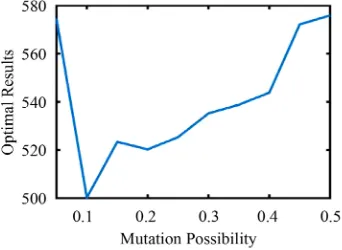
Figure 5. Mutation possibility’s effects on results.
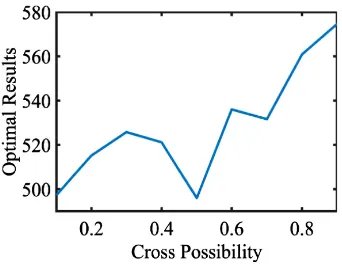
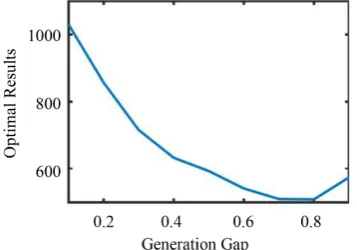
algorithm works best, and other values will reduce the optimized performance. From Figure 6, it can be seen that as the generation gap increases, the results continuously decrease, indicating that the results at this time are closer to the optimal solution. Therefore, the performance of optimization can be improved by increasing the value of generation gap.
3. Hybrid Particle Swarm Algorithm
3.1. The Principle of Hybrid Particle Swarm Algorithm
DOI: 10.4236/jcc.2018.67001 7 Journal of Computer and Communications
Figure 6. Generation gap’s effects on results.
3.2. Optimal Results of Hybrid Particle Swarm Algorithm
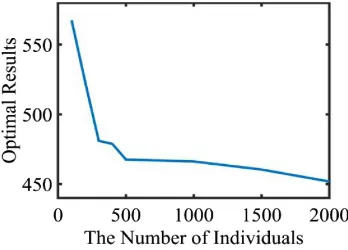
In this paper, a specific case is analyzed, we need to choose a shortest path that goes through all the points which are showed in Figure 1. There are two factors (the number of generations and the number of individuals) affecting the opti-mization performance of hybrid particle swarm algorithm. From Figure 7, we can see that as the value of generations increases, the optimal results decrease rapidly at the initial stage and slowly at the latter stage. This indicates that the results are closer to the optimal solution. Therefore, with the value of genera-tions increases, the optimized performance improves. From Figure 8, we can see that as the value of individuals increases, the optimized value decreases conti-nuously, and it declines quickly in the early stage and slowly in the later stage. This shows that the results are closer to the optimal solution, so we can increase the value of individuals to improve the optimized performance.
4. Ant Colony Algorithm
4.1. The Principle of Ant Colony Algorithm
DOI: 10.4236/jcc.2018.67001 8 Journal of Computer and Communications
Figure 7. Generations’ effects on results.
Figure 8. Individuals’ effects on results.
and pheromone trails. Randomly place the starting nodes of all ants. The second step is solution construction. Taking into account heuristic information depen-dence and problem path-tracking advantages, each ant chooses the next node that will not move with probability. Repeat this step until the solution building is complete. The third step is to update the path. The solution is evaluated accord-ing to the quality of the solution and stores the pheromone in the solution path. The better the solution is, the greater the amount of pheromone deposition is. The fourth step is the evaporation of pheromones. At the end of the iteration, in order to build a complete solution, the pheromone path is reduced by a constant factor [17].
4.2. Optimal Results of Ant Colony Algorithm
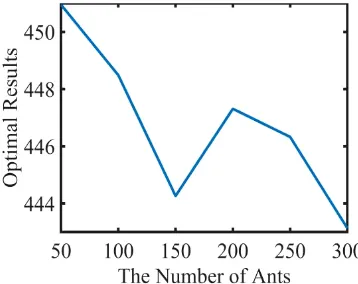
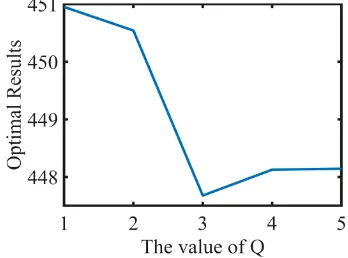
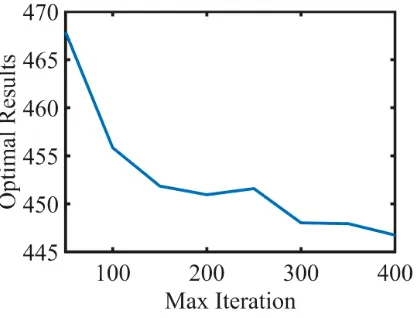
In this paper, a specific case is analyzed, we need to choose a shortest path that goes through all the points which are showed in Figure 1. There are six factors (the number of ants, the value of α, the value of β, the value of ρ, the value of Q, max iteration) affecting the optimization performance of ant colony algorithm. The value of α represents the importance factor of pheromone, the value of β
[image:8.595.286.460.237.362.2]DOI: 10.4236/jcc.2018.67001 9 Journal of Computer and Communications increasing the number of ants can be used to improve optimized performance. From Figure 10, we can see that as the value of α increases, the optimal results keep rising and there will be some fluctuations in this process, which means that the results at this time are getting far away from the optimal solution. Therefore, the optimized performance can be improved by reducing the value of α. From Figure 11, we can see that with the increase of β, the optimization result de-creases rapidly at the initial stage, and at this time, the optimal solution is con-tinuously approached. When the value of β is close to 4, the optimal solution is obtained. As the value of β continues to increase, the optimal results will con-tinue to increase, gradually deviating from the optimal solution. From Figure 12, we can see that as the value of ρ increases, the optimal results decrease ra-pidly at the initial stage, and at this point, the optimal solution is gradually ap-proached. When the value of ρ is 0.3, the optimal solution is obtained. With the value of ρ continuing to increase, the optimal results will continue to increase, gradually deviating from the optimal solution. From Figure 13, we can see that with the increase of Q, the optimal results decline quickly at the initial stage, which are close to the optimal solution at this time. When the value of Q is 3, the optimal solution is obtained. As the value of Q increases, the optimal results will increase, gradually deviating from the optimal solution. From Figure 14, we can see that as the max iteration increases, the optimization results decrease rapidly
[image:9.595.288.463.561.707.2]Figure 9. Ants number’s effects on results.
DOI: 10.4236/jcc.2018.67001 10 Journal of Computer and Communications
[image:10.595.282.466.238.375.2]Figure 11. β’s effects on results.
Figure 12. ρ’s effects on results.
Figure 13. Q’s effects on results.
at an early stage, and then gradually tend to be flat. At this time, the optimal re-sults are close to the optimal solution. Therefore, in order to obtain better op-timal results, the max iteration should be increased.
5. Comparison of Different Optimization Algorithms
[image:10.595.290.464.409.538.2]DOI: 10.4236/jcc.2018.67001 11 Journal of Computer and Communications
Figure 14. Max iteration’s effects on results.
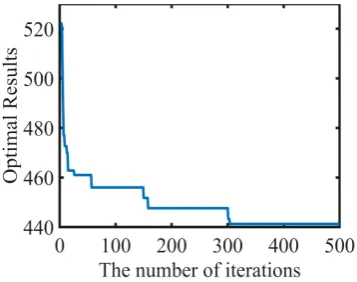
optimal result of genetic algorithm is 440.818, the optimal result of hybrid par-ticle algorithm is 436.482, and the optimal result of ant colony algorithm is 441.253. It can be concluded that the optimal result of hybrid particle algorithm is the smallest and its optimization performance is the best. Secondly, compare the convergence speed of the three algorithms. From Figure 15, we can see that for genetic algorithm, as the number of iterations increases, the optimal results decrease rapidly in [0, 100], decrease smoothly in [100, 300], and remain un-changed in [300, 500]. From Figure 16, we can see that for hybrid particle algo-rithm, the optimal results decrease quickly in [0, 50], as the number of iterations increase, decrease more gradually in [50, 150], and remain unchanged in [150, 500]. From Figure 17, we can see that for ant colony algorithm, as the number of iterations increases, the optimal results decrease rapidly in [0, 30], decline slowly in [30, 300] with sudden changes in some places, and remain unchanged in [300, 500]. After comparing convergence speed of three algorithms, we can see that ant colony algorithm converges fastest, followed by hybrid algorithm, and genetic algorithm converges slowest. It can be seen from the figure that the convergence speed of ant colony algorithm and the hybrid algorithm are rela-tively close and are better than genetic algorithm. In summary, after considering the two key factors, this paper recommends to use hybrid particle algorithm, which can achieve better optimization performance.
6. Conclusion
DOI: 10.4236/jcc.2018.67001 12 Journal of Computer and Communications
[image:12.595.285.463.232.366.2]Figure 15. Genetic algorithm.
Figure 16. Hybrid particle algorithm.
Figure 17. Ant colony algorithm.
analysis, this paper recommends to use hybrid particle algorithm to solve the problem of path optimization for construction robots.
References
[1] Koo, K.J., Russell, J.S. and Kim, S.K. (2003) Construction Robot Path-Planning for Earthwork Operations. Journal of Computing in Civil Engineering, 17, 97-104. https://doi.org/10.1061/(ASCE)0887-3801(2003)17:2(97)
[2] Soltani, A.R., Tawfik, H., Goulermas, J.Y. and Fernando, T. (2002) Path Planning in Construction Sites: Performance Evaluation of the Dijkstra A* and GA Search Al-gorithms. Advanced Engineering Informatics, 16, 291-303.
[image:12.595.285.464.397.538.2]DOI: 10.4236/jcc.2018.67001 13 Journal of Computer and Communications [3] Soltani, A.R. and Fernando, T. (2004) A Fuzzy Based Multi-Objective Path Planning
of Construction Sites. Automation in Construction, 13, 717-734. https://doi.org/10.1016/j.autcon.2004.04.012
[4] Sivakumar, P., Varghese, K. and Babu, N.R. (2000) Path Planning of Cooperative Construction Manipulators Using Genetic Algorithms. Isarc Proceedings, Taipei, 18-20 September 2000, 1-6. https://doi.org/10.22260/ISARC2000/0070
[5] Nieuwenhuisen, D., Kamphuis, A., Mooijekind, M. and Overmars, M.H. (2004) Automatic Construction of High Quality Roadmaps for Path Planning. UU-CS, Utrecht.
[6] Lee, S. and Adamsb, T.M. (1999) A Path Planning Algorithm for Automated Con-struction Equipment. Proceedings of the 16th ISARC, Madrid, 22-24 September 1999, 543-548.
[7] Lu, M. and Li, H. (2003) Resource-Activity Critical-Path Method for Construction Planning. Journal of Construction Engineering & Management, 129, 412-420. https://doi.org/10.1061/(ASCE)0733-9364(2003)129:4(412)
[8] Stouffs, R., Krishnamurti, R., Lee, S. and Oppenheim, I.J. (1994) Construction Process Simulation with Rule-Based Robot Path Planning. Automation in Con-struction, 3, 79-86. https://doi.org/10.1016/0926-5805(94)90035-3
[9] Chang, Y.C., Hung, W.H. and Kang, S.C. (2012) A Fast Path Planning Method for Single and Dual Crane Erections. Automation in Construction, 22, 468-480. https://doi.org/10.1016/j.autcon.2011.11.006
[10] Lei, Z., Behzadipour, S., Al-Hussein, M. and Hermann, R. (2011) Application of Robotic Obstacle Avoidance in Crane Lift Path Planning. Proceedings of the 28th ISARC, Seoul, Korea, 29 June-2 July 2011, 292-297.
https://doi.org/10.22260/ISARC2011/0052
[11] Mitchell, M. (1998) An Introduction to Genetic Algorithms. MIT Press, Cambridge. [12] Whitley, D. (1994) A Genetic Algorithm Tutorial. Statistics and Computing, 4,
65-85. https://doi.org/10.1007/BF00175354
[13] Li, S., Wu, X. and Tan, M. (2008) Gene Selection Using Hybrid Particle Swarm Op-timization and Genetic Algorithm. Soft Computing, 12, 1039-1048.
https://doi.org/10.1007/s00500-007-0272-x
[14] Juang, C.F. (2004) A Hybrid of Genetic Algorithm and Particle Swarm Optimiza-tion for Recurrent Network Design. IEEE Transactions on Systems Man & Cyber-netics Part B CyberCyber-netics A Publication of the IEEE Systems Man & CyberCyber-netics Society, 34, 997-1006. https://doi.org/10.1109/TSMCB.2003.818557
[15] Shelokar, P.S., Siarry, P., Jayaraman, V.K. and Kulkarni, B.D. (2007) Particle Swarm and Ant Colony Algorithms Hybridized for Improved Continuous Optimization. Applied Mathematics & Computation, 188, 129-142.
https://doi.org/10.1016/j.amc.2006.09.098
[16] Rajendran, C. and Ziegler, H. (2004) Ant-Colony Algorithms for Permutation Flowshop Scheduling to Minimize Makespan/Total Flowtime of Jobs. European Journal of Operational Research, 155, 426-438.
https://doi.org/10.1016/S0377-2217(02)00908-6