ISSN Online: 2331-4249 ISSN Print: 2331-4222
DOI: 10.4236/wjet.2018.62B005 May 22, 2018 41 World Journal of Engineering and Technology
Effects of Quality and Quantity of Information
Processing on Design Coordination
Performance
R. Zhang
1*, A. M. M. Liu
2, I. Y. S. Chan
21Department of Quantity Survey, School of Construction Management and Real Estate, Chongqing University, Chongqing, China 2Department of Real Estate and Construction, Faculty of Architecture, The University of Hong Kong, Hong Kong, China
Abstract
It is acknowledged that lacking of interdisciplinary communication amongst designers can result in poor coordination performance in building design. Viewing communication as information processing activity, this paper aims to explore the relationship between inter-disciplinary information processing (IP) and design coordination performance. Both amount and quality are con-cerned regarding information processing. 698 project based samples are col-lected by questionnaire survey from design institutes in mainland China. Sta-tistical data analysis shows that the relationship between information proc-essing amount and design coordination performance follows a nonlinear ex-ponential expression: performance = 3.691 (1−0.235IP amount) rather than
re-verted U curve. It implies that design period is too short to allow information overload. It indicates that the main problem in interdisciplinary communica-tion in design institute in China is insufficient informacommunica-tion. In addicommunica-tional, it is found the correlation between IP quality and coordination process perfor-mance is much stronger than that between IP amount and coordination process performance. For practitioners, it reminds design mangers to pay more attention to information processing quality rather than amount.
Keywords
Inter-Disciplinary, Information Processing, Design Coordination Performance
1. Introduction
Changes in construction projects are very common and could lead to project de-lays and cost overruns. Lu and Issa believe that the most frequent and most How to cite this paper: Zhang, R., Liu,
A.M.M. and Chan, I.Y.S. (2018) Effects of Quality and Quantity of Information Proc-essing on Design Coordination Perform-ance. World Journal of Engineering and Technology, 6, 41-49.
https://doi.org/10.4236/wjet.2018.62B005
DOI: 10.4236/wjet.2018.62B005 42 World Journal of Engineering and Technology costly changes are often related to design, such as design changes and design er-rors [1]. Hence, design stage is of primary importance in construction project life-cycle [2]. Common types of design deficiencies include design information inconsistency (e.g. location of a specific wall differing on the architectural and structural drawings), mismatches/physical interference between connected components (e.g. duct dimensions in building service drawings not matching related pass/hole dimensions in structural drawings), and component malfunc-tions (e.g. designing a room’s electrical supply to suit classroom activities, while architectural drawings designate the room as a computer lab) [3] [4]. Based on a questionnaire survey of 12 leading Canadian design firms, Hegazy, Khalifa and Zaneldin report eight common problems—all of which are due to insufficient and inadequate communication and information exchange (e.g., delay in ob-taining information, not everyone on the team getting design change informa-tion) [5]. Communication and information exchange is termed information processing in this paper. Information processing includes the collection, processing and distribution of information [6], and can be either personal or impersonal (e.g. accomplished using a program) [7] [8].
Building design is a multi-disciplinary task. The process of designing a build-ing is the process of integratbuild-ing information from multiple disciplinary profes-sionals (e.g. architects, structure engineers, building service engineers, survey-ors). Compared to intra-disciplinary coordination, inter-disciplinary coordina-tion is much more challenging. Informacoordina-tion processing in the latter situacoordina-tion might come across knowledge boundary, geographical remoteness, goal hetero-geneity, as well as organization boundary (in most of western project design team). In Mainland China, most of time, all disciplinary team are employed in the same design institute. Hence, this paper does not consider the effect of or-ganization boundary in the context of Mainland China.It is acknowledged that lacking of interdisciplinary information processing amongst designers can result in poor design coordination performance (e.g. suboptimal solutions, design change, construction delay).
Information Processing Amount and Design Coordination
Performance
DOI: 10.4236/wjet.2018.62B005 43 World Journal of Engineering and Technology tax performance due to information overload [12] [13]. Redundant information processing overloads people’s cognitive capacity, which impedes the normal processing of necessary information. Processing more information than neces-sary may help to ensure good quality, but it does so at the cost of reduced effec-tiveness. Coordination and information processing impose additional task loads on project team actors, and should be kept to the minimum necessary to achieve integration. In theory, the relationship between information processing amount and design coordination performance follows a reverted U curve. Due to tight design schedule, the situation in most of design institutes are lacking interdiscip-linary communication. The overloaded communication is quite few.
Hence, it is hypothesized that:
The relationship between information processing amount and design coordi-nation performance follows a nonlinear exponential expressione of:
(
)
Performance=b1 1−b2x (1)
What is the relationship between information processing amount and infor-mation processing quality? According to Chinese philosophy, the accumulation of amount increase brings the improvement of quality. Under the context of in-terdisciplinary information processing in Chinese design institute, it is hypothe-sized that: The relationship between information processing amount and per-ceived information quality follows a nonlinear exponential expression of
(
)
Performance=b1 1−b2x
Literature in the field of communication studies is reviewed here to investigate the concept of information processing quality, for two reasons. The first is that information process quality should be constructed as a multi-dimensional con-struct to properly investigate its rich content; however, little research within the information processing theory literature discusses the multiple dimensions of information processing quality, perhaps due to the short history of information processing theory. Fortunately, in the communication study community, re-searchers have deeply discussed the content of information quality in commu-nication [14] [15]. Usually, commucommu-nication refers to commucommu-nication between people; here, communication is not limited to people talking to other people di-rectly, but also includes people getting information from media sources, such as online management systems on which other people have posted information. Information processing in design coordination includes both personal commu-nication, and communication through programming; in this sense, communica-tion and informacommunica-tion processing are the same issue, which is the second reason why research findings from the communication studies field can be used.
la-DOI: 10.4236/wjet.2018.62B005 44 World Journal of Engineering and Technology bel perceived source quality [16]. A substantial body of literature suggests that a receiver’s perceptions of information quality influences the degree to which he or she is willing to act on it. Six critical communication variables are identified by Thomas et al. [15], four of which are highly related to information processing quality: clarity (how clear the information received is, as indicated by the fre-quency of conflicting instructions, poor communications, and lack of coordina-tion); understanding (shared with supervisors and other groups) of information expectations; timeliness (of the information received, including design and schedule changes); and, completeness (the amount of relevant information re-ceived). Four similar variables are used by Maltz [14], in discussing perceived information quality: credibility (the degree to which information is perceived by the receiver to be a reliable refection of the truth); comprehensibility (perceived clarity of the information received); relevance (the degree to which information is deemed appropriate for the user’s task or application); and timeliness (wheth-er information is transmitted quickly enough to be utilized). In a study of coor-dination quality in construction management, Chang and Shen [17] used two dimensions: perceived utility (i.e., the relevance, credibility and completeness of information) and clarity of communication (i.e., comprehensibility, conciseness, and consistency of representation). The two concepts seem of have some over-lap.
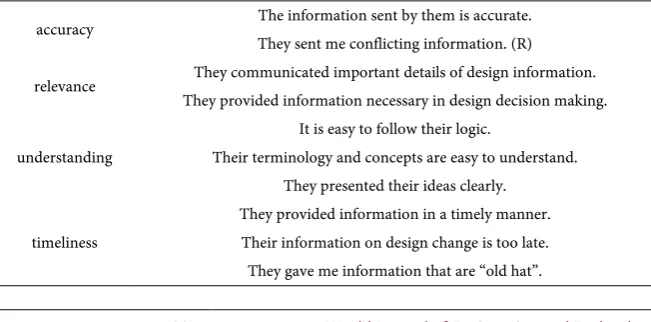
In this study, accuracy, relevance, understanding and timeliness have been se-lected to represent the multi-dimensional construct, PIQ, as shown in Table 1. Accuracy herein refers to the degree to which information is perceived by the receiver to be a reliable refection of the real situation. Relevance denotes the de-gree to which the information is appropriate for the user’s task. Understanding refers to the perceived clarity of the information received. Timeliness represents whether the information is transmitted quickly enough to allow the receiver to complete the task on time.
2. Methods
2.1. Data Collection Method
[image:4.595.208.534.583.744.2]Web-based questionnaire survey is applied to collect data for this investigation.
Table 1. Measurement scale of perceived information quality.
accuracy The information sent by them is accurate. They sent me conflicting information. (R)
relevance They communicated important details of design information. They provided information necessary in design decision making.
understanding
It is easy to follow their logic.
Their terminology and concepts are easy to understand. They presented their ideas clearly.
timeliness
DOI: 10.4236/wjet.2018.62B005 45 World Journal of Engineering and Technology The target respondents in this survey are participants in a building design project team from a design institute in Mainland China. Respondents are chosen based on three criteria; specifically, respondents should: 1) have participated in a project that had been completed within the past year (as they would be asked to recall design coordination activity); 2) have been either a project design manag-er, discipline leadmanag-er, or designer/engineer (top managers is excluded); and 3) have been in one of the following disciplines during the project – project man-agement, architecture, structure engineering, mechanical engineering, electrical engineering, plumbing engineering, or BIM engineering.
1174 questionnaire responses are received, of which 219 are completely an-sared, yielding a completion rate of 18.7%. 10 of completely questionnaires are dropped in data analysis as obvious data outliers. Each respondent reported data on his/her dyadic interdisciplinary design coordination with from two to seven disciplines (see Table 2). As the level of analysis is dyadic interdisciplinary de-sign coordination, each questionnaire is split into two to seven samples. Data on both intra- and inter-discipline coordination are collected, although the study’s focus is on inter-discipline coordination. The total sample size in the in-ter-disciplinary coordination data set is 698 (sum of figures in grey background).
2.2. Measurement
2.2.1. Interdisciplinary Communication Amount
Interdisciplinary communication frequency is applied to measure Interdiscipli-nary communication amount, using a five-point scale. Respondents are asked to indicate the frequency with which they communicated with designers from other discipline teams (1 = zero, 2 = less than once monthly, 3 = several times monthly, 4 = several times weekly, 5 = several times daily). Generally, building design has three stages: conceptual design, preliminary design, and detailed de-sign. In each of the different stages, information exchange frequency differs. The conceptual design stage is dominated by architects, with the exception of limited advice-seeking from other disciplines. The most frequent information exchange
Table 2. Matrix of dyadic coordination samples.
GD Archi. SE ME EE PE BIM
GD 2 5 5 2 2 2 2
Archi. 15 65 65 44 44 44 44
SE 12 66 66 38 38 38 38
ME 2 15 15 6 6 6 6
EE 1 12 12 2 2 2 2
PE 2 11 11 7 7 7 7
BIM 3 19 19 9 9 9 9
DOI: 10.4236/wjet.2018.62B005 46 World Journal of Engineering and Technology happens in the detailed design stage, where all disciplines are heavily involved, with each producing detailed designs to ensure the final product can function well. Hence, frequency of interdisciplinary communication in the detailed design stage is used to test hypotheses in this study.
2.2.2. Coordination Performance
Coordination process performance refers to the extent to which the respondent (focal unit a) has effective information processing with another person in the design team (unit j). It is a dyadic concept, and the five-item dyadic coordina-tion performance scale used by Sherman and Keller [18] is applied. The scale in-cludes items examining: 1) the extent to which the focal unit a had an effective working relationship with unit j; 2) the extent to which unit j fulfilled its respon-sibilities to unit a; 3) the extent to which unit a fulfilled its responrespon-sibilities to unit j; 4) the extent to which the coordination is satisfactory; and, 5) the positive or negative effect on productivity, as a result of the coordination.
3. Data Analysis
3.1. Information Processing Amount and Design
Coordination Performance
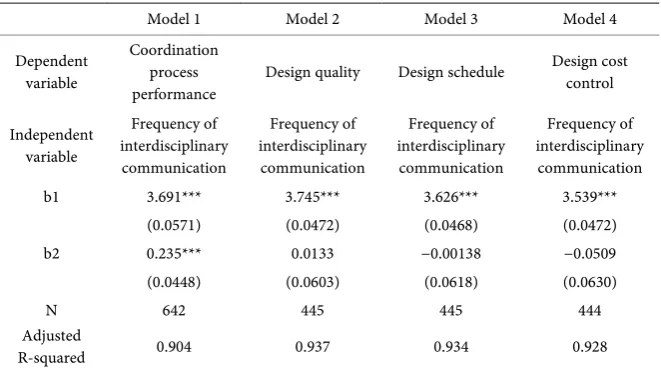
For coordination process performance (Table 3), b1 and b2 are quite significant in Model 1. This suggests that the relationship between frequency of interdiscip-linary communication in the detailed design stage and coordination process performance can be expressed as:
(
)
Performance 3.691 1 0.235= − x
[image:6.595.208.539.516.700.2]H1 is thus strongly supported. In Models 2, 3 and 4, b2 is not significant. One possible reason is that, many other factors influence design project performance, besides coordination process performance.
Table 3. Information processing amount and design coordination performance.
Model 1 Model 2 Model 3 Model 4
Dependent variable
Coordination process
performance Design quality Design schedule
Design cost control
Independent variable
Frequency of interdisciplinary communication
Frequency of interdisciplinary
communication
Frequency of interdisciplinary
communication
Frequency of interdisciplinary
communication b1 3.691*** 3.745*** 3.626*** 3.539***
(0.0571) (0.0472) (0.0468) (0.0472)
b2 0.235*** 0.0133 −0.00138 −0.0509
(0.0448) (0.0603) (0.0618) (0.0630)
N 642 445 445 444
Adjusted
R-squared 0.904 0.937 0.934 0.928
DOI: 10.4236/wjet.2018.62B005 47 World Journal of Engineering and Technology
3.2. Information Processing Amount and Information
Processing Quality
As for the relationship between information processing (IP) amount and infor-mation processing quality, the nonlinear exponential expression of
(
)
Performance=b1 1−b2x is computed, as shown in Table 4. Both b1 and b2
are significant. IP quality = 3.353 (1−0.311IP amount). H2 is strongly supported.
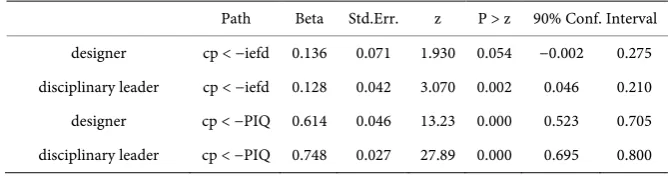
With the assumption that both information processing amount and informa-tion processing quality is positively related with design coordinainforma-tion process performance, an explorative study is conducted to compare the correlation using regression function. The results are showed in Table 5.
As it is an explorative study, P value less than 0.1 is accepted as significant. The results show that 1) Both IP amount and IP quality are positively related with coordination process performance; 2) In addition, it is found the correla-tion between IP quality and coordinacorrela-tion process performance is much stronger than that between IP amount and coordination process performance.
4. Discussion
[image:7.595.209.537.436.569.2]On one hand, insufficient interdisciplinary communication will lead to coordi-nation failure. On the other hand, too much information processing will lead to information overload as well as coordination cost overrun. The challenge for cross-functional teams is to ensure the level of information exchange amongst team members allows them to optimize their performance [11]. In this study, it
Table 4. Information processing amount and information processing quality.
Dependent variable Perceived information quality Independent variable Frequency of interdisciplinary communication
b1 3.353***
(0.0530)
b2 0.311***
(0.0371)
N 852
Adjusted R-squared 0.892
Standard errors in parentheses *p < 0.05, **p < 0.01, ***p < 0.001; Difference on sample size due to missing data.
Table 5. Information processing amount, information processing quality and coordina-tion process performance.
[image:7.595.204.539.637.727.2]DOI: 10.4236/wjet.2018.62B005 48 World Journal of Engineering and Technology is found that information processing amount is positively related to coordina-tion process performance; specifically, it is found that the relacoordina-tionship between the frequency of interdisciplinary communication in the detailed design stage and coordination process performance followed the nonlinear exponential expression of performance = 3.691 (1−0.235IP amount). Whether the finding can be
used in other areas rather than Mainland China need further study.
Although both IP amount and IP quality are positively related with coordina-tion process performance, the correlacoordina-tion between IP quality and coordinacoordina-tion process performance is much stronger than that between IP amount and coor-dination process performance. The result is consistent with former research on decision effectiveness, in which the impact of information quality is stronger [19]. It suggests that more attention should be paid on improving information processing quality. To improve information processing quality, effort can be made on improving information accuracy, relevance, understanding and timeli-ness. The role of building information modelling in improving interdisciplinary communication could be investigated in the future.
5. Conclusion
This paper explores the relationship between interdisciplinary communication and design coordination performance in design institutes in Mainland China. From information processing perspective, interdisciplinary communication is viewed as information processing activity. Both information processing amount and quality are concerned. Information processing quality is measured by four dimensions: perceived information accuracy, relevance, understanding and timeliness. Based on 698 samples of quantitative survey data in project level, it is found that the relationship between information processing amount and design coordination process performance follows a nonlinear exponential expression: performance = 3.691 (1−0.235IP amount) rather than reverted U curve. It implies
that design period is too short to allow information overload. It indicates that the main problem in interdisciplinary communication in design institute in China is insufficient information. In additional, it is found the correlation be-tween IP quality and coordination process performance is much stronger than that between IP amount and coordination process performance. For practition-ers, it reminds design mangers to pay more attention to information processing quality rather than amount.
References
[1] Lu, H. and Issa, R.R. (2005) Extended Production Integration for Construction: A Loosely Coupled Project Model for Building Construction. Journal of Computing in Civil Engineering, 19, 58-68.
https://doi.org/10.1061/(ASCE)0887-3801(2005)19:1(58)
[2] Harpum, P. (Ed.) (2004) Design Management. John Wiley and Sons Ltd., USA.
https://doi.org/10.1002/9780470172391.ch18
DOI: 10.4236/wjet.2018.62B005 49 World Journal of Engineering and Technology Coordination. Journal of Construction Engineering and Management, 129, 627-634.
https://doi.org/doi:10.1061/(ASCE)0733-9364(2003)129:6(627)
[4] Mokhtar, A.H. (2002) Coordinating and Customizing Design Information through the Internet. Engineering Construction and Architectural Management, 9, 222-231.
https://doi.org/10.1108/eb021217
[5] Hegazy, T., Khalifa, J. and Zaneldin, E. (1998) Towards Effective Design Coordina-tion: A Questionnaire Survey 1. Canadian Journal of Civil Engineering, 25, 595-603.
https://doi.org/10.1139/l97-115
[6] Tushman, M.L. and Nadler, D.A. (1978) Information Processing as an Integrating Concept in Organizational Design. Academy of Management Review, 613-624. [7] Dietrich, P., Kujala, J. and Artto, K. (2013) Inter-Team Coordination Patterns and
Outcomes in Multi-Team Projects. Project Management Journal, 44, 6-19.
https://doi.org/10.1002/pmj.21377
[8] Van de Ven, A.H., Delbecq, A.L. and Koenig Jr., R. (1976) Determinants of Coordi-nation Modes within Organizations. American Sociological Review, 322-338.
https://doi.org/10.2307/2094477
[9] Mathieu, J.E., Heffner, T.S., Goodwin, G.F., Salas, E. and Cannon-Bowers, J.A. (2000) The Influence of Shared Mental Models on Team Process and Performance. Journal of Applied Psychology, 85, 273. https://doi.org/10.1037/0021-9010.85.2.273
[10]Katz, D. and Kahn, R.L. (1978) The Social Psychology of Organizations.
[11]Patrashkova, R.R. and McComb, S.A. (2004) Exploring Why More Communication Is Not Better: Insights from a Computational Model of Cross-Functional Teams. Journal of Engineering and Technology Management, 21, 83-114.
https://doi.org/10.1016/j.jengtecman.2003.12.005
[12]Goodman, P.S. and Leyden, D.P. (1991) Familiarity and Group Productivity. Journal of Applied Psychology, 76, 578. https://doi.org/10.1037/0021-9010.76.4.578
[13]Boisot, M.H. (1995) Information Space. Int. Thomson Business Press.
[14]Maltz, E. (2000) Is All Communication Created Equal? An Investigation into the Ef-fects of Communication Mode on Perceived Information Quality. Journal of Prod-uct Innovation Management, 17, 110-127.
https://doi.org/10.1016/S0737-6782(99)00030-2
[15]Thomas, S.R., Tucker, R.L. and Kelly, W.R. (1998) Critical Communications Va-riables. Journal of Construction Engineering and Management, 124, 58-66.
https://doi.org/10.1061/(ASCE)0733-9364(1998)124:1(58)
[16]Choo, C.W. (2005) The Knowing Organization. Oxford University Press.
https://doi.org/10.1093/acprof:oso/9780195176780.001.0001
[17]Chang, A.S. and Shen, F.-Y. (2014) Effectiveness of Coordination Methods in Con-struction Projects. Journal of Management in Engineering.
https://doi.org/10.1061/(ASCE)ME.1943-5479.0000222
[18]Sherman, J.D. and Keller, R.T. (2011) Suboptimal Assessment of Interunit Task In-terdependence: Modes of Integration and Information Processing for Coordination Performance. Organization Science, 22, 245-261.
https://doi.org/10.1287/orsc.1090.0506
[19]Keller, K.L. and Staelin, R. (1987) Effects of Quality and Quantity of Information on Decision Effectiveness. Journal of Consumer Research, 14, 200-213.