s z
RESEARCH ARTICLE
PROCESSING OF ELETROLESS NI-P-W COATED NANOCENOSPHERE/POLYMER COMPOSITE FOR
EMI SHIELDING APPLICATION
*1
Vynatheya, S.
2Chandra Sagar, L. and
3Bheema Raju, V.
1
Materials Technology Division, Central Power Research Institute, Bangalore-560 080
2Department of Mechanical Engineering, Dr. Ambedkar Institute of Technology, Bangalore-560 056
3
Department of Chemistry, RNS Institute of Technology, Bangalore-560098
ARTICLE INFO ABSTRACT
Electromagnetic interference (EMI) is an escalating concern in the modern era of electronics. As such it has become a critical area to study while designing and packagingelectronics. With the growing volume of electronic devices and increasing processor frequencies, the electromagnetic environment is becoming ever more congested resulting in need for adequate EMI shielding. Further, due to the steady growth of communication technology and adverse effects of electromagnetic radiations on human body and electronic devices, it is essential to reduce the Electro- Magnetic Interference (EMI) and its impact. The desire for high performance, combined with reductions in size, weight andmanufacturing cost suggests that polymers could be ideal material especially for electronic housings. Unfortunately polymers generally do not provide shielding fromelectromagnetic waves because of their insulating nature. In this context, Electroless Alloy(Ni-P-W) Coated Nanocenosphere in and Acrylonitrile Butadiene Styrene (ABS)and Poly methyl Methacrylate (PMMA) composites have been investigated for their EMI shielding effectiveness. The strategy is to render the polymer conductive by dispersingNickel-Phosphorous-Tungsten alloy coated Nanocenospheres along with Conductive fillersin the polymer (PMMA/ABS) which promotes wave absorption. All the studies have been made on polymer composite sheets with electroless alloy coated Nano-cenospheres. In the present study, EDX (Energy Dispersive X-Ray) analysis confirmed the presence of Ni, W and P on the coated Nanocenosphere particles substantiated by Phase analysis using XRD (X-Ray Diffractometer). SEM (Scanning Electron Microscope) analysis was conducted to study the size, shape of the coated particles and to observe the distribution of these particles along with conductive fillers in polymer matrix in the composite sheet. This paper discusses theprocessing methods, electrical surface resistivity and its correlation with EMI shielding. In the current formulation, shielding effectiveness of approximately 35 dB at a frequency of 1GHz wasachieved for Electroless alloy coated Nanocenospheres in ABSpolymer, which is higher than that of PMMA polymer. Further, the effects of coated Nanocenosphere particle size and distribution in polymer matrix have been discussed.
Copyright©2017, Dr. Bimal Krushna Panda and Dr. Sujata Panda. This is an open access article distributed under the Creative Commons Attribution License, which permits unrestricted use, distribution, and reproduction in any medium, provided the original work is properly cited.
INTRODUCTION
Electro Magnetic Interference (EMI) is a topic of current interest. As technology advances, the need to integrate large number of electrical and electronic systems into automobiles, airplanes, ship, etc. has dramatically increased. To name a few, these systems include Control Area Networks (CAN), safety systems, communications, mobile media, infotainment systems including wireless headsets, DC motors and controllers. Placing large amount of electrical and electronic systems in a very confined space poses the problem of keeping the Electro
*Corresponding author: Vynatheya
Materials Technology Division, Central Power Research Institute, Bangalore-560 080
Magnetic Interference (EMI) of these systems from interfering with each other. EMI is a process by which disruptive electromagnetic energy is transmitted from one electronic device to another via radiated or conducted paths, or both. In an automotive electronic system, EMI can adversely affect the performance of an integrated circuit internally as well as that of the other electronic components in close proximity. The interference sources may be internal or external to the electrical or electronic system and they may propagate by radiation or conduction (John Noto, 2010). The word Cenosphere literally means hollow spheres. A Cenosphere is a light weight; inert, hollow sphere made largely of silica and alumina and filled with air or inert gas, typically produced as a by-product of coal combustion at thermal power plants
ISSN: 0975-833X
Available online at http://www.journalcra.com
International Journal of Current Research Vol. 9, Issue, 01, pp.45672-45677, January, 2017
INTERNATIONAL JOURNAL OF CURRENT RESEARCH
Article History: Received 18thOctober, 2016 Received in revised form 28thNovember, 2016 Accepted 20thDecember, 2016 Published online 31stJanuary, 2017
Key words:
Nanocenosphere,
Electromagnetic Interference, Shielding Effectiveness, Eletroless coating.
Citation: Dr. Bimal Krushna Panda and Dr. Sujata Panda, 2017.“Post opertive nausea vomiting (ponv): effect of ondansetron and palonosetron”,
International Journal of Current Research, 09, (01), 45672-45677.
s z
RESEARCH ARTICLE
PROCESSING OF ELETROLESS NI-P-W COATED NANOCENOSPHERE/POLYMER COMPOSITE FOR
EMI SHIELDING APPLICATION
*1
Vynatheya, S.
2Chandra Sagar, L. and
3Bheema Raju, V.
1
Materials Technology Division, Central Power Research Institute, Bangalore-560 080
2Department of Mechanical Engineering, Dr. Ambedkar Institute of Technology, Bangalore-560 056
3
Department of Chemistry, RNS Institute of Technology, Bangalore-560098
ARTICLE INFO ABSTRACT
Electromagnetic interference (EMI) is an escalating concern in the modern era of electronics. As such it has become a critical area to study while designing and packagingelectronics. With the growing volume of electronic devices and increasing processor frequencies, the electromagnetic environment is becoming ever more congested resulting in need for adequate EMI shielding. Further, due to the steady growth of communication technology and adverse effects of electromagnetic radiations on human body and electronic devices, it is essential to reduce the Electro- Magnetic Interference (EMI) and its impact. The desire for high performance, combined with reductions in size, weight andmanufacturing cost suggests that polymers could be ideal material especially for electronic housings. Unfortunately polymers generally do not provide shielding fromelectromagnetic waves because of their insulating nature. In this context, Electroless Alloy(Ni-P-W) Coated Nanocenosphere in and Acrylonitrile Butadiene Styrene (ABS)and Poly methyl Methacrylate (PMMA) composites have been investigated for their EMI shielding effectiveness. The strategy is to render the polymer conductive by dispersingNickel-Phosphorous-Tungsten alloy coated Nanocenospheres along with Conductive fillersin the polymer (PMMA/ABS) which promotes wave absorption. All the studies have been made on polymer composite sheets with electroless alloy coated Nano-cenospheres. In the present study, EDX (Energy Dispersive X-Ray) analysis confirmed the presence of Ni, W and P on the coated Nanocenosphere particles substantiated by Phase analysis using XRD (X-Ray Diffractometer). SEM (Scanning Electron Microscope) analysis was conducted to study the size, shape of the coated particles and to observe the distribution of these particles along with conductive fillers in polymer matrix in the composite sheet. This paper discusses theprocessing methods, electrical surface resistivity and its correlation with EMI shielding. In the current formulation, shielding effectiveness of approximately 35 dB at a frequency of 1GHz wasachieved for Electroless alloy coated Nanocenospheres in ABSpolymer, which is higher than that of PMMA polymer. Further, the effects of coated Nanocenosphere particle size and distribution in polymer matrix have been discussed.
Copyright©2017, Dr. Bimal Krushna Panda and Dr. Sujata Panda. This is an open access article distributed under the Creative Commons Attribution License, which permits unrestricted use, distribution, and reproduction in any medium, provided the original work is properly cited.
INTRODUCTION
Electro Magnetic Interference (EMI) is a topic of current interest. As technology advances, the need to integrate large number of electrical and electronic systems into automobiles, airplanes, ship, etc. has dramatically increased. To name a few, these systems include Control Area Networks (CAN), safety systems, communications, mobile media, infotainment systems including wireless headsets, DC motors and controllers. Placing large amount of electrical and electronic systems in a very confined space poses the problem of keeping the Electro
*Corresponding author: Vynatheya
Materials Technology Division, Central Power Research Institute, Bangalore-560 080
Magnetic Interference (EMI) of these systems from interfering with each other. EMI is a process by which disruptive electromagnetic energy is transmitted from one electronic device to another via radiated or conducted paths, or both. In an automotive electronic system, EMI can adversely affect the performance of an integrated circuit internally as well as that of the other electronic components in close proximity. The interference sources may be internal or external to the electrical or electronic system and they may propagate by radiation or conduction (John Noto, 2010). The word Cenosphere literally means hollow spheres. A Cenosphere is a light weight; inert, hollow sphere made largely of silica and alumina and filled with air or inert gas, typically produced as a by-product of coal combustion at thermal power plants
ISSN: 0975-833X
Available online at http://www.journalcra.com
International Journal of Current Research Vol. 9, Issue, 01, pp.45672-45677, January, 2017
INTERNATIONAL JOURNAL OF CURRENT RESEARCH
Article History: Received 18thOctober, 2016 Received in revised form 28thNovember, 2016 Accepted 20thDecember, 2016 Published online 31stJanuary, 2017
Key words:
Nanocenosphere,
Electromagnetic Interference, Shielding Effectiveness, Eletroless coating.
Citation: Dr. Bimal Krushna Panda and Dr. Sujata Panda, 2017.“Post opertive nausea vomiting (ponv): effect of ondansetron and palonosetron”,
International Journal of Current Research, 09, (01), 45672-45677.
s z
RESEARCH ARTICLE
PROCESSING OF ELETROLESS NI-P-W COATED NANOCENOSPHERE/POLYMER COMPOSITE FOR
EMI SHIELDING APPLICATION
*1
Vynatheya, S.
2Chandra Sagar, L. and
3Bheema Raju, V.
1
Materials Technology Division, Central Power Research Institute, Bangalore-560 080
2Department of Mechanical Engineering, Dr. Ambedkar Institute of Technology, Bangalore-560 056
3
Department of Chemistry, RNS Institute of Technology, Bangalore-560098
ARTICLE INFO ABSTRACT
Electromagnetic interference (EMI) is an escalating concern in the modern era of electronics. As such it has become a critical area to study while designing and packagingelectronics. With the growing volume of electronic devices and increasing processor frequencies, the electromagnetic environment is becoming ever more congested resulting in need for adequate EMI shielding. Further, due to the steady growth of communication technology and adverse effects of electromagnetic radiations on human body and electronic devices, it is essential to reduce the Electro- Magnetic Interference (EMI) and its impact. The desire for high performance, combined with reductions in size, weight andmanufacturing cost suggests that polymers could be ideal material especially for electronic housings. Unfortunately polymers generally do not provide shielding fromelectromagnetic waves because of their insulating nature. In this context, Electroless Alloy(Ni-P-W) Coated Nanocenosphere in and Acrylonitrile Butadiene Styrene (ABS)and Poly methyl Methacrylate (PMMA) composites have been investigated for their EMI shielding effectiveness. The strategy is to render the polymer conductive by dispersingNickel-Phosphorous-Tungsten alloy coated Nanocenospheres along with Conductive fillersin the polymer (PMMA/ABS) which promotes wave absorption. All the studies have been made on polymer composite sheets with electroless alloy coated Nano-cenospheres. In the present study, EDX (Energy Dispersive X-Ray) analysis confirmed the presence of Ni, W and P on the coated Nanocenosphere particles substantiated by Phase analysis using XRD (X-Ray Diffractometer). SEM (Scanning Electron Microscope) analysis was conducted to study the size, shape of the coated particles and to observe the distribution of these particles along with conductive fillers in polymer matrix in the composite sheet. This paper discusses theprocessing methods, electrical surface resistivity and its correlation with EMI shielding. In the current formulation, shielding effectiveness of approximately 35 dB at a frequency of 1GHz wasachieved for Electroless alloy coated Nanocenospheres in ABSpolymer, which is higher than that of PMMA polymer. Further, the effects of coated Nanocenosphere particle size and distribution in polymer matrix have been discussed.
Copyright©2017, Dr. Bimal Krushna Panda and Dr. Sujata Panda. This is an open access article distributed under the Creative Commons Attribution License, which permits unrestricted use, distribution, and reproduction in any medium, provided the original work is properly cited.
INTRODUCTION
Electro Magnetic Interference (EMI) is a topic of current interest. As technology advances, the need to integrate large number of electrical and electronic systems into automobiles, airplanes, ship, etc. has dramatically increased. To name a few, these systems include Control Area Networks (CAN), safety systems, communications, mobile media, infotainment systems including wireless headsets, DC motors and controllers. Placing large amount of electrical and electronic systems in a very confined space poses the problem of keeping the Electro
*Corresponding author: Vynatheya
Materials Technology Division, Central Power Research Institute, Bangalore-560 080
Magnetic Interference (EMI) of these systems from interfering with each other. EMI is a process by which disruptive electromagnetic energy is transmitted from one electronic device to another via radiated or conducted paths, or both. In an automotive electronic system, EMI can adversely affect the performance of an integrated circuit internally as well as that of the other electronic components in close proximity. The interference sources may be internal or external to the electrical or electronic system and they may propagate by radiation or conduction (John Noto, 2010). The word Cenosphere literally means hollow spheres. A Cenosphere is a light weight; inert, hollow sphere made largely of silica and alumina and filled with air or inert gas, typically produced as a by-product of coal combustion at thermal power plants
ISSN: 0975-833X
Available online at http://www.journalcra.com
International Journal of Current Research Vol. 9, Issue, 01, pp.45672-45677, January, 2017
INTERNATIONAL JOURNAL OF CURRENT RESEARCH
Article History: Received 18thOctober, 2016 Received in revised form 28thNovember, 2016 Accepted 20thDecember, 2016 Published online 31stJanuary, 2017
Key words:
Nanocenosphere,
Electromagnetic Interference, Shielding Effectiveness, Eletroless coating.
Citation: Dr. Bimal Krushna Panda and Dr. Sujata Panda, 2017.“Post opertive nausea vomiting (ponv): effect of ondansetron and palonosetron”,
(Elena, 2011). Cenospheres are also hard and rigid, waterproof and Insulative. Cenospheres have a size range from 5 to 200 microns with an average compressive strength of 3000 psi. Colours range from white to light grey. They are also referred to as microspheres, hollow spheres, hollow ceramic microspheres, micro balloons or glass beads. Cenospheres are easy to handle and provide a low surface area: volume ratio. Due to their inert properties, they are not affected by solvents, water, acids or alkalis. The particles are further reduced to Nano size by mechanical milling.
Eletroless Plating: There are many methods available to coat
metals, ceramics, glass etc. such as: Electroplating, hot dipping, Metal Spraying, Vacuum metalizing, Eletroless plating etc. Among these methods, Eletroless plating is considered more suitable for the present study involving fine particles, since the substrates are in the form of powder (Nanocenosphere) and the coating method is provides a thin, controllable and homogenized coating (Sadhana, 2003 and Supriyoroy and Prasanta Sahoo, 2012).
EXPERIMENTAL PROCEDURE
Chemicals and raw material
Cenospheres collected from Raichur Thermal Power station, Nickel Sulphate, Sodium Hypophosphite, Sodium Citrate, Ammonium Sulphate, Lactic acid, Sodium tungstate, Poly Methyl Methacrylate (PMMA), (ABS) (Acrylo-Nitrile Butadiene Styrene), DMF (Dimethyl Formamide), Acetone, Chloform, Tin Chloride, Palladium Chloride, Hydrochloric Acid, Nitric Acid and Sulphuric Acid.
Preparation of Nanocenospheres
About 50 gm. of acid washed (Dil. H2SO4) Cenosphere powder was weighed and placed inHigh Energy Ball mill Zirconia jar containing Zirconia balls of different sizes; to this powder 150ml of Acetone was added, and ground for 40Hrs with 300 RPM. Dried in an oven at 1000C. TheNanocenospherethus obtained was again washed with dilute acid (H2SO4). Filtration was carried out using fine membrane filter to recover all particles. The average size of the particles after high energy ball milling was ranging between 100-250 nm. The surface area (BET) of the powder was ranging from 500-550m2/gram.
Pre-treatment of Nanocenospheres
The Nanocenosphere powder thus preparedwas washed well before carrying out the coating process in order to remove impurities.The following process was adopted for acid wash:About 50g of Nanocenosphere wastaken in a beaker with a solution of sulphuric acid of 0.5% concentration (500ml). The fine material in acid was thoroughly agitated using magnetic stirrer for about one hour and filtered using fine filter paper. The residuewas then dried in a hot air oven at 90˚C.The acid washed Nanocenosphere particles are now ready to be used for alloy coating.
Mechanism of electroless NI-P-W
Coating
The EletrolessNi-P-W coating bath consists of the following components:
Nickel sulphate is used as the source of nickelwhile sodium hypophosphite is the reducing agent. Sodium tungstatesolutionisusedasthesourceoftungstenion. The bath is prepared by adding the constituents in appropriate sequence. The pH of the solution is maintained at around 7-8 by continuous monitoring with a pH meter[2].The bath composition and operatingconditions for Ni-P-W coating are shown below with detailed procedure.
Detailed Procedure
TheNanocenospherethus prepared was transferred to sensitization bath compositions shown below and stirred each time with a mechanical stirrer.
Sensitization bath: 5g/l SnCl2and 30ml/l conc. HCl for 1 hr
Filtrationcarried out by fine membrane filter and the residue transferred to Activation bath.
Activation bath: 0.1g/l PdCl2, 5ml/l conc. HNO3 and25ml/l conc. HCl–1hr.
Again filtration was carried out followed by washing with deionized water thoroughly and transferring to Electroless plating bath.
Plating bath
Nickel sulphate - 20g/l Sodium hypophosphite - 20g/l Sodium citrate - 35g/l
Ammonium sulphate - 30g/l Lactic acid–5ml/l
Sodium tungstate - 15g/l
Temperature–900C Time–3hr.
PH–7-8.
Again Filtration carried out using by clean membrane filter& washed with deionized water.
Dried at 1100C in an oven.
Preparation of Ni-P-W CNC / PMMAComposite Sheet
Preparation of Ni-P-W CNC/PMMA composite sheet was carried out by dissolving PMMA in Analytical Grade Chloroform and adding Ni-P-W CNC with constant stirring for an hour followed by sonication. The concentrated polymer solution with uniformly dispersed coated Nanocenosphere (CNC) was carefully transferred to a petri dish and dried. The composite sheet obtained was tested for Shielding effectiveness.
The detailed procedure of Ni-P-W CNC /PMMA composite sheet (30% coated Nanocenosphere) preparation is as shown below;
Weighed PMMAwas added in 100ml Chloroform and stirred with slight heating until PMMA dissolved completely in Chloroform.
After complete dissolving of PMMA, Weighed Ni-P-W coated Nanocenosphere was added to the polymer solution and again stirred well for an hour.
Finally the reaction mixture was sonicated for half an hour to get uniform dispersion of the coated powder in polymer matrix to get good connectivity between the particles, followed by pouring solution on to a petri dish and dried in a vacuum oven at 800C. The petri dish was taken out after cooling and the dried sheet was carefully removed. Vacuum drying helps in preventing air bubble formation during drying thereby improves the conductivity of the sheet.
The following table gives % of Ni-P-W CNC in Polymer.
% CNC in composite sheet
Weight of CNC(g)
Weight of Polymer PMMA (g)
5 0.5 9.5
10 1.0 9.0
15 1.5 8.5
20 2.0 8.0
25 2.5 7.5
30 3.0 7.0
35 3.5 6.5
Preparationof Ni-P-W CNC /ABS Composite Sheet
Preparation of Ni-P-W CNC/ABS composite sheet was carried out by dissolving ABS in DMF and adding Ni-P-W CNC with constant stirring for an hour followed by sonication. The concentrated polymer solution with uniformly dispersed coated Nanocenosphere was carefully transferred to a petri dish and dried. The composite sheet obtained was tested for Shielding effectiveness.
The detailed procedure of Ni-P-W CNC /ABS composite sheet (30% coated Nanocenosphere) preparation is as shown below;
Weighed quantityABSwas added in 100ml DMF and stirred with slight heating until ABS dissolves completely in DMF.
After complete dissolving of ABS, weighed of Ni-P-W coated Nanocenosphere was added to the polymer solution and again stirred well for an hour without heating.
The following table gives % of Ni-P-W CNC in Polymer.
% CNC in composite sheet
Weight of CNC(g)
Weight of Polymer ABS(g)
5 0.5 9.5
10 1.0 9.0
15 1.5 8.5
20 2.0 8.0
25 2.5 7.5
30 3.0 7.0
35 3.5 6.5
Finally the reaction mixture was sonicated for half an hour to get uniform dispersion of the coated powder in polymer matrix to get good connectivity between the particles, followed by pouring solution on to a petri dish and dried in a vacuum oven at 800C. The petri dish was taken out after cooling and the dried sheet was carefully removed. Vacuum drying helps in preventing air bubble formation during drying thereby improves the conductivity of the sheet.
Characterization
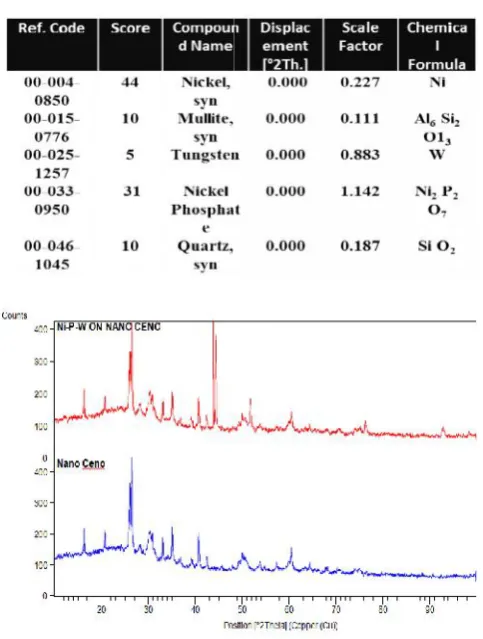
Both nanocenospheres(NC) and coated Nanocenospheres (CNC) were subjected to XRD, EDAX and SEM analysis. The
[image:3.595.64.259.189.279.2]presence of Ni, W and P was confirmed both by XRD and EDAX tests in CNC.
[image:3.595.313.555.309.629.2]Fig. 1. XRD of Ni-P-W CNC
Fig. 2. Comparison of XRD of NC and Ni-P-W CNC
The SEM micrographs were taken at different magnifications. At low magnification of 1.5KX (Fig.6) the morphology of the coated powders were found to be almost uniform. However, the particles could not be dispersed because of high agglomeration and very good attachment between fine particles.However, at high magnification of 10KX (Fig. 5) agglomeration of particles could be observed with the particle size range of individual grains between 100-250nm. Fig. 7 gives uniform distribution of 25% Ni-P-W CNC particles in ABS polymer matrix exposed at lower magnification (100X). Fig.8 gives distribution of 30% Ni-P-W CNC particles in PMMA polymer matrix. However, the distribution is not so uniform.
45674 International Journal of Current Research, Vol. 9, Issue, 01, pp.45672-45677, January, 2017
Finally the reaction mixture was sonicated for half an hour to get uniform dispersion of the coated powder in polymer matrix to get good connectivity between the particles, followed by pouring solution on to a petri dish and dried in a vacuum oven at 800C. The petri dish was taken out after cooling and the dried sheet was carefully removed. Vacuum drying helps in preventing air bubble formation during drying thereby improves the conductivity of the sheet.
The following table gives % of Ni-P-W CNC in Polymer.
% CNC in composite sheet
Weight of CNC(g)
Weight of Polymer PMMA (g)
5 0.5 9.5
10 1.0 9.0
15 1.5 8.5
20 2.0 8.0
25 2.5 7.5
30 3.0 7.0
35 3.5 6.5
Preparationof Ni-P-W CNC /ABS Composite Sheet
Preparation of Ni-P-W CNC/ABS composite sheet was carried out by dissolving ABS in DMF and adding Ni-P-W CNC with constant stirring for an hour followed by sonication. The concentrated polymer solution with uniformly dispersed coated Nanocenosphere was carefully transferred to a petri dish and dried. The composite sheet obtained was tested for Shielding effectiveness.
The detailed procedure of Ni-P-W CNC /ABS composite sheet (30% coated Nanocenosphere) preparation is as shown below;
Weighed quantityABSwas added in 100ml DMF and stirred with slight heating until ABS dissolves completely in DMF.
After complete dissolving of ABS, weighed of Ni-P-W coated Nanocenosphere was added to the polymer solution and again stirred well for an hour without heating.
The following table gives % of Ni-P-W CNC in Polymer.
% CNC in composite sheet
Weight of CNC(g)
Weight of Polymer ABS(g)
5 0.5 9.5
10 1.0 9.0
15 1.5 8.5
20 2.0 8.0
25 2.5 7.5
30 3.0 7.0
35 3.5 6.5
Finally the reaction mixture was sonicated for half an hour to get uniform dispersion of the coated powder in polymer matrix to get good connectivity between the particles, followed by pouring solution on to a petri dish and dried in a vacuum oven at 800C. The petri dish was taken out after cooling and the dried sheet was carefully removed. Vacuum drying helps in preventing air bubble formation during drying thereby improves the conductivity of the sheet.
Characterization
Both nanocenospheres(NC) and coated Nanocenospheres (CNC) were subjected to XRD, EDAX and SEM analysis. The
presence of Ni, W and P was confirmed both by XRD and EDAX tests in CNC.
[image:3.595.67.258.550.640.2]Fig. 1. XRD of Ni-P-W CNC
Fig. 2. Comparison of XRD of NC and Ni-P-W CNC
The SEM micrographs were taken at different magnifications. At low magnification of 1.5KX (Fig.6) the morphology of the coated powders were found to be almost uniform. However, the particles could not be dispersed because of high agglomeration and very good attachment between fine particles.However, at high magnification of 10KX (Fig. 5) agglomeration of particles could be observed with the particle size range of individual grains between 100-250nm. Fig. 7 gives uniform distribution of 25% Ni-P-W CNC particles in ABS polymer matrix exposed at lower magnification (100X). Fig.8 gives distribution of 30% Ni-P-W CNC particles in PMMA polymer matrix. However, the distribution is not so uniform.
45674 International Journal of Current Research, Vol. 9, Issue, 01, pp.45672-45677, January, 2017
Finally the reaction mixture was sonicated for half an hour to get uniform dispersion of the coated powder in polymer matrix to get good connectivity between the particles, followed by pouring solution on to a petri dish and dried in a vacuum oven at 800C. The petri dish was taken out after cooling and the dried sheet was carefully removed. Vacuum drying helps in preventing air bubble formation during drying thereby improves the conductivity of the sheet.
The following table gives % of Ni-P-W CNC in Polymer.
% CNC in composite sheet
Weight of CNC(g)
Weight of Polymer PMMA (g)
5 0.5 9.5
10 1.0 9.0
15 1.5 8.5
20 2.0 8.0
25 2.5 7.5
30 3.0 7.0
35 3.5 6.5
Preparationof Ni-P-W CNC /ABS Composite Sheet
Preparation of Ni-P-W CNC/ABS composite sheet was carried out by dissolving ABS in DMF and adding Ni-P-W CNC with constant stirring for an hour followed by sonication. The concentrated polymer solution with uniformly dispersed coated Nanocenosphere was carefully transferred to a petri dish and dried. The composite sheet obtained was tested for Shielding effectiveness.
The detailed procedure of Ni-P-W CNC /ABS composite sheet (30% coated Nanocenosphere) preparation is as shown below;
Weighed quantityABSwas added in 100ml DMF and stirred with slight heating until ABS dissolves completely in DMF.
After complete dissolving of ABS, weighed of Ni-P-W coated Nanocenosphere was added to the polymer solution and again stirred well for an hour without heating.
The following table gives % of Ni-P-W CNC in Polymer.
% CNC in composite sheet
Weight of CNC(g)
Weight of Polymer ABS(g)
5 0.5 9.5
10 1.0 9.0
15 1.5 8.5
20 2.0 8.0
25 2.5 7.5
30 3.0 7.0
35 3.5 6.5
Finally the reaction mixture was sonicated for half an hour to get uniform dispersion of the coated powder in polymer matrix to get good connectivity between the particles, followed by pouring solution on to a petri dish and dried in a vacuum oven at 800C. The petri dish was taken out after cooling and the dried sheet was carefully removed. Vacuum drying helps in preventing air bubble formation during drying thereby improves the conductivity of the sheet.
Characterization
Both nanocenospheres(NC) and coated Nanocenospheres (CNC) were subjected to XRD, EDAX and SEM analysis. The
presence of Ni, W and P was confirmed both by XRD and EDAX tests in CNC.
Fig. 1. XRD of Ni-P-W CNC
Fig. 2. Comparison of XRD of NC and Ni-P-W CNC
The SEM micrographs were taken at different magnifications. At low magnification of 1.5KX (Fig.6) the morphology of the coated powders were found to be almost uniform. However, the particles could not be dispersed because of high agglomeration and very good attachment between fine particles.However, at high magnification of 10KX (Fig. 5) agglomeration of particles could be observed with the particle size range of individual grains between 100-250nm. Fig. 7 gives uniform distribution of 25% Ni-P-W CNC particles in ABS polymer matrix exposed at lower magnification (100X). Fig.8 gives distribution of 30% Ni-P-W CNC particles in PMMA polymer matrix. However, the distribution is not so uniform.
Fig. 3. EDAX of Nanocenosphere
Fig. 5. SEM micrograph of Ni-P-W CNC at 10KX
Fig. 4. EDAX of coated Nanocenosphere
Fig. 7. SEM micrograph of ABS composite sheet at 100X (25% Ni-P-W CNC)
Fig. 6. SEM micrograph of Ni-P-W CNC at 1.5KX
Fig. 9 gives distribution of 30% Ni-P-W CNC particles in ABS polymer matrix. Here a uniform wave like structure can be observed. This uniform distribution can be attributed to higher conductivity in the case of 30% Ni-P-W CNC distributed in ABS polymer matrix resulting in higher shielding efffectiveness.
45675 Dr. Bimal Krushna Panda and Dr. Sujata Panda, Post opertive nausea vomiting (ponv): effect of ondansetron and palonosetron
Fig. 3. EDAX of Nanocenosphere
Fig. 5. SEM micrograph of Ni-P-W CNC at 10KX
Fig. 4. EDAX of coated Nanocenosphere
Fig. 7. SEM micrograph of ABS composite sheet at 100X (25% Ni-P-W CNC)
Fig. 6. SEM micrograph of Ni-P-W CNC at 1.5KX
Fig. 9 gives distribution of 30% Ni-P-W CNC particles in ABS polymer matrix. Here a uniform wave like structure can be observed. This uniform distribution can be attributed to higher conductivity in the case of 30% Ni-P-W CNC distributed in ABS polymer matrix resulting in higher shielding efffectiveness.
45675 Dr. Bimal Krushna Panda and Dr. Sujata Panda, Post opertive nausea vomiting (ponv): effect of ondansetron and palonosetron
Fig. 3. EDAX of Nanocenosphere
Fig. 5. SEM micrograph of Ni-P-W CNC at 10KX
Fig. 4. EDAX of coated Nanocenosphere
Fig. 7. SEM micrograph of ABS composite sheet at 100X (25% Ni-P-W CNC)
Fig. 6. SEM micrograph of Ni-P-W CNC at 1.5KX
Fig. 9 gives distribution of 30% Ni-P-W CNC particles in ABS polymer matrix. Here a uniform wave like structure can be observed. This uniform distribution can be attributed to higher conductivity in the case of 30% Ni-P-W CNC distributed in ABS polymer matrix resulting in higher shielding efffectiveness.
Fig.9. SEM micrograph of ABS composite sheet at 500X (30% Ni-P-W CNC)
RESULTS AND DISCUSSIONS
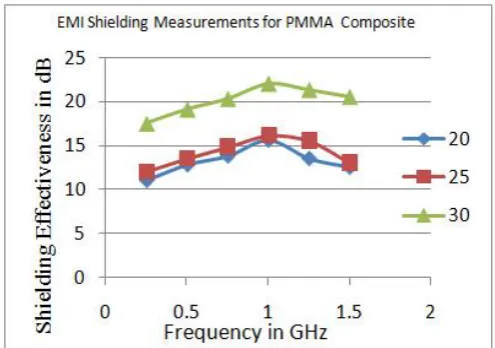
As a result of lower uniformity in distribution of Ni-P-W CNC particles (30 %) in PMMA there is decrease in Conductivity of the composite sheet (Fig. 10) as a result of which the EMI shielding effectiveness is around 23dB at 1 GHz (Fig. 11). 30% Ni-P-W CNC composite sheet was taken for EMI measurements since this composition showed highest conductivity.
[image:5.595.310.561.53.228.2]Fig. 10. Conductivity of PMMA composite sheet for different wt% of Ni-P-W CNC
[image:5.595.307.560.269.459.2]Fig. 11. EMI Measurements for PMMA Composite sheet for 30% Ni-P-W CNC
Fig. 12. Conductivity of ABS composite sheet for different wt% of Ni-P-W CNC
Fig. 13. EMI Measurements for ABS Composite sheet for 30% Ni-P-W CNC
The conductivity of Ni-P-W CNC particles in ABS matrix (Fig. 12) was higher than in the case of PMMA polymer due to higher uniformity of distribution of the particles in the composite sheet. Thus the EMI shielding effectiveness (Fig. 13) is higher in the case of Ni-P-W CNC distributed composite sheet. Here also 30% composition was taken for EMI studies as this composition has highest conductivity.
Conclusions
Eletroless method has been successfully adopted for coating Ni-P-W alloy on Nanocenospheres particles which can be observed through SEM, XRD & EDX. The processing of particles distribution in ABS matrix
is quite uniform which can be further being improved. Conductivity was found to be 0.02 S/m for 30Wt% of
Ni-P-W CNC/ABS composite. There is a scope for further improvement in conductivity by addition of Nano fillers along with CNC.
Shielding Effectiveness is found to be appreciable at 1GHz for 30Wt% of Ni-P-W CNC/ABS composite.
REFERENCES
[image:5.595.45.289.393.552.2] [image:5.595.41.289.593.767.2]Cenospheres: Composition, Morphology, Structure and Helium Permeability”, World of Coal-Ash Conference, May 9-11, 2011in Denver, USA.
John Noto, Gary Fenical and Colin Tong, “Automotive EMI Shielding-Controlling Automotive Electronic Emissions and Susceptibility with Proper EMI Suppression Methods”, April 1, 2010.
Sadhana, “Electroless Alloy/Composite Coatings: A Review”, Vol. 28, Parts 3 & 4, June/August (2003) pp. 475– 493Supriyoroy and Prasanta Sahoo, “Corrosion study of Electroless Ni-P-W coating using Electrochemical Impedance Spectroscopy”, 2012, ACTA. ISSN 1647-1571.