ISSN Online: 2327-6053 ISSN Print: 2327-6045
DOI: 10.4236/msce.2018.68002 Aug. 8, 2018 9 Journal of Materials Science and Chemical Engineering
Microstructure Evolution and Simulation in
22MnB5 Steel during Hot Stamping
Kuanhui Hu, Shizheng Zhou, Rongdong Han, Jun Gao, Yi Yang
Wuhan Iron & Steel Co. Ltd., Wuhan, China
Abstract
Hot stamping components with 1500 MPa ultra-high strength are obtained by press hardening during hot stamping, and the properties depend on the microstructures. It is very important that the microstructure evolution rule is found out during hot stamping process. To characterize the microstructure evolution during hot stamping, a method combining finite element and expe-riment is carried out. Samples were heated to 950˚C and held for 300 second at a induction heating furnace, then taken out from the furnace and stayed in the air at different time (7 s, 11 s, 13 s, 22 s), respectively, finally the speci-mens were formed and quenched at a die. Microstructural observation as well as surface hardness profiling of formed specimens was performed. And the numerical simulation to predict the austenite transformation into ferrite, pearlite, bainite, and martensite and the volume fraction of each phase during the hot stamping process was made with ABAQUS software. The results show that the ferrite is observed when the specimen stays in the air for 22 s, and the temperature drops to 325˚C when the dwell time increases from 7 s to 22 s. The results of numerical simulation and experimental results are in good agreement. So the method finite element can be used to guide the optimiza-tion of hot stamping process parameters.
Keywords
Hot Stamping Process, Simulation, Microstructure Evolution, 22MnB5 Steel
1. Introduction
Even though a new generation advanced high strength steels with ultra-high strength and excellent formability are developed. The application of press har-dening steel is still increased for the safety parts of body in white, due to the much higher demand for light weight of car body, guaranteeing the driver and How to cite this paper: Hu, K.H., Zhou,
S.Z., Han, R.D., Gao, J. and Yang, Y. (2018) Microstructure Evolution and Simulation in 22MnB5 Steel during Hot Stamping. Journal of Materials Science and Chemical Engineering, 6, 9-14.
https://doi.org/10.4236/msce.2018.68002
Received: July 19, 2018 Accepted: August 5, 2018 Published: August 8, 2018
Copyright © 2018 by authors and Scientific Research Publishing Inc. This work is licensed under the Creative Commons Attribution International License (CC BY 4.0).
DOI: 10.4236/msce.2018.68002 10 Journal of Materials Science and Chemical Engineering passenger safety, and lower gas emission [1][2]. During hot stamping process, the steel sheets are austenitized at temperatures between 900˚C and 950˚C and soaked for 4 to 8 minutes to obtain a homogenous austenitic microstructure. Then the heated steel sheets are transferred from the oven to a die with cooling system. The steel sheets are formed and quenched in the cooled die, and com-plex geometries parts are obtained due to the high formability of the hot materi-al. During quenching process, the austenitic microstructure transforms into a martensitic one. The ultimate tensile strength of the steel sheets is increased to approximately 1500 MPa because of the martensite evolution [3]. So the micro-structure evolution during hot stamping process is important.
Nikravesh, et al. [4] simulated the hot stamping process by a deformation di-latometer to investigate the phase transformations. Wu, et al. [5] developed a coupled 3D thermomechanical phase transformation finite element simulation of the hot stamping process. The mechanism of martensitic transformation was investigated by Khan [6]. New models were developed to predict the grain growth during hot stamping process by Zhu, et al. [7]. Nevertheless, the effect of time to stay in the air of the austenitizing steel sheet on the phase transforma-tions has rarely been investigated and unclear.
In this paper, the effect of the time of staying in the air during the samples being transferred on the phase transformation was analyzed, considering the in-fluence of the sample temperature on the diffusion and diffusionless phase transformation. The current work focus on the influence of the different time of staying in the air on subsequent phase transformations. And the volume fraction of each phase during the hot stamping process was numerical simulated with ABAQUS software.
2. Experimental Methods
1.5 mm sheet of 22MnB5 press hardening steel with a composition of Fe-0.22C- 0.25Si-1.20Mn-0.20Cr-0.002B (wt%) was used in this work. The microstructures of as-reveived steel are 76% ferrite and 24% pearlite.
The samples were heated up to 950˚C for 300 s, then taken out from the fur-nace and stayed in the air at different time (7 s, 11 s, 13 s, 22 s), that is sample transfer time, respectively, finally the specimens were formed and quenched at a die with water cooling system. And this process was simulated by using ABAQUS software. The microstructures were examined by light optical micro-scope, and the samples were inlayed in epoxy resin, ground and polished into mirror face using 180, 400, 800 and 1200 emery papering, subsequently by 2.5 μm and 1 μm polishing agent. The specimens were then etched using a 3% Natal solution for microstructure observation. And the volume fraction of every phase with different transfer time was simulated.
3. Results and Discussion
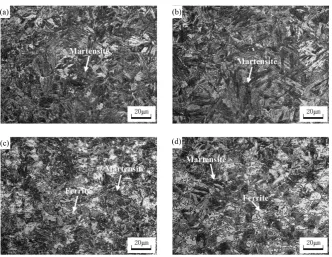
DOI: 10.4236/msce.2018.68002 11 Journal of Materials Science and Chemical Engineering Figure 1. Microstructures obtained after hot stamping process with a transfer time: (a) 7 s, (b) 11 s, (c) 13 s, (d) 22 s.
with different transfer time. As shown in Figure 1(a) and Figure 1(b), the spe-cimens after hot stamping process with 7 s an 11 s transfer time obtain a fully martensitic microstructure. This is due to the austenitized specimens were still a fully austenitic microstructure before it were formed and quenched, because the temperature drop of the austenitized specimens was relatively small. Such as the temperature of the sample with 7 s transfer time reduced from 950˚C to 819˚C, the reduction temperature from 950˚C to 742˚C for the sample with 11 s transfer time. When the heated sample was stayed at air up to 13 s, as shown in Figure 1(c), based on the effects of temperature on the phase transformation behaviour, a small amount of the prior ferrite was generated. However a considerable amount of ferrite was appeared in the microstructure in Figure 1(d) after hot stamping process. Because the temperature of specimen with 22 s staying time at air was dropped from 950˚C to 625˚C, obviously, the heated sample had already entered the two phase region. So the austenitized specimens can not stay time longer than 11 s from the heating furnace to the die during hot stamping process.
3.2. Effect of Transfer Time on the Microstructure Based on
Simulating
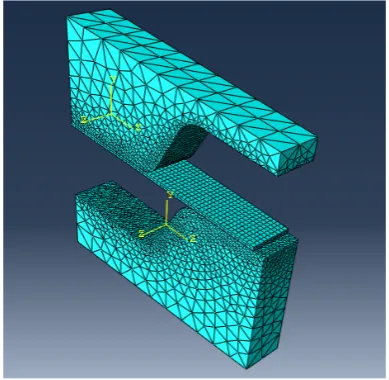
DOI: 10.4236/msce.2018.68002 12 Journal of Materials Science and Chemical Engineering Figure 2. The finite elements model.
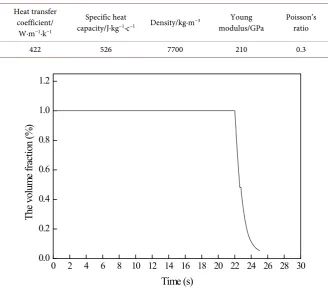
process, the material of die is H11, and the relevant parameters are showed in Table 1. The empirical JMAK constitutive relation is applied to calculate the volume fraction of the diffusion phase transformation. The following form of the JMAK relation is given [8]:
(
)
1 exp n
F= − − ×b t (1)
where F is the volume fraction of phase, b is a constant of the relevant of tem-perature, phase and grain size, t is current time, n is a constant of phase trans-formation, b and n can be obtained by the isothermal transformation curve cal-culation.
The diffusionless phase transformation from austenite into martensite is si-mulated by using the finite element method, the volume fraction of martensite can be calculated by the relation given [8]:
(
)
{
}
1 exp 0.011
m a s
F = F × − − × M T− (2)
where Fm is the volume fraction of martensite, Fa is the volume fraction of the
remaining austenite when the phase transformation from austenite into maten-site is start, Ms is the start temperature of martensitic transformation, T is the
actual time.
DOI: 10.4236/msce.2018.68002 13 Journal of Materials Science and Chemical Engineering Table 1. The relevant parameters of the die for the simulation of hot stamping process.
Heat transfer coefficient/
W·m−1·k−1
Specific heat
capacity/J·kg−1·c−1 Density/kg·m−3 modulus/GPa Young Poisson’s ratio
[image:5.595.208.539.404.520.2]422 526 7700 210 0.3
Figure 3. The volume fraction of austenite with different transfer time.
Figure 4. The distribution of martensite with 22 s transfer time.
4. Conclusion
The effect of transfer time on the phase transformation of hot stamping process is significant, the ferrite formation will occur when the transfer time is up to 13 s. and a considerable amount of ferrite was appeared in the microstructure with the transfer time 22 s. The results of numerical simulation and experimental re-sults are in good agreement. So the method finite element can be used to guide the optimization of hot stamping process parameters.
Conflicts of Interest
The authors declare no conflicts of interest regarding the publication of this pa-per.
0 2 4 6 8 10 12 14 16 18 20 22 24 26 28 30 0.0
0.2 0.4 0.6 0.8 1.0 1.2
The
vol
um
e f
ra
cti
on (
%
)
DOI: 10.4236/msce.2018.68002 14 Journal of Materials Science and Chemical Engineering
References
[1] Karbasian, H. and Tekkaya A.E. (2010) A Review on Hot Stamping. Journal of Ma-terials Processing Technology, 210, 2103-2118.
https://doi.org/10.1016/j.jmatprotec.2010.07.019
[2] Xing, Z.W., Bao, J. and Yang, Y.Y. (2009) Numerical Simulation of Hot Stamping of Quenchable Boron Steel. Materials Science and Engineering A, 499, 28-31. https://doi.org/10.1016/j.msea.2007.09.102
[3] Bardelcik, A., Worswick, M.J. and Wells, M.A. (2014) The Influence of Martensite, Bainite and Ferrite on the As-Quenched Constitutive Response of Simultaneously Quenched and Deformed Boron Steel—Experiments and Model. Materials and De-sign, 55, 509-525. https://doi.org/10.1016/j.matdes.2013.10.014
[4] Nikravesh, M., Naderi, M., Akbari, G.H. and Bleck, W. (2015) Phase Transforma-tions in a Simulated Hot Stamping Process of the Boron Bearing Steel. Materials and Design, 84, 18-24. https://doi.org/10.1016/j.matdes.2015.06.108
[5] Wu, W., Hu, P. and Shen, G. (2015) Thermomechanical-Phase Transformation Si-mulation of High-Strength Steel in Hot Stamping. Mathematical Problems in Engi-neering, 2015, Article ID: 982785. https://doi.org/10.1155/2015/982785
[6] Zhu, K., Chen, H., Masse, J.P., Bouaziz, O., et al. (2013) The Effect of Prior Ferrite Formation on Bainite and Martensite Transformation Kinetics in Advanced High-Strength Steels. Acta Materialia, 61, 6025-6036.
https://doi.org/10.1016/j.actamat.2013.06.043
[7] Zhu, L.J., Gu, Z.W., Xu, H., et al. (2014) Modeling of Microstructure Evolution in 22MnB5 Steel during Hot Stamping. Journal of Iron and Steel Research Interna-tional, 21, 197-201. https://doi.org/10.1016/S1006-706X(14)60030-3