QUANTITATIVE ESTIMATION OF ALCOHOL IN ALCOHOLIC BEVERAGES BY USING
DENSITOMETER AND ALCOLYZER
1
Alka Kumari,
1
Department of Forensic Science
2
Chemistry Division, Forensic Science Laboratory, Mahanagar
ARTICLE INFO ABSTRACT
This paper describe how one research team can uses variety of different solvents to analyze their different effect on density of alcohol to better understand the characteristics of alcohol. On many occasions now need to drink, so drinking security has beco
alcohol incidents endanger people’s lives. Different adulterants like methanol, ammonium chloride, Urea in poisoning cases are investigated by using Alcolyzer instrumentation technique. Adulterated alcoholic beverag
criminally adulterating them with water purposely putting them into new container to conceal their true origin or adding toxic substances to manipulate the qualities
serious health difficulties like metabolic problems, blindness, permanent neurological damage and even death [
massive alcohol
Ammonium chloride, also for treating patient of alcohol toxicant Normal saline (9%) solution is admistrated which cause neuro
Copyright©2017, Alka Kumari et al. This is an open access article distributed under the Creative Commons Att distribution, and reproduction in any medium, provided the original work is properly cited.
INTRODUCTION
An alcohol is an organic compound having OH (hydroxyl group). It can be diluted to a certain percentage in order to reduce its effect in human body who intakes it. An alcohol in alcoholic beverages i.e. ethanol is most widely used psychoactive drug in the world and is employed as depressant [I Journals: (IJSRC) ISSN: 2015]. The lethal dose of alcohol is 5 to 8g/Kg in adult and 3g/Kg in children, 300g of alcohol can kill which is equal to about 1 liter of spirits or four bottles of wine [Vonghia et al., 2008]. Its effectiveness decreases when the concentration in the product is less than 70% and increase when the concentration is greater than 75% [Dumas
et al., 2014]. Exposure to ethanol to in air and water is very low as it is broken down by sunlight. Most people will be exposed to ethanol in form of alcoholic beverages in which ethanol is found at varying concentration from 4% to 45%. However exposure to higher concentration may occur in an occupational setting such as in industry or a laboratory, wher 100% ethanol is sometimes used. Ethanol can cause adverse effects on the reproductive system in males and females and on fertility. It can also affect the foetus, such as causing fetal alcoholic syndrome which is characterized by abnormalities, lower birth rate,
*Corresponding author: Manoj K Verma,
Chemistry Division, Forensic Science Laboratory, Mahanagar, Lucknow, Uttar Pradesh, India.
ISSN: 0975-833X
Article History:
Received 28th October, 2016
Received in revised form 14th November, 2016
Accepted 18th December, 2016
Published online 31st January,2017
Key words:
Ethanol, Methanol, Urea, Ammonium chloride, Normal saline,
Densitometer and alcolyzer.
Citation: Alka Kumari, Neeraj Kumar and Manoj K Verma Alcolyzer”, International Journal of Current Research
RESEARCH ARTICLE
QUANTITATIVE ESTIMATION OF ALCOHOL IN ALCOHOLIC BEVERAGES BY USING
DENSITOMETER AND ALCOLYZER
Alka Kumari,
1Neeraj Kumar and *
,2Manoj K Verma
Department of Forensic Science, Banaras Hindu University, Varanasi
Chemistry Division, Forensic Science Laboratory, Mahanagar, Lucknow, Uttar Pradesh, India
ABSTRACT
This paper describe how one research team can uses variety of different solvents to analyze their different effect on density of alcohol to better understand the characteristics of alcohol. On many occasions now need to drink, so drinking security has become a bigger problem. There are many fake alcohol incidents endanger people’s lives. Different adulterants like methanol, ammonium chloride, Urea in poisoning cases are investigated by using Alcolyzer instrumentation technique. Adulterated alcoholic beverages are legal alcoholic products that have been illicitly tampered with, for instance by criminally adulterating them with water purposely putting them into new container to conceal their true origin or adding toxic substances to manipulate the qualities
serious health difficulties like metabolic problems, blindness, permanent neurological damage and even death [Magnύsdόttir et al., 2010]. This way of counterfeiting alcoholic drink was the reason of massive alcohol poisoning. Poisoning by toxic chemicals such as Methanol, Urea, Acetone, Ammonium chloride, also for treating patient of alcohol toxicant Normal saline (9%) solution is admistrated which cause neuro-depressive effect.
is an open access article distributed under the Creative Commons Attribution License, which distribution, and reproduction in any medium, provided the original work is properly cited.
alcohol is an organic compound having OH (hydroxyl group). It can be diluted to a certain percentage in order to reduce its effect in human body who intakes it. An alcohol in alcoholic beverages i.e. ethanol is most widely used ld and is employed as depressant ]. The lethal dose of alcohol is 5 to 8g/Kg in adult and 3g/Kg in children, 300g of alcohol can kill which is equal to about 1 liter of spirits or four bottles of Its effectiveness decreases when the concentration in the product is less than 70% and increase Dumas-Campagna Exposure to ethanol to in air and water is very Most people will be exposed to ethanol in form of alcoholic beverages in which ethanol is found at varying concentration from 4% to 45%. However exposure to higher concentration may occur in an occupational setting such as in industry or a laboratory, where 100% ethanol is sometimes used. Ethanol can cause adverse effects on the reproductive system in males and females and on fertility. It can also affect the foetus, such as causing fetal alcoholic syndrome which is characterized by organ
Chemistry Division, Forensic Science Laboratory, Mahanagar, Lucknow, Uttar
abnormal brain development and behavioral problems. However such effects are achieved only due to the consumption of alcoholic beverages rather than occupational exposure or use of consumer products containing ethanol [Bull, 2010]. The quantitative detection was done by using Densitometer and Alcolyzer. The Alcolyzer modules are based on patented NIR (Near infrared spectroscopy) analysis method to determine the alcohol content of various alcoholic beverages with highest accuracy. Different measuring modules used as Beer, Wine, Cider, Vodka, Whiskey cognac, Tequila, Rum, Molasses, Wash [Instruction Manual
Alcohol % v/v calculated by using a specific function of absorption intensity of NIR line of alcohol.
ρ100% alcohol (20˚c) = 0.7924g/cm
ρ = Density
Specific gravity of alcohol = ρ
The different adulterants used for adulteration of alcohol was Water, Methanol, Urea, Ammonium chloride, and the Normal saline (solution of 0.9% sodium chloride in distilled water)used for the treatment of alcohol toxicant. Any amount of water content will help to dilute alcohol concentration in body, so the higher water content, the less concentrated alcohol will become.
Alcohol metabolism rate in human body
metabolic capacity to remove alcohol is about 170 to 240 g/day
Available online at http://www.journalcra.com
International Journal of Current Research Vol. 9, Issue, 01, pp.45232-45236, January, 2017
Manoj K Verma, 2017. “Quantitative estimation of alcohol in alcoholic beverages by using densitometer and
International Journal of Current Research, 9, (01), 45232-45236.
z
QUANTITATIVE ESTIMATION OF ALCOHOL IN ALCOHOLIC BEVERAGES BY USING
Manoj K Verma
Banaras Hindu University, Varanasi
, Lucknow, Uttar Pradesh, India
This paper describe how one research team can uses variety of different solvents to analyze their different effect on density of alcohol to better understand the characteristics of alcohol. On many me a bigger problem. There are many fake alcohol incidents endanger people’s lives. Different adulterants like methanol, ammonium chloride, Urea in poisoning cases are investigated by using Alcolyzer instrumentation technique. Adulterated es are legal alcoholic products that have been illicitly tampered with, for instance by criminally adulterating them with water purposely putting them into new container to conceal their true origin or adding toxic substances to manipulate the qualities of alcoholic beverages, which cause serious health difficulties like metabolic problems, blindness, permanent neurological damage and
]. This way of counterfeiting alcoholic drink was the reason of poisoning. Poisoning by toxic chemicals such as Methanol, Urea, Acetone, Ammonium chloride, also for treating patient of alcohol toxicant Normal saline (9%) solution is
ribution License, which permits unrestricted use,
abnormal brain development and behavioral problems. However such effects are achieved only due to the consumption of alcoholic beverages rather than occupational exposure or use of consumer products containing ethanol ]. The quantitative detection was done by using Densitometer and Alcolyzer. The Alcolyzer modules are based infrared spectroscopy) analysis method to determine the alcohol content of various alcoholic beverages with highest accuracy. Different measuring modules used as Beer, Wine, Cider, Vodka, Whiskey cognac, Tequila, Rum,
Instruction Manual].
Alcohol % v/v calculated by using a specific function of absorption intensity of NIR line of alcohol.
˚c) = 0.7924g/cm3
alcohol/ρ water
The different adulterants used for adulteration of alcohol was Water, Methanol, Urea, Ammonium chloride, and the Normal saline (solution of 0.9% sodium chloride in distilled water)used for the treatment of alcohol toxicant. Any amount help to dilute alcohol concentration in body, so the higher water content, the less concentrated alcohol
Alcohol metabolism rate in human body: The average metabolic capacity to remove alcohol is about 170 to 240 g/day
INTERNATIONAL JOURNAL OF CURRENT RESEARCH
for a person with a body weight of 70 Kg, this would be equivalent to an average metabolic rate of about 7g/hr. which translate to about one drink per hour. Since alcoholic may consume 200 to 300g of ethanol per day [Clin Liver Dis Methanol has been added to legally produce wines to increase their “bite”. It is a potent toxicant in humans occurs naturally at a low level in most alcoholic beverages without causing harm, tolerable daily dose of Methanol in adult as 2g and toxic dose is 8g. Dose of 3-20ml cause serious damage to Central nervous system (CNS), and gastrointestinal tract irritation.
can consume 100ml standard measures of a drink containing 40% alcohol by volume over a period of 2 hrs. The maximum concentration of methanol in such drink would be
volume. Industrial alcohol contains 4% of methanol, as the consumption of alcohol by criminals making alcohol, which was after drinking, it will produce methanol poisoning. Lethal dose of methanol is about 70 ml, the maximum alcohol limit for human consumption 0.1g/Kg. The minimal lethal dose is considered to be in range of 300-1000 mg/kg. Ocular toxicity ranges from photophobia and blurred vision and an ingestion of 4-10ml of methanol in adults may cause permanent blindness. Although the body has the capacity to metabolize the low doses of methanol to which people regularly exposed, it cannot handle high dose because too much methanol overwhelms the body. The normal blood concentration of methanol from endogenous sources is less than 0.5mg/l, b
may increase blood methanol level. As the methanol concentration increases in alcoholic beverages it causes no changes in density of alcohol, density remains at 0.80g/cm But cause high toxicity [Paine et al., 2001;
Kathleen M. Nauss, 1990; Methanol (Environmental Health Criteria, 1997; 196)-ipcs inchem]. Urea reacts with alcohol to form Urethanes, The discovery of widespread presence of ethylcarbamate or urethane in alcoholic beverages first occurs during the mid-1980s. It is not actually toxic to humans. Acute toxicity studies so that the lowest fatal dose in rats, mice and rabbits equals to 1.2g/Kg or more. When urethane was used medicinally, about 50% of the patients exhibited hemorrhages. The compound has almost no odor and a cooling saline, bitter taste. The contents of urethane in alcoholic beverages vary over a wide range. The levels of urethane in wine ranged from 8µ/L, in stone-fruit brandies ranged from 100 to 22,000µg/kg, 80% of its present in spirits was formed during the distillation step and in beer 5.8µg/kg [Washington, 2016; National toxicology Program, Department of Health and Human Services, Report on carcinogens, 13th edition]. 0.9 % normal saline is frequently use of treat patient with acute alcohol in toxicant despite the lack of evidence for its efficacy. The theory behind the administration of normal saline not only counteract the dehydration effect of alcohol but might also have a dilution effect on the level of alcohol and it neurodepressive effect making a patients sober faster and there for spend the less time in emergency departments [Original research on Intravenous 0.9% sodium chloride therapy does not reduce length of stay of alcohol-intoxication patients in the emergency department: A randomized controlled trial, 2013]
MATERIALS
Highly pure methanol (99.9%) and ethanol (99.9%) of density 0.792g/cm3 and 0.790g/cm3 respectively, obtained from the MERK were used for preparing samples in different concentration, urea(Carmol brand) in solid form from market was bought, Distilled water from laboratory was collected, 10% Ammonium chloride solution and 0.9% normal saline were prepared. The laboratory work was carried out at the
45233 Alka Kumari et al. Quantitative estimation of alcohol in alcoholic beverages by using densitometer and Alcolyzer
body weight of 70 Kg, this would be equivalent to an average metabolic rate of about 7g/hr. which translate to about one drink per hour. Since alcoholic may Clin Liver Dis, 2012]. roduce wines to increase their “bite”. It is a potent toxicant in humans occurs naturally at a low level in most alcoholic beverages without causing harm, tolerable daily dose of Methanol in adult as 2g and toxic dose is mage to Central nervous system (CNS), and gastrointestinal tract irritation. Also an adult can consume 100ml standard measures of a drink containing 40% alcohol by volume over a period of 2 hrs. The maximum concentration of methanol in such drink would be 2 %( v/v) by volume. Industrial alcohol contains 4% of methanol, as the consumption of alcohol by criminals making alcohol, which was after drinking, it will produce methanol poisoning. Lethal dose of methanol is about 70 ml, the maximum alcohol limit The minimal lethal dose is 1000 mg/kg. Ocular toxicity ranges from photophobia and blurred vision and an ingestion of 10ml of methanol in adults may cause permanent blindness. has the capacity to metabolize the low doses of methanol to which people regularly exposed, it cannot handle high dose because too much methanol overwhelms the body. The normal blood concentration of methanol from endogenous sources is less than 0.5mg/l, but dietary sources may increase blood methanol level. As the methanol concentration increases in alcoholic beverages it causes no changes in density of alcohol, density remains at 0.80g/cm3.
., 2001; Robert Kavet and thleen M. Nauss, 1990; Methanol (Environmental Health Urea reacts with alcohol to form Urethanes, The discovery of widespread presence of ethylcarbamate or urethane in alcoholic beverages first occurs . It is not actually toxic to humans. Acute toxicity studies so that the lowest fatal dose in rats, mice and rabbits equals to 1.2g/Kg or more. When urethane was used medicinally, about 50% of the patients exhibited hemorrhages. odor and a cooling saline, bitter taste. The contents of urethane in alcoholic beverages vary over a wide range. The levels of urethane in wine ranged from 8µ/L, fruit brandies ranged from 100 to 22,000µg/kg, 80% of ed during the distillation step and National toxicology Program, Department of Health and Human Services, Report 0.9 % normal saline is frequently toxicant despite the lack of evidence for its efficacy. The theory behind the administration of normal saline not only counteract the dehydration effect of alcohol but might also have a dilution effect on the level of alcohol and it neurodepressive effect making a patients sober faster and there for spend the less time Original research on Intravenous 0.9% sodium chloride therapy does not reduce length of stay of intoxication patients in the emergency department: A
Highly pure methanol (99.9%) and ethanol (99.9%) of density respectively, obtained from the MERK were used for preparing samples in different concentration, urea(Carmol brand) in solid form from market was bought, Distilled water from laboratory was collected, 10% Ammonium chloride solution and 0.9% normal saline The laboratory work was carried out at the
chemistry division of Forensic science laboratory, Lucknow and was carried out by using instrument Densitometer and Alcolyzer Anton Paar DMA 4100M.
METHODS
Adulteration of Ethanol was done with
like Distilled water, Methanol, Urea, Ammonium chloride, Normal saline.
For Adulteration of ethanol with different adulterants: percentage of ethanol was taken by increasing the ethanol concentration with the difference of 10 ml
with different adulterants and makeup up to 100 ml.
Procedure for sampling in instrument
At first dilution of ethanol with different adulterants was done and makeup to 50 ml solution mixture of 90%, 80%, 70%, 60%, 50%, ethanol solution. All the mixture was kept in plastic tubes and sampled in instrument densitometer and X
alcolyzer, and the method setup was at Ethanol OIML (%v/v) and density was measured.
RESULTS AND DISCUSSION
Adulteration of ethanol with water
Observation:-
Table 1
Ethanol % taken Ethanol %
90% 86.57%
80% 79.51%
70% 70.02%
60% 56.74%
50% 47.81%
40% 37.46%
30% 27.12%
20% 18.75%
10% 9.45%
Figure 1
Discussion
As we adulterated ethanol with water simultaneously density increases while alcohol percent decreases as shown in
and Figure 1. The interesting thing observed was that up to the dilution of 50% color of solution become cloudy immediatel but above 50% dilution there is no change in color.
0.7 0.8 0.9 1
90 80 70 60
DENS
ITY (
G/CM
3)
ETHANOL % TAKEN
Adulteration of Ethanol with
water
Quantitative estimation of alcohol in alcoholic beverages by using densitometer and Alcolyzer
chemistry division of Forensic science laboratory, Lucknow and was carried out by using instrument Densitometer and Alcolyzer Anton Paar DMA 4100M.
Adulteration of Ethanol was done with different adulterants like Distilled water, Methanol, Urea, Ammonium chloride,
For Adulteration of ethanol with different adulterants: The percentage of ethanol was taken by increasing the ethanol concentration with the difference of 10 ml for each dilution with different adulterants and makeup up to 100 ml.
ure for sampling in instrument
At first dilution of ethanol with different adulterants was done and makeup to 50 ml solution mixture of 90%, 80%, 70%, All the mixture was kept in plastic tubes and sampled in instrument densitometer and X-sampler alcolyzer, and the method setup was at Ethanol OIML- ITS-90 (%v/v) and density was measured.
AND DISCUSSION
Adulteration of ethanol with water
Table 1.
Ethanol % v/v Density (in g/cm3)
86.57% 0.8401
79.51% 0.8606
70.02% 0.8855
56.74% 0.9163
47.81% 0.9344
37.46% 0.9520
27.12% 0.9657
18.75% 0.9751
9.45% 0.9854
Figure 1
As we adulterated ethanol with water simultaneously density
increases while alcohol percent decreases as shown in Table 1
. The interesting thing observed was that up to the dilution of 50% color of solution become cloudy immediately but above 50% dilution there is no change in color.
50 40 30 20 10
ETHANOL % TAKEN
Adulteration of Ethanol with
water
Showing color change while adulterating ethanol with water.
Adulteration of ethanol with methanol
Observation
Table 2.
Ethanol % taken Ethanol % v/v Density
50% 95.99%
40% 96.89%
30% 97.16%
20% 97.67%
10% 97.21%
Figure 2.
Discussion
As we adulterated the ethanol with methanol only slight variation was observed in density of ethanol while ethanol percentage decreases initially and after that it become almost constant, as shown in Table 2 and Figure 2.
Adulteration of ethanol with Ammonium chloride solution (10%)
Observation
Table 3.
Ethanol % taken Ethanol % v/v Density
50% 45.32%
40% 33.31%
30% 14.32%
20% 1.61%
10% Out of range
0.796 0.798 0.8 0.802 0.804 0.806
0.8080.81
50 40 30 20 10
DENS
ITY (
G/CM
3)
ETHANOL % TAKEN
Adulteration of Ethanol with
Methanol
45234 International Journal of Current Research,
Showing color change while adulterating ethanol with water.
Density (g/cm3)
0.8075 0.8038 0.8026 0.8003 0.8024
As we adulterated the ethanol with methanol only slight variation was observed in density of ethanol while ethanol percentage decreases initially and after that it become almost
Ammonium chloride solution
Density (g/cm3)
0.9390 0.9579 0.9797 0.9958 1.0098
Figure 3
Discussion
As we adulterated the ethanol with Ammonium chloride, as the ethanol percentage decreases density increases as shown in Table 3 and Figure 3. An interesting thing observed was at 10% dilution of ethanol, density
density of water (pure water at room temperature is about
1g/cm3) [Density, Department of Physical sciences
Kingsborough community College, The city university of New York Winter 2010].
Adulteration of ethanol with methanol and ammonium chloride
Observation
*
Mixture of ethanol % and methanol
adulterated by NH4Clsolution (10%)
Table 4
* Mixture % taken Ethanol %v/v
50% 40.63%
40% 25.28%
30% 9.24%
20% Out of range
10% Out of range
Figure 4 Discussion
As we adulterated the ethanol with mixture of Methanol and ammonium chloride, while decreasing ethanol percentage, density increases. Also at 10% and 20% dilution density was
Adulteration of Ethanol with
0.9 0.92 0.94 0.96 0.98 1 1.02
50 40 30 20
DENS
ITY (G/
CM
3)
ETHANOL % TAKEN
Adulteration of Ethanol with
NH
0.9 0.92 0.94 0.96 0.98 1 1.02
50 40 30 20
DENS
ITY (G/
CM
3)
MIXTURE % TAKEN
Adultration of Ethanol with Mixture of Methanol and NH
International Journal of Current Research, Vol. 9, Issue, 01, pp.45232-45236, January, 2017
Figure 3.
As we adulterated the ethanol with Ammonium chloride, as the ethanol percentage decreases density increases as shown in . An interesting thing observed was at density approximately reached to the (pure water at room temperature is about
Density, Department of Physical sciences
Kingsborough community College, The city university of New
Adulteration of ethanol with methanol and ammonium
and methanol % taken in 1:1 ratio, was Clsolution (10%)
Table 4.
Ethanol %v/v Density (g/cm3)
40.63% 0.9470
25.28% 0.9678
9.24% 0.9856
Out of range 1.0022
Out of range 1.0079
Figure 4.
As we adulterated the ethanol with mixture of Methanol and ammonium chloride, while decreasing ethanol percentage, density increases. Also at 10% and 20% dilution density was
10
ETHANOL % TAKEN
Adulteration of Ethanol with
NH
4Cl
10 MIXTURE % TAKEN
Adultration of Ethanol with
Mixture of Methanol and NH4Cl
approximately reached to that of water density as shown in Table 4 and Figure 4.
Adulteration of ethanol with Urea (solid)
Observation
Table 5.
Concentration taken(in ml) Ethanol
% v/v
100% Ethanol(ml) Urea(gm)
50 0.5 93.03%
50 1.0 92.17%
50 1.5 91.84%
50 2.0 88.97%
Figure 5.
Discussion
As we added urea in ethanol (taking constant amount of 50ml) density was slightly increases as the quantity of urea increases, shown in given Table 5 and Figure 5.
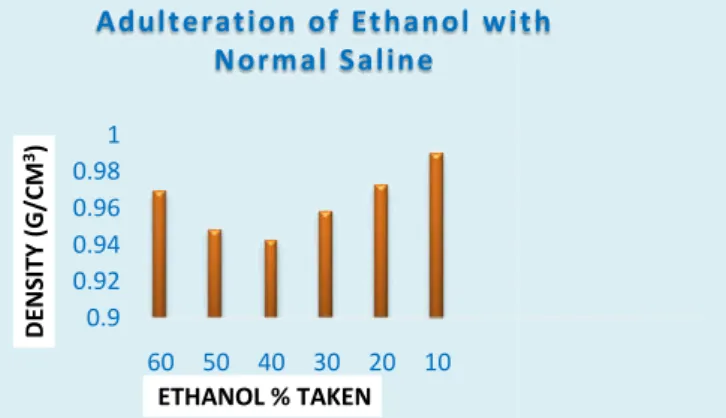
Dilution of ethanol with Normal saline
Observation
Table 6.
Ethanol % taken Normal saline Ethanol % v/v
60% 6% 23.47%
50% 5% 39.66%
40% 4% 43.01%
30% 3% 33.21%
20% 2% 20.75%
10% 1% 5.75%
Note: - Percentage of normal saline was taken different for each dilution.
Figure 6.
0.81 0.815 0.82 0.825 0.83 0.835
0.5 1 1.5 2
DENS
ITY (
G/CM
3)
AMOUNT OF UREA
Adulteration of Ethanol with Urea
0.9 0.92 0.94 0.96 0.98 1
60 50 40 30 20 10
DENS
ITY (G/
CM
3)
ETHANOL % TAKEN
Adulteration of Ethanol with Normal Saline
45235 Alka Kumari et al. Quantitative estimation of alcohol in alcoholic beverages by using densitometer and Alcolyzer
approximately reached to that of water density as shown in
Ethanol % v/v
Density ( g/cm3)
93.03% 0.8188
92.17% 0.8218
91.84% 0.8230
88.97% 0.8326
As we added urea in ethanol (taking constant amount of 50ml) density was slightly increases as the quantity of urea increases,
Density (g/cm3)
0.9698 0.9486 0.9430 0.9581 0.9729 0.9901 Percentage of normal saline was taken different for each dilution.
Discussion
As we diluted ethanol with normal saline, by decreasing the ethanol percentage, density also decreases up to 40% and after that density increases as shown in
Conclusion
It is widely accepted in the scientific community that inhaling the Alcoholic Beverages is responsible for adverse health effects. Adulteration of ethanol with different
done for determination of density change for different ethanol concentration. While adulterating ethanol with water, Ammonium Chloride solution and the mixture (NH +Methanol) density increases while ethanol percentage decreases. But in case of Normal s
density decreases and after it increases. And in case of adulteration with Methanol and Urea there is very slight change in density of ethanol. The very interesting thing observed in this experiment was the colour change of solutio when adulterating with water.
done with NH4Cl solution and mixture of NH
at 10% and 20% density reached to the density of water. Therefore in this experiment it is shown that how this adulterants are used for manipulating the quantity of alcoholic beverages cause serious health difficulties like Metabolic and neurological damage and effect on fertility, But Normal saline used for treating patient with acute alcohol in toxicant and it cause neuro-depressive effect making patient sober faster.
Acknowledgement
This research was successfully completed in Chemistry department of Forensic Science laboratory, Lucknow, India. We thanks to the Director of Forensic Science Laboratory who provides us Lab for working. We wo
gratitude to the librarian of FSL for sharing their pearls of wisdom with us during the course of this research, although any errors are our own and should not tarnish the reputation of these esteemed persons.
REFERENCES
[Magnύsdόttir K, et al. leaknabladid. Adulterated alcoholic beverages, 2010 Oct, 96 (10): 626
Clin Liver Dis, Alcohol Metabolism clinics in Liver Disease, 2012 Nov., 1694):667-687.
Density, Department of Physical sciences Kingsborough community College, The
Winter 2010; 10th edition, pp. 18
Dumas-Campagna et al. 2014. J Environ Anal Toxicol
I Journals: International Journal of Social Relevance and Concern (IJSRC) ISSN: 2015 July, vol. 3, issue 7, 2347 9698.
Instruction Manual, Alcolyzer ME, Alcolyzer(Beer ME, Wine ME, Shake ME, Spirits ME), pages 9,21; Version 2.60 Methanol (Environmental Health Criteria, 1997; 196)
inchem.
National toxicology Program, Department of Health and Human Services, Report on carcinogens,
urethane CAS NO. 51-79-6.
Original research on Intravenous 0.9% sodium chloride therapy does not reduce length of stay of alcohol intoxication patients in the emergency department: A
Adulteration of Ethanol with
Adulteration of Ethanol with
Quantitative estimation of alcohol in alcoholic beverages by using densitometer and Alcolyzer
As we diluted ethanol with normal saline, by decreasing the ethanol percentage, density also decreases up to 40% and after that density increases as shown in Table 6 and Figure 6.
It is widely accepted in the scientific community that inhaling the Alcoholic Beverages is responsible for adverse health effects. Adulteration of ethanol with different adulterants was done for determination of density change for different ethanol concentration. While adulterating ethanol with water,
Ammonium Chloride solution and the mixture (NH4Cl
+Methanol) density increases while ethanol percentage decreases. But in case of Normal saline dilution up to 40% density decreases and after it increases. And in case of adulteration with Methanol and Urea there is very slight change in density of ethanol. The very interesting thing observed in this experiment was the colour change of solution when adulterating with water. Also when adulteration was
Cl solution and mixture of NH4Cl and Methanol
at 10% and 20% density reached to the density of water. Therefore in this experiment it is shown that how this nipulating the quantity of alcoholic beverages cause serious health difficulties like Metabolic and neurological damage and effect on fertility, But Normal saline used for treating patient with acute alcohol in toxicant and it
making patient sober faster.
This research was successfully completed in Chemistry department of Forensic Science laboratory, Lucknow, India. We thanks to the Director of Forensic Science Laboratory who We would also like to show our of FSL for sharing their pearls of wisdom with us during the course of this research, although any errors are our own and should not tarnish the reputation of
leaknabladid. Adulterated alcoholic beverages, 2010 Oct, 96 (10): 626-8].
Clin Liver Dis, Alcohol Metabolism clinics in Liver Disease,
Density, Department of Physical sciences Kingsborough community College, The city university of New York
edition, pp. 18-19.
J Environ Anal Toxicol., 5:2.
International Journal of Social Relevance and
2015 July, vol. 3, issue 7,
2347-Manual, Alcolyzer ME, Alcolyzer(Beer ME, Wine ME, Shake ME, Spirits ME), pages 9,21; Version 2.60 Methanol (Environmental Health Criteria, 1997; 196)-ipcs
National toxicology Program, Department of Health and
Human Services, Report on carcinogens, 13th edition,
6.
Original research on Intravenous 0.9% sodium chloride therapy does not reduce length of stay of alcohol-intoxication patients in the emergency department: A
randomized controlled trial. Vol. 25, issue 6; Dec. 2013, pages 527-534.
Paine A, et al. Hum Exp Toxicol. Defining a tolerable concentration of methanol in alcoholic drinks, 2001.
Robert kavet, Sc.D, and Kathleen M. Nauss, Ph.D.; The
toxicity of inhaled Methanol vapors, 1990. Vol.-21, Issue 1. S Bull CRCE HQ, Health protection Agency, Ethanol general
information 2010 version 1
U.S. EPA, Washington, D.C Office of toxic substances,
Chemical Hazard information profile urethane, 2006 may 13; 12 pages, 26 references.
Vonghia, L., leggio, L., ferrulli, A., Bertini, M., Gasbarrini G., Addolorato, G., et al. 2008. European Journal of Internal Medicine, 19 (8), 561-567.