RESISTANCE OF BIO-BASED CEMENTITIOUS MATERIAL TO ACID ATTACK
*
Leena Chaurasia
Bio-Concrete Laboratory, Environmental Science and Technology Group, CSIR
ARTICLE INFO ABSTRACT
Concrete although is a mechanically strong construction material, but suffer from several inherent drawbacks, such as low tensile strength, permeability to liquid and consequent corrosion of reinforcement, susceptibility to chemical attack and low durabili
Therefore, properties such as strength, permeability, crack formation and corrosion properties defines the overall quality of concrete. To improve the overall performance of concrete from these deficiencies, microbial m
microorganisms in concrete has been attempted. Concrete incorporated bacteria can produce copious amounts of minerals which can potentially seal freshly formed cracks. However, its p
presence of acid need to be understood. This paper reports the effects of microbial calcite precipitation on parameters affecting the transport processes and durability of mortar. To study the effect of durability, mortar cubes with and witho
attack. Treatments were evaluated by visualizing and calculating the extent of acid attack in terms of % strength loss and % weight loss on 0.5%HCl and H
of the
terms of acid attack factor and increased durability in terms of acid durability factor. Microbial calcite precipitation was quantified by X
deposition of a layer of calcite on the surface of the specimens resulted in reduction in pore percentage and therefore, a decrease of acid ingress inside the mortar specimen was detected. From all the aforesaid stud
Copyright © 2015 Leena Chaurasia and Vishakha Bisht
unrestricted use, distribution, and reproduction in any medium, provided the original work is properly cited.
INTRODUCTION
Although concrete is the widely used construction material despite its versatility in construction, it suffers from cracks due to various reasons in its service life. The mechanisms such as drying shrinkage, freeze-thaw reactions and mechanical compressive forces give rise to cracks in concrete
2007). Although micro cracks (width smaller than 0.2mm) can self-heal, do not affect strength properties of concrete structures directly but they contribute to material porosity and permeability which leads to ingression of aggressive chemicals such as chlorides, sulfates and acids that results in concrete matrix degradation and premature corrosion of the embedded reinforcement hampering the structural performance in the
long term (Jonkers and Schlangen, 2008). Crack prevention is
often employed by steel reinforcement which is highly
*Corresponding author: Leena Chaurasia,
Bio-Concrete Laboratory, Environmental Science and Technology Group, CSIR-Central Building Research Institute, Roorkee India.
ISSN: 0975-833X
Vol.
Article History:
Received 14th August, 2015 Received in revised form 05th September, 2015 Accepted 07th October, 2015 Published online 30th November,2015
Citation: Leena Chaurasia and Vishakha Bisht,
of Current Research, 7, (11), 23112-23118.
Key words: Acid attack, Bio-admixture, Concrete, Cracks, Durability,
Microbial calcite precipitation.
RESEARCH ARTICLE
BASED CEMENTITIOUS MATERIAL TO ACID ATTACK
Leena Chaurasia and Vishakha Bisht
Environmental Science and Technology Group, CSIR-Central Building Research
Institute, Roorkee-247 667, India
ABSTRACT
Concrete although is a mechanically strong construction material, but suffer from several inherent drawbacks, such as low tensile strength, permeability to liquid and consequent corrosion of reinforcement, susceptibility to chemical attack and low durabili
Therefore, properties such as strength, permeability, crack formation and corrosion properties defines the overall quality of concrete. To improve the overall performance of concrete from these deficiencies, microbial mineral precipitation resulting from metabolic activities of some specific microorganisms in concrete has been attempted. Concrete incorporated bacteria can produce copious amounts of minerals which can potentially seal freshly formed cracks. However, its p
presence of acid need to be understood. This paper reports the effects of microbial calcite precipitation on parameters affecting the transport processes and durability of mortar. To study the effect of durability, mortar cubes with and without Bacillus cohnii were cast and subjected to acid attack. Treatments were evaluated by visualizing and calculating the extent of acid attack in terms of % strength loss and % weight loss on 0.5%HCl and H2SO4 exposed mortar specimens. The durability
bacteria treated specimens have been studied by measuring the resistance against acid attack in terms of acid attack factor and increased durability in terms of acid durability factor. Microbial calcite precipitation was quantified by X-ray diffraction analysis and visualized by SEM. Bacterial deposition of a layer of calcite on the surface of the specimens resulted in reduction in pore percentage and therefore, a decrease of acid ingress inside the mortar specimen was detected. From all the aforesaid studies it was revealed that bio-concrete is more durable.
Leena Chaurasia and Vishakha Bisht. This is an open access article distributed under the Creative Commons Att use, distribution, and reproduction in any medium, provided the original work is properly cited.
Although concrete is the widely used construction material, despite its versatility in construction, it suffers from cracks due to various reasons in its service life. The mechanisms such as thaw reactions and mechanical
compressive forces give rise to cracks in concrete (Jonkers,
Although micro cracks (width smaller than 0.2mm) can heal, do not affect strength properties of concrete structures directly but they contribute to material porosity and permeability which leads to ingression of aggressive chemicals sulfates and acids that results in concrete matrix degradation and premature corrosion of the embedded reinforcement hampering the structural performance in the . Crack prevention is ement which is highly
Concrete Laboratory, Environmental Science and Technology Central Building Research Institute, Roorkee-247 667,
expensive and requires large amount of steel which wi
be acceptable. From the perspective of durability, rapid sealing of freshly formed surface cracks is important as this prevents the ingress of moisture and other aggressive chemicals into
concrete matrix (Jonkers, 2009)
in use for crack repair like impregnation of cracks with epoxy based fillers, latex binding agents such as acrylic, polyvinyl acetate, butadiene styrene, etc. However, there are several disadvantages associated with these in
namely i)different thermal expansion coefficient/s compared to concrete, ii) weak bonding, iii) environmental
hazards along with iv) high cost of the polymers/chemicals Belie and De Muynck 2009)
autonomous capacity to self-heal cracks smaller than 0.2mm width but in such cases, the alternative and robust way to overcome these disadvantages is by use of bioconcrete (bacteria incorporated in concrete). Currently, urease enzyme activity in most of the microorganism’s metabolic processes have been used as a tool to induce the precipitation of calcite. Available online at http://www.journalcra.com
International Journal of Current Research
Vol. 7, Issue, 11, pp.23112-23118, November, 2015
INTERNATIONAL
, 2015. “Resistance of Bio-Based Cementitious Material to Acid Attack z
BASED CEMENTITIOUS MATERIAL TO ACID ATTACK
Central Building Research
Concrete although is a mechanically strong construction material, but suffer from several inherent drawbacks, such as low tensile strength, permeability to liquid and consequent corrosion of reinforcement, susceptibility to chemical attack and low durability, ultimately reduced service life. Therefore, properties such as strength, permeability, crack formation and corrosion properties defines the overall quality of concrete. To improve the overall performance of concrete from these ineral precipitation resulting from metabolic activities of some specific microorganisms in concrete has been attempted. Concrete incorporated bacteria can produce copious amounts of minerals which can potentially seal freshly formed cracks. However, its performance in presence of acid need to be understood. This paper reports the effects of microbial calcite precipitation on parameters affecting the transport processes and durability of mortar. To study the ut Bacillus cohnii were cast and subjected to acid attack. Treatments were evaluated by visualizing and calculating the extent of acid attack in terms of exposed mortar specimens. The durability bacteria treated specimens have been studied by measuring the resistance against acid attack in terms of acid attack factor and increased durability in terms of acid durability factor. Microbial calcite alysis and visualized by SEM. Bacterial deposition of a layer of calcite on the surface of the specimens resulted in reduction in pore percentage and therefore, a decrease of acid ingress inside the mortar specimen was detected. From all
concrete is more durable.
is an open access article distributed under the Creative Commons Attribution License, which permits
expensive and requires large amount of steel which will never be acceptable. From the perspective of durability, rapid sealing of freshly formed surface cracks is important as this prevents the ingress of moisture and other aggressive chemicals into the , 2009). Many traditional methods are in use for crack repair like impregnation of cracks with epoxy based fillers, latex binding agents such as acrylic, polyvinyl acetate, butadiene styrene, etc. However, there are several disadvantages associated with these in vogue repair systems, namely i)different thermal expansion coefficient/s compared to concrete, ii) weak bonding, iii) environmental and health
hazards along with iv) high cost of the polymers/chemicals (De
De Muynck 2009). Although cement has
heal cracks smaller than 0.2mm width but in such cases, the alternative and robust way to overcome these disadvantages is by use of bioconcrete (bacteria incorporated in concrete). Currently, urease enzyme e microorganism’s metabolic processes have been used as a tool to induce the precipitation of calcite.
INTERNATIONAL JOURNAL OF CURRENT RESEARCH
Copious production of endospore forming bacteria-mediated bio-minerals subsequently results in clogging and crack
closure, reducing material permeability and leakage.
Biologically induced self-healing is a promising technology to increase the strength, life and durability of concrete structures. Biomineralization is one of the best eco-friendly techniques to tackle the problem of cracks in concrete structures. The consumption of oxygen during the metabolic biochemical
reactions to form CaCO3 helps in arresting corrosion of steel
because the oxygen is responsible to initiate the process of corrosion. This method was already showing positive results in the field of prevention of acid mine drainage, prevention of
leaching in channels and other such areas (Ghosh and Mandal,
2006). The evidence of microorganism involvement in calcite precipitation has led the development of bioprocess technology in the field of construction materials. Such bio based concrete is able to autonomously reduce matrix permeability substantially will be less susceptible to leakage and consequent reinforcement corrosion. It will not only save maintenance and repair cost considerably but also increases the service life of a construction. This phenomenon will reduce the need of raw materials, energy consumption and emission of waste products, particularly increased service life and reduced consumption of synthetic repair materials which are traditionally used for crack repair. Self-healing bioconcrete thus represents a more durable and sustainable alternative of classical concrete.
Experimental investigation
MATERIALS
The following are the material composition for development of bio-concrete mix.
Bacterial sources
The cultures of Bacillus cohnii (MTCC 10221) and Bacillus
megaterium (MTCC 10086) were obtained from Microbial
Type Culture Collection and Gene Bank, CSIR- Institute of Microbial Technology, Chandigarh. Both the strains of bacteria which were used for investigation were found gram positive and endospore forming. The urease positive test was carried out using phenol red indicator, which change the color of urea based broth from yellow to pink.
Maintenance of stock cultures
The bacterial strains were maintained constantly on nutrient agar slants and nutrient agar plates at pH 8.5 and were preserved in deep freezer (-80ºC) until further use. All the inoculated plates were incubated at 30ºC in Innova 44 shaker incubator. Colonies were observed after 24 and 48 hrs for
B.cohnii and B.megaterium, respectively. Sub culturing of
culture medium was carried out in every 15 days and contamination was checked periodically by streaking on nutrient agar plates.
Media composition for growth of bacteria
The bacteria were cultured in Himedia urea based broth. Calcium chloride hydrate was used as a source of calcium for
precipitation of calcium carbonate. Aseptically 20g/liter of 40% urea and calcium source (calcium chloride) was also added after sterilization.
Cement
Ordinary Portland cement of 43 grade was used in the mix. The cement has been tested for various properties as per IS: 4031-1988 and found to be confirming to various specifications of IS: 12269-1987.
Sand
Natural river sand well graded passing through 60 µm sieve was used. Specific gravity was found to be 2.63. Fineness modulus was found to be 2.1, water absorption 0.26% and confirming to zone III.
Water
All mortar mixing was done using tap water.
Specimen preparation
Preparation of bio-admixture incorporated mortar cubes
Mortar cubes were prepared in 50.8 mm3 cube mould,
composed of one part of cement, four parts of standard sand by mass and (P/4 + 3) per cent (of combined weight of cement and sand), water (where P is the percentage of water required to produce a paste of standard consistency) and prepared, stored
and tested in the manner described in IS 4031: Part 6 (1988).
Control mortar specimens were casted without the addition of bio-admixture i.e biomass + chemical feed (calcium lactate). Optimised dose of bio-admixture was incorporated into mortar specimens in non-control/bacterial mortar specimens. Casting was undertaken in two sets for two different acids namely HCl
and H2SO4, each set comprise of control specimens, biomass
and calcium lactate incorporated specimen. In each set, total 36 cubes having 18 specimens each of control and bio-admixture were casted. Out of 18 specimens of control 9 were kept in
water, another 9 in 0.5% HCL and/or 0.5% H2SO4. Same trend
is followed in bacteria, calcium lactate incorporated specimens such that effect of acid can be observed distinctly. Each 9 specimens of water and acid exposed bio-admixture treated and non-treated specimens were categorized in sets of three specimens for durability studies after 30,60 and 90 days duration.
Standardized method for crack generation
Cracks of 0.3 mm width and 10-15 mm depth were generated
on mortar cubes of dimension 50.8 mm3 through insertion of
aluminum plate (0.3 mm) at the time of casting .The aluminium plate was inserted into the wet mortar mixture to a depth of 25 mm and removed. Demolding of moulds was done after 24hrs. After demolding all specimens were cured in water at room temperature (27± 2°C) for 28 days.
Tests procedures
After casting of 50mm3 mortar specimens and initial curing for
admixture), were immersed in 0.5% HCl and another set was
immersed in 0.5% H2SO4 to study the effect of exposure to
acidic environment. The arrangement of the specimens in the curing container was done in manner such that the clearance around and above the specimen should not be less than 30mm. The solution was refreshed in every 15 days. The effect of acid on the specimen were constantly monitored through visual observation, residual alkalinity, weight loss, strength loss, Acid Durability Factor and Acid Attack Factor measurement during the experimentation.
Study of bacterial growth curve
Fresh medium was inoculated with B. cohnii and the population
growth was monitored over a period of time. Graph of optical density (O.D) verses time was then plotted by taking O.D at 600 nm after every 5 hours till 30hrs of incubation.
Visual observation
On exposure of 0.5% HCl and H2SO4, the mortar specimens
(control and bacterial) were observed after regular interval of time for color change at surface, corners and edges. The extent of deterioration was observed with time and difference in destruction level in specimens was noticed and compared.
Residual alkalinity
Residual alkalinity was determined after cutting the specimens into halves us in low speed saw and spraying 1% phenolphthalein solution on the freshly cut surface.
Weight loss, Strength loss
Universal testing machine was employed to determine the compressive strength of the specimen at regular intervals. Specimens for weight change measurements were initially primed in water for 3 days and its weight in saturated surface dry condition was taken as initial weight.
Acid Durability Factor and Acid Attack Factor on control and bacterial mortar
To determine the concrete resistance to aggressive environment such as acid attack, the durability factors are proposed by the author as described in ASTM C666-1997, as the basis. In the present investigation, the “Acid Durability Factor” is derived in terms of relative strength of the specimens which is taken with respect to 28 days value.
Acid Durability Factor (ADF) = Sr N/M
Where,
Sr = relative strength at N days, (%)
xposure period.
N = number of days at which the durability factor is needed. M = number of days at which the exposure is to be terminated.
Acid Attack test was terminated at 90 days, So, M is 90 days in this case. The extent of deterioration at each corner of the struck face and the opposite face is measured in terms of the solid diagonals (in mm) for each of two cubes and the Acid Attack Factor (AAF) per face is calculated as follows:
Acid Attack Factor (AAF) = ( Loss in mm on eight corners of each of 2 cubes)/The percentage weight loss and strength loss
at 30,60and 90 days of acid exposure has been presented in
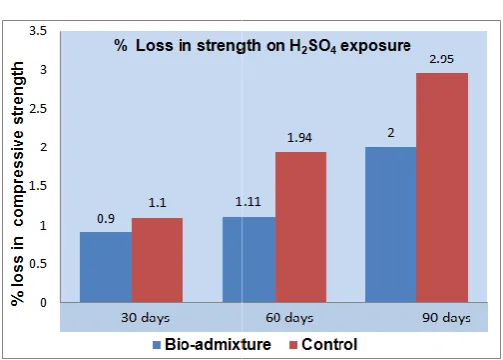
Table-1 and Fig.5. Acid Durability Factor (ADF)and Acid Attack Factor(AAF) are presented in Table-2,3 and Figures 5,6.
SEM - EDAX Analysis
SEM-EDAX analysis was carried out on the tested samples of the mortar cubes after 28 days of curing. Samples were gold coated with a JFC-1200 fine coater prior to examination. SEM micrographs were obtained using a ZEISS Ultra- Plus FEG-SEM. The morphology of bacteria and remediated crack was analysed with SEM at various magnifications [1x, 2x, 5x, 10x]. Calcite layer formed by the bacterial isolates were completely dried at room temperature and then examined by SEM.
RESULTS AND DISCUSSION
Study of bacterial growth curve
Maximum OD was seen between 6 to 10 hours and referred as log phase (Fig. 1). Spectrophotometer reading showed that the cultures reached the stationary phase after 10 hours. However, after 24 hour bacterial growth was inhibited due to the depletion of media components and release of secondary
metabolites.
Maximum OD was seen between 6 to 10 hours and referred as log phase (Fig. 1). Spectrophotometer reading showed that the cultures reached the stationary phase after 10 hours. However, after 24 hour bacterial growth was inhibited due to the depletion of media components and release of secondary
metabolites.
Fig.1. Growth phases of Bacillus Cohnii
Visual Inspection
to be more prominent in control specimens than in bacterial specimens. Similarly, the extent of deterioration was alleviated at surface, corners and edges of control specimens in contrast to bacterial specimens when exposed to 0.5% H
HCl solution.
Fig.2. HCl exposed mortar specimens (with and without Bio admixture) after 30,60,90 days
23115 Leena Chaurasia and Vishakha Bisht, Resistance of bio
to be more prominent in control specimens than in bacterial specimens. Similarly, the extent of deterioration was alleviated of control specimens in contrast
to bacterial specimens when exposed to 0.5% H2SO4 and 0.5%
HCl exposed mortar specimens (with and without Bio-admixture) after 30,60,90 days
Fig.3. H2SO4 exposed mortar specimens (with and without Bio admixture) after 30,60,90 days
The surface seen more destructed from outer surface though inside remain structurally intact.
acid and hydrochloric acid, the deterioration of the surface was seen to increase with time and the
easily differentiated in 30, 60 and 90 days. The deteriorated corroded surface of specimens observed at regular intervals and photographs at various stages of exposure are presented in Fig. 2, 3 for specimens in hydrochloric aci
Residual Alkalinity
The residual alkalinity of the specimens were examined roughly by spraying a 1% phenolphthalein solution on the freshly cut surface. On spraying, dealkalized (acidic) part of specimen showed colourless while remaining part exhibited a magenta colour indicating its residual alkalinity. Fig.4 shows the residual alkalinity of specimen in acid solutions. It was noticed that the process of dealkalization progressed inwards with time. Alkalinity were seen to
for bacterial specimen while control specimen were completely dealkalized earlier. For the same exposure duration, specimens in sulfuric acid solution showed faster dealkalization than its counterparts in hydrochloric acid.
Fig.4. Control and Bio-admixture incorporated specimens showing residual alkalinity after 30
Weight Reduction and Strength Loss
The results of studies on percentage of weight reduction and percentage of strength loss in conventional/control mortar and optimized dose incorporated bacterial mortar specimens at Leena Chaurasia and Vishakha Bisht, Resistance of bio-based Cementitious material to acid attack
H2SO4 exposed mortar specimens (with and without Bio-admixture) after 30,60,90 days
The surface seen more destructed from outer surface though inside remain structurally intact. On exposure to 0.5% sulfuric acid and hydrochloric acid, the deterioration of the surface was seen to increase with time and the extent of deterioration was easily differentiated in 30, 60 and 90 days. The deteriorated corroded surface of specimens observed at regular intervals and photographs at various stages of exposure are presented in Fig. 2, 3 for specimens in hydrochloric acid and sulfuric acid.
The residual alkalinity of the specimens were examined roughly by spraying a 1% phenolphthalein solution on the freshly cut surface. On spraying, dealkalized (acidic) part of while remaining part exhibited a magenta colour indicating its residual alkalinity. Fig.4 shows the residual alkalinity of specimen in acid solutions. It was noticed that the process of dealkalization progressed inwards with time. Alkalinity were seen to have almost lost in 12 weeks for bacterial specimen while control specimen were completely dealkalized earlier. For the same exposure duration, specimens in sulfuric acid solution showed faster dealkalization than its counterparts in hydrochloric acid.
admixture incorporated specimens
showing residual alkalinity after 30, 60, 90 days in HCl and H2SO4
Weight Reduction and Strength Loss
The results of studies on percentage of weight reduction and percentage of strength loss in conventional/control mortar and optimized dose incorporated bacterial mortar specimens at
different ages (30,60 and 90 days) are given in Table 5,6. In this case study, it can be observed that pores are partially clogged by material growth in bio
incorporated mortar.
Reduction in pore due to such material growth will obviously increase the density of the material and strength. It is observed that there is less percentage of weight reduction and compressive strength of bacterial mortar when compared with conventional mortar specimens. In addition to this, it is seen that the specimens immersed in water showed no weight loss and strength loss in comparision to acid immersed specimens.
ADF and AAF
On immersion in HCl and H2SO4, the ADF, AAF of
conventional/control and bio-admixture incorporated mortar specimens are given in Table 2 and 3 and Figures 7,8
respectively for 30,60,90 days.
Fig.5. % Loss in compressive strength on HCl exposure
Acids
[image:5.595.309.561.53.233.2]Control No. of days 30 60 Initial weight 2.560 2.560 Weight at refined age 2.540 2.485 %Weight reduction 0.78 2.92
Table II. Acid durability factor of control and bacterial
Period of immersion in HCl 30 days 60 days 90 days
[image:5.595.66.536.303.367.2]N = number of days at which the durability factor is needed. M = number of days at which the exposure is to be terminated
Table III. Acid durability factor of control and bacterial mortar specimens
Period of immersion in H2SO4
30 days 60 days 90 days
N = number of days at which the durability factor is needed. M = number of days at which the exposure is to be terminated
23116 International Journal of Current Research,
different ages (30,60 and 90 days) are given in Table 1, Fig. 5,6. In this case study, it can be observed that pores are partially clogged by material growth in bio-admixture
Reduction in pore due to such material growth will obviously increase the density of the material and strength. It is observed that there is less percentage of weight reduction and compressive strength of bacterial mortar when compared with ortar specimens. In addition to this, it is seen that the specimens immersed in water showed no weight loss and strength loss in comparision to acid immersed specimens.
the ADF, AAF of admixture incorporated mortar specimens are given in Table 2 and 3 and Figures 7,8
Fig.5. % Loss in compressive strength on HCl exposure
Fig.6. % Loss in compressive
SEM - EDAX Analysis
Fig. 9 A is scanning electron micrograph of control mortar matrix indicating atomic % of calcium 4.48.
Fig.7. Acid Attack (HCl) on Control & Bacterial Mortar specimens
Table I. % Loss in weight on acid exposure
HCl H2SO Bio-admixture Control 90 30 60 90 30 60 90 2.560 2.560 2.560 2.560 2.560 2.560 2.560 2.438 2.550 2.507 2.468 2.533 2.477 2.385 4.76 0.39 2.07 3.59 1.05 3.24 6.83
Acid durability factor of control and bacterial mortar specimens
Relative strength
N M
Acid DurabilityFactor Control Bio-admixture Control Bio-admixture
92.69 96.72 30 90 32.23 32.24 85.51 90.98 60 90 57.00 60.04 77.14 89.67 90 90 77.14 89.67 N = number of days at which the durability factor is needed.
M = number of days at which the exposure is to be terminated
Acid durability factor of control and bacterial mortar specimens
Relative strength
N M
Acid DurabilityFactor Control Bio-admixture Control Bio-admixture
86.21 92.60 30 90 28.73 30.86 77.10 90.90 60 90 50.88 59.99 65.20 83.60 90 90 65.20 83.60 N = number of days at which the durability factor is needed.
number of days at which the exposure is to be terminated
International Journal of Current Research, Vol. 7, Issue, 11, pp.23112-23118, November
Fig.6. % Loss in compressive strength on H2SO4 exposure
Fig. 9 A is scanning electron micrograph of control mortar matrix indicating atomic % of calcium 4.48.
(HCl) on Control & Bacterial Mortar specimens
SO4
Bio-admixture 30 60 90 2.560 2.560 2.560 2.545 2.529 2.440 0.58 1.21 4.68
mortar specimens
Acid DurabilityFactor admixture 32.24 60.04 89.67
Acid durability factor of control and bacterial mortar specimens
Acid DurabilityFactor admixture 30.86 59.99 83.60
[image:5.595.135.465.393.445.2] [image:5.595.138.464.495.547.2] [image:5.595.309.555.626.732.2]Fig.8. Acid Attack (H2SO4) on Control & Bacterial Mortar
specimens
Microbial calcite precipitation in the biomass incorporated mortar specimen is evident through SEM. Fig.9 B,C shows
micrographs of the specimen prepared with B.cohnii (biomass)
and calcium lactate. The sample showed calcite crystals grown
on the cell wall of rod shaped bacteria. Calcium % in this treated specimen was 24.75 and 25.87 respectively. The abundant presence of Ca was evident and the precipitation was inferred to as calcite (CaCO3) crystals.
Fig.9. Scanning electron micrographs and EDEX of A) Control and B,C) Bio- admixture incorporated mortar specimens shows copious amount of calcite on the surface of embedded rod shaped bacteria inside cement sand matrix
A
B
C
Conclusion
The current study demonstrated the link between permeability and degradation in cementitious materials. Result confirms that, incorporation of ureolytic bacteria in mortar increases the resistance of mortar specimens towards degradation processes. The deposition of calcite and microbial biomass resulted in a decrease of the permeation properties of cementitious materials by clogging the pores in the cement sand matrix. As a result, the ingress of aggressive chemicals was limited. Moreover, the use of calcium lactate as a chemical feed show that a similar protective performance was obtained as in case of biomass alone.
Calcium carbonate is solubilised in acidic environments, therefore the prime concern of future research is to focus on the effect of acidic rain on the durability of the biodeposition treatment and use of different chemical feed.
Acknowledgement
Authors thanks Director, CSIR-CBRI, Roorkee for constant engagement and permission to publish this paper. The financial support from CSIR-CBRI, Roorkee for the present research programme is gratefully acknowledged.
REFERENCES
De Belie, N. and De Muynck, W. 2009. Crack repair in concrete using biodeposition. Con Rep, Rehab and Retro II
– Alexander et al. (eds) Taylor and Francis Group, London.
Ghosh, P and Mandal S, 2006. Development of bioconcrete material using an enrichment culture of novel thermophilic
anaerobic bacteria. In J of Exp Biol., 44(4):336-339p.
IS 4301: part 4, 1988.Methods of physical tests for hydraulic cement: determination of consistency of standard cement paste, Bureau of Indian standard, New Delhi.
IS, 4301: part 6, 1988. Methods of physical tests for hydraulic cement: determination of compressive strength of hydraulic cement (other than masonry cement) (with amendment no.1), Bureau of Indian standard, New Delhi.
IS: 12269, 1987. Indian standard specification for 53 grade ordinary Portland cement, Bureau of Indian standard, New Delhi.
Jonkers, H.M. 2007. Self healing concrete: a biological approach. In S. Vander Zwaag (ed.) self healing materials– An alternative approach to 20 centuries of materials science. Sprin, The Netherlands.195–204 p.
Jonkers, H.M. 2009. A two component bacteria-based self-healing concrete. Con Rep, Rehab and Retro II – Alexander
et al (eds) Taylor and Francis Group, London, ISBN
978-0-415-46850-3.
Jonkers, H.M. and Schlangen, E. 2008. Development of a
bacteria-based self-healing concrete. J of Tailor Made Con
Struc., 425-429 p.