Original Article
Genetic polymorphisms and phenotypic analysis of
drug-metabolizing enzyme
CYP2C19
in a Li Chinese population
Yipeng Ding1*, Dongchuan Xu1*, Xiyang Zhang2, Hua Yang2, Tingting Geng3, Ping He1, Jinjian Yao1, Shengyang Yi1, Heping Xu1, Duoyi Wu1, Xiang Wang1, Tianbo Jin2,4
1Department of Emergency, People’s Hospital of Hainan Province, Haikou 570311, Hainan, R. R. China; 2School of Life Sciences, Northwest University, Xi’an 710069, Shaanxi, China; 3Department of Endocrinology, The First Af-filiated Hospital of Xi’an Jiaotong University School of Medicine, Xi’an 710061, Shaanxi, China; 4Key Laboratory of High Altitude Environment and Genes Related to Diseases of Tibet Autonomous Region, School of Medicine, Tibet
University for Nationalities, Xianyang 712082, Shaanxi, China. *Equal contributors.
Received August 10, 2015; Accepted September 22, 2015; Epub October 1, 2015; Published October 15, 2015
Abstract: CYP2C19 is a highly polymorphic gene and CYP2C19 enzyme results in broad inter-individual variability in response to certain clinical drugs, while little is known about the genetic variation of CYP2C19 in Li Chinese popula-tion. The aim of this study was to identify different CYP2C19 mutant alleles and determine their frequencies, along with genotype frequencies, in the Li Chinese population. We used DNA sequencing to investigate promoter, exons, introns, and 3’UTR of the CYP2C19 gene in 100 unrelated healthy Li individuals from Hainan Province, China. We also used SIFT and PolyPhen-2 to predict the protein function of the non-synonymous mutation in CYP2C19 coding regions. We identified 22 different CYP2C19 polymorphisms in the Li Chinese population, including three novel vari-ants (-254A > G, 17807T > C and 58025C > T). The allele frequencies of CYP2C19*1A, *1B, *2A and *3A were 50%, 24%, 24.5%, and 1.5%, respectively. The most common genotype combinations were *1A/*1B (48%) and *1A/*2A (49%). Additionally, the mutation Ala161Pro was predicted to be intolerant and possibly damaging by SIFT and PolyPhen-2, respectively. Our results shed new light on CYP2C19 polymorphisms in Li individuals, which may help to optimize pharmacotherapy effectiveness by providing personalized medicine to this ethnic group.
Keywords: Genetic polymorphism, CYP2C19, Li Chinese population, ethnic groups
Introduction
The cytochrome P450 (CYP450) superfamily is a large and diverse group of enzymes, mainly localized in the endoplasmic reticulum, that metabolize many common therapeutic drugs [1]. CYP2C19 is a member of the CYP2C sub-family of cytochromes P450 and involved in the metabolism of a range of clinically important compounds [2]. These compounds include cer-tain tricyclic antidepressants (e.g., amitripty-line, clomipramine and imipramine), anticonvul-sant drugs (e.g., phenytoin and diazepam), antiulcer drugs (e.g., lansoprazole, omeprazole and rabeprazole), benzodiazepines (e.g. quaze-pam, diazepam and unitrazepam) and specific b-adrenoceptor blockers [3-6].
CYP2C19 is a highly polymorphic gene and genetic variants in the CYP2C19 might cause
changes to the enzyme, thus giving rise to dif-ferent enzymatic activities and resulting in great intra- and inter-population differences in therapeutic outcomes and adverse drug reac-tions [7]. To date, at least 34 alleles of CYP2C19 have been identified. Among them, CYP2C19*2 and CYP2C19*3 are the most prevalent alleles and have been associated with decreased metabolism of the substrates (drugs); by con-trast, CYP2C19*17 is less studied and showed increased gene expression and enzyme activity [8]. Previous studies had demonstrated signifi-cant inter-individual and inter-ethnic differenc-es in the frequencidifferenc-es of CYP2C19 alleles and genotypes [9].
own spoken and written language. Li popula-tion, living mainly in Hainan Island, is geograph-ically isolated from other ethnic groups in the region. To our knowledge, no genotype informa-tion on CYP2C19 mutants in this population is available. We systematically screened the whole CYP2C19 genes of 100 healthy, unrelat-ed Li people for polymorphisms and comparunrelat-ed their allelic frequencies with previous observa-tions of other ethnic groups, hoping to offer rec-ommendations pertaining to the drug sub-strates of CYP2C19 in the Li population.
Materials and methods
Subjects
One hundred healthy, unrelated Li Chinese (50 males and 50 females) were recruited between March 2013 and October 2014 from Hainan Provincial People’s Hospital. All participants were Li Chinese residing in the Hainan prov-ince, and they had at least three generations of Li paternal ancestry. Subjects with any type of medical illness, organ transplant, drug or alco-hol addiction, and pregnant females were excluded from the study. These exclusion crite-ria were used to minimize controllable factors
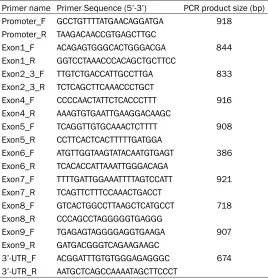
of the CYP2C19 gene, and their sequences are provided in Table 1. Polymerase chain reaction (PCR) for all single nucleotide polymorphisms (SNPs) was performed in 10 μL reactions with 5 μL HotStar Taq Master Mix, 1 μL of template DNA, 0.5 μL each primer (5 μM) and 3 μL deion-ized water. Thermal cycling conditions were as follows: a initial denaturation step of 15 min at 95°C, followed by 35 cycles of denaturation at 95°C for 30 s, annealing at 55-64°C for 30 s, extension at 72°C for 1 min, and a final exten-sion at 72°C for 3 min. The PCR products were sequenced using the ABI PrismBigDye Terminator Cycle Sequencing Kit version 3.1 (Applied Biosystems) on an ABI Prism3100 sequencer (Applied Biosystems).
Data analysis
Sequencher 4.10.1 (http://www.genecodes. com/) software was used to initially analyze the sequences including manual curation, frag-ment assembly, and mutation detection. We named the CYP2C19 variants based on the nucleotide reference sequence NG_008384.2 and CYP allele nomenclature (http://www.cyp-alleles.ki.se/). Allelic frequency comparisons between Li Chinese population and other
popu-Table 1. Primers used to amplify regions of CYP2C19
Primer name Primer Sequence (5’-3’) PCR product size (bp) Promoter_F GCCTGTTTTATGAACAGGATGA 918 Promoter_R TAAGACAACCGTGAGCTTGC
Exon1_F ACAGAGTGGGCACTGGGACGA 844 Exon1_R GGTCCTAAACCCACAGCTGCTTCC
Exon2_3_F TTGTCTGACCATTGCCTTGA 833 Exon2_3_R TCTCAGCTTCAAACCCTGCT
Exon4_F CCCCAACTATTCTCACCCTTT 916 Exon4_R AAAGTGTGAATTGAAGGACAAGC
Exon5_F TCAGGTTGTGCAAACTCTTTT 908 Exon5_R CCTTCACTCACTTTTTGATGGA
Exon6_F ATGTTGGTAAGTATACAATGTGAGT 386 Exon6_R TCACACCATTAAATTGGGACAGA
Exon7_F TTTTGATTGGAAATTTTAGTCCATT 921 Exon7_R TCAGTTCTTTCCAAACTGACCT
Exon8_F GTCACTGGCCTTAAGCTCATGCCT 718 Exon8_R CCCAGCCTAGGGGGTGAGGG
Exon9_F TGAGAGTAGGGGAGGTGAAGA 907 Exon9_R GATGACGGGTCAGAAGAAGC
3’-UTR_F ACGGATTTGTGTGGGAGAGGGC 674 3’-UTR_R AATGCTCAGCCAAAATAGCTTCCCT
that may have influenced genetic variation in the genes of interest. The purpose and experimental procedures of the study were explained to all participants, and written informed consent was obtained from all individuals prior to sample donation. The study protocol was performed in accor-dance with the Declaration of Helsinki and was approved by The Ethics Committees of Hainan Provincial People’s Hospital. PCR and DNA sequencing
[image:2.612.91.359.84.363.2]lations were performed using the Chi-squared test with a significance level set at P = 0.05 [10]. HAPLOVIEW 4.1 (http://broad.mit.edu/ mpg/haploview) was used to assess linkage disequilibrium (LD) and Hardy-Weinberg equilib-rium for each genetic variant [11]. Haplotypes were constructed from the selected SNPs and haplotype frequencies were derived for the Li population.
Transcriptional prediction
We analyzed non-synonymous SNPs in the CYP2C19 coding regions to predict the corre-sponding protein function. Two algorithms, SIFT
protein function. The SIFT divided results into four categories based on these scores: tolerant (0.201-1.00), borderline (0.101-0.20), poten-tially intolerant (0.051-0.10) and intolerant (0.00-0.05). PolyPhen-2 results were divided into three categories: benign, possibly damag-ing and probably damagdamag-ing.
Results
Genetic variants
[image:3.612.95.523.85.389.2]We sequenced CYP2C19 from our study sub-jects and successfully identified a total of 22 CYP2C19 polymorphisms in this population.
Table 2. Frequency distribution of CYP2C19 polymorphisms in 100 Li subjects
NO. SNP Position Nucleotide change Region Allele Frequencies Amino-acid effect 1 rs190944530 -283 G > T Promoter 9/100 9% No translated 2 -254 A > G Promoter Novel 1 1/100 1% No translated 3 rs17885098 99 C > T Exon 1 91/94 96.80% Pro33Proa
4 rs17878649 12306 G > A Intron 1 1/100 1% No translated 5 rs145328984 12401 C > T Exon 2 1/100 1% Arg73Cysb
6 rs12769205 12662 A > G Intron 2 55/100 55% No translated 7 rs181297724 12834 G > C Exon 3 3/99 3.03% Ala161Prob
8 17807 T > C Exon 4 Novel 2 1/98 1.02% Asp165Aspa
9 rs4986893 17948 G > A Exon 4 CYP2C19*3A 3/98 3.06% Trp212Terb
10 rs184151290 18074 C > T Intron 4 1/98 1.02% No translated 11 rs7088784 18911 A > G Intron 4 5/100 5% No translated 12 rs4244285 19154 G > A Exon 5 CYP2C19*2A 53/100 53% Pro227Proa
13 rs12571421 19520 A > G Intron 5 53/100 53% No translated 14 58025 C > T Intron 6 Novel 3 5/100 5% No translated 15 rs28399513 79936 T > A Intron 6 53/100 53% No translated 16 rs3758580 80160 C > T Exon 7 CYP2C19*2A 53/100 53% Val330Vala
17 rs3758581 80161 A > G Exon 7 100/100 100% Ile331Valb
18 rs4917623 87106 C > T Intron 7 61/94 64.89% No translated 19 rs17886522 87313 A > C Exon 8 CYP2C19*3A 3/100 3% Gly417Glya
20 rs17882572 87594 G > T Intron 8 3/100 3% No translated 21 rs17885052 87620 A > T Intron 8 5/100 5% No translated 22 rs191493794 90647 C > T 3’-UTR 5/100 5% No translated
aSynonymous mutations; bnon-synonymous mutations.
Table 3. Allele and genotype frequencies of CYP2C19 in Li population Total (N = 100) Frequency Phenotype
Allele *1A 100 50.00% Normal
*1B 48 24.00% Normal
*2A 49 24.50% None
*3A 3 1.50% None
Genotype *1A/*1B 48 48.00% Normal enzyme activity *1A/*2A 49 49.00% Decreased enzyme activity *1A/*3A 3 3.00% Decreased enzyme activity
[image:3.612.91.386.436.540.2]Three of the polymorphisms had not previously been reported in either the NCBI database or the Human Cytochrome P450 Allele Nomen- clature Committee tables (Table 2). -254A > G was in the promoter region, 17807T > C was a synonymous mutation in exon 4, and 58025C > T was in the intron 6.
Allele frequency and genotype frequency Four CYP2C19 alleles were detected in the Li study group (Table 3). The CYP2C19*1A allele had the highest frequency (50%), followed by the CYP2C19*1B allele (24.00%), and the CYP2C19*2A allele (24.50%). The last allele, CYP2C19*3A, was relatively rare with frequen-cies of only 1.50%.
We also detected three CYP2C19 genotypes, with a frequency range from 3.00% to 49.00% in this Li population. Individuals with the wild-type *1/*1 genowild-type have normal enzyme activity, and this genotype was the relatively prevalent (48.00%) in our study group. Other identified genotypes included the heterozygous genotype *1/*2 (49.00%) and *1/*3 (3.00%), which leads to decreased enzyme activity. According to Haploview analysis, all allele and genotype frequencies (Table 3) were in Hardy-Weinberg equilibrium.
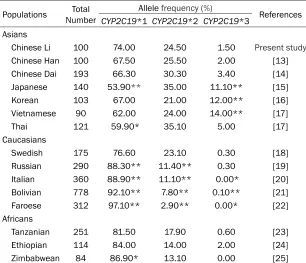
Caucasians. Additionally, we found no signifi-cant differences between Li Chinese and Africans.
Linkage disequilibrium analysis
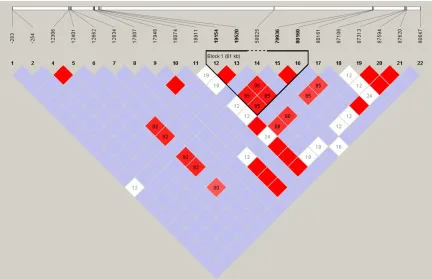
We performed LD analysis using Haploview with confidence intervals to define LD blocks (Figure 1). The extent of LD for each pair of SNPs was measured by the D’ value, which was most accurate when minor allele frequencies (MAFs) were greater than 5%. Haplotype analy-sis identified one LD blocks within CYP2C19, and very strong linkage was found be- tween rs4244285, rs12571421, novel variant 58025C > T, rs28399513 and rs3758580.
Predicted protein function of the non-synony-mous mutation
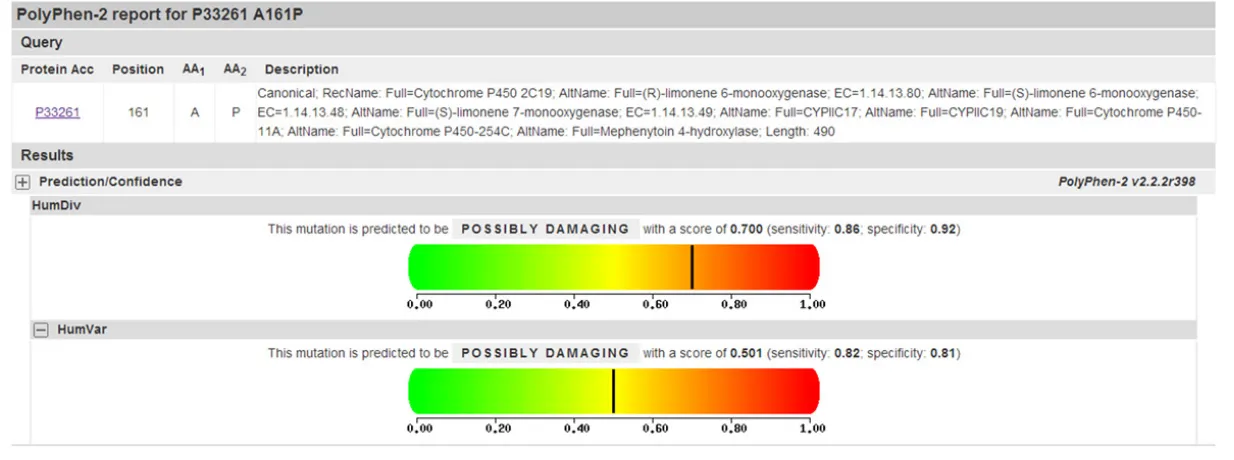
[image:4.612.90.396.84.347.2]We identified four non-synonymous mutation of CYP2C19 in our study group, Arg73Cys, Ala161Pro, Trp212Ter and Ile331Val. Trp212Ter was excluded because it is a termination of pro-tein sequence. Analysis using SIFT of the Arg73Cys and Ala161Pro variants indicated that they were intolerant (score = 0.01), while the variant Ile331Val was identified as tolerant (score = 0.29). PolyPhen-2 results for the
Table 4. Allele frequencies of CYP2C19 in different populations
Populations NumberTotal Allele frequency (%) References
CYP2C19*1 CYP2C19*2 CYP2C19*3 Asians
Chinese Li 100 74.00 24.50 1.50 Present study
Chinese Han 100 67.50 25.50 2.00 [13] Chinese Dai 193 66.30 30.30 3.40 [14] Japanese 140 53.90** 35.00 11.10** [15] Korean 103 67.00 21.00 12.00** [16] Vietnamese 90 62.00 24.00 14.00** [17]
Thai 121 59.90* 35.10 5.00 [17]
Caucasians
Swedish 175 76.60 23.10 0.30 [18]
Russian 290 88.30** 11.40** 0.30 [19] Italian 360 88.90** 11.10** 0.00* [20] Bolivian 778 92.10** 7.80** 0.10** [21] Faroese 312 97.10** 2.90** 0.00* [22] Africans
Tanzanian 251 81.50 17.90 0.60 [23] Ethiopian 114 84.00 14.00 2.00 [24] Zimbabwean 84 86.90* 13.10 0.00 [25]
**P < 0.01, compared with the data of the present study; *P < 0.05, compared with the data of the present study.
Inter-population com-parisons
Arg73Cys and Ile331Val revealed that both mutations were benign; while Ala161Pro was identified as possibly damaging. PolyPhen-2 utilized two models (HumDiv and HumVar), in which the latter is more rigorous in its false dis-covery rate. So the HumVar dataset was usually used to predict protein function (Figure 2). The protein function prediction results from SIFT and PolyPhen-2 analysis of the Arg73Cys were inconsistent. However, the protein function pre-diction results of the Ala161Pro and Ile331Val variants were highly consistent.
Discussion
Genetic polymorphisms in CYP2C19 are highly involving in the metabolism of many clinically prescribed drugs and may give rise to impor-tant inter-individual and inter-ethnic differenc-es in patient rdifferenc-esponsivendifferenc-ess and adverse drug reactions [26]. All of these years, several study has determined CYP2C19 genetic polymor-phisms in Han Chinese populations, few stud-ies to date have focused on ethnic minoritstud-ies in China, especially Li Chinese. We identified 22 genetic variants including three novel polymor-phisms, four alleles, and three genotypes of
CYP2C19 in our study Li Chinese population, and compared these data with previous obser-vations of other ethnic groups. Therefore, our results provide a better understanding of CYP2C19 polymorphisms and a potential data-base for promoting personalized medicine in Li Chinese population.
[image:5.612.90.522.71.350.2]Africans, which may relate to the similarity of their residences. Hainan Province is in the southernmost point of China, and belongs to tropical and subtropical zones, which was con-sistent with most part of Africanterritory. Recent studies have shown that CYP2C19 poly-morphisms have caused a diverse responsive-ness to clopidogrel [30]. The risk of cardiovas-cular events is increased in patients who are PM (poor metabolizer, carrying at least one CYP2C19*2 allele) despite patients receiving adequate doses of an antiplatelet agent, clopi-dogrel [31]. In our current study, we determined that the allele *2 and *3 are common genetic variant in the Li Chinese population, and indi-viduals who are homozygous carriers for the *2 or *3 allele show decreased enzyme activity compared to the wild type. So clinical treatment used clopidogrel should be more carefully in Li Chinese population.
Analysis of genetic variants in the coding region revealed variant Ala161Pro will affect the pro-tein structure and function, and the results of SITF and PolyPhen-2 were highly consistent. However, the protein prediction results of Arg73Cys from the SIFT and PolyPhen-2 were inconsistent. The prediction accuracy of SIFT and PolyPhen-2 is 63% and 75%, while the false positive rate is 19% and 9%, respectively [12, 32]. Therefore, the results identified here should be confirmed by other means in further studies.
In summary, our results provide a basic profile of CYP2C19 polymorphisms in the Li Chinese population, and future studies will use a larger sample size of Li Chinese, leading to the enhanced application of personalized medicine in this population.
Acknowledgements
This work is supported by Special Project of Science and Technology for Hainan Province Social Development (No. SF201402) and Applied Technology Research and Development and Demonstration Projects of Hainan Province (No. ZDXM2014119).
Disclosure of conflict of interest
None.
Address correspondence to: Dr. Yipeng Ding, Department of Emergency, People’s Hospital of
Hainan Province, Haikou 570311, Hainan, People’s Republic of China. Tel: +86 898 6622 2502; E-mail: [email protected]; Dr. Tianbo Jin,Key Laboratory of High Altitude Environment and Genes Related to Diseases of Tibet Autonomous Region, School of Medicine, Tibet University for Nationalities, 6 East Wenhui Road, Xianyang 712082, Shaanxi, China. Tel: +86-29-33755247; E-mail: [email protected]
References
[1] Nelson DR, Zeldin DC, Hoffman SM, Maltais LJ, Wain HM and Nebert DW. Comparison of cyto-chrome P450 (CYP) genes from the mouse and human genomes, including nomenclature recommendations for genes, pseudogenes and alternative-splice variants. Pharmacoge-netics 2004; 14: 1-18.
[2] Gerbal-Chaloin S, Pascussi JM, Pichard-Garcia L, Daujat M, Waechter F, Fabre JM, Carrère N and Maurel P. Induction of CYP2C genes in hu-man hepatocytes in primary culture. Drug Metab Dispos 2001; 29: 242-251.
[3] Andersson T, Holmberg J and Walan A. Phar-macokinetics and effect on caffeine metabo-lism of the proton pump inhibitors, omepra-zole, lansopraomepra-zole, and pantoprazole. Br J Clin Pharmacol 1998; 45: 369-375.
[4] Gardiner SJ and Begg EJ. Pharmacogenetics, drug-metabolizing enzymes, and clinical prac-tice. Pharmacol Rev 2006; 58: 521-590. [5] Onof S, Hatanaka T, Miyazawa S, Tsutsui M,
Aoyama T, Gonzalez F and Satoh T. Human liv-er microsomal diazepam metabolism using cDNA-expressed cytochrome P450s: role of CYP2B6, 2C19 and the 3A subfamily. Xenobi-otica 1996; 26: 1155-1166.
[6] Paveliu MS, Bengea S and Paveliu FS. Individu-alized drug response related to genetic varia-tions of cytochrome P450 isoforms and other enzymes. Farmacia 2010; 58: 245-254. [7] Goldstein JA. Clinical relevance of genetic
poly-morphisms in the human CYP2C subfamily. Br J Clin Pharmacol 2001; 52: 349-355.
[8] Chang M, Tybring G, Dahl ML and Lindh JD. Im-pact of cytochrome P450 2C19 polymor-phisms on citalopram/escitalopram exposure: a systematic review and meta-analysis. Clin Pharmacokinet 2014; 53: 801-811.
[9] Hu LM, Dai DP, Hu GX, Yang JF, Xu RA, Yang LP, Qian JC, Ge RS and Cai JP. Genetic polymor-phisms and novel allelic variants of CYP2C19 in the Chinese Han population. Pharmacoge-nomics 2012; 13: 1571-1581.
hap-lotype maps. Bioinformatics 2005; 21: 263-265.
[12] Ng PC and Henikoff S. Accounting for human polymorphisms predicted to affect protein function. Genome Res 2002; 12: 436-446. [13] Zhou Q, Yu X, Lin H, Wang L, Yun Q, Hu S and
Wang D. Genetic polymorphism, linkage dis-equilibrium, haplotype structure and novel al-lele analysis of CYP2C19 and CYP2D6 in Han Chinese. Pharmacogenomics J 2009; 9: 380-394.
[14] He N, Yan FX, Huang SL, Wang W, Xiao ZS, Liu ZQ and Zhou HH. CYP2C19 genotype and S-mephenytoin 4’-hydroxylation phenotype in a Chinese Dai population. Eur J Clin Pharmacol 2002; 58: 15-18.
[15] Kimura M, Ieiri I, Mamiya K, Urae A and Higu-chi S. Genetic polymorphism of cytochrome P450s, CYP2C19, and CYP2C9 in a Japanese population. Ther Drug Monit 1998; 20: 243-247.
[16] Roh HK, Dahl ML, Tybring G, Yamada H, Cha YN and Bertilsson L. CYP2C19 genotype and phe-notype determined by omeprazole in a Korean population. Pharmacogenetics 1996; 6: 547-551.
[17] Yamada S, Onda M, Kato S, Matsuda N, Mat-suhisa T, Yamada N, Miki M and Matsukura N. Genetic differences in CYP2C19 single nucleo-tide polymorphisms among four Asian popula-tions. J Gastroenterol 2001; 36: 669-672. [18] Chang M, Dahl ML, Tybring G, Gotharson E and
Bertilsson L. Use of omeprazole as a probe drug for CYP2C19 phenotype in Swedish Cau-casians: comparison with S-mephenytoin hy-droxylation phenotype and CYP2C19 genotype. Pharmacogenetics 1995; 5: 358-363.
[19] Gaikovitch EA, Cascorbi I, Mrozikiewicz PM, Brockmöller J, Frötschl R, Köpke K, Gerloff T, Chernov JN and Roots I. Polymorphisms of drug-metabolizing enzymes CYP2C9, CY-P2C19, CYP2D6, CYP1A1, NAT2 and of P-gly-coprotein in a Russian population. Eur J Clin Pharmacol 2003; 59: 303-312.
[20] Scordo MG, Caputi AP, D’Arrigo C, Fava G and Spina E. Allele and genotype frequencies of CYP2C9, CYP2C19 and CYP2D6 in an Italian population. Pharmacol Res 2004; 50: 195-200.
[21] Bravo-Villalta HV, Yamamoto K, Nakamura K, Bayá A, Okada Y and Horiuchi R. Genetic poly-morphism of CYP2C9 and CYP2C19 in a Boliv-ian population: an investigative and compara-tive study. Eur J Clin Pharmacol 2005; 61: 179-184.
[22] Halling J, Petersen MS, Damkier P, Nielsen F, Grandjean P, Weihe P, Lundgren S, Lundblad MS and Brøsen K. Polymorphism of CYP2D6, CYP2C19, CYP2C9 and CYP2C8 in the Faroese population. European J Clin Pharmacol 2005; 61: 491-497.
[23] Herrlin K, Massele AY, Jande M, Alm C, Tybring G, Abdi YA, Wennerholm A, Johansson I, Dahl ML and Bertilsson L. Bantu Tanzanians have a decreased capacity to metabolize omeprazole and mephenytoin in relation to their CYP2C19 genotype. Clin Pharmacol Ther 1998; 64: 391-401.
[24] Persson I, Aklillu E, Rodrigues F, Bertilsson L and Ingelman-Sundberg M. S-mephenytoin hy-droxylation phenotype and CYP2C19 genotype among Ethiopians. Pharmacogenetics 1996; 6: 521-526.
[25] Masimirembwa C, Bertilsson L, Johansson I, Hasler JA and Ingelman-Sundberg M. Pheno-typing and genoPheno-typing of S-mephenytoin hy-droxylase (cytochrome P450 2C19) in a Shona population of Zimbabwe. Clin Pharmacol Ther 1995; 57: 656-661.
[26] Kobori L, Kohalmy K, Porrogi P, Sárváry E, Ger-lei Z, Fazakas J, Nagy P, Járay J and Monostory K. Drug-induced liver graft toxicity caused by cytochrome P450 poor metabolism. Br J Clin Pharmacol 2008; 65: 428-436.
[27] Chen L, Qin S, Xie J, Tang J, Yang L, Shen W, Zhao X, Du J, He G and Feng G. Genetic poly-morphism analysis of CYP2C19 in Chinese Han populations from different geographic ar-eas of mainland China. Pharmacogenomics 2008; 9: 691-702.
[28] Ota T, Kamada Y, Hayashida M, Iwao-Koizumi K, Murata S and Kinoshita K. Combination analysis in genetic polymorphisms of drug-me-tabolizing enzymes CYP1A2, CYP2C9, CY-P2C19, CYP2D6 and CYP3A5 in the Japanese population. Int J Med Sci 2015; 12: 78-82. [29] Desta Z, Zhao X, Shin JG and Flockhart DA.
Clinical significance of the cytochrome P450 2C19 genetic polymorphism. Clin Pharmacoki-netics 2002; 41: 913-958.
[30] Lin R, Zhang L, Zhang P, Zhou L, Liu T, Li Y, Zhang W, Wang W and Zhang J. Influence of CYP2C19 loss-of-function variants on the me-tabolism of clopidogrel in patients from north-western China. J Clin Pharm Ther 2015; 40: 308-314.
[31] Collet JP, Hulot JS, Pena A, Villard E, Esteve JB, Silvain J, Payot L, Brugier D, Cayla G and Beygui F. Cytochrome P450 2C19 polymorphism in young patients treated with clopidogrel after myocardial infarction: a cohort study. Lancet 2009; 373: 309-317.