www.impactjournals.com/oncotarget/
Oncotarget, Vol. 7, No. 23
Translin and Trax differentially regulate telomere-associated
transcript homeostasis
Natalia Gomez-Escobar
1,*, Nasser Almobadel
1,*, Othman Alzahrani
1,*, Julia
Feichtinger
2,3,*, Vicente Planells-Palop
1,*, Zafer Alshehri
1, Gerhard G. Thallinger
2,3,
Jane A. Wakeman
1and Ramsay J. McFarlane
11 North West Cancer Research Institute, School of Medical Sciences, Bangor University, Bangor, Gwynedd, United Kingdom 2 Computational Biotechnology and Bioinformatics Group, Institute of Molecular Biotechnology, Graz University of Technology, Graz, Austria
3 Omics Center Graz, BioTechMed Graz, Graz, Austria * These authors have contributed equally to this work
Correspondence to: Ramsay J. McFarlane, email: [email protected] Keywords: telomeres, Translin, Trax, C3PO, TERRA, Chromosome Section
Received: February 15, 2016 Accepted: April 19, 2016 Published: May 10, 2016
AbstrAct
Translin and Trax proteins are highly conserved nucleic acid binding proteins that have been implicated in RNA regulation in a range of biological processes including tRNA processing, RNA interference, microRNA degradation during oncogenesis, spermatogenesis and neuronal regulation. Here, we explore the function
of this paralogue pair of proteins in the fission yeast. Using transcript analysis we
demonstrate a reciprocal mechanism for control of telomere-associated transcripts. Mutation of tfx1+ (Trax) elevates transcript levels from silenced sub-telomeric
regions of the genome, but not other silenced regions, such as the peri-centromeric heterochromatin. In the case of some sub-telomeric transcripts, but not all, this elevation is dependent on the Trax paralogue, Tsn1 (Translin). In a reciprocal fashion, Tsn1 (Translin) serves to repress levels of transcripts (TERRAs) from the telomeric repeats, whereas Tfx1 serves to maintain these elevated levels. This reveals a novel mechanism for the regulation of telomeric transcripts. We extend this to demonstrate that human Translin and Trax also control telomere-associated transcript levels in
human cells in a telomere-specific fashion.
IntroductIon
The faithful segregation of chromosomes during
the eukaryotic cell cycle is a multifaceted event, failures
in which can drive diverse human diseases, including
cancers [1]. Protection of the termini of linear eukaryotic
chromosomes, the telomeres, during this process is
essential to prevent nucleolytic chromosomal degradation
[2]. Telomere maintenance is normally mediated by a
specific DNA polymerase termed telomerase, which is
capable of extending telomeric DNA independently of the
major genomic replisome [3, 4]. Telomere length control
provides a molecular limiter on cellular proliferative
potential as telomerase activity is repressed in most
healthy somatic cells. Without length homeostasis being
maintained, telomeres will shorten with each division,
ultimately resulting in cellular senescence [3, 5].
Proliferating cancer cells must override this senescence
pathway, either via the activation of telomerase,
chromosomal circularization or activation of alternative
telomere maintenance pathways [6]. Telomeres also
contribute to the correct chromosomal architecture
within the nucleus [7] and telomere dysfunction has been
associated with a range of human genetic diseases [8].
including DNA damage response [12-16].
The human protein Translin was first identified by
virtue of its ability to bind to the breakpoint junctions of
chromosomal translocations in lymphoid malignancies
[17] and other genetic diseases [18]. It was independently
identified in the mouse as the testis-brain RNA binding
protein
[19]. Translin is highly conserved in eukaryotes
and archaea and has a paralogue binding partner Trax
(Translin-associated protein X) [18]. The Translin-Trax
complex has the ability to bind to nucleic acid, with a
bias towards RNA, and it possesses RNA nucleolytic
activity
[18, 20-23].
DNA sequence binding preferences
has led to the suggestion that Translin may function in
telomere regulation, although to date there is no direct
evidence for this
[24]. Telomeres directly interact with
proteins associated with homologous recombination and
DNA double-strand break (DSB) repair [25], and Trax has
recently been demonstrated to have a role in the murine
DNA damage response via association with the ATM
pathway [26]. Whilst a role for Translin in this response
has not yet been found, Translin function has also been
linked to the mammalian DNA damage response [27].
Since their initial identification, Translin and Trax
have been implicated in a wide range of nucleic acid
processing pathways, including tRNA maturation and
mRNA regulation both in spermatogenesis and neuronal
dynamics, with mutations in the Translin binding site
of
BDNF
(brain-derived neurotrophic factor) mRNA
resulting in memory deficits and psychiatric disorders
[18,28,29]. Recently, Drosophila and mammalian Translin
and Trax were revealed to be the constituents of the C3PO
complex [22, 30-32], which is responsible for assisting
the removal of the passenger RNA strand from small
interfering RNAs involved in Argonaute-dependent
RNA-induced transcriptional silencing [33]. In most activities
studied to date, Translin and Trax have been shown to
function in unison, and the maintenance of Trax stability
is a conserved function of Translin [18, 27]. Importantly,
a direct role in oncogenesis has recently been reported
for Translin and Trax in cancers that are haploinsufficient
for Dicer, as they degrade pre-microRNAs that would
be processed to microRNAs by a full Dicer complement
to maintain tumour suppression
[34]. This has led to the
suggestion that Translin and Trax could provide drug
targets in Dicer haploinsufficient tumours
[34].
Here we reveal previously unknown roles for
Translin and Trax in controlling homeostasis of distinct
telomere-associated transcripts in both fission yeast and
human cells. Moreover, we demonstrate that Translin
and Trax can act independently, indicating that they do
not function solely as a heteromeric complex, but have
interrelated roles in controlling telomere-associated
transcript.
results
trax, but not translin, represses sub-telomeric
transcript levels
The extensive conservation of Translin and
Trax indicate they serve a fundamentally important
biological role. Despite this, deletion of both the Translin
(
tsn1
+) and Trax (
tfx1
+) genes of the fission yeast
Schizosaccharomyces pombe does not result in any readily
detectable phenotypic change [35, 36]. Given the finding
that Translin and Trax regulate RNA dynamics in other
organisms, we set out to determine whether S. pombe Tsn1
and Tfx1 are involved in transcript regulation. To do this,
we used tiling arrays to analyse the transcriptome and to
identify any changes when tsn1
+and tfx1
+are mutated.
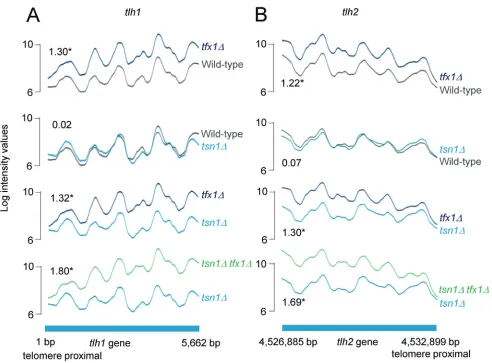
Comparison of the wild-type and
tsn1∆
transcripts
reveals no statistically meaningful difference. However,
comparison of the wild-type and tfx1
∆ strains revealed one
significant change: an up-regulation of sub-telomeric
tlh
gene transcripts in the tfx1
∆ mutant (Figure 1). It should
be noted that the annotated DNA sequences for
tlh1 and
tlh2 genes are 100% identical so we cannot rule out a tlh1-
or tlh2
-only dysregulation (i.e. a specific sub-telomeric
region). The double
tsn1
∆
tfx1
∆ mutant exhibits the same
tlh transcript elevation seen in the tfx1
∆ single mutant
(Figure 1). Not only is the elevation of the
tlh transcripts
the first measurable phenotype of a
tfx1
∆ mutant, it also
reveals a functional separation between Tfx1 and Tsn1 in
S. pombe. S. pombe Tsn1 functions to stabilize Tfx1 [35]
and in the absence of Tsn1 there are considerably reduced
levels of Tfx1 [35]. The tlh transcript data indicate that
the low levels of Tfx1 in the tsn1
∆ background remain
sufficient to maintain
tlh transcript repression.
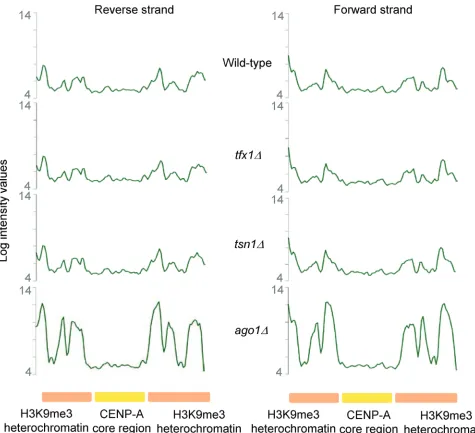
DNA strand (Figure 2, Figure S1-S2). Collectively, these
data indicate that Tfx1, but not Tsn1 functions in
sub-telomeric, but not centromeric, transcript regulation.
loss of tfx1 suppresses the requirement for Ago1
Similar to the loss of Tfx1, the loss of the telomere
regulator Taz1 [38] has also been demonstrated to elevate
the
tlh
transcript levels [39]. Moreover, loss of Taz1
function has been shown to partially suppress sensitivity
to the microtubule destabilizing drug thiabendazole
(TBZ) of cells mutated in the RNA interference regulator
gene ago1
+[40] (Figure S3). It has been postulated that
this suppression occurs due to heterochromatin factors
mediating the sub-telomeric silencing being ‘released’
from the sub-telomeric regions to relocate and enhance
the centromeric function that is compromised due to loss
of Ago1 [40]. To determine whether loss of Tfx1 results
in a similar phenotypic outcome as loss of the known
telomere regulator Taz1, we generated ago1
∆
tfx1
∆ and
ago1
∆
tsn1
∆ double mutants and tested their response to
TBZ. Consistent with the
tlh transcript up-regulation data
(Figure 1), Figure 3A shows that loss of Tfx1, but not Tsn1
partially suppresses the need for Ago1, which is the same
for the suppression reported upon loss of Taz1 [40] (Figure
S3), consistent with a functional link for Tfx1 to telomeric
regulation.
tfx1 and tsn1 do not regulate telomere length
[image:3.612.61.553.295.658.2]Taz1 is required to limit telomere length and in
the absence of Taz1 telomeres become highly elongated
[38]. Given the phenotypic similarities between taz1
∆ and
tfx1
∆ mutants, we wished to determine whether Tfx1 also
contributed to telomere length regulation. To address this,
Southern blot analysis was carried out to compare telomere
lengths between a taz1
∆,
tsn1
∆ and
tfx1
∆ mutants (and
the tfx1
∆
tsn1
∆ double mutant).
tsn1
∆ and
tfx1
∆ single
mutants had mean telomere lengths indistinguishable from
the wild-type, whereas telomeres in the taz1
∆ mutant were
greatly elongated (Figure 3B/C). These data indicate that
the de-silencing of the tlh genes seen in the tfx
1∆ mutant
is not related to telomere length dysregulation, as it is in
the taz1
∆ mutant.
tsn1 and tfx1 differentially regulate telomeric
transcripts
[image:4.612.63.538.208.641.2]TERRA production from telomeric DNA template
is a conserved feature of telomeres in both humans and
fission yeast [12-16]. Other sub-telomeric transcripts,
termed ARRETs have also been detected in
S. pombe
for the sub-telomeric regions on chromosomes 1, 2 and
occasionally 3 [41, 42]. ARRET and TERRA sequences
are not covered on the tiling arrays used in this study.
To further confirm the regulation of sub-telomeric
transcripts by Tfx1, we examined ARRET (immediately
sub-telomeric regions) levels in
tfx1
∆ and
tsn1
∆ strains
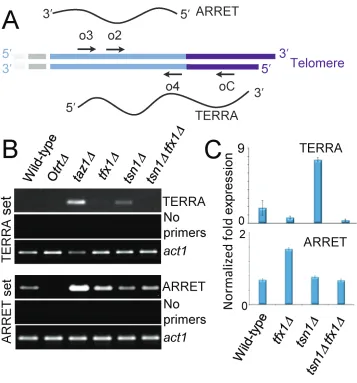
using RT-PCR/RT-qPCR [43]. Loss of Taz1 gives elevated
ARRET levels, consistent with activation of
tlh genes in
the absence of Taz1 [39, 42]. Loss of Tfx1 resulted in
an approximately two-fold elevation in ARRETs, again,
consistent with the tlh
transcripts (Figure 4). However,
unlike the tlh transcript elevation, additional mutation of
tsn1
+results in a reduction of ARRET transcripts back to
wild-type levels, indicating an interplay between Tfx1
and Tsn1 for ARRET regulation, but not
tlh transcript
regulation (Figure 1, Figure 6); so, in the absence of Tfx1,
Tsn1 is required to maintain elevated ARRET levels.
Taz1-defficient cells also exhibit elevated levels
of TERRAs [42]. Telomeric DNA is not extended in the
tfx1
∆ mutant (Figure 3B/C) and so we wished to address
whether the regulation of telomere-associated transcripts
extended into the TERRA encoding telomeric regions.
To do this, we analysed TERRA levels in the various
mutants. Using RT-PCR/RT-qPCR we could only detect
very limited TERRA levels in the wild-type (Figure 4).
However, both taz1
∆ and
tsn1
∆ mutants exhibited clearly
elevated levels of TERRA (Figure 4), whereas levels in the
tfx1
∆ mutant were indistinguishable from the wild-type.
This surprise finding indicates that Tsn1 is required for
suppression of TERRA levels whereas Tfx1 is required
for suppression of sub-telomeric transcripts (
tlh genes
and ARRETs). Interestingly, additional mutation of
tfx1
+in the tsn1
∆ background results in restoration of
TERRA levels to those of the wild-type indicating that in
the absence of Tsn1, Tfx1 stabilizes the elevated levels
of TERRA (Figure 4). So, importantly, these findings
indicate an inverted reciprocal relationship between
Tfx1 and Tsn1 for sub-telomeric and telomeric transcript
regulation, respectively. Upon loss of Tfx1, ARRETs, but
not TERRAs, are elevated in a Tsn1-dependent fashion,
and upon loss of Tsn1, TERRAs, but not ARRETs, are
elevated in a Tfx1-dependent fashion. The requirement for
Tsn1 to maintain elevated sub-telomeric transcripts only
applied to the ARRETs and not the
tlh genes indicating
a positional constraint on this relationship, possibly
governed by proximity to the telomeric DNA where
Tsn1 functions to suppress TERRA transcript levels.
S.
pombe also produces other telomeric and sub-telomeric
transcripts (termed ARIAs and α-ARRETs respectively)
[41,42], but we could not distinguish RT-PCR products of
these transcripts from transcripts produced by first strand
cDNA primed by endogenous priming; for both TERRA
and ARRET analysis lack of first strand primers produced
no PCR products and so problematic endogenous priming
was eliminated (Figure 4).
translin and trax regulate human terrA levels
TERRA was originally detected in mammals
[44,
45]. To explore whether the role of Translin in suppressing
TERRA levels was conserved, we measured TERRAs for
the q arm of chromosome 10 and the sex chromosomes
(X/Y)
[46] in human SW480 cells following siRNA
depletion of either TSN1
(Translin) or
TSNAX
(Trax)
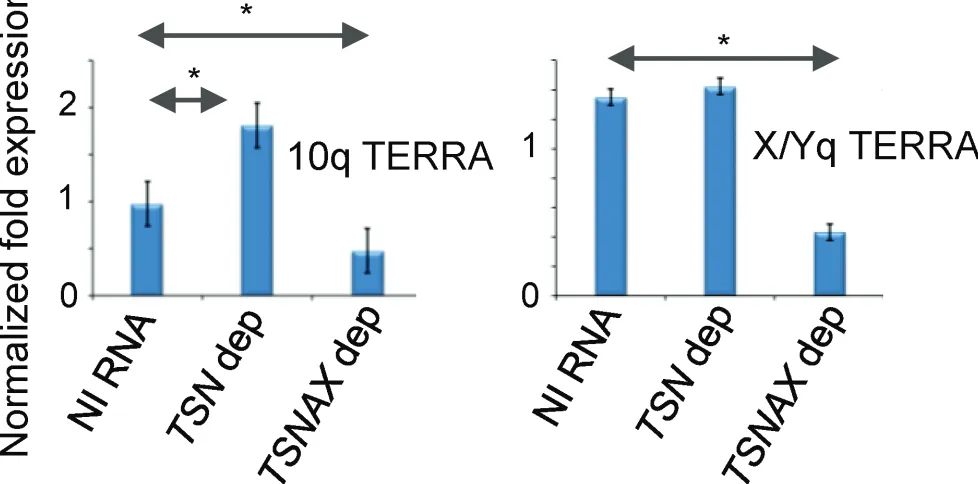
expression (Figure S4). Figure 5 shows that TERRA levels
were elevated in TSN-depleted cells, but not in
TSNAX-depleted cells for the 10q telomere. The TSNAX-TSNAX-depleted
cells showed reduced TERRA levels for all telomeres
tested.
These findings indicate that the separation of roles
for Translin and Trax in TERRA regulation is conserved
from S. pombe to some telomeres in humans. The 10q
TERRA data indicate that Translin serves to suppress
levels of some human TERRAs, whereas Trax serves
to stabilize/maintain their levels, raising the possibility
of a reciprocal TERRA stabilization mechanism at play.
The same relationship was not readily observed for the
q arm of the sex chromosomes, where depletion of TSN
did not result in elevated X/Yq TERRAs, but depletion of
TSNAX reduced TERRAs (Figure 5). These data indicate
a more complex picture in human cells, with the potential
for a telomere-specific requirement for distinct TSN and
TSNAX functions.
dIscussIon
translin and trax function to regulate telomere
transcripts
it an excellent system in which to study this important
function of these proteins in the absence of perturbation
of other biological roles.
TERRAs control a range of telomere-associated
functions, including regulation of telomerase activity,
telomere length control, telomeric heterochromatinization
and cellular differentiation
[12-16]. TERRA has both
positive and negative influences upon telomere length
[image:6.612.86.524.184.610.2]regulation, with cell cycle and tissue-specific influences
[16]. In budding yeast, loss of Rat1 ribonuclease
processing results in accumulation of TERRAs and
inhibition of telomerase leading to telomere shortening
[50]. Whilst we show here that loss of tsn1 also results
in TERRA accumulation, this alone does not appear to
be sufficient for measurable telomere length alteration
or reduction in cell viability. This function of tsn1 seems
Figure 3: loss of tfx1 results in a telomere-defective phenotype, but telomere length is unaltered.
A. Suppression of TBZ sensitivity of an ago1∆ mutant is a feature of telomere regulator proteins [38]. The tfx1∆ mutant, like the taz1∆ mutant [38] (Figure S3), partially suppresses the ago1∆ TBZ sensitivity, whereas a tsn1∆ mutation does not. b. Southern blot probed with a telomere-specific probe showing that both tfx1∆ and tsn1∆ mutants have telomeres with lengths similar to the wild-type. The taz1∆ mutant had highly elongated telomeres. The Otrt∆ strain has circular chromosomes without telomeres and serves as a control for the probe specificity. c. Quantification of telomere fragment migration ratios demonstrates no statistically significant difference between the mean telomere lengths of the tfx1∆,to be conserved, as depletion of human TSN results
in elevation of TERRA from the q arm telomere of
chromosome 10, although this same effect was not seen
for the q arm of X/Y, which might reflect a requirement for
distinct levels of TSN (siRNA does not cause full cellular
depletion) or a telomere specificity for TSN function.
Interestingly, a recent systematic approach to identify
telomere DNA and TERRA interacting proteins did not
identify TSN or TSNAX. This suggests that
telomere-associated transcriptome regulation by TSN and/or
TSNAX in humans is likely mediated by an indirect and/
or transient/labile association
[51]. In S. pombe, Translin
(Tsn1) only forms weak interactions with other non-Trax
(Tfx1) proteins
[52], and possibly other macromolecules,
and no interactions have been demonstrated with known
telomere regulators.
distinct and joint functions for translin and trax
Almost all studies to date, revealing a biological role
for Translin and Trax, have demonstrated a close functional
association between the two [18]. Here, we show both a
joint and separate functional association between these
paralogues. Firstly, the transcript up-regulation for
sub-Figure 4: Translin and Trax regulate telomere-associated transcripts in fission yeast cells.
A. A schematic of an S. pombetelomere showing the telomere (purple) and the sub-telomeric region (light blue; previously referred to as STE) [42]. The ARRET and TERRA transcripts are aligned to their approximate template location. Arrows indicate primer positions used for first strand cDNA synthesis and RT-PCR (for TERRAs cDNA priming used oC, PCR was primed using o2/o4; for ARRETs cDNA priming used o3 and PCR was primed using o2/o4; primer sequences and designations are derived from Greenwood and Cooper [42]). b. Agarose gels showing analytical RT-PCR for TERRAs (first strand oC) and ARRETs (first strand o3). No primer controls indicate no first strand cDNA primers, demonstrating that PCR products are not due to endogenous first strand priming. RT-PCT for the act1+ gene transcripts are given as a positive control. c.
RT-qPCR for TERRAs and ARRETs in tsn1∆ and tfx1∆ cells. Error bars represent standard deviation. Student’s t-test pairwise comparison were carried out for mean values between the wild-type vs. mutants. In all cases P values were > 0.05 with the exceptions of wild-type vs.
[image:7.612.128.485.212.595.2]telomeric regions only occurs when tfx1
+is mutated
but not upon tsn1
+mutation. The elevation of ARRET
levels is tsn1
-dependent (Figure 4), but the
tlh transcripts
remain elevated in the
tsn1∆ tfx1∆
double mutant
(Figure 1), indicating there may be a transcript/positional
[image:8.612.62.551.142.384.2]specificity to this regulation. Conversely, the elevation
of TERRA levels in the
tsn1∆
mutant is tfx1-dependent.
These findings indicate that there is a reciprocal control
mechanism operating between Tsn1 and Tfx1 to maintain
telomere-associated transcriptional homeostasis (Figure
Figure 5: Human Translin and Trax influence TERRA levels differentially for distinct telomeres. RT-qPCR for human
TERRAs for the telomeres of the q arm of chromosome 10 (left) and the q arm of the sex chromosome (X/Y; right) in TSN and TSNAX depleted SW480 cells. NI RNA = non-interfering RNA. Error bars represent standard deviations. Student’s t-test pairwise comparison were carried out for mean values between NI RNA treated cells and siRNA depleted cells. Only comparisons marked with * showed statistical significance (P < 0.05).Figure 6: Model for the mechanism of telomere-associated transcript differential control by tfx1 and tsn1 in
S.
[image:8.612.61.552.466.664.2]6). Previously, it has been demonstrated that mouse
Trax can inhibit the binding of mouse Translin to mRNA
[53], and a similar direct regulation might be occurring
here to drive the inter paralogue modulation mechanism.
Additionally, when
tsn1
+is mutated, Tfx1 levels become
depleted
[35], so the residual Tfx1 found in the
tsn1∆
mutant must be sufficient to maintain a functional role for
telomere transcript level regulation.
Trax function has recently been linked to the DNA
damage response
[26] and TERRAs have been linked
to the telomeric DNA damage response
[12-16]. We
previously found no altered sensitivity of the S. pombe
tfx1∆
(or
tsn1
∆) mutant to a wide range of DNA damaging
agents [34], so there is no current evidence to link this
phenomenon to telomeric DNA damage tolerance in
S.
pombe.
The finding that Translin and Trax control
telomeric transcript homeostasis adds a new dimension
to our understanding of these conserved nucleic acid
regulators. It has recently been proposed that Translin
and Trax may provide anti-cancer therapeutic targets
[34];
however, before small molecule inhibitors are developed
and applied to the clinical setting it is of fundamental
importance that we fully elucidate the normal function of
this protein pair to ensure that inhibition of their function
does not adversely influence non-diseased tissues.
MAterIAls And Methods
S. pombe
strains and media
A list of strains used in this study and their
genotypes are shown in Table S1. Media, standard growth
conditions, S. pombe transformations and genetic analyses
were as described by Forsburg and Rhind
[54]. All gene
deletions in strains were created as described by Bähler
and co-workers
[55].
S. pombe
dnA extraction and southern blotting
DNA extraction was performed as described in
Forsburg and Rhind
[54]. After digestion with
ApaI
(New England Biolabs), 15 µg of DNA was separated
on a 1.2% agarose gel, transferred to positively charged
nylon membrane (GeneScreen
Plus
) and hybridized
to a radioactively labelled probe at 42°C for 18 hours
in Church Gilbert buffer. Oligonucleotide probe
corresponding to the telomeric G-strand was 5’-end
labelled with T4 polynucleotide kinase (New England
Biolabs) in the presence of [γ-
32P]ATP. The probe sequence
was 5’- GGGTTACAGGTTACAGGTTACA-3’. After
hybridization, membranes were washed three times in 6 x
SSC/0.1% SDS at room temperature. Radioactive signals
were detected using a Molecular Imager FX (Bio-Rad) and
analysed using Quantity One (Bio-Rad). Migration ratio
was calculated as the ratio of the distance migrated for the
2 kb marker as a fraction of the distance migrated by the
telomere probe signal midpoint as determined by Quantity
One. Mean values were obtained from four independently
generated blots.
human cell cultures
Human SW480 cell line was obtained from the
European Collection of Cell Culture. They were grown
in Invitrogen Dulbeco’s Modified Eagle’s medium
(DMEM+Glutamax) supplemented with 10% foetal
bovine serum (Life Technologies) in a 37°C incubator
with 5% CO
2.SW480 cells were authenticated prior to use
using LGC Standards Cell Line Authentication service
(tracking number 710418378). Cells were checked for
mycoplasma at regular intervals using the LookOut®
Mycoplasma Detection Kit (Sigma Aldrich; MP0035).
rnA extraction and reverse transcription Pcr
Total RNA was isolated from
S. pombe cells using
the MasterPure™ Yeast RNA Purification Kit (Epicentre)
following the manufacturer’s instructions and treated
with RNase-free DNase (Promega). Total RNA was
extracted from human SW480 cells using TRIzol (Life
Technologies) as described by Feichtinger and co-workers
[56]. 1 µg of RNA was used as template in first strand
synthesis by Superscript III (Invitrogen). The RNA was
denatured in the presence or absence of primer at 90°C for
1 minute followed by cooling to 55°C before adding the
reverse transcriptase mix and incubating for 50 minutes.
A volume of 2 µl of cDNA was PCR amplified using
MyTaq™ Red Mix (Bioline). PCR with subtelomeric
primers was carried out for 3 minutes at 95°C, then 35
cycles of 95°C for 30 seconds, 62°C for 20 seconds, 72°C
for 20 seconds, followed by 72°C for 5 minutes. The
same cycling conditions were used for act1, except that
an annealing temperature of 58°C was used for 25 cycles.
RNA reversed transcribed with Superscript III was
also used for TERRA qRT-PCR experiments. cDNA was
amplified using the GoTaq® qPCR Master Mix (Promega)
on a CFX96 real-time system (Bio-Rad) following the
manufacturer’s protocol. Sequences of all primers used in
the study are given in Table S2.
Whole transcriptome microarray analysis
Double-Stranded Target Assay Manual from Affymetrix
using the GeneChip S. pombe
Tiling 1.0FR. Data
processing is described in the Supplemental methods.
tsn and tsnAX depletion in sW480 cells
SW480 cells were transfected with pre-designed
siRNAs directed to
TSNAX
(Qiagen, SI00751982) and
TSN
(Qiagen,SI03650318) using HiPerFect Transfection
Reagent (Qiagen). After three hits, each lasting 24 hours,
RNA was extracted using RNeasy Mini Kit (Qiagen) and
reverse transcribed using the SuperScript III First-Strand
Synthesis System (Invitrogen) in the presence of oligo dT
cDNA was amplified using the GoTaq® qPCR Master
Mix (Promega) on a CFX96 real-time system (Bio-Rad)
following the manufacturer’s protocol. Primer sequences
are provided in Table S2.
AcknoWledgMents
The authors would like to thank C. Norbury for
sharing unpublished information on the number of S.
pombe tlh genes. We would also like to thank J. Cooper
for S. pombe
strains and M. Bühler for access to array
facilities.
conFlIcts oF Interest
There are no known conflicts of interest associated
with this work.
grAnt suPPort
This work was funded in part by awards from
Cancer Research Wales, the Government of the Kingdom
of Saudi Arabia (to R.J.M. and J.A.W.) and the OMICS
Center Graz grant of the Austrian Ministry for Science,
Research and Economy (to G.G.T.).
reFerences
1. Santaguida S, Amon A. Short- and long-term effects of chromosome mis-segregation and aneuploidy. Nat Rev Mol Cell Biol. 2015; 16: 473-485.
2. Jain D, Cooper JP. Telomeric strategies: means to an end. Annu Rev Genet. 2010; 44: 243-269.
3. Hockemeyer D, Collins K. Control of telomerase action at human telomeres. Nat Struct Mol Biol. 2015; 22: 848-852. 4. Schmidt JC, Cech T. Human telomerase: biogenesis,
trafficking, recruitment, and activation. Genes Dev. 2015; 9: 1095-1105.
5. Martinez P, Blasco MA. Replicating through telomeres: a means to an end. Trends Biochem Sci. 2015; 40: 504-515. 6. Pickett HA, Reddel RR. Molecular mechanisms of activity
and derepression of alternative lengthening of telomeres. Nat Struct Mol Biol. 2015; 22: 875-880.
7. Novo CL, Londoňo-Vallejo JA. Telomeres and the nucleus. Semin Cancer Biol. 2013; 23: 116-124.
8. Sarek G, Marzec P, Margalef P, Boulton SJ. Molecular basis of telomere dysfunction in human genetic diseases. Nat Struct Mol Biol. 2015; 2: 867-874.
9. de Lange T. Shelterin: the protein complex that shapes and safeguards human telomeres. Genes Dev. 2005; 19: 2100-2110.
10. Bühler M, Gasser SM. Silent chromatin at the middle and ends: lessons from yeast. EMBO J. 2009; 28: 2149-2161. 11. Schoeftner S, Blasco MA. A ‘higher order’ of telomere
regulation: telomere heterochromatin and telomeric RNAs. EMBO J. 2009; 28: 2323-2336.
12. Azzalin CM, Lingner J. Telomere functions grounding on TERRA firma. Trends Cell Biol. 2015; 25: 29-36.
13. Cusanelli E, Chartrand P. Telomeric repeat-containing RNA TERRA: a noncoding RNA connecting telomere biology to genome integrity. Front Genet. 2015; 6: 143.
14. Maicher A, Lockhart A, Luke B. Breaking new ground: digging into TERRA function. Biochim Biophys Acta. 2014; 1839: 387-394.
15. Rippe K, Luke B. TERRA and the state of the telomere. Nat Struct Mol Biol. 2015; 22: 853-858.
16. Wang C, Zhao L, Lu S. Role of TERRA in the regulation of telomere length. Int J Biol Sci. 2015; 11: 316-323. 17. Aoki K, Suzuki K, Sugano T, Tasaka T, Nakahara K, Kuge
O, Omori A, Kasai M. A novel gene, Translin, encodes a recombination hotspot binding protein associated with chromosomal translocations. Nat Genet. 1995; 10: 167-174. 18. Jaendling A, McFarlane RJ. Biological roles of translin and
translin-associated factor-X: RNA metabolism comes to the fore. Biochem J. 2010; 429: 225-234.
19. Wu XQ, Gu W, Meng X, Hecht NB. The RNA-binding protein, TB-RBP, is the mouse homologue of translin, a recombination protein associated with chromosomal translocations. Proc Natl Acad Sci USA. 1997; 94: 5640-5645.
20. Parizotto EA, Lowe ED, Parker JS. Structural basis for duplex RNA recognition and cleavage by Archaeoglobus fulgidus C3PO. Nat Struct Mol Biol. 2013; 20: 380-386. 21. Eliahoo E, Ben Yousef R, Pérez-Cano L, Fernández-Recio
J, Glaser F, Manor H. Mapping the interaction sites of the Schizosaccharomyces pombe protein Tranlisn with nucleic acids and proteins: a combined molecular genetics and bioinformatics study. Nucleic Acids Res. 2010; 38: 2975-2989.
22. Li L, Gu W, Liang C, Liu Q, Mello CC, Liu Y. The translin-TRAX complex (C3PO) is a ribonuclease in tRNA processing. Nat Struct Mol Biol. 2012; 19: 824-830. 23. Wang J, Boja ES, Oubrahim H, Chock PB. Testis brain
single-stranded and double-stranded ribonuclease activities. Biochemistry. 2004; 43: 13424-13431.
24. Jacob E, Pucshansky L, Zeruya E, Baran N, Manor H. The human protein translin specifically binds single-stranded microsatellite repeats, d(GT)n, and G-strand telomeric repeats, d(TTAGGG)n: a study of the binding parameters. J Mol Biol. 2004; 344: 939-950.
25. Arnoult N, Karlseder J. Complex interaction between the DNA-damage response and mammalian telomeres. Nat Struct Mol Biol. 2015; 22: 859-866.
26. Wang JY, Chen SY, Sun CN, Chien T, Chern Y. A central role of TRAX in the ATM-mediated DNA repair. Oncogene. 2015; doi: 10.1038/onc.2015.228.
27. Fukuda Y, Ishida R, Aoki K, Nakahara K, Takashi T, Mochida , Suzuki O, Matsuda J, Kasai M. Contribution of Translin to hematopoietic regeneration after sublethal ionizing irradiation. Biol Pharm Bull. 2008; 31: 207-211. 28. Li Z, Wu Y, Baraban JM. The Translin/Trax RNA binding
complex: clues to function in the nervous system. Biochim Biophys Acta. 2008; 1779: 479-485.
29. Chiaruttini C, Vicario A, Li Z, Baj G, Braiuca P, Wu Y, Lee FS, Gardossi L, Baraban JM, Tongiorgi E. Dendritic trafficking of BDNF mRNA is mediated by translin and blocked by the G196A (Val66Met) mutation. Proc Natl Acad Sci USA. 2009; 106: 16481-16486.
30. Liu Y, Ye X, Jiang F, Laing F, Chen D, Peng J, Kinch LN, Grishin NV, Liu Q. C3PO, an endoribonuclease that promotes RNAi by facilitating RISC activation. Science. 2009; 325: 750-753.
31. Tian Y, Simanshu DK, Ascano M, Diaz-Avalos R, Park AY, Juranek SA, Rice WJ, Yin Q, Robinson CV, Tuschi T, Patel DJ. Multimeric assembly and biochemical characterization of the Trax-Translin endonuclease complex. Nat Struct Mol Biol. 2011; 18: 658-664.
32. Ye X, Huang N, Liu Y, Paroo Z, Huerta C, Li P, Chen S, Liu Q, Zhang H. Structure of C3PO and mechanism of human RISC activation. Nat Struct Mol Biol. 2011; 18: 650-657.
33. Holoch D, Moazed D. RNA-mediated epigenetic regulation of gene expression. Nat Rev Genet. 2015; 16: 71-84. 34. Asada K, Canestrari E, Fu X, Li Z, Makowski E, Wu YC,
Mito JK, Kirsch DG, Baraban J, Paroo Z. Rescuing dicer defects via inhibition of an anti-dicing nuclease. Cell Rep. 2014; 9: 1471-1481.
35. Jaendling A, Ramayah S, Pryce DW, McFarlane RJ. Functional characterisation of the Schizosaccharomyces pombe homologue of the leukaemia-associated translocation breakpoint binding protein translin and its binding partner, TRAX. Biochim Biophys Acta. 2008; 1783: 203-213. 36. Laufman O, Ben Yosef R, Adir N, Manor H. Cloning
and characterization of the Schizosaccharomyces pombe homologs of the human protein Translin and Translin-associated protein TRAX. Nucleic Acids Res. 2005; 33: 4128-4139.
37. Mandell JG, Goodrich KJ, Bähler J, Cech TR. Expression of a RecQ helicase homolog affects progression through crisis in fission yeast lacking telomerase. J Biol Chem. 2005; 280: 5249-5257.
38. Cooper JP, Nimmo ER, Allshire RC, Cech TR. Regulation of telomere length and function by a Myb-domain protein in fission yeast. Nature. 1997; 385: 744-747.
39. Hansen KR, Ibarra PT, Thon G. Evolutionary-conserved telomere-linked helicase genes of fission yeast are repressed by silencing factors, RNAi components and the telomere-binding protein Taz1. Nucleic Acids Res. 2006; 34: 78-88. 40. Tadeo X, Wang J, Kallgren SP, Liu J, Reddy BD, Qiao F,
Jia S. Elimination of shelterin components bypasses RNAi for pericentric heterochromatin assembly. Genes Dev. 2013; 27: 2489-2499.
41. Bah A, Wischnewski H, Shchepachev V, Azzalin CM. The telomeric transcriptome of Schizosaccharomyces pombe. Nucleic Acids Res. 2012; 40: 2995-3005.
42. Greenwood J, Cooper JP. Non-coding telomeric and subtelomeric transcripts are differentially regulated by telomeric and heterochromatin assembly factors in fission yeast. Nucleic Acids Res. 2012; 40: 2956-2963.
43. Lorenzi LE, Bah A, Wischnewski H, Shchepachev V, Soneson C, Santagostino M, Azzalin CM. Fission yeast Cactin restricts telomere transcription and elongation by controlling Rap1 levels. EMBO J. 2015; 34: 115-129. 44. Schoeftner S, Blasco MA. Developmentally regulated
transcription of mammalian telomeres by DNA-dependent RNA polymerase II. Nat Cell Biol. 2008; 10: 228-236. 45. Azzalin CM, Reichenbach P, Khoriauli L, Giulotto E,
Lingner J. Telomeric repeat containing RNA and RNA surveillance factors at mammalian chromosome ends. Science. 2007; 318: 798-801.
46. Porro A, Feuerhahn S, Reichenbach P, Lingner J. Molecular dissection on telomeric repeat-containing RNA biogenesis unveils the presence of distinct and multiple regulatory pathways. Mol Cell Biol. 2010; 30: 4808-4817.
47. Yang S, Hecht NB. Translin associated protein X is essential for cellular proliferation. FEBS Lett. 2004; 576: 221-225.
48. Yang S, Cho YS, Chennathukuzhi VM, Underkoffler LA, Loomes K, Hecht NB. Tranlsin-associated factor X is post-transcriptionally regulated by its partner protein TB-RBP, and both are essential for normal cell proliferation. J Biol Chem. 2004; 279: 12605-12614.
49. Ishida R, Okado H, Sato H, Shionoiri C, Aoki K, Kasai M. A role for the octomeric ring protein, Translin, in mitotic cell division. FEBS Lett. 2002; 525: 105-110.
50. Luke B, Panza A, Redon S, Iglesias N, Li Z, Lingner J. The Rat1p 5’ to 3’ exonuclease degrades telomeric repeat-containing RNA and promotes telomere elongation in Saccharomyces cerevisiae. Mol Cell. 2008; 32: 465-477. 51. Luo Z, Dai Z, Xie X, Feng X, Liu D, Songyang Z, Xiong
network in mammalian cells. Database. 2015; 2015:pii: bav018.
52. Eliahoo E, Litovco P, Ben Yosef R, Bendalak K, Ziv T, Manor H. Identification of proteins that form specific complexes with the highly conserved protein Translin in Schizosaccharomyces pombe. Biochim Biophys Acta. 2014; 1844: 767-777.
53. Chennsthukuzhi V, Kurihara Y, Bray JD, Hecht NB. Trax (translin-associated factor X), a primarily cytoplasmic protein, inhibits the binding of TB-RBP (translin) to RNA. J Biol Chem. 2001; 276: 13256-13263.
54. Forsburg SL, Rhind N. Basic methods for fission yeast. Yeast 2006; 23: 173-183.
55. Bähler J, Wu JQ, Longtine MS, Shah NG, McKenzie A 3rd, Steever AB, Wach A, Philippsen P, Pringle JR. Heterologous modules for efficient and versatile PCR-based gene targeting in Schizosaccharomyces pombe. Yeast. 1998; 14: 943-951.
56. Feichtinger J, Aldeailej I, Anderson R, Almutairi M, Almatrafi A, Alsiwiehri N, Griffiths K, Stuart N, Wakeman JA, Larcombe L, McFarlane RJ. Meta-analysis of clinical data using human meiotic genes identifies a novel cohort of highly restricted cancer-specific marker genes. Oncotarget. 2012; 3: 843-853. doi: 10.18632/oncotarget.580.