thematic review
Vulnerable people in general
needs housing
Introduction
In July 2007, the Housing Corporation published Investing in Independence, which sets out how we will engage with housing providers and support them in responding to the needs of vulnerable people. It outlines the importance of addressing the requirements of individuals with varying support needs, and focuses on the promotion of independence and social inclusion.
As part of this approach, we have undertaken this Thematic Review to assess how well housing associations meet the needs of vulnerable
people within the provision of general needs stock. Thematic Reviews are intended to use existing sources of data that we hold on housing associations and examine specific areas of performance, or performance by specific sections of the housing association sector.
The reviews enable our regulators to have an overview of sector performance and identify outliers, and may be used to influence proportionate and targeted regulatory
engagement. They also enable associations to use the analysis to benchmark their own performance against their peers. In How We Regulate 4:
Our Overall Approach we outlined that the Corporation’s corporate priorities and emerging risks will determine the topics that we select for Thematic Reviews.
Executive summary
In 2006-07, 45% of general needs lettings made by housing associations were made to vulnerable people. This equates to over 57,000 lettings. Indicators of vulnerability were used to identify those who could be considered vulnerable, to try to capture all relevant aspects of vulnerability. Homelessness was found to be the most common indicator of vulnerability, followed by people who are sick or disabled, and those whose previous property was unsuitable because of ill health or disability.
Factors such as location, size of association and group structure have an impact on the proportion of general needs lettings to vulnerable people. The influence of these factors varies. When looking at this information at a high level, the influence is limited, with the proportion of lettings to vulnerable people ranging from 40% to 50%. When looking at the information at a more detailed level, however, this range increases significantly. For example, the proportion of lettings made to vulnerable people when reviewed at local authority level ranges from 10% to 79%.
On average, vulnerable people going into general needs stock were recorded as having 1.4 indicators of vulnerability. This indicates that most people had one primary issue which indicated that they were vulnerable, but many also showed additional indicators of vulnerability. This highlights that it is important to recognise that many vulnerable people have multiple needs.
Housing associations should gather and monitor tenant profile information to develop a better understanding of their tenants’ needs and requirements and to ensure that they are better placed to meet these needs.
Housing vulnerable people
Investing in Independence sets out our
expectations of the sector, and why this is a key policy area for the Housing Corporation. Our aim is to secure the provision of homes within existing and new communities that respond to vulnerable people’s particular requirements for support, care and self-determination, thereby maximising their quality of life. This includes a commitment to promote choice for vulnerable people, so they are offered a maximum degree of independence in the way they live their lives.
We recognise that vulnerability is not necessarily permanent, and that people’s needs have to be met in different ways. These needs can be met in a variety of settings, such as specialist supported housing, hostels, and through floating support in general needs housing.
The Corporation’s Regulatory Code, states that housing associations must “manage good-quality homes that seek to meet people’s needs and
preferences now and in the future” and that they “must provide good-quality housing services for residents and prospective residents: by being responsive to the individual characteristics and circumstances of residents”. Our expectation of associations is that this should include being responsive to the needs of vulnerable people.
Additionally, regulatory guidance states that the needs of vulnerable residents should be considered, that services should be shaped around customers’ needs and that “vulnerable and marginalised residents are provided with appropriate responsive housing services. Support and care arrangements (including liaison with other agencies) are in place, where appropriate.”
A central role of Thematic Reviews is to utilise existing data sets to answer specific questions. Assessing how well housing associations are meeting the needs of vulnerable people within their general needs stock ideally requires a comprehensive set of research to explore:
• the context – how many people who identify
themselves as vulnerable are living in general needs housing;
• whether their landlord is responsive to their
needs in how it delivers services;
• how provision of general needs and supported
accommodation work together effectively, and how floating support is promoted and facilitated;
• different approaches to provision of services to
vulnerable people across housing associations; and
• best practice examples of innovative schemes
and services.
Housing vulnerable people covers a broad area with a wide range of possible avenues for investigation. As such, it was agreed that this Thematic Review would focus on the following:
• the context – identifying people whose
circumstances prior to and at letting
demonstrate indicators of vulnerability and comparing this data nationally, across the regions, and by local authority area, using data from Continuous Recording (CORE) of lettings by housing associations for 2006-07; and
Approach
• the detail – housing association approaches
to providing housing for vulnerable people through general needs stock via research with individual housing associations.
Data sources and limitations
The Corporation’s CORE dataset provides
information on all new lettings made by housing associations and the tenants who move into general needs and supported housing. In total, data from 572 associations was included in this review.
Supported housing is designated as being for particular client groups, such as ‘people with drug related problems’ or ‘vulnerable women with children’. General needs housing is not designated to any particular group.
set met the criteria for at least one of the client groups and that the criteria would be considered indicators of vulnerability rather than definitions.
It was not possible to identify every client group using the information provided in the general needs CORE form, as client group information is only captured for lettings to supported housing.
The client groups that could not be identified were: people with AIDS/HIV; people with a degenerative and debilitating illness; and people with learning difficulties.
The indicators of vulnerability are as follows:
Homeless immediately prior to letting
Statutorily homeless Other homeless
Previous accommodation: direct access hostel
Health issues/disability
Economic status of tenant: long-term sick/disabled Wheelchair user in household
Reason for leaving last settled home: previous accommodation unsuitable because of ill health/ disability
Previous accommodation: hospital Source of referral: health service
Source of referral: Community Mental Health Team
Moving to accommodation with support
Reason for leaving last settled home: to move to accommodation with support
Domestic violence
Reason for leaving last settled home: domestic violence
Referral made by Social Services
Source of referral: Social Services
Previous accommodation indicating support needs
Previous accommodation: supported housing Previous accommodation: housing for older people Previous accommodation: residential care home Previous accommodation: children’s home or foster care
Refugees
Reason for leaving last settled home: left home country as refugee
Prison/probation
Reason for leaving last settled home: discharged from prison/long stay hospital/other institution Previous accommodation: prison
Previous accommodation: approved probation hostel
Multiple indicators of vulnerability
It is important to recognise that many vulnerable people will have multiple needs and may fall into a number of categories. Analysis showed that vulnerable people going into general needs stock in 2006-07 were recorded as having on average 1.4 indicators of vulnerability. This means that most people had one primary issue which indicated that they were vulnerable, but a number also showed additional indicators of vulnerability.
The most common combinations of vulnerability were as follows:
• unable to work due to being sick or disabled,
and previous property being unsuitable because of ill health/disability;
• statutorily homeless, and unable to work due
to being sick or disabled;
• statutorily homeless, and domestic violence;
and
• wheelchair user in household, and previous
property unsuitable because of ill health/ disability.
The context: housing vulnerable
people in general needs
accommodation
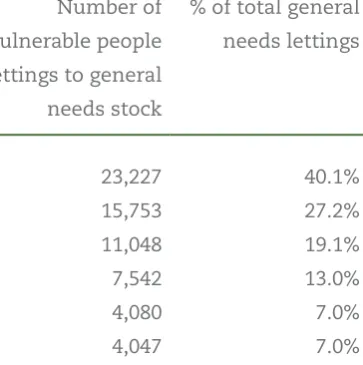
In 2006-07, 45% of general needs lettings were made to vulnerable people. This equates to over 57,000 lettings. Those who are statutorily homeless accounted for most of these, followed by people who are sick or disabled and those whose previous property was unsuitable because of ill health or disability. Table 1 shows the proportions of general needs lettings made to the most
[image:7.595.367.549.509.692.2]common vulnerable people categories.
Table 1
Indicator of vulnerability
Number of vulnerable people lettings to general needs stock
% of total general needs lettings
Statutorily homeless 23,227 40.1%
Sick or disabled 15,753 27.2%
Previous property unsuitable because of ill health/disability 11,048 19.1%
Other homeless 7,542 13.0%
Wheelchair user in household 4,080 7.0%
We analysed the data to assess the variation in numbers of lettings made by associations. Chart 1 below shows the number of general needs lettings by the proportion made to vulnerable people.
This shows the majority of general needs lettings are made by associations that make between 40% and 59% of their general needs lettings to vulnerable people. Comparatively, a small number of general needs lettings are made by associations that make 80% or more of their lettings to
vulnerable people. The smallest number of lettings is made by those associations where 19% or less of their general needs lettings are made to vulnerable people.
From the analysis, we found that two thirds of associations made 40% or more of their general needs lettings to vulnerable people. Around a quarter made 60% or more, and one in ten made more than 80%. Just under one in 20 associations made less than 20% of their general needs lettings to vulnerable people. This tells us that there is a clear prevalence of those associations that make around half of their general needs lettings to vulnerable people, with associations in this category accounting for more lettings than all the others combined.
Chart 1: Number of general needs lettings by the proportion made to vulnerable people
Number of lettings
0 5000 10000 15000 20000 25000 30000 35000
A – 80% - 100% B – 60% - 79% C – 40% - 59% D – 20% - 39% E – 1% - 19%
Proportion of association’s general needs lettings made to vulnerable people
1,325
9,879
29,887
16,086
307
Proportion of associations’ general needs lettings made to vulnerable people
Regional variation
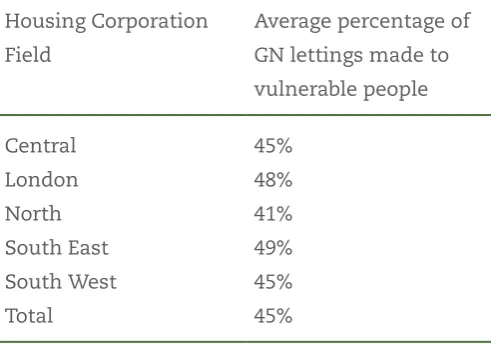
[image:9.595.30.276.366.539.2]Table 2 below sets out an analysis of the average percentage of general needs lettings made to vulnerable people by associations operating in each of the Corporation’s fields. Contextual issues present in each region such as demography and levels of migration will impact on the numbers of vulnerable people in each area, and on the number of lettings to social housing.
Table 2
Housing Corporation Field
Average percentage of GN lettings made to vulnerable people
Central 45%
London 48%
North 41%
South East 49% South West 45%
Total 45%
Local authority area
The map on page 9 shows the percentage of general needs lettings to vulnerable people, by local authority area in 2006-07. This shows the proportion of lettings to vulnerable people, ranging
from 10% to 79%. When viewing this map, it must be remembered that only lettings made by housing associations have been included. Local authority data has not been included because local authorities are not required to complete CORE forms (though many do and the number is increasing). As such, a complete picture of lettings made by local authorities is not available from CORE. It is therefore likely that a key explanation for those areas with low proportions of housing association lettings to vulnerable people is that a significant proportion of stock in these areas is owned and managed by other social landlords, such as the local authority.
Analysis by type of association
As part of the review, we looked at a range of characteristics of associations to see what influence this had (if any) on general needs lettings to vulnerable people. For this part of the analysis, data from CORE and the Regulatory and Statistical Return (RSR) for 2006-07 was used.
Size of association
Percentage of general needs lettings to vulnerable people by local authority, 2006-07
Source: Core 07
London
This map is reproduced from Ordnance Survey material with the permission of Ordnance Survey on behalf of the Controller of Her Majesty's Stationery Office ©Crown Copyright. Unauthorised reproduction infringes Crown copyright and may lead to prosecution or civil proceedings. Licensee: Housing Corporation. Licence No.100042275©2004
Lets
10% - 15%
16% - 30%
31% - 45%
46% - 60%
61% - 75%
Chart 2: Number of lettings by size of association
Number of lettings
0 5,000 10,000 15,000 20,000 25,000 30,000 35,000 40,000 45,000
More than
10,000 units 10,000 units5,000 to 5,000 units2,500 to 2,500 units1,000 to 1,000 unitsLess than
Size of association
Other general needs lettings
Geneal needs lettings to vulnerable people
Source: CORE and RSR 2006-07
It can be seen that the proportion of general needs lettings made to vulnerable people is reasonably consistent across all sizes of association.
Associations with between 5,000 and 10,000 units made the highest proportion of total lettings to vulnerable people, at 47.3%. Associations with less than 1,000 units made the lowest proportion of lettings to vulnerable people at 40.0%.
Chart 2 also shows that associations with between 5,000 and 10,000 units made both the highest number of general needs lettings and the highest number of general needs lettings to vulnerable people. The smallest number of general needs lettings to vulnerable people was made by associations with between 1,000 and 2,500 units.
This is at least partly explained by the proportion of general needs stock provided by associations of different size. Associations with more than 5,000 units manage two thirds of general needs stock, whilst those with less than 2,500 units account for less than 10% of general needs stock.
It can be seen that the proportion of general needs lettings made to vulnerable people is reasonably consistent across all sizes of association.
Case study
Coastline Housing Ltd is a stock transfer association with properties located in the towns and villages of west Cornwall, primarily in the Kerrier district. Coastline manages approximately 3,500 homes. Its operational focus is on general needs housing, which accounts for approximately 80% of the total stock.
In 2006-07, 78% of new general needs lettings were to tenants with at least one indicator of vulnerability. Coastline accounts for this through:
• the nominations agreement in place with the local authority as part of the homelessness action plan.
This ensures that up to 75% of lettings are provided for this purpose;
• the operation of a housing register of need – as opposed to a waiting list. Where allocations are made
from the association’s own register, priority goes to the applicant with the most points. As points are allocated on need, vulnerable people have greater success in securing housing; and
• the operation of a downsizing incentive scheme whereby Kerrier District Council provides an incentive
for residents to downsize to more appropriately sized accommodation in return for the offer of the new vacant property for local authority nominated applicants.
The New Connection, which joined the association in 2007, is a charity based in Camborne that specialises in working with homeless and vulnerable people. Through its work with New Connection, Coastline is able to offer access to a wider range of housing opportunities and support services to homeless vulnerable people in a dedicated temporary housing unit. Support services are provided to enable residents to move on to permanent housing and independent living arrangements.
Chart 2 also shows that associations with between 5,000 and 10,000 units made both the highest number of general needs lettings and the highest number of general needs lettings to vulnerable people. The smallest number of general needs lettings to vulnerable people was made by associations with between 1,000 and 2,500 units. This is at least partly explained by the proportion of general needs stock provided by associations of different size. Associations with more than 5,000 units manage two thirds of general needs stock, whilst those with less than 2,500 units account for less than 10% of general needs stock.
Group structure
Associations not part of a group structure made on average 47% of their general needs lettings to vulnerable people. This compares to an average of 44% made by associations in a group structure. The chart below shows the lettings to vulnerable people as a proportion of all general needs lettings, by group structure.
It can be seen, however, that associations in group structures made a significantly higher number of general needs lettings, and therefore a higher number of general needs lettings to vulnerable people. Associations in group structures manage around two thirds of general needs stock, so these findings are in line with expectations.
Chart 3: Number of lettings by group structure
Number of lettings
0 10,000 20,000 30,000 40,000 50,000 60,000 70,000 80,000 90,000
Independent Group structure
Other general needs lettings
Geneal needs lettings to vulnerable people
Case study
Impact Housing Association is a community based organisation which operates in Cumbria with a particularly strong presence in the north of the county, on the west coast and within the Lake District National Park. It owns and manages over 2,400 properties.
In 2006-07, 61% of its new lettings were to tenants with at least one indicator of vulnerability. Impact puts this down to its:
• lettings policy – high priority is given to
people who are statutorily homeless and people with acute medical need;
• history of working with and housing
vul`nerable people;
• specific lettings targets set, which includes
supported housing move-on;
• range of in-house services to be able to
respond to individual needs, such as the tenant support worker service and the domestic violence service;
• running recycled furniture stores – low-cost
quality furnishings are available, which have proved particularly useful for young single people setting up their first home, those fleeing domestic violence, and people who were homeless; and
• Impact for Life Group, which provides
support for elderly tenants and the wider community.
Stock transfer
On average, stock transfer associations made just under 47% of their general needs lettings to vulnerable people. Forty-three per cent of general needs lettings were made to vulnerable people by associations whose stock has not been transferred from the local authority.
Chart 4, opposite, shows the lettings to vulnerable people as a proportion of all general needs
lettings, by stock transfer and non-stock transfer associations.
The graph shows that non-stock transfer associations made a larger number of general needs lettings than stock transfer associations, but a smaller proportion of lettings to vulnerable people.
Chart 4: Number of lettings by type of association
Number of lettings
0 10,000 20,000 30,000 40,000 50,000 60,000 70,000 80,000
Stock transfer Non stock transfer
Other general needs lettings
Geneal needs lettings to vulnerable people
Case study
West Kent Housing Association, one of the first LSVT associations from Sevenoaks District Council, is a general needs provider with 5,650 homes. In 2006-07, 66% of its lettings were made to people with at least one indicator of vulnerability. West Kent considers this to be due to:
• 100% of its lettings being made through the housing register of the local authority (which it manages
via a Service Level Agreement) which aims to house the most vulnerable in society. The overall needs-based allocation coupled with low supply, means that only those with multiple needs and therefore more vulnerable are likely to be housed;
• demographic factors – there are high proportions of elderly people and people with disabilities in the
Sevenoaks area;
• economic issues – Sevenoaks is a high demand area, with high sale cost which means increased
demand for social housing;
• the association addresses identified needs through a range of additional support;
• via Neighbourhood Housing Officers, providing help around debt management, anti-social behaviour,
dealing with garden maintenance and repairs where tenants are unable to or cannot afford to undertake the work;
• West Kent Extra – this is a community development registered charity to which West Kent dedicates
1% of its rent roll in order to support tenant engagement, youth work and training to help individuals and areas provide access opportunities for learning;
• offering discounts to tenants to its furniture recycling warehouse project which serves the general
public, facilitating the furnishing of first homes for vulnerable tenants at a low cost; and
Older vulnerable people
We looked at the proportion of vulnerable people that were aged 65 or over to assess the extent to which general needs lettings are being made to older vulnerable people.
Of all the general needs lettings made to vulnerable people, 9% of these were made to older vulnerable people. Looking only at general needs lettings to older people, we found that 56% (5,395) were made to older people with at least one indicator of vulnerability. This compares to 45% of general needs lettings to vulnerable people for all age groups.
For older vulnerable people, the most common indicators of vulnerability are those relating to ill health or disability. The most significant indicator by some margin was previous property being unsuitable due to ill health/disability, with lettings for this reason accounting for a third of all lettings made to older vulnerable people.
Black and minority ethnic
vulnerable people
Conclusions
From the data available to us, we have been able to assess the extent to which housing associations are making general needs lettings to vulnerable people. On average, almost half of all general needs lettings are being made to people with indicators of vulnerability. Various factors, such as size of association and group structure have an influence on this, but as we have seen, the impact of different types of associations on the proportion of lettings made to vulnerable people is limited.
The most common indicators of vulnerability for those lettings made to general needs stock in 2006-07 provide a useful insight into the most prevalent issues. It is unsurprising that a large proportion of new lettings in 2006-07 were made to statutory homeless households, as associations have a statutory duty to work with local
authorities to contribute to tackling homelessness. It is interesting that a significant number of new tenants were sick or disabled, or had to move from their previous accommodation as it was unsuitable because of their ill health/disability, particularly when levels of stock accessibility is considered.
The data currently available means we have not been able to assess some issues in any depth. There are a number of options for exploring these further. These include revising the information requested from associations in returns such as CORE, the RSR, and the Existing Tenants Survey, and looking at this topic with the Residents Panel. Tenant profiling provides useful data on the needs and characteristics of associations’ tenants. Good practice on tenant profiling could be produced and key summary information from profiling gathered to promote best use of this data in meeting the needs of vulnerable people. The Gold Award
scheme could also be used to identify and promote good practice in this area. Issues such as these will be considered within the context of minimising the regulatory burden, making best use of data, and focusing on the needs and aspirations of tenants.
Recommendations
This review has provided an overview of the extent to which associations are making lettings to their general needs stock to vulnerable people.
Maple House
149 Tottenham Court Road London W1T 7BN
For enquiries, contact us at: Tel: 0845 230 7000
Fax: 0113 233 7101
Email: [email protected] Internet: www.housingcorp.gov.uk
East of England
Westbrook Centre Block 1 Suite 1 Milton Road
Cambridge CB4 1YG
East Midlands
Attenborough House 109 - 119 Charles Street Leicester LE1 1FQ
London
Maple House
149 Tottenham Court Road London W1T 7BN
North East
St George’s House Kingsway
Team Valley
Gateshead NE11 0NA
North West
Fourth Floor
One Piccadilly Gardens Manchester M1 1RG
South East
Leon House High Street Croydon CR9 1UH
South West
Beaufort House 51 New North Road Exeter EX4 4EP
West Midlands
Waterloo Court 31 Waterloo Road
Wolverhampton WV1 4DJ
Yorkshire and the Humber
1 Park Lane Leeds LS3 1EP