ISSN Print: 2473-1889
DOI: 10.4236/ojogas.2019.43013 Jul. 24, 2019 174 Open Journal of Yangtze Gas and Oil
Research on High Temperature and High
Density White Oil Based Drilling Fluid and
Its Application in Well 201H7-6
Bobo Qin, Yidi Wang, Chunzhi Luo, Gang Liu
College of Chemistry and Environmental Engineering, Yangtze University, Jingzhou, China
Abstract
As the depth and horizontal length of shale gas development wells increase, the requirement for the temperature resistance and the ability of the drilling fluids to stabilize the shale formation becomes higher. A new type of high temperature and high density white oil based drilling fluid system has been developed in laboratory. Research shows that the drilling fluid system has good rheological property, low filtration loss, strong anti-debris pollution ca-pability and good plugging performance at high temperature and high densi-ty. The system has been successfully applied in the 201H7-6 well. Application results show that the drilling fluid rheology, high temperature and high pres-sure fluid loss and demulsification voltage meet the field requirements. The drilling fluid performance is stable in drilling an 1800 m horizontal section, and no stuck or shale swelling and wellbore collapsing are induced. It is the first well drilled successfully with domestic white oil-based drilling fluid in Zigong Region. It also sets several new records including the deepest well, the shortest drilling cycle, and the fastest drilling speed in that region, which pro-vides valuable experience for the future drilling activities.
Keywords
Oil-Based Drilling Fluid, Demulsification Voltage, Rheology, Fluid Loss, Inhibition, Pollution, Plugging
1. Introduction
The geological structure of Zigong Area is complex, and there are many layers with high fluid loss risk, high formation pressure and hydrogen sulfide. The risk of well control is high and the well construction is difficult due to frequent pipe stuck and wellbore stability problems, especially in the horizontal section. Well
How to cite this paper: Qin, B.B., Wang, Y.D., Luo, C.Z. and Liu, G. (2019) Research on High Temperature and High Density White Oil Based Drilling Fluid and Its Application in Well 201H7-6. Open Journal of Yangtze Gas and Oil, 4, 174-182.
https://doi.org/10.4236/ojogas.2019.43013
Received: April 28, 2019 Accepted: July 21, 2019 Published: July 24, 2019
Copyright © 2019 by author(s) and Scientific Research Publishing Inc. This work is licensed under the Creative Commons Attribution International License (CC BY 4.0).
DOI: 10.4236/ojogas.2019.43013 175 Open Journal of Yangtze Gas and Oil 201H7-6 is a shale gas well deployed by SINOPEC in this block, in which vertical depth is 3290 m, horizontal length is 1800 m, formation pressure coefficient is 1.6, maximum bottom temperature is 147˚C with a fault of 50 m, and thinnest reservoir thickness of 5 m. The length of the horizontal section in several pre-vious wells drilled in this block is less than 1500 m, and all those wells are drilled with diesel-based drilling fluid system. During the drilling process, all those wells encounter serious problems such as shale swelling, and the drilling cycle lasted for more than three months. In addition, the formation temperature of the block is high, and the diesel-based drilling fluids not only encounter vaporisa-tion problems in high temperature condivaporisa-tions, but also induce serious safety ha-zards and serious environmental pollution. Moreover, the high-temperature sand-carrying and suspended capacity of the drilling fluid decrease as the viscos-ity of the diesel oil decreases, which brings a series of problems to drilling activi-ty [1]-[6]. To overcome these problems, a white oil based drilling fluid system is designed, which is more difficult to emulsify under high temperature conditions than diesel. In this design, macromolecular emulsifiers with anti-warming groups, wetting agents, organic soils with good temperature resistance, high temperature fluid loss additives and high temperature plugging agents are chosen to develop high temperature and high density white oil based drilling fluid. The rheology, fluid loss, electrical stability, sedimentation stability, and film-forming plugging properties of the system are evaluated at different tem-peratures, different densities and different oil-water ratios [7]-[12]. A series of plans for the successful application of the system are prepared. The system was applied in the building section and horizontal section of Well 201H7-6 in Octo-ber 2018. Based on the encountered difficulties such as high wellbore pressure, thin thickness of the production box and complicated trajectory of the wellbore, the performance of the drilling fluid is adjusted, which leads to smooth con-struction of the well with high quality and high efficiency. It sets several records including the deepest drilling depth, the shortest drilling cycle, and the fastest drilling speed of Sichuan Company, and it is the first successful application of white oil-based drilling fluid in the area. It also provides valuable experience for future well construction in the region, which strongly supports the efficient de-velopment of the block.
2. Design Methodology
DOI: 10.4236/ojogas.2019.43013 176 Open Journal of Yangtze Gas and Oil
2.1. Increase the Strength of the Oil-Water Interface Film
and Improve the Stability of the Emulsion
A surfactant with large molecular weight is developed based on the relationship between molecular structure and surface activity. It is then combined with sev-eral other surfactants to form a stable interfacial film at the oil-water interface, which ensures that the fluid flows into the wellbore during the drilling process is oil phase. Meanwhile, macromolecules can enhance the grid structure of the system, thereby improving the ability to carry cuttings and suspended debris.
2.2. Guarantee the Wettability of the System to Barite and Cuttings
The well has a minimum formation pressure coefficient of 1.6 and an additional pressure coefficient of 0.15 - 0.20. In order to prevent the shale swelling, the de-signed drilling fluid density is up to 2.3 g/cm3. To address this problem, a po-lyamide-based wetting agent is developed. The wetting agent has a large number of adsorbing groups, which are well adsorbed on the surfaces of the weighting material and the cuttings, so that the barite and the cuttings can be fully dis-persed and suspended in the drilling fluid.
2.3. Enhance the Fluid Loss Prevention Performance of the System
The stability of mud shale is not only related to the density of the supporting drilling fluid, but also has a close relationship with the film-forming plugging property of the drilling fluid. The combination of ultra-fine rigidity and flexible plugging agent can form a sealing film on the surface of shale surrounding the wellbore, micro-cracks and pores, which can reduce the fluid loss of drilling flu-id, prevent shale hydration and spalling, and stabilize the wellbore.
2.4. The Process of On-Site Preparation of Drilling Fluid
At the beginning of the drilling, the density of drilling fluid is low, and the fluid is mixed with low oil-to-water ratio. As the well depth and horizontal length in-crease, the temperature and density of the drilling fluid gradually increase. At the same time, the oil-water ratio needs to be gradually increased to ensure good rheological properties and wellbore stability of the drilling fluid [13][14][15].
3. Formula Optimization and Performance Evaluation
Based on the design methodology of drilling fluid system discussed in the pre-vious sections, investigations and optimizations are conducted on the key treat-ment agents such as emulsifier, wetting agent, fluid loss additive and plugging agent. Then, the basic formula of the high-temperature and high-density white oil-based drilling fluid system is obtained by optimizing the dosages of the emulsifier, wetting agent, organic soil, fluid loss reducer and the like, and the oil-water ratio.
3.1. Formula Optimization
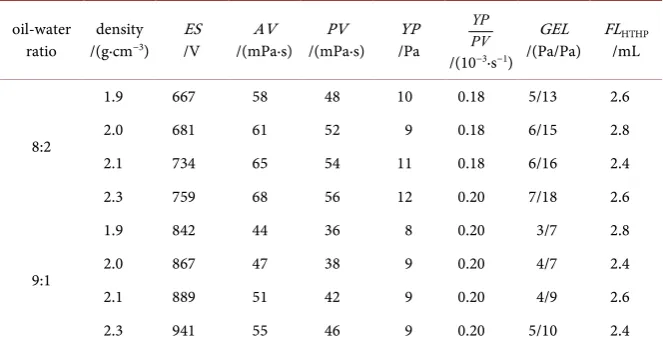
DOI: 10.4236/ojogas.2019.43013 177 Open Journal of Yangtze Gas and Oil laboratory. The barite is weighted to different densities and rolled at 135˚C and 150˚C for 16 h. Apparent viscosity (AV), plastic viscosity (PV), dynamic shear force (YP), dynamic plastic ratio (YP/PV), static shear force (GEL), demulsifica-tion voltage (ES) and high temperature and high pressure fluid loss (FLHTHP) are measured after the aging of the drilling fluid at 65˚C. The experimental results are shown in Table 1 and Table 2.
[image:4.595.206.540.295.468.2]Basic formula of drilling fluid is: 3# white oil + (2.5% - 4.0%) primary emul-sifier + (1.5% - 3.0%) co-emulemul-sifier + (0.5% - 1.0%) wetting agent + (0.8% - 1.5%) organic soil + (2.0% - 2.5%) CaO + 1.5% fluid loss additive + 1.5% plug-ging agent + CaCl2 saline (CaCl2 mass fraction is 25%). The amount of emulsifi-er, wetting agent, CaO and organic soil can be adjusted according to the oil-water ratio and density in the actual conditions.
Table 1. The basic performance of the system after 135˚C hot rolling.
oil-water
ratio /(g∙cmdensity −3) ES /V /(mPa∙s) AV /(mPa∙s) PV YP /Pa
YP PV
/(10−3∙s−1) GEL
/(Pa/Pa) FLHTHP /mL
8:2
1.9 657 59 50.0 9.0 0.18 5/13 2.8 2.0 689 63 53.5 9.5 0.18 6/15 2.6 2.1 725 66 56.0 10.0 0.18 6/16 2.4 2.2 746 75 57.0 11.0 0.20 7/18 2.4
9:1
1.9 812 43 36.0 7.0 0.20 3/7 2.6 2.0 864 48 40.0 8.0 0.20 4/7 2.8 2.1 892 65 43.5 8.5 0.20 4/9 2.6 2.2 956 71 46.0 9.0 0.20 5/10 2.4
Table 2. The basic performance of the system after 150˚C hot rolling.
oil-water
ratio /(g∙cmdensity −3) ES /V /(mPa∙s) AV /(mPa∙s) PV /Pa YP
YP PV
/(10−3∙s−1) GEL
/(Pa/Pa) FLHTHP /mL
8:2
1.9 667 58 48 10 0.18 5/13 2.6 2.0 681 61 52 9 0.18 6/15 2.8 2.1 734 65 54 11 0.18 6/16 2.4 2.3 759 68 56 12 0.20 7/18 2.6
9:1
1.9 842 44 36 8 0.20 3/7 2.8 2.0 867 47 38 9 0.20 4/7 2.4 2.1 889 51 42 9 0.20 4/9 2.6 2.3 941 55 46 9 0.20 5/10 2.4
[image:4.595.207.539.498.671.2]DOI: 10.4236/ojogas.2019.43013 178 Open Journal of Yangtze Gas and Oil fluid loss gradually decreases, and both test results are less than 3.0 mL, indicat-ing that the system has good pluggindicat-ing and fluid loss reduction effect, and a good function of stabilizing the wellbore. Under the same density, the temperature rises, the system’s demulsification voltage, viscosity, and fluid loss show no ob-vious changes, indicating that the system has good temperature resistance and can adapt to different formation temperatures between 135 - 150˚C. At the same density, the oil-water ratio increases, the demulsification voltage increases, and both results are above 600 V, indicating that the system has good emulsion sta-bility. Viscosity, fluid loss, and other parameters can also meet the requirements of the field applications.
The white oil-based system has a high demulsification voltage, low filtration loss and reasonable viscosity at different densities, different temperatures, and different oil-water ratios compared to the diesel based fluids. It shows that the system has good emulsion stability, can adapt to various complicated situations in the well, and provides guarantee for smooth drilling operation.
3.2. Inhibition Performance Evaluation
The shale cuttings of Longmaxi Formation in Pengshui Block, Liangshan For-mation in the Zigong Block and the Longmaxi ForFor-mation in Zigong Block are selected, and the inhibition performance of the system is evaluated by linear ex-pansion experiments and cuttings recovery experiments.
[image:5.595.205.538.605.688.2]Expansion rate experiment with cuttings: 1) the cuttings are ground to less than 200 mesh, and the sieved powders are dried at a temperature of 105 ± 20˚C; 2) weigh 100.0 g of rock cuttings and press it at a pressure of 54 MPa for 10 min in a mold of the sampler to prepare a column sample; 3) the linear expansion rate is measured after immersion in distilled water and oil-based drilling fluid for 16 h on the OFIT shale dilatometer; 4) 6 - 10 mesh shale cuttings are used for a cuttings recovery test, take 350 mL drilling fluid in the aging tank, add 30 g 6 - 10 mesh shale cuttings, stir evenly with glass rod, cover the lid, put it in the roll in the sub-furnace; 5) roll the sample at 150˚C for 16 h, and recover the undi-stributed cuttings by a 40-mesh sieve, rinse it with petroleum ether, and dry it at 105˚C ± 2˚C; 6) weigh the process cuttings to obtain the rolling recovery of cut-tings. The experimental results are shown in Table 3.
Table 3. The expansion rate and recovery rate of cuttings in drilling fluid.
Cuttings level area Linear expansion ratio/% Cuttings rolling recovery/% water Oil-based drilling fluid water Oil-based drilling fluid Longmaxi pengshui 7.9 0.2 56.7 98.3 Liangshan zigong 9.3 0.1 62.4 98.8 Longmaxi zigong 8.1 0.2 81.7 97.9
DOI: 10.4236/ojogas.2019.43013 179 Open Journal of Yangtze Gas and Oil and can effectively inhibit the hydration expansion and dispersion of shale.
3.3. Anti-Pollution Performance Evaluation
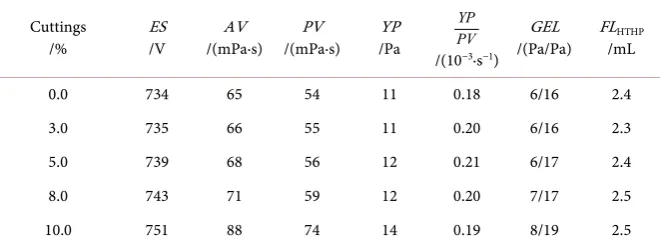
[image:6.595.208.539.251.374.2]Oil-based drilling fluid may be contaminated by drill cuttings during on-site drilling, resulting in changes in drilling fluid performance and failing to meet safe drilling requirements. In the laboratory, a drilling fluid with a oil-water ratio of 8:2 and a density of 2.1 g/cm3 is used, and cuttings powder with different mass fractions from Longmaxi Formation in Zigong Block is added (the cuttings are over 200 mesh). The experimental results are shown in Table 4.
Table 4. The effect of cuttings content on drilling fluid performance.
Cuttings
/% ES /V /(mPa∙s) AV /(mPa∙s) PV /Pa YP
YP PV
/(10−3∙s−1) GEL
/(Pa/Pa) FLHTHP /mL
0.0 734 65 54 11 0.18 6/16 2.4 3.0 735 66 55 11 0.20 6/16 2.3 5.0 739 68 56 12 0.21 6/17 2.4 8.0 743 71 59 12 0.20 7/17 2.5 10.0 751 88 74 14 0.19 8/19 2.5
It can be seen from Table 4 that with the addition of cuttings, the demulsifi-cation voltage, apparent viscosity, plastic viscosity and dynamic shear force of the system gradually increase, the dynamic plastic ratio and the high tempera-ture and high pressure filtration loss change slightly. When the amount of cut-tings is less than 5%, the performance of drilling fluid changes little. When the do-sage is 8%, the apparent viscosity and plastic viscosity increase quickly than those in previous conditions. When the dosage is 10%, the apparent viscosity and plastic viscosity increase more obviously. It shows that the cutting debris limit of this sys-tem is 8%. Thus, attention is needed to remove cuttings out of this low-density solid phase during on-site applications to ensure safe and rapid drilling.
3.4. Fluid Loss Prevention Performance Evaluation
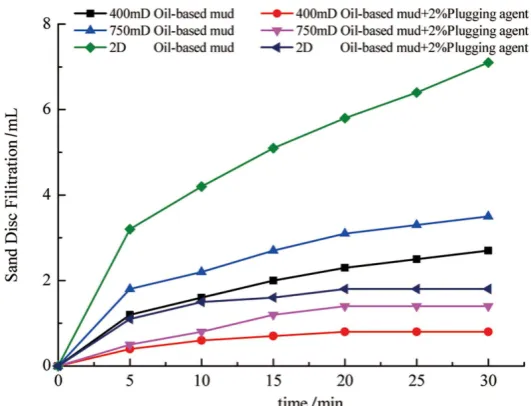
DOI: 10.4236/ojogas.2019.43013 180 Open Journal of Yangtze Gas and Oil
Figure 1. The sealing performance of drilling fluid for sand discs with different
permea-bilities.
It can be seen from Figure 1 that the loss of the sand disc with the plugging agent is much less than that of the unfilled. The smaller the permeability of the sand disc is, the smaller the loss of the sand disc is. However, the fluid loss of the drilling fluid with the plugging agent on the sand disc with different permeabili-ties is almost the same. It indicates that the drilling fluid with plugging agent has good sealing property for sand discs with different permeabilities, and the seal-ing performance of the low permeability sand discs is especially better, which can prevent the solid phase and liquid phase in the drilling fluid from entering the wellbore. Thus, the shale swelling caused by the filtration can be inhibited, and the wellbore remains stable.
4. Field Application
DOI: 10.4236/ojogas.2019.43013 181 Open Journal of Yangtze Gas and Oil
Table 5. The oil-based mud performance from the four-open sections of Well 201H7.
well Deep
/m
density
/(g∙cm−3) viscosity/s Funnel Demulsification voltage/V /(mPa∙s) AV /(mPa∙s) PV Dynamic ratio/l
YP PV
/(10−3∙s−1) GEL /(Pa/Pa) Cl
− concentration /(mg∙L−1)
3204 1.91 53 728 47.5 41 0.16 5/13 3.4 /
3377 2.02 65 842 63.5 54 0.18 5/14 2.6 20,000
3630 2.10 63 820 66.0 58 0.14 6/16 2.4 23,000
3711 2.18 64 945 63.5 56 0.13 6/16 2.4 24,000
4395 2.16 66 1132 70.0 62 0.13 7/16 3.0 25,000
4838 2.14 64 1024 65.0 54 0.2 6/16 2.0 26,000
5000 2.13 66 1024 75.0 61 0.23 7/17 1.6 28,000 5486 2.15 67 1089 72.0 59 0.22 6/16 1.6 29,000
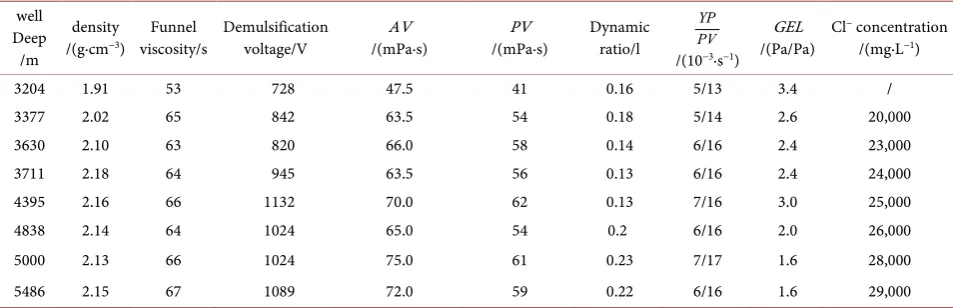
The results of drilling in the horizontal section of Well 201H7-6 show that the white oil-based drilling fluid has good emulsifying effect and high demulsifica-tion voltage. At the end of the drilling, the demulsificademulsifica-tion voltage is more than 1000 V, and the performance is stable. It has low apparent viscosity, plastic vis-cosity, high dynamic-plastic ratio and static shearing force. It shows that the system has good flow performance; the anti-collapse formation protection ability is strong, the fluid loss is low, the wellbore is stable, and there is basically no swelling and breakouts during the drilling process. Well logging and casing ac-tivities are smooth after the drilling is completed. It sets the records of the deep-est drilling depth, the shortdeep-est cycle, and the fastdeep-est drilling speed in that region, which provides valuable experience for future drilling.
5. Conclusions
1) The oil-water ratio of the oil-based drilling fluid system is 8:2 and 9:1. At different densities, after rolling at 135˚C and 150˚C, it has good emulsion stabil-ity, suitable viscosity and shear force, and low filtration loss at high temperature and high pressure, which can meet the needs of field applications.
2) The system has good inhibition performance and resistance to cuttings pollution, and its rolling recovery rate is over 97%, and the resistance to cuttings pollution is 8%.
3) The system has good sealing properties for different permeability sand discs. 4) The system has been successfully applied in Well 201H7-6. The rheology of drilling fluid meets the requirements of hole cleaning; the high temperature and high pressure fluid loss is less than 3.5 mL, the mud cake quality is good, the sealing is strong, the wellbore is stable, the casing and well logging are smooth. It has set the records of the deepest drilling depth, the shortest cycle, and the fast-est drilling speed in the region, which provides valuable experience for future drilling.
Conflicts of Interest
DOI: 10.4236/ojogas.2019.43013 182 Open Journal of Yangtze Gas and Oil
References
[1] He, S., Li, S., Wang, X., etal. (2013) Development of High Performance Oil-Based Drilling Fluid and Its Application in Pengwan 3HF Well. Drilling Fluid and Com-pletion Fluid, 30, 1-4.
[2] Liu, X.Q., Chen, D.H., Chen, Y., etal. (2011) Research and Application of Envi-ronmentally Friendly All-White Oil-Based Drilling Fluid. Drilling Fluid and Com-pletion Fluid, 28, 10-12.
[3] Taugbl, K., Lilledal, L., Juel, H., et al. (2004) The Completion of Subsea Production Wells Eased by the Use of a Unique, High-Density, Solids-Free, Oil Based Comple-tion Fluid. Society of Petroleum Engineers.
[4] Zhang, Y., Wang, J., Shu, F., et al. (2012) Research and Application of White Oil-Based Oil-in-Water Drilling Fluid Technology. Journal of Oil and Gas, 34, 235-237.
[5] Zhang, H., Zhou, Z., Liu, F., et al. (2016) Research and Application of White Oil Base Oil Drilling Fluid System. Drilling and Mining Technology, 39, 99-102. [6] Xu, T. (2015) High-Density White Oil-Based Drilling Fluid Research. China
Uni-versity of Petroleum, Beijing.
[7] Fossum, P.V., Moum, T.K., Sletfjerding, E., et al. (2007) Design and Utilization of Low Solids OBM for Aasgard Reservoir Drilling and Completion. Society of Petro-leum Engineers.
[8] Zanten, R.V., Miller, J.J., Baker, C., et al. (2012) Impoved Stability of Invertemulsion Fluids. Society of Petroleum Engineers.
[9] Zhou, Z. (2012) Practical Application Research of Environmentally Friendly All-White Oil-Based Drilling Fluid. China Petroleum and Chemical Industry Stan-dards and Quality, 2, 174.
[10] Wang, M., Xiao, H., Xiao, D.S., et al. (2011) Application of Low Density White Oil Based Drilling Fluid in Underbalanced Drilling. Science and Technology Innovation Guide, 19, 47-48.
[11] Ren, J. (2017) Application of GL-1 Well to 260˚C White Oil-Based Water-in-Oil Drilling Fluid. ProspectingEngineering (Rock and Soil Drilling Engineering), 44, 51-54.
[12] Gao, Y., Yang, P., Li, J., et al. (2016) Indoor Research on High Temperature and High Density All White Oil Based Drilling Fluid System. Drilling & Production Technology, 39, 88-90.
[13] Wang, X., Li, X., Lin, Y., et al. (2013) Research and Application of High Perfor-mance Oil-Based Drilling Fluid for Shale Horizontal Wells. Oil Drilling Technolo-gy, 41, 17-22.
[14] Zhang, W., Wu, J., Jiang, G., et al. (2018) Applicability of MEGADRIL Oil-Based Drilling Fluid in High Temperature and High Pressure Gas Fields in the Western South China Sea. Journal of Yangtze University, 15, 43-49.