ISSN Online: 2327-7203 ISSN Print: 2327-7211
DOI: 10.4236/jdaip.2019.73008 Aug. 15, 2019 118 Journal of Data Analysis and Information Processing
Blockchain in Smart Cities: Exploring
Possibilities in Terms of Opportunities
and Challenges
Raed A. Salha
1, Maher A. El-Hallaq
2, Abdelkhalek I. Alastal
11Geography and GIS Department, Arts College, Islamic University of Gaza, Gaza, Palestine
2Civil Engineering Department, Engineering College, Islamic University of Gaza, Gaza, Palestine
Abstract
The ultimate aim of a smart city is to enhance the quality of life for its resi-dents and businesses through modern technologies in order to reduce resource deterioration and maintain overall costs. From this perspective, blockchain is one of these technologies that has received much attention during the recent years as it offers new alternatives for individuals and institutions in the smart city context. This study aims to explore the potential and contribution of blockchain in smart cities by studying and reviewing the literature of scien-tific research on the concept and fundamentals of blockchain, involving its most practical applications. In addition, it summarizes worldwide examples of success in using blockchain as well as exploring the challenges and oppor-tunities related to this technology in smart cities. Thus, this study provides a useful reference for researchers to review all about the new blockchain tech-nology.
Keywords
Blockchain Technology, Consensus, Distributed Ledger, Smart Cities, Smart Contracts
1. Introduction
The smart city concept can be looked upon as a framework for realization im-plementing a vision of advanced and modern urbanization. Smart cities control technology and utilize existing and planned infrastructure investments to pro-vide a higher quality of living to residents and a conducive investment climate for businesses and to maximize resource utilization and transparency for gov-ernments. Smart cities can be considered an organic integration of systems, IT How to cite this paper: Salha, R.A.,
El-Hallaq, M.A. and Alastal, A.I. (2019) Blockchain in Smart Cities: Exploring Pos-sibilities in Terms of Opportunities and Challenges. Journal of Data Analysis and Information Processing, 7, 118-139.
https://doi.org/10.4236/jdaip.2019.73008
Received: July 1, 2019 Accepted: August 12, 2019 Published: August 15, 2019
Copyright © 2019 by author(s) and Scientific Research Publishing Inc. This work is licensed under the Creative Commons Attribution International License (CC BY 4.0).
http://creativecommons.org/licenses/by/4.0/
DOI: 10.4236/jdaip.2019.73008 119 Journal of Data Analysis and Information Processing infrastructure, physical infrastructure, and social and business infrastructure. These systems work collectively so as to generate intelligent and actionable in-formation for decision makers [1]. Incorporating new technologies into the de-velopment of smart cities means rethinking the way different services provided. From this perspective, blockchain might represent the future of both smart cities and smart communities as it offers new alternatives for individuals and institu-tions [2]. The blockchain emerges as an innovative tool which proves to be use-ful in a number of application scenarios. A number of large industrial players, such as IBM, Microsoft, Intel, and NEC, are currently investing in exploiting the blockchain in order to enrich their portfolio of products [3]. The innovation and imbalance driven by blockchain provide a great opportunity for countries and ci-ties. Blockchain technology can help to the remodeling of the economy reshape of smart cities, society and public institutions, but it is still new and experimental
[4]. The application of blockchain technology varies from city to city, from project to project, depending on economic and social conditions, infrastructure, technical expertise, and other factors.
The main objective of this study is to explore the potential and contribution of blockchain in smart cities by studying the literature of scientific research on the concept and fundamentals of the blockchain, as well as to show the most prac-tical applications of this new technology involving some worldwide examples of success in applying it. In addition, it tries to explore the challenges and oppor-tunities related to this new technology in smart cities.
2. Previous Studies
There are many studies conducted about smart cities regarding their concepts, their components, their tools and how to establish a smart city [5]-[12]. Mainly in the Palestinian Territories, Alastal et al. [13] try to promote sustainable urban development by adopting the smart city approach by identifying the concept of smart cities in the reality of the cities of the Gaza Strip, considering Khan Younis city as a case study. The study reveals that Khan Younis has 41.7% of the cha-racteristics features of the smart city and needs further improvements in all axes especially the availability of social and economic infrastructures. El-Hallaq et al.
[14] aim to promote sustainable urban development through the adoption of smart city approaches using the city’s 3D representation and analysis capabilities to reflect and define the current situation and formulate a future vision using GIS and BIM. In this study, a 3D GIS/BIM model is developed for Sheikh Ha-mad city in the Gaza Strip as an example. In addition to, a web-based application is launched to assist in sharing, viewing, managing, analyzing and supporting decision-making process.
DOI: 10.4236/jdaip.2019.73008 120 Journal of Data Analysis and Information Processing exploring the idea of using it for financial transactions, logistics and securing contracts.Tapscott D. and Tapscott A. [15] have acknowledged the potential the blockchain revolution on redefining the idea of trust in both digital and local communities. Penzes [16] considers that the fundamental concept that can ena-ble the combination of BIM and blockchain technology is their shared ability to serve as a single source of truth. BIM can combine information from the block-chain, such as supply chain information, the provenance of materials, payment details, etc., particularly during construction; and, it can also assign information to the blockchain, like design decisions, source of data or model modification or-ders. This information can later be used by smart contracts to initiate further ac-tion, such as payments or material orders. Shen and Pena-Mora [17] present and organize use cases from 159 selected papers into nine sectors recognized as cru-cial for sustainable and smart urban future. At the micro-level, they identify a component-based framework and analyze the design and prototypes of block-chain systems studied in a subset of 71 papers. The high-level use case review allows illustrating the relationship between them and the four pillars of urban sustainabil-ity; social, economic, environmental, and governmental. Moreover, the system level analysis helps highlight interesting inconsistencies between well-known blockchain applicability decision rules and the approaches taken by the literature. Pieroni et al. [18] consider that the integration of different technologies and different IT systems, needed to build smart city applications and services, remains the most challenge to overcome. In the smart city context, it intends to investigate the smart environment pillar, and in particular, the aspect related to the implemen-tation of a smart energy grid for citizens in the urban context. The innovative characteristic of the proposed solution consists of using the blockchain technol-ogy to join the grid, exchanging information, and buy/sell energy between the involved nodes (energy providers and private citizens), using the blockchain granting ledger. Yannis [19] tries to explore the blockchain technology and its related platforms. It presents existing global and governmental initiatives, to-gether with potential applications of blockchain in different domains, with a fo-cus on education. The need to learn about this emerging technology is disfo-cussed, together with pioneering cases in formal and informal learning settings. While Ref. [20] points out that the blockchain technology in that it is focused on de-centralization and in terms of functioning is transparent can help increase the value of a smart city. From its implementation of electricity transactions to nat-ural resource management, this technology can always find its place in the de-velopment priorities of new cities based on smart grid systems.
3. Smart City
DOI: 10.4236/jdaip.2019.73008 121 Journal of Data Analysis and Information Processing resources optimally, and create a more livable urban environment [21], which is known as the smart city.
3.1. Smart City Definition
Actuality, there is no standardized commonly accepted definition of a smart city. Various definitions of a smart city are summarized in Table 1. We can say that there are significant differences between smart city definitions, by specialization, angle of view, and the elements that smart cities address. It means that the concept
Table 1. Basic definitions for a smart city.
s. Definition Field
1 A smart sustainable city is a city well performing in 6 characteristics, built on the “smart” combination of endowments and activities of self-decisive, independent and aware citizens [22].
Economic growth, transport, mobility, environment, standard of
living, governance
2
A smarter city uses technology to transform its core systems and optimize finite resources. At the highest levels of maturity, a smarter city is a knowledge-based system that provides real-time insights to stakeholders and enables decision makers to manage the city’s subsystems proactively. Effective information management is at the heart of this capability, and integration and analytics are the key enablers [23].
Technology
3
Based on the exploration of a wide and extensive array of literature from various disciplinary areas we identify eight critical factors of smart city initiatives: management and organization, technology, governance, policy context, people and communities, economy, built infrastructure, and natural environment [24].
Technology, governance, policy context, people and
communities, economy, infrastructure, and the
natural environment
4
A smart city is a city that has developed some technological infrastructure that enables it to collect, aggregate and analyze real-time data and has made a concerted effort to use that data to improve the lives of its residents. Smart city initiatives often involve three components: information and communication technologies (ICTs) that generate and aggregate data; analytical tools which convert that data into usable information; and organizational structures that encourage collaboration, innovation and the application of that information to solve public problems [25].
Technology, organizational structures, collaboration, innovation
5
A smart city is a designation given to a city that incorporates information and communication technologies (ICT) to enhance the quality and performance of urban services such as energy, transportation and utilities to reduce resource consumption, wastage and overall costs. The overarching aim of a smart city is to enhance the quality of living for its citizens through technology. And how power of Blockchain can impact the functioning of a smart city. An approach is being presented on how Blockchain can be used on a smart city services platform to enable businesses and companies to participate in the smart city environment [26].
Technology, urban services, transportation,
citizens, quality of living, blockchain
6
The use of smart computing technologies to make the critical infrastructure components and services of a city—which include city administration, education, healthcare, public safety, real estate, transportation, and utilities—more intelligent, interconnected, efficiency and effectiveness [27].
Technology, services, infrastructure, education,
DOI: 10.4236/jdaip.2019.73008 122 Journal of Data Analysis and Information Processing of the sustainable smart city extends to include a number of important elements including vision, solutions, integration, cooperation, and continuity. It can be said that the second definition may be the most comprehensive and clearest one.
3.2. Smart City Characteristics
Table 2 illustrates six characteristics of a smart city and their assigned factors; smart economy, smart people, smart governance, smart mobility, smart envi-ronment and smart living. Smart economy includes factors all around economic competitiveness as innovation, entrepreneurship, trademarks, productivity and flexibility of the labor market as well as the integration in the (inter-)national market. Smart people is not just described by the level of qualification or educa-tion of the citizens but also by the quality of social interaceduca-tions regarding inte-gration and public life and the openness towards the “outer” world. Smart go-vernance comprises aspects of political participation, services for citizens as well as the functioning of the administration. The other three characteristics and their corresponding elements are listed in Table 2. The next section will address the blockchain technology in terms of definitions, components, types, characte-ristics and main requirements, and other key elements related to the blockchain environment in a smart city.
4. Blockchain Technology
Blockchain is enabling a smart city to leverage all the advantages of cloud com-puting while the blockchain assessment and implementation: flexibility, agility, capex-free, compliance, scalability, allowing the smart city to deal with decentra-lized blockchain network concurrently. A time can be saved in creating blocks, managing a blockchain network, designing the network, and the developing ap-plications, swiftly pool and validate use cases as well as rapidly scale and roll out blockchain based services.The following subsections review the most important elements of blockchain technology.
4.1. Blockchain Definition
It can be said that blockchain is a technology that is still under development, characterized by diversity and rapid development. There is no universally agreed-upon definition for blockchain. However, many of the best definitions emphasize a public, digital, chronological and distributed ledger for transactions. Where it interferes with most academic and practical specializations, and there-fore different definitions of different specializations and how to deal with it are shown in Table 3.
4.2. Blockchain Versions
DOI: 10.4236/jdaip.2019.73008 123 Journal of Data Analysis and Information Processing Table 2. Smart city characteristics [22].
Smart Economy
(competitiveness) (social and human capital) Smart People • Innovative spirit
• Entrepreneurship
• Economic image & trademarks • Productivity
• Flexibility of labor market • International embeddedness • Ability to transform
• Level of qualification • Affinity to lifelong learning • Social and ethnic plurality • Flexibility
• Creativity
• Cosmopolitanism/open mindedness • Participation in public life Smart Governance
(participation) (transport and ICT) Smart Mobility • Participation in decision-making
• Public and social services • Transparent governance • Political strategies & perspectives
• Local accessibility
• (Inter-)national accessibility • Availability of ICT-infrastructure
• Sustainable, innovative and safe transport systems Smart Environment
(natural resources) (quality of life) Smart Living
• Attractively of natural conditions • Pollution
• Environmental protection • Sustainable resource management
• Cultural facilities • Health conditions • Individual safety • Housing quality • Education facilities • Touristic attractively • Social cohesion
Table 3. Blockchain and distributed ledger technology (DLT) definitions.
Author Definition
Robby and Alexander [28]
Blockchain is a particular type or subset of so-called distributed ledger technology. DLT is a way of recording and sharing data across multiple data stores (also known as ledgers), which each have the exact same data records and are collectively maintained and controlled by a distributed network of computer servers, which are called nodes.
Holotescu [29]
Blockchain technology enables the creation of a decentralized environment, where the cryptographically validated transactions and data are not under the control of any third party organization. Any transaction ever completed is recorded in an immutable ledger in a verifiable, secure, transparent and permanent way, with a timestamp and other details.
Bahga and Madisetti [30]
Blockchain is a distributed data structure comprising a chain of blocks. Blockchain acts as a distributed database or a global ledger which maintains records of all transactions on a Blockchain network.
UK Government Office for Science [31]
Distributed ledgers are a type of database that is spread across multiple sites, countries or institutions, and is typically public. Records are stored one after the other in a continuous ledger, rather than sorted into blocks, but they can only be added when the participants reach a quorum.
4.3. Blockchain Components
[image:6.595.209.540.423.650.2]DOI: 10.4236/jdaip.2019.73008 124 Journal of Data Analysis and Information Processing Figure 1. Blockchain versions [19].
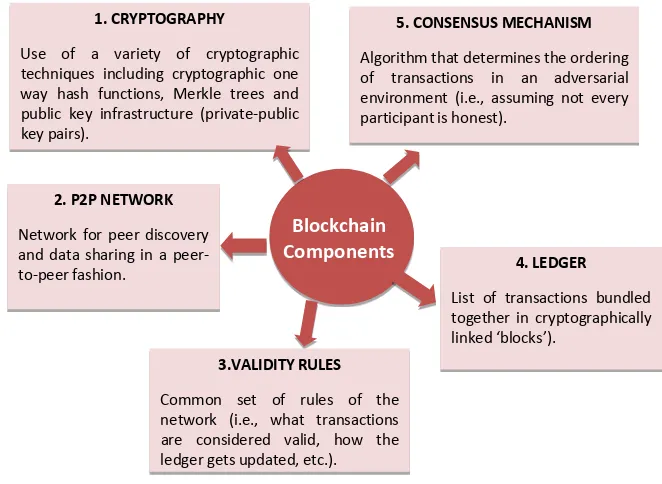
from non-technical disciplines. Reasons might be the complex interplay of blockchain components and resulting properties that are hard to grasp in detail and the lack of a solid common knowledge base [29]. Figure 2 illustrates the core components that include the blockchain and its environment.
4.4. Blockchain Structure
Blockchain is a sequence of blocks that hold all transaction records in a block-chain network. Assume four transactions namely: A, B, C and D as described in
Figure 3, each block contains a block header and block body. Block header con-tains the following [33]:
• Block version: refers to the rules of validation based on a set of blocks.
• Parent block hash: contains the hash value which indicates the previous
block.
• Merkle tree root hash: the hash value of all the transactions in the block.
• Timestamp: refers to the timestamp by seconds currently.
• N-Bits: includes the existing hashing target in a compact format.
• Nonce: a 4-byte field, which usually starts with 0 and increases for every hash calculation.
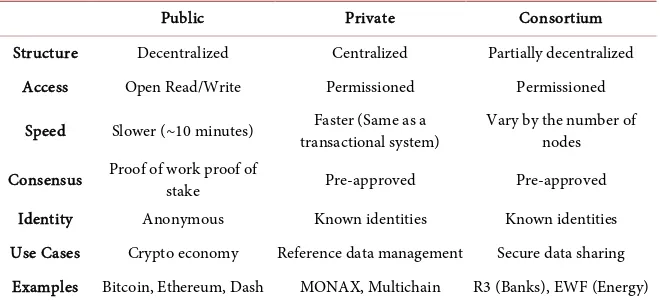
There are three main types of blockchain platforms [34]: public, private and consortium. Organizations use these platforms based on their specific needs and it includes three formative mechanisms and structure as in Figure 4. The dif-ference [35] in the structure, functions, nature, mechanisms, and use of the three types of blockchain can be noticed as in Table 4. Where:
• Public: Everyone can check the transaction and verify it.
• Consortium: It refers to the node that had authority can be chosen in
ad-vance, usually has partnerships like business to business, the data in a block-chain can be open or private, can be seen as Partly Decentralized as Hyper-ledger.
•CURRENCY specialist, deployment cryptocurrencies in apps related to cash, and financial transactions.
•Decentralization of money and payments.
Blockchain 1
•CONTRACTS, the deployment of smart properties, digital assets, and smart contracts. •Decentralization of markets.
•Typical platform is Ethereum.
Blockchain 2
•APPLICATIONS, in new areas of smart cities, government ,health, science, and art. •Typical application is Solidity.
Blockchain 3
•INTEROPERABILITY
•Usable in industry, enterprise resource planning, integration of different execution systems, supply chain management , IoT data collection, and asset management.
DOI: 10.4236/jdaip.2019.73008 125 Journal of Data Analysis and Information Processing Figure 2. The main components of Blockchain [32].
Figure 3. Blockchain structure and its components [26].
Figure 4. Blockchain network types: (a) Public; (b) Consortium; and (c) Private.
• Private: It refers to not every node can participate, maybe one or more
re-stricted in the constructed blockchain. That interpretation of the firm au-thority for access to data management.
Blockchain Components 1. CRYPTOGRAPHY
Use of a variety of cryptographic techniques including cryptographic one way hash functions, Merkle trees and public key infrastructure (private-public key pairs).
5. CONSENSUS MECHANISM Algorithm that determines the ordering of transactions in an adversarial environment (i.e., assuming not every participant is honest).
4. LEDGER
List of transactions bundled together in cryptographically linked ‘blocks’).
2. P2P NETWORK
Network for peer discovery and data sharing in a peer-to-peer fashion.
[image:8.595.209.539.498.639.2]DOI: 10.4236/jdaip.2019.73008 126 Journal of Data Analysis and Information Processing Table 4. Comparison between blockchain types.
Public Private Consortium
Structure Decentralized Centralized Partially decentralized Access Open Read/Write Permissioned Permissioned
Speed Slower (~10 minutes) transactional system) Faster (Same as a Vary by the number of nodes
Consensus Proof of work proof of stake Pre-approved Pre-approved
Identity Anonymous Known identities Known identities Use Cases Crypto economy Reference data management Secure data sharing Examples Bitcoin, Ethereum, Dash MONAX, Multichain R3 (Banks), EWF (Energy)
4.5. Consensus Methods
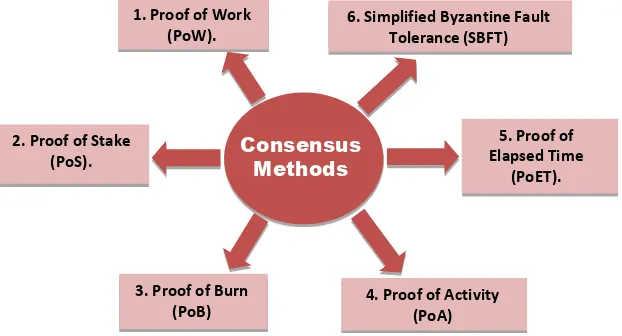
Blockchains are peer-to-peer networks with no central administrator or author-ity. It is crucial to ensure that the network participants reach consensus on the state of the ledger i.e. the uniqueness and order of records. This is done through consensus algorithms that apply different methods to ensure that the right order and uniqueness of transactions have been determined and validated by enough users to be added to the ledger. Figure 5 illustrates the consensus methods [36].
4.6. Artificial Intelligence (AI)
Blockchain Technology powered by AI is the most advanced IT development taking place in the blockchain and cryptocurrency market, for example. AI pro-vides several features to manage decentralized monetary systems. AI algorithms can be used to predict the value of Bitcoins, which can help Bitcoin traders to manage Bitcoin transactions. It will also help the customers to have easy access to comparative information and will allow investors to be better informed before making decisions about their financial plans [37]. Artificial intelligence will be effective through its use of smart networks in various smart sectors of the city; to achieve more efficiency and effectiveness in the delivery of different services, as well as the use of AI in finding the mechanisms of consensus used in the imple-mentation of transactions for users in different types of blockchain and also in different scenarios and operations in the smart city.
4.7. Smart Contracts
DOI: 10.4236/jdaip.2019.73008 127 Journal of Data Analysis and Information Processing Figure 5. Consensus methods.
words, it can be said that the smart contracts are computer protocols that facili-tate, verify or enforce the execution of a contract. At a fundamental level, smart contracts are analogous to a series of if-then statements applied to the details of a transaction [39]. Figure 6 illustrates how a smart contract works [40]. There are various benefits of using smart contracts but reducing transaction costs and in-creased transparency are the two key elements achieved by increasing digital ef-ficiency by eliminating the need for mediators.
4.8. Requirements for Blockchain Environment
A smart city can have vastly different requirements for different use cases and scenarios, which needs high levels of trust, save time and cost, security, and etc. To address this diversity, basic requirements must be met for blockchain as shown below:
• A peer-to-peer network which is either public, partially or totally private. • A distributed database acting as a ledger, where all transactions and other
re-levant information are recorded for network members.
• A variety of tools and cryptographic processes ensuring the security of the network and the integrity of exchanges among its members.
• A consensus algorithm managing the updating of the ledger and allowing for the process of validation of transactions among the members of the network to be automated through a variety of procedural rules.
• An incentive mechanism embedded in the network’s operating protocol, which is necessary for rewarding the most active members of the network—that is, those who take responsibility for ensuring that the network works correctly and is secure, especially if the network is completely open.
4.9. Blockchain Mechanism
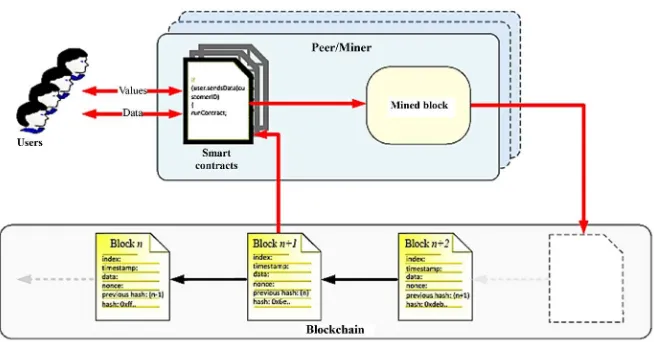
Blockchain is, simply put, an electronic ledger system managed without a central authority by a distributed network of independent computers, called “nodes” (Figure 7). At their most basic level, blockchain enables users to record digital
Consensus Methods
1. Proof of Work (PoW).
5. Proof of Elapsed Time
(PoET).
4. Proof of Activity (PoA) 2. Proof of Stake
(PoS).
3. Proof of Burn (PoB)
DOI: 10.4236/jdaip.2019.73008 128 Journal of Data Analysis and Information Processing Figure 6. How a smart contract works.
Figure 7. Blockchain mechanism.
transactions without the risk of third-party interference or alteration. New actions are sent to a node informing the computer network of the pending trans-action. A node is randomly selected to review the details of the pending transac-tion and determine its legitimacy using rules established by the blockchain’s de-sign. To maximize efficiency, many transactions are bundled together by nodes into a block and are then added to the chain. All nodes receive an updated copy of the blockchain and there exists no “master” version [20].
4.10. Blockchain Applications
Although blockchain is quite a new technology, it can be widely used in industry with many use cases in the new solutions that are constantly introduced. A sur-vey conducted by the World Economic Forum in 2015 predicts that 10% of global GDP will be stored in blockchain technology by 2027 [41]. The next para-graphs show some applications of blockchain technology in a smart city field
[16] [19] [42] [43]. Identity services
DOI: 10.4236/jdaip.2019.73008 129 Journal of Data Analysis and Information Processing for managing passports, birth and wedding certificates, national and electoral identity, and managing e-residency programs, among others. However, there are critics who claim that existing digital ID technologies work well and are more scalable than those using blockchain platforms. Indeed blocking the scalability limits of blockchain technology could block the massive deployment of countries with large populations such as India and China.
Governmental services
Blockchain can be used to support the provision of public needs to citizens and stakeholders, especially those who require personal interaction and need personal identification. An implicit link between blockchain technology and e-Government exists, and this link is exploited by a series of startup blocks. Thus, the delivery of selected and personalized governmental services will be possible using this tech-nology.
Education
Student records, faculty records, educational certificates, etc., are key assets in the education domain. Such records need to be shared with multiple stakeholders and it is imperative to ensure that they are trustworthy. The provenance of these records also needs to be determined accurately. Student records, faculty records, and educational certificates can be maintained with the application of block-chain technology. Blockblock-chain can also simplify certificate attestation and verifi-cation. It could even transform the manner in which the policy for educational inclusion is framed by bringing in base uniformity in the tracking of national metrics.
Financial services
Cryptocurrencies and blockchain can universally rectify the situation, which resulted from the current financial industry. With a smartphone and an internet connection, both of which are widely available, anyone can bank, start a business and receive payments.
Publishing
An example of a rather unexpected application of blockchain, the publishing industry too can benefit from decentralization. A platform like an authorship is set to overturn the current system, where influence is in the hands of publishers, by using a tokenized system that recognizes the work of any writer. Publishers can choose to digitally publish writers and print their books, should they feel convinced of their quality and should demand to exist.
Elections
DOI: 10.4236/jdaip.2019.73008 130 Journal of Data Analysis and Information Processing offer loans or sell their private keys in economic interest. Once it appears to be a viable method, it will be interesting to compare voting in the blockchain with the Internet vote, which is already used in Estonia.
Aid and development
Aid Tech, a London company, is probably the first launch of blockchain tech-nology that has supported humanitarian and development efforts in the Middle East. The company offers a voucher system that can be used even in the most difficult contexts and helps ensure that financial resources are safe in the final destination. Bitnation now also provides support for refugees.
Healthcare
Patient data is a crucial part of the medical industry. Secure storage and data access, which could protect and make an efficient diagnosis, is possible with blockchain. With a view to reaching improve the healthcare space by offering a secure space for stakeholders to store and manage data. Their target audience is patients, providers and healthcare organizations. Patients can easily access their data and hand it over to providers, who may not have a complete history of the patient’s health but will be able to view notes from previous providers and or-ganizations. The organizations benefit from cheaper, secure and efficacious record storage.
Supply chain management
The supply chain industry is one fraught with many challenges, most of which are concerned with curtailing rising costs and efficiently supplying products to retailers and customers. The industry faces several intractable obstacles. Fuel costs are ever on the rise, which makes transportation an increasingly expensive activity. Overproduction of products wastes precious resources like water and electricity, as well as taking up space and eventually becoming harmful waste. Smart contracts offer a potential solution to this problem. With smart contracts, it is possible for funds to be locked into a contract, whereupon manufacturers would begin production only after a certain number has been reached. It would eliminate the worry of overestimating demand and resource consumption, and could also eliminate middlemen by directly connecting consumers with manu-facturers.
Internet of things
Along with blockchain and artificial intelligence, the Internet of Things is another technological development that is up and coming, with radical trans-formative effects. Combining RFID technology with blockchain and the Internet of Things to form what they call the “Value Internet of Things”, a new business system will evolve where logistics, manufacturing, retail, and infrastructure can share data securely. Because of RFID technology, the system will also feature product traceability and asset ownership.
Cloud computing/distributed computing
DOI: 10.4236/jdaip.2019.73008 131 Journal of Data Analysis and Information Processing trouble is that it requires resources that are currently only accessible to major corporate powers who have the funds to operate power systems. The distributed nature of blockchain lets any user across the world utilize the computing power of ordinary computers to perform computationally-intensive tasks.
Construction industry
The fundamental concept that can enable the combination of BIM and block-chain technology is their shared ability to serve as a single source of truth. BIM can combine information from the blockchain, such as supply chain informa-tion, the provenance of materials, payment details, etc. particularly during con-struction; and, it can also assign information to the blockchain, like design deci-sions, source of data or model modification orders. This information can later be used by smart contracts to initiate further action, such as payments or material orders. The French start-up BIMCHAIN is developing a similar blockchain ap-plication that was described above. The main concept is to deploy blockchain together with BIM processes and data making the BIM data and model contrac-tual. Through smart contracts, BIMCHAIN would like to validate models, in-itiate automatic payments and enhance collaboration with blockchain enabled proof of consistency, publication, and approval. The project developed plugins for software such as ArchiCAD and Revit in order to integrate its blockchain solution to the main Autodesk BIM software. A Beta Program is launched in December 2018 in order to support the development of the company’s first product.
Insurance
The insurance market has several layers of intermediaries, making approval a frustrating chore. The process is inefficient and lacks ease of communication. Blockchain’s goal is to encourage new business models, increase transaction speed and insurance approval, reduce risk through better data access, and im-prove customer experience.
Blockchain-as-a-service
Software is the backbone of every computing device, from the smartphone to the personal computer. The modular nature of it has helped many a developer create even more software. Some projects offer end-to-end solutions for software development, making testing and deployment on the blockchain simpler. They also feature an academy where one can learn about development. Essentially, it is a Software-as-a-Service platform that provides blockchain utility to its users.
Digital advertising
The power to reach an audience and influence them has always been with those with the largest amount of money. This results in numerous problems, not the least of which is centralized advertising power. Users are bombarded with irrelevant and frequent advertisements. Data is collected and exploited to further target individuals.
Energy
con-DOI: 10.4236/jdaip.2019.73008 132 Journal of Data Analysis and Information Processing tracts. The energy used by individuals in homes could form a micro grid where communities become resilient to power outages, as well as reduce the drain on the environment.
Human resources/recruitment
Tamper-proof ledgers that safely store personal data while simultaneously al-lowing them to be easily accessed makes blockchain ideal for use in a field like hu-man resources, where the verification of employee data can be time-consuming and laborious. It would make hiring more efficient and streamline all of the tangen-tial processes associated with HR, such as setting up an employee bank account and medical benefits.
5. Examples of Blockchain’s Experiments
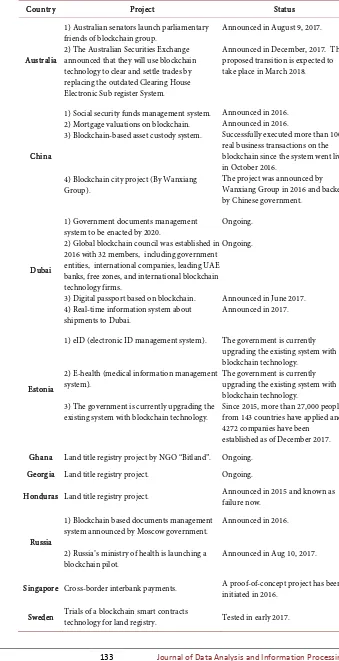
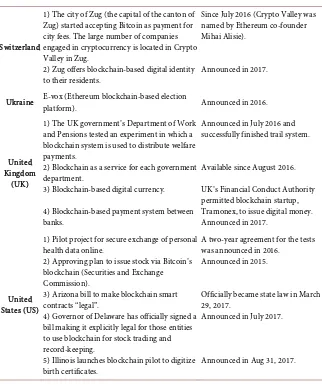
Nowadays, we can find that so many blockchain projects underway in so many countries. Moreover, the speed of expansion of government-led blockchain projects worldwide is astonishing. For example, Estonia has used blockchain technology to issue e-ID for identity verification for their citizens. Additionally, electronic voting systems based on blockchain are being built in many countries including Ukraine, Estonia, and Australia. The United States is working to incorporate blockchain technology to record and share medical information, and the UK is pursuing research and development to apply blockchain technology to public services. Dubai wants to move many government transactions into blockchain by 2020. The Swiss city of Zug uses blockchain to digitize ID registration and is working on e-voting. Zug also accepts cryptocurrency as payment for public ser-vices. China has announced a plan to build a “Blockchain city”, based on block-chain technology. Table 5 summarizes examples of government-led blockchain projects [44].
6. Evaluation of Blockchain Technology
Several benefits of the blockchain technology in smart city are highlighted in-cluding the reduced transaction cost, speedy process, enhanced privacy and relia-bility. As a blockchain is a specific type of distributed ledger shared within a network, it is not owned by one person or organization. Unlike traditional trans-actions where a trusted third party is needed to verify and certify the transaction, the blockchain technology does not require a middleman that verifies the accu-racy or the authenticity of the transaction, thus, reducing its transaction cost.
Table 6 shows the key benefits of blockchain technology in a smart city [45]. The main challenges facing blockchain involve [46]:
• Lack of clarity on the terminology and perceived immaturity of the technol-ogy.
• Perceived risks in early adoption and likely disruption to existing industry practices.
DOI: 10.4236/jdaip.2019.73008 133 Journal of Data Analysis and Information Processing Table 5. Examples of government-led blockchain projects.
Country Project Status
Australia
1) Australian senators launch parliamentary friends of blockchain group.
2) The Australian Securities Exchange announced that they will use blockchain technology to clear and settle trades by replacing the outdated Clearing House Electronic Sub register System.
Announced in August 9, 2017.
Announced in December, 2017. The proposed transition is expected to take place in March 2018.
China
1) Social security funds management system. 2) Mortgage valuations on blockchain. 3) Blockchain-based asset custody system.
4) Blockchain city project (By Wanxiang Group).
Announced in 2016. Announced in 2016.
Successfully executed more than 100 real business transactions on the blockchain since the system went live in October 2016.
The project was announced by Wanxiang Group in 2016 and backed by Chinese government.
Dubai
1) Government documents management system to be enacted by 2020.
2) Global blockchain council was established in 2016 with 32 members, including government entities, international companies, leading UAE banks, free zones, and international blockchain technology firms.
3) Digital passport based on blockchain. 4) Real-time information system about shipments to Dubai.
Ongoing.
Ongoing.
Announced in June 2017. Announced in 2017.
Estonia
1) eID (electronic ID management system).
2) E-health (medical information management system).
3) The government is currently upgrading the existing system with blockchain technology.
The government is currently upgrading the existing system with blockchain technology.
The government is currently upgrading the existing system with blockchain technology.
Since 2015, more than 27,000 people from 143 countries have applied and 4272 companies have been established as of December 2017. Ghana Land title registry project by NGO “Bitland”. Ongoing.
Georgia Land title registry project. Ongoing.
Honduras Land title registry project. Announced in 2015 and known as failure now.
Russia
1) Blockchain based documents management system announced by Moscow government.
2) Russia’s ministry of health is launching a blockchain pilot.
Announced in 2016.
Announced in Aug 10, 2017.
Singapore Cross-border interbank payments. A proof-of-concept project has been initiated in 2016.
DOI: 10.4236/jdaip.2019.73008 134 Journal of Data Analysis and Information Processing Continued
Switzerland
1) The city of Zug (the capital of the canton of Zug) started accepting Bitcoin as payment for city fees. The large number of companies engaged in cryptocurrency is located in Crypto Valley in Zug.
2) Zug offers blockchain-based digital identity to their residents.
Since July 2016 (Crypto Valley was named by Ethereum co-founder Mihai Alisie).
Announced in 2017.
Ukraine E-vox (Ethereum blockchain-based election platform). Announced in 2016.
United Kingdom
(UK)
1) The UK government’s Department of Work and Pensions tested an experiment in which a blockchain system is used to distribute welfare payments.
2) Blockchain as a service for each government department.
3) Blockchain-based digital currency.
4) Blockchain-based payment system between banks.
Announced in July 2016 and successfully finished trail system.
Available since August 2016.
UK’s Financial Conduct Authority permitted blockchain startup, Tramonex, to issue digital money. Announced in 2017.
United States (US)
1) Pilot project for secure exchange of personal health data online.
2) Approving plan to issue stock via Bitcoin’s blockchain (Securities and Exchange Commission).
3) Arizona bill to make blockchain smart contracts “legal”.
4) Governor of Delaware has officially signed a bill making it explicitly legal for those entities to use blockchain for stock trading and record-keeping.
5) Illinois launches blockchain pilot to digitize birth certificates.
A two-year agreement for the tests was announced in 2016.
Announced in 2015.
Officially became state law in March 29, 2017.
Announced in July 2017.
[image:17.595.212.534.81.466.2]Announced in Aug 31, 2017.
Table 6. Key benefits of the blockchain technology in smart city.
Benefit Description
Reliable and available Since multiple participants share a blockchain, it has no single point of failure and is thus resilient to attacks.
Immutable It is nearly impossible to make changes to a blockchain without detection, thus reducing chances of fraud.
Irrevocable It is possible to make records irrevocable, which can increase accuracy and simplify back-end processes.
Near real time It provides unbroken and timely record of information.
Saves costs Since there is no third party or intermediary (banks, legal institution, government) involved, blockchain can cut down costs.
Transparency The consensus mechanisms provide the benefits of a consolidated, consistent dataset with reduced errors.
• Uncertainty around regulation.
DOI: 10.4236/jdaip.2019.73008 135 Journal of Data Analysis and Information Processing • Ensuring the integrity of data and strong encryption.
• Energy-intensive nature of the technology.
• Lack of clarity regarding smart contracts and how to implement them through DLT/Blockchain.
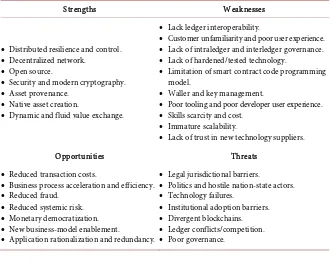
The blockchain technology operates in a multidimensional way. Different au-thors usually highlight different aspects of it or describe the same aspect with dif-ferent terms. There seems, however, to be a consensus around four central proper-ties of blockchain technology [47]. Table 7 shows the most salient characteristics of the blockchain protocol. It involves the strengths factors in opposite to weak-ness ones. In addition, opportunities are listed against threats.
7. Conclusion
[image:18.595.209.539.471.733.2]The smart city faces various challenges. Some of the most significant challenges are related to the increased amount of data transfer and ensuring security. This study introduces the capabilities of using novel blockchain technologies that can mitigate challenges by taking advantage of the opportunities and benefits of blockchain and other new technologies. Blockchain technology has enormous potential when it comes to shaping the enhanced smart communities in the fu-ture in ways that are more efficient and provide a better quality of living. For technology to deliver on its promise, it must be allowed to change the current situation, replaced, and will be replaced through innovation. This study also ex-plains how blockchain-based sharing services can help create smart cities, and discusses the concepts and foundations of blockchain, as well as key blockchain technology applications. Clear examples of the practical use of this technique are
Table 7. The most salient characteristics of the blockchain protocol.
Strengths Weaknesses
• Distributed resilience and control. • Decentralized network.
• Open source.
• Security and modern cryptography. • Asset provenance.
• Native asset creation.
• Dynamic and fluid value exchange.
• Lack ledger interoperability.
• Customer unfamiliarity and poor user experience. • Lack of intraledger and interledger governance. • Lack of hardened/tested technology.
• Limitation of smart contract code programming model.
• Waller and key management.
• Poor tooling and poor developer user experience. • Skills scarcity and cost.
• Immature scalability.
• Lack of trust in new technology suppliers.
Opportunities Threats
• Reduced transaction costs.
• Business process acceleration and efficiency. • Reduced fraud.
• Reduced systemic risk. • Monetary democratization. • New business-model enablement. • Application rationalization and redundancy.
• Legal jurisdictional barriers.
• Politics and hostile nation-state actors. • Technology failures.
DOI: 10.4236/jdaip.2019.73008 136 Journal of Data Analysis and Information Processing represented in the experience of different countries in different sectors. It shows the oldest successful, comprehensive and continuous experiments, which pro-vide a clear perception of the advantages and benefits as well as the challenges that can face the implementation of such technology in other contexts.
Conflicts of Interest
The authors declare no conflicts of interest regarding the publication of this pa-per.
References
[1] PwC and FICCI (2015) India: Surging to a Smarter Future.
https://www.pwc.in/assets/pdfs/publications/2015/india-surging-to-a-smarter-futur e.pdf
[2] Nãsulea, C. and Mic, S. (2018) Using Blockchain as a Platform for Smart Cities. University of Bucharest, Bucharest.
[3] Ghassan, K. (2016) On the Security and Scalability of Bitcoin’s Blockchain. Pro-ceedings of the 2016 ACM SIGSAC Conference on Computer and Communications Security, Vienna, Austria, 24-28 October 2016, 1861-1862.
[4] National League of Cities (2016) Trends in Smart City Development.
https://www.nlc.org/sites/default/files/2017-01/Trends%20in%20Smart%20City%20
Development.pdf
[5] Abbas, R. (2017) A Comparison of Smart City Indicators for Three Top Ten US Ci-ties. Master Thesis, The University of Texas at Arlington, Arlington, TX.
https://rc.library.uta.edu/uta-ir/bitstream/handle/10106/26843/ABBAS-THESIS-201
7.pdf?sequence=1&isAllowed=ySeptember
[6] Antonsen, H. (2017) Platform Infrastructure as a Driver of Smart City Develop-ment. Master Thesis. University of Oslo, Norway.
https://www.datek.no/dv-cms/resources/masterhaakoaan-1.pdf
[7] Carnevale, M.J. (2017) Toronto Augmented Reality Map: Enhancing Citizen En-gagement with Open Government Data Using Contemporary Media Platforms. Master Thesis, OCAD University, Toronto.
http://openresearch.ocadu.ca/id/eprint/1680/
[8] Gabrielle, F. (2017) The Origin and Implementation of the Smart-Sustainable City Concept the Case of Malmö-Sweden. Master Thesis, Lund University, University of Manchester and University of the Aegean. Sweden, Manchester, Lesvos, Greece. [9] Jessen, J. (2015) How to Create a Smart City? Co-Creation of a Smart City with
Cit-izens. Master Thesis, Eindhoven University, Holland.
http://www.digitalbydel.dk/wp-content/uploads/2015/01/MA_Guenter_final.pdf
[10] Shahi, K. (2018) Evaluation of Current Construction Permitting Process in City of Toronto and Future of Permitting in the Global Construction Industry. Master Thesis, University of Toronto, Toronto, Canada.
[11] Song, Y., Wang, X., Yi, T., Wu, P., Sutrisna, M. and Cheng, J. (2017) Trends and Opportunities of BIM-GIS Integration in the Architecture, Engineering and Con-struction Industry: A Review from a Spatio-Temporal Statistical Perspective. ISPRS International Journal of Geo-Information, 6, 397.
https://doi.org/10.3390/ijgi6120397
DOI: 10.4236/jdaip.2019.73008 137 Journal of Data Analysis and Information Processing and GIS for Large Scale (Building) Asset Management: A Critical Review. Paper for CC2009, School of the Built Environment, University of Salford, Salford, Greater Manchester.
[13] Alastal, A.I., Salha, R.A. and El-Hallaq, M.A. (2019) The Reality of Gaza Strip Cities towards the Smart City’s Concept. A Case Study: Khan Younis City. Current Urban Studies, 7, 143-155. https://doi.org/10.4236/cus.2019.71006
[14] El-Hallaq, M.A., Alastal, A.I. and Salha, R.A. (2019) Enhancing Sustainable Devel-opment through Web Based 3D Smart City Model Using GIS and BIM. Case Study: Sheikh Hamad City. Journal of Geographic Information System, 11, 321-330.
https://doi.org/10.4236/jgis.2019.113019
[15] Tapscott, D. and Tapscott, A. (2016) Blockchain Revolution: How the Technology behind Bitcoin Is Changing Money, Business, and the World. Penguin, New York.
https://www.amazon.com/Blockchain-Revolution-Technology
[16] Penzes, B. (2018) Blockchain Technology in the Construction Industry: Digital Transformation for High Productivity. Institution of Civil Engineers (ICE), Lon-don. https://www.ice.org.uk/ICEDevelopmentWebPortal/media/Documents/ [17] Shen, C. and Pena-Mora, F. (2018) Blockchain for Cities—A Systematic Literature
Review. IEEE Access, 6, 76787-76819.
https://doi.org/10.1109/ACCESS.2018.2880744c
[18] Pieroni, A., Scarpato, N., Di Nunzio, L., Fallucchi, F. and Raso, M. (2018) Smarter City: Smart Energy Grid Based on Blockchain Technology. International Advanced Science Engineering Information Technology, 8, 298-306.
https://doi.org/10.18517/ijaseit.8.1.4954
[19] Yannis, k. (2017) Blockchain & Smart Contracts Building Blocks for Smart Cities. Orange Business Services.
https://www.decentralized.com/wp-content/uploads/2017/12/John-Karamitsos-Bloc
kchain-Smart-Contracts-Building-blocks-for-Smart-Cities.pdf
[20] Energy Futures Initiative (2018) Promising Blockchain Applications for Energy: Separating the Signal from the Noise. Policy Paper, Washington DC.
[21] Wright, O. and Wright, W. (1906) Flying-Machine. US Patent No. 821393.
[22] Biswas, K. and Muthukkumarasamy, V. (2016) Securing Smart Cities Using Blockchain Technology. Technical Report, Kaspersky Lab, Griffith University,Brisbane, 1-22. [23] Sogeti Labs (2014) IBM’s Smarter Cities Challenge: A 5-Year Evaluation.
https://labs.sogeti.com/ibms-smarter-cities-challenge-5-year-evaluation/
[24] Chourabi, H., Nam, T., Walker, S., Mellouli, S., Nahon, K., Pardo, T. and Scholl, H. (2012) Understanding Smart Cities: An Integrative Framework. 2012 45th Hawaii International Conference on System Sciences, Maui, HI, 4-7 January 2012, 2289-2297. https://doi.org/10.1109/HICSS.2012.615
[25] National League of Cities (2016) Blockchain in Cities: Restoring Trust and Trans-parency Digital Transactions.
https://www.nlc.org/sites/default/files/2018-06/CSAR_Blockchain%20Report%20PR INT.pdf
[26] Vineet, M. (2017) An Approach to Recovery of Critical Data of Smart Cities Using Blockchain. Master Thesis, University of Toronto, Toronto, Canada.
[27] Washburn, D., Sindhu, U., Balaouras, S., Dines, R.A., Hayes, N.M. and Nelson, L.E. (2010) Helping CIOs Understand “Smart City” Initiatives: Defining the Smart City, Its Drivers, and the Role of the CIO. Forrester Research, Inc., Cambridge, MA.
DOI: 10.4236/jdaip.2019.73008 138 Journal of Data Analysis and Information Processing [28] Robby, H. and Alexander, S. (2018) Cryptocurrencies and Blockchain: Legal Con-text and Implications for Financial Crime, Money Laundering and Tax Evasion. European Parliament’s Special Committee on Financial Crimes, Tax Evasion and Tax Avoidance.
[29] Holotescu, C. (2018) Understanding Blockchain Technology and How to Get In-volved. The 14th International Scientific Conference eLearning and Software for Education, Bucharest, 19-20 April 2018, 1-22.
[30] Bahga, A. and Madisetti, V. (2016) Blockchain Platform for Industrial Internet of Things. Journal of Software Engineering and Applications, 9, 533-546.
https://doi.org/10.4236/jsea.2016.910036
[31] Government Office for Science (2016) Distributed Ledger Technology: Beyond Block Chain. A Report by the UK Government Chief Scientific Advisor. London. [32] Garrick, H and Michel, R. (2017) Global Blockchain Benchmarking Study.
Cam-bridge Centre for Alternative Finance, CamCam-bridge.
[33] Abid, S., Muhammad, A. and Azhar, M. (2018) Internet of Things Security Issues and their Solutions with Blockchain Technology Characteristics: A Systematic Lite-rature Review. American Journal of Computer Science and Information Technolo-gy, 6, 27. https://doi.org/10.21767/2349-3917.100027
[34] Zheng, Z., Xie, S., Dai, H., Chen, X. and Wang, H. (2017) An Overview of Block-chain Technology: Architecture, Consensus, and Future Trends. 2017 IEEE Inter-national Congress on Big Data, Honolulu, HI, 25-30 June 2017, 557-564.
[35] Timothy, L. (2017) Blockchain for Transportation: Where the Future Starts. White Paper Blockchain for Transportation, a Trimble Company, Sunnyvale, CA. https://www.tmwsystems.com/sites/default/files/TMW_Blockchain-WhitePaper_9. 12.17.pdf
[36] IAB Tech Lab (2018) Blockchain Technology Primer, Version 1.0.
https://iabtechlab.com/wp-content/uploads/2018/07/Blockchain-Technology-Prime r.pdf
[37] Winter Green Research (2018) Blockchain Market Shares, Market Strategies, and Market Forecasts, 2018 to 2024. WinterGreen Research, Inc., Lexington, MA. [38] Grech, A. and Camilleri, F. (2017) Blockchain in Education. Publications Office of
the European Union, Luxembourg.
[39] PwC (2018) Fourth Industrial Revolution for the Earth Series: Building Block (Chain)s for a Better Planet.
https://www.pwc.com/gx/en/sustainability/assets/blockchain-for-a-better-planet.pd f
[40] Jovović, I., Husnjak, S.,Forenbacher, I. and Maček, S. (2019) Innovative Applica-tion of 5G and Blockchain Technology in Industry 4.0. EAI Endorsed TransacApplica-tions on Industrial Networks and Intelligent Systems, 6, No. 18.
https://doi.org/10.4108/eai.28-3-2019.157122
[41] Dylan, Y., Peter, M., Nik, R. and Karen, S. (2018) Blockchain Technology Overview. National Institute of Standards and Technology Internal Report No. 8202.
https://doi.org/10.6028/NIST.IR.8202
[42] Rebrisoreanu, M., Rus, C., Leba, M. and Ionica, A. (2018) Exploring the Possibilities of Blockchain Use in a Smart City. International Journal of Systems Applications, Engineering & Development, 12, 164-167.
[43] Abhimanyu, K. (2018) 24 Industries That Blockchain Will Radically Transform.
DOI: 10.4236/jdaip.2019.73008 139 Journal of Data Analysis and Information Processing [44] Jun, M.S. (2018) Blockchain Government—A Next Form of Infrastructure for the
Twenty-First Century. Journal of Open Innovation: Technology, Market, and Com-plexity, 4, 7.
[45] Deloitte and FICCI (2018) Blockchain in Public Sector: Transforming Government Services through Exponential Technologies.
https://www2.deloitte.com/content/dam/Deloitte/in/Documents/public-sector/in-p
s-blockchain-noexp.pdf
[46] Deshpande, A., Stewart, K., Lepetit, L. and Gunashekar, S. (2017) Distributed Ledg-er Technologies/Blockchain: Challenges, Opportunities and the Prospects for Stan-dards. British Standards Institution.
https://www.bsigroup.com/LocalFiles/zh-tw/InfoSec-newsletter/No201706/downloa
d/BSI_Blockchain_DLT_Web.pdf
![Table 2. Smart city characteristics [22].](https://thumb-us.123doks.com/thumbv2/123dok_us/9000048.396801/6.595.209.540.423.650/table-smart-city-characteristics.webp)
![Figure 1. Blockchain versions [19].](https://thumb-us.123doks.com/thumbv2/123dok_us/9000048.396801/7.595.211.534.72.261/figure-blockchain-versions.webp)