ISSN Online: 2327-5227 ISSN Print: 2327-5219
DOI: 10.4236/jcc.2019.75004 May 31, 2019 42 Journal of Computer and Communications
A Data Mining Based Approach to Customer
Behaviour in an Electronic Settings
A. Tope-Oke, C. A. Afolalu, O. Omofade
Department of Mathematical and Physical Sciences, Afe Babalola University, Ado Ekiti, Nigeria
Abstract
The understanding of customer incidents and behaviour is crucial to the suc-cess of any organization. Evidence from literature shows a prediction pattern of products to customer. These studies predicted product characteristics leaving out the customers characteristics. To address this gap, this study aims to design datamining system and implement it on an electronic commerce organization website. The customer information and history (clickstreams) from the electronic commerce website was used to predict the customers’ be-haviour. This will give meaningful and usable data patterns to organizations. Python programming language was used to design the datamining system, while PHP, HTML, and JavaScript were used for the e-commerce website. A brief description of the background of e-commerce and data mining, previous work of researchers who have worked on data mining in e-commerce set-tings, was reviewed and the relationship between their findings and this work was established. The data mining system utilizes consensus clustering tech-nique and the clustering algorithm with a graphical-based approach. Fur-thermore, the interaction between the data mining system and the customer’s dataset on an ecommerce website was defined. Quantitative evidence for de-termining the number and membership of possible customer behavioural clusters within the dataset was generated.
Keywords
Customer Behavior, Datamining, Ecommerce, Website, Electronic
1. Introduction
Data mining is the process of discovering meaningful pattern and correlation by sifting through large quantities of data stored in repositories. There are several tools for this data generation, which include abstractions, aggregations,
summa-How to cite this paper: Tope-Oke, A., Afolalu, C.A. and Omofade, O. (2019) A Data Mining Based Approach to Customer Behaviour in an Electronic Settings. Journal of Computer and Communications, 7, 42-53.
https://doi.org/10.4236/jcc.2019.75004
Received: March 3, 2019 Accepted: May 28, 2019 Published: May 31, 2019
Copyright © 2019 by author(s) and Scientific Research Publishing Inc. This work is licensed under the Creative Commons Attribution International License (CC BY 4.0).
DOI:10.4236/jcc.2019.75004 43 Journal of Computer and Communications rization and characteristics of data [1]. Technically, data mining is the process of finding correlations or patterns among dozens of fields in large relational data-bases. It concentrates on discovering and identifying rules that describe specific and sequential patterns within the data. Market basket analysis was one of the first applications of data mining. This technique identifies items that typically occur together in purchase transactions [2]. However, with the rapidly increas-ing volume of data in modern times, more automatic and effective minincreas-ing ap-proaches are required. Early methods such as Bayes’ theorem in the 1700s and regression analysis in the 1800s were some of the first techniques used to identify patterns in data. After the 1900s, the explosion, ubiquity, and continuously de-veloping power of computer technology, data collection and data storage were remarkably enlarged. Sequel to the increasing complexity of datasets, direct hands-on data analysis has increasingly been augmented with indirect, automat-ic data processing. This has been aided by other discoveries in computer science, such as neural networks, clustering, genetic algorithms in the 1950s, Decision trees in the 1960s and support vector machines in the 1980s. Data mining there-fore is the process of applying these methods to data with the intention of unco-vering hidden patterns [3]. Data mining has been used for many years by many fields such as businesses, scientists and governments.
Electronic presence is often used to establish an organization’s image. It has been used to promote goods and services, and to provide customer support on the internet and other electronic platform. The success of the electronic pres-ence, however, affects and reflects directly the success of the organization in the electronic settings. As the Internet works on a basis of interchangeable data, there are new data sources that companies are required to exploit to achieve an improved performance. This data enables ecommerce managers to have a grasp of the business in ways that were not previously possible. Through an electronic store, it is possible to track much more data that is a direct result of how the customer interacts with the company. The clickstream data therefore is impor-tant in understanding customer behaviour and it is also the main source of in-formation for the companies to adapt their service according to their electronic audience [4]. In order to understand customer behaviour, this study aims to de-sign a customer mining system and implement it on an electronic grocery web-site base on their customer clickstreams. Clickstream data, or clickstreams, is the common terminology for the collection of Web logs that compose the session of a specific customer on the company website. These sessions contain information regarding the path that a customer took through the website’s structure. Thus, this work will provide a system that will be used to capture, and interpret the patterns associated with Customer behaviour in an E-commerce setting using the clickstream analysis of the customer.
DOI: 10.4236/jcc.2019.75004 44 Journal of Computer and Communications products, services, experiences, or ideas to satisfy their needs and wants [5]. Customers who visit sites leave behind valuable information about themselves, analyzing these has the potential to improve business performance through the understanding of past and present customers to determine and identify future customers and their behaviour. These organizations also must learn to take ad-vantage of what they have in large quantity which is the customer’s data. [6] de-scribes data mining as an approach to predict user behaviour in e-commerce sites. The core of their approach involves extracting knowledge from integrated data of purchase patterns of past users obtainable from web server logs to predict the purchase behaviour of future users. Data mining, Customer profiling and personalization allow organizations to study patterns through the mining of customer’s data to plan their business activities and operations as well as develop new research on products or services for prosperous ecommerce. The outcome of data mining creates the possibilities for organizations to be able to track their customers purchasing patterns, demand trends and locations, making their tac-tical decision more effective for the advancement of their business [7]. The next section delves into related studies and how they informed this study.
2. Review of Related Studies
Xuesong and Kaifan [8] designed a web mining-based tourism e-commerce re-commender system based on Association Rules mining and the Apriori algo-rithm. The study carried out an application example on five tour products, and they were required to find the frequent product set with strong relation by Asso-ciation Rule mining. These products were then recommended to web Customers to increase the cross-sales of tourist website. Of all the five Products used in the study, the first, second and fourth products has strong association rules which helps the e-commerce seller recommend the products with strong relation to web customers to increase cross-sales of tourism e-commerce. This study is like their work since they both predict relationships. However, this work is focused on customer characteristics rather than product characteristics and we are mak-ing use of Cluster-based Similarity Partitionmak-ing Algorithm (CSPA) rather than apriori.
DOI:10.4236/jcc.2019.75004 45 Journal of Computer and Communications frequency, similarity with respect to time spent. [10] worked on Item-Based Collaborative Filtering Recommendation Algorithms with the aim of recom-mending valuable products to target web customers. They constructed a model based on customer’s behaviour such as registration information, evaluation data, and online shopping history and find out the nearest neighbour set, after which recommendation of valuable products to target web Customer was done using the nearest neighbour set.
The study made use of Collaborative Filtering to filter customers. The collec-tion of customer’s web informacollec-tion plays an important role and affects the rec-ommendation results. The realization of customer based on collaborative filter-ing is divided into three steps. First, a matrix of evaluations on different prod-ucts was constructed. It was discovered that the evaluation data can be acquired from server and expressed by a m x n matrix. Where, m stands for the number of customers and n the number of items. The items can be online products or web pages of a website. Secondly, the nearest neighbor set was calculated. Third-ly, recommendation result was generated for target customers. This study on the other is not a recommender system to customers but is designed for organiza-tion so that the customer data are translated into meaningful interpretaorganiza-tions.
Evidence from literature shows a prediction pattern of products to customer [8][9][10]. These studies predicted product characteristics leaving out the cus-tomers characteristics. To address this gap, a datamining system was designed and implemented electronic commerce organization website. The customer in-formation and history (clickstreams) from the electronic commerce website was then used to predict the customers behaviour. This will give meaningful and us-able data patterns to organizations.
Consequently, this work or a follow up on it will be useful to managers who seek in-depth knowledge about their customer behaviour and how it can trans-late to more profit for business.
3. Objective of the Work
To address the gap identified above, the objectives of this study are: 1) To design a datamining system,
2) To implement it on an electronic commerce website by predicting custom-er behaviour.
4. Input and Output Design of the System
1) Analysis of Existing SystemsDOI: 10.4236/jcc.2019.75004 46 Journal of Computer and Communications that were used for data mining were described by pure mathematical expres-sions; which are used to compute the values required to study the data for spe-cific patterns. However, this work adopted the Object-Oriented Analysis and Design (OOADM) methodologies to design this model. Even though the existing system requires a reasonable measure of mathematical background to be dep-loyed effectively for the mining of data, there is a requirement to reorganize the data in the database before the data mining operation commences.
2) Methodology
The proposed data mining system is a data visualization and data mining toolkit. The mining technique used is Consensus Clustering. Consensus cluster-ing, also called aggregation of clustering (or partitions), refers to the situation in which several different (input) clustering’s have been obtained for a dataset and it is desired to find a single clustering (consensus) which is a better fit in some sense than the existing clusterings. Consensus Clustering is a method that pro-vides quantitative evidence for determining the number and membership of possible clusters within a dataset [12]. A graph-based approach, Cluster-based Similarity Partitioning Algorithm (CSPA) was adopted. In this algorithm, the similarity between two data-points is defined to be directly proportional to number of constituent clustering’s of the body in which they are clustered to-gether. The intuition is that the more similar two data-points are the higher is the chance that constituent clustering’s will place them in the same cluster. The reason for choosing this algorithm is that CSPA is the simplest heuristic amongst others such as Hyper Graph Partitioning Algorithm (HGPA), and Me-ta-Clustering Algorithm (MCLA), its computational and storage complexity are both quadratic in n, and this algorithm is computationally less expensive. In this approach, a measure of similarity between a pair of data points can be estimated as the ratio of several clustering’s in which the two data points are shared the same clusters to the total number of clustering’s in the body. More precisely, the similarity between two data points xi and xj is defined as:
(
,)
[ ]
ij i j
S =S x x = cxc , where c=1, I c x
(
π( )
i)
=πc x( )
j (1)where I is the indicator function. Thus, any similarity-based clustering algo-rithms can be applied to the similarity matrix S to find a consensus clustering of the body. First, the similarity matrix is computed as in Equation (1). Then, an induced similarity graph, where vertices correspond to data points and edges’ weights to similarity measures, is partitioned into K clusters using METIS. This implies that the shortest the shortest distance (Sij) from the data point is where a cluster lies. METIS multilevel approach has three phases with several algorithms for each phase:
1) Coarsen the graph by generating a sequence of graphs G G0, , ,1 GN, where G0 is the original graph and for each 0 ≤ i ≤ j ≤ N, the number of vertices in Gi is greater than the number of vertices in Gj.
DOI:10.4236/jcc.2019.75004 47 Journal of Computer and Communications 3) Project the partition back through the sequence in the order of GN, , G0, refining it with respect to each graph.
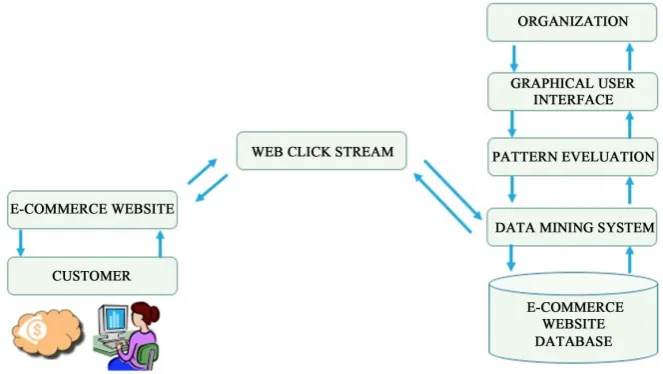
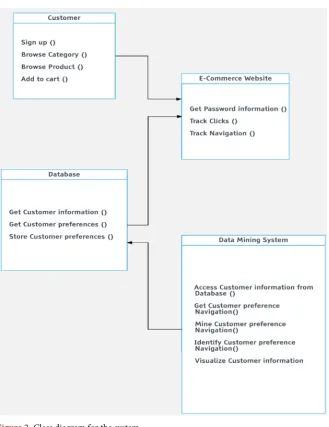
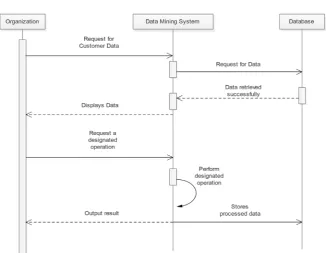
The final partition computed during the third phase (the refined partition projected onto G0) is a partition of the original graph. It will feature a visual programming front-end for explorative data analysis and interactive data visua-lization. In visualizing the data mining system result, Python open-source libra-ries for scientific computing such as NumPy, SciPy and Scikit-learn was used, while its graphical user interface will operate within a cross-platform Qt frame-work using PyQt Python bindings. The data mining system was written in py-thon with C data types which is also known as Cypy-thon. The Object-oriented re-presentation of the system architecture is illustrated in Figure 1, while the class diagram and sequence diagram of the system are shown in Figure 2 and Figure 3 respectively.
Figure 1 is a set of iterative processes that describe the system. The customer uses the ecommerce website to shop for products online. As the customer clicks on products, this click of the customer using the e-commerce website will be stored in a database. The data mining system based on web click stream tech-nique is used to extract the appropriate patterns for a customer from the data base and then the company or organization uses to produce a customized expe-rience for the customer.
[image:6.595.207.539.517.704.2]Figure 2 describes the classes and attributes of the data mining system. The classes include customer, e-commerce website, database and the datamining system. The attributes on the other hand include: Sign-up(), Browse category(), Get password information(), track clicks(), Get customer information(), Access customer information from database() and a host of other attributes shown in Figure 2.
Figure 3, however, describes operations of the classes of the data mining sys-tem and their interrelationships. Section V describes the input and output data outlook for the system.
DOI: 10.4236/jcc.2019.75004 48 Journal of Computer and Communications Figure 2. Class diagram for the system.
5. System Interface
1) Input DataThe information collected from customers on the e-commerce website is the input for the data mining system to clean and preprocess the data. Figure 4 shows the dialog box for the user to select the data file to be analyzed.
2) Output Result
The results obtained are easy to understand and is interpretable for an e-commerce company or data analyst user as they are represented using an ob-ject-oriented approach.
a) Geographic quantitative message:
DOI:10.4236/jcc.2019.75004 49 Journal of Computer and Communications Figure 3. Sequence diagram for the datamining system.
Figure 4. Input data for the data mining system.
products on the website, Dairy products and meat and seafood are the most sought after products in the North-Central region, and South-West region are not frequent buyers of vegetables and fruits who also dislike canned foods.
DOI: 10.4236/jcc.2019.75004 50 Journal of Computer and Communications and 30 who frequently visit the website in respect to the state they reside in. This can be used to create campaigns for the youths on certain states. This figure dis-plays an outlier in Ogun state, which implies an absent population of customers who visit the website from Ogun state. It also explains that Lagos state is the highest state with customers between the age of 21 and 30 visiting the website and performing transactions.
b) Correlation Quantitative Message:
The scatter plot in Figure 7 is used to represent the month’s customers make purchases in year against the age group of the customers in correlation to the gender of customers who visit the e-commerce website.
c) Month sequence quantitative message
[image:9.595.215.538.279.485.2] [image:9.595.209.541.526.708.2]The distribution plot in Figure 8 displays the month of the year with the most order of products, which is May, followed by April, slightly followed by the
Figure 5. Frequency of purchases of certain products by the regions.
DOI:10.4236/jcc.2019.75004 51 Journal of Computer and Communications Figure 7. Months of the year and customer age group in correlation with males and fe-males.
Figure 8. Plot displaying the month with the highest purchase.
month of March. This can be interpreted as customers frequently visit the web-site to purchase food products.
6. Conclusions
[image:10.595.208.540.295.465.2]DOI: 10.4236/jcc.2019.75004 52 Journal of Computer and Communications During the advancement of the project, difficulties were experienced dealing with large number of dimensions and large number of data items which were problematic because of time complexity of the project’s completion.
Request for customer’s data from an existing e-commerce organization was not attainable due to time constraints. Another challenge was the slow computa-tion and processing of the data mining system while testing data provided by a large population of customers stored in the database. Also, there was a limit to the amount of data size required to integrate the data mining system, because, the system can only handle less than a million customers data at once. Finally, the ecommerce website was not hosted on the internet as it was locally hosted with the use of XAMPP.
Acknowledgements
We hereby acknowledge the constructive criticism by all lecturers in the De-partment of Mathematical and Physical Sciences, Afe Babalola University. Thank you all.
Conflicts of Interest
The authors declare no conflicts of interest regarding the publication of this pa-per.
References
[1] Ismail, M., Ibrahim, M., Sanusi, Z. and Nat, M. (2015) Data Mining in Electronic Commerce: Benefits and Challenges. International Journal of Communications,
Network and System Sciences, 8, 501-509. https://doi.org/10.4236/ijcns.2015.812045 [2] Wang, J.C., David, C.Y. and Chris, R. (2002) Data Mining Techniques for Customer
Relationship Management. Technology in Society, 24, 483-502.
https://doi.org/10.1016/S0160-791X(02)00038-6
[3] Kantardzic, M. (2003) Data Mining: Concepts, Models, Methods, and Algorithms. John Wiley & Sons Inc., New York.
[4] Bucklin, R.E. and Sismeiro, C. (2009) Advances in Click-Stream Data Analysis in Marketing. Journal of Interactive Marketing, 23, 35-48.
https://doi.org/10.1016/j.intmar.2008.10.004
[5] Loudon, D.L. (1979) Customer Behaviour: Concepts and Applications.McGraw-Hill, New York.
[6] Vallamkondu, S. and Gruenwald, L. (2003) Integrating Purchase Patterns and Tra-versal Patterns to Predict Http Requests in E-Commerce Sites. IEEE International Conference on E-Commerce, Newport Beach, CA, 24-27 June 2003, 256-263. [7] Michael, J.A.B. and Gordon, S.L. (1997) Data Mining Techniques: For Marketing
and Sales, and Customer Relationship Management.3rd Ed., Wiley Publishing Inc., Canada.
[8] Zhao, X.S. and Ji, K.F. (2013) Tourism E-Commerce Recommender System Based on Web Data Mining. International Conference on Computer Science & Education, 2, 30-33.
Re-DOI:10.4236/jcc.2019.75004 53 Journal of Computer and Communications
commender Systems. International Journal of Computer Applications, 127, 10-12.
https://doi.org/10.5120/ijca2015906643
[10] Sarwar, B., Karypis, G., Konstan, J. and Riedl, J. (2001) Item-Based Collaborative Filtering Recommendation Algorithms. International Conference on World Wide Web, Chiba, 10-14 May 2001, 285-295.
[11] O’Brien, J.A. (2011) Introduction to Information Systems. The McGraw-Hill Com-panies, New York.