Christian Schneider, Martin Kamp, Sven Höfling, Chao-Yang Lu, and Jian-Wei Pan 1Shanghai Branch, National Laboratory for Physical Sciences at Microscale and Department of Modern Physics,
University of Science and Technology of China, Shanghai, 201315, China
2CAS Center for Excellence and Synergetic Innovation Center in Quantum Information and Quantum Physics,
University of Science and Technology of China, Hefei, Anhui 230026, China
3CAS-Alibaba Quantum Computing Laboratory, Shanghai 201315, China 4
DTU Fotonik, Department of Photonics Engineering, Technical University of Denmark, Building 343, DK-2800 Kongens Lyngby, Denmark
5
Technische Physik, Physikalisches Instität and Wilhelm Conrad Röntgen-Center for Complex Material Systems, Universitat Würzburg, Am Hubland, D-97074 Wüzburg, Germany
6
SUPA, School of Physics and Astronomy, University of St. Andrews, St. Andrews KY16 9SS, United Kingdom
(Received 29 September 2015; published 14 January 2016)
Scalable photonic quantum technologies require on-demand single-photon sources withsimultaneously
high levels of purity, indistinguishability, and efficiency. These key features, however, have only been demonstrated separately in previous experiments. Here, bys-shell pulsed resonant excitation of a Purcell-enhanced quantum dot-micropillar system, we deterministically generate resonance fluorescence single photons which, atπpulse excitation, have an extraction efficiency of 66%, single-photon purity of 99.1%, and photon indistinguishability of 98.5%. Such a single-photon source for the first time combines the features of high efficiency and near-perfect levels of purity and indistinguishabilty, and thus opens the way to multiphoton experiments with semiconductor quantum dots.
DOI:10.1103/PhysRevLett.116.020401
Single-photon devices[1]that deterministically emit one and only one photon at a time are central resources for scalable photonic quantum technologies[2]. In particular, they are of considerable interest in boson sampling[3], an intermediate quantum computation where it is estimated that with 20–30 single photons one can demonstrate complex tasks that can be difficult for classical computers. To be useful for these applications, it is crucial that the single-photon source simultaneously possesses high effi-ciency, near perfect photon antibunching and indistinguish-ability—a long sought-after goal in quantum photonics.
Self-assembled quantum dots (QDs)[4]have been shown to possess the highest quantum efficiency in all solid-state single-photon devices so far, and thus are promising as deterministic single-photon emitters. Tremendous progress has been made in the past decades in demonstrations of various single-photon sources [5–12]; however, none has allowed a scalable extension to multiphoton experiments. The reason is that most previous experiments either relied on nonresonant excitation of a QD microcavity that degraded the photon purity and indistinguishability, or used resonant excitation of a QD in a planar cavity that limited the extraction efficiency.
In the nonresonant excitation experiments, single-photon generation efficiencies typically increased asymptotically with pump power, and a trade-off between efficiency and single-photon purity and/or indistinguishability were
observed [5–10]. It has been shown that the recapture of carriers into the QD micropillar due to nonresonant pumping can lead to a significant degradation of the single-photon purity[13]. Furthermore, the photon’s indis-tinguishability can be reduced by nonresonant excitation that induces homogeneous broadening of the excited state [14] and uncontrolled emission time jitter from the non-radiative high-level to s-shell relaxation [15]. The detri-mental effect of the time jitter can be more severe when using a QD-microcavity system where the Purcell-reduced radiative lifetime (T1) of the QD, which bounds the single photon’s coherence time (T2) byT2≤2T1, is comparable to or smaller than the time jitter[15].
To overcome these shortcomings, increasing efforts have been devoted to resonant excitation of QDs[11,12,16–18]. By s-shell resonant laser excitation on a single QD with picosecond laser pulses, near-background-free resonance fluorescence (RF) has been obtained and allowed the observation of Rabi oscillations [11]. Under π pulse excitation, single photons have been deterministically generated with a single-photon purity of 98.8(2)% and indistinguishability of 97(2)%. However, the planar cavity structure used in Ref. [11]has allowed only ∼6% of the generated single photons collected by the first lens.
resonant excitation of a Purcell-enhanced QD-micropillar system, atπpulse we obtain pulsed RF single photons with a count rate of 3.7×106=sec on a silicon single-photon detector, which corresponds to an extraction efficiency of ∼66%from GaAs. The RF photons show an antibuching of g2ð0Þ ¼0.009ð2Þand a raw (corrected) two-photon inter-ference visibility of 96.4(3)% [98.5(4)%]. Our work opens the way to scalable multiphoton quantum information experiments with solid-state devices.
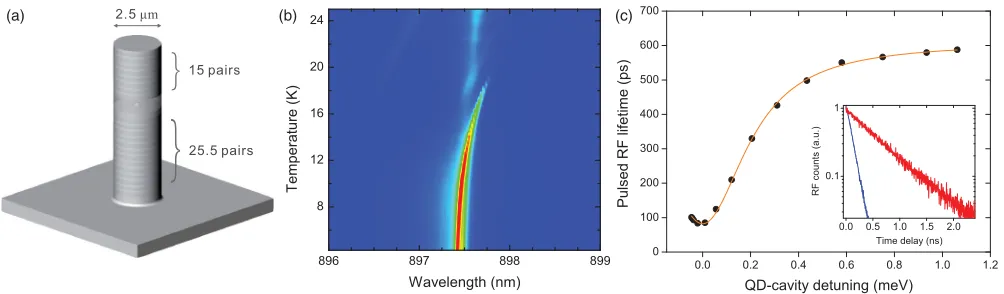
Our experiments were performed on an InAs=GaAs self-assembled QD embedded inside a2.5μm diameter micro-pillar cavity which has 25.5 (15) λ=4-thick AlAs=GaAs mirror pairs forming the lower (upper) distributed Bragg reflectors[18][see Fig.1(a)]. The device is cooled inside a cryogen-free bath cryostat with a temperature that can be finely tuned from 4.2 to 30 K. We first characterize the QD through microphotoluminescence measurements with 780 nm laser excitation. Figure1(b)shows photolumines-cence spectra of a single QD as a function of temperature tuning. The photoluminescence intensity reaches a plateau at a temperature range of 4.5–10 K. The quality factor of the micropillar cavity is measured to be 6124.
For pulsed resonant excitation, a Ti:sapphire laser is used to generate laser pulses at a central wavelength of 897.44 nm and a pulse width of∼3ps. The excitation laser is further filtered with an etalon with a linewidth of 45 GHz to match the micropillar cavity. A confocal microscope is operated in a cross-polarization configuration [11], whereby a polarizer is placed in the collection arm with its polarization perpendicular to the excitation laser sup-pressing the laser background by a factor exceeding107. To determine the Purcell factor of the micropillar cavity, we perform time-resolved RF measurements for different cavity-QD detunings, as plotted in Fig.1(c). The shortest RF lifetime is 83.9 ps at 7.8 K [blue curve in the inset of
Fig 1(c)]. At 28 K with a large (>1meV) detuning, the decay time constant increases to 587.8 ps [red curve in the inset of Fig1(c)]. The measured lifetime as a function of detuning is well fitted by the standard weak-coupling theoretical model (orange curve) [19], which allows us to deduce a Purcell factor of 6.3(4).
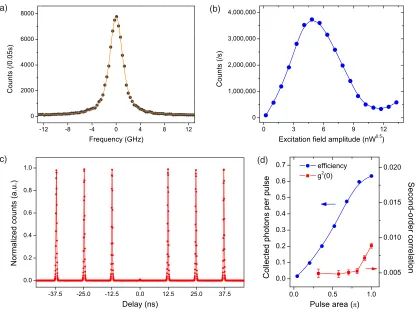
Figure 2(a) shows a high-resolution spectrum of the pulsed RF, which can be best fitted using a Voigt profile with a homogeneous (Lorentzian) linewidth of 1.91(7) GHz and inhomogeneous (Gaussian) linewidth of 1.14(9) GHz. The homogeneous linewidth is very close to the lifetime-limited linewidth of 1.89 GHz. The inhomogeneous (Gaussian) component in the spectrum can be caused by spectral diffusion due to charge fluctuations in the vicinity of the QD[20].
Figure2(b)shows the detected pulsed RF photon counts on a silicon single-photon detector as a function of incident field amplitude. We observe a Rabi oscillation which is due to coherent control of the QD two-level system[21]. The single-photon counts reaches the maximum for aπ pulse with a pumping laser power of 24 nW. We note that this is in stark contrast to previous experiments with nonresonant excitation where the generated single-photon counts typ-ically grow asymptottyp-ically with excitation laser power; thus, a near unity efficiency would need very high power pumping.
At theπpulse, we observe a count rate of3700000=sec on a silicon single-photon detector, under 81 MHz repeti-tion rate laser excitarepeti-tion, which gives an overall system efficiency of 4.6%. The signal (RF) to background (mainly laser leakage) ratio is40∶1. After correcting for independ-ently calibrated photon detection efficiency (∼33%), polari-zation extinction (∼50%), transmission rate in the optical path (∼60%, including optical window, polarizer, and two beam splitters), and single-mode fiber coupling efficiency
[image:2.612.56.558.45.192.2](a) (b) (c)
(∼72%), excited-state preparation efficiency (∼96%) at π pulse, and assuming perfect internal quantum efficiency of the QD, we estimate that 66% of the generated single photons are collected into the first objective lens (NA¼0.68).
To further improve the signal to background ratio, we pass the RF through a 3-GHz etalon and then characterize its purity and indistinguishability. The single-photon nature of the collected RF at the π pulse is evident from the second-order coherence measurement [22] shown in Fig.2(c), where nearly vanishing multiphoton probability is observed at zero delay [g2ð0Þ ¼0.009ð1Þ]. Figure 2(d) summarize the combined performance of the efficiency and single-photon purity as a function of pump power. We emphasize that the high generation and extraction effi-ciency are obtained with little compromise of the single-photon purity, which is important for real applications in photonic quantum information processing.
Another crucial demand is that the photons should possess a high degree of indistinguishability, which is at the heart of optical quantum computing [2], Boson
sampling [23], and solid-state quantum networks [24]. Pulseds-shell resonant excitation has been demonstrated to yield a near-unity indistinguishability by eliminating emission time jitter and dephasings, however, only for QDs in planar cavities. We note that the pulsed RF technique is more critically needed for QDs with large Purcell factors where the reduced radiative lifetime approaches the time jitter[11,15].
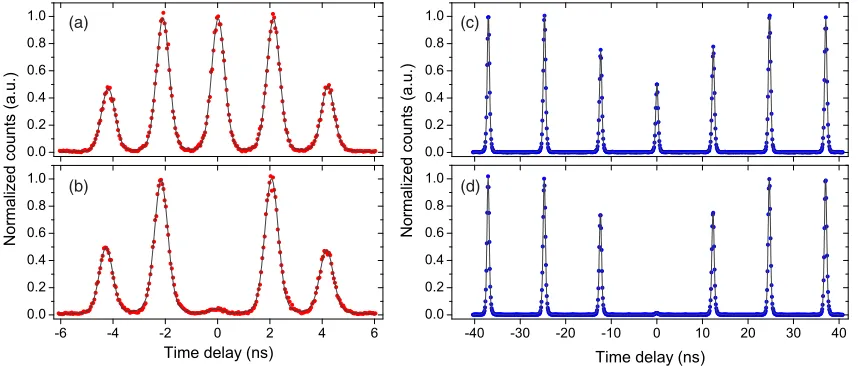
The single photons’ indistinguishability is tested using non-post-selective two-photon Hong-Ou-Mandel interfer-ence[25]experiments. We first adopt a similar free-space setup as shown in Ref.[11] with a time delay of 2.1 ns between two pulses. Figures 3(a) and 3(b) show time-delayed histograms of normalized two-photon counts for orthogonal and parallel polarization, respectively. An almost vanishing zero-delay peak is observed for two photons with identical polarization. In contrast, for two photons with cross polarization, the zero-delay peak has the same intensity as its adjacent peaks. We obtain a raw two-photon quantum interference visibility of 0.964(3). After correcting with the residual multiphoton probability
[image:3.612.100.516.44.353.2](c) (d)
[g2ð0Þ ¼0.009ð1Þ], we obtained the corrected degrees of indistinguishability to be 0.985(4).
We further test the Hong-Ou-Mandel interference between two consecutively emitted single photons at an increased time delay of 12.4 ns—the laser pulse separation (see Ref.[9]for a similar setup). The resulting histograms for orthogonal and parallel polarized two photons are shown in Figs. 3(c)–3(d), from which we extract raw and corrected visibilities of 0.959(3) and 0.978(4), respec-tively. In strong contrast to Ref.[9]that used nonresonant excitation, increasing the time delay by 10 ns has a negligible effect on the photons’indistinguishability, indi-cating that the inhomogeneous broadening [see Fig.2(a)] of the pulsed RF photons are mainly from spectral diffusions at time scales much slower than 10 ns. This demonstrates the potential of this QD-micropillar device as an efficient source of a string of indistinguishable single photons, which are particularly suitable for linear optical quantum computing and Boson sampling experiments with time-bin encoding[26]. Alternatively, one can also demultiplex the single-photon string into multiple photons at separate spatial modes.
We compare the performance of the single-photon source created in this work with heralded single photons produced by parametric down conversion[27], which have served as the workhorse for multiphoton interferometric experiments in the past decades [2]. In the previous demonstration of the largest, eight-photon entanglement [28], sources of triggered single photons were generated with a count rate of 310000=sec, multiphoton emission probability of 2.9% and raw indistinguishablility of 76%, under a laser pump power of 880 mW. For applications
such as Boson sampling[23]that needs single photons as input, the single-photon source realized here is superior, as it is ten times brighter, near perfectly pure and indistin-guishable, and requires a pump power that is 7 orders of magnitude lower.
In summary, by pulsed s-shell pumping a QD-micropillar system with a Purcell factor of 6.3, we have realized a high-performance single-photon source that atπ pulse excitation simultaneously achieves a generation efficiency of 96%, extraction efficiency of 66%, single-photon purity of 99.1%, and indistinguishability of 98.6%. Such a single-photon source can be readily used to perform multiphoton interferometric experiments with a solid-state platform. Immediate applications include implementation of Boson sampling [23] with time-bin encoding using a loop-based architecture [26]. In addition to the photonic applications, the high-efficiency extraction of transition-selective RF would also allow a fast (nsec), high-fidelity single-shot readout of single electron spins[29].
The time-jitter free, pulsed RF method is compatible with higher Purcell factor, which can allow photon extraction to be further improved in the future by optimized microcavity fabrications, without comprising the single-photon purity and indistinguishability. The current overall system efficiency—4.6%, the highest reported in QDs—can also be improved using techniques such as orthogonal excitation and detection of RF[16,17], near-unity-efficiency super-conducting nanowire single-photon detection [30], and antireflection coatings of the optical elements.
This work was supported by the National Natural Science Foundation of China, the Chinese Academy of Sciences, and the National Fundamental Research (a)
(b)
(c)
[image:4.612.93.522.47.230.2](d)
Note added.—After this Letter was submitted, we became aware of a related work[31].
*[email protected] †[email protected]
[1] B. Lounis and M. Orrit,Rep. Prog. Phys.68, 1129 (2005); S. Buckley, K. Rivoire, and J. Vuĉković,Rep. Prog. Phys.
75, 126503 (2012).
[2] P. Kok, W. J. Munro, K. Nemoto, T. C. Ralph, J. P. Dowling, and G. J. Milburn, Rev. Mod. Phys. 79, 135 (2007); J. L. O’Brien, A. Furusawa, and J. Vuĉković,Nat. Photonics
3, 687 (2009); J.-W. Pan, Z.-B. Chen, C.-Y. Lu, H. Weinfurter, A. Zeilinger, and M. Żukowski, Rev. Mod. Phys.84, 777 (2012).
[3] S. Aaronson and A. Arkhipov, Proceedings of the 43rd Annual ACM Symposium on Theory of Computing, 2011, San Jose(ACM, New York, 2011), p. 333.
[4] P. Lodahl, S. Mahmoodian, and S. Stobbe,Rev. Mod. Phys.
87, 347 (2015).
[5] P. Michleret al.,Science290, 2282 (2000); C. Santori, M. Pelton, G. Solomon, Y. Dale, and Y. Yamamoto,Phys. Rev. Lett. 86, 1502 (2001); Z. Yuan, B. E. Kardynal, R. M. Stevenson, A. J. Shields, C. J. Lobo, K. Cooper, N. S. Beattie, D. A. Ritchie, and M. Pepper, Science 295, 102 (2002).
[6] J. M. Gérard, B. Sermage, B. Gayral, B. Legrand, E. Costard, and V. Thierry-Mieg, Phys. Rev. Lett. 81, 1110 (1998); M. Pelton, C. Santori, J. Vučković, B. Zhang, G. S. Solomon, J. Plant, and Y. Yamamoto,Phys. Rev. Lett.89, 233602 (2002); S. Strauf, N. G. Stoltz, M. T. Rakher, L. A. Coldren, P. M. Petroff, and D. Bouwmeester,Nat. Photonics
1, 704 (2007); T. Heindel, C. Schneider, M. Lermer, S. H. Kwon, T. Braun, S. Reitzenstein, S. Höfling, M. Kamp, and A. Forchel,Appl. Phys. Lett.96, 011107 (2010).
[7] D. Englund, D. Fattal, E. Waks, G. Solomon, B. Zhang, T. Nakaoka, Y. Arakawa, Y. Yamamoto, and J. Vučković, Phys. Rev. Lett.95, 013904 (2005); A. Faraon, I. Fushman, D. Englund, N. Stoltz, P. Petroff, and J. Vuckovic, Nat. Phys. 4, 859 (2008); K. H. Madsen, S. Ates, J. Liu, A. Javadi, S. M. Albrecht, I. Yeo, S. Stobbe, and P. Lodahl, Phys. Rev. B90, 155303 (2014); L. Sapienza, M. Davanco, A. Badolata, and K. Srinivasan, Nat. Commun. 6, 7833 (2015).
[8] J. Claudon et al., Nat. Photonics 4, 174 (2010); M. E. Reimer, G. Bulgarini, N. Akopian, M. Hocevar, M. B. Bavinck, M. A. Verheijen, E. P. A. M. Bakkers, L. P. Kouwenhoven, and V. Zwiller, Nat. Commun. 3, 737 (2012); M. Munsch, N. S. Malik, E. Dupuy, A. Delga, J. Bleuse, J.-M. Gérard, J. Claudon, N. Gregersen, and J. Mørk,Phys. Rev. Lett.110, 177402 (2013).
Nat. Commun.4, 1425 (2013); P. Gold, A. Thoma, S. Maier, S. Reitzenstein, C. Schneider, S. Höfling, and M. Kamp, Phys. Rev. B 89, 035313 (2014); S. Maier, P. Gold, A. Forchel, N. Gregersen, J. Mørk, S. Höfling, C. Schneider, and M. Kamp,Opt. Express22, 8136 (2014); S. Unsleber, D. P. S. McCutcheon, M. Dambach, M. Lermer, N. Gregersen, S. Höfling, J. Mørk, C. Schneider, and M. Kamp,Phys. Rev. B91, 075413 (2015).
[11] Y.-M. He, Y. He, Y.-J. Wei, D. Wu, M. Atatüre, C. Schneider, S. Höfling, M. Kamp, C.-Y. Lu, and J.-W. Pan, Nat. Nanotechnol. 8, 213 (2013); Y.-J. Wei et al., Nano Lett.14, 6515 (2014).
[12] Y. Heet al.,Phys. Rev. Lett. 111, 237403 (2013); T. M. Sweeneyet al., Nat. Photonics8, 442 (2014).
[13] V. Giesz, O. Gazzano, A. K. Nowak, S. L. Portalupi, A. Lemâıtre, I. Sagnes, L. Lanco, and P. Senellart,Appl. Phys. Lett.103, 033113 (2013).
[14] A. J. Bennett, D. C. Unitt, A. J. Shields, P. Atkinson, and D. A. Ritchie,Opt. Express13, 7772 (2005); E. B. Flagg, A. Muller, S. Polyakov, A. Ling, A. Migdall, and G. Solomon,Phys. Rev. Lett.104, 137401 (2010).
[15] C. Santori, D. Fattal, J. Vuckovic, G. S. Solomon, and Y. Yamamoto,New J. Phys.6, 89 (2004).
[16] A. Müller, E. B. Flagg, P. Bianucci, X. Y. Wang, D. G. Deppe, W. Ma, J. Zhang, G. J. Salamo, M. Xiao, and C. K. Shih,Phys. Rev. Lett.99, 187402 (2007); A. N. Vamivakas, Y. Zhao, C.-Y. Lu, and M. Atatüre,Nat. Phys.5, 198 (2009); E. B. Flagg, A. Muller, J. W. Robertson, S. Founta, D. G. Deppe, M. Xiao, W. Ma, G. J. Salamo, and C. K. Shih,Nat. Phys.5, 203 (2009); S. Ates, S. M. Ulrich, S. Reitzenstein, A. Löffler, A. Forchel, and P. Michler,Phys. Rev. Lett.103, 167402 (2009); D. Englund, A. Majumdar, A. Faraon, M. Toishi, N. Stoltz, P. Petroff, and J. Vučković, Phys. Rev. Lett.104, 073904 (2010).
[17] H. Jayakumar, A. Predojević, T. Huber, T. Kauten, G. S. Solomon, and G. Weihs, Phys. Rev. Lett. 110, 135505 (2013); M. Müller, S. Bounouar, K. D. Jöns, M. Glässl, and P. Michler,Nat. Photonics8, 224 (2014).
[18] S. Unsleberet al.,arXiv:1512.01048 [Opt. Express (to be published)].
[19] M. Fox, Quantum Optics (Oxford University Press, New York, 2006).
[20] J. Houelet al.,Phys. Rev. Lett.108, 107401 (2012). [21] A. Zrenner, E. Beham, S. Stufler, F. Findeis, M. Bichler, and
G. Abstreiter,Nature (London)418, 612 (2002); R. Melet, V. Voliotis, A. Enderlin, D. Roditchev, X. L. Wang, T. Guillet, and R. Grousson,Phys. Rev. B78, 073301 (2008). [22] R. Hanbury Brown and R. Q. Twiss,Nature (London)178,
1447 (1956).
R. Osellame, R. Ramponi, D. J. Brod, E. F. Galvão, N. Spagnolo, C. Vitelli, E. Maiorino, P. Mataloni, and F. Sciarrino,Nat. Photonics7, 545 (2013).
[24] A. Delteil et al.,arXiv:1507.00465.
[25] C. K. Hong, Z. Y. Ou, and L. Mandel,Phys. Rev. Lett.59, 2044 (1987).
[26] P. C. Humphreys, B. J. Metcalf, J. B. Spring, M. Moore, X.-M. Jin, M. Barbieri, W. Steven Kolthammer, and I. A. Walmsley, Phys. Rev. Lett. 111, 150501 (2013); K. R. Motes, A. Gilchrist, J. P. Dowling, and P. P. Rohde,Phys. Rev. Lett.113, 120501 (2014).
[27] P. G. Kwiat, K. Mattle, H. Weinfurter, A. Zeilinger, A. V. Sergienko, and Y. Shih,Phys. Rev. Lett.75, 4337 (1995).
[28] X.-C. Yao, T.-X. Wang, P. Xu, H. Lu, G.-S. Pan, X.-H. Bao, C.-Z. Peng, C.-Y. Lu, Y.-A. Chen, and J.-W. Pan, Nat. Photonics6, 225 (2012).
[29] C.-Y. Lu, Y. Zhao, A. N. Vamivakas, C. Matthiesen, S. Fält, A. Badolato, and M. Atatüre, Phys. Rev. B 81, 035332 (2010); A. N. Vamivakas, C.-Y. Lu, C. Matthiesen, Y. Zhao, S. Fält, A. Badolato, and M. Atatüre, Nature (London)
467, 297 (2010); A. Delteil, W.-b. Gao, P. Fallahi, J. Miguel-Sanchez, and A. Imamoğlu,Phys. Rev. Lett.112, 116802 (2014).