SELF LIGATING BRACKETS
1
Dr. Anjali Dhananjayan,
2,*5
Dr. Abhinay
2
Post Graduate Student, A.J Institute Of Dental Sciences, Mangalore
3
Professor & Head, Department Of Orthodontics and Dentofacial Orthopedics,A.J Institue Of Dental Sciences,
4
Professor, Department of Orthodontics and Dentofacial Orthopedics,
5Reader, Department of Orthodontics and Dentofacial Orthopedics,
6Assistant Professor, Department Of Orthodontics
ARTICLE INFO ABSTRACT
Self-ligating brackets are those type of brackets that do not require an elastic or wire ligature but have inbuilt mechanism that can be opened and
isgaining popularity over the year. Various advantagesfor these systems have been claimed.Self ligating brackets have been reported for faster and more efficient treatments, which bought about curiosity
brackets do not require elastomeric or metal ligatures, better friction, torque expression, patient friendly and comfort, better maintaince of oral hygiene, faster al
invention has bought about drastic change in the orthodontic mechanics.Therefore, the purpose of this literature review was to seek the latest studiesabout self
orthodontic treatments, con
Copyright © 2018, Anjali Dhananjayan et al. This unrestricted use, distribution, and reproduction in any medium,
Introduction
The concept of self-ligation isn’t conceptually
intervention in the field of orthodontics and have been have been gaining popularity over the recent years.
brackets (SLBs) use mechanically locking or sliding devices to close the slots, eliminating the need for wire or elastomeric ligatures. The first self-ligating bracket, the Russell attachment, was introduced by Stolzenberg1in the early 1930’ which have been pioneered.
History
SLB was first developed in the 1930’s, they have experienced a significant revival since the 1990s, with several new appliances being developed and others being
modified to suit the requirements of clinicians and patients
*Corresponding author: Dr. Jayakrishnan U.,
Post Graduate Student, A.J Institute Of Dental Sciences, Mangalore
DOI: https://doi.org/10.24941/ijcr.32127.08.2018
ISSN: 0975-833X
Article History:
Received 05th May, 2018 Received in revised form 20th June, 2018
Accepted 17th July, 2018 Published online 30th August, 2018
Citation: Dr. Anjali Dhananjayan, Dr. Jayakrishnan U, and
Archwires”, International Journal of Current Research
Key Words:
Self Ligating, Conventional appliances, Torque, Orthodontics.
RESEARCH ARTICLE
SELF LIGATING BRACKETS- AN INHERENT LOCK FOR SECURING ARCHWIRES
,*
Dr. Jayakrishnan U.,
3Dr. K Nillan Shetty,
Dr. Abhinay Sorake and
6Dr. Pratham Shetty
1
Practicing Clinician, Mangalore
Post Graduate Student, A.J Institute Of Dental Sciences, Mangalore
Department Of Orthodontics and Dentofacial Orthopedics,A.J Institue Of Dental Sciences,
Mangalore
f Orthodontics and Dentofacial Orthopedics, A.J Institue of Dental Sciences, Mangalore
f Orthodontics and Dentofacial Orthopedics, A.J Institue of Dental Sciences, Mangalore
Department Of Orthodontics and Dentofacial Orthopedics, A.J Institue
Mangalore
ABSTRACT
ligating brackets are those type of brackets that do not require an elastic or wire ligature but have inbuilt mechanism that can be opened and closed to secure the archwire. Self
isgaining popularity over the year. Various advantagesfor these systems have been claimed.Self ligating brackets have been reported for faster and more efficient treatments, which bought about curiosity to compare them to the conventional system. Unlike conventional appliances,self brackets do not require elastomeric or metal ligatures, better friction, torque expression, patient friendly and comfort, better maintaince of oral hygiene, faster al
invention has bought about drastic change in the orthodontic mechanics.Therefore, the purpose of this literature review was to seek the latest studiesabout self-ligating brackets currently used in orthodontic treatments, confirming or correctingcurrent speculations.
is an open access article distributed under the Creative Commons medium, provided the original work is properly cited.
conceptually a new intervention in the field of orthodontics and have been have been gaining popularity over the recent years. Self-ligating brackets (SLBs) use mechanically locking or sliding devices to close the slots, eliminating the need for wire or elastomeric ligating bracket, the Russell in the early 1930’s
SLB was first developed in the 1930’s, they have experienced a significant revival since the 1990s, with several new appliances being developed and others being refined and
ans and patients
Post Graduate Student, A.J Institute Of Dental Sciences, Mangalore
.08.2018
The idea behind a ligature-Wildman, with theintroduction
1972 (Ormco, Glendora, California). The mechanism to ligate the archwire involved a labial sliding cap across the top of the archwire slot. When that vertical device was closed
bracket slot was converted into a four Rinchuse et al., 2007; Shivapuja
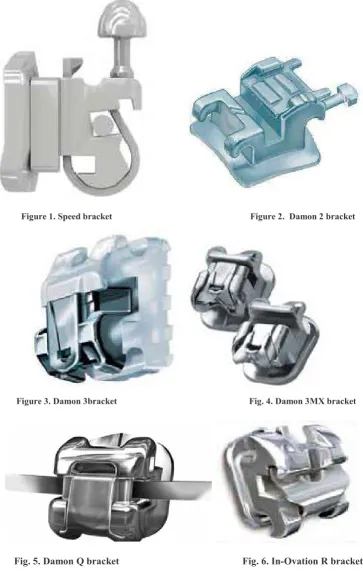
developed the self-ligating bracket Speed (Fig.1) (Strite Industries Ltd., Ontario, Canada), which consists of a stainless steel flexible spring, that exert pressure over the arch
the slot, allowing a constant activation upon thicker wires. Its stainless-steel spring was replaced by nickel titanium spring and is one of the most employed system, at present.
later, “A” Company (Johnson& Johnson, San Diego, California) had launched the br
2007; Shivapuja, 1994). Those cylindrical brackets presented a rigid curved wall, which opened and closed off, rotating
towards occlusal-gingival direction. However, the
commercialization of those brackets was suspended, due facility in which patients locked and unlocked the wall (Damon, 1998).
International Journal of Current Research
Vol. 10, Issue, 08, pp.72676-72680, August, 2018
Dr. Anjali Dhananjayan, Dr. Jayakrishnan U, and Dr. K Nillan Shetty, et al 2018. “Self Ligating Brackets International Journal of Current Research, 10, (08), 72676-72680.
AN INHERENT LOCK FOR SECURING ARCHWIRES
hetty,
4Dr. Rohan Rai,
Post Graduate Student, A.J Institute Of Dental Sciences, Mangalore
Department Of Orthodontics and Dentofacial Orthopedics,A.J Institue Of Dental Sciences,
f Dental Sciences, Mangalore
f Dental Sciences, Mangalore
and Dentofacial Orthopedics, A.J Institue of Dental Sciences,
ligating brackets are those type of brackets that do not require an elastic or wire ligature but have closed to secure the archwire. Self-ligating brackets isgaining popularity over the year. Various advantagesfor these systems have been claimed.Self-ligating brackets have been reported for faster and more efficient treatments, which bought about
to compare them to the conventional system. Unlike conventional appliances,self-ligating brackets do not require elastomeric or metal ligatures, better friction, torque expression, patient friendly and comfort, better maintaince of oral hygiene, faster alignment and space closure. This invention has bought about drastic change in the orthodontic mechanics.Therefore, the purpose of this ligating brackets currently used in firming or correctingcurrent speculations.
Commons Attribution License, which permits
-free system was refined by introductionof the Edgelok appliance in (Ormco, Glendora, California). The mechanism to ligate the archwire involved a labial sliding cap across the top of the archwire slot. When that vertical device was closed off, the bracket slot was converted into a four-wall tube (Berger, 1994; Shivapuja et al., 1994). In 1975, Hanson ligating bracket Speed (Fig.1) (Strite Canada), which consists of a stainless-steel flexible spring, that exert pressure over the arch wire in
owing a constant activation upon thicker wires. Its steel spring was replaced by nickel titanium spring and is one of the most employed system, at present. Ten years later, “A” Company (Johnson& Johnson, San Diego,
brackets Activa (Rinchuse et al.,
. Those cylindrical brackets presented a rigid curved wall, which opened and closed off, rotating
gingival direction. However, the
commercialization of those brackets was suspended, due to the facility in which patients locked and unlocked the wall
INTERNATIONAL JOURNAL OF CURRENT RESEARCH
New models of self-ligating brackets are being manufactured:
the brackets Time (Harradine, 2003; Henao, 2004)(American
Orthodontics, Shebiyan, Wis) were made available in 1994. The aspect and activation were very much similar to Speed, wherein the flexible spring was curved and less rigid, even though it was 1q made with stainless steel. In 1996, the
brackets Damon SL (Damon, 1998) (Ormco, Glendora,
California)was marketed as passive self-ligating brackets with
low or absence friction. This system was improved and then in 1999, Damon 2 was launched (Fig 2) as metallic brackets with a sliding wall, whose unlocking and locking occurred by
means of a specific instrumental. Then following
improvement, Damon 3 (Fig 3) were manufactured from a
combinationof a resinous composite reinforced by fiber glass
and stainless steel Recently, Damon 3MX was presented (Fig 4) and Damon Q (Fig 5), which are entirely metallic brackets and more curved. Similar to Speed in concept and design, the brackets In-Ovation was been suggested by GAC®. Over the years, its dimensions were reduced and In-Ovation-R (Fig 6) was launched, where in the system keeps the wire passive during alignment and leveling, and as the dimensions of the arch are enhanced, the tight contact of the wire with the spring bracket makes it active.
The SmartClip (Rinchuse, 2007; Miles, 2007) (Fig 7) are
self-ligating brackets very similar to the conventional ones. However, they present mesial and distal nickel titanium clips, which keep the wire passively inside the slots during the initial phases of the treatment. If necessary, the bracket becomes active, by the employment of ligatures. Due to the great acceptance and esthetic demand nowadays, lingual self-ligating brackets and esthetic self-self-ligating were designed to attend the necessities. Since 2001, lingual brackets with self-ligating system as Evolution (Fig 8) were designed. According to esthetical pattern, Oyster brackets were launched and manufactured employing fibre glass reinforced composite polymer. Nowadays, it was launched In-Ovation C (Fig 9), translucent ceramic self-ligating brackets.
Friction: The main advantage of SLB brackets is that reduced
frictional resistance between the bracket slot and archwire. Several authors have quantified in various studies about the low friction. The placing of ‘figure-of-eight’ elastomeric ties increased friction by a factor of 70-220 per cent compared to
the “O” elastomeric ties (Sims et al., 1993) Consequently, the
device which dispenses the employment of these ligatures, certainly causes lower friction levels. Read-Ward and colleagues, evaluating the static frictional resistance of three different SLBs and one conventional bracket, found that increasing either archwire size or bracket/archwire angulation resulted in greater static frictional resistance for all bracket types, while the presence of saliva had an inconsistent effect (Read-Ward, 1997). In a study comparing self-ligating brackets—Time2, In-Ovation R, Speed, Damon3—Budd,
Daskalogiannakis and Tompson (Budd, 2008) pointed out that
Damon3 showed the lowest friction value. The outcome is intrinsically linked to the passive design of this system. More recent clinical studies support the view that resistance to bodily tooth movement by sliding has little to do with friction, but rather is largely a “binding and release” phenomenon that occurs in the same way with both conventional and
self-ligating brackets (Burrow, 2009).
Oral Hygeine/Plaque Accumulation: In Fixed orthodontic
restricted, creating microbial colonization where in many studies have found that there is increase amounts of Streptococcus mutans and lactobacilli in saliva and dental plaque during orthodontic treatment. Most of the patients bonded with self-ligating presented fewer bacteria in plaque. The outcomes are related to the archwire ligating method; in case of conventional ones, to the elastomeric ligatures, which
retain higher levels of bacteria in plaque (Pellegrini et al.,
2009). Pandis and colleagues in their study have found that
SLBs do not have an advantage over conventional brackets with respect to the periodontal status of the mandibular
anteriorteeth (Pandis et al., 2008).
Treatment Efficiency
In the previous studies by Harradine (Harradine, 2001) found
the following:
● A very modest average time saving from a reduction in archwire placement/removal of 24 seconds per arch,
● A mean reduction of 4 months in active treatment time from 23.5 to 19.4 months,
● A mean reduction of four visits during active treatment from 16 to 12, and the same average reduction in Peer Assessment Rating scores for matched cases. Concerning the chair side
time savings, Shivapuja and Berger (Shivapuja et al., 1994)
concludes that when stainless steel wire ligatures are employed, a mean time of 8 minutes is spent for the positioning and removal of the wire. If elastomeric ligatures are employed, 2.3 minutes will be spent. If Speed self-ligating are employed, 0.7 minutes are required.
The ability to assure a safe and complete positioning of the arch into the slot of self-ligating brackets, concomitant to the employment of high technology arches, makes possible longer
appointment intervals (Harradine, 2003; Damon, 1998).
Hamilton and colleagues found that active SLBs appeared to have no measurable advantages in orthodontic treatment time, number of treatment visits, or time spent in initial alignment over conventional pre adjusted edgewise brackets, with both bracket systems averaging 15.7 months of treatment (Hamilton, 2008). Fleming and colleagues reported that bracket type did not influence the duration of treatment or the number of visits required.
Root Resorption: There are very less studies which support
some differences of root resorption employing self-ligating
brackets and the conventional ones. In study, Pandis et al.
(2008) demonstrated a relation between the period of treatment and root reabsorption, but there were no differences between the groups treated with self-ligating or conventional
brackets.The results obtained by Scott et al., (2008) who
assessed changes in root lengths of mandibular incisors on periapical radiographs following arch alignment. The mean amount of resorption was slightly greater with the Damon 3 appliance (2.26 vs 1.21 mm), although the difference failed to
reach statistical significance. Pandis et al. (2008) using
panoramic radiographs, reported no mean difference in the amount of apical root resorption of the maxillary incisors with Microarch and Damon 2 systems.
Arch Alignment and Space Closure: Few clinical trials
considered the efficiency of initial orthodontic alignment., among which One study was a three-dimensional measuring
Figure 1. Speed bracket Figure 2. Damon 2 bracket
Figure 3. Damon 3bracket Fig. 4. Damon 3MX bracket
Fig. 5. Damon Q bracket Fig. 6. In-Ovation R bracket
[image:3.595.122.281.50.251.2]
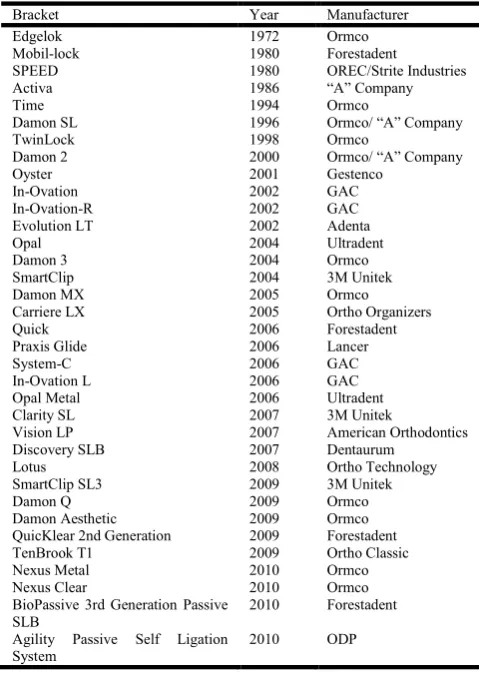
Table 1. Slb Evolution
Bracket Year Manufacturer
Edgelok 1972 Ormco
Mobil-lock 1980 Forestadent
SPEED 1980 OREC/Strite Industries
Activa 1986 “A” Company
Time 1994 Ormco
Damon SL 1996 Ormco/ “A” Company
TwinLock 1998 Ormco
Damon 2 2000 Ormco/ “A” Company
Oyster 2001 Gestenco
In-Ovation 2002 GAC
In-Ovation-R 2002 GAC
Evolution LT 2002 Adenta
Opal 2004 Ultradent
Damon 3 2004 Ormco
SmartClip 2004 3M Unitek
Damon MX 2005 Ormco
Carriere LX 2005 Ortho Organizers
Quick 2006 Forestadent
Praxis Glide 2006 Lancer
System-C 2006 GAC
In-Ovation L 2006 GAC
Opal Metal 2006 Ultradent
Clarity SL 2007 3M Unitek
Vision LP 2007 American Orthodontics
Discovery SLB 2007 Dentaurum
Lotus 2008 Ortho Technology
SmartClip SL3 2009 3M Unitek
Damon Q 2009 Ormco
Damon Aesthetic 2009 Ormco
QuicKlear 2nd Generation 2009 Forestadent
TenBrook T1 2009 Ortho Classic
Nexus Metal 2010 Ormco
Nexus Clear 2010 Ormco
BioPassive 3rd Generation Passive SLB
2010 Forestadent
Agility Passive Self Ligation
System
2010 ODP
The other studies where a two dimensional measurement; one among was a split-mouth design allowing consideration of just four mandibular contact points. Alignment efficiency was assessed in the mandibular archin all cases, with four studies confined to the lower anterior region and one study
considering the arch from first molar to first molar (Fleming et
al., 2010). Miles et al. (2006) Scott et al. (2008) and Miles (Miles, 2007) followed similar treatment protocols with alignment efficiency assessed using Little’s irregularity index
in the mandibular arch recorded at similar intervals. Scott et
al20 assessed changes in the irregularity index 8 weeks after
appliance placement; Miles, (2007) and Miles et al. (2006)
both assessed residual irregularity 10 weeks and 20 weeks after placement of appliances. Only one study considered the rate of
orthodontic space closure (Miles et al., 2006) at intervals of 5
weeks until complete space closure was achieved. This study had an inadequate sample size, with 4 of 18 subjects (22%) failing to complete the study. Posted archwires were used on both sides; therefore, tooth movement on one side may not have been independent of the other.
Torque: Various factors influence the torque expressions such
as bracket design, wire/slot play (engagement angle), mode of ligation, bracket deformation, wire stiffness, magnitude of wire torsion and dimension, and wire edge beveling. Clinical factors such as initial tooth inclination, tooth anatomy, and bracket positioning are also factors involved in torque expressions. Morina and colleagues, compared the torquing capacity of active and passive SLBs with that of metallic, ceramic, and polycarbonate edgewise brackets, found that Fascination 2
ceramic brackets registered the highest torquing
moments23.When torquing the. 022" brackets with. 019" ×
.025" stainless steel archwires, the authors observed the least
torque loss with the ceramic and Ultratrimm stainless steel brackets. Self-ligating, polycarbonate, and certain metallic brackets demonstrated almost seven times less torquing moments after insertion of .019" × .022" stainless steel wires into .022" slots, as well as 100% more torque loss compared to
the ceramic bracket (Morina et al., 2008).
Cost and Patient Comfort
SLBs’ main advantage is that there is elimination of ligature wires which makes them more superior to conventional edgewise brackets in terms of soft-tissue injuries and techniques. Because of its ligature less feature makes the chair side time less compared to conventional brackets. Currently self-ligating brackets are more expensive than most good quality tie wing brackets. Pain and discomfort experienced by patients was comparatively less compared to conventional brackets.
Conclusion
This advancement, brought about a drastic change in the treatment efficiency, stability, patient comfort and helps in maintaining good oral hygiene. The main advantages of self-ligation are now established and readily available. These developments offer the possibility of significant reduction in average treatment time and in anchorage requirements.
REFERENCES
Adriana Candida Albuquerque Nogueira, Karina Maria Salvatore Freitas, Darwin Vaz de Lima, Fabrício Pinelli
Valarelli and Rodrigo Hermont Cançado; 2018.
Comparison of Changes in Incisors Position in Cases Treated with Damon Self-Ligating and Conventional Fixed Appliances; The Open Dentistry Journal, Volume 12.
Berger JL. 1994.The SPEED appliance: a 14-year update on this unique self-ligating orthodontic mechanism. Am J
Orthod Dentofacial Orthop., Mar;105(3):217-23.
Budd S, Daskalogiannakis J, Tompson BD. 2008.A study of the frictional characteristics of four commercially available self ligating bracket systems. Eur J Orthod., Dec;30(6):645-53.
Burrow, S.J.:2009. Friction and resistance to sliding in orthodontics: A critical review, Am. J. Orthod., 135:442-447,
Damon DH. The Damon low-friction bracket: 1998. A biologically compatible straight-wire system. J Clin Orthod., Nov;32(11):670-80.
Damon DH. The Damon low-friction bracket: 1998.A biologically compatible straight-wire system. J Clin Orthod., Nov;32(11):670-80.
Fernandes DJ, Almeida RCC, Quintão CCA, Elias CN, Miguel JAM. A estética no sistema de braquetes autoligáveis. 2008. Rev Dental Press Ortod Ortop Facial., 2008 maio-jun;13(3):97-103
Fleming, P.S., DiBiase, A.T. and Lee, R.T.: 2010. Randomized clinical trial of orthodontic treatment efficiency with self ligating and conventional fixed orthodontic appliances,
Am. J. Orthod., 137:738-742,
Harradine NW. Self-ligating brackets: 2003. where are we now? J Orthod. Sep;30(3):262-73.
Harradine NWT: 2001.Self-ligating brackets and treatment efficiency. Clin Orthod Res., 4:220-227,
Henao SP, Kusy RP. 2004. Evaluation of the frictional resistance of conventional and self-ligating bracket designs using standardized archwires and dental typodonts. Angle Orthod., Apr;74(2):202-11.
Miles PG, Weyant RJ, Rustveld L. 2006. A clinical trial of Damon 2 vs conventional twin brackets during initial alignment. Angle Orthod., 76:480–485.
Miles PG. Self-ligating vs conventional twin brackets during en-masse space closure with sliding mechanics. 2007.Am J
Orthod Dentofacial Orthop. Aug;132(2):223-5.
Morina, E., Eliades, T., Pandis, N., Jäger, A., and Bourauel, C.: 2008. Torque expression of self-ligating brackets compared with conventional metallic, ceramic, and plastic brackets, Eur. J. Orthod. 30:233-238,
Nazeer Ahmed Meeran; Self-Ligating Brackets:2012. An Update; JCO,
Nigel Harradine; 2008. The History and Development of Self-Ligating Brackets; Semin Orthod; 14:5-18
Padhraig S. Fleming; Ama Johal; 2010.Self-Ligating Brackets in Orthodontics; A Systematic Review; Angle Orthod., 80:575–584.
Pandis N, Nasika M, Polychronopoulou A, Eliades T. External apical root resorption in patients treated with conventional and self-ligating brackets. Am J Orthod Dentofacial
Orthop. 2008; 134:646–651
Pandis, N., Vlachopoulos, K., Polychronopoulou, A., Madianos, P., and Eliades, T.: 2008. Periodontal condition of the mandibular anterior dentition in patients with conventional and self-ligating brackets, Orthod. Craniofac. Res. 11:211-215,
Pellegrini P, Sauerwein R, Finlayson T, McLeod J, Covell DA Jr, Maier T, et al. 2009. Plaque retention by self-ligating vs elastomeric orthodontic brackets: quantitative comparison of oral bacteria and detection with adenosine triphosphatedriven bioluminescence. Am J Orthod Dentofacial Orthop. Apr;135(4): 426.e1-9.
Read-Ward, G.E., Jones, S.P., and Davies, E.H.: 1997. A comparison of self-ligating and conventional orthodontic bracket systems, Br. J. Orthod., 24:309-317,
Rehana Bashir, Saurabh Sonar, Anu Singla, Amit Srivastava,
Puneet Batra; 2018. A Comparative Computed
Tomographic Evaluation of Expression of Angulation and Inclination in Self Ligating Brackets; Journal of Indian Orthodontic Society.
Renata Sathler, Renata Gonçalves Silva, Guilherme Janson,
Nuria Cabral Castello Branco, Marcelo
Zanda;Demystifying self-ligating brackets; 2011. Dental Press J Orthod; Mar-Apr;16(2):50. e1-8
Rinchuse DJ, 2007. Miles PG. Self-ligating brackets: present and future. Am J Orthod Dentofacial Orthop. Aug;132(2):216-22.
Scott P, DiBiase AT, Sherriff M, Cobourne MT. Alignment efficiency of Damon 3 self-ligating and conventional orthodontic bracket systems: 2008. A randomized clinical trial. Am J Orthod Dentofacial Orthop., 134:470. e1– 470.e8.
Shivapuja PK, Berger J.1994. A comparative study of conventional ligation and self-ligation bracket systems. Am J Orthod Dentofacial Orthop. Nov;106(5):472-80. Sims AP, Waters NE, Birnie DJ, Pethybridge RJ. 1993. A
comparison of the forces required to produce tooth movement in vitro using two self-ligating brackets and a pre-adjusted bracket employing two types of ligation. Eur J Orthod. Oct;15(5):377-85.
Stephanie Shih-Hsuan Chen, Geoffrey Michael Greenlee, Jihyun-Elizabeth Kim, Craig L. Smith, and Greg J. Huang; 2010. Systematic review of self-ligating brackets; Am J
Orthod Dentofacial Orthop;137: 726.e1-726.e18
Stolzenberg J: 1935. The Russell attachment and its improved advantages. Int J Orthod Dent Child 21:837-840,