GROUPS
ANDREAS B ¨ACHLE∗, ALLEN HERMAN†, ALEXANDER KONOVALOV, LEO MARGOLIS‡, AND GURMAIL SINGH
Abstract. We identify all small groups of order up to 288 in the GAP Library for which
the Zassenhaus conjecture on rational conjugacy of units of finite order in the integral group ring cannot be established by an existing method. The groups must first survive all the-oretical sieves and all known restrictions on partial augmentations (the HeLP+ method). Then two new computational methods for verifying the Zassenhaus conjecture are applied to the unresolved cases, which we call the quotient method and the partially central unit con-struction method. To the cases that remain we attempt an assortment of special arguments available for units of certain orders and the lattice method. In the end, the Zassenhaus conjecture is verified for all groups of order less than 144 and we give a list of all remaining cases among groups of orders 144 to 287.
The Zassenhaus conjecture for torsion units of integral group rings states that any torsion unit of ZG should be conjugate in QG to a unit of ±G [21]. By [19, (37.5)] it suffices to establish this conjugacy in CG. We will abbreviate the conjecture as ZC1. Though this conjecture was made in the 1960s, it has only been established for a few families of groups. In this article, we study the status of the conjecture for groups of small order. This effort follows an earlier one by H¨ofert and Kimmerle that dealt with groups of order up to 71 [13]. Using recent theoretical and computational advances, we establish ZC1 for all groups of order less than 144, and give an accurate account of the groups of order 144 to 287 for which ZC1 cannot be established by the methods currently at our disposal (see Table 1).
The first step is to apply theoretical sieves. First we eliminate all nilpotent groups [20], cyclic-by-abelian groups [5], and groups whose derived subgroup is contained in a Sylow subgroup for some prime p [9, Theorem 1.2]. Groups of the form H ×C2 for which ZH
satisfies ZC1 can also be eliminated [13, Corollary 3.3], since we are inducting on group order. Metabelian groups of the form AoCp whereA is abelian of ordern,pis prime, and p < q, for any primeq dividingn, can also be sieved [16].
Letεdenote the augmentation map on CG. A unituofZGis normalized if ε(u) = 1. We will denote the normalized units ofZGby V(ZG). The partial augmentation ofu=P
gugg
on the conjugacy classxG of x∈Gis εx(u) =Py∈xGuy. An important connection between
Date: August 31, 2016.
2010Mathematics Subject Classification. 16U60, 16S34, 20C05, 20C10.
Key words and phrases. Integral group ring, groups of units, Zassenhaus conjecture.
∗ This author is a postdoctoral researcher of the FWO (Research Foundation Flanders). † This author’s research has been supported by an NSERC Discovery Grant.
torsion units in V(ZG), established in [16, Theorem 2.5], says that the torsion units satisfying the property:
(*) for alln ≥0, there is only one conjugacy class xG in Gsuch that εx(un)6= 0
are precisely the torsion units that are conjugate in CG to normalized trivial units. This result has inspired an approach that investigates the potential existence of normalized torsion units with more than one nonzero partial augmentation. The Luthar-Passi method [15], its modular extension by Hertweck [10], the Cohn-Livingstone and power congruence criteria (see [4, Remark 6]), and Hertweck’s criteria thatεx(u)6= 0 implies the order ofxmust divide
the order ofu[10, Theorem 2.3] produce several restrictions on partial augmentations that a normalized torsion unit of ZGmust satisfy. The first and fourth authors recently produced the GAP package help[2] that implements this collection of methods, to which we refer as HeLP+.
After the sieve, the HeLP+-method is applied to the remaining list of groups. For this step we use the GAP package [2], which utilizes the integer optimization programsnormaliz [17] and 4ti2 [18]. Each HeLP+-solution consists of the lists of partial augmentations for a possible normalized torsion unit and its powers. A nontrivial HeLP+-solution is one for
which εx(u) 6= 0 for more than one conjugacy class xG of G. For each nontrivial HeLP+
-solution, we have to show that there is no torsion unit of V(ZG) that produces these partial augmentations. As this is an inductive approach, we can also eliminate a nontrivial HeLP+
solution forGby mapping it modulo a proper normal subgroupN to a nontrivial list of partial augmentations summing in G/N. If a normalized unit u with these partial augmentations exists inZG, then its image would be a normalized unit with nontrivial partial augmentations in Z[G/N], whose existence would already be ruled out. Elimination by this “quotient method” is quite useful in groups that have several normal subgroups.
The HeLP package also gives the spectrum for the torsion unit under each irreducible representation of the group. This information is equivalent to the partial augmentation information. It is used directly in the partially central construction and in the lattice method. In the partially central construction, we directly check if the central components of uin the Wedderburn decomposition ofCGlie in the image of ZG. If they do not, the unit cannot be conjugate to an element of ZG. The partially central construction and the quotient method are implemented with software (see [1]).
To the groups with nontrivial HeLP+-solutions that remain after these computational
procedures, we check a few more additional criteria available for units of particular orders by hand, and finally check if the lattice method of [3] can be applied. In the end, only a handful of groups of order between 144 and 287 survive all of these tests (see Table 1.)
Our notation is based on GAP’s. We will refer to the group identified bySmallGroup(n,r) in GAP’s Small Groups Library as SG(n, r). We will writeNoH for a split extension and
Table 1. Unresolved nontrivial HeLP+-solutions among groups of order up to 287.
GAP Id Structure unresolved cases: PAs[powers] (144,117) C2
3 oD16 (6b,6d,6e)=(-1,1,1)[2b,3b]
(144,119) C2
3 oQ16 (12a,12b,12d)=(1,1,-1)[2a,3a,4a,6a]
(150,5) C2
5 oS3 (10a,10c)=(2,-1)[2a,5a]
(160,234) C4
2 oD10 (2a,2b,2c)=(1,-1,1)
(192,955) C4
2 oD12 (2a,2c,2f)=(1,1,-1),(1,-1,1)
(192,973) C23.SG(24,8) (8a,8bc,8d) = (1,-1,1)[2b,4db] (192,974) C23.SG(24,8) (8a,8bc,8d) = (1,-1,1)[2c,4ca] (192,975) C23.SG(24,8) (8a,8bc,8d) = (1,-1,1)[2a,4fc] (192,976) C23.SG(24,8) (8a,8bc,8d) = (1,-1,1)[2b,4eb] (192,1489) C23.S4 (8a,8b,8c)=(-1,1,1)[2b,4e]
(192,1490) C3
2.S4 (8a,8b,8c) = (-1,1,1)[2c,4d]
(216,33) C2
3 o(C3oQ8) (12a,12c,12f) = (1,1,-1)[2a,3a,4a,6a]
(0,2,-1)[2a,3c,4c,6c] (216,35) C2
3 oSG(24,8) (12a,12b)=(2,-1)[2c,3c,4d,6e]
(216,37) C2
3 oD24 (6a,6e,6h) = (1,1,-1)[2a,3a],
(0,2,-1)[2c,3c] (216,153) C2
3 oSL(2,3) (3a,3d,6a)= (1,-1,1),(-1,1,1)[3c,2a]
(240,91) A5oC4 (4a,4c,4d)=(1,0,-1,1)[2a]
Remarks. (i). In Table 1, the nontrivial lists of partial augmentations of the unit u and the conjugacy classes in G of powers ud for d dividing the order o(u) of u are given. Since
we only seek a counterexample of minimal unit order, we assume ud is always conjugate to
an element of G for any proper divisor d of o(u). We use an order convention for multiple nontrivial solutions; so (8a,8bc,8d) = (1,−1,1)[2a,4f c] in Table 1 denotes the information for the two solutions (8a,8b,8d) = (1,−1,1)[2b,4f] and (8a,8c,8d) = (1,−1,1)[2a,4c]. (ii). SG(24,8)'C3oD8 is one of three groups with this structure description.
(iii). SG(240,91) is a (central) quotient ofGL(2,5). ZC1 was verified forGL(2,5) by Bovdi and Hertweck in [4]. However, it does not follow from their arguments that ZC1 holds for
G.
1. Groups of order less than 288 that survive our sieves.
We abbreviate the group identified as SmallGroup(n,r) in GAP’s Small Groups Library as SG(n, r). Our first theoretical sieve removes all nilpotent, cyclic-by-abelian, and p -by-abelian groups, and groups satisfying case (a) of [16, Main Theorem]. Since we are looking for a minimal counterexample, we can also eliminate groups of the form C2×H, where the
groupHis known to satisfy ZC1. After this sieve, 1121 groups of order less than 288 remain. To these groups we apply the HeLP+ method. This leaves a list of 99 groups.
of the group, it is eliminated by our inductive argument. This leaves a list of 35 groups, which appear in Table 2.
Table 2. Cases remaining after sieves, HeLP+, and the quotient method.
Order GAP Id #, (unit order)
48 30(4)
72 40(6)
96 65(8), 186(4), 227(2) 144 117(6), 119(12), 182(6)
150 5(10)
160 234(2,4)
168 43(6)
192 182(4), 186(16), 955(2), 958(4,8)
973(8), 974(8), 975(8), 976(8), 987(4), 990(4), 1473(4), 1478(4), 1489(8), 1490(8),
1491(4), 1492(4), 1493(2) 200 43(10)
216 33(12), 35(12), 37(6), 153 (3,6), 161 (3)
240 91(4)
Remark. The smallest groups our methods do not cover turn out to have order 144, so it is at order 288 where the quotient method becomes ineffective.
2. Partially central unit constructions
The second, third, and fifth authors have developed a computer program that can construct torsion units ofCGthat have the partial augmentations and powers in a given HeLP-solution (see [1] and [8]). Each nontrivial HeLP+-solution has accompanying spectral information. A complete set of explicit irreducible representations of the group is used to construct a unit of CG with the desired spectrum, and it follows it is conjugate in CG to any torsion unit with the same partial augmentations and powers. Since this construction requires a complete set of explicit irreducible representations for the group, the effectiveness of this method is directly dependent on that of the algorithm used to construct these irreducible representations. Currently the algorithms implemented in GAP for constructing irreducible representations of groups are reasonably efficient for groups of order up to 10000 appearing in GAP’s Small Groups Library [7].
Once a unit u ∈ CG with the desired spectrum at each irreducible representation has been constructed, we then takee to be the sum of all the centrally primitive idempotents of
CG for which ue is central in CGe. The centrality can be observed directly from the
HeLP+-solution will not produce a counterexample to ZC1. When this occurs, we simply
say that the unit u ispartially central.
When constructing units, we writee3abc for the sum of the centrally primitive idempotents
of CG corresponding to χ3a, χ3b, and χ3c. If we write e124, then this means the sum of all
centrally primitive idempotents of CG corresponding to all irreducible characters of degrees 1, 2, and 4. We use, for example,g4b to denote a group element in the conjugacy class of G
labelled 4b by GAP, χ3d for the 4th irreducible character of degree 3 in GAP.
SG(48,30), order 4. There is one Aut(G)-orbit of nontrivial HeLP+-solutions that
survive the quotient method. Its partial augmentations are (4a,4c,4d) = (−1,1,1), and its square lies in the class 2a. Its spectral information shows the central part of the unit is
ue13cd.
χ1abcd χ2a χ2b χ3a χ3b χ3c χ3d
spec(X(u)) 1,−1, i,−i (i,−i) (1,−1) (1,1,1) (−1,−1,−1) (i, i,−i) (i,−i,−i)
Using this spectral information and explicit irreducible representations constructed in GAP for eachχ∈Irr(G), we can construct a representative ofuinCG. With our notational conventions, the unit our program constructs is
u=g4be123cd+g2ae3a−g2ae3b.
With our program we then construct an explicitZ-basis of ZGe13ab and write ue13ab in terms
of this basis. When we do this the coefficients we get are non-integer rational numbers, so this means u is partially central. So the partially central unit construction completes the verification of ZC1 for this group.
As we have implemented this partially central check with our software, we just give a summary of the cases where it works.
SG(96,65), order 8: There is one Aut(G)-orbit of nontrivial HeLP+-solutions that
sur-vive the quotient method: (8a,8d,8g) = (1,−1,1), with u2 ∈ 4a,u4 ∈2a. The central part
of the unit is ue13ef gh and it does not lie inZGe13ef gh. So ZC1 holds for G.
SG(96,186), order4: There is one Aut(G)-orbit of solutions left to resolve: (4b,4g,4h) = (−1,1,1), withu2 ∈2b. Our calculations show its central part ue
13ef gh 6∈ZGe13ef gh. So ZC1
holds for G.
SG(96,227), order 2: One orbit of solutions to resolve: (2b,2c,2d) = (1,1,−1). The unit we construct is partially central. So ZC1 holds for G.
SG(192,182), order 4: Only one solution is left to resolve: (4c,4d,4g) = (1,1,−1),
u2 ∈2a. Since ue
13gh 6∈ZGe13gh, this verifies ZC1 forG.
SG(192,186), order 16: One solution is left to resolve: (16a,16e,16k) = (1,−1,1),
u2 ∈8a, u4 ∈4a, and u8 ∈2a. Sinceue
13ijk`mnop6∈ZGe13ijk`mnop, ZC1 holds forG.
SG(192,955), order 2: There are five Aut(G)-orbits of order 2 solutions left to resolve: (2a,2b,2c,2d,2f) = (1,0,−1,0,1),(0,1,−1,0,1),
For the first, second, and fourth of these, the central part of the unit we construct for them lies in ZGe, so the partially central method does not resolve them. For the third and fifth, the central part of the unit does not lie in ZGe, so these cases are resolved. The other three nontrivial HeLP+-solutions for this group remain unresolved.
SG(192,958), order 4: One solution left to resolve: (4b,4g,4j) = (1,−1,1), u2 ∈ 2b.
The unit we construct for this solution is partially central, so this verifies ZC1 for units of order 4.
SG(192,958), order 8: One orbit of solutions left to resolve: (8b,8h,8n) = (1,−1,1), with u2 ∈4a, and u4 ∈2b. ue13abcdghij 6∈ ZGe13abcdghij, so the unit is partially central. This
verifies ZC1 forG.
SG(192,987), order4: There are four Aut(G)-orbits of HeLP+-solutions remaining to be resolved, which we can summarize as (4abcd,4e,4f) = (1,1,−1), u2 ∈2a. Our construction shows all four of these units are partially central. So this verifies ZC1 for G.
SG(192,990), order4: There are three Aut(G)-orbits of nontrivial solutions to consider: (4abc,4d,4e) = (1,1,−1), with u2 ∈ 2c. All three are shown to be partially central by our
program. So ZC1 is verified forG.
SG(192,1473), order 4: One orbit of solutions to resolve: (4b,4h,4k) = (1,−1,1),
u2 ∈2c, which is shown to be partially central by our construction. So this resolves ZC1 for G.
SG(192,1478), order 4: One orbit of solutions to resolve: (4c,4i,4m) = (1,−1,1),
u2 ∈2b, which is shown to be partially central by our construction. So this resolves ZC1 for G.
SG(192,1491), order 4: One orbit of solutions to resolve: (4a,4d,4e) = (1,−1,1),
u2 ∈2c. The unit our program constructs for this solution is partially central, so this verifies ZC1 for G.
SG(192,1492), order 4: There are two orbits of solutions remaining: (4ab,4c,4e) = (1,−1,1), with u2 ∈ 2b. The units our program constructs for these solutions are partially central, so this verifies ZC1 for G.
SG(192,1493), order 2: There is one orbit of solutions to resolve, represented by (2a,2b,2e) = (−1,1,1). The unit our program gives for this solution is partially central, so this verifies ZC1 for G.
3. Methods for units of special order.
The first of the special results we can apply is Proposition 4.2 of [9] concerning p-adic conjugacy of units. An easy integral consequence of this p-adic result is the following one, relevant for thep-subgroup version of the Zassenhaus conjecture (p-ZC3):
SG(160,234), order 2: There are two orbits of solutions to consider: (2a,2b,2c) = (1,1,−1) and (2b,2c,2d) = (1,1,−1). For the latter, the classes 2b, 2c, and 2dare contained in a normal subgroup N of order 16, so we can apply Proposition 1 to resolve it. The other solution remains unresolved.
SG(192,955), order 2: The three nontrivial solutions remaining to be resolved are (2a,2b,2c,2f) = (1,0,−1,1),(1,0,1,−1),(0,1,−1,1). The group has a normal subgroup N
of order 32 that contains the classes 2b, 2c, and 2f. An application of Proposition 1 resolves the third of these solutions. The first two remain unresolved.
The next lemma we can use is [12, Proposition 2]:
Proposition 2. LetN be a normalp-subgroup of G. Suppose uis a torsion unit of ZGwith augmentation 1 whose image modulo N has strictly smaller order than u. Then εg(u) = 0
for every g ∈G whose p-part has strictly smaller order than the p-part of u.
SG(72,40), order 6: The nontrivial HeLP+-solutions lie in two distinct Aut(G)-orbits,
whose partial augmentations are: (2a,2c,6a) = (1,1,−1),(−1,1,1). The group has a normal subgroup N of order 9, and the image of u modulo N in both cases would have order 2. Both of these cases fail the criteria of Proposition 2 at the prime p= 3.
SG(144,182), order 6: The same reasoning applies. There are two orbits of nontrivial solutions, with (2a,2b,6a) = (1,1,−1),(−1,1,1). There is a normal subgroup N of order 9 for which umod N has order 2. So these partial augmentations of u also fail Proposition 2.
SG(160,234), order 4: There is one orbit of nontrivial solutions to resolve: (2a,4a) = (2,−1), u2 ∈ 2c. As noted earlier, G has a normal subgroup of order 16 containing g
2c but
not g2a. Modulo N, u will have order 2, so Proposition 2 applies. So normalized torsion
units of order 4 in ZG will be rationally conjugate to elements of G.
SG(168,43), order 6: There are ten nontrivial HeLP+-solutions of order 6:
(3a,3b,6a,6b) = (1,2,−1,−1),(1,−1,−1,2),(2,1,−1,−1),(−1,1,2,−1),(−1,1,1,0),
(1,−1,0,1),(2,1,−2,0),(1,2,0,−2),(3,0,−2,0),(0,3,0,−2).
The groupGhas a nontrivial normal subgroupN of order 8 generated by the class 2a. Since
|G/N| = 21, any torsion unit u of ZG that has order 6 will be mapped modulo N to an element of order 3. By applying Proposition 2 withp= 2 we can eliminate every nontrivial solution withε3a(u)6= 0 or ε3b(u)6= 0. So this verifies ZC1 for G.
SG(200,43), order 10: There are two Aut(G)-orbits of nontrivial HeLP+-solutions to
resolve: (2a,2c,10a) = (−1,1,1),(1,1,−1). Ghas a normal subgroup of order 25, so Propo-sition 2 tells us the partial augmentations of a normalized torsion unit of ZG with order 10 should vanish on elements of order 2. So these solutions are resolved, and this verifies ZC1 for G.
We will need another result [6, Theorem 5.3] where ZC3 for p-subgroups is known.
Of course, the last nontrivial term of the lower central series is the smallest normal sub-group L of Gfor which G/L is nilpotent.
SG(216,153), order 3: For this group, if L is the last non-trivial term of the lower central series of G, then |L| = 72. By Proposition 3, normalized units of ZG with 2- or 3-power order are rationally conjugate to elements of G.
SG(216,161), order 3: For this group, if L is the last non-trivial term of the lower central series of G, then |L| = 27. By Proposition 3, normalized units of ZG with 3-power order are rationally conjugate to elements ofG. This verifies ZC1 for this group.
4. Applying the Lattice Method.
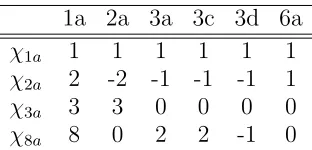
[image:8.612.210.366.314.389.2]Let G=SG(216,153), the special affine group F23oSL(2,3). After the arguments above there remain four Aut(G)-orbits of possibly non-trivial partial augmentations for units of order 6 in V(ZG). Two of these we will exclude using the lattice method introduced in [3]. We will use parts of the character table ofGand the decomposition matrix ofGgiven in the tables 3 and 4. The values of all characters on classes not given in these tables are integral.
Table 3. Character table of G
1a 2a 3a 3c 3d 6a
χ1a 1 1 1 1 1 1
χ2a 2 -2 -1 -1 -1 1
χ3a 3 3 0 0 0 0
[image:8.612.236.341.438.510.2]χ8a 8 0 2 2 -1 0
Table 4. Decomposition matrix of Gfor the prime 3
ϕ1a ϕ2a ϕ3a
χ1a 1 0 0
χ2a 0 1 0
χ3a 0 0 1
χ8a 1 2 1
2a is the only class of involutions in G and in both possibilities of units we are going to study u2 is rationally conjugate to elements in 3c. Denote by ζ a primitive complex 3rd
root of unity. Assume first that (ε3a(u), ε3d(u), ε6a(u)) = (−2,2,1).Then for representations D2a and D8a corresponding to the characters χ2a and χ8a respectively we find the following
eigenvalues for u.
D2a(u)∼diag(−ζ,−ζ2), D8a(u)∼diag(ζ, ζ2, ζ, ζ2,−1,−1,−1,−1).
By a theorem of Fong [14, Corollary 10.13] we may assume that the representationsD2a and D8a are realized over a 3-adically complete discrete valuation ring which is unramified over
corresponding to D2a and D8a respectively. Then when viewed as khu¯i-modules we have
by [3, Proposition 1.3] that ¯L2a ∼= ¯L+2a ⊕L¯
−
2a and ¯L8a ∼= ¯L+8a⊕ L¯
−
8a are such that all the
composition factors of ¯L+2a and ¯L+8a are trivial while the composition factors of ¯L−2a and ¯L−8a
are non-trivial. Moreover by [3, Propositions 1.3, 1.4] we know that ¯L2a is a 2-dimensional
indecomposable module while ¯L−8a is the direct sum of four 1-dimensional summands. But since ¯L−2a is a sub- or factor module of ¯L−8a by the decomposition numbers in table 4, this contradicts the existence of u.
Next assume (ε3a(u), ε3d(u), ε6a(u)) = (2,−2,1). We will use similar notation as in the
paragraph above. Then
D3a(u)∼diag(1, ζ, ζ2), D8a(u)∼diag(−ζ,−ζ2,−ζ,−ζ2,1,1,1,1).
Then viewed as khu¯i-modules we conclude, again by [3, Propositions 1.3, 1.4], that ¯L+3a
contains a direct indecomposable summand of dimension at least 2 while ¯L+8a is the direct sum of four 1-dimensional modules. This again contradicts the decomposition numbers given in table 4.
References
[1] A. B¨achle, A. Herman, A. Konovalov, L. Margolis, and G. Singh, ZCTU Source Code, https://github.com/drallenherman/ZCTU-Source-Code
[2] A. B¨achle and L. Margolis, HeLP – A GAP-package for torsion units in integral group rings, arXiv:1507.08174v3 [math.RT].
[3] A. B¨achle and L. Margolis, Rational conjugacy of torsion units in integral group ring of non-solvable groups,Proc. Edinburgh Math. Soc., to appear;arXiv:1305.7419v3[mathRT].
[4] V. Bovdi and M. Hertweck, Zassenhaus conjecture for central extensions of Sn, J. Group Theory, 11
(1), (2008), 63-74.
[5] M. Caicedo, L. Margolis, and ´A. del R´ıo, Zassenhaus conjecture for cyclic-by-abelian groups,J. London Math. Soc., (2),88 (1), (2013), 65-78.
[6] M. Dokuchaev and S. Juriaans, Finite subgroups in integral group rings,Can. J. Math.,48(6), 1996), 1170-1179.
[7] The GAP Group, GAP – Groups, Algorithms, and Programming, Version 4.8.6; 2016, http://www.gap-system.org.
[8] A. Herman and G. Singh, Revisiting the Zassenhaus Conjecture on torsion units for the integral group rings of small groups,Proceedings. Math. Sciences. Indian Academy of Sciences, 125(2), (2015), 167-172.
[9] M. Hertweck, On the torsion units of some integral group rings,Algebra Colloq.,13(2), (2006), 329-348. [10] M. Hertweck, Partial augmentations and Brauer character values of torsion units in group rings,
arXiv:math/0612429v2 [math.RA].
[11] M. Hertweck, Torsion units in integral group rings of certain metabelian groups,Proc. Edinburgh Math. Soc., 51, (2008), 363-385.
[12] M. Hertweck, The orders of torsion units in integral group rings of finite solvable groups,Comm. Algebra,
36(10), (2008), 3585-3588.
[13] C. H¨ofert and W. Kimmerle, On torsion units of integral group rings of groups of small order.Groups, rings and group rings, 243252, Lect. Notes Pure Appl. Math., 248, Chapman & Hall/CRC, Boca Raton, FL, 2006.
[14] I. M. Isaacs,Character theory of finite groups. Pure and Applied Mathematics, No. 69. Academic Press, New York-London, 1976.
[16] Z. Marciniak, J. Ritter, S. Sehgal, and A. Weiss, Torsion units in integral group rings of some metabelian groups, II,J. Number Theory,25, (1987), 340-352.
[17] normaliz W. Bruns, B. Ichim, and C. S¨oger, The power of pyramid decomposition in Normaliz. J. Symbolic Comput., 74 (2016), 513-536.
[18] 4ti2 team, 4ti2 – A software package for algebraic, geometric and combinatorial problems on linear spaces. Available atwww.4ti2.de.
[19] S. K. Sehgal, Units in Integral Group Rings, Pitman Monographs and Surveys in Pure and Applied Mathematics, No. 69, Longman Scientific and Technical, Harlow, copublished in the United States by John Wiley and Sons, New York, 1993.
[20] A. Weiss, Torsion units in integral group rings,J. Reine Angew. Math.,415(1991), 175-187.
[21] H. Zassenhaus, On the torsion units of finite group rings.Estudos de matem´atica. Em homenagem al Prof. A. Almeida Costa, pp. 119-126. Instituto de Alta Cultura, Lisbon, 1974.
Vakgroep Wiskunde, Vrije Universiteit Brussel, Pleinlaan 2, 1050 Brussels, Belgium E-mail address: [email protected]
Department of Mathematics and Statistics, University of Regina, Regina, Canada S4S 0A2
E-mail address: [email protected]
School of Computer Science, University of St. Andrews, North Haugh, St. Andrews, Fife, KY16 SX9, U.K.
E-mail address: [email protected]
Departamento de matem´aticas, Facultad de matem´aticas, Universidad de Murcia, 30100 Murcia, Spain
E-mail address: [email protected]
Department of Mathematics and Statistics, University of Regina, Regina, Canada S4S 0A2