doi:10.4236/ti.2011.21005 Published Online February 2011 (http://www.SciRP.org/journal/ti)
Evaluation on Information Technology Service
Management Process with AHP
Jiangping Wan1,2, Hui Zhang1, Dan Wan1 1
School of Business Administration, South China University of Technology, Guangzhou, China
2
Institute of Emerging Industrialization Development South China University of Technology, Guangzhou, China E-mail: scutwjp@126.com, shidelan@163.com, dandanwan42@126.com
Received November 9, 2010; revised January 10, 2011; accepted January 28, 2011
Abstract
Though analyzing the IT service management framework and associated processes of KM company, this paper determines various indicators of IT service management process. The weights of each indicator are calculated with analytical hierarchy process (AHP), and the evaluation was executed in KM company. And the suggestions are proposed with consideration of both the evaluation results and the real situation of KM company’s IT service management. The case is deeply considered in the views of IT service management objectives and misunderstandings, customer satisfaction model of IT service management, knowledge sup-porting structure of IT service management. It is concluded that if the organization wishes to successfully implement IT service management’s customer satisfaction model, it should eliminate the misunderstandings of IT service objectives first, while the adoption of knowledge supporting structure of IT service manage-ment can play a multiplier effect.
Keywords: Information Technology Infrastructure Library, Information Technology Service Management Process, Analytical Hierarchy Process, Customer Satisfaction, Knowledge Support Structure
1. Introduction
Information Technology Service Management (ITSM) based on Information Technology Infrastructure Library (ITIL), which integrates the best practices of global IT management and forms the normative truth standard to reduce effectively cost and improve the quality of service, is applied widely in the world [1]. ITIL, which was de-veloped by the Central Computer and Telecommunica-tions Agency (CCTA, merged with the OGC) of the UK government in the middle of 1980s, is a set of service management standard library which focuses on IT industry. In the past 20 years, the content of ITIL has been updated and renewed. Today the OGC has enacted the ITIL 3.0.
ITIL emphasizes on managing IT service from or-ganization business and customer desires, and realizes the integration of service management processes and organization business. The module of service manage-ment plays a role of “glue” which makes an organic connection between the business perspective and the
technology. The core module of ITIL, service manage-ment, consists of ten core processes and an ITSM func-tion. Service support and service delivery are considered to be at the heart of the ITIL framework for ITSM. Ser-vice delivery describes the serSer-vices that the customer needs to support their business, and what is needed to provide these services; service support describes how a customer can get access to the appropriate services to support their business.
This paper is organized as follows: Firstly, IT service management of KM company is introduced. Secondly, its IT service management processes are deeply analyzed, then IT service management process assessment model is proposed based on Analytical Hierarchy Process (AHP) and assessment is made. Finally, conclusions are put forward according to the resultsand the thinking on case study.
2. KM Company and Its IT Service
Management
This research was supported by Key Project of Guangdong Province Education Office (06JDXM63002), NSF of China (70471091), and QualiPSo (IST-FP6-IP-034763)
consulting services. KM company has more than a dozen subsidiaries in Beijing, Tianjin, Daian, Shanghai, Nanjing, Chengdu, Hangzhou, Guangzhou, Changsha, Shenzhen, Hong Kong SAR and Macao SAR, with over 8,000 pro-fessionals. KM’ IT department is an independent de-partment, constituting the company’s basic structure with personnel, administration, marketing, training, and fi-nance department. IT department’s main responsibilities include planning, constructing and maintaining com-pany’s hardware and software of computer system, de-veloping IT system’s security policies, monitoring the company’s network applications, backup company’s data and planning and procuring computers, printers and other consumable goods for the company.
Based on the ITIL model, through studying and un-derstanding ITIL, and enterprise’s own practice for IT service management, KM company develops processes completely on its own and continuously improves them. KM company’s IT service management implementation is divided into three phases: 1) To implement IT help-desk and service level management. 2) To implement emergency management, problem management and change management. 3) To implement configuration ma- nagement, cost management, availability management and IT service continuity management.
The scope of IT application management service that KM company provides, covers the user’s application system, database performance and monitoring, data backup and so on, such as: 1) Application service man-agement: Incident Management, Problem Management, Configuration Management, Change Management and Knowledge Management. 2) Technical support: Con-figuration Installation, Service Upgrading, Application Incident Management, Ordinary Onsite Maintenance and Operation Supporting Service. 3) Monitoring manage-ment: Monitoring Service and Application Performance Management Service.
3. Analysis on KM Company’s IT Service
Management Processes
This section analyzes KM company’s IT service man-agement process in the views of customer satisfaction management, operation maintenance service process, IT service financial management, service level management and IT service implementation management process. It is believed that all IT service management processes should be aimed at enhancing customer satisfaction.
3.1. Customer Satisfaction Management of KM Company
Customer satisfaction management is an organizational behavior that enterprises try to understand customer
sat-isfaction through investigating, analyzing and research-ing, based on this, we identify the effect factors and con-tinuously improve it. KM’s solutions are: 1) Developing the principles of customer satisfaction management from the concept level. 2) Formulating strategies from the technical aspect to improve customer satisfaction. 3) Focusing on customer value, and promoting satisfactory experience delivery. 4) Shortening service-response time, and providing continuous service. 5) Optimizing service cycle and saving cost.
3.2. Operation Maintenance Service Process of KM Company
The key roles of KM company’s application system op-eration maintenance service team are as follows: 1) Op-eration director, who is responsible for controlling the quality of services, maintaining customer satisfaction, timely responding to users’ new needs and reporting the situation of operation maintenance to the management. 2) Operation manager, who is responsible for managing the operation maintenance services team, keeping in touch with every department’s heads, and ensuring to complete the operation maintenance support service with high- quality. 3) Operation maintenance service support team, including on-site operation maintenance service and support team and remote support team, who grantee the stable operation of users’ application system together. The operation maintenance service processes mainly include service team, service process, management tool, fault prevention, emergency response system and so on.
3.3. IT Service Financial Management of KM Company
KM company’s IT service financial work includes de-fining the cost elements, and further subdividing the cost project. Define cost element structure in terms of service, that is, identify the cost based on determining the service element structure, distribute them to every service and sum up respectively. After determining the relationship between cost elements structure and service elements structure, service-based cost model would be established.
3.4. IT Service Level Management of KM Company
3.5. IT Service Implementation Management Process of KM Company
KM company will gradually track and handle all cus-tomer service content electronically with special tools and customers’ information will be stored in the form of database or table. The service processes will be regularly checked and tracked, and continuously optimized in or-der to improve service efficiency and quality, including incident management, problem management, change management, configuration management, helpdesk man-agement, knowledge management and other processes.
4. IT Service Management Process
Assessment System of KM Company
4.1. Analytical Hierarchy Process
AHP was proposed in the mid 1970’s by T. L. Saaty, a U.S. operational research expert and professor at the University of Pittsburgh. Its feature is based on deeply analyzing the essence of complex decision-making pro- blem, influencing factors and their intrinsic relationship, using little quantitative information to achieve mathe-matics of decision-making process to provide simple me- thod for complex decision-making problems with multi- objective, multi-standard or non-structural properties [2].
There are five steps in AHP: 1) To clarify the scope, policies to be adopted, guidelines for achieving objective, strategy and various constrains involved in decision planning, and determine the general goal by deeply un-derstanding the system. 2) To establish a multi-level hi-erarchical structure, and to divide the system into several hierarchical levels in terms of different objectives and different functions. 3) To define the correlation degree between the elements of adjacent-level in the hierarchical structure by constructing the comparison matrix and ma-trix operation of mathematical method. 4) To calculate the elements’ synthesis weight in each level for system target, and then sort totally, in order to determine the importance of the various elements at the bottom of the hierarchical structure to the general goal. 5) To consider the corresponding decision-making, according to the analysis results.
4.2. Evaluation Model
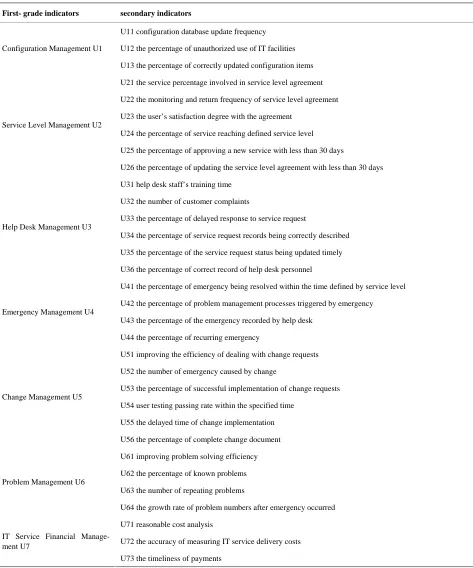
According to the service level agreement of KM com-pany’s IT service management, this paper uses the method of two-way communication with the experts. Firstly, the indicator system is designed with through repeatedly consulting experts, the key performance indi-cators of KM company’s IT service management process framework are developed at last. There are 7 first-grade
indicators (Table 1), namely configuration management (configuration database update frequency, the percentage of unauthorized use facilities and the percentage of cor-rectly updated configuration items), service level man-agement (the service percentage involved in service level agreement, the monitoring and return frequency of ser-vice level agreement, the user’s satisfaction degree with the agreement involved in service level agreement, the monitoring and return frequency of service level agree-ment, the user’s satisfaction with the agreeagree-ment, the per-centage of service reaching defined service level, the percentage of approving a new service with less than 30 days and the percentage of updating the service level agreement with less than 30 days), help desk manage-ment (help desk staff’s training time, the number of cus-tomer complaints, the percentage of delayed response to service request, the percentage of service request records being correctly described, the percentage of the service request status being updated timely and the percentage of correct record of help desk personnel), emergency man-agement (the percentage of emergency incident being resolved within the time defined by service level, the percentage of problem management processes triggered by emergency incident, the percentage of the emergency incident recorded by help desk, the percentage of emer-gency incident being resolved within the time defined by service level, the percentage of problem management processes triggered by emergency incident, the percent-age of the emergency incident recorded by help desk and the percentage of emergency incident recurring), change management(improving the efficiency of dealing with change requests, the number of emergency caused by change, the percentage of successful implementation of change requests, user testing passing rate within the specified time, the delayed time of change implementa-tion and the percentage of complete change document), problem management (improving problem solving effi-ciency, the percentage of known problems, the number of repeating problems and the increasing percentage of problem numbers after emergency incident occurred) and IT services financial management (reasonable cost anal-ysis, the accuracy of measuring IT service delivery costs and the timeliness of payments), and there are 32 secon-dary indicators.
4.3. Determine the Weight
First, this study invites 10 experts, including the IT di-rector, technical manager, IT information technol-ogyspecialists, system pre-designer and users, to score the judgment matrix, and then calculates the average value, constructs judgment matrix. For the convenience
Table 1. KM Company’s IT service management process assessment indicator system.
First- grade indicators secondary indicators
U11 configuration database update frequency
U12 the percentage of unauthorized use of IT facilities Configuration Management U1
U13 the percentage of correctly updated configuration items
U21 the service percentage involved in service level agreement
U22 the monitoring and return frequency of service level agreement
U23 the user’s satisfaction degree with the agreement
U24 the percentage of service reaching defined service level
U25 the percentage of approving a new service with less than 30 days Service Level Management U2
U26 the percentage of updating the service level agreement with less than 30 days
U31 help desk staff’s training time
U32 the number of customer complaints
U33 the percentage of delayed response to service request
U34 the percentage of service request records being correctly described
U35 the percentage of the service request status being updated timely Help Desk Management U3
U36 the percentage of correct record of help desk personnel
U41 the percentage of emergency being resolved within the time defined by service level
U42 the percentage of problem management processes triggered by emergency
U43 the percentage of the emergency recorded by help desk Emergency Management U4
U44 the percentage of recurring emergency
U51 improving the efficiency of dealing with change requests
U52 the number of emergency caused by change
U53 the percentage of successful implementation of change requests
U54 user testing passing rate within the specified time
U55 the delayed time of change implementation Change Management U5
U56 the percentage of complete change document
U61 improving problem solving efficiency
U62 the percentage of known problems
U63 the number of repeating problems Problem Management U6
U64 the growth rate of problem numbers after emergency occurred
U71 reasonable cost analysis
U72 the accuracy of measuring IT service delivery costs IT Service Financial
Manage-ment U7
U73 the timeliness of payments
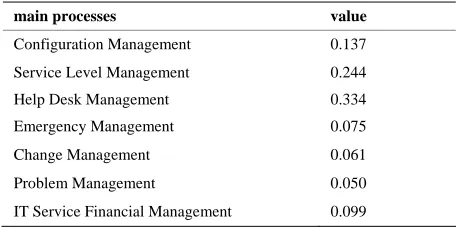
The judgment matrix of first-grade indicators is illus-trated in Table 2. The Expert Choice software is used to calculate the weight, getting the Results Configuration Management (U1, 0.137), Service Level Management
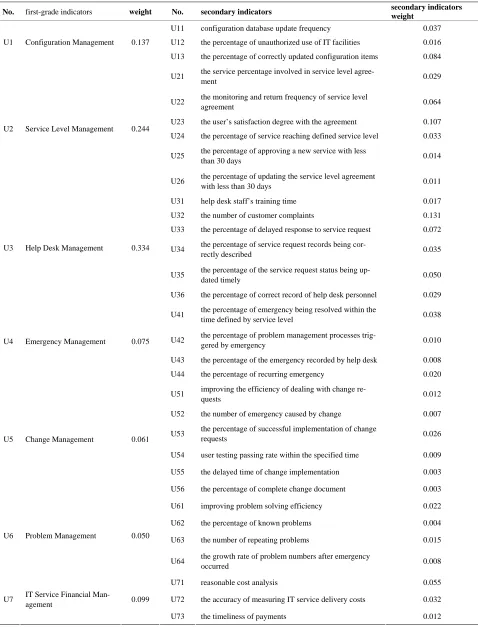
consistency test is done, the CR = 0.07 < 0.1, therefore, it can be concluded that the matrix is acceptable. The weights of 32 secondary indicators are worked out by calculating their corresponding weight respectively (Table 3).
5. KM Company’s IT Service Management
Process Assessment
5.1 Assessment Implementation
Invite the KM company’s core staff to assess the con-figuration management, service level management, ser-vice desk management, emergency management, change management, problem management and configuration management, and finally obtain the evaluation value (Table 4). It is found that the most concerned areas in the IT service management are help desk management, configuration management and service level manage-ment, so that we can determine priorities for project im-plementation.
5.2 Analysis of Assessment Results
[image:5.595.58.286.452.568.2]With assessing IT service management and comparing traditional IT work pattern with new ITIL management style, we can reach the following suggestions for im-provement: 1) IT work pattern will become active mode from the traditional passive mode: The computer prob-lematic events are presented by the user, and help desk
Table 2. First-grade indicators judgment matrix.
U1 U2 U3 U4 U5 U6 U7
U1 1 5 1/3 4 6 6 5
U2 1/5 1 1/4 3 4 4 4
U3 3 4 1 3 5 4 4
U4 1/4 1/3 1/5 1 3 2 2
U5 1/6 1/4 1/5 1/3 1 3 3
U6 1/6 1/4 1/5 1/2 1/3 1 1
[image:5.595.57.285.609.723.2]U7 1/5 1/4 1/2 1/2 1/3 1 1
Table 3. The result of IT service management process as- sessment.
main processes value
Configuration Management 0.137
Service Level Management 0.244
Help Desk Management 0.334
Emergency Management 0.075
Change Management 0.061
Problem Management 0.050
IT Service Financial Management 0.099
allocates tasks according to each IT worker’s ability, establishing resolution with IT. The original unordered passive mode was gradually transformed to ordered ac-tive way. 2) To avoid malicious use of IT resources: Traditional IT work pattern allows for user’s malicious use of IT resources. After the implementation of ITIL, it will help to avoid malicious use of IT resources. 3) To reduce the loss of events: Under the traditional mode, the event would be recorded by each IT staff member, which easily causes the loss of incidents. Implementation of ITIL will let help desk track and record the entire event process, ensuring practical resolution of users’ problems. 4) To share IT resources: Some staffs are scattered, which leads to ineffective improve efficiency and reduce costs: After the situation, thus companies have a wide scope of IT management, and share of resources among IT staff and finally causes that some IT staff are busy chronically, while other IT staff cannot play their role. Once ITIL is implemented, help desk will allocate com-puter events to every area’s IT staff according to actual the IT resources can be shared. 5) To implementation of ITIL, IT resources will be fully shared, so the existing IT resources can cover a larger area, at the same time real-izing the goal of improving efficiency and reducing IT costs. 6) To maintain a stable system and provide the necessary platform for KM business: The implementa-tion of ITIL will enable the KM company to plan the network platform from the perspective of management, and to reach a stable state.
6. Thinking on IT Service Management
6.1. The Goals of IT Service Management
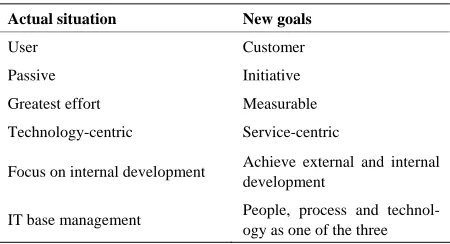
From the perspective of marketing development, the goal of IT service management is to change the past random behavior completely and achieve the service process standardization with ITIL methods (Table 5).
Table 4. Weight of all indicators.
No. first-grade indicators weight No. secondary indicators secondary indicators weight
U11 configuration database update frequency 0.037
U12 the percentage of unauthorized use of IT facilities 0.016 U1 Configuration Management 0.137
U13 the percentage of correctly updated configuration items 0.084
U21 the service percentage involved in service level
agree-ment 0.029
U22 the monitoring and return frequency of service level
agreement 0.064
U23 the user’s satisfaction degree with the agreement 0.107
U24 the percentage of service reaching defined service level 0.033
U25 the percentage of approving a new service with less
than 30 days 0.014
U2 Service Level Management 0.244
U26 the percentage of updating the service level agreement
with less than 30 days 0.011
U31 help desk staff’s training time 0.017
U32 the number of customer complaints 0.131
U33 the percentage of delayed response to service request 0.072
U34 the percentage of service request records being
cor-rectly described 0.035
U35 the percentage of the service request status being
up-dated timely 0.050
U3 Help Desk Management 0.334
U36 the percentage of correct record of help desk personnel 0.029
U41 the percentage of emergency being resolved within the
time defined by service level 0.038
U42 the percentage of problem management processes
trig-gered by emergency 0.010
U43 the percentage of the emergency recorded by help desk 0.008 U4 Emergency Management 0.075
U44 the percentage of recurring emergency 0.020
U51 improving the efficiency of dealing with change
re-quests 0.012
U52 the number of emergency caused by change 0.007
U53 the percentage of successful implementation of change
requests 0.026
U54 user testing passing rate within the specified time 0.009
U55 the delayed time of change implementation 0.003 U5 Change Management 0.061
U56 the percentage of complete change document 0.003
U61 improving problem solving efficiency 0.022
U62 the percentage of known problems 0.004
U63 the number of repeating problems 0.015 U6 Problem Management 0.050
U64 the growth rate of problem numbers after emergency
occurred 0.008
U71 reasonable cost analysis 0.055
U72 the accuracy of measuring IT service delivery costs 0.032 U7 IT Service Financial
Man-agement 0.099
Table 5. The goals of IT service management.
Actual situation New goals
User Customer
Passive Initiative
Greatest effort Measurable
Technology-centric Service-centric
Focus on internal development Achieve external and internal development
IT base management People, process and technol-ogy as one of the three
high. IT service providers should take the initiative to set up their own service evaluation system, evaluating the IT service management process provided from the cus-tomer’s perspective, in this way, the company can re-main invincible position in the marketplace. 3) IT service management assessment is needed when IT service ma-turity is evaluated. The ability of IT service to provide service management for enterprise is not formed after IT external evaluation, but improved during the processes of enterprise continuously improving and restraining itself.
6.2. The Customer Satisfaction Model of IT Service Management
The ITSM architecture model can classified to six dif-ferent levels, each considering one or two the most con-cern problems for services and determine the priorities of ITIL modules basing on the analysis of the actual man-agement situation. It can be illustrated in Table 6.
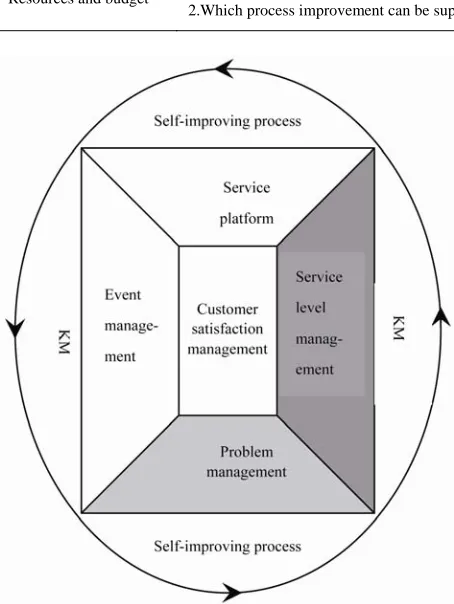
With case study and experience learnt from informa-tion systems [3-5], and Chinese ITIL best practices (e.g., Guangzhou Earth Village Corp. and YuWei Corp., and CEPREI certification body etc.), three processes are ex-tracted in the following: namely “Service Level agement”, “Event Management” and “Problems Man-agement”, and a function module, namely “ Help Desk Management”, integrating the service concept of ITIL V3 and clarifying that the “Customer Satisfaction Man-agement” guide the overall specific operations. Note that the synergy and interdependence of the above five basic elements collectively figure out the key to the ITSM processes. These five major processes are interrelated and have influence on each other, if the company only focuses on a certain level of the five basic processes, while ignoring the impact of other processes, then the efficiency of such service management implementation will often be compromised. On the other hand, any one business process design can not be finished in one step. For this reason the implementation process of service management process can embody the principles, which include to be controlled, managed, assessed and
imple-mented, and these processes indeed penetrate into the actual service process, “Self-Improving Process” and “Knowledge Management” which are two sets of control functions should be added to the model to ensure the sustainable development of the management model. It can be illustrated in Figure 1.
6.3. ITSM Knowledge Support Structure
In our understanding, ITSM solution implementation is essentially complicated knowledge transfer, and the suc-cessful knowledge management experiences of software process improvement (SPI) [6,7] could be applied to the operation and maintenance management. For examples, integrated operation and maintenance system of state tax e-Government system of ShenZhen City implements the transition from “technology-focused” to “process-fo- cused”, and from the role of a passive “emergency tr- eatment doctor” to the role of an active “health protec-tion doctor”. It also disentangles IT administrators from frequent, repetitive maintenance jobs to improve their work efficiency, and makes them have time to reflect how to use IT to improve service. SLA defines the re-sponsibility, rights and duties of both sides. When asking for service, SLA can responses in accordance to service priority and submits it to the corresponding administrator to dispose.
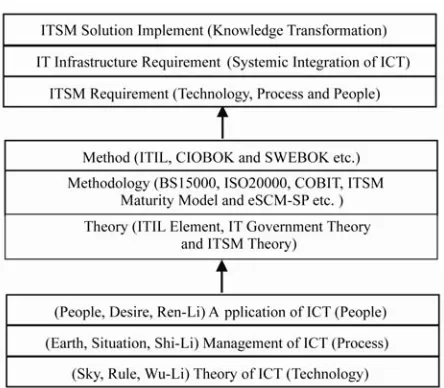
ITSM knowledge support structure is put forward in Figure 2 [8]. ITSM administrators need merge orient management philosophy with west management phi-losophy, in accordance with Chinese situation, and learn the lessons from the best practices to design the suitable ITSM solution. When the implemental standards and me- thods are established, managing three elements of ITSM, “Technology, Process and People”, just accords with the unification of three parts, “Sky, Earth and People”, and obeys to the systemic methodology thoughts of “Wu-Li Shi-Li Ren-Li”. Rule is “Sky”, to obey the requirement of theory of ICT; real world is “Earth”, to accord with the logic of management of ICT; people desire is “Ren- Li”, to deal with the relationship between application of ICT with the benefit-related people in the organization.
Table 6. Process priorities checklist.
Level Problems considered
Confusing points 1. What’s the most confusing points?
2. Which process or processes can improve them?
Process maturity degree 1.Considering the company requirement, which process or processes are the most urgent to be improved?
ROI 1. Basing on the current requirements and business circumstance, which process or processes can obtain the biggest ROI?
Organizational structure 1.Whether the functional organizational structure can be established? 2.Which processes can improve this organizational structure?
Service partition 1.Is the current IT service partition reasonable?
2.Is there a need to improve it according to certain processes?
Resources and budget 1. What resources and budget are owned by the IT service department currently? 2.Which process improvement can be supported by the future business?
Figure 1. ITSM architecture model for customer satifaction.
Six key successful factors in ITIL implementation in China by Mr. Zhao Guoxiang are in the following [12]: 1) Top leaders. 2) Customers. 3) Achievement. 4) Cognition. 5) Quickly Win. 6) Tools. Methodology includes several kinds of models and standards, such as BS15000, ISO20000, COBIT, ITSM Maturity Model and eSCM-SP (eSourcing Capability Model Service Provid-ers by IT Sqc of CMU). Method involves ITIL, CIOBOK and SWEBOK, such as the guidelines of CIO knowledge
body and CIO Wisdom [13-15].
Although some standards have been formed based on the theory related to IT management and the best prac-tices, ITIL is just explains what to do to manage opti-mally IT operation and maintenance, and don’t tell you how to do it. Some companies develop the ITSM imple-mental solution, such as ESM of CA, ITPM of IBM; and explore the relative software products, such as Unicenter of CA, Tivoli of IBM. In the real world, enterprise should select the implemental modules and the imple-mental order that are suitable for itself in accordance with the situation of enterprise and real world. In the first step, enterprise could realize service support on the op-eration layer, and realizes service delivery on the tactics layer, firstly, the enterprise should analyze ITSM re-quirement, including technology, process and people. Secondly, IT infrastructure requirement, which mainly is the systemic integration of ICT, is refined. Finally, the ITSM implementation is essentially ITSM knowledge, including explicit knowledge and implicit knowledge, transformation to reach the objective of improving the organizational ITSM capability.
[image:8.595.58.285.281.583.2]Figure 2. ITSM knowledge support structure.
7. Conclusions
With analyzing the IT service management framework and associated processes of KM company, this paper determines various indicators of IT service management process. The weights of each indicator are calculated with AHP, and KM company is evaluated. And some reasonable suggestions are proposed with consideration of both the evaluation results and the actual situation of KM company’s IT service management. In the end, the case is deeply considered in the views of IT service management objectives and misunderstandings, customer satisfaction model of IT service management, knowledge supporting structure of IT service management. It is con-cluded that if the organization wishes to successfully im- plement IT service management’s customer satisfaction model, it should eliminate the misunderstandings of IT service objectives first, while the adoption of knowledge supporting structure of IT service management can play a multiplier effect. For example, operation maintenance management should be considered during the design stage of IT service management, which requires clear and profoundly understanding of the four development stages of IT service management: technology-centric, service-centric, business-centric and customer-centric.
8. Acknowledgements
Thank for helpful discussion with Mr. Zhuo Zhixin, Mr. Cai hua, Mr. Chen Ji, Mr. Zhao Guoxiang, and Zhao Xi etc..
9. References
[1] Zaltbommel, “Foundations of IT Service Management based on ITIL,” Van Haren Publishing, 2005.
[2] T. L. Saaty, “The Analytic Hierarchy Process,” New York: McGraw-Hill International, 1980.
[3] Dean Lane, “CIO Wisdom: Best Practices from Silicon Valley’s Leading IT Experts,” Prentice-Hall, Inc, 2004. [4] C. C. Chen, C. Law and S. C. Yang, “Managing ERP
Implementation Failure: A Project Management Perspec-tive,” IEEE Transactions on Engineering Management, Vol. 56, No. 1, January, 2009, pp.157-170.
doi:10.1109/TEM.2008.2009802
[5] D. Severance and J. Passino, “Make It Work,” John Wi-ley & Sons, 2002.
[6] Brooks and P. Frederick, “No Silver Bullet: Essence and Accidents of Software Engineering,” IEEE Computer, Vol. 20, No. 4, April, 1987, pp.10-19.
[7] J. P. Wan, “Research on Software Product Support Struc-ture,” Journal of Software Engineering and Applications, Vol. 2, No. 3, October, 2009, pp.174-194.
doi:10.4236/jsea.2009.23025
[8] J. P. Wan, Y. F. Wang and C. W. Zheng, “Research on Knowledge Support Structure of IT Service Management,” IEEE WiCom 2007, Shanghai, China, September, 2007, pp. 6729-6733.
[9] P. Weill, “IT Governance: How Top Performers Manage IT Decision Rights for Superior Results,” Harvard Busi-ness School Press, 2004.
[10] Son Pham, “Pulling it All Together: How to Implement ITSM,”http://www.tivoli-ug.org/presentations/A02_Impl ementing ITSM.ppt, 2007.
[11] C. Kelbrick, “ITSM Road Map, http://www.hp.com.au/ services/downloads/hp_itsm_work-shop.pdf,” 2007. [12] G. X. Zhao, “ITSM Improvement and Promotion, http:
//www.gdspin.com/WebEditor/Upload-File/00910301052 30614.rar,” 2009.
[13] D. Lane, “CIO Wisdom: Best Practices from Silicon Val-ley’s Leading IT Experts,” Prentice-Hall, Inc, 2004. [14] M. Y. Zuo, “The Guidelines of CIO Knowledge Body,”
Beijing Chian, Publishing House of Electronics, 2004, pp.301-425.
[15] P. Bourque, R. Dupuis, A. Abran, James W. Moore and L. Tripp, “The guide to the Software Engineering Body of Knowledge,” IEEE Software, Vol. 16, No. 6, Novem-ber/December,1999, pp.35-44
[16] J. Azar, R. K. Smith and D. Cordes, “Val-ue-Oriented Requirements Prioritization in a Small Development Organization,” IEEE Software, Vol.24, No.1, January/February, 2007, pp. 32-37.